
Amines - AL only (3.3.11)
On this page
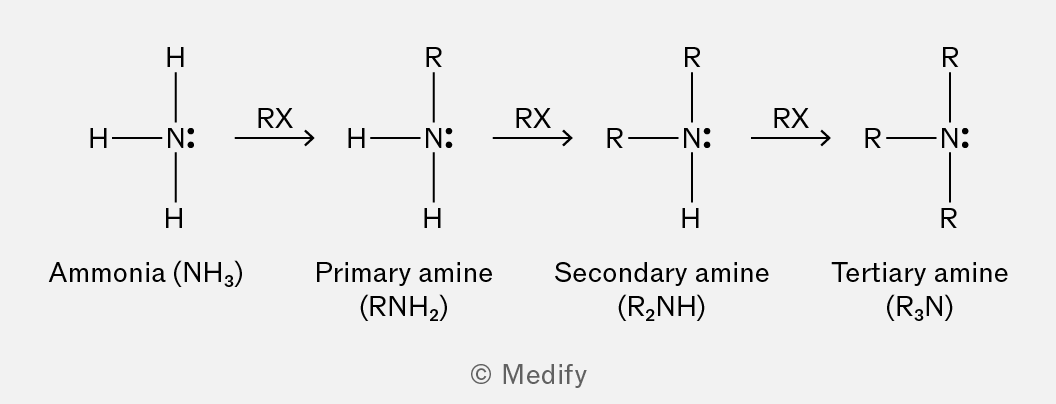
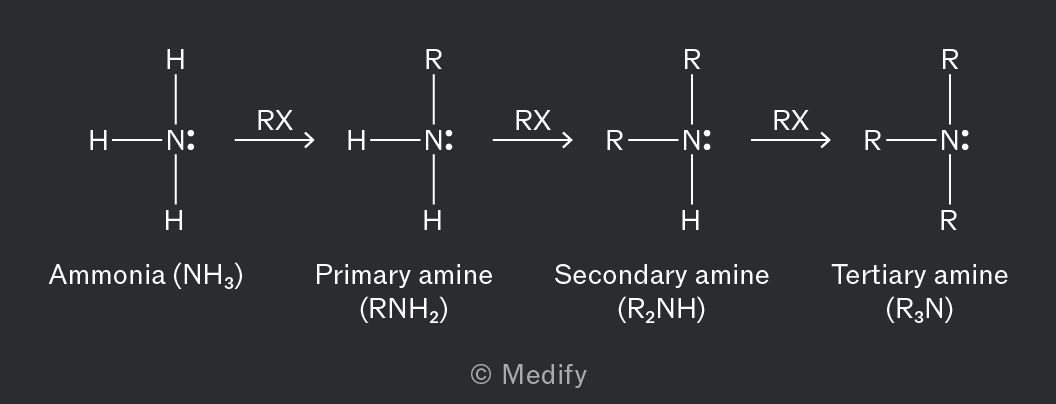
Secondary amines can be formed as a major product in the nucleophilic substitution reaction between haloalkanes and excess ethanolic primary amine.
Ethanolic solvent is used to prevent hydrolysis of the haloalkane.
The carbon atom, of the polarised carbon-halogen bond, is readily attacked by nucleophiles, such as ammonia and amines.
To ensure the secondary amine is the major product the primary amine must be in excess.
Tertiary amines can be formed as a major product in the nucleophilic substitution reaction between haloalkanes and an excess secondary amine.
where is a halogen.
The reaction occurs in ethanolic conditions.
Ammonia and amines act as nucleophiles, substituting the halogen atom in haloalkanes.
If the haloalkane is in excess, a mixture of primary, secondary, and tertiary amine products will be formed.
The nucleophilic substitution reaction mechanism for the formation of primary amines from haloalkanes is shown below:
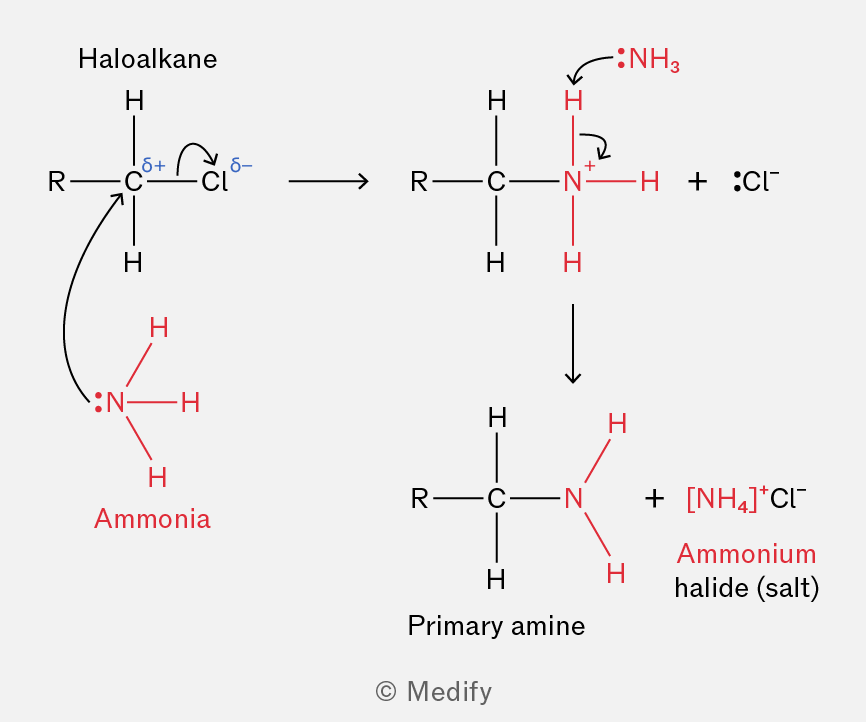
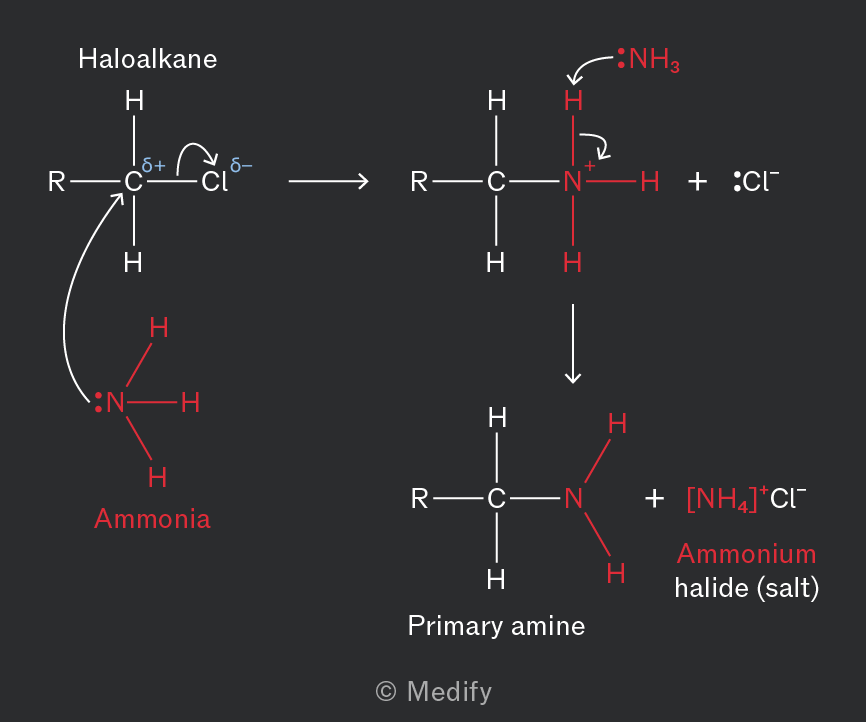
The carbon atom, of the polarised carbon-halogen bond of a haloalkane, is readily attacked by the nucleophilic nitrogen’s lone pair.
In the reaction, the initial nucleophilic attack is followed by deprotonation by a second ammonia molecule. In this case the ammonia acts as a base.
The halide ion is lost as an ammonium salt, and the substituted amine product is formed.
The mechanism for formation of a secondary or tertiary amine is primarily the same, but features an amine nucleophile.
Aromatic primary amines have the amino group directly bonded to a carbon atom in the benzene ring.
They are prepared by a reduction of the corresponding aromatic nitro compound.
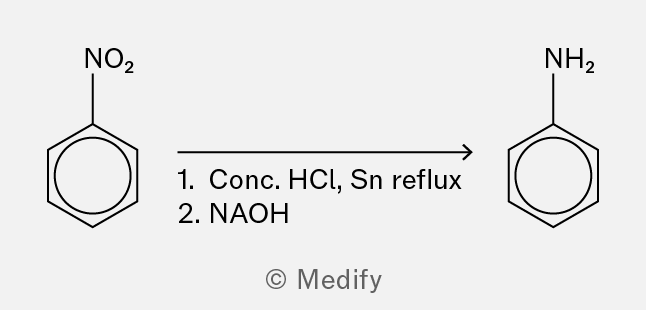
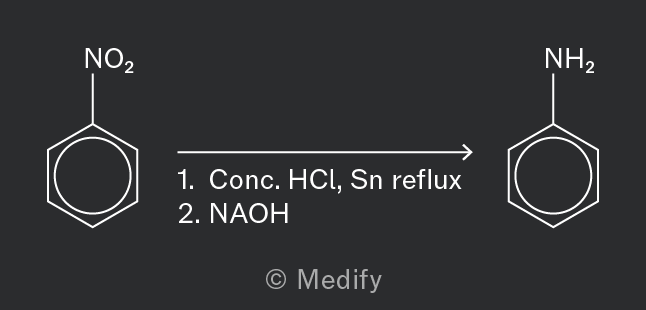
The reaction is carried out by refluxing with metallic tin, , and concentrated hydrochloric acid.
The initial product formed is a salt, due to the strongly acidic conditions, so treatment of the product with is required to liberate the aromatic amine.
It is conventional to represent the reducing reagents as and are needed to reduce each aromatic group to .
Amines can be produced by the reduction of nitriles, , by hydrogenation.
is used as a reducing agent, under acidic conditions to reduce the nitrile to an amine.
can be used to represent a reducing agent. Four equivalents of are required to reduce a nitrile group.
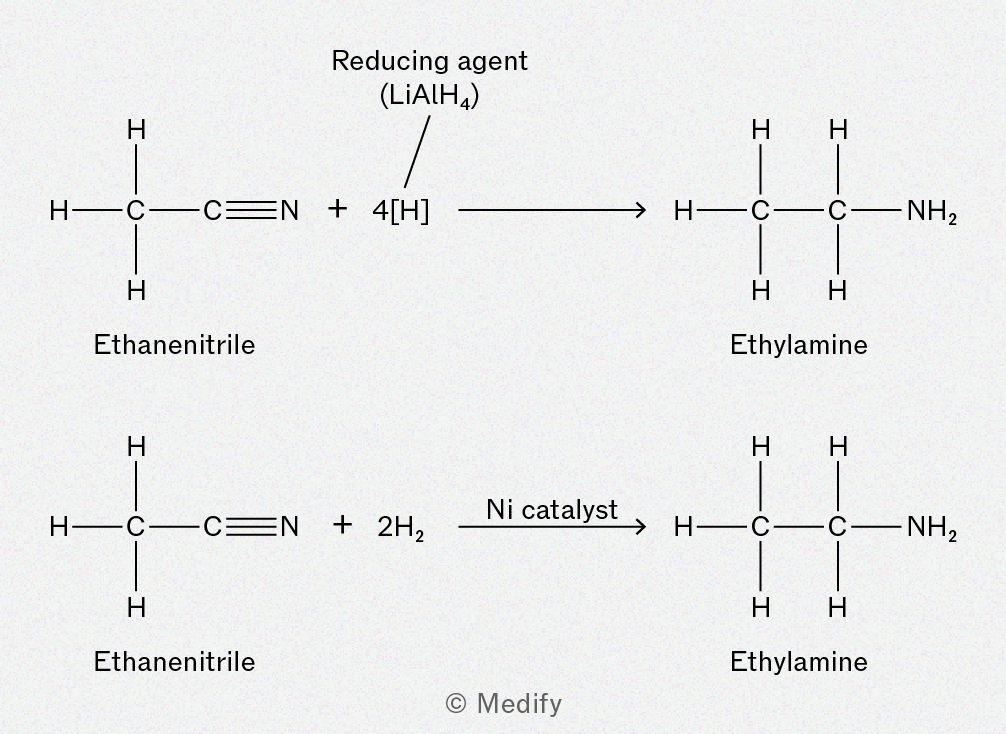
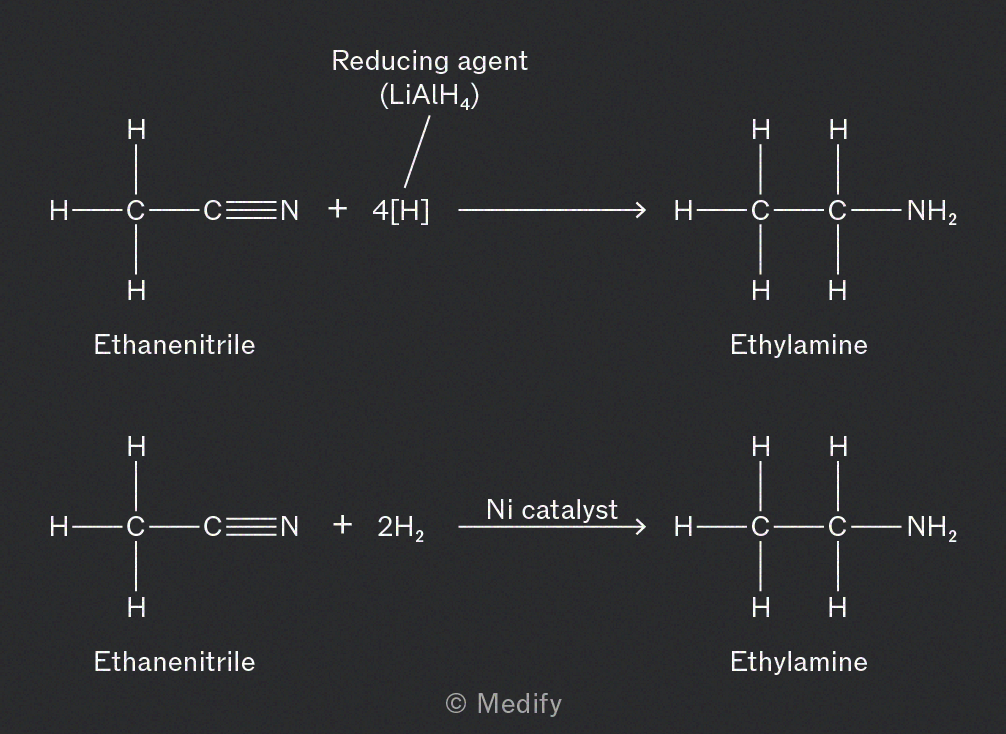
Nitriles can also be reduced to primary amines through catalytic hydrogenation using a catalyst with hydrogen.
Amines are organic derivatives of ammonia.
They have groups, (alkyl or aryl), substituted in place of ammonia hydrogens.
Amines, like ammonia, act as bases by donating the lone pair on the nitrogen atom in a dative covalent bond to protons.
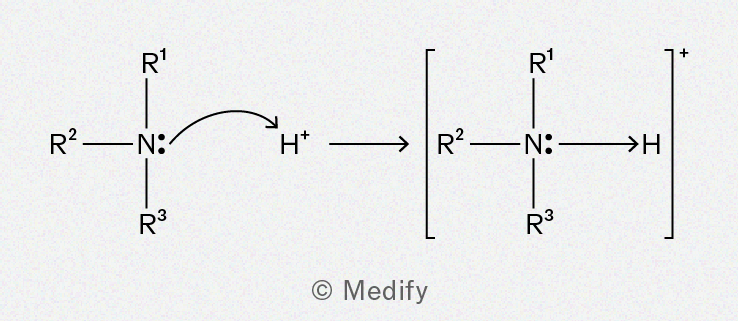
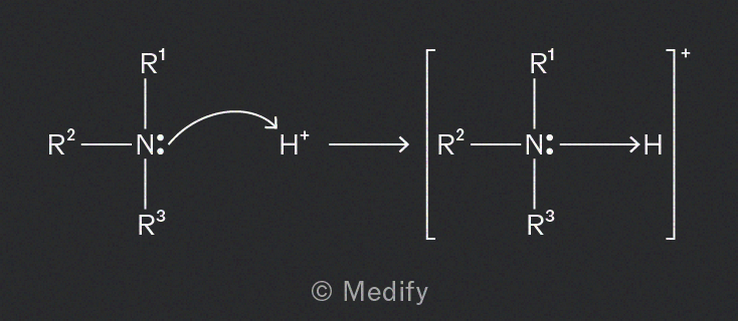
The relative base strength of aliphatic amines depends on how easily the nitrogen lone pair can be donated.
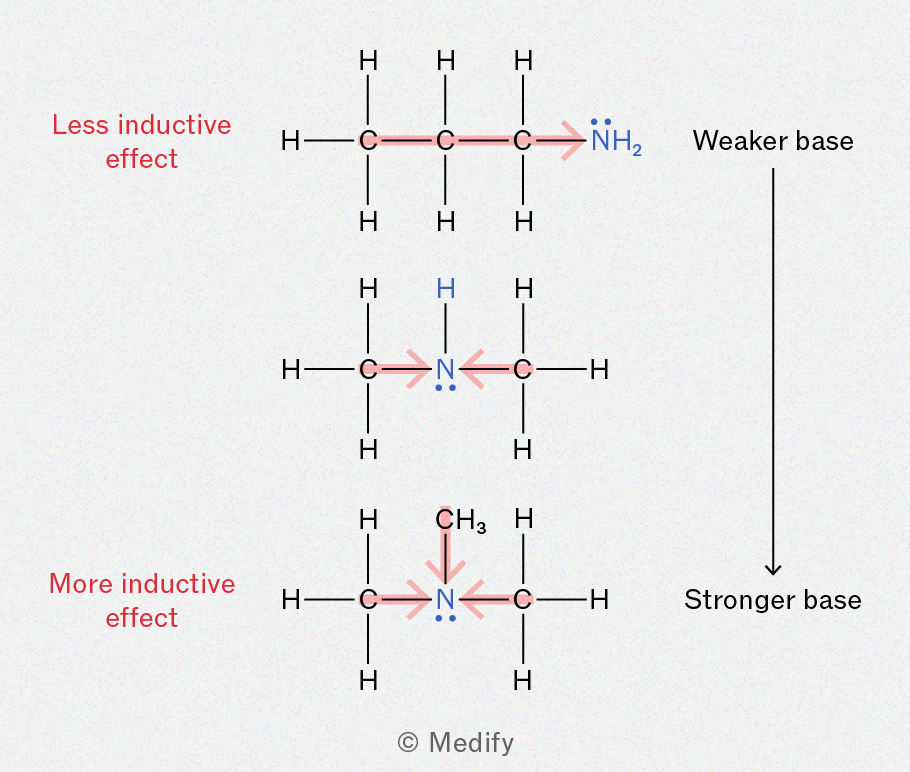
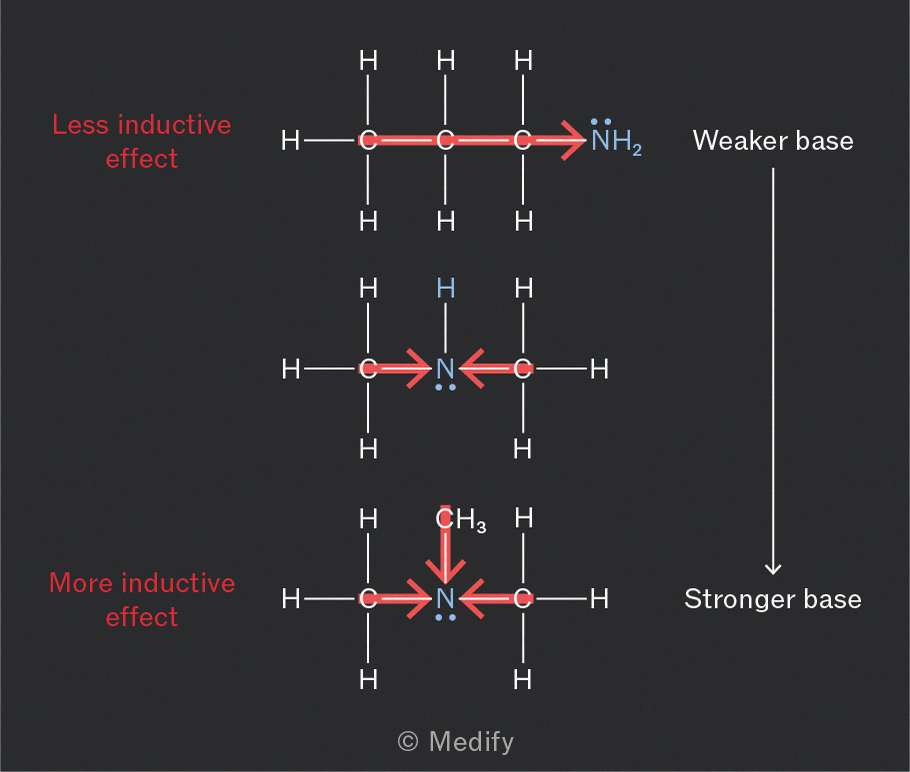
groups are electron donating towards the nitrogen, and facilitate accessibility of the lone pair.
Tertiary amines are stronger bases than secondary amines, which are stronger bases than primary amines, due to the decreasing number of groups.
It is worth noting that recent work has disproved the ‘inductive nature’ of groups but the terminology is still used in many resources and exams. In reality the electron donation is caused by a combination of polarisability and hyperconjugation; in terms of electronegativity the groups are actually inductively withdrawing!
The nucleophilic substitution reaction mechanism for the formation of primary amines from haloalkanes is shown below:
The carbon atom, of the polarised carbon-halogen bond of a haloalkane, is readily attacked by the nucleophilic nitrogen’s lone pair.
In the reaction, the initial nucleophilic attack is followed by deprotonation by a second ammonia molecule. In this case the ammonia acts as a base.
The halide ion is lost as an ammonium salt, and the substituted amine product is formed.
The mechanism for formation of a secondary or tertiary amine is primarily the same, but features an amine nucleophile.
Primary amines, react with acyl chlorides in a nucleophilic addition elimination reaction to form a N-substituted amide and hydrochloric acid.
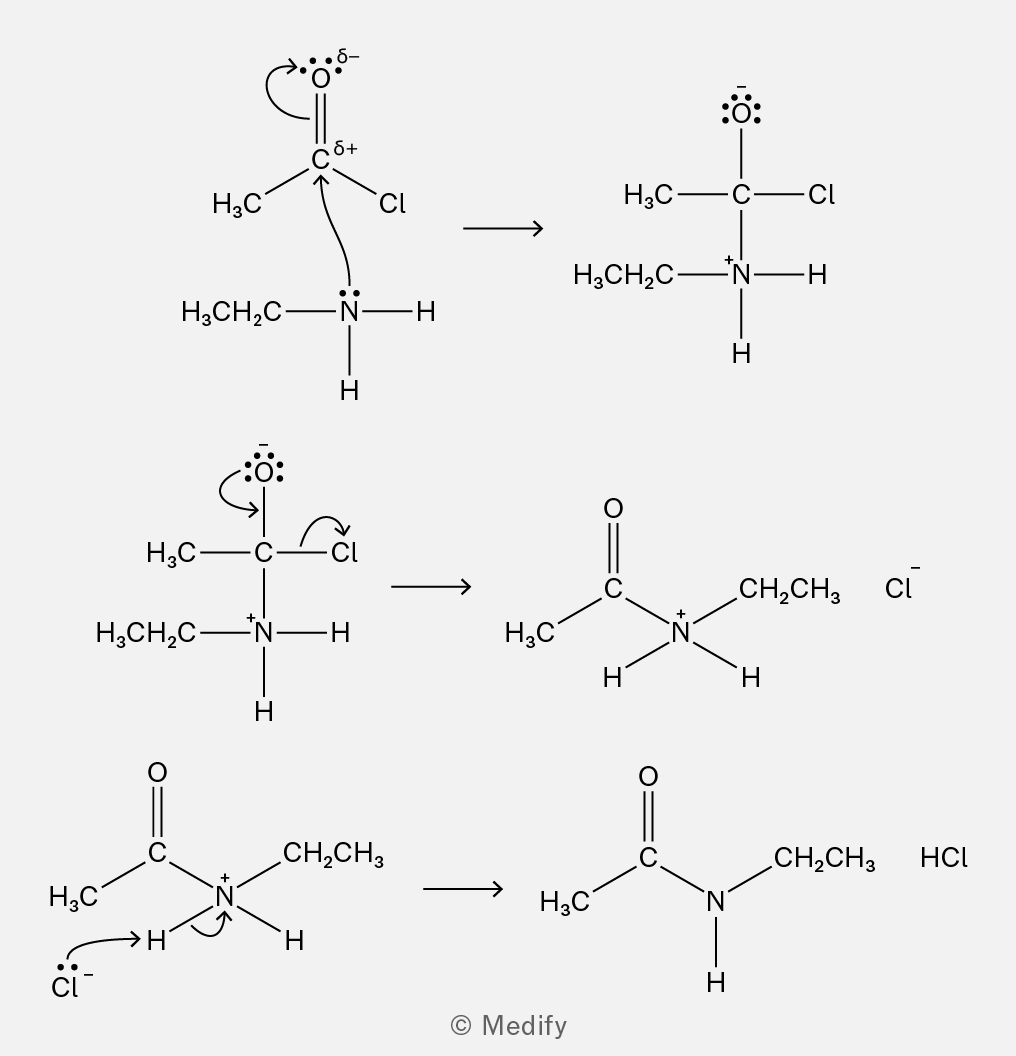
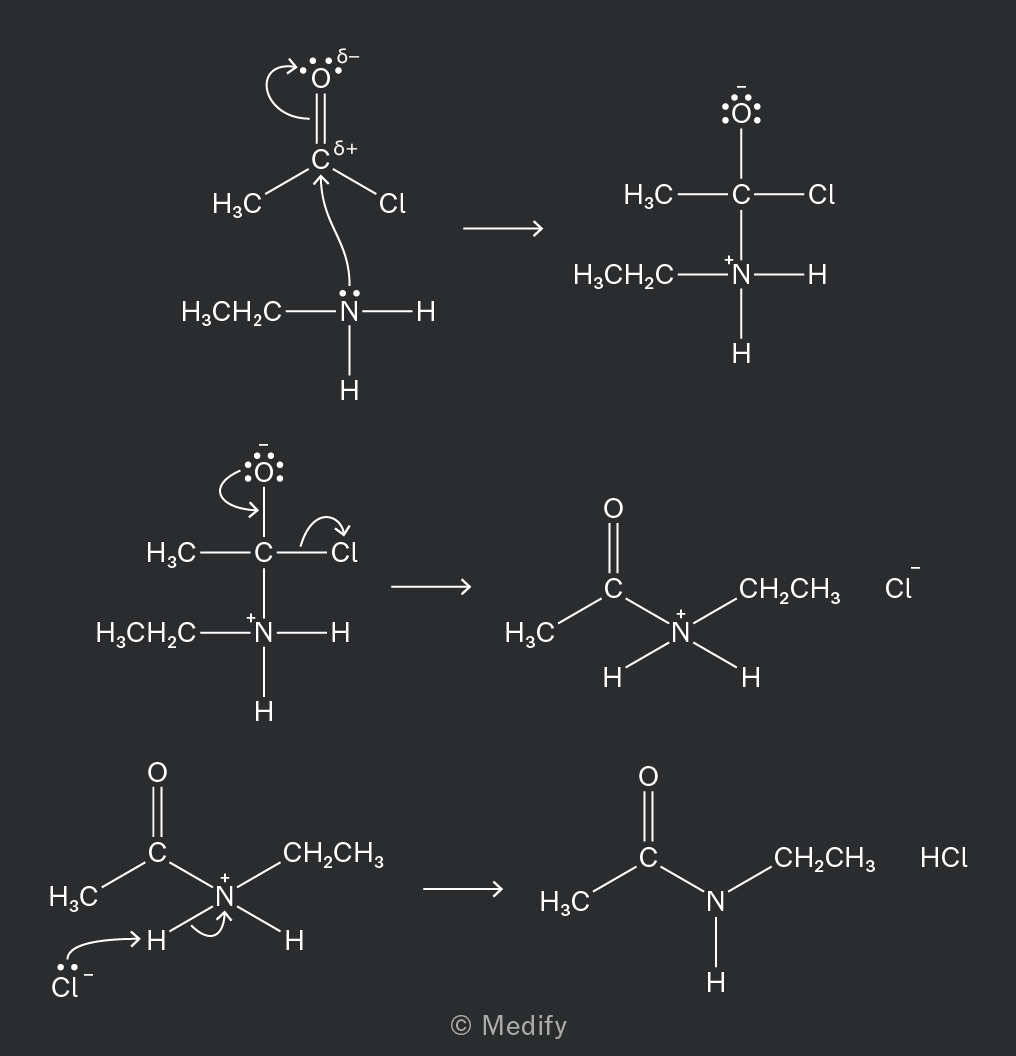
Step 1: Nucleophilic addition
The nitrogen atom of the amine has a lone pair of electrons, making it a nucleophile.
The lone pair on the nitrogen attacks the electrophilic carbon atom of the carbonyl group () in ethanoyl chloride. This weakens the π-bond in the bond, causing it to break and form a tetrahedral intermediate.
Step 2: Elimination
The lone pair on the oxygen reforms the double bond, expelling the chloride ion () as the leaving group.
Step 3: Proton transfer
The expelled chloride ion acts as a base and attacks the hydrogen atom attached to the positive nitrogen. This removes the positive charge from the nitrogen to form the N-substituted amide.
Note that the formed reacts with any unreacted amine in the mixture to form an alkyl ammonium chloride.
Primary amines react with acid anhydrides in a nucleophilic addition–elimination reaction to form an N-substituted amide and carboxylic acids.
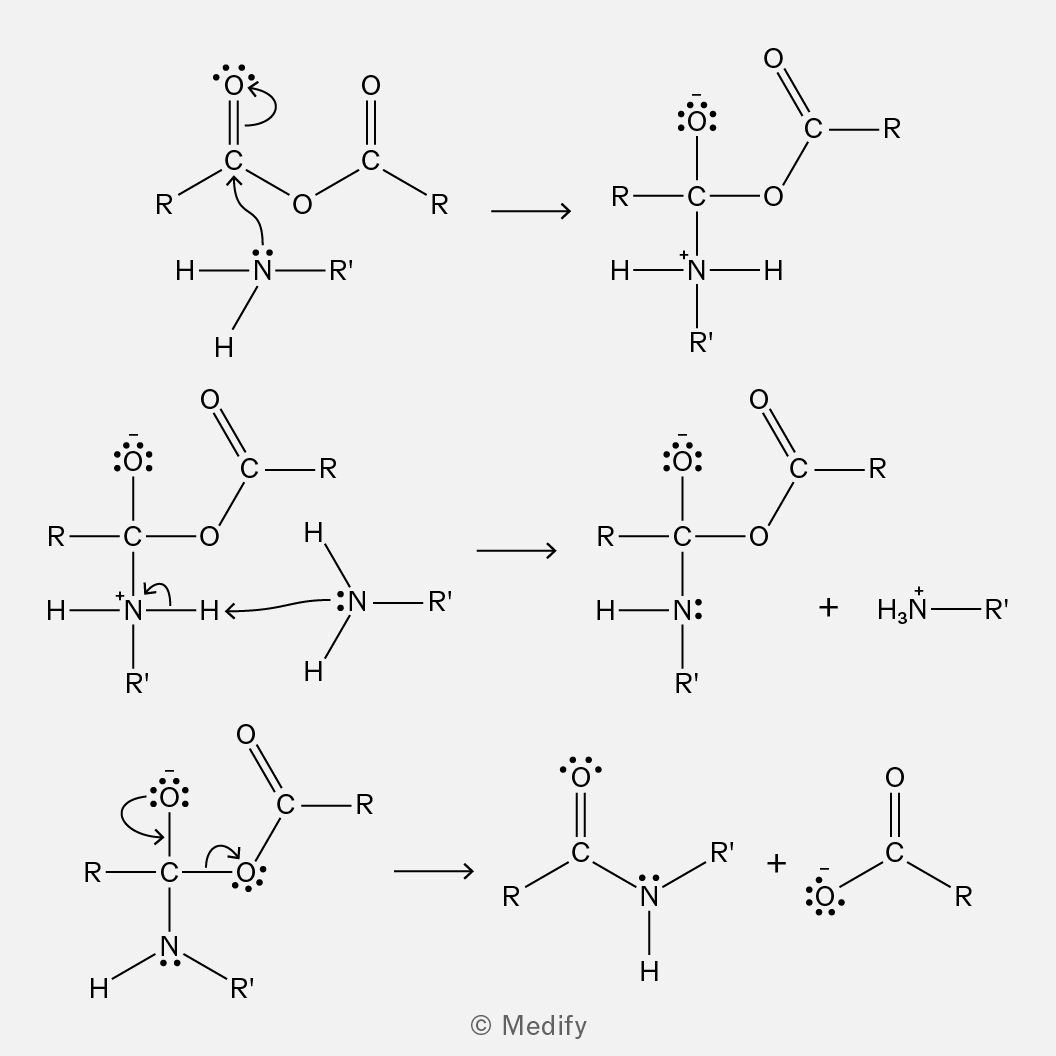
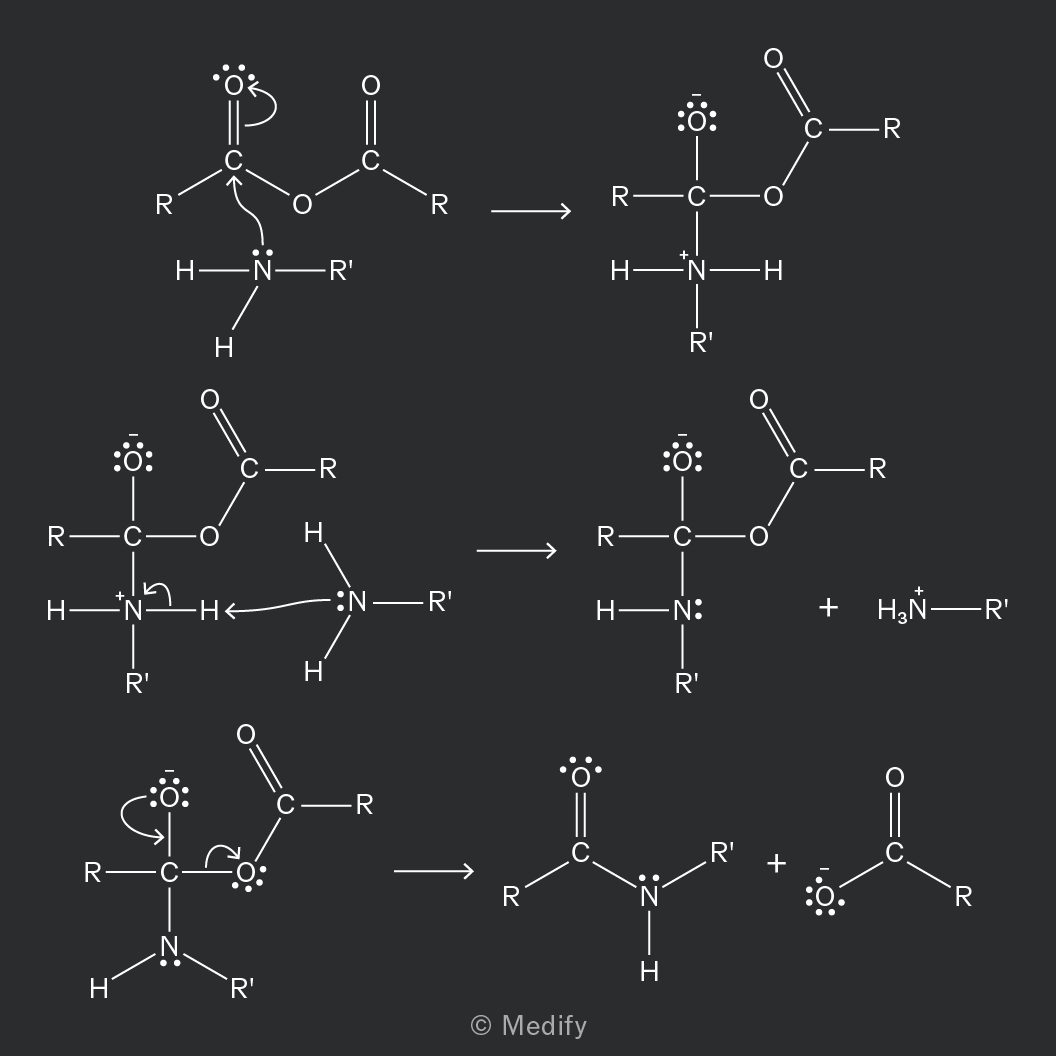
Step 1: Nucleophilic addition
The nitrogen atom of the amine has a lone pair of electrons, making it a nucleophile.
The lone pair on the nitrogen attacks the electrophilic carbon atom of the carbonyl group () in acid anhydride. This weakens the -bond in the bond, causing it to break and form a tetrahedral intermediate.
Step 2: Deprotonation
The amide nitrogen is positively charged due to the addition of the hydrogen during nucleophilic attack.
A proton transfer occurs where the positively charged nitrogen loses a hydrogen ion () to another molecule of amine.
Step 3: Elimination
The lone pair on the oxygen reforms the double bond, expelling the carboxylate ion as the leaving group.
This step converts the intermediate into the N-substituted amide product and the carboxylate ion.
The carboxylate ion can react with to form a carboxylic acid.
Quaternary ammonium salts are used as cationic surfactants.
Surfactants are substances which can be added to a liquid to reduce its surface tension. They reduce the energy barrier of mixing between immiscible materials.
Surfactants are used in cleaning products and laundry detergents.
Quaternary ammonium salts consist of a positively charged nitrogen atom (cationic head) bonded to four alkyl groups and a counterion (typically a halide like chloride or bromide).
They are amphiphilic, meaning they have both a hydrophilic (water-attracting) cationic head and hydrophobic (water-repelling) alkyl tails.
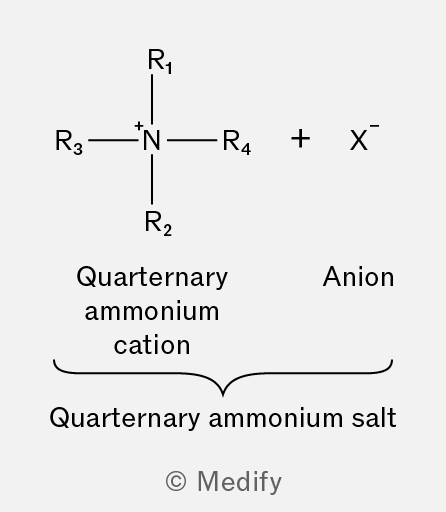
The cationic head is attracted to negatively charged surfaces and polar solvents whereas the alkyl groups are soluble in non-polar substances.