
The elements of Groups 1 and 2 (Topic 4A)
On this page
The Group 2 elements react by losing their electrons forming +2 cations. The formation of these +2 cations from gaseous atoms requires two ionisation energies:
The first ionisation energy removes one mole of electrons from one mole of gaseous atoms.
The second ionisation energy removes one mole of electrons from one mole of gaseous +1 ions.
The reactivity of the Group 2 elements can be explained based on their first and second ionisation energies as shown in the bar graph.
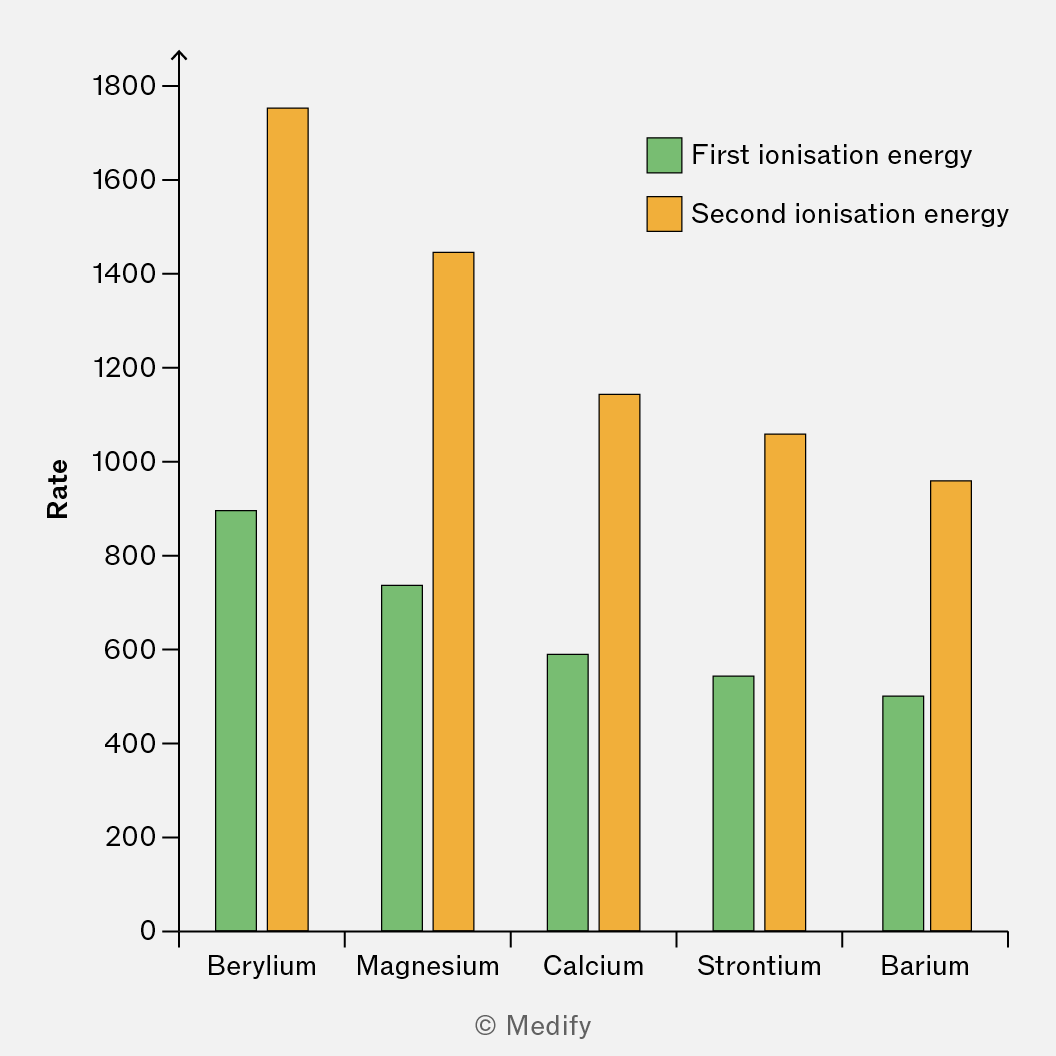
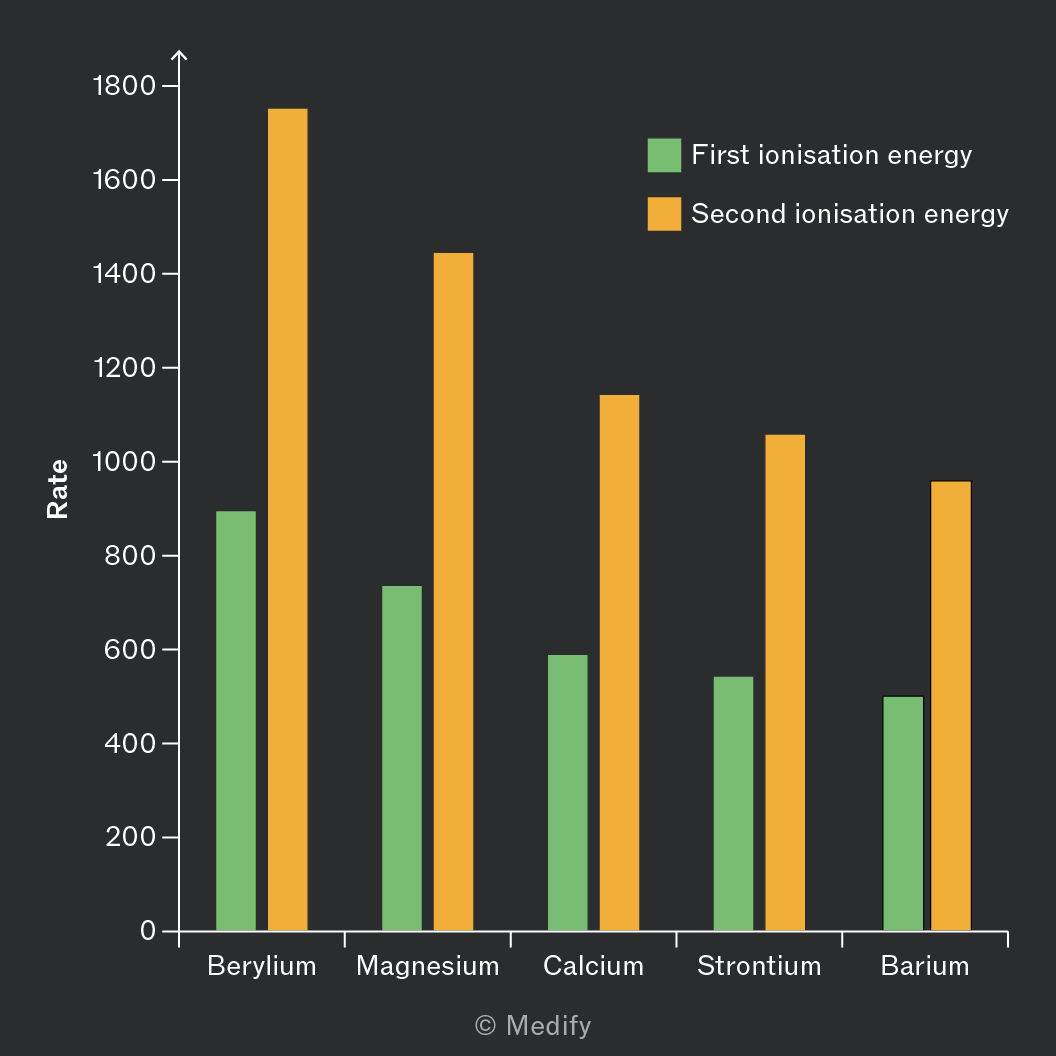
Both the first and second ionisation energies decrease as you go down Group 2.
The second ionisation energy is always higher than the first ionisation energy; it requires more energy to remove an electron from a positive ion due to the increased electrostatic attraction.
The increased reactivity of Group 2 metals as you go down the group is explained as follows.
Increasing atomic radius. As you move down the group, each element has an additional electron shell compared to the one above it. This increased distance between the nucleus and the outermost electrons means the nucleus has less pull on these outer electrons.
Greater shielding effect. With more inner electron shells, there is increased shielding. The inner electrons create a barrier that lessens the attraction between the nucleus and the outermost electrons.
Although the positive nuclear charge increases with each successive element, this is offset by the larger atomic radius and increased shielding. Consequently, the effective nuclear charge felt by the outer electrons decreases down the group, contributing to the increased reactivity.
As you go down group 2, reactivity increases.
When explaining this trend reference these four key points.
1. Increasing atomic radius as an extra shell of electrons is added.
2. Increasing nuclear shielding effect from inner shells of electrons.
3. Reduced attraction of the outer electrons to the positive nucleus.
4. The outer electrons are therefore more easily lost as you go down the group.
The Group 2 metals undergo redox reactions in which they lose their outer electrons to form +2 cations.
The reactions of Group 2 metals with oxygen occur by the following general equation:
For example, looking at the reaction of calcium with oxygen:
In the reaction the following oxidation state changes occur:
Note: the metal and the metal oxide are both solid. In exams, these reactions commonly appear alongside calculations based around the change in mass.
The reactions of Group 2 metals with water occur by the following general equation:
For example looking at the reaction of calcium with water:
In the reaction the following oxidation state changes occur:
Note: the state symbol for can be (aq) or (s).
The Group 2 metal hydroxides’ solubility increases as you go down Group 2 meaning that under standard conditions, will form as a solid precipitate, whereas will form an aqueous solution.
The reactions of Group 2 metals with acids occur by the following general equation:
The state of the salt formed in these reactions is dependent on its solubility.
The reactions of Group 2 metals with follow the general trend:
For example looking at the reaction of calcium with hydrochloric acid:
In the reaction the following oxidation state changes occur:
All Group 2 metal chlorides are highly soluble in water, hence the (aq) state symbol.
The reactions of Group 2 metals with :
For example, let us examine the reaction of calcium with sulfuric acid:
In the reaction the following oxidation state changes occur:
The solubility of the Group 2 metal sulfates decreases as you go down the group and so the salt can form in solution (aq) or as a precipitate (s).
The reactions of Group 2 metals with
For example, let us examine the reaction of calcium with nitric acid:
In the reaction the following oxidation state changes occur:
All Group 2 metal nitrates are highly soluble in water, hence the (aq) state symbol.
Group 2 metals react with chlorine to produce metal chlorides.
For example, if we examine the reaction of calcium with chlorine gas:
In the reaction the following oxidation state changes occur:
With the exception of beryllium which is amphoteric, Group 2 oxides are basic oxides, and their reaction with water produces metal hydroxides. They are commonly known as the alkaline earth metals.
The general reaction of Group 2 oxides with water can be represented as follows:
Note: the state symbol for can be (aq) or (s).
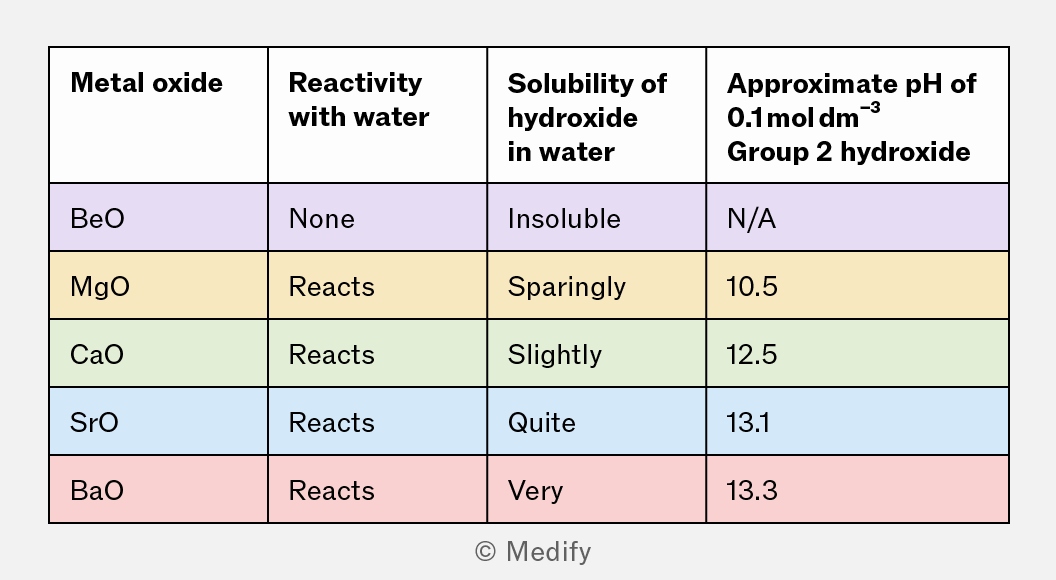
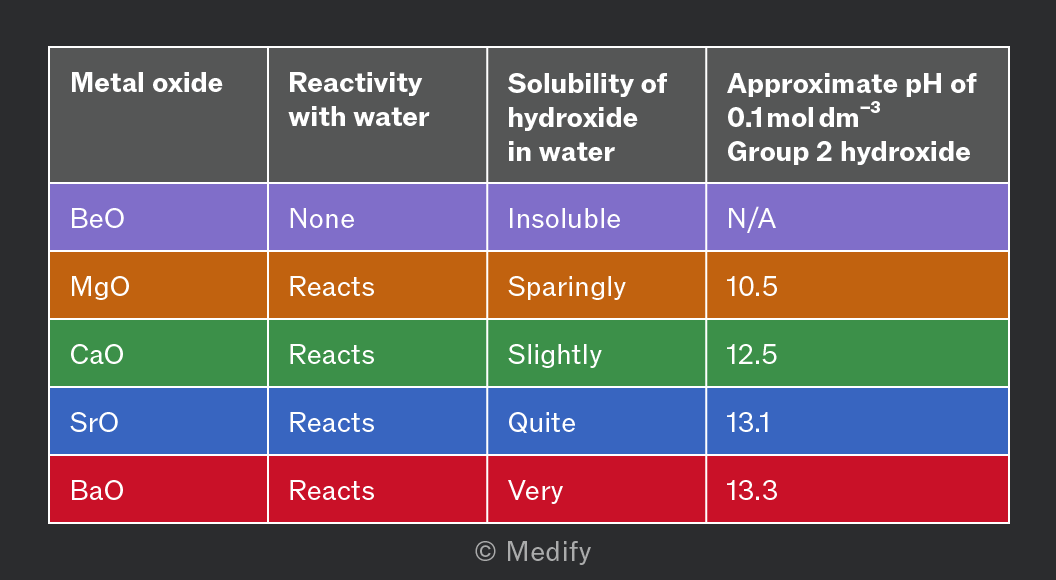
The solubility of Group 2 metal hydroxides increases as you go down Group 2. This means that under standard conditions, will form as a solid precipitate, whereas will form an aqueous solution.
The hydroxides formed, , have variable solubility in water, forming alkaline solutions.
The alkalinity of the resulting solution increases down the group in line with solubility.
Magnesium hydroxide, , is only sparingly soluble and therefore only a small number of hydroxide ions dissociate in water. is normally observed as a precipitate when it is formed in an aqueous environment.
Barium hydroxide, , is very soluble and therefore more hydroxide ions dissociate which leads to a higher in comparison.
Group 2 oxides are bases which react with dilute acids to form salts and water.
This is a neutralisation reaction forming salt and water. Chlorides and nitrates are always soluble salts, whereas the solubility of Group 2 metal sulfates decreases down the group.
Group 2 hydroxides are bases which react with dilute acids to produce salts and water.
This is a neutralisation reaction, forming salt and water. Chlorides and nitrates are always soluble salts whereas the solubility of Group 2 metal sulfates decreases down the group.
In both Group 1 and Group 2, the thermal stability of nitrates and carbonates increases as you go down the group.
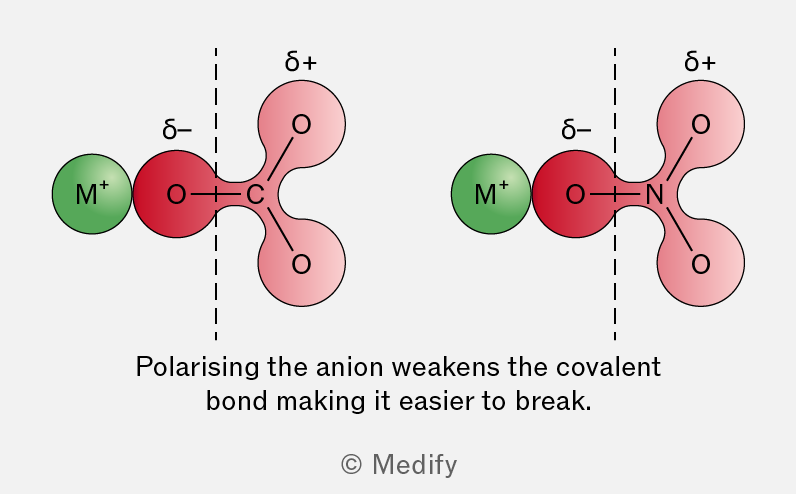
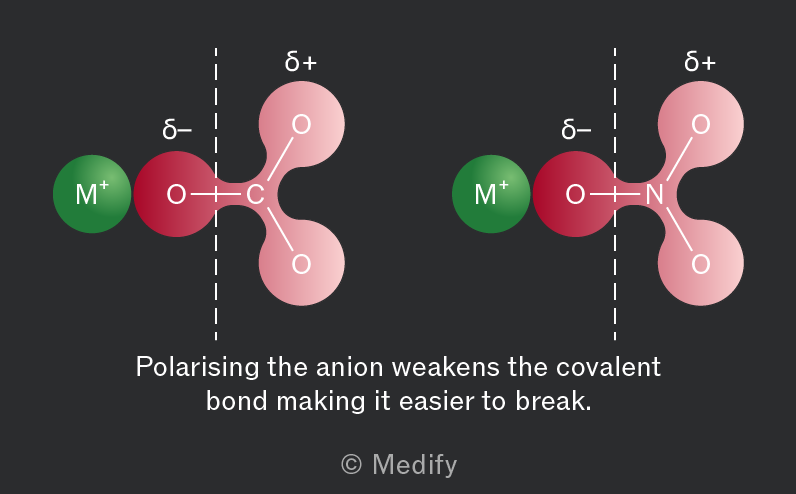
As you go down the group, the bigger cations are less polarising to the electron cloud of the counterion. With less distortion, more energy is required to decompose the nitrate or carbonate ion.
Group 1 nitrates decompose upon heating to form metal nitrites and oxygen.
The ability of the metal ion to polarise the nitrate ion decreases down the group; thermal stability increases and the rate of decomposition decreases.
Group 2 nitrates decompose more readily than Group 1 nitrates, forming metal oxides, nitrogen dioxide, and oxygen.
The reduced thermal stability of Group 2 nitrates compared to Group 1 nitrates is linked to the increase of polarisation of the nitrate ion by the smaller and more highly charged Group 2 cation weakening the bond.
Group 1 carbonates below lithium are very thermally stable and do not decompose easily on heating. The thermal stability is significantly less for Group 2 carbonates.
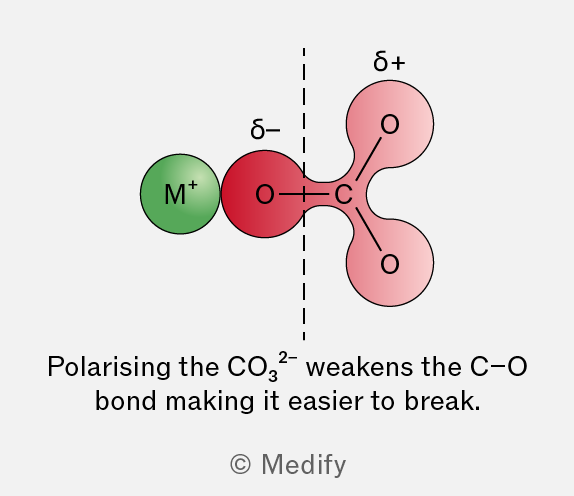
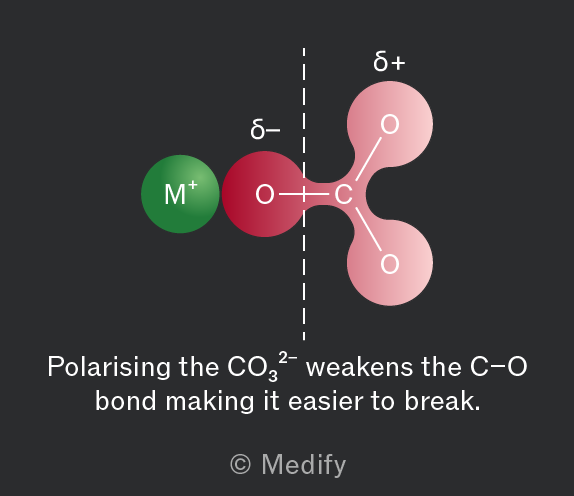
The cations in Group 1 have a single positive charge and relatively large size compared to the 2+ charge on Group 2 metal ions. This leads to lower charge density, making them less effective at polarising the carbonate ions.
The lower polarisation means these complex ions are less destabilised, making it harder for the covalent bond to break, resulting in higher thermal stability down the group.
Ions from Groups 1 and 2 metals are distinguishable by their characteristic flame colours.
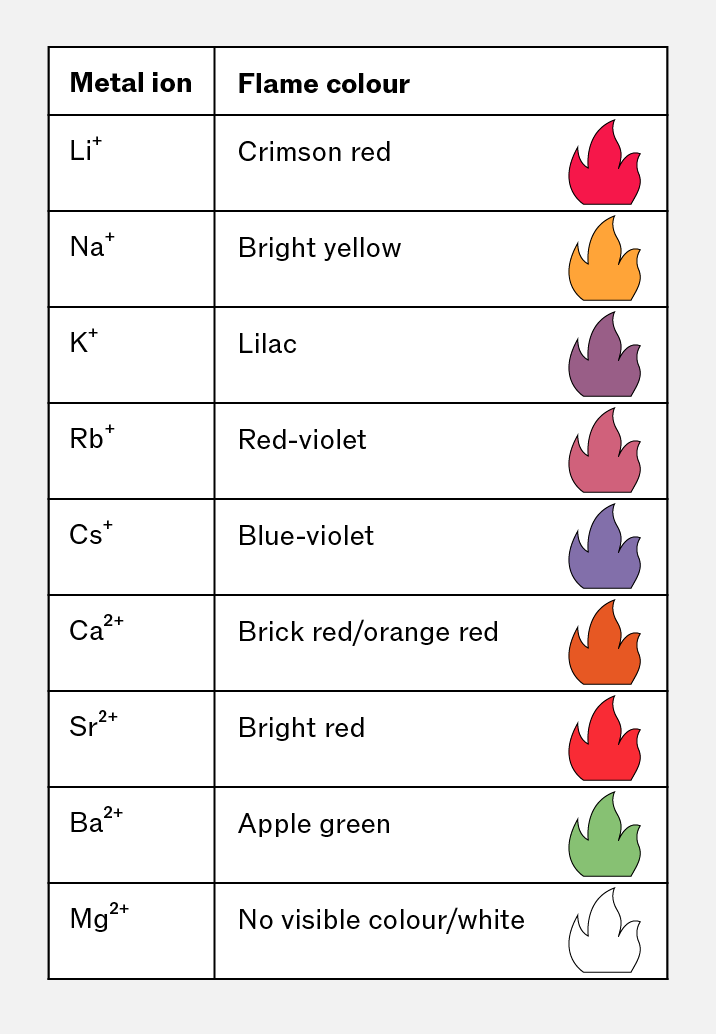
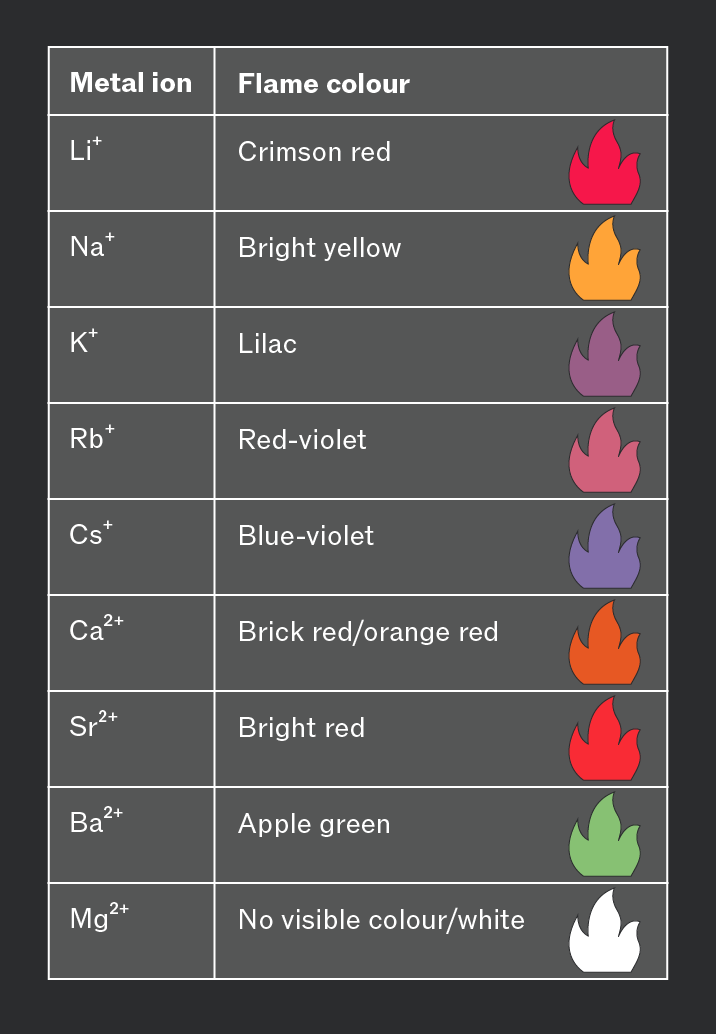
Note: recall of these colours is required.
When heated, electrons in metal ions are excited to higher energy levels. As they return to their ground states, they release energy as light.
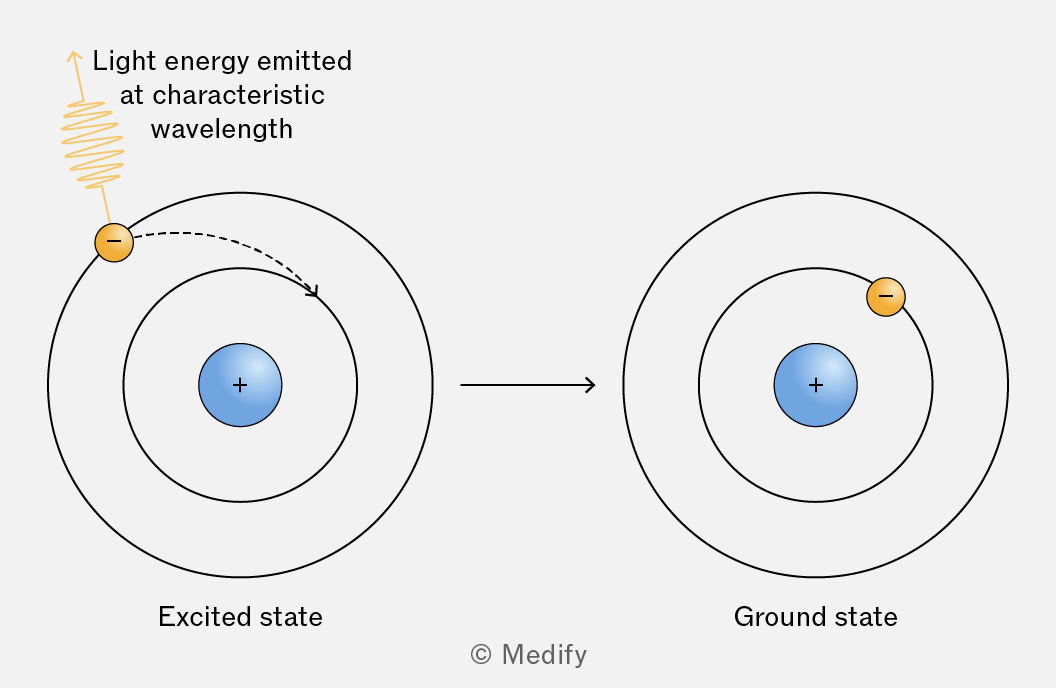
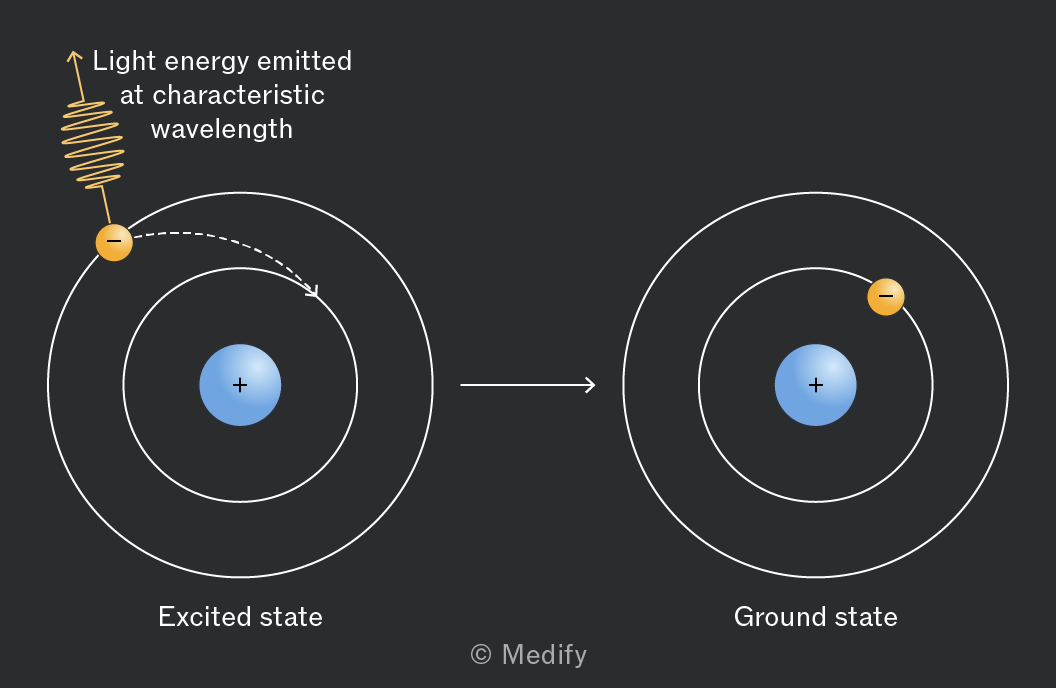
The colour observed corresponds to the specific wavelengths emitted, which are unique to each element due to their distinct electron configurations.
The thermal stability of different Group 2 nitrates and carbonates increases down the group. This can be modelled in the laboratory.
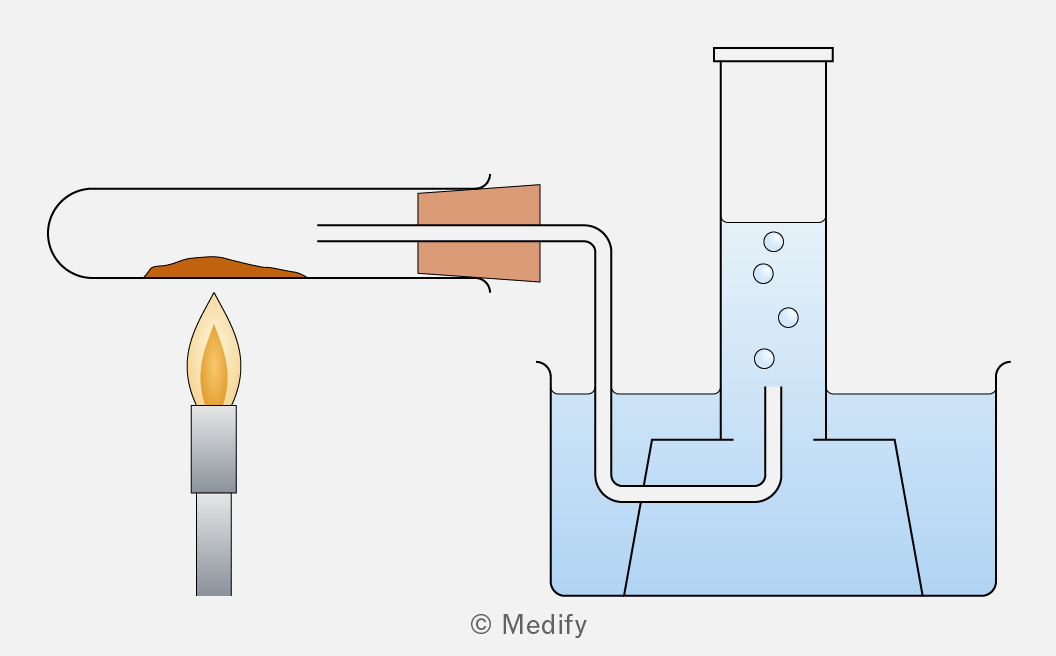
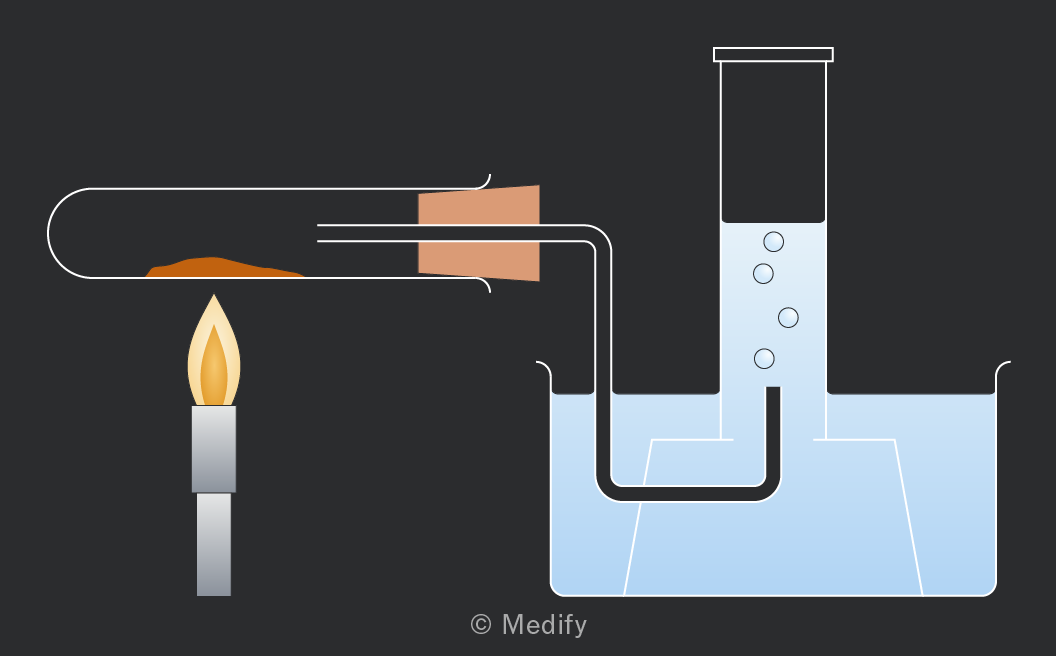
Procedure:
1. Place a small amount of the sample in a boiling tube fitted with a delivery tube. A similar amount of each sample should be used.
2. The delivery tube should be submerged in water so that gas produced can be observed as bubbles.
3. Heat the test tube using a Bunsen burner ensuring the same blue flame and position within the flame is used for each sample.
4. Observe the time taken for bubbles to be produced and the rate of bubble production.
The samples with the highest thermal stability will show the slowest production of bubbles.
SAFETY NOTE: When the sample is removed from the heat, the delivery tube must be removed promptly to prevent suckback of water into the hot tube.
Flame colours in compounds of Group 1 and 2 elements can be observed in the lab.
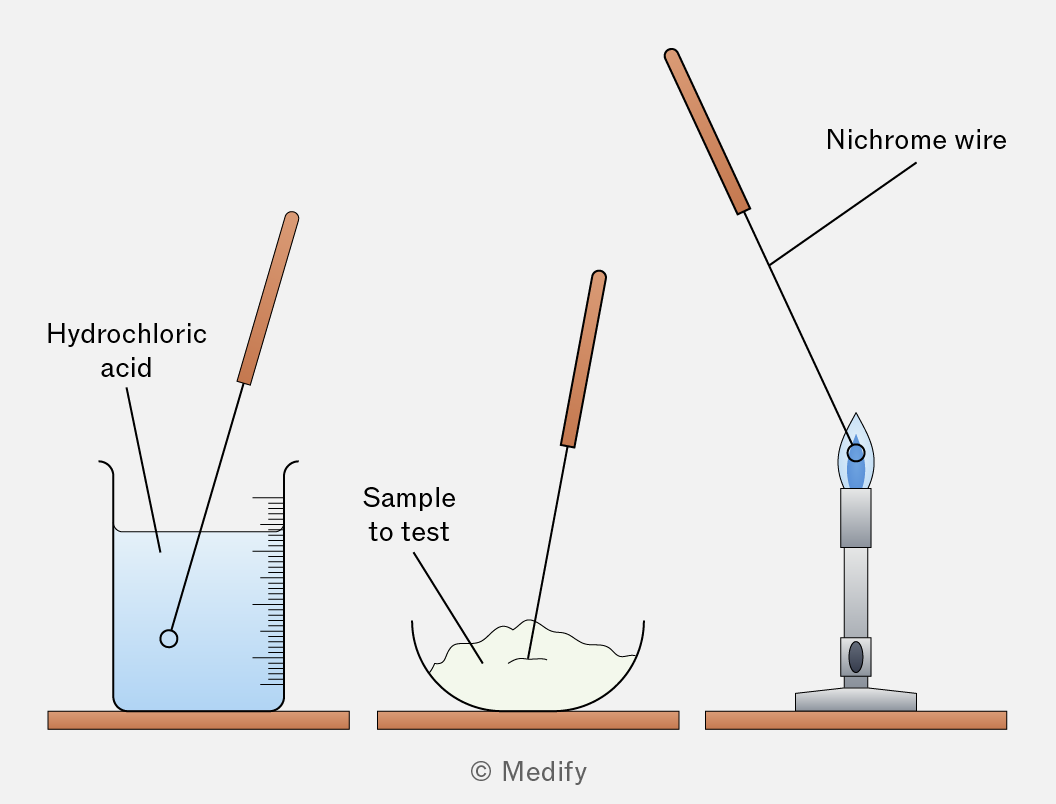
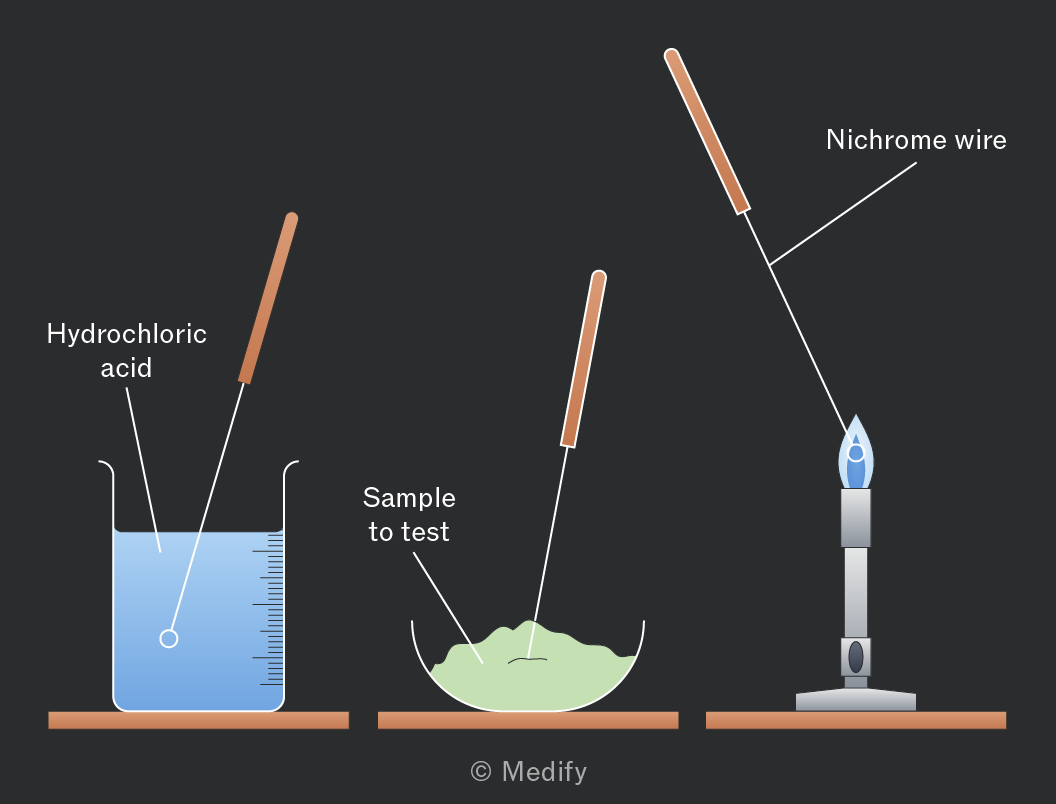
Procedure:
1. Set the Bunsen burner to a blue flame with the air hole fully open.
2. Clean a nichrome or platinum wire by dipping it in concentrated hydrochloric acid and heating it in the Bunsen flame until no colour is visible in the flame.
3. Dip the wire back into the acid, then into a small amount of the powdered sample.
4. Place the sample in the hottest part of the Bunsen flame and observe the colour produced.