
Equilibrium II (Topic 11)
On this page
is the equilibrium constant for gases, expressed in terms of partial pressures.
It quantifies the ratio of gaseous products and reactants at equilibrium.
For a gaseous equilibrium:
The equilibrium constant in terms of partial pressures, is given by:
Where:
- is the equilibrium partial pressure of species
- , , , and are the stoichiometric coefficients from the balanced chemical equation.
Partial pressures can be in any pressure unit but must align across the equation.
The units of are established by inputting the units for partial pressure into the expression.
In a gaseous chemical system, each gas exerts its own partial pressure. The sum of these partial pressures is equal to the total pressure of the system.
To determine the partial pressure of a gas, you multiply its mole fraction by the total system pressure:
The mole fraction of a component in a mixture is defined as the ratio of the number of moles of that component to the total number of moles of all components in the mixture.
It can be calculated using:
Homogeneous equilibria involve reactants and products that are in the same phase.
Heterogeneous equilibria involve reactants and products in different phases. In these equilibria, solids and pure liquids (solvents) are not included in the equilibrium expressions.
With the following homogeneous system:
the equilibrium constant, , only includes the gaseous reactants and is given by:
Where:
- is the equilibrium constant
- is the equilibrium partial pressure of each gaseous species
- and are the stoichiometric coefficients from the balanced chemical equation
and are solids and do not appear in the expression.
An ICE (Initial, Change, Equilibrium) table is useful for establishing equilibrium concentrations.
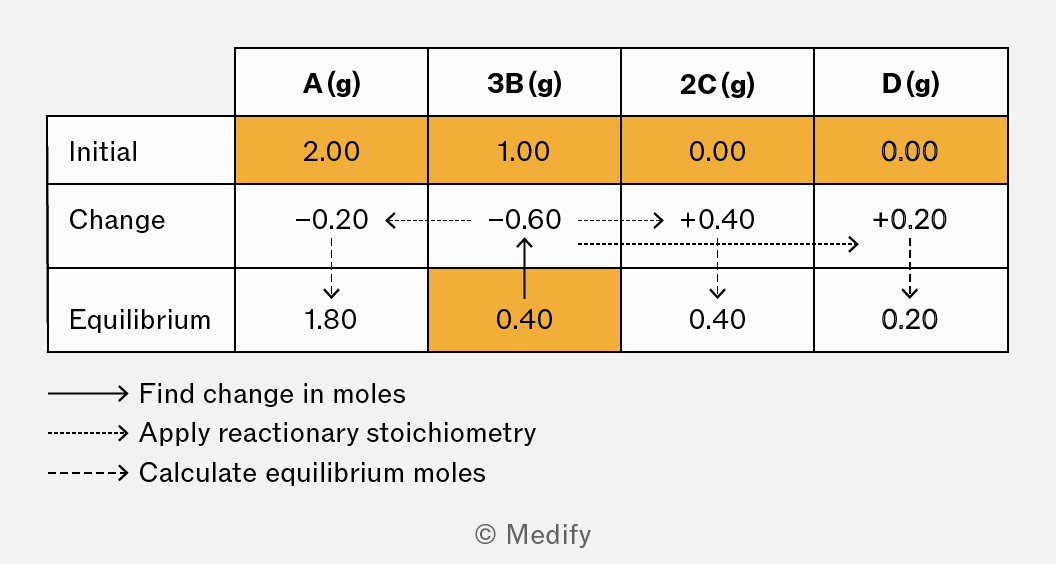
1. Write the balanced chemical equation: This will help determine the stoichiometric relationships between the reactants and products.
2. Set up an ICE table: Add any data you have for the initial moles, changes in moles, and equilibrium moles of the reactants and products.
3. Apply the reaction stoichiometry to the change in moles.
Remember all the data in an ICE table is in moles; you may need to convert between moles and concentration or partial pressure.
Calculate by inputting the equilibrium concentrations of each species into the expression for .
Determine units for by inserting the unit for concentration into the expression and applying the laws of indices.
Question walkthrough
A Kp calculation
Using partial pressures to calculate the value of Kp
The equilibrium constants, and remain constant at a given temperature; when temperature changes, the equilibrium constant also changes.
Partial pressure or concentration changes cause equilibrium shifts to regain the ratio described by or respectively, but the equilibrium constant remains unchanged.
In general terms:
increasing pressure shifts equilibria towards the side where there are fewer moles of gas.
The Haber process is commonly used to demonstrate the behaviour of gaseous equilibria.
Equilibrium constant, , is given by the equation:
If the volume of the container decreases, all the partial pressures will initially increase.
In this instance the equation’s output will become lower than that described by ; the denominator has increased more than the numerator.
The system will shift towards the right hand side, to increase the value of the numerator and decrease that of the denominator, restoring the balance as dictated by .
In general terms:
increasing temperature shifts equilibrium to favour the endothermic reaction.
Changing temperature changes the value of the equilibrium constants, and .
The impact of temperature on the equilibrium constant, and therefore the position of equilibria, varies depending on whether the forward reaction is exothermic (releases heat, ) or endothermic (absorbs heat ).
Where the forward reaction is exothermic, increasing the temperature will decrease the equilibrium constant.
This happens because, according to Le Chatelier’s principle, the system will shift to the left to counteract the added heat energy by favouring the endothermic reverse reaction, which absorbs heat energy from the surroundings.
This shift results in an increase in the concentration of reactants and a decrease in the concentration of products, aligning to the new lower value of the equilibrium constant,
Catalysts increase the rate of reaction by providing an alternative reaction pathway with a lower activation energy. They have no impact on the equilibrium constant.
As they increase the rate of both the forward and reverse reaction equally the position of equilibrium remains unchanged. Dynamic equilibrium is, however, achieved at a faster rate.