Math skills for physics›Geometry and Trigonometry (M4)

Geometry and Trigonometry (M4)

Master vectors, angles, trig, small-angle approximations and radian measure to solve mechanics, waves and field problems.
24 min

In geometry, angles are usually measured in degrees, where a rotation of represents a complete turn.

If a complete turn is split into several angles, those angles must add up to

A straight line splits a complete turn in half. Therefore, the angles on one side of a straight line add up to
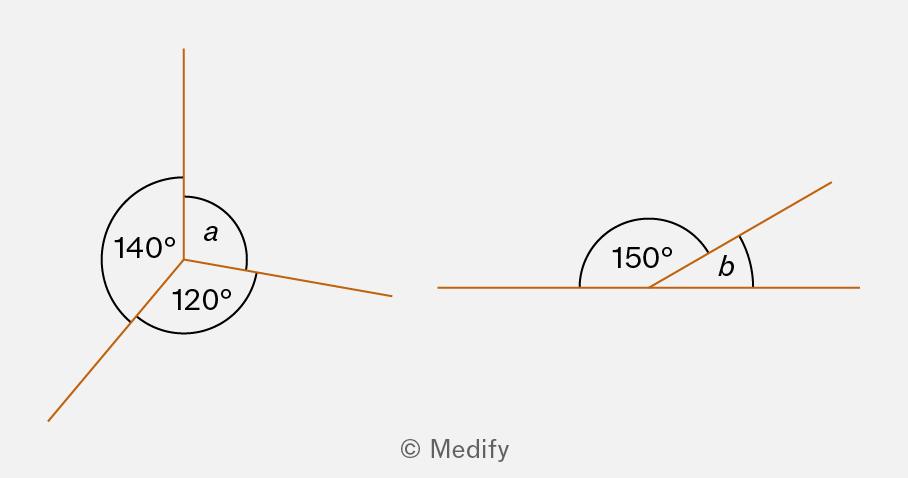
The image shows two diagrams of angles. On the left, there is a circle with three intersecting lines, forming angles labeled as 140°, 120°, and 'a'. On the right, another circle is shown with a straight horizontal line intersected by a diagonal line, forming an angle labeled as 150° and 'b'.

You can use these rules to find missing angles around a point, or on a straight line.

Add to favourites

It is important to know the sum of the interior angles of a triangle and a quadrilateral.

  • Any shape with three sides is a triangle. There are also three interior angles between these sides. These angles always add up to .
  • Any shape with four sides is a quadrilateral. There are also four interior angles between these sides. These angles always add up to .

It is useful to know that the sum of the interior angles of any simple polygon is equal to the number of sides in the shape minus 2, multiplied by :
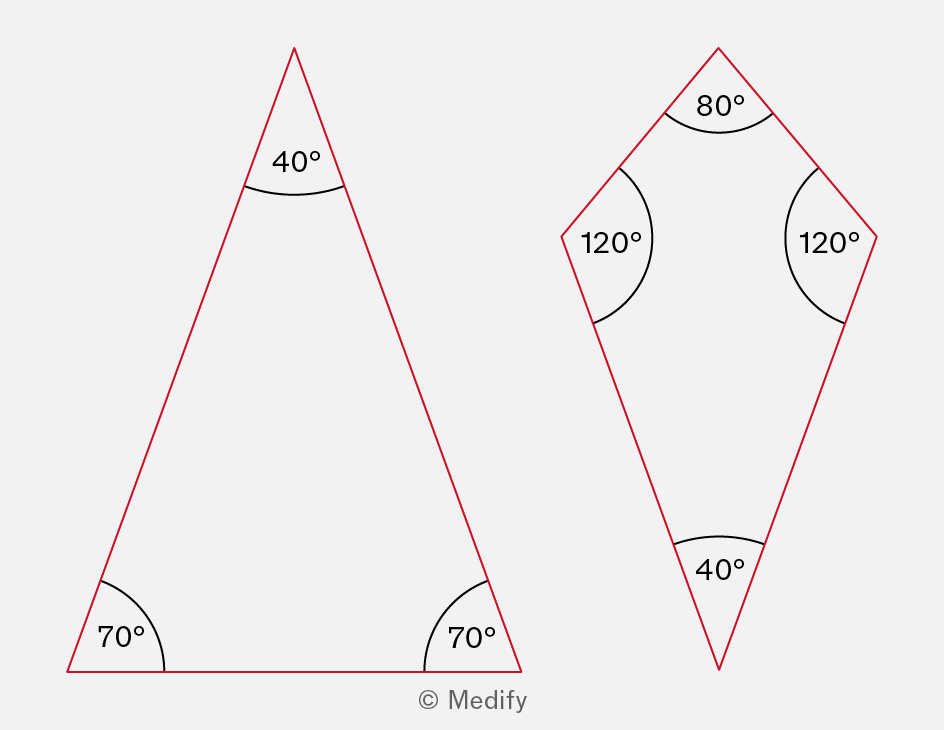
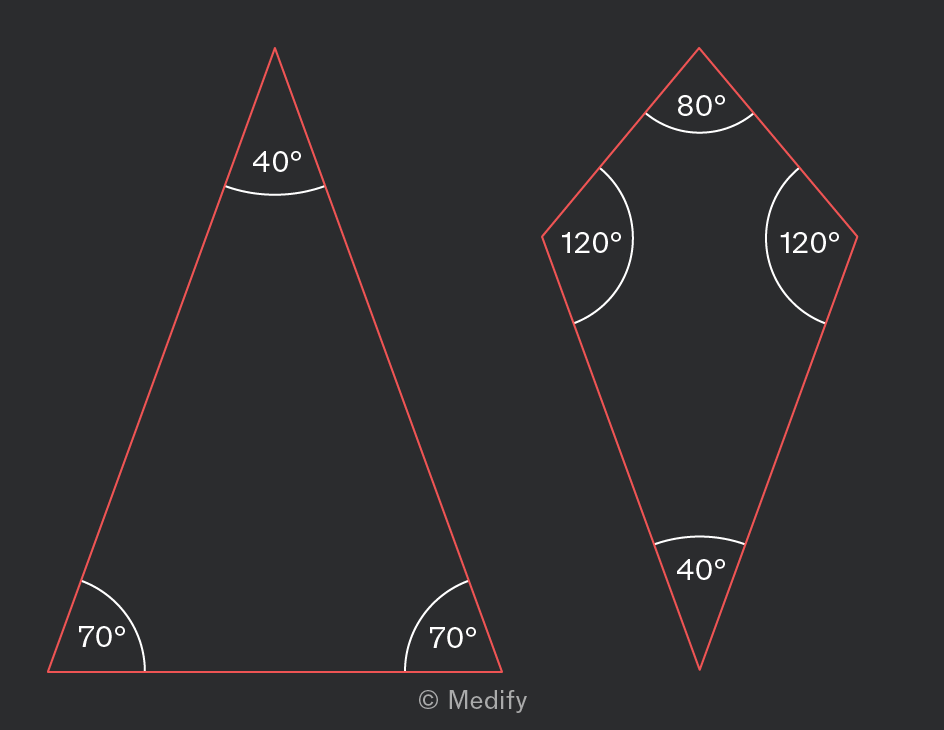
The image displays two geometric shapes outlined in red. The shape on the left is a triangle with internal angles labeled as 40°, 70°, and 70°. The shape on the right is a quadrilateral with internal angles labeled as 80°, 120°, 120°, and 40°.

For example, for the angles in the triangle:

For the angles in the kite (a type of quadrilateral):

Add to favourites

When two angles are on the same side of a straight line, like and below, they add up to Therefore, when two lines cross at a point, you can easily use one of the angles at this point to find all the other angles.

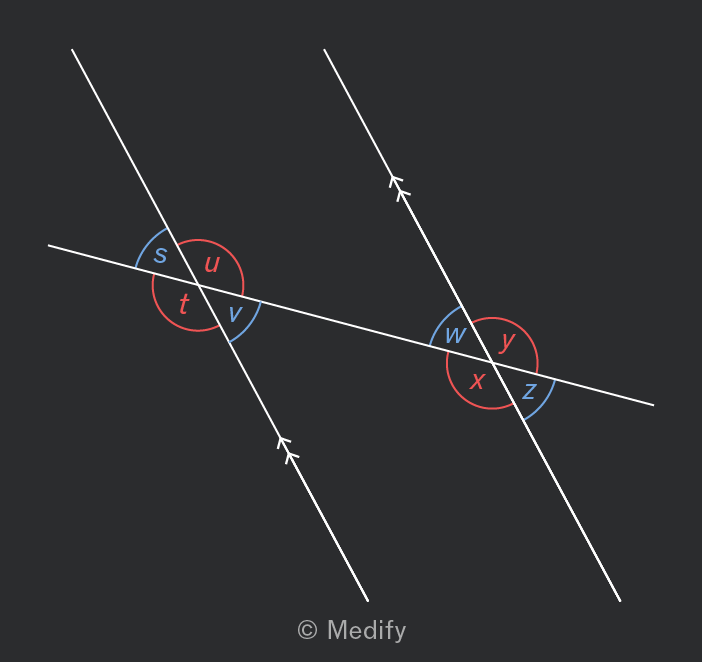
Furthermore, if a line crosses two parallel lines, the angles on both parallel lines are equal.
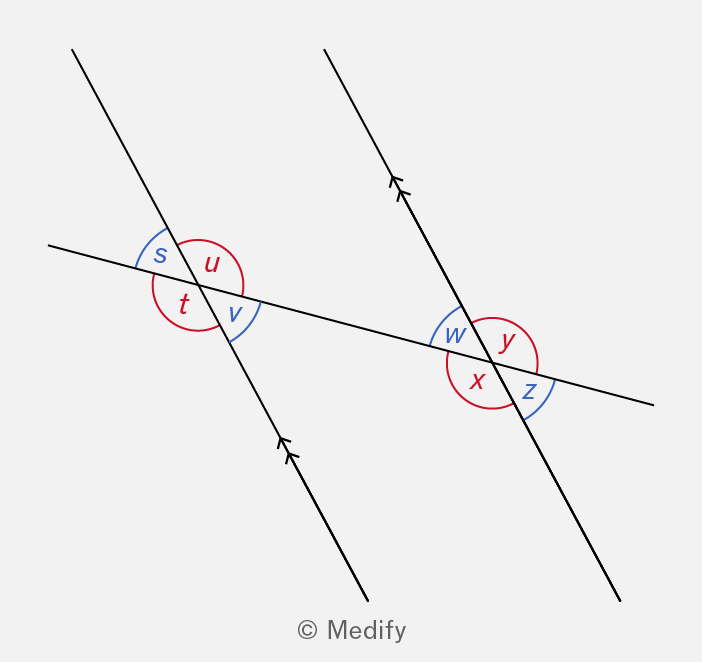
The image shows two parallel lines intersected by a transversal line, creating angles labeled with letters. The parallel lines have arrowheads pointing in the same direction. At the first intersection, angles are labeled s, t, u, and v, with s and v in blue circles, and t and u in red circles. At the second intersection, angles are labeled w, x, y, and z, with w and z in blue circles, and x and y in red circles. The transversal forms corresponding and alternate interior angles with the parallel lines.

By following these principles:

  • because they are on parallel lines
  • because they are on parallel lines

Hence, and are equal.

Furthermore,

By a similar reasoning, and are equal.

If any of these eight angles is known, we can easily calculate any of the others.

Add to favourites

Question walkthrough

Find angles using properties of triangles, quadrilaterals, and parallel lines

Uses the angle sum of a quadrilateral and of a straight line, then a parallel lines angle relationship, to find an unknown angle in an irregular quadrilateral diagram.

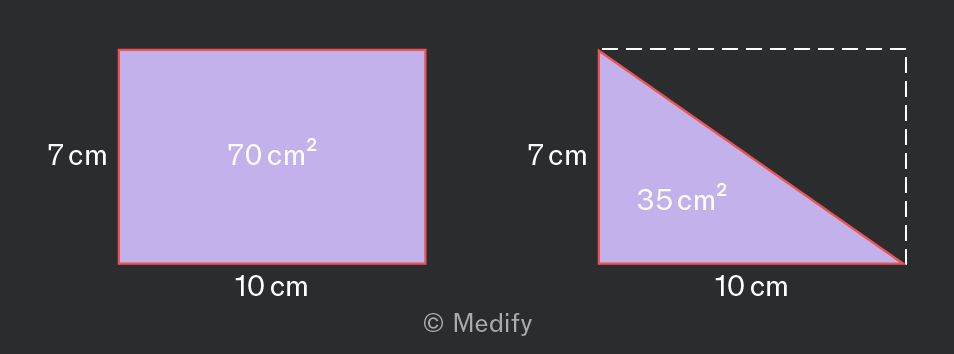
To find the area of a rectangle (or a square), multiply its base by its height:
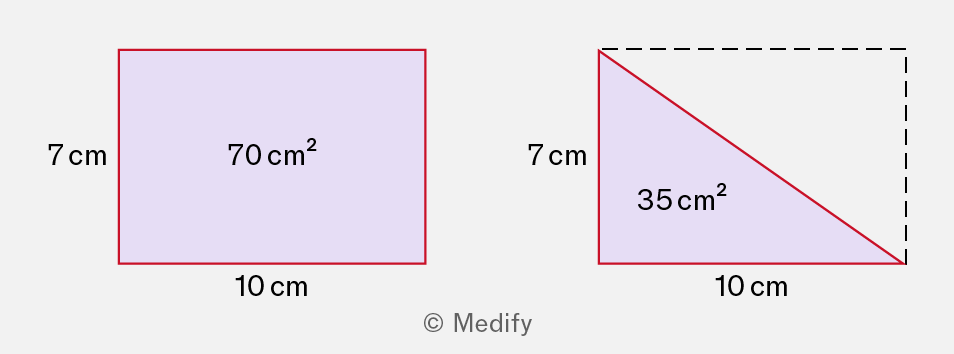
The image shows two geometric shapes side by side. On the left is a rectangle with dimensions labeled as 7 cm for the height and 10 cm for the width. The area is labeled as 70 cm² inside the rectangle. On the right is a right-angled triangle with the same base and height dimensions as the rectangle, 10 cm and 7 cm respectively. The area is labeled as 35 cm² inside the triangle. A dashed line completes the rectangle around the triangle. © Medify is noted at the bottom.

To find the area of a triangle, multiply its base by its height, and halve the answer. This is because the triangle fills exactly half of a rectangle with the same base and height:

Add to favourites

The circumference of a circle is the length of its perimeter. To calculate the circumference and area of a circle, you need to use the value of (the Greek letter pi).

Your calculator has a button for this value.

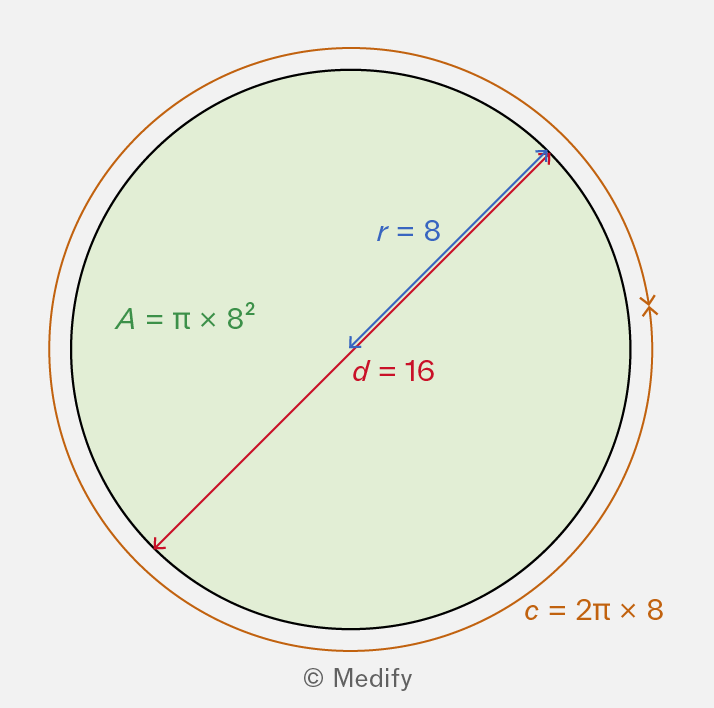
The radius of a circle is the distance from its centre to anywhere on its perimeter.

The diameter of a circle is the straight-line distance passing through its centre, connecting two opposite points on the circumference. It is therefore twice the radius.

You can use the formulas:

  • Circumference: or
  • Area:
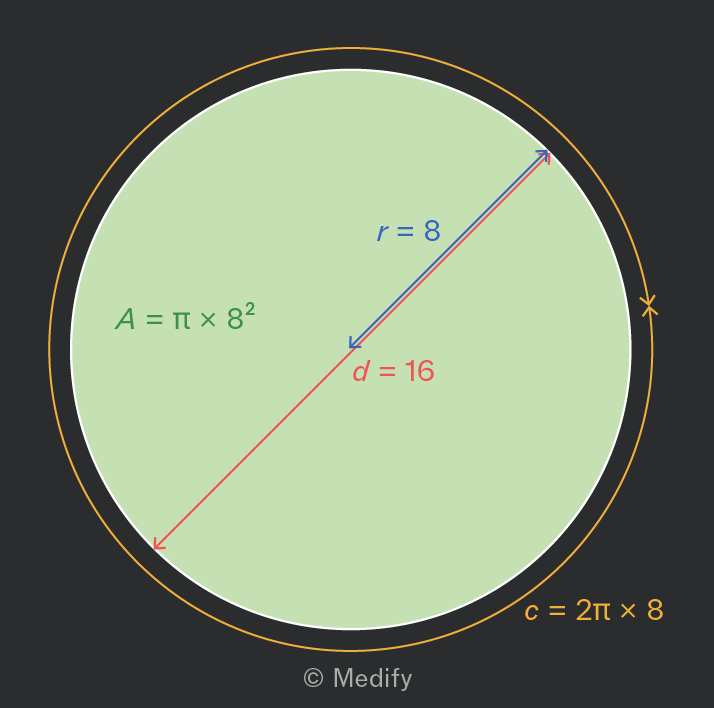
The image is a diagram of a circle with various annotations. Inside the circle, there is a green-filled area with the label 'A = π x 8^2' in green, indicating the area of the circle. A blue line labeled 'r = 8' represents the radius of the circle. A red line labeled 'd = 16' represents the diameter of the circle. The circumference of the circle is marked with an orange line labeled 'c = 2π x 8'. The circle is shown with a light green interior and outlined with a thin black line, with an additional orange border indicating the circumference.

In this particular circle:

(Results are rounded to 3 significant figures.)

Add to favourites

Most geometry formulas use the radius rather than the diameter.

In some exam questions, the radius will be given, and in others, the diameter will be given. Be sure to halve the diameter to get the radius (if necessary).

Suppose a football measures across. What is its volume?

Do

Use the radius when the formula requires.

You might need to calculate this from the diameter if the radius is not given.

Don't

Use the diameter when the radius would be correct.

Add to favourites

For some shapes, such as rectangles, triangles and circles, you can use a formula to find the area.

Some shapes have a more complex structure, but you might find a way to split them into several simple shapes whose area you can easily calculate.

For example, the area of the front wall of this barn can be considered a large rectangle, plus the triangular roof, minus the rectangular door.
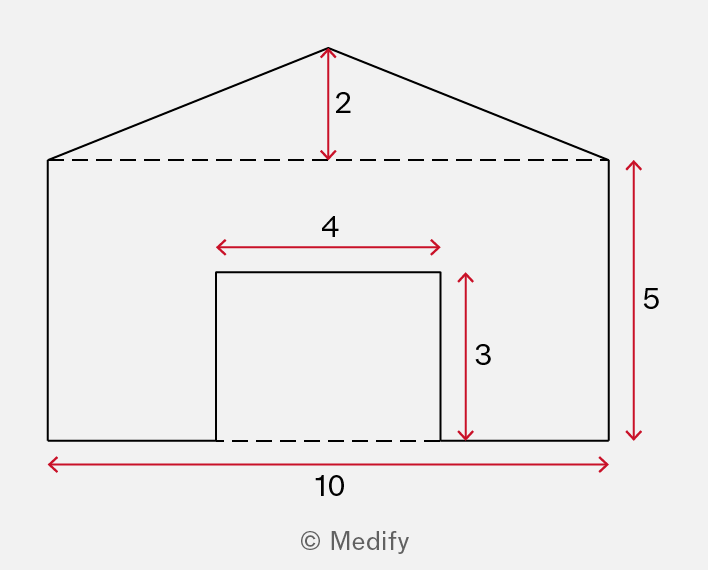
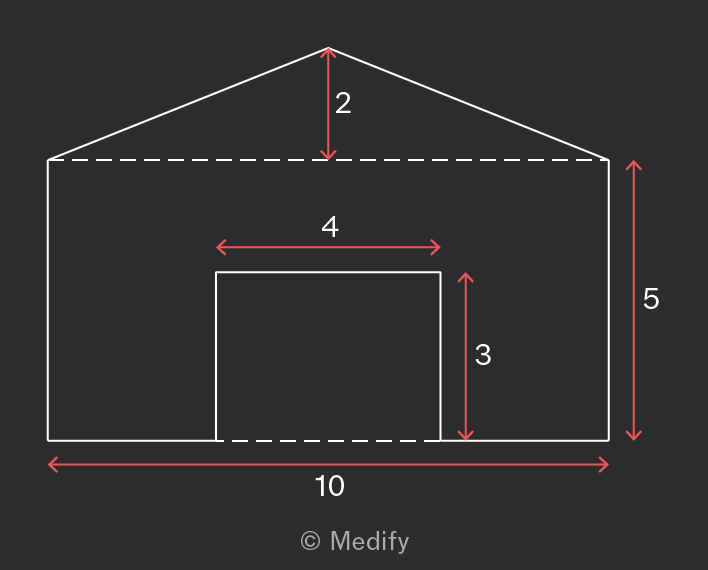
A diagram of a house-like structure with dimensions indicated. The structure has a triangular roof with a vertical arrow labeled '2' indicating the height of the roof. The main rectangular section of the structure has a height labeled '5' on the right side with a vertical arrow. A smaller rectangular door is present on the lower section, with a width labeled '4' and a height labeled '3', both with horizontal and vertical arrows respectively. The overall width of the structure is labeled '10' at the bottom with a horizontal arrow. The roof is depicted with dashed lines separating it from the main section.

Add to favourites

The surface area of a 3D shape is the total area of all its exterior surfaces.

The surface area of some shapes, such as cuboids (and cubes), consists of several flat surfaces. For shapes like these, you can simply find these areas and add them together.

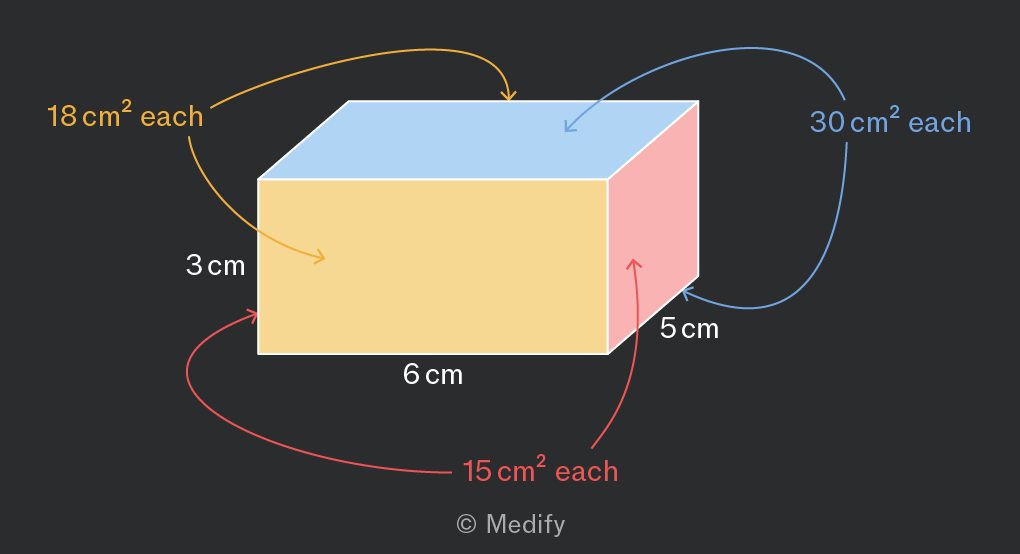
For example, consider a cuboid with dimensions and
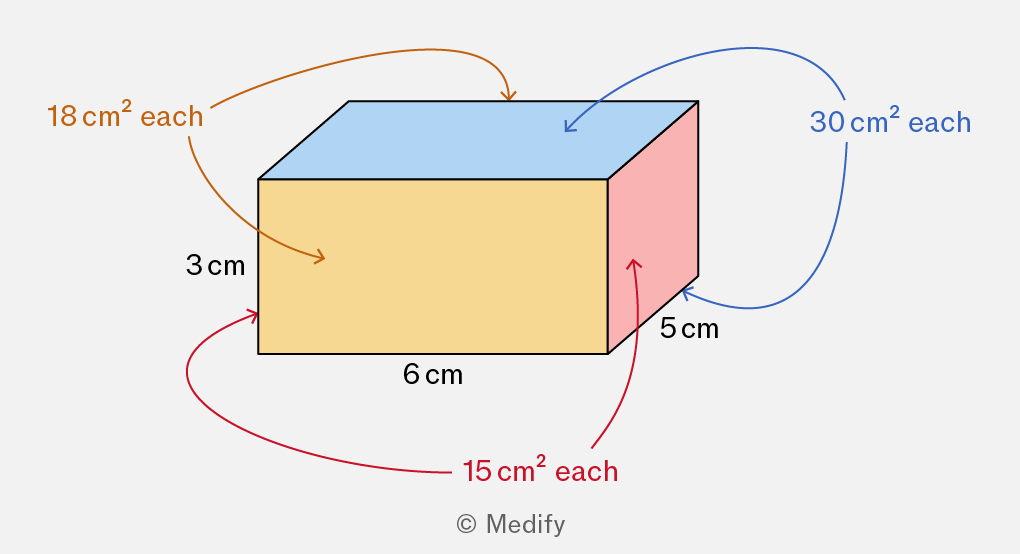
The image shows a rectangular prism with labeled dimensions and area calculations. The width is labeled as 3 cm, the length as 6 cm, and the height as 5 cm. The top face of the prism is labeled 18 cm² each in orange. The side face is labeled 30 cm² each in blue. The front face is labeled 15 cm² each in red. Arrows connect each labeled area to the corresponding face of the prism.

The cuboid has:

  • A front and back (yellow), whose areas are each
  • Two side (red), whose areas are each
  • A top and bottom (blue), whose areas are each

Add these together:

Add to favourites

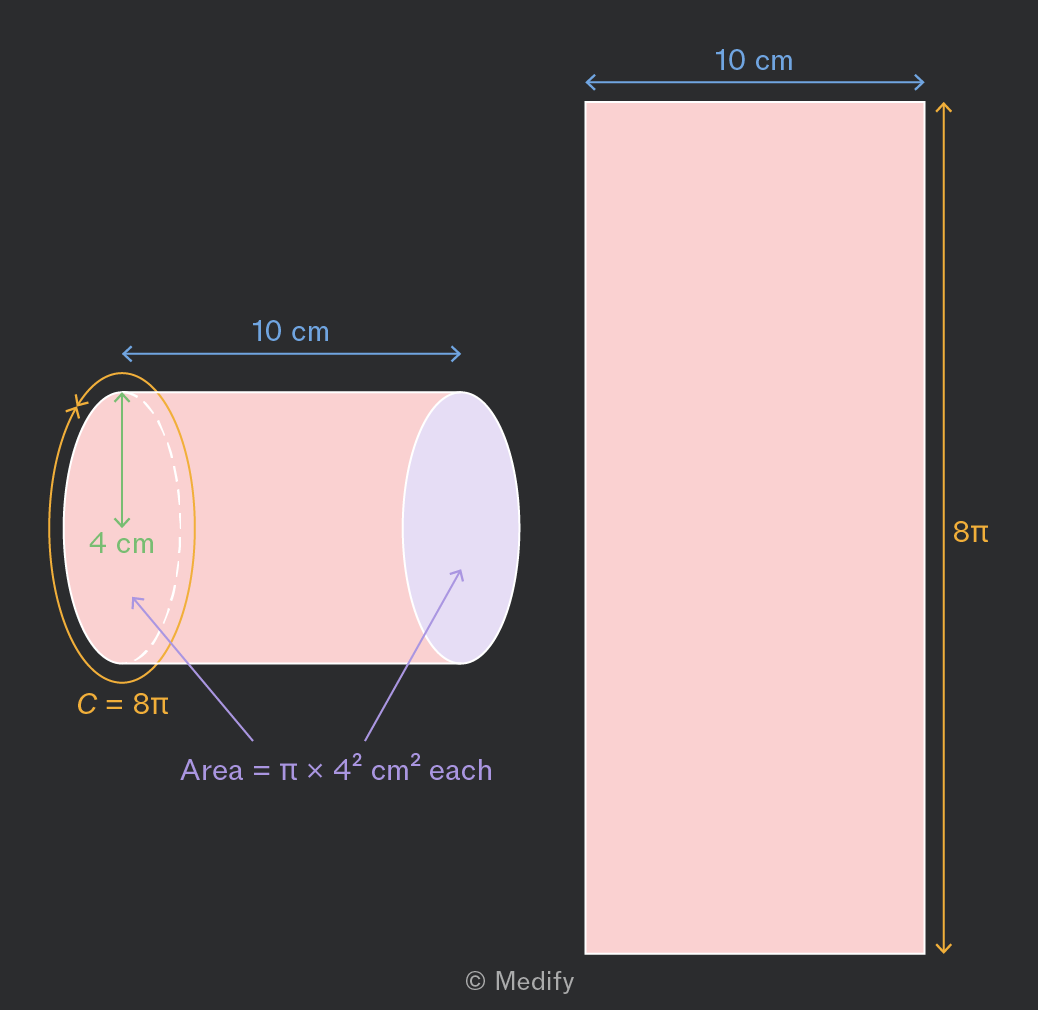
The surface of a cylinder consists of two circles (at the ends) and a curved surface.

If you flattened the curved surface, it would be a rectangle where:

  • Length is the length of the cylinder.
  • Height is the circumference of the circles at the ends.
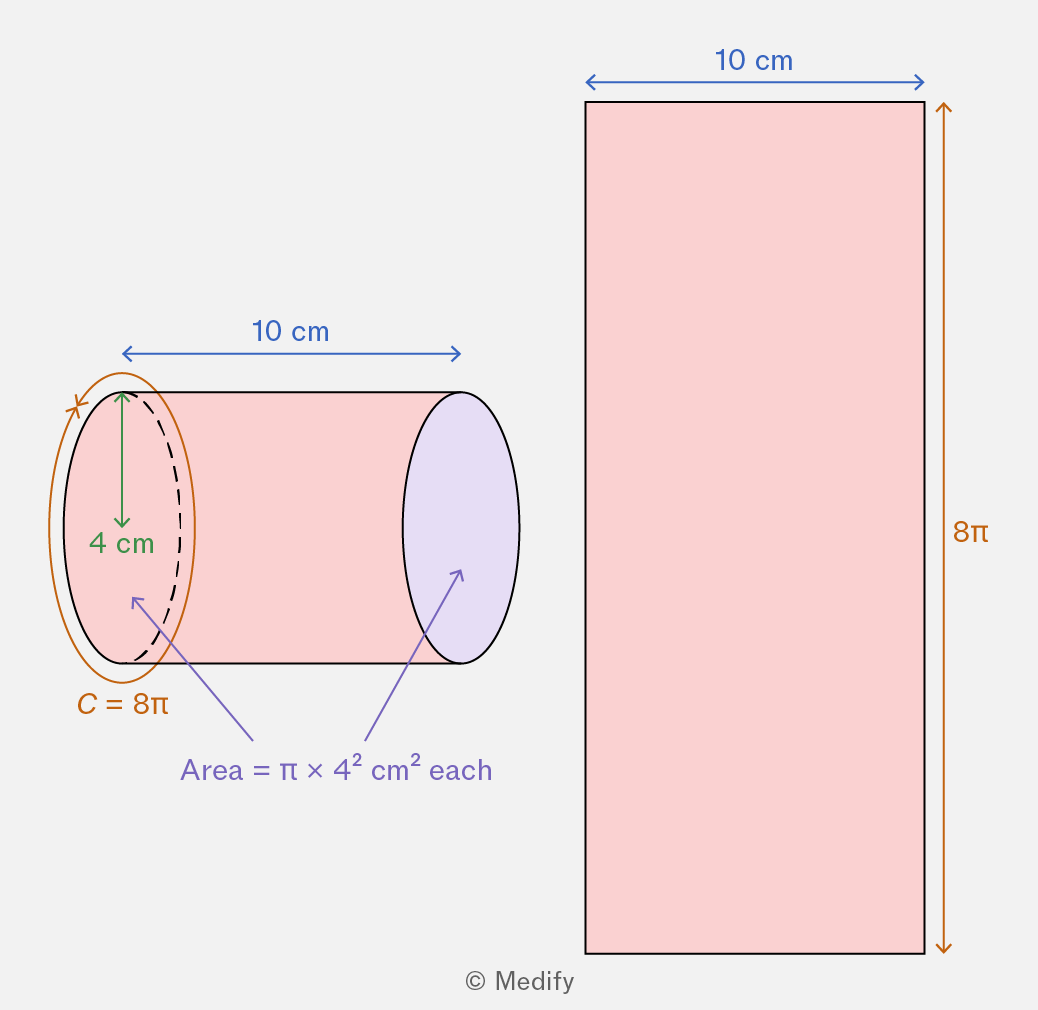
The image depicts a cylinder with a height of 10 cm and a radius of 4 cm. The left side shows the cylinder with annotations: 'C = 8π' around the circumference, 'Area = π × 4² cm² each' for the circular ends, and a green arrow indicating the radius labeled '4 cm'. The length of the cylinder is labeled '10 cm'. On the right, the cylinder is unfolded into a rectangle with dimensions labeled '10 cm' for the width and '8π' for the height, indicating the circumference of the cylinder.

For this cylinder:

It is useful to note that for a cylinder of length, and radius,

Add to favourites

In mathematics, a prism is defined as any 3D shape formed from a 2D shape that is given depth.

You need to calculate the volumes of the following prisms:

  • cuboids (and cubes), where the 2D shape is a rectangle (or a square), and
  • cylinders, where the 2D shape is a circle.

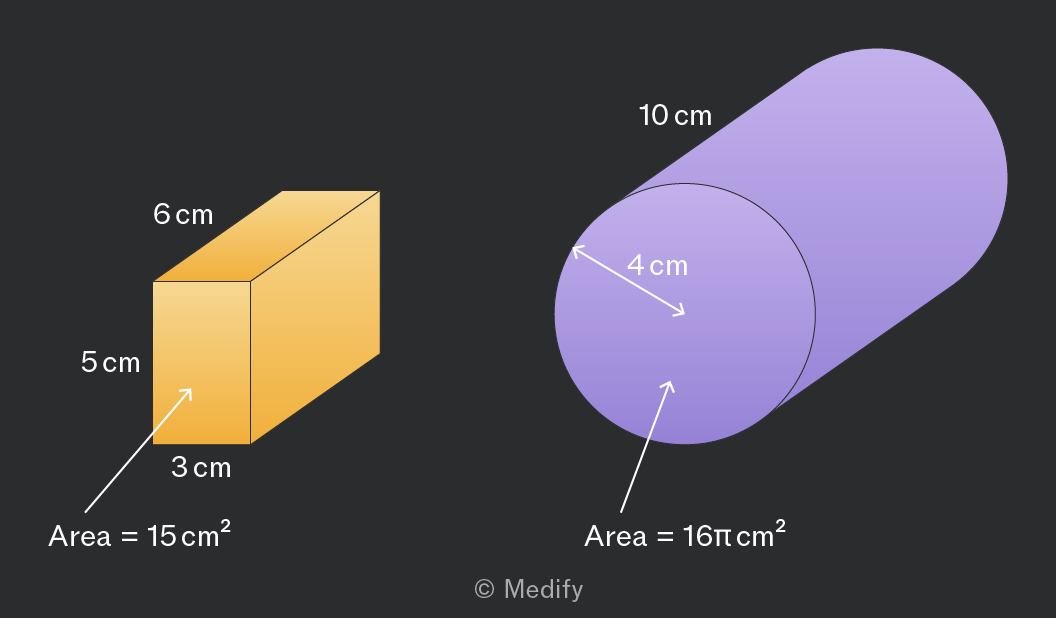
For any prism, the volume is calculated as the area of the 2D shape, multiplied by the depth.
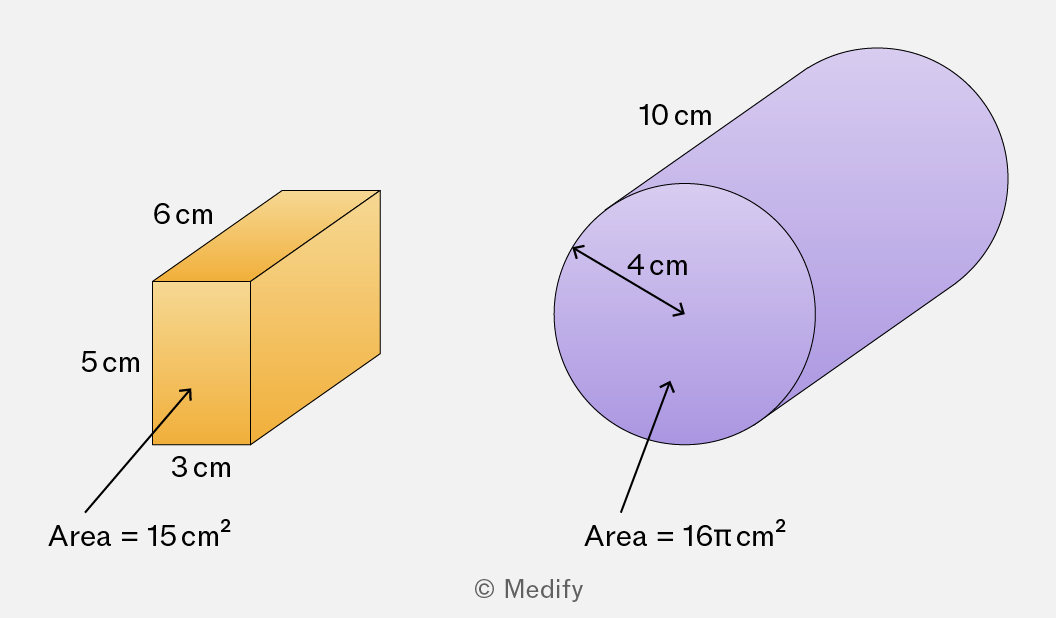
The image shows two geometric shapes with dimensions and area annotations. On the left, there is a rectangular prism with dimensions labeled as 6 cm in length, 3 cm in width, and 5 cm in height. An arrow points to the base with a text label 'Area = 15 cm²'. On the right, there is a cylinder with a height labeled as 10 cm and a radius labeled as 4 cm. An arrow points to the circular face with a text label 'Area = 16π cm²'.

Add to favourites

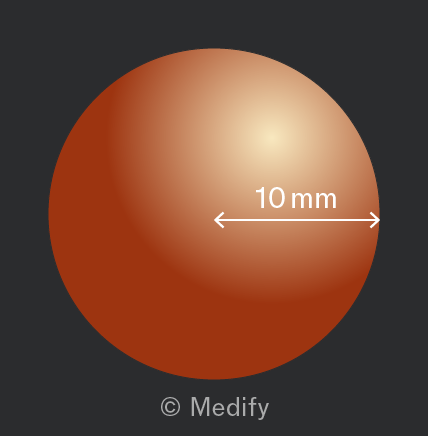
You need to know the formulas for the surface area and volume of a sphere of radius, :
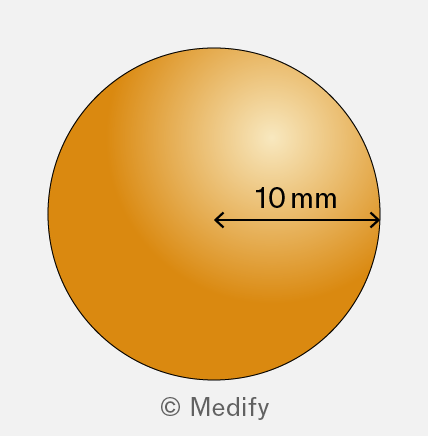
A circular orange sphere with a horizontal arrow labeled '10 mm' indicating its diameter. © Medify is written below the sphere.

For this sphere:

Add to favourites

Question walkthrough

Calculate areas and volumes of cylinders.

Uses V=πr²L and total surface area (curved surface plus two circular ends) to compare the volumes and surface areas of two cylindrical wagon designs with different dimensions.

Question walkthrough

Surface area and volume of cubes.

Finds the surface area and volume of a single cube using its side length, then scales both up to find the total surface area and volume of 1000 wooden dice.

In any triangle, the sum of angles is always . This means that if you know any two of the angles, you can easily calculate the other angle.
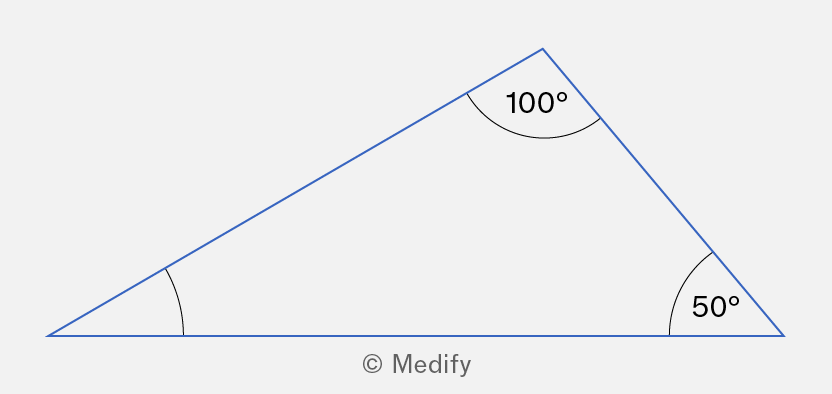
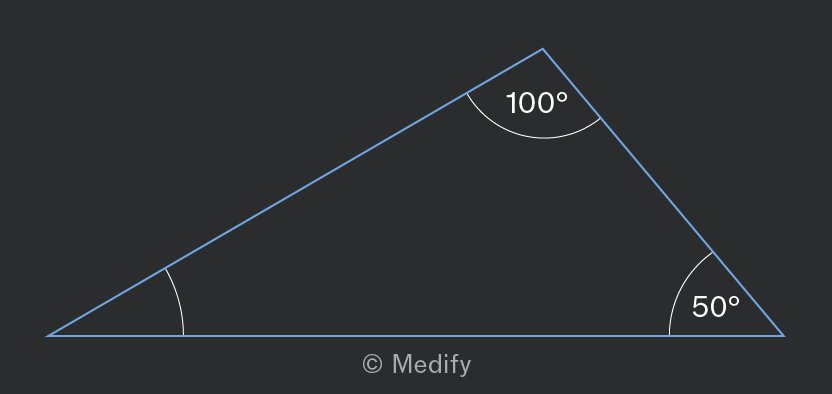
Image of a triangle with three angles labeled. The top angle is labeled 100 degrees. The bottom right angle is labeled 50 degrees. The bottom left angle is not labeled. The triangle is outlined in blue. © Medify is written below the triangle.

Here, the sum of the known angles is .

The sum of all angles must be .

, so the missing angle is .

Add to favourites

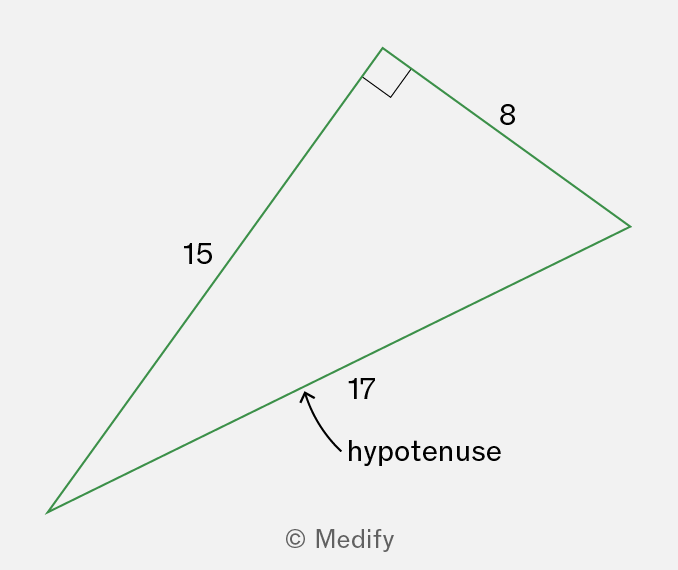
In a right-angled triangle, the right angle is always the largest angle. The side opposite the right angle is called the hypotenuse, which is guaranteed to be the longest side.

In a right-angled triangle, the lengths of the sides always satisfy Pythagoras’ Theorem:

You may see this written as:

Where:

  • represents the hypotenuse, and
  • and are the other sides.
The image shows a green right triangle with a right angle indicated at the top vertex. The side opposite the right angle is labeled as the hypotenuse and has a length of 17. The vertical side is labeled 15 and the horizontal side is labeled 8. An annotation with an arrow points to the hypotenuse, labeling it as 'hypotenuse'. © Medify is noted at the bottom.

For this triangle:

This illustrates Pythagoras’ Theorem for this triangle.

Add to favourites

Question walkthrough

Use Pythagoras' theorem, and the angle sum of a triangle

Uses Pythagoras' theorem to find the horizontal distance between a kite and the person flying it, given the string length and the vertical height difference.

All triangles consist of three sides and three angles. If you know any three of these six measurements, you can typically determine the length of the remaining sides and the measure of the remaining angles.
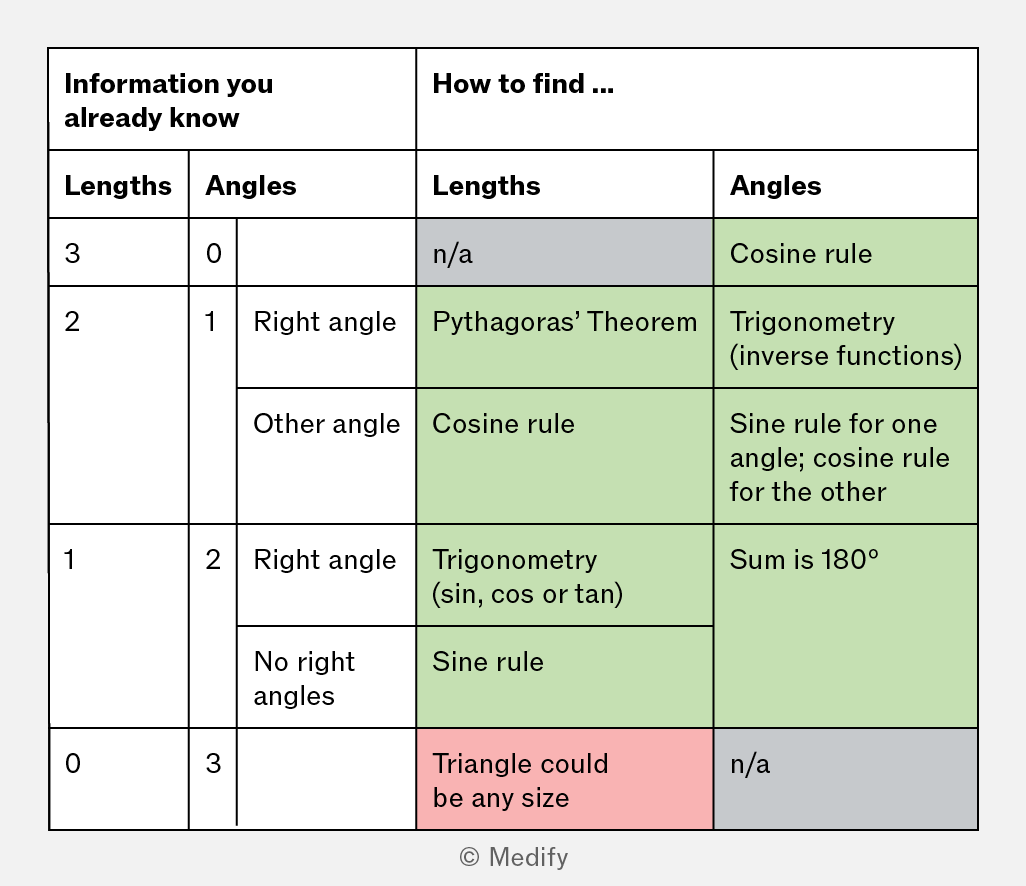
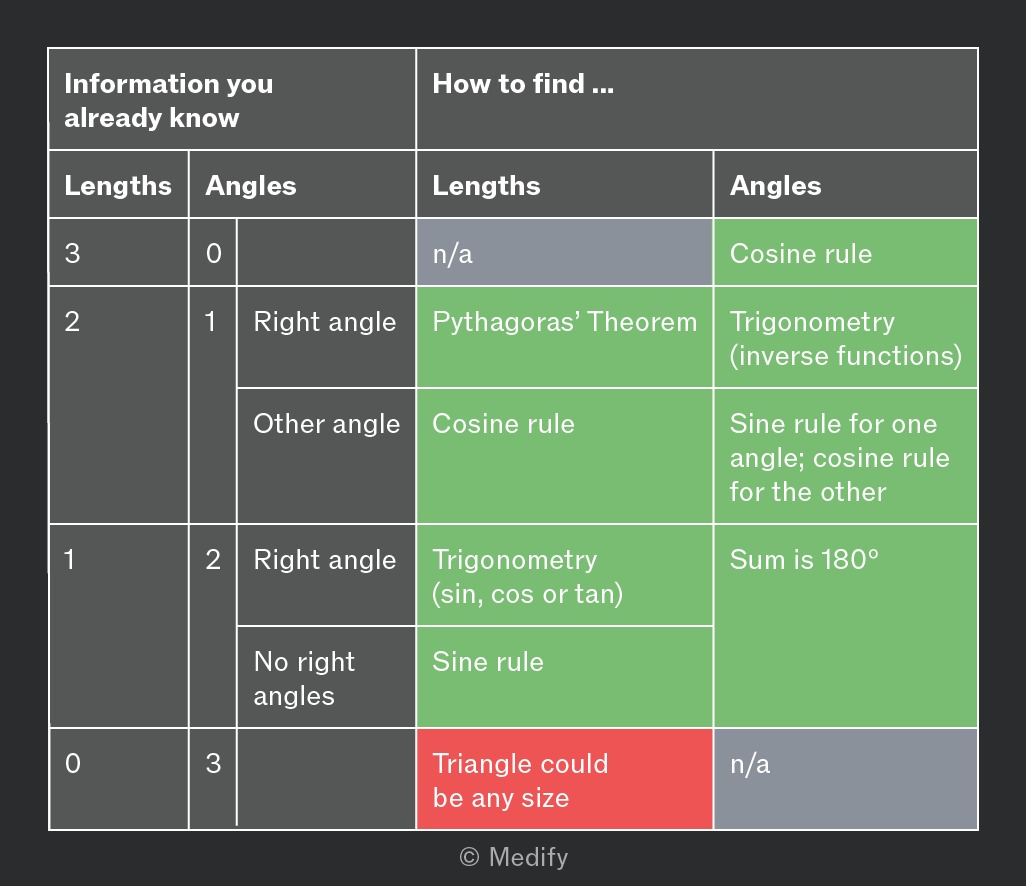
A table with two main columns labeled 'Information you already know' and 'How to find ...'. Each has sub-columns; 'Information you already know' includes 'Lengths' and 'Angles', while 'How to find ...' includes 'Lengths' and 'Angles'. The rows are as follows: Row 1: Lengths 3, Angles 0, Lengths n/a (gray background), Angles 'Cosine rule'. Row 2: Lengths 2, Angles 1, 'Right angle', Lengths 'Pythagoras’ Theorem' (green background), Angles 'Trigonometry (inverse functions)'. Another entry in Row 2 for 'Other angle', Lengths 'Cosine rule' (green background), Angles 'Sine rule for one angle; cosine rule for the other'. Row 3: Lengths 1, Angles 2, 'Right angle', Lengths 'Trigonometry (sin, cos or tan)' (green background), Angles 'Sum is 180°'. Another entry in Row 3 for 'No right angles', Lengths 'Sine rule' (green background). Row 4: Lengths 0, Angles 3, Lengths 'Triangle could be any size' (red background), Angles n/a (gray background). © Medify is noted at the bottom right corner.

It is important to know the following facts and techniques to determine the lengths and angles of a triangle:

  • Angles in a triangle add up to
  • Pythagoras’ Theorem:
  • Basic trigonometry: sin, cos, and tan
  • Inverse trigonometry: and
  • Sine rule:
  • Cosine rule:
Add to favourites

Suppose you have a triangle and you resize it to make a bigger or smaller triangle. These triangles have the same angles. You can describe these triangles as similar triangles.

It is important to note that the ratio between any two side lengths is the same in both triangles.
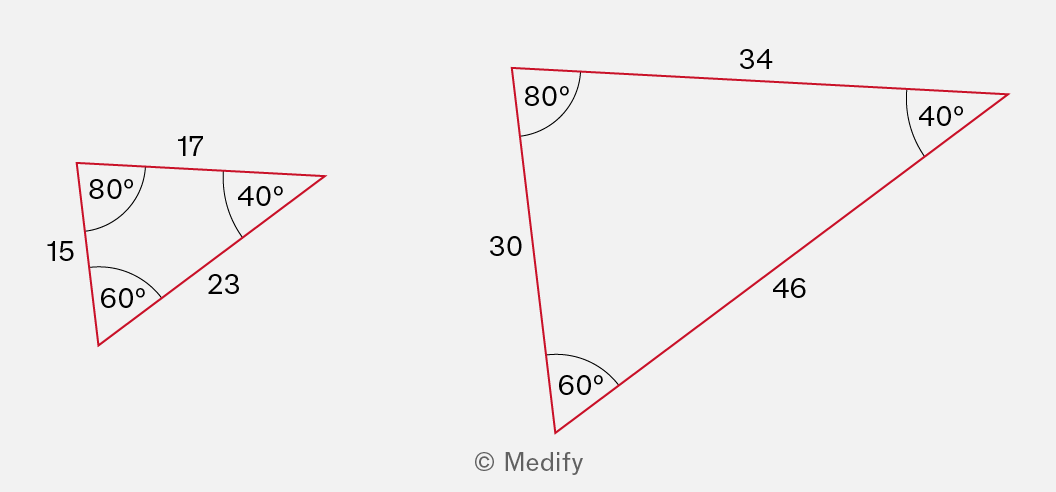
The image shows two triangles with angle and side measurements. The smaller triangle on the left has sides labeled 15, 17, and 23. It has angles labeled as 60°, 80°, and 40°. The larger triangle on the right has sides labeled 30, 34, and 46. It also has angles labeled as 60°, 80°, and 40°.

In the larger triangle, all lengths are double. Therefore, both triangles have the same shape, and their angles are the same. The ratio between any two sides, therefore, is also the same.

For example, consider the ratio between the shortest and longest sides.

  • Small triangle:
  • Large triangle:

The trigonometric ratios of sin, cos, and tan are also ratios between side lengths. Therefore, they depend on the angle, but not on the size of the triangle.

Add to favourites

In any right-angled triangle, you can use the trigonometric ratios of sin, cos, and tan to find missing side lengths and missing angles.
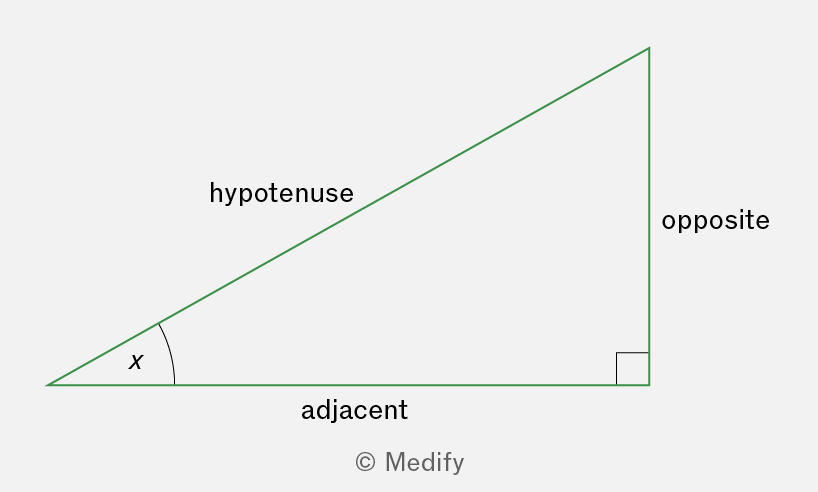
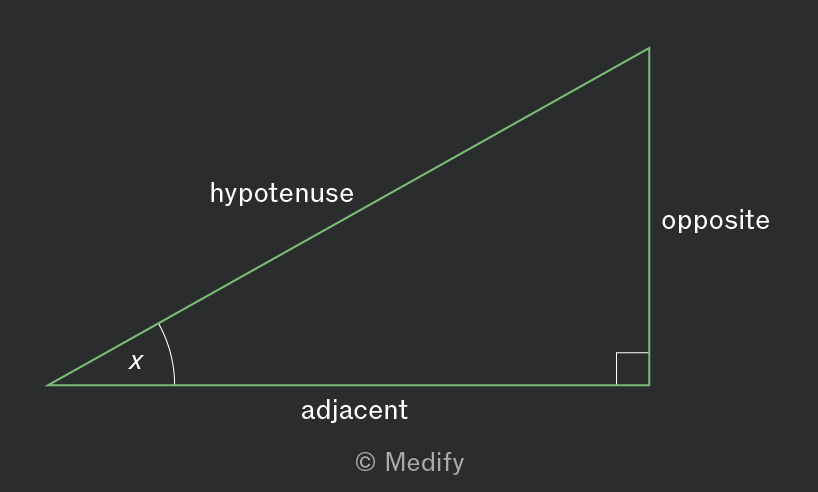
A right triangle is shown with three sides labeled: 'hypotenuse' on the longest side, 'opposite' on the vertical side, and 'adjacent' on the horizontal side. The angle at the bottom left corner is labeled 'x'. A small square marks the right angle at the bottom right corner. The image is credited to © Medify.

It is important to know the following definitions, because they are the basic formulas of trigonometry:

Some students use the phrase to help them remember these definitions, where, for example, “SOH” is the first letter of each word in the first formula.

Add to favourites

Question walkthrough

Use trigonometry to calculate a missing side in a right-angled triangle.

Uses trigonometry across two connected right-angled triangles to find the length of a support rope needed to stabilise a tent, first finding an unknown length in the inner triangle before applying it in the outer one.

You can use trigonometry to find missing angles. Typically, you’ll end up with an equation like:

To solve these equations, you need to use the inverse trigonometric functions, which are the opposites of the functions sin, cos, and tan. In this case:

The table below presents the three basic trigonometric functions and their inverses, along with illustrative examples in parentheses.
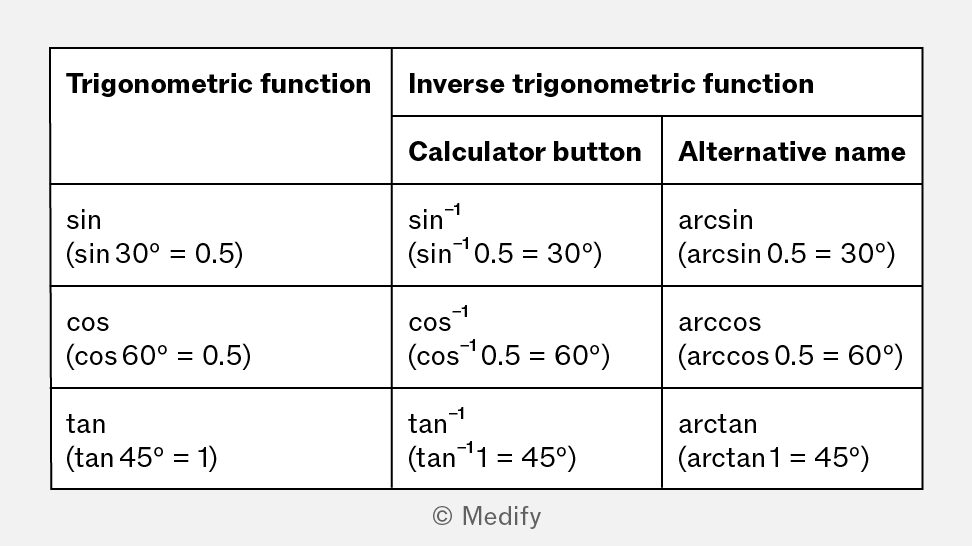
A table comparing trigonometric functions with their inverse functions. The table has three columns: 'Trigonometric function', 'Inverse trigonometric function: Calculator button', and 'Inverse trigonometric function: Alternative name'. Row 1: Trigonometric function is 'sin' with annotation '(sin 30° = 0.5)'. Inverse calculator button is 'sin⁻¹' with annotation '(sin⁻¹ 0.5 = 30°)'. Alternative name is 'arcsin' with annotation '(arcsin 0.5 = 30°)'. Row 2: Trigonometric function is 'cos' with annotation '(cos 60° = 0.5)'. Inverse calculator button is 'cos⁻¹' with annotation '(cos⁻¹ 0.5 = 60°)'. Alternative name is 'arccos' with annotation '(arccos 0.5 = 60°)'. Row 3: Trigonometric function is 'tan' with annotation '(tan 45° = 1)'. Inverse calculator button is 'tan⁻¹' with annotation '(tan⁻¹ 1 = 45°)'. Alternative name is 'arctan' with annotation '(arctan 1 = 45°)'.

It is important to familiarise yourself with your calculator’s functions to avoid wasting time during the exam.

Add to favourites

Question walkthrough

Use inverse trigonometric functions to calculate a missing angle in a right-angled triangle.

Uses right-angled trigonometry and the inverse tangent to calculate a plane's angle of descent from its horizontal distance and altitude, converting between kilometres and metres before solving.

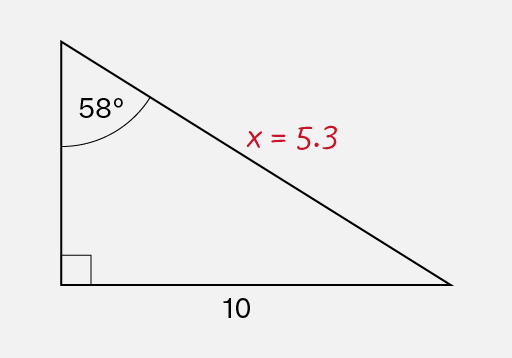
Each trigonometric ratio (sin, cos, and tan) can be defined as the ratio of two sides of a triangle.

It is essential that you use these ratios the correct way around! Use the acronym if that helps you.
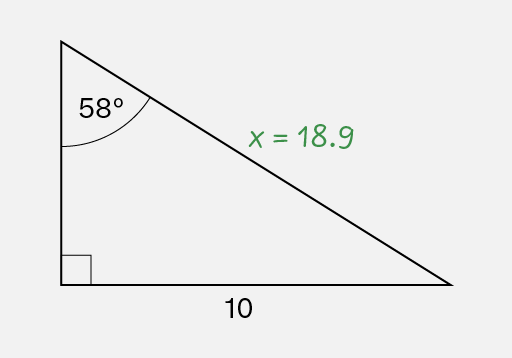
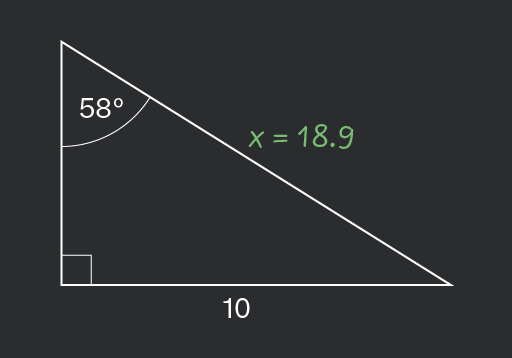
A right triangle with a horizontal side labeled 10, a vertical side, and a hypotenuse. The angle between the vertical side and the hypotenuse is labeled 58 degrees. There is a right angle symbol at the intersection of the horizontal and vertical sides. An annotation near the hypotenuse reads 'x = 18.9'.
Do

Divide the adjacent by the hypotenuse to calculate the cosine.

A right triangle with the right angle at the bottom left corner. The base of the triangle is labeled with a length of 10. The angle at the top left corner is labeled 58 degrees. The hypotenuse is labeled with an annotation 'x = 5.3' in red.
Don't

Divide the sides incorrectly when using a trigonometrical function like sin, cos, or tan.

Add to favourites

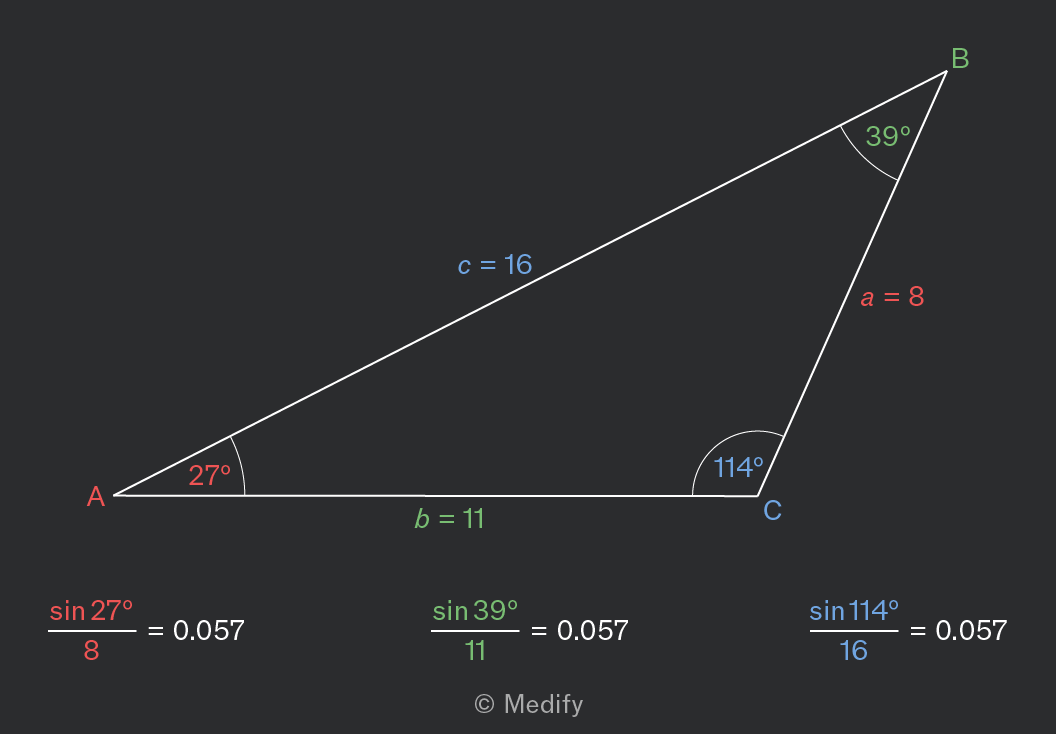
The sine rule is a remarkable mathematical fact that allows you to find unknown angles and lengths in triangles that do not have a right angle.

The sine rule says that for any triangle, the ratio:

is the same for each of its three angles.
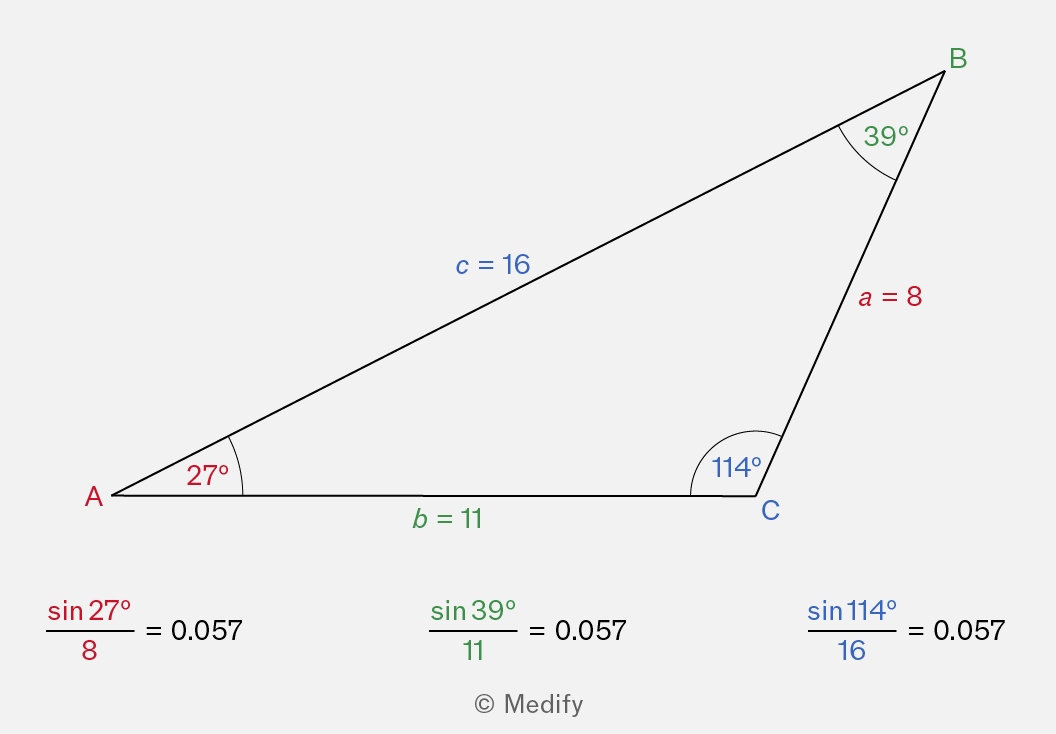
The image depicts a triangle with vertices labeled A, B, and C. Angle A is 27 degrees, angle B is 39 degrees, and angle C is 114 degrees. The side opposite angle A is labeled 'a = 8' in red, opposite angle B is 'b = 11' in green, and opposite angle C is 'c = 16' in blue. Below the triangle are three equations: 'sin 27° / 8 = 0.057' in red, 'sin 39° / 11 = 0.057' in green, and 'sin 114° / 16 = 0.057' in blue. The equations demonstrate the sine rule for the triangle.

The sine rule is often written as:

Where is the side opposite angle and is the side opposite angle

Add to favourites

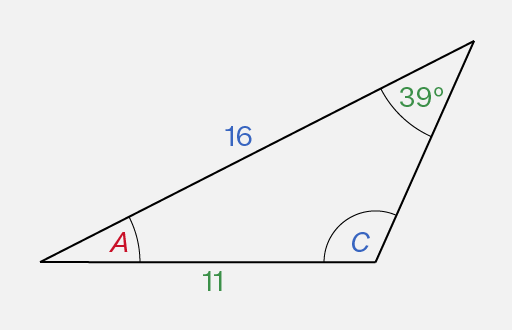
When using the sine rule to find a missing angle or side length, you must match angles with their opposite sides. Otherwise, the rule is not true.
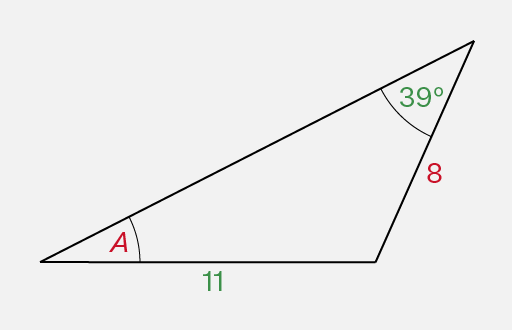
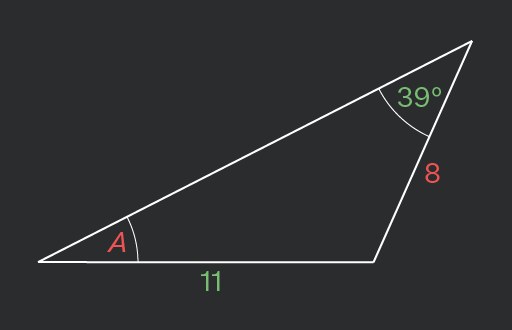
The image shows a right triangle with one angle labeled 'A' in red and another angle labeled '39°' in green. The side opposite the 39° angle is labeled '8' in red, and the base of the triangle is labeled '11' in green.
Do

Match angles with opposite sides when applying the sine rule:

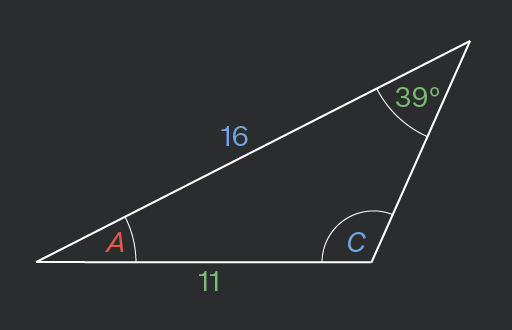
A triangle with one angle labeled as 39 degrees in green. The sides of the triangle are labeled with numbers: the side opposite the 39-degree angle is labeled 16 in blue, and the base of the triangle is labeled 11 in green. Two other angles are labeled: angle A in red and angle C in blue.
Don't

Match angles with unrelated sides when applying the sine rule.

In this example, you cannot use the sine rule to calculate angle because the length of the side opposite is not given.

(You would first need to calculate

Add to favourites

Question walkthrough

Use the sine rule to calculate a missing side length.

Uses the sine rule twice to find the two missing sides of a triangle, calculating one unknown angle from the angle sum of a triangle along the way.

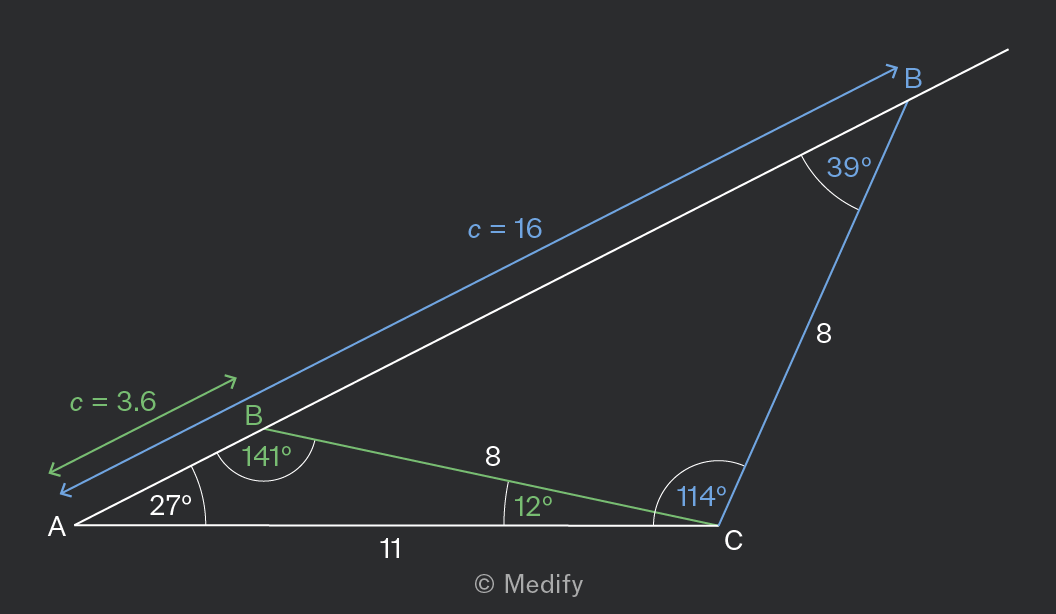
When given two side lengths and an angle not included between those sides of an unknown triangle, there might be two possible triangles that can be drawn from the incomplete description.

This is the ‘problem with angle–side–side’.

For example, suppose we know angle and lengths and as shown below.
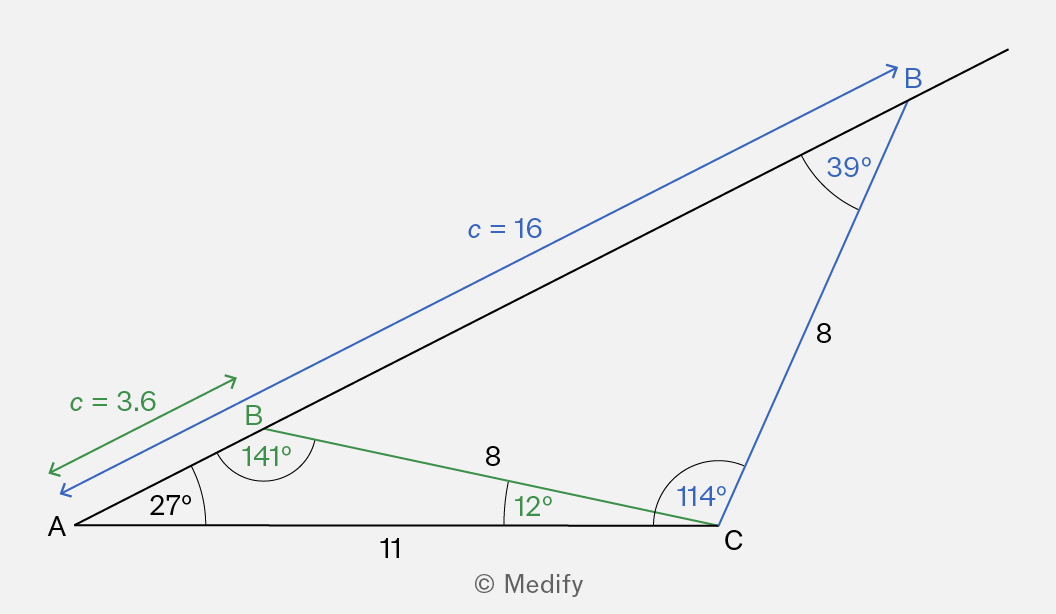
The image shows a geometric diagram with two triangles sharing a common side labeled AC. Triangle ABC has angles labeled as 27° at vertex A, 141° at vertex B, and 12° at vertex C. The side AB is labeled as 11, side BC as 8, and side AC as 8. Another triangle with vertices A, B, and an external point labeled B' is formed by extending sides AB and BC. Angle AB'B is labeled as 39°, and angle CB'B is labeled as 114°. Side AB' is extended and labeled as c = 16, with an additional segment on the line AB labeled as c = 3.6. The diagram also includes labels for each angle and side length, with different colors used for different segments and angles.

There are two triangles matching this description. There is no way to know which one is correct!

In the blue triangle:

In the green triangle:

  • When applying the sine rule to find a missing angle, this arises because takes the same value for two angles in the range
  • When applying the cosine rule to find a missing length, this might arise when this rule gives a quadratic equation with two solutions.
Add to favourites

Question walkthrough

Use the sine rule to calculate a missing angle.

Uses the sine rule, including the ambiguous case, to find the smallest possible angle at a hook where a fisherman ties a rope, then checks whether a shorter rope makes the configuration geometrically impossible.

The cosine rule is an extension to Pythagoras’ Theorem that works for all triangles, even if they do not have a right angle.
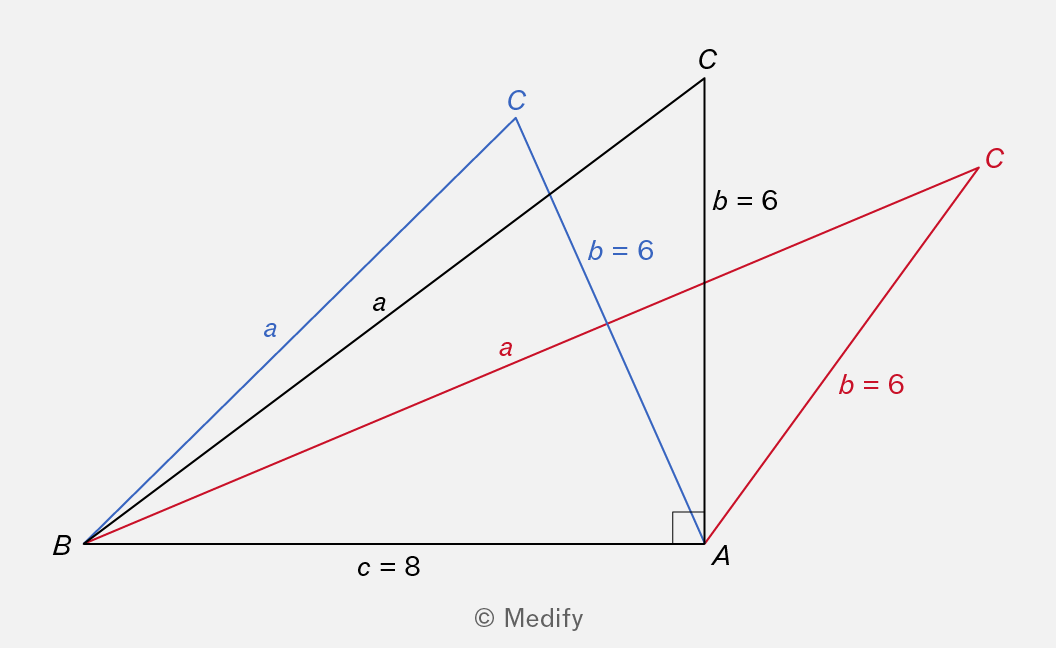
The image shows three right-angled triangles. The largest triangle, ABC, has a right angle at A, with AB as the base measuring c = 8, and AC as the height. Side BC is labeled a. Inside this triangle is another right triangle with a hypotenuse also labeled a, a base labeled b = 6, and a height labeled b = 6. Another triangle extends from point B with a base labeled c = 8, a side labeled a, and a height labeled b = 6. The triangles are color-coded: the outer triangle is black, the left triangle is blue, and the right triangle is red. Points A, B, and C are marked at the vertices of the triangles.

In a right-angled triangle, the hypotenuse, depends on the lengths and according to Pythagoras’ Theorem:

In general, the unknown length, varies depending on the opposite angle, according to the cosine rule:

It is useful to note that in a right-angled triangle, In this case, the cosine rule matches Pythagoras’ Theorem.

Add to favourites

Question walkthrough

Cosine rule for finding any angle.

Uses the cosine rule to find the smallest angle (opposite the shortest side) in a triangular sailing course from three given side lengths.

Question walkthrough

Cosine rule for finding the side opposite the known angle.

Uses the cosine rule with the 120° interior angle of a regular hexagon to find the length of a line connecting a vertex to the midpoint of a non-adjacent side.

Sometimes, you may have information about a triangle that cannot exist, because the lengths and angles are impossible.

One case of this is if the longest side is longer than the sum of the shortest sides. This is always impossible.

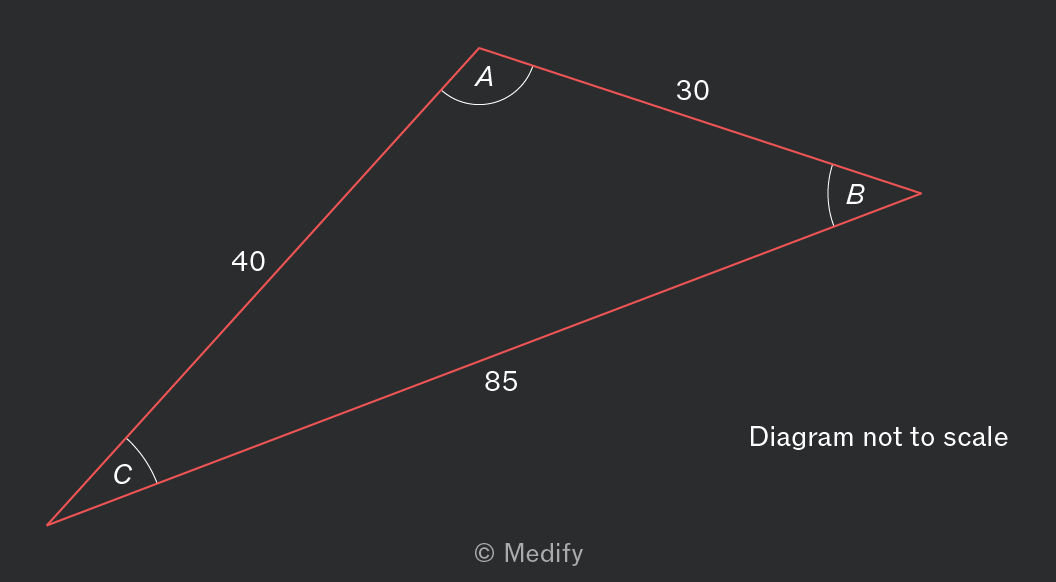
Suppose you calculate the largest angle in a triangle with lengths 30, 40 and 85.
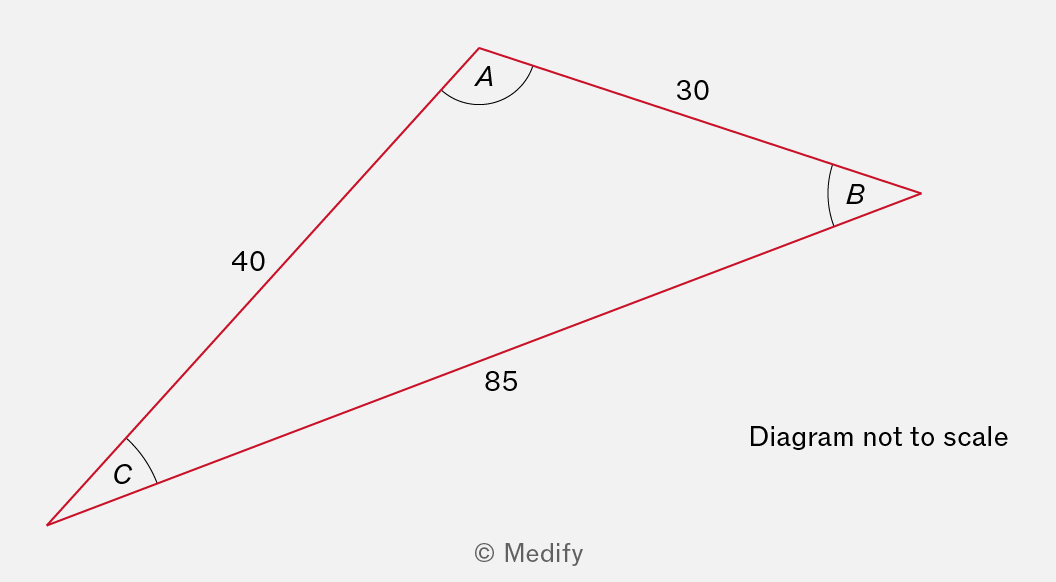
The image shows a triangle diagram labeled 'Diagram not to scale'. The triangle has three sides with lengths labeled as 30, 40, and 85. The angles of the triangle are labeled A, B, and C. The diagram includes a copyright notice at the bottom reading '© Medify'.

You must use the cosine rule:

There are no real solutions to this, as cosine has a minimum value of –1. Therefore, the triangle is impossible. Indeed, so the longest side is too long to fit.

Add to favourites

Sometimes, you may have information about a triangle that cannot exist, because the lengths and angles are impossible.

If you know the lengths of two sides of a triangle and one of the angles that is not between those sides, it is sometimes impossible for a triangle to match this description.

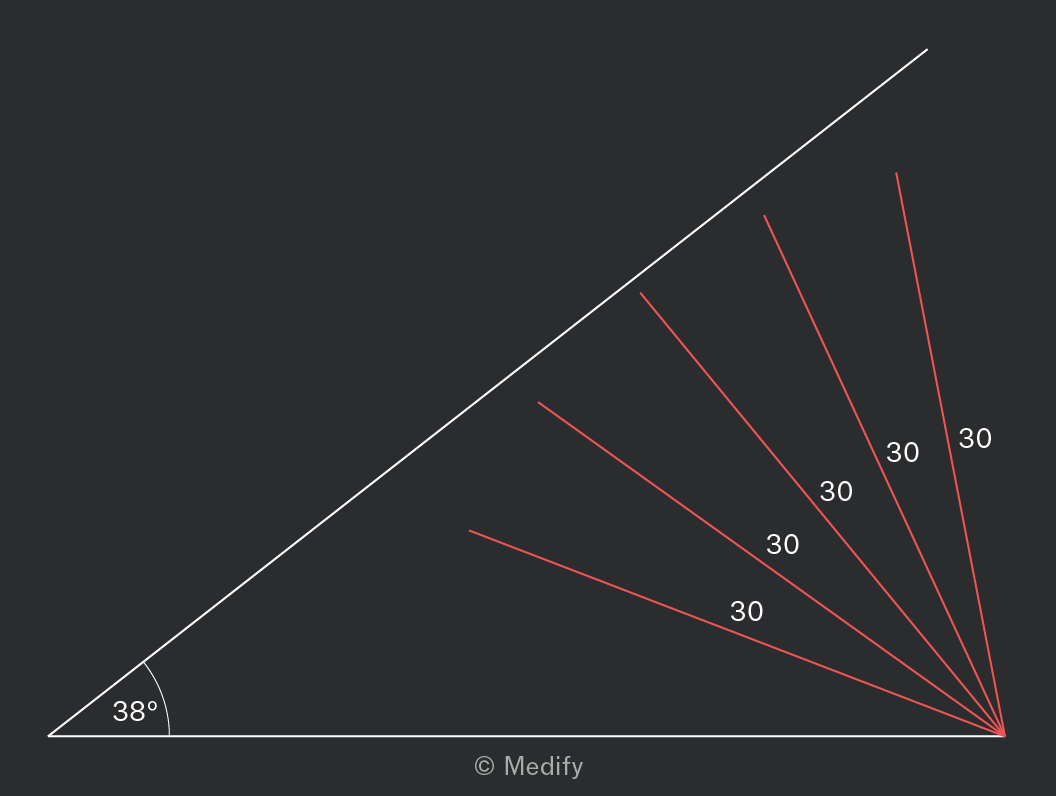
Suppose a triangle contains an angle of opposite a side of length 30. One of the other sides has a length of 50. What could be the angle opposite this side?

In fact, the side of length 30 is not long enough to reach the other side!
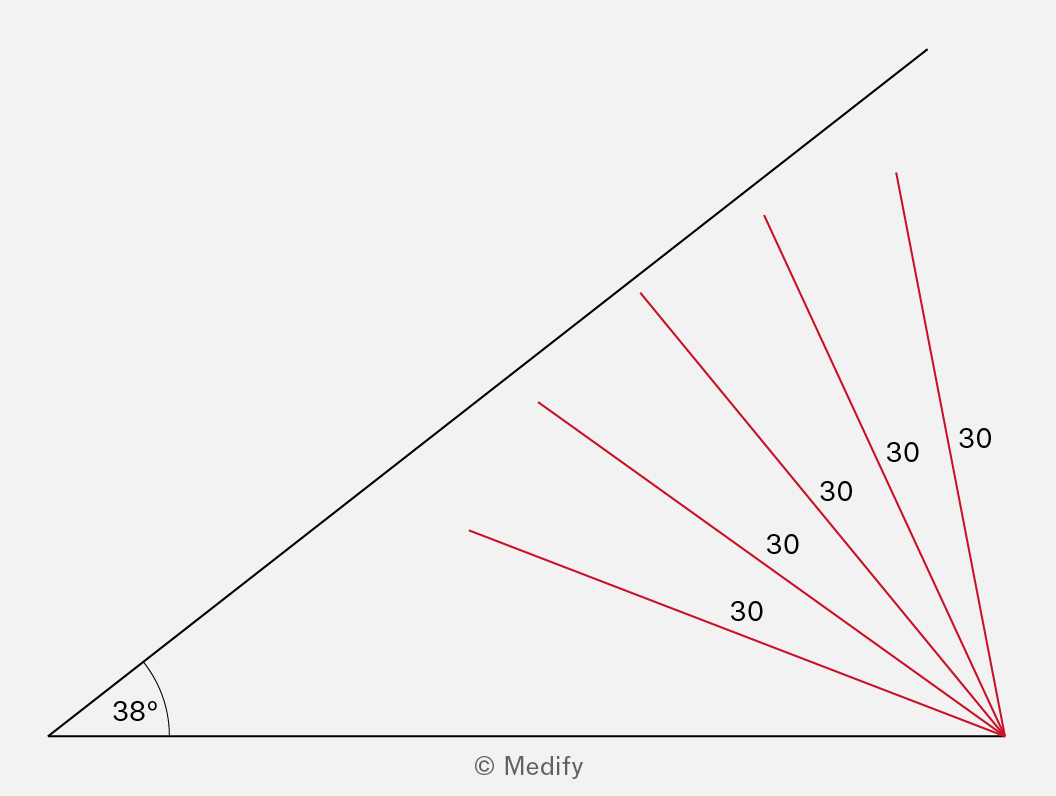
A right triangle with multiple internal red lines drawn from the right-angle vertex to the hypotenuse. The angle opposite the hypotenuse is labeled as 38 degrees. There are five internal red lines, each labeled with the number 30, spaced evenly within the triangle.

Using the sine rule:

This is impossible, because the maximum value of is 1.

If using the cosine rule to find one of the unknown angles, you will end up with a quadratic equation with no real roots, also indicating that the triangle is impossible.

Add to favourites

Question walkthrough

Use sin, cos and tan in physical problems

Uses the cosine rule to set up a quadratic equation for where two support rods meet an isosceles roof truss, then solves it to find both distances LB and LC from the two resulting roots.

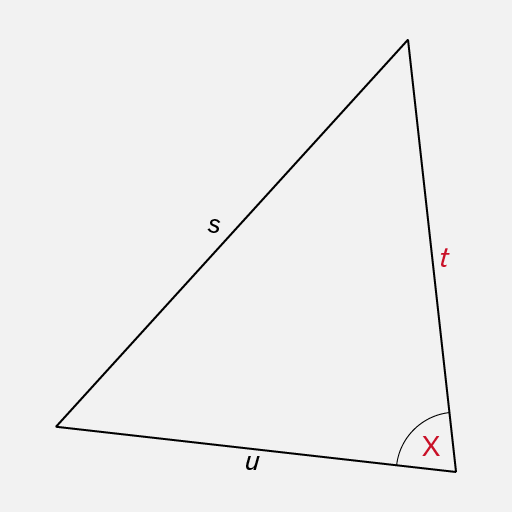
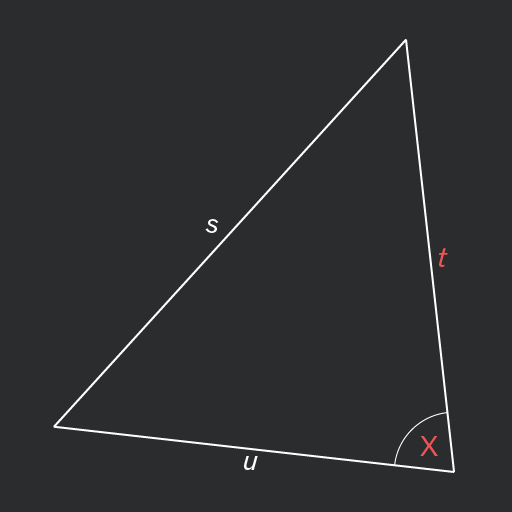
When using the cosine rule to find a missing angle or side length, the letters might not be and For example:

But the angle (in the right-hand side of the cosine rule) must be opposite the length on the left-hand side. Usually, these are given the same letter, with the angle in capitals.
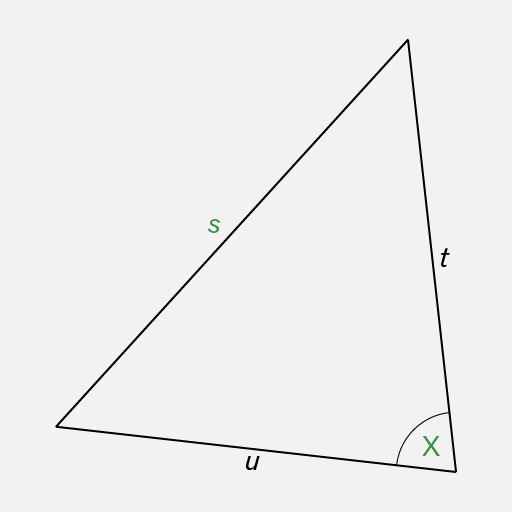
A triangle with three sides labeled as follows: 's' on the left side, 't' on the right side, and 'u' on the bottom side. The angle at the bottom right corner is labeled 'X'.
Do

Match angles with opposite sides when applying the cosine rule:

A triangle with sides labeled as follows: the side opposite the angle is marked 'u', the side adjacent to the angle is marked 's', and the hypotenuse is labeled 't'. An angle at the bottom right corner is marked with a red 'X'.
Don't

Match angles with adjacent sides when applying the cosine rule.

Add to favourites

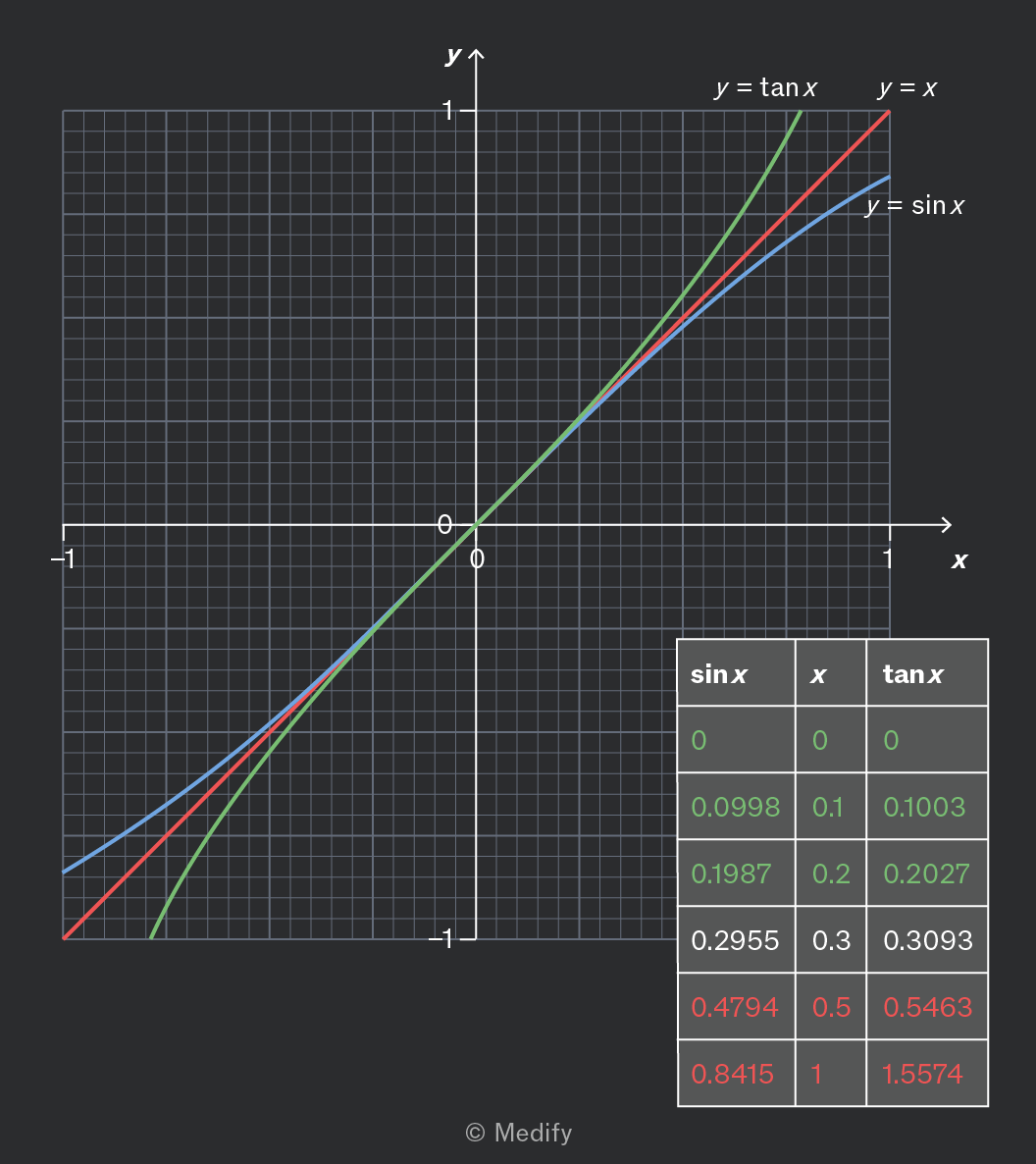
You should be aware of the following useful small angle approximations, which are only valid in radians (not degrees), and only when the angle is close to zero.

For example, you can use the approximations when the angle is 0.2 radians.
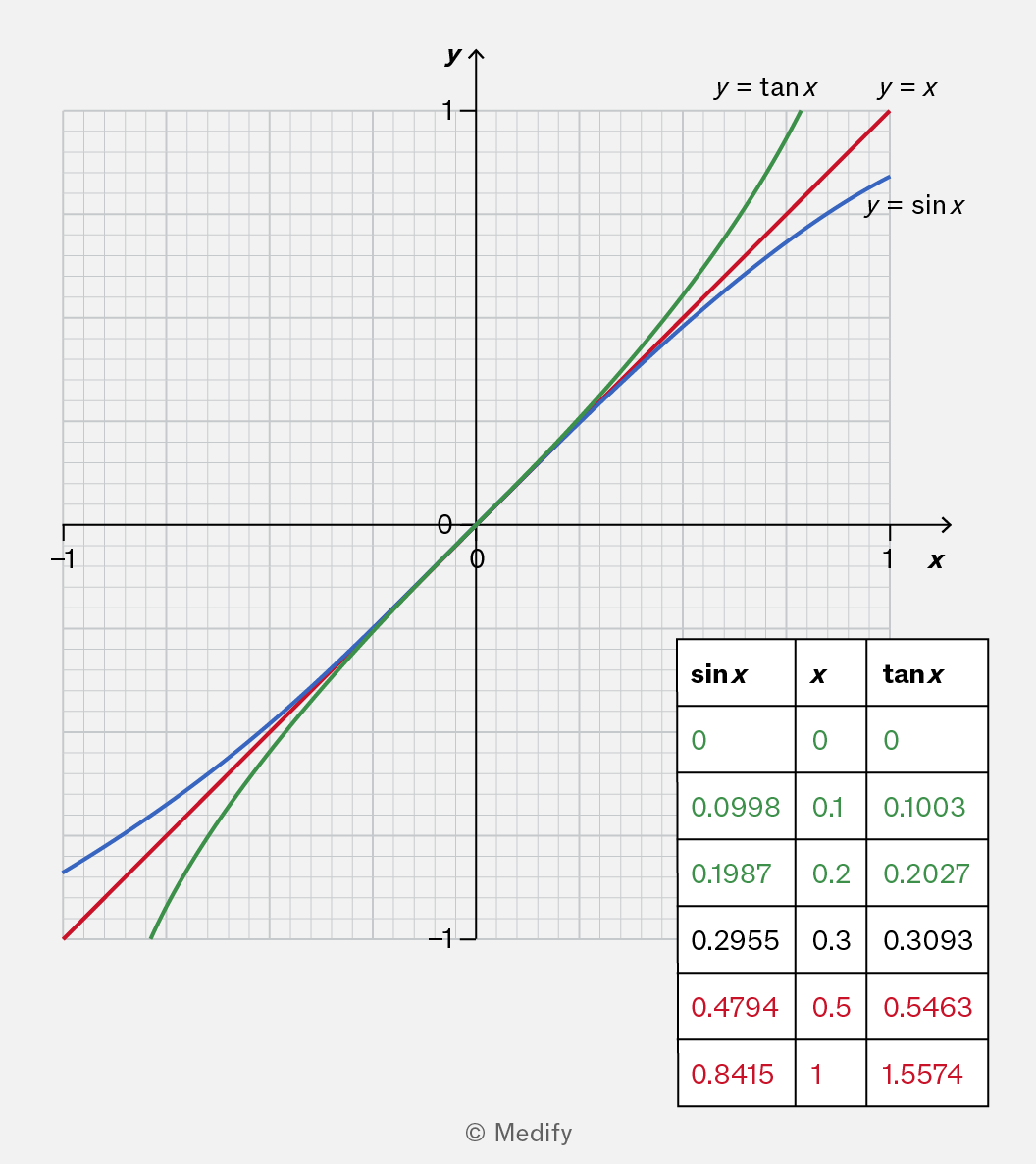
The image shows a graph with three plotted lines and a table. The graph has x-axis labeled as 'x' and y-axis labeled as 'y', both ranging from -1 to 1. There are three lines: a green line labeled 'y = tan x', a red line labeled 'y = x', and a blue line labeled 'y = sin x'. These lines intersect at the origin (0, 0). A table on the right lists values for 'sin x', 'x', and 'tan x'. Values are: sin x: 0, 0.0998, 0.1987, 0.2955, 0.4794, 0.8415; x: 0, 0.1, 0.2, 0.3, 0.5, 1; tan x: 0, 0.1003, 0.2027, 0.3093, 0.5463, 1.5574. The table highlights values for x = 0.5 and 1 in red.

In certain circumstances, you may be asked to recall and use these approximations. Exam questions will indicate if an angle is “small” enough.

For example, when deriving formulas to describe Young’s double-slit experiment in Physics, you may need the approximation

Add to favourites

You should be aware of the following useful small angle approximation, which is only valid when the angle is close to zero.

For example, you can use this approximation when the angle is 0.2 radians.

It is useful to know that a more precise approximation exists (although only in radians), but you won’t need to remember this for your exam:
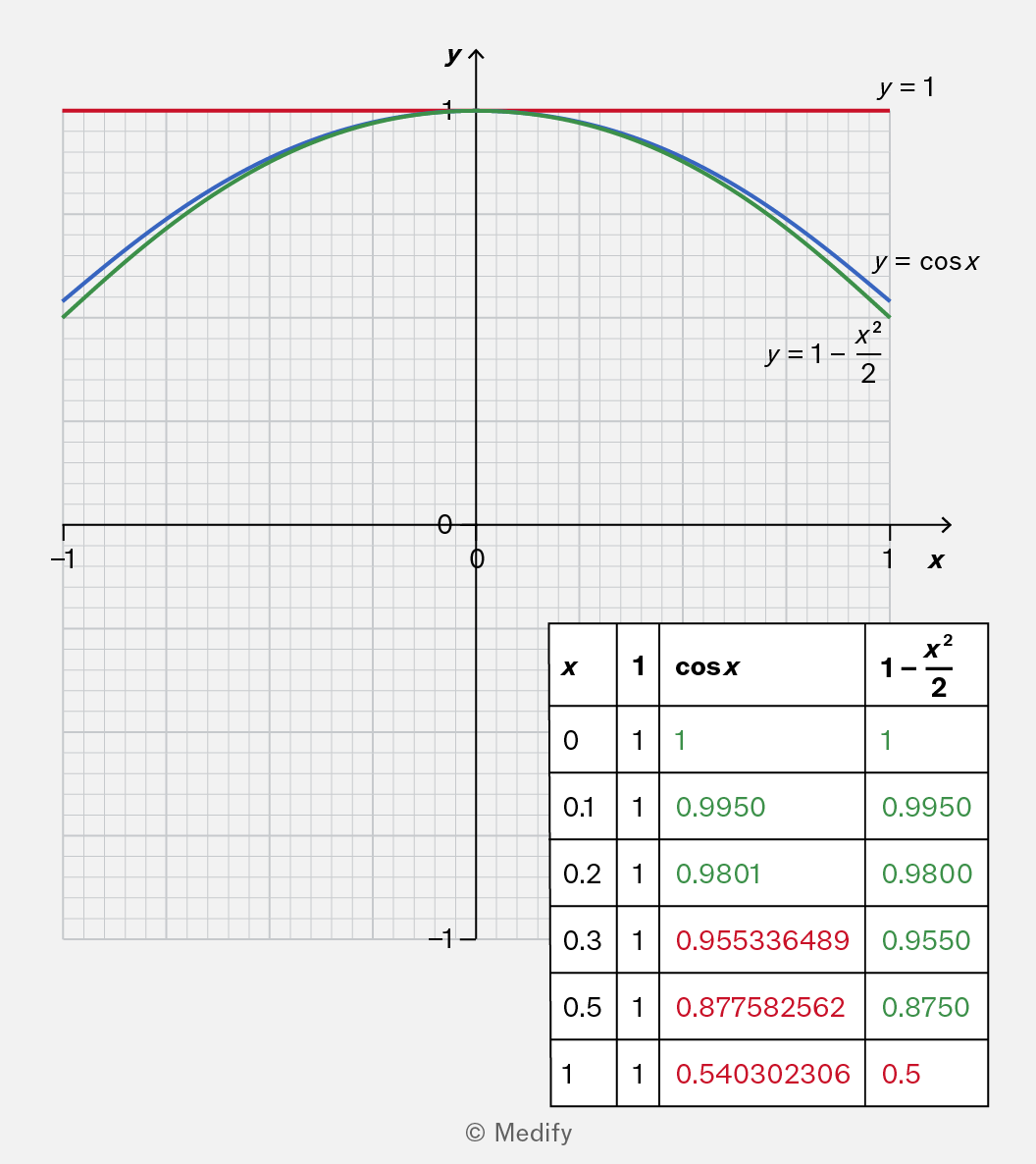
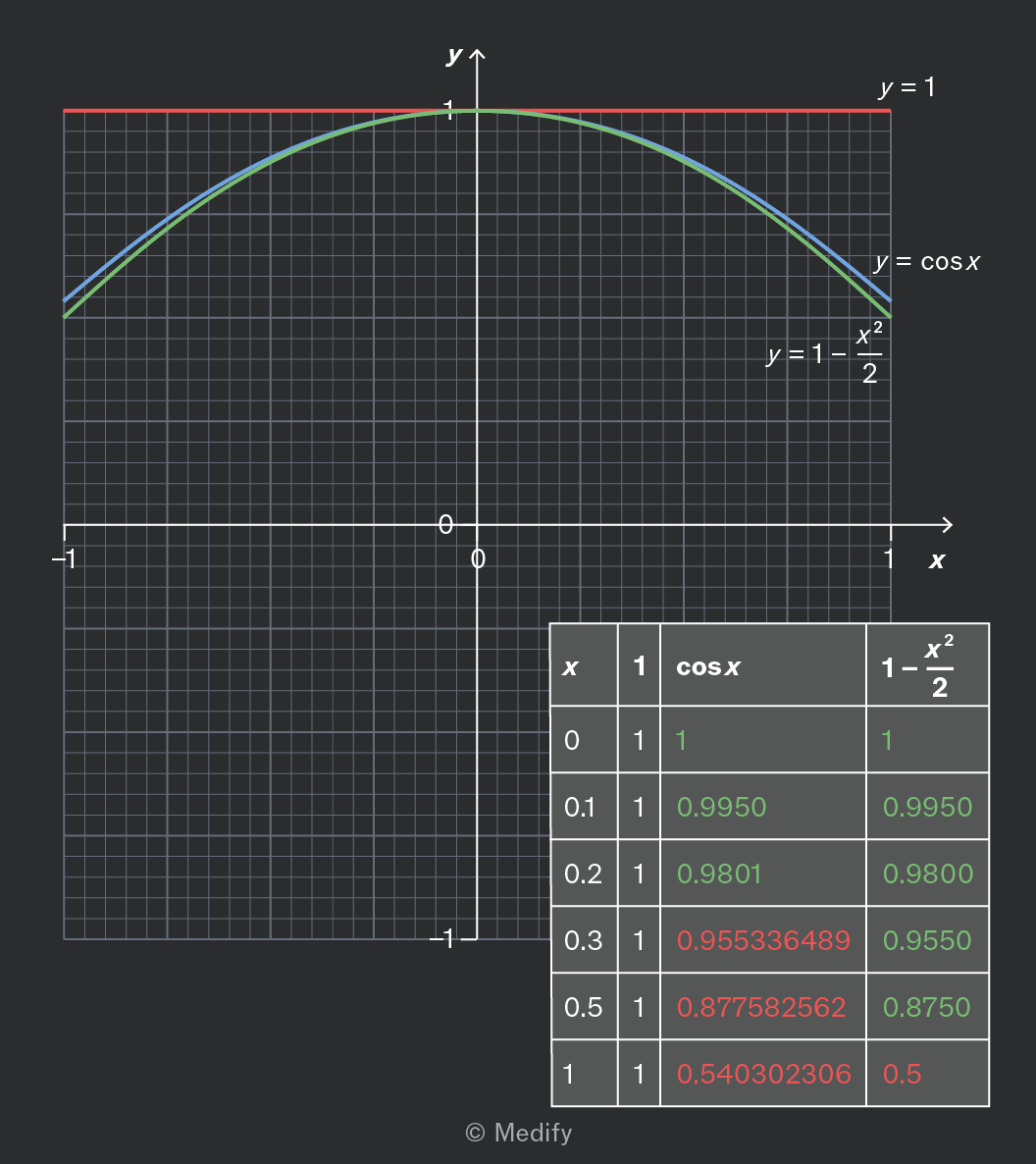
The image shows a graph with x-axis labeled from -1 to 1 and y-axis labeled from -1 to 1. Three curves are plotted: a red horizontal line labeled 'y = 1', a green curve labeled 'y = 1 - x^2/2', and a blue curve labeled 'y = cos x'. The red line is at y = 1, the green curve is a parabola, and the blue curve resembles a cosine wave. A table on the right lists values for x, 1, cos x, and 1 - x^2/2. For x = 0, cos x and 1 - x^2/2 are both 1. For x = 0.1, cos x and 1 - x^2/2 are 0.9950. For x = 0.2, both values are 0.9800. For x = 0.3, cos x is 0.955336489 and 1 - x^2/2 is 0.9550. For x = 0.5, cos x is 0.877582562 and 1 - x^2/2 is 0.8750. For x = 1, cos x is 0.540302306 and 1 - x^2/2 is 0.5.

In certain circumstances, you may be asked to recall and use the approximation that Exam questions will indicate if an angle is “small” enough.

Add to favourites

Question walkthrough

Use small-angle approximations to solve a simple equation.

Uses small-angle approximations to estimate a solution to a trigonometric equation, then checks the validity of the approximation by evaluating the resulting angles.

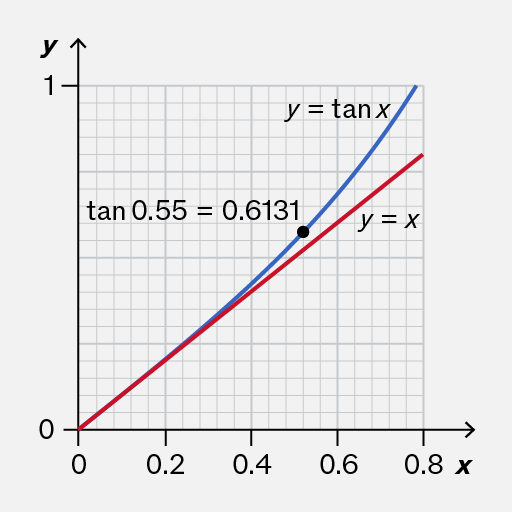
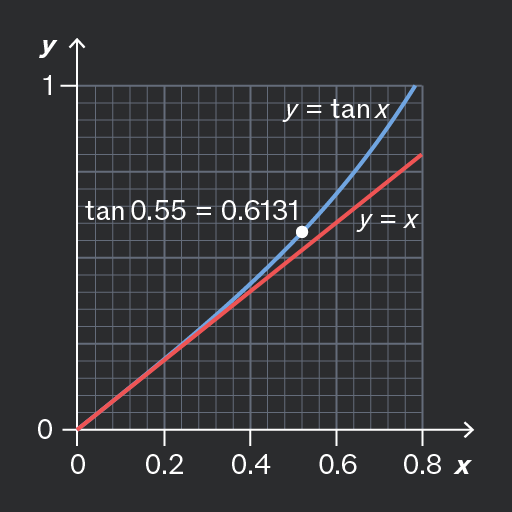
Small-angle approximations are only valid for small angles. You can use them for angles around 0.2 radians or less, but they become inaccurate for larger angles.
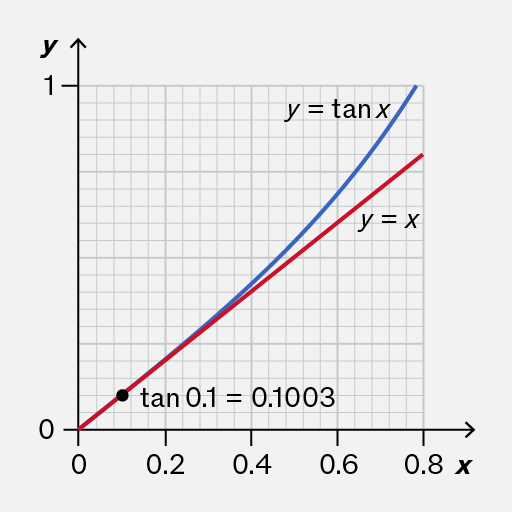
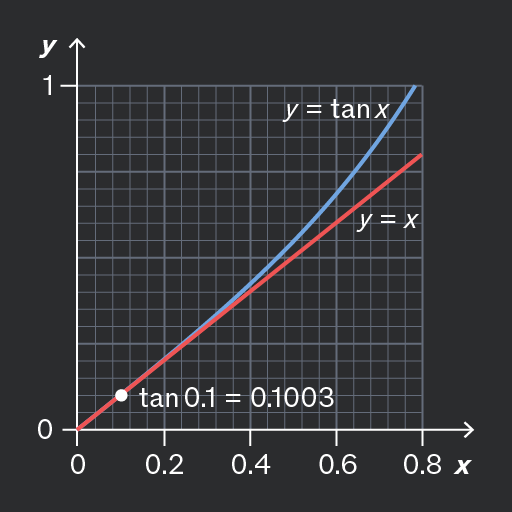
The graph shows two lines on a grid with x and y axes. The x-axis is labeled from 0 to 0.8, and the y-axis is labeled from 0 to 1. A red line represents the equation y = x, and a blue curve represents the equation y = tan x. The lines intersect at the origin. A black dot is marked on the red line at the position (0.1, 0.1) with the annotation 'tan 0.1 = 0.1003' nearby. The blue curve rises more steeply than the red line as x increases.
Do

Use small-angle approximations for small angles, such as 0.1 radians.

A graph with x-axis labeled 'x' ranging from 0 to 0.8 and y-axis labeled 'y' ranging from 0 to 1. The graph contains two lines: one in blue labeled 'y = tan x' and one in red labeled 'y = x'. There is a black dot on the blue line at approximately (0.55, 0.6131) with an annotation 'tan 0.55 = 0.6131'.
Don't

Use small-angle approximations for angles much larger than 0.2 radians, such as 0.55 radians.

Add to favourites

Small-angle approximations are only valid when you work in radians.

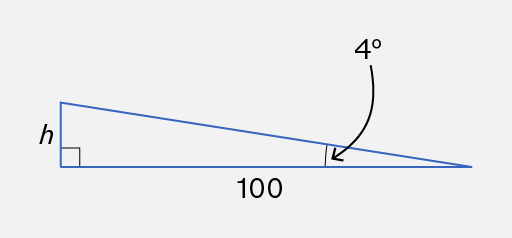
It is useful to know that happens to be valid in both radians and degrees, as long as the angle is small.
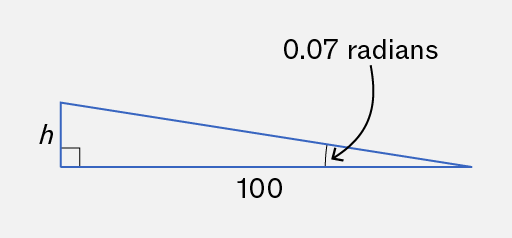
A right triangle with a horizontal base labeled '100', a vertical side labeled 'h', and a hypotenuse forming an angle of 0.07 radians with the base. The right angle is marked in the corner between the base and the vertical side.
Do

Use small-angle approximations when asked to do so, but only when working in radians.

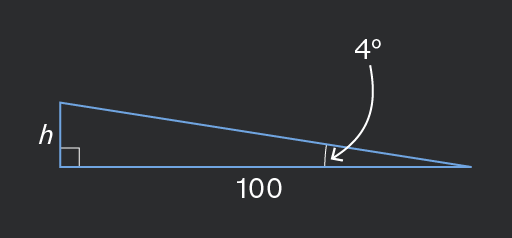
A right triangle with a horizontal base labeled '100' and a vertical side labeled 'h'. The angle between the base and the hypotenuse is labeled '4°'.
Don't

Use small-angle approximations when working in degrees.

Add to favourites

A full turn can be divided into 360 degrees, written Degrees are used to measure angles and rotation.

A full turn can instead be divided into other quantities. One such quantity is the radian, which is defined as the angle in a circle subtended by an arc of the same length as the circle’s radius, as illustrated below.
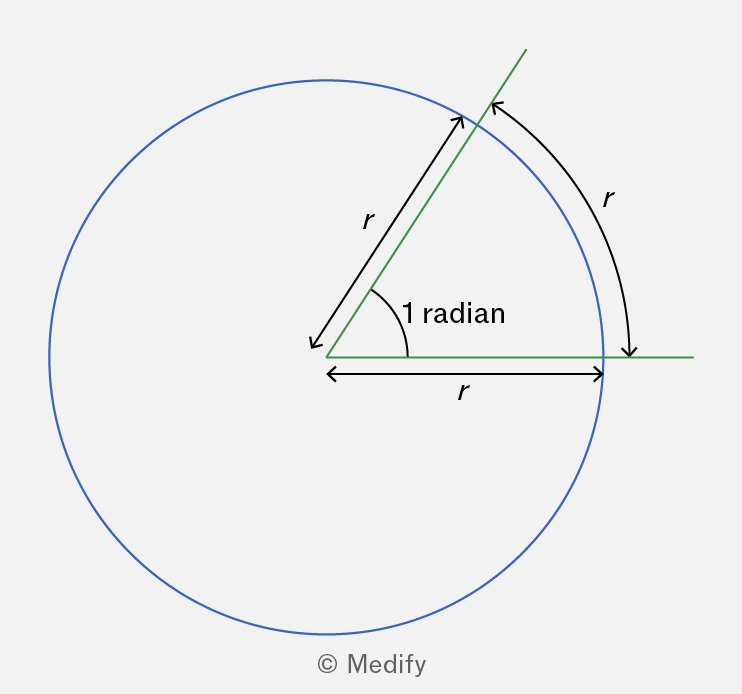
The image shows a circle with a blue outline and a central angle labeled '1 radian.' Two radii labeled 'r' form the angle at the circle's center. A curved arc between the two radii is also labeled 'r,' indicating the arc length equals the radius for the angle of one radian. The radii and arc form an isosceles triangle, and the angle between the two radii is marked as '1 radian.' The diagram is labeled with '© Medify.'

The circumference of a circle is , so radians make a full turn:

It is important to note that radians are a key concept in mathematics and science. A solid understanding of them is essential for your exams and further learning.

Add to favourites

A full turn can be divided into or radians. Therefore:

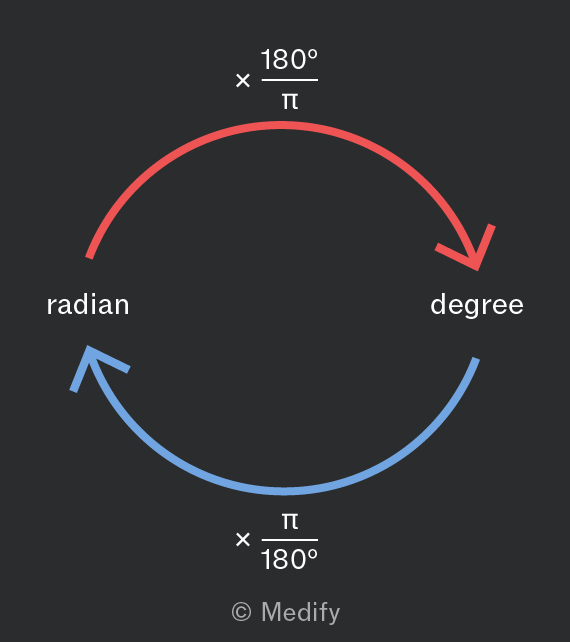
Consequently, the conversion between radians and degrees is:
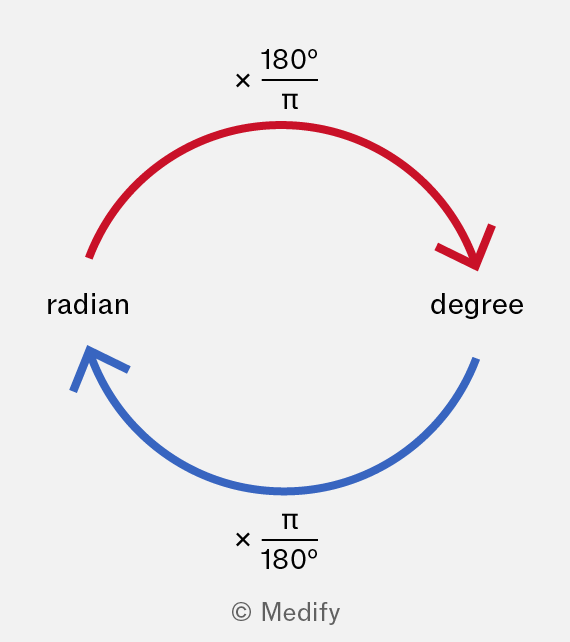
A diagram showing the conversion between radians and degrees. A red arrow points from 'radian' to 'degree' with the label '× 180°/π' above it. A blue arrow points from 'degree' to 'radian' with the label '× π/180°' below it.

You need to remember this conversion for your exams.

For example, to describe an angle of 2.3 radians in degrees:

For example, to describe an angle of in radians:

Add to favourites

Angles in radians are often written as a fraction of It is useful to note some common angles in radians.
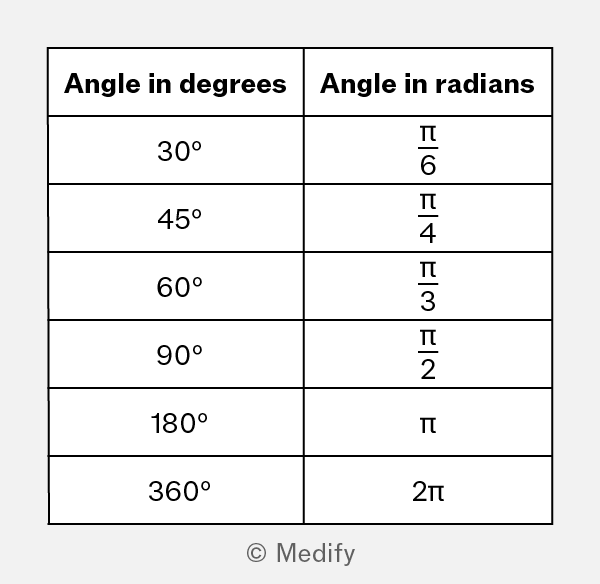
A table with two columns labeled 'Angle in degrees' and 'Angle in radians.' The rows contain the following values: 30° corresponds to π/6, 45° corresponds to π/4, 60° corresponds to π/3, 90° corresponds to π/2, 180° corresponds to π, and 360° corresponds to 2π.

However, you can always calculate these (and any other angle) easily using:

Add to favourites

You will need to use both degrees and radians, depending on the context. The question always makes clear which measurement you should use, for example, by using the degrees symbol or the word ‘radians’.

The following areas of mathematics and science typically use degrees:

  • geometry, including polygons and circle theorems,
  • basic trigonometry, and
  • bearings.

The following areas of mathematics and science typically use radians:

  • calculus,
  • circular motion,
  • oscillations and waves, and
  • small-angle approximations.
Add to favourites

The trigonometric ratios sin, cos, and tan work in both degrees and radians, including for advanced formulas such as the sine rule and cosine rule.

However, when using your calculator for trigonometry, you must put your calculator in the correct mode: degrees mode or radian mode. Otherwise, your answers will be incorrect.

Learn to switch calculator modes quickly to save time in your exams.
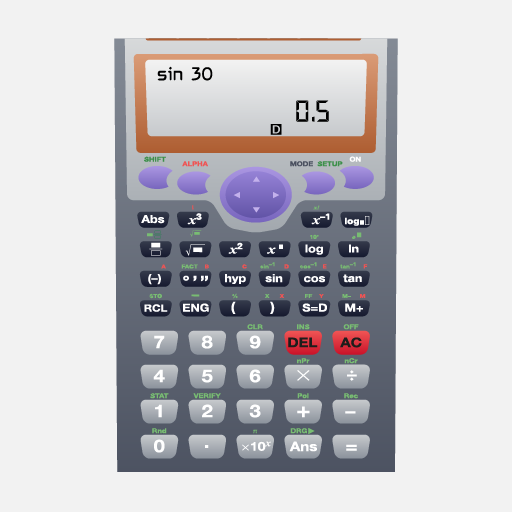
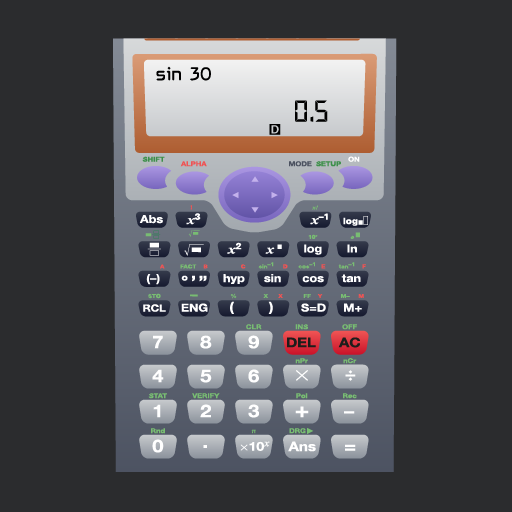
Image of a scientific calculator displaying 'sin 30' with a result of '0.5' on the screen. The calculator has various buttons including 'Shift', 'Alpha', 'Mode', 'Setup', 'Abs', 'x^2', '√', 'log', 'ln', 'sin', 'cos', 'tan', '7', '8', '9', '4', '5', '6', '1', '2', '3', '0', '.', 'EXP', and others. The buttons are arranged in rows with numerical and functional keys.
Do

Use your calculator in degrees mode when an angle like is in degrees.

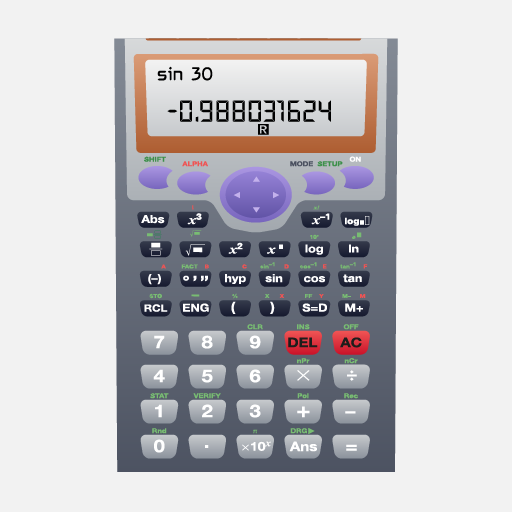
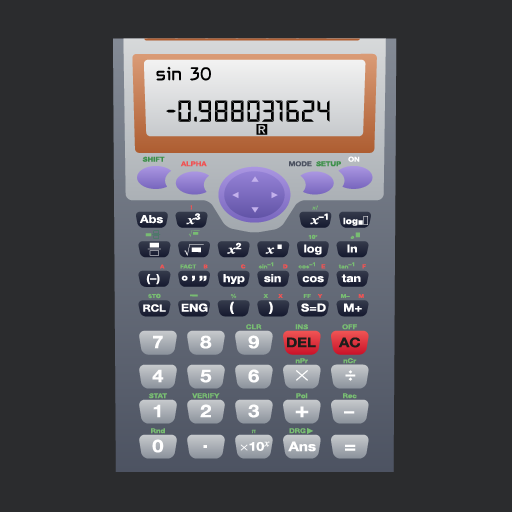
Image of a scientific calculator displaying 'sin 30' and '-0.988031624' in the screen. The calculator features various buttons including numerical keys 0-9, trigonometric functions (sin, cos, tan), and other functions such as log, ln, x^2, and square root. It also includes buttons for operations like addition, subtraction, multiplication, and division, as well as specific keys labeled with functions like SHIFT, ALPHA, MODE, SETUP, DEL, AC, and ENG. There is a directional pad in the center for navigation.
Don't

Use your calculator in radian mode when an angle is in degrees.

Use radian mode only when the angle is in radians.

Add to favourites