
Venn Diagram Question basics
On this page
In Decision Making, the fifth question type is Venn Diagram questions.
You must make calculations and inferences based on shapes that represent overlapping groups.
In some questions, you must reverse the logic in order to deduce the correct diagram based on numerical and textual information about the groups involved.
Less commonly, you may find questions without diagrams that assume you must draw a diagram in your notebook in order to work out the correct answer.
Each Venn Diagram question includes:
- A stimulus with textual and/or numerical information, often with a Venn diagram that may or may not include numbers or letters.
- Four answer choices, from A to D. You will find one correct answer along with three wrong answers.
You can earn one mark per Venn Diagram question, regardless of difficulty.
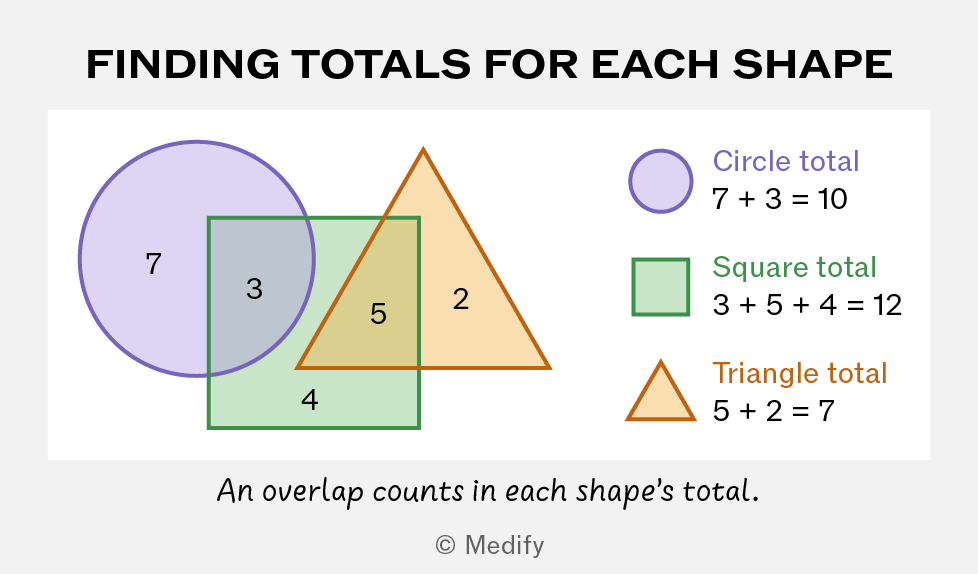
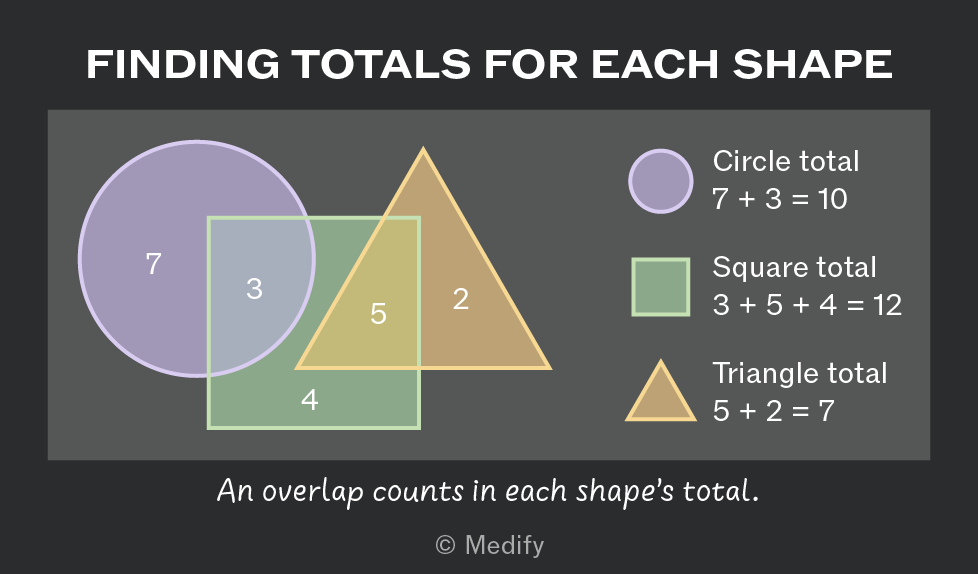
Most Venn diagrams will include numbers in various parts of the shapes. A number that is inside parts of two overlapping shapes counts towards the total for each individual shape.
Some diagrams will include a number inside parts of three or more overlapping shapes – check carefully, as it is easy to miscount the number of overlapping shapes.
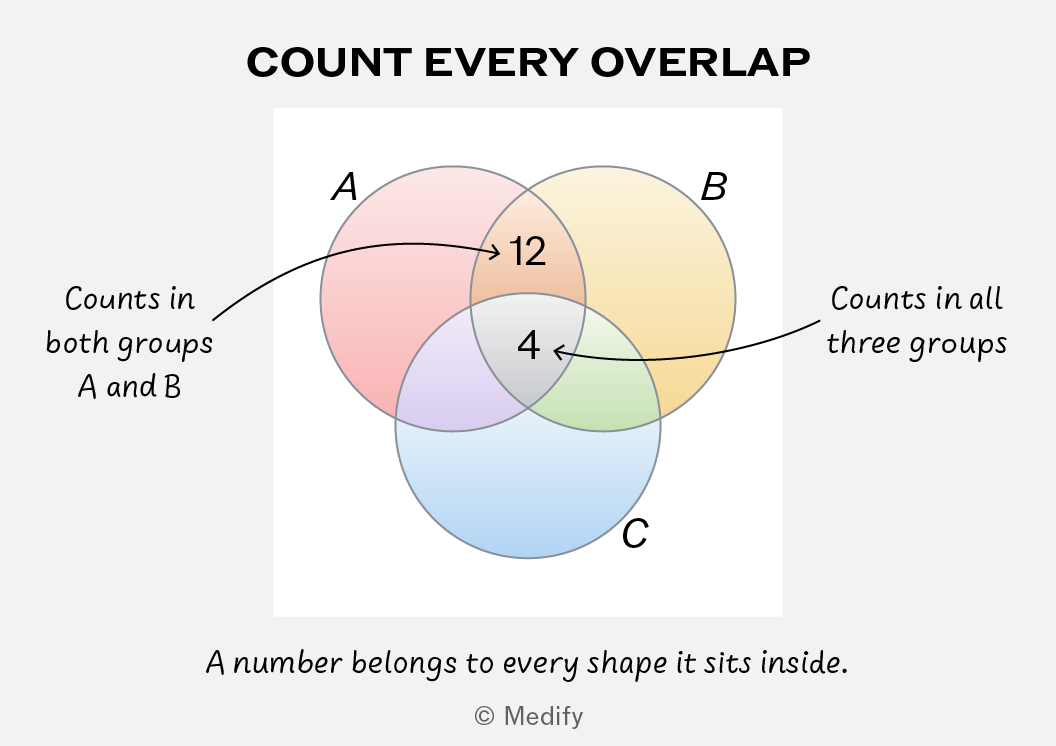
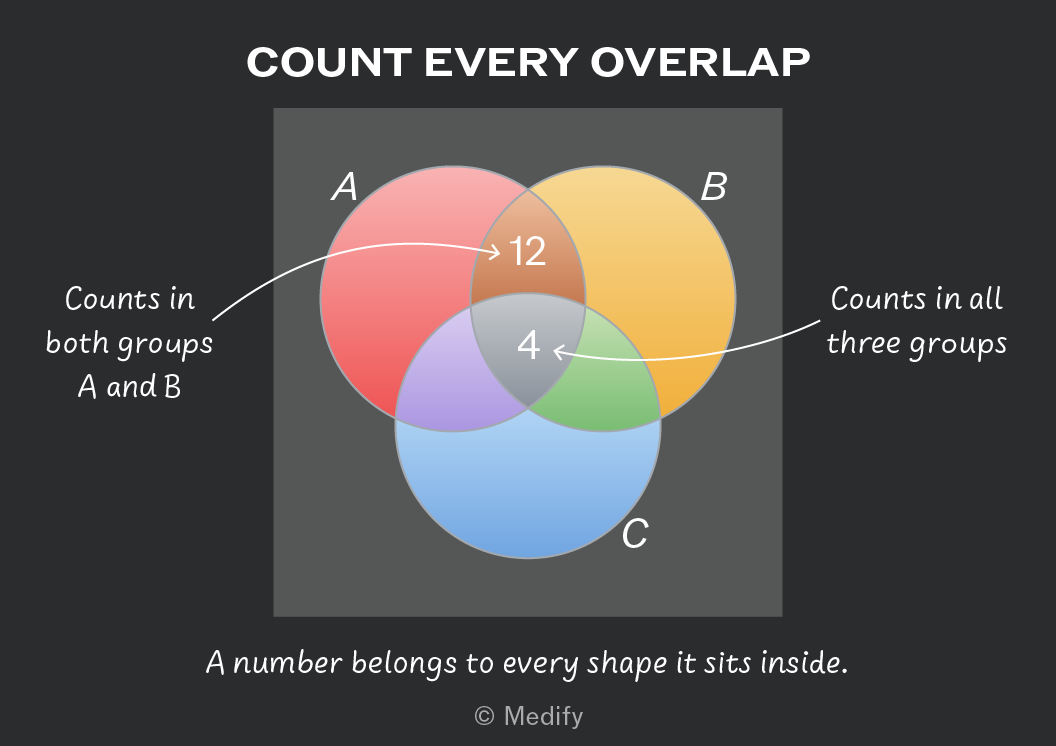
The total for each shape is the sum of all the numbers inside the shape.
If two or more shapes overlap, the number in the overlap is part of the total for each individual shape.
If three shapes overlap in various ways, consider the different ways of grouping the shapes. The people or things represented by the numbers could be in:
- Shape 1 only
- Shape 2 only
- Shape 3 only
- Shape 1 and Shape 2 but not Shape 3
- Shape 1 and Shape 3 but not Shape 2
- Shape 2 and Shape 3 but not Shape 1
- All three shapes
You could also potentially have a number representing people or things in none of the shapes, but this is generally far less common in official practice materials.
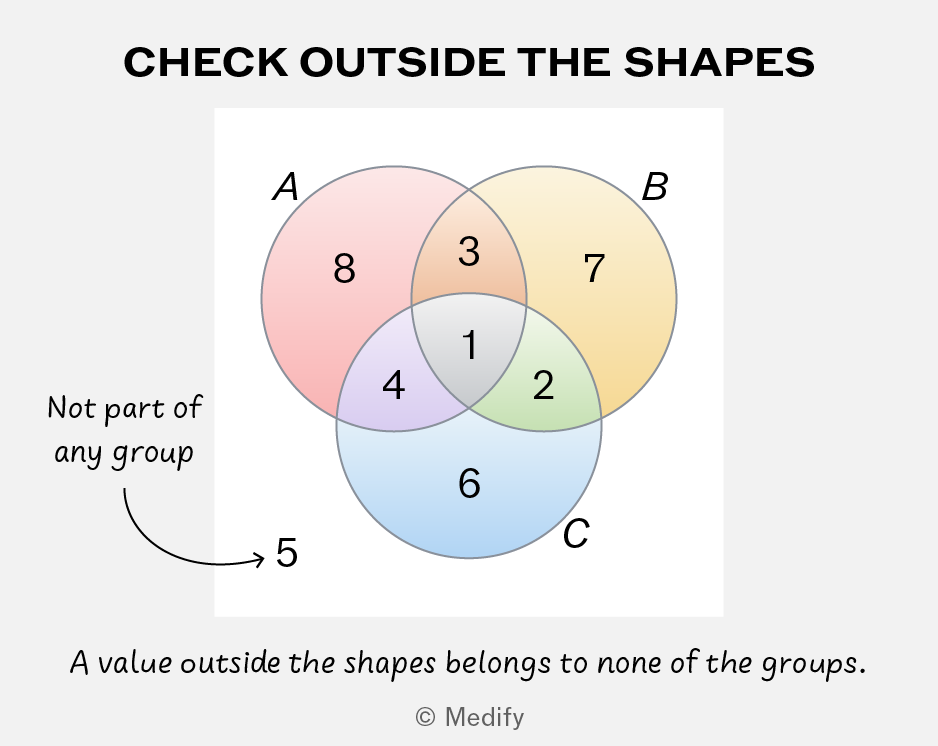
The key task in Venn Diagram questions is to visualise relationships.
You must analyse the groups in each question and see if they overlap entirely, partially or not at all.
In most Venn Diagram questions, you must translate words into shapes and often, back into words.
To build your speed and accuracy, you must learn to think in terms of shapes.
On Test Day, you should aim to answer most Venn Diagram questions in 30 seconds.
With the shortest, simplest questions, push yourself to answer in 15 seconds or less.
You may see a few questions that are far more complicated, so try to keep to 1 minute per question on the hardest ones. This way, you can bank time for the five-part questions that are worth two marks each.
Use the Medify Top Tips for every Venn Diagram question in your UCAT revision and on Test Day:
1. Find the goal in the question stem, so you know exactly what you must look for in the diagram. Use the goal and the question format to help you choose a technique to solve.
2. Turn words into shapes as you check the diagram to find the groups you need.
3. Use the calculator for any maths that is too elaborate to do quickly in your head without error.
4. Check and eliminate wrong answers as you work. This approach can be frustrating at first, but it is necessary in many Venn Diagram question formats.
In the UCAT, Venn diagrams represent data with a series of shapes, most of which overlap partially. You may also see shapes that are entirely inside or outside of another shape.
Each shape represents a group. The group could be people, places or things, or it could represent a common quality or characteristic of some of the people, places or things in the diagram.
This means there can be many irrelevant groups or shapes in any single question. At the same time, you may find it easy to make errors by including part or all of a wrong group by using an incorrect overlap.
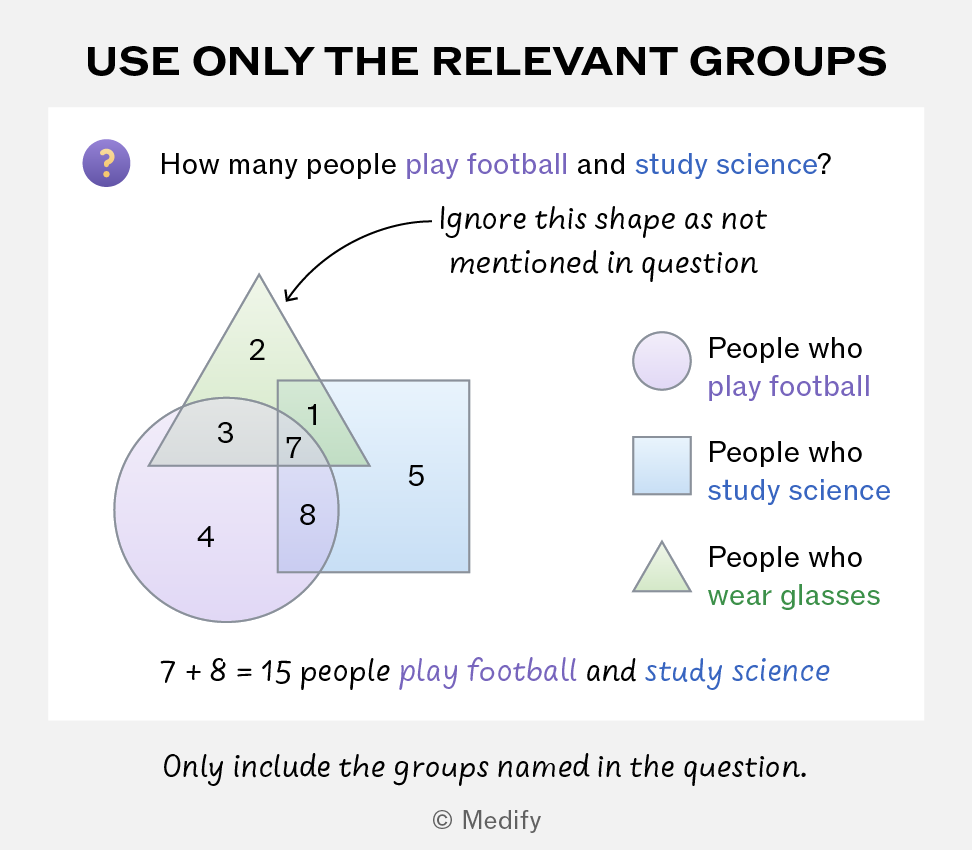
Do not look at the diagram until you glance at the question stem and find the goal. This way, you can keep focused and ensure you know what you need from the diagram.
Sometimes, the goal will require straightforward work, such as one simple calculation or a single combination of groups or shapes in the diagram. You can answer such questions fairly quickly once you develop your Venn diagram skills.
Most times, though, the goal will require you to check each answer to see if it is correct. Thus, you must be ready to eliminate wrong answers briskly and ruthlessly.
Most questions will require you to add up the numbers for one or more data categories. You may need to use these sums to do further maths, such as calculating a ratio, percentage or percentage change.
Some questions will have Venn diagrams as the answer choices.
Occasionally, a question will not have any Venn diagrams. The UCAT assumes that you must make a Venn diagram in your notebook to answer the question, though sometimes you can solve algebraically or with mental maths.
You must train your brain to turn words into shapes in order to:
- Identify the right shapes in the diagram to use to solve for the goal
- Describe the right relationships between these shapes
- Select the right overlaps and any numbers in those overlaps
- Complete any maths or logical work needed to find the correct answer
It will take some practice, but you will find it is much simpler to go between the question and answer text and the diagram if you can think in shapes.
Do your best to develop this skill in your timed practice and mocks.
Your main challenge in Venn Diagram questions is to sort out the parts of shapes that overlap with other shapes.
- If there are no numbers in the diagram, you can answer quickly without maths.
- Usually, you will find numbers, so you will likely have to solve by calculating.
- If the answers are diagrams, you must use the numbers in the overlaps to eliminate the wrong answers.
You will need the calculator frequently as you work through Venn Diagram questions.
As you practise, look for opportunities to save time whilst limiting errors:
- Can you add two or three numbers quickly in your head?
- Can you compare instead of calculating, using a quick estimate of whether one sum is clearly much larger or smaller than another?
- Should you note the total sum of each shape in the notebook as you first find it in a question to avoid having to re-calculate? This may be useful in questions with lengthy textual answers.
You will likely see many Venn Diagram questions that require an elimination technique.
Be ready to check and eliminate wrong answers when a question starts with the words: ‘Which of the following…?’ Common examples:
- Which of the following statements is true?
- Which of the following statements is correct?
- Which of the following diagrams best represents the above data?
‘Which of the following…?’ means that:
- You cannot do straightforward maths in one go as you would in QR.
- The correct answer matches the stimulus, but the wrong answers contradict the text or the diagram (or both).
- You must check to see if each answer is correct or incorrect.
If you must check and eliminate answers in a Venn Diagram question, use one of two basic techniques.
1. Apply the rules or limitations in the stimulus, one at a time, and eliminate any answers that violate the rule or limitation. This works well when the answers are diagrams.
2. Check one answer at a time, taking care to compare to the diagram and see if it makes any errors. Bear in mind that most answers are incorrect, so you should be ready to eliminate ruthlessly as soon as you see that an answer goes wrong. This technique is vital for questions with long textual answers.
When you must eliminate textual answers, remember that you can check the answers in any order.
You do not have to start with A, work through its maths or logic, then move on to B next if A is incorrect.
Instead, you may prefer to:
- Start with the simplest answer. This could be the shortest one, or the one that will be quickest to check against the diagram.
- If your first answer is wrong, move on to the next simplest.
- Continue with the next shortest or simplest of the two remaining answers.
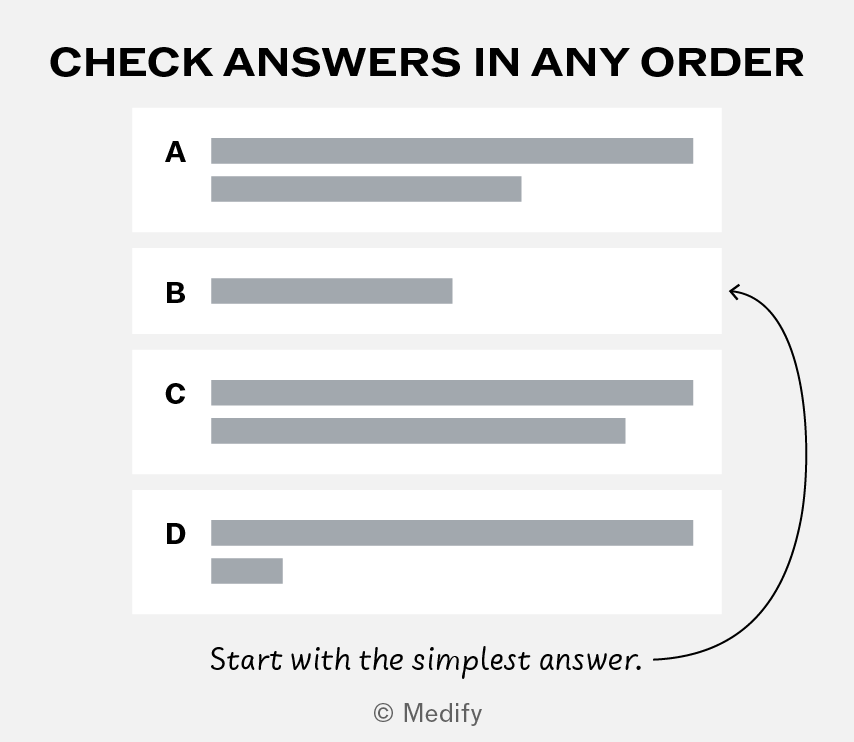
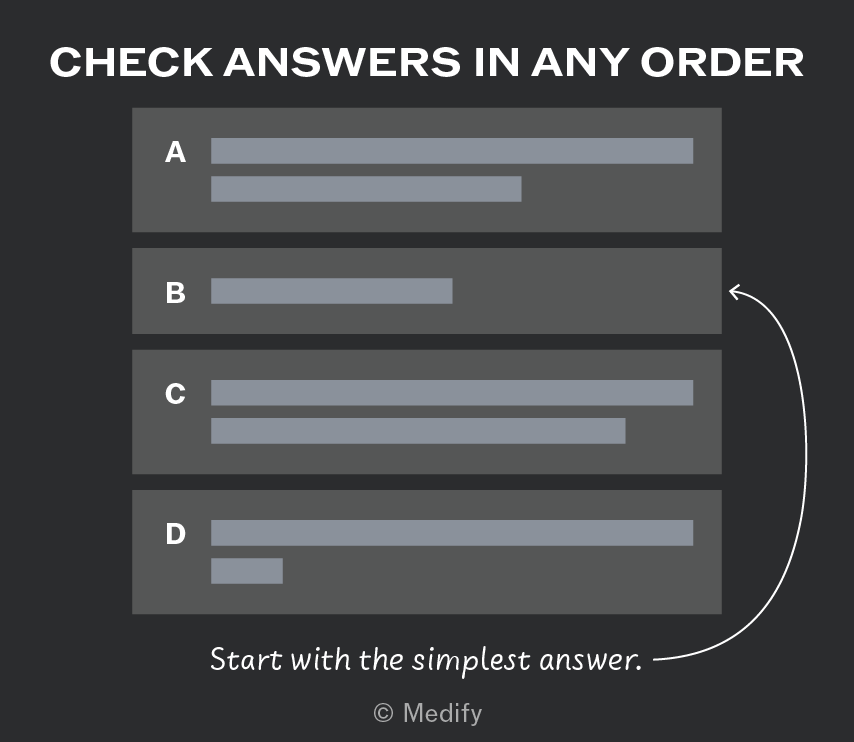
Try to save the longest or most complex answer for last. This way, you won’t have to do the mental work or calculations to check it.
- If one of the three shorter, simpler answers is correct, you will have already found and clicked it.
- If the three shorter, simpler answers are all wrong, you know that the one remaining answer must be correct.
Be sure to practise this technique as you revise to build confidence. You can then be ruthless in selecting the one remaining answer based on your process of elimination.
If three answers are clearly wrong, the one answer left is correct. Click it and keep moving.