
Strongest Argument questions – part 2
On this page
In Strongest Argument questions, the marks come from matching the terms in the original question to the terms in the correct answer.
The correct answer will address the question at hand in the most direct and precise way.
Wrong answers will be indirect, imprecise or will otherwise shift the terms and ideas from the original question.
Look for the answer that makes the most direct impact on the original terms.
Because of the logical errors in wrong answers, every incorrect answer is a weak argument.
This makes your approach in Strongest Argument questions fundamentally different from almost every other UCAT question type.
You cannot possibly predict the correct answer, since it could be literally almost anything that directly supports or attacks the original question on its own terms.
Thus, you must be ready to use an elimination technique in these questions.
Look for the answer that addresses the original question on its own terms, either:
- supporting the original question (a ‘Yes’ answer)
- attacking the original question (a ‘No’ answer)
The correct answer must make a direct hit on the original question by impacting the original terms. Wrong answers will partially or entirely miss the mark in some way, so they are weak arguments.
Thus, you will see only one strong argument – the correct answer – along with three weak arguments. All of the latter are wrong.
You do not need to rank the relative strength of the answers.
The ‘terms’ of the original question are the logical terms, which are the groups or categories under discussion. Think of a logical term as a concept in specific focus.
Logical terms are about the same concept and scope, rather than being literally the same words. The correct answer can use different or related words whilst maintaining the same concept in the same focus as the original question. Hence, it will have the same logical terms.
If multiple answers appear to have the same logical terms as the original question, look for other errors that indicate faulty logic in one of them. This is a more advanced skill, but it may be necessary for eliminating the final wrong answer.
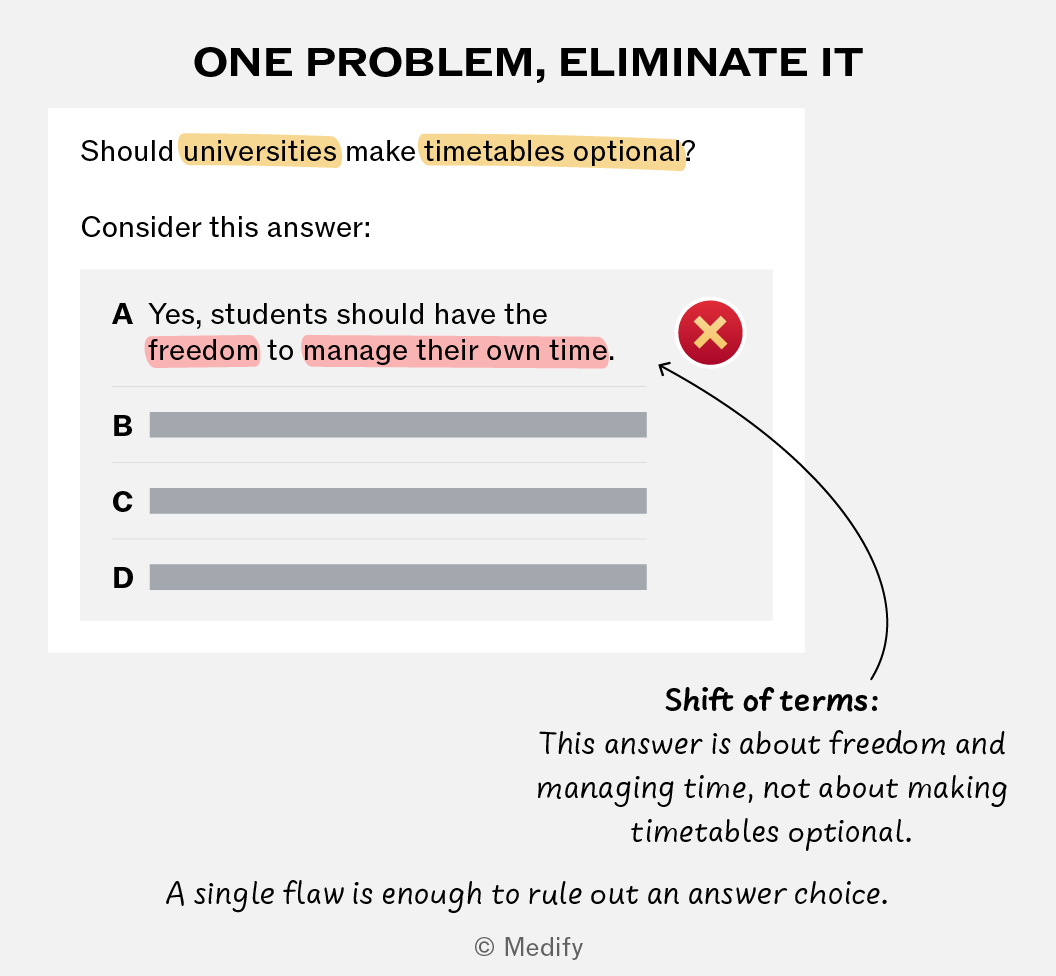
Wrong answers will often have different logical terms that could be entirely changed from the original question, or they could be somewhat similar but no longer the same due to a shift in concept or scope. The terms in an answer might be broader or narrower than the focus in the original question, so the groups are logically not the same.
Wrong answers can repeat the same words from the original question, but watch out for a shift in concept or scope that means the logical terms are different.
Bear in mind that you could use any number of variations to express the same logical term, so the correct answer may not repeat the original terms verbatim.
Instead, you are likely to see correct answers that use synonyms or related words, or that restate the original terms with a paraphrase (a heavy rewording, not just a single synonym) or a summary (a condensed version of the same idea).
Look out for the application of the logical terms in the stimulus. The correct answer may provide a specific example or reason to endorse or oppose the original question. As always, check whether the new example or reason endorses or opposes the question on its own terms.
Walkthrough question
Same or different terms?
Let's look at a question with differing key terms.
The logical terms of the original question are stated or implied in the question itself.
In the vast majority of Strongest Argument questions, the logical terms will be directly stated, though you may find that you need to restate them in a logically equivalent way to identify the correct answer.
It is not sufficient to identify that an answer choice merely repeats one or more terms from the original question.
You must go a step further and confirm that the answer is logically sound in its own right and that it works as a response to the original question, both logically and in a real-world sense.
Some wrong answers may repeat an original term, yet fail to answer the original question or propose something that is simply illogical. Eliminate these answers ruthlessly, with confidence that they are absolutely wrong.
The terms of the original question are sometimes implied in the correct answer, if it is clearly addressed in the context of the original question.
Remember, each answer choice is an attempt to answer the original question, so you must read the answers using the simple, everyday logic of responding to a question.
Walkthrough question
Implied terms
Try this question with implied terms in the answer choices.
You will likely see one or more Strongest Argument questions on Test Day that are very challenging.
A few common twists can make a question much harder than average:
- The original question is extremely long, so there are lots of potential terms to check against each answer choice.
- The answer choices are lengthy with extensive new information that you must assess against the original terms.
- Paradoxically, you could have a super short question with very long answers, making it tougher to compare the terms.
- You might see a question with multiple answers that appear to match the original terms, meaning you must eliminate based on other logical errors.
If the original question stem or the answers (or both) in a Strongest Argument question are very long:
- Take a moment to identify key terms in the original question BEFORE you look at the answer choices.
- Consider whether each answer addresses the key terms with the same scope. If there is a scope shift – or the terms have changed – the answer is incorrect.
- Look for a direct impact on the original terms – the answer that aligns exactly is correct.
If a long question is effectively in two parts, use this structure to your advantage. The most common format is a reason or goal, often introduced with words like ‘in order to’, along with the main part of the question. Note that sometimes, the reason or goal comes at the end of the main part of the question.
The strongest argument must:
- directly address key terms from both parts of the question.
- respond logically to the link between the two parts.
Incorrect answers may relate to a different reason or goal, or they may fail to connect the question’s reason or goal to the main part of the original question. This could be a simple logical error – due to different terms – or it could be that the two parts in an answer do not make sense or link up, perhaps in a real-world context.
Any part of an answer choice may be sufficient to disqualify it from being the strongest argument.
You may find a long answer that seems really good, except there is a problem with a single word or phrase that shifts the original terms in some way.
You know what to do: eliminate that answer and continue to check the remaining choices.
Walkthrough question
Long, complex answers
Now try this question with much longer answer choices.
Sometimes, the original question will be very short, but the answer choices could be quite lengthy. This can be challenging as you have the risk of new ideas coming in that may or may not line up with the original terms.
Any new ideas must directly relate to one of the original terms in order for an answer to be correct.
Wrong answers can bring in new ideas that contradict the original terms, or simply do not align with them. The latter can be especially difficult – watch out for scope shifts and other changes in terms, even when the individual words may seem superficially similar.
As always, focus on the logical meaning of groups and phrases rather than single repeated words.
If a question stem is very short, watch out for compressed meaning in the original question.
A word or phrase may appear brief or simple in the question itself, but this could be significantly expanded into a longer phrase or idea in answer choices.
If the expansion is consistent with the original meaning in its logical effect, the answer choice is likely to be correct, so long as it aligns with other key terms and avoids other errors. Notice this can be quite subtle; the focus is more on the overall logic being consistent in the question stem and correct answer.
If the expansion shifts the original meaning in a way that has a different effect on the overall logic, it goes beyond the compressed term; it is a change in terms. Eliminate the answer choice. Look for examples of these wrong answers as you practise – it will make it easier to spot them as you continue to revise.
Walkthrough question
Short question, long answers
Let's look at a question with a shorter question and long answer choices.
In a Strongest Argument question, the correct answer may add additional info that was not part of the original question, so long as it has a direct impact on the original terms.
In the strongest argument, this outside info is in the form of evidence, but it must combine with the original terms in a way that directly supports or attacks the original question using the question’s own logic.
Wrong answers may try to bring in additional info but will usually commit logical errors. In wrong answers, the additional info might:
- be irrelevant to the original question.
- have no impact on the original terms.
- fail to support a specific argument for or against the original question.
- fail to align with the original terms due to a scope shift.
Occasionally, you may see a Strongest Argument question where more than one answer appears to align with the same key terms as the original question.
As always, take care to compare each answer to the question – NEVER compare answers to each other.
But you will need to adjust your technique for this difficult argument. It will require you to look at other logical errors.
A common logical error in Strongest Argument questions is an answer that seems logically sound except it starts with the wrong word.
If you changed the initial ‘Yes’ to ‘No’ – or ‘No’ to ‘Yes’ – it would be a correct answer.
But as written, the answer uses accurate logic but on the wrong side of the argument. This makes the answer choice invalid.
Two possibilities:
- The answer starts ‘Yes’, but it gives a valid reason to attack the original question. So it is in fact a weakener; it should start with ‘No’, so it’s wrong.
- The answer starts ‘No’, but it gives a valid reason to support the original question. Thus, it is actually a strengthener; it should start with ‘Yes’, so it’s wrong.
Wrong answers may appear to use the original terms accurately with subtler logical errors that make them weak arguments. These errors require you to think deeper for a few seconds, as their faults may be less obvious at first glance.
Take a moment to consider whether the answer:
- combines key terms in a way that makes logical and real-world sense.
- does not contradict or disprove itself, or the reason or goal of the original question.
- does not make the problem worse whilst purporting to solve it.
- makes no sense in real-world terms, often because it is preposterous, impossible, illegal or self-defeating.
- relies on circular logic, which simply repeats the original question without anything new, or which uses the original question to argue against itself.
You do not have to give a reason why each wrong answer is incorrect. You must only see for yourself that something in the answer is bad or faulty or illogical.
Whatever word you use, however you ‘see’ or recognise this – eliminate it.
If an answer seems like it’s not right but you can’t articulate the specific reason – set it aside and check the remaining answers. It is very possible you will find a strong argument in a later answer choice, so you can just click it and move on without coming back to the earlier, weaker answer you set aside.
With practice, you will eventually see more examples of difficult arguments that use less common logical errors in one or more wrong answers. Make a note of such questions, as you may find it helpful to return later and review these specific challenges closer to Test Day.
Walkthrough question
Difficult arguments
Let's try a question with some more challenging arguments.
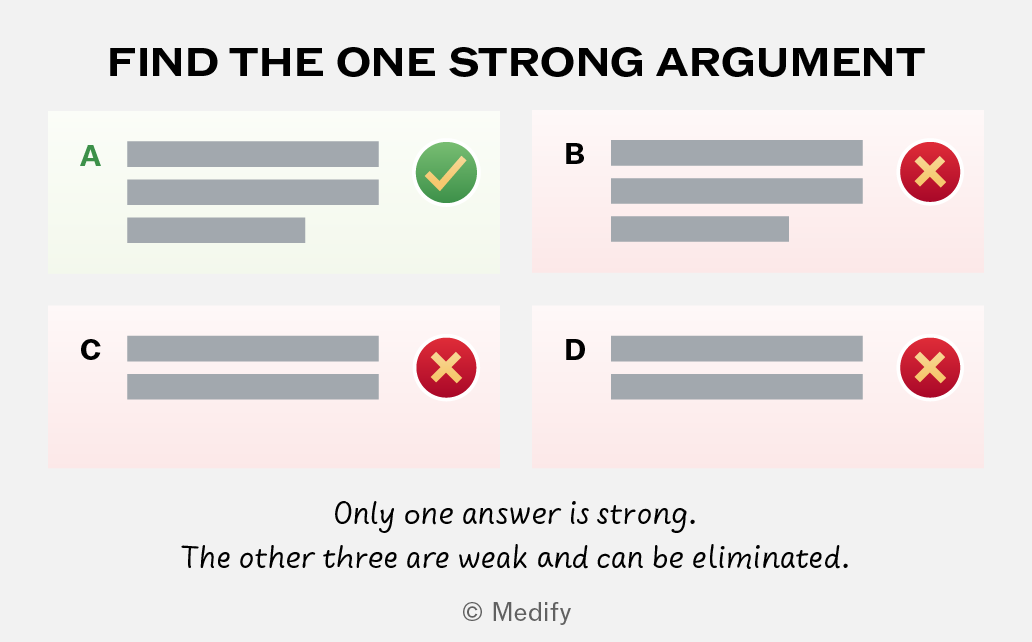
Only one answer will persuasively answer the original question. It is the strongest argument because it directly impacts the original question on its own terms.
Three answers will fail to answer the original question because they are weak arguments. They cannot directly affect the original question – if one of them did, it would be a second correct answer.
There are no degrees of strength, and you must not compare answers to each other.
One strong argument. Three weak arguments. Nothing more, nothing less.
Walkthrough question
Timed practice
Try answering this question within 30 seconds.