
Survival and response - AL only (3.6.1.1)
On this page
Plants must respond to changing environmental conditions to optimise growth.
Tropisms are directional growth responses to an environmental stimulus:- A positive tropic response is when a plant grows towards a stimulus.
- A negative tropic response is when a plant grows away from a stimulus.
There are many types of tropism each resulting from a different environmental stimulus:
- Light triggers phototropism; shoots grow towards light.
- Gravity triggers gravitropism; roots grow downwards.
- Water triggers hydrotropism; roots grow towards water.
Auxins are plant hormones (e.g., IAA) that play many roles. They are involved in regulating plant growth and are responsible for phototropism, where plant shoots grow towards a light source. Auxins are produced mainly in the shoot tip and move down the shoot.
Positive phototropism is a growth response caused by the unequal distribution of indoleacetic acid (IAA) in a shoot.
When light shines on one side of a shoot, IAA moves laterally to the shaded side. This causes greater cell elongation on the shaded side, resulting in the shoot bending towards the light.
When light is evenly distributed, IAA is distributed evenly, causing the shoot to grow straight.
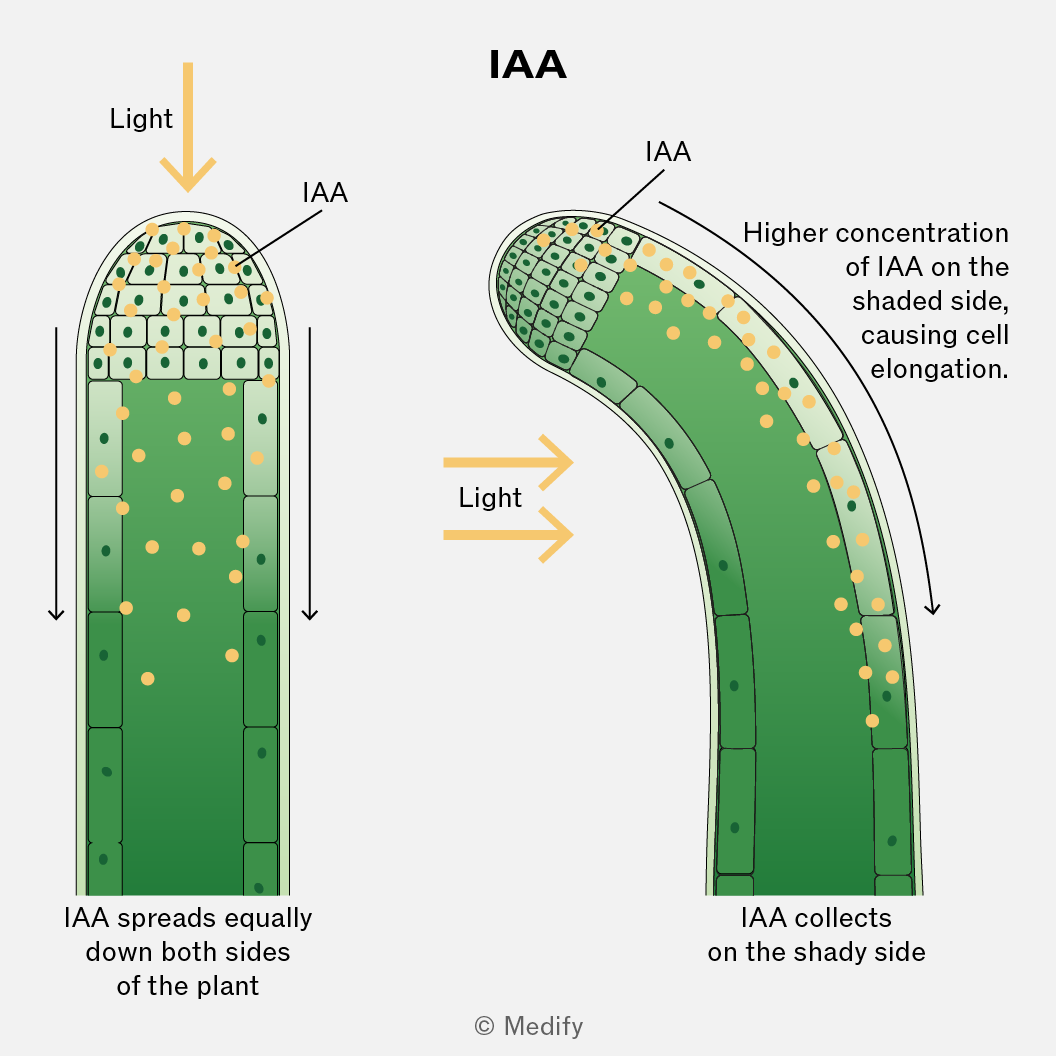
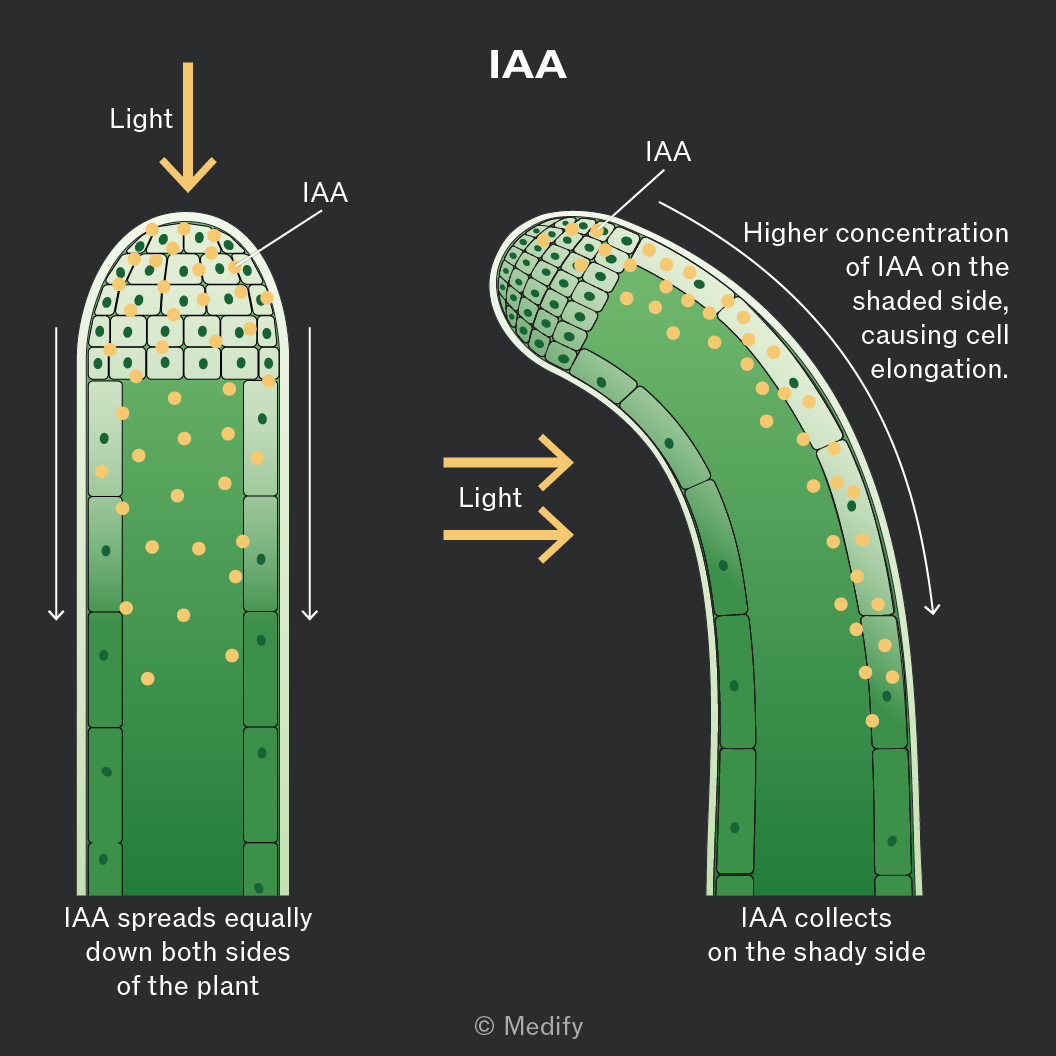
IAA in the shoots of plants promote cell elongation and plant growth as well as positive phototropism.
IAA in plant roots has the opposite effect, inhibiting cell elongation. This means that roots exposed to light show cell elongation on the light side, meaning they bend away from light – they are negatively phototropic.
The effect of gravity on root growth direction is called gravitropism and is caused by the unequal distribution of IAA within a root.
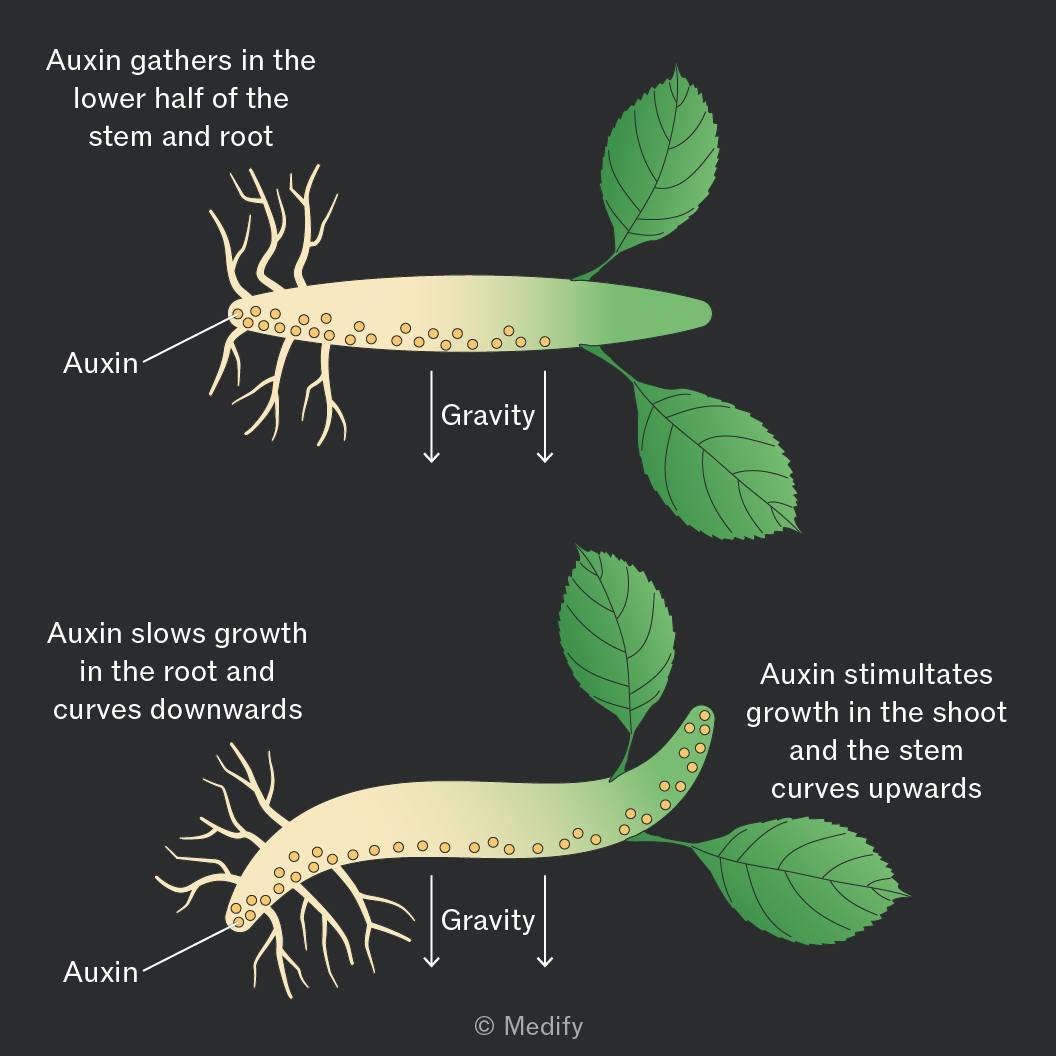
IAA produced in the root tip accumulates on the lower side of the root in response to gravity. In roots, high auxin concentrations inhibit cell elongation, so cells on the upper side elongate more than those on the lower side. This causes the root to bend downwards.
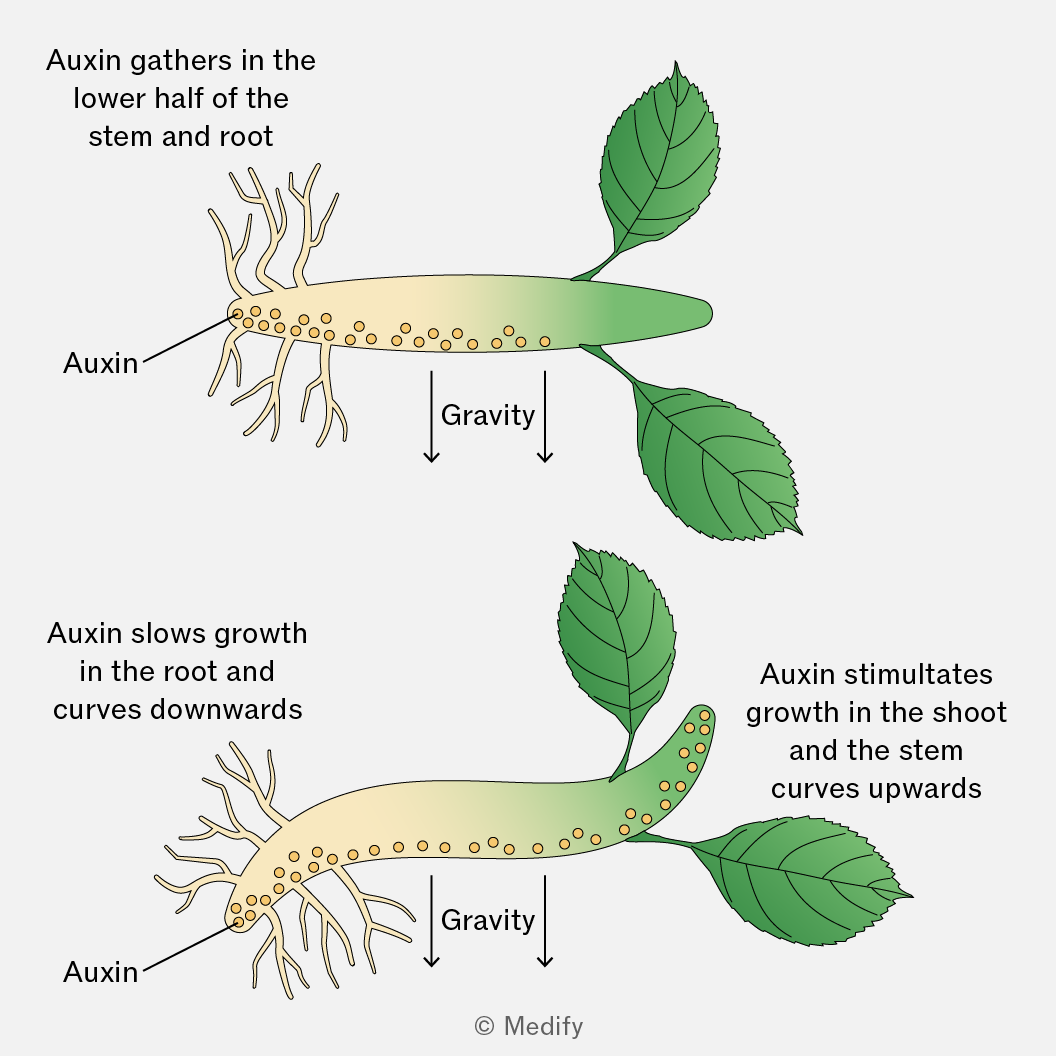
Large multicellular organisms use two main systems to respond to internal and external stimuli:
- Hormonal responses in plants and animals involve chemical messengers and are usually slower but longer-lasting.
- Nervous responses in animals involve electrical impulses and produce rapid, short-term responses.
Organisms increase their chances of survival by detecting changes in their internal and external environments and responding to them.
Receptors detect the stimulus, coordinators then process it, and effectors bring about a response


Responses to stimuli can be simple and can include directional movement and speed of movement towards or away from a stimulus.
The mobility of an organism contributes to determining how it responds.
A taxis is a directional movement in response to a stimulus.
This response is always described in terms of the direction of movement relative to the stimulus and the type of stimulus being detected.
For example:
- Positive phototaxis is when an organism moves toward light
- Negative chemotaxis is when an organism moves away from a chemical.
A kinesis is a change in the rate of movement or rate of direction change, depending on the intensity of a stimulus. This response increases the likelihood that an organism will find a favourable environment.
For example, woodlice move more quickly in dry areas to increase their chances of finding a moist region.
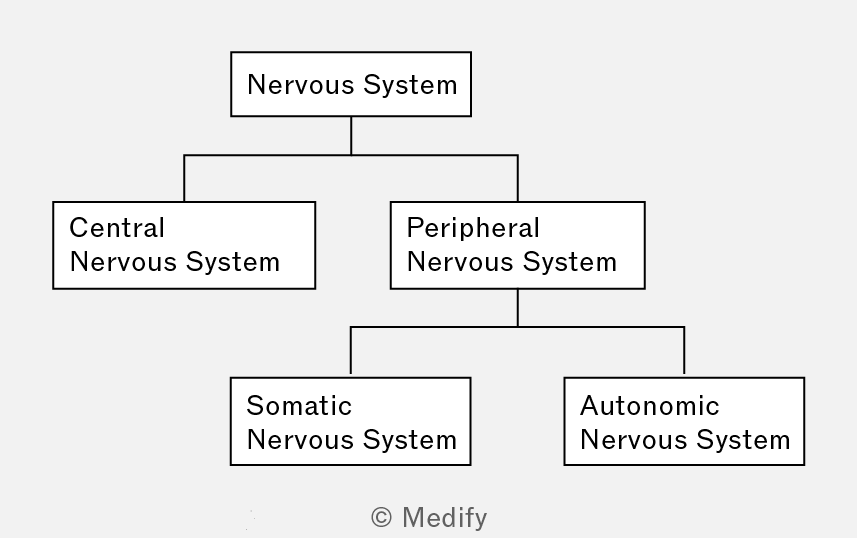
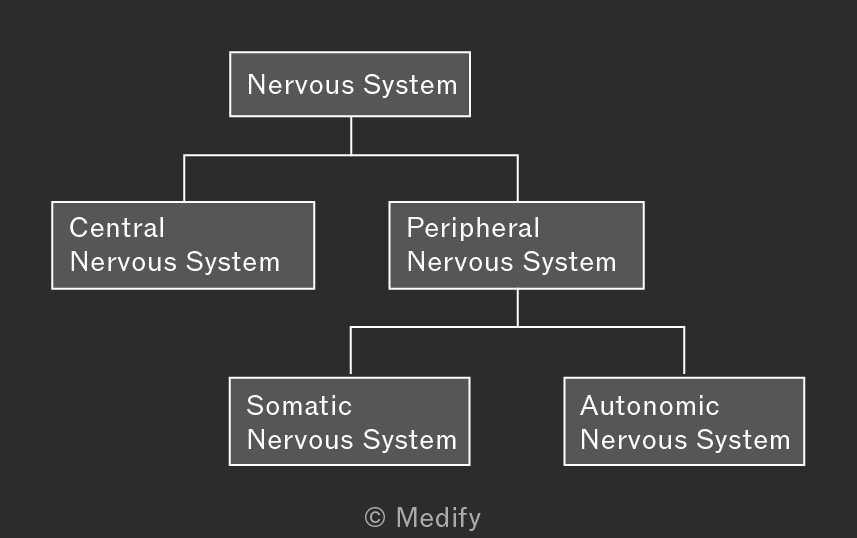
The mammalian nervous system coordinates responses to internal and external stimuli. It is organised in the following way:
- The Central nervous system (CNS), made up of the brain and spinal cord.
- The Peripheral nervous system (PNS), which can be split into the voluntary nervous system and the autonomic nervous system (ANS).
A reflex is an involuntary response to a sensory stimulus (e.g., blinking).
Reflexive actions are faster than actions done under conscious thought and increase the chances of survival.
Nerve pathways responsible for reflexes are called reflex arcs.
Reflexes are fast because they are involuntary and involve a limited number of neurones and synapses.
Reflexes are also protective; they do not need to be learned; they are innate.
The mechanism of a reflex arc uses three neurones:
- Stimulus detected by a receptor (e.g., a pain receptor in the skin).
- A sensory neuron transmits an impulse to the spinal cord.
- A coordinator / intermediate neurone in the spinal cord processes the signal and sends an impulse to a motor neurone.
- The motor neurone carries an impulse to the effector (e.g., muscle or gland).
- The effector produces a response (e.g., muscle contraction).