
Oxidation and reduction (Topic 3)
On this page
Oxidation numbers are a way of describing the location of electrons in a chemical species. They indicate the degree of oxidation (loss of electrons) or reduction (gain of electrons) of an atom in a compound compared to in its elemental form.
There are rules for assigning oxidation numbers.
- The oxidation number of an atom in its elemental form is (e.g., ).
- For monatomic ions, the oxidation number is equal to the charge of the ion (e.g., is , is ).
- Oxygen in compounds usually has an oxidation number of (except in peroxides where it is ).
- Hydrogen in compounds usually has an oxidation number of (except when bonded to metals in hydrides, where it is ).
- The sum of the oxidation numbers in a neutral compound must be , and in a polyatomic ion, it must equal the overall charge of the ion.
Roman numerals (without a sign) are used to indicate the magnitude of the oxidation number of an element which commonly holds different oxidation numbers in different compounds.
Iron (II) represents where the oxidation number of iron is +2.
Iron (III) denotes where the oxidation number of iron is +3.
Nitrate (V) represents where the oxidation number of nitrogen is +5.
Nitrate (III) represents where the oxidation number of nitrogen is +3. The common name for is the nitrite ion.
The name nitrate written without an oxidation number is always assumed as .
The rules for assigning oxidation numbers can be used to construct the chemical formulae of a compound from its name.
There are many varieties of manganese oxide. The chemical formula of each compound can be deduced using the oxidation states given by roman numerals in the name.
Manganese (II) Oxide – The oxidation state of manganese is +2 and the oxidation state of oxygen is -2. A neutral compound must contain a 1:1 ratio of as the sum of the oxidation states must equal 0. The chemical formula is therefore .
Manganese (III) Oxide – The oxidation state of manganese is +3 and the oxidation state of oxygen is -2. A neutral compound must contain a 1:1.5 ratio of as the sum of the oxidation states must equal 0. This translates to a 2:3 whole number ratio. The chemical formula is therefore .
The sum of the oxidation numbers of all atoms present in a polyatomic molecule or ion equals the overall charge present on the molecule or ion.
Considering the relative electronegativity of the atoms in a molecule allows oxidation states to be assigned.
- The most electronegative atom is assigned a negative oxidation number and the least electronegative atom a positive oxidation number.
- The oxidation state of any remaining atom is calculated by considering the net charge alongside the oxidation states of the atoms already assigned.
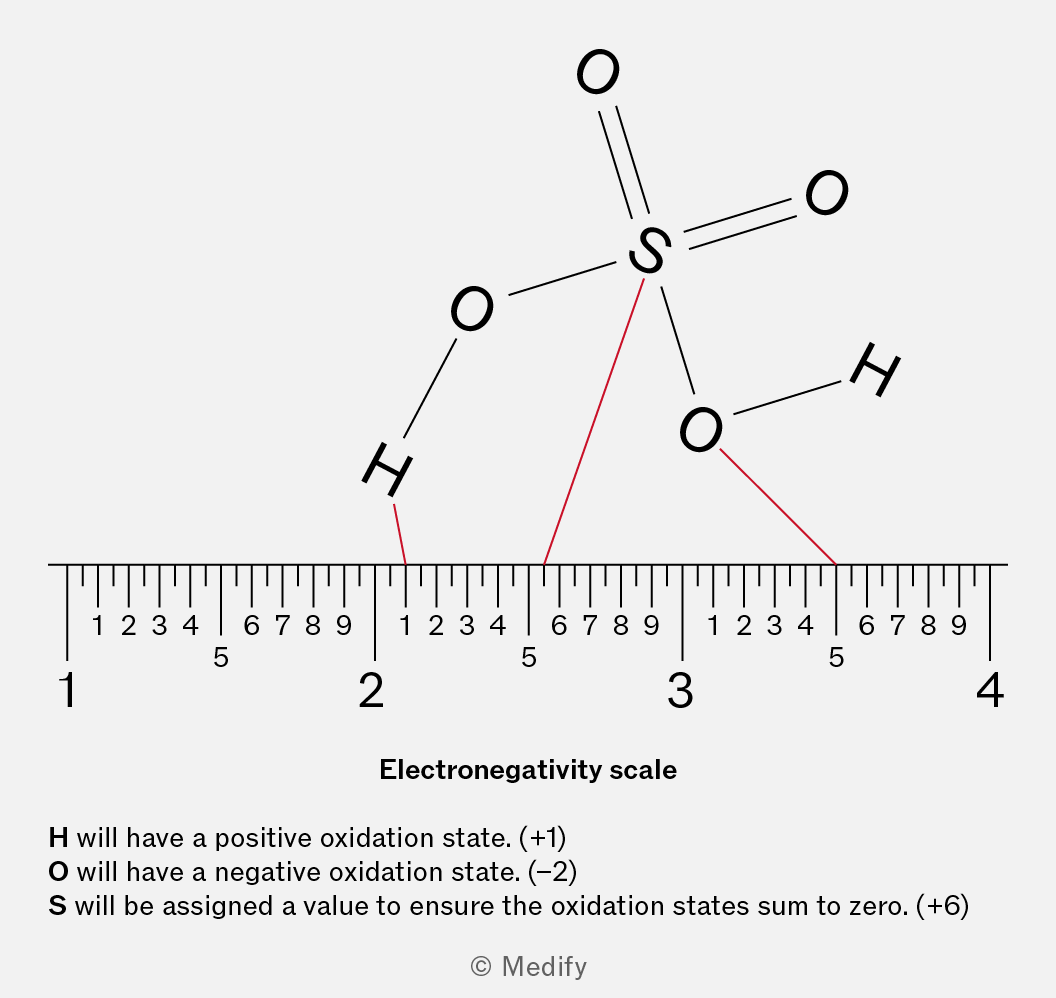
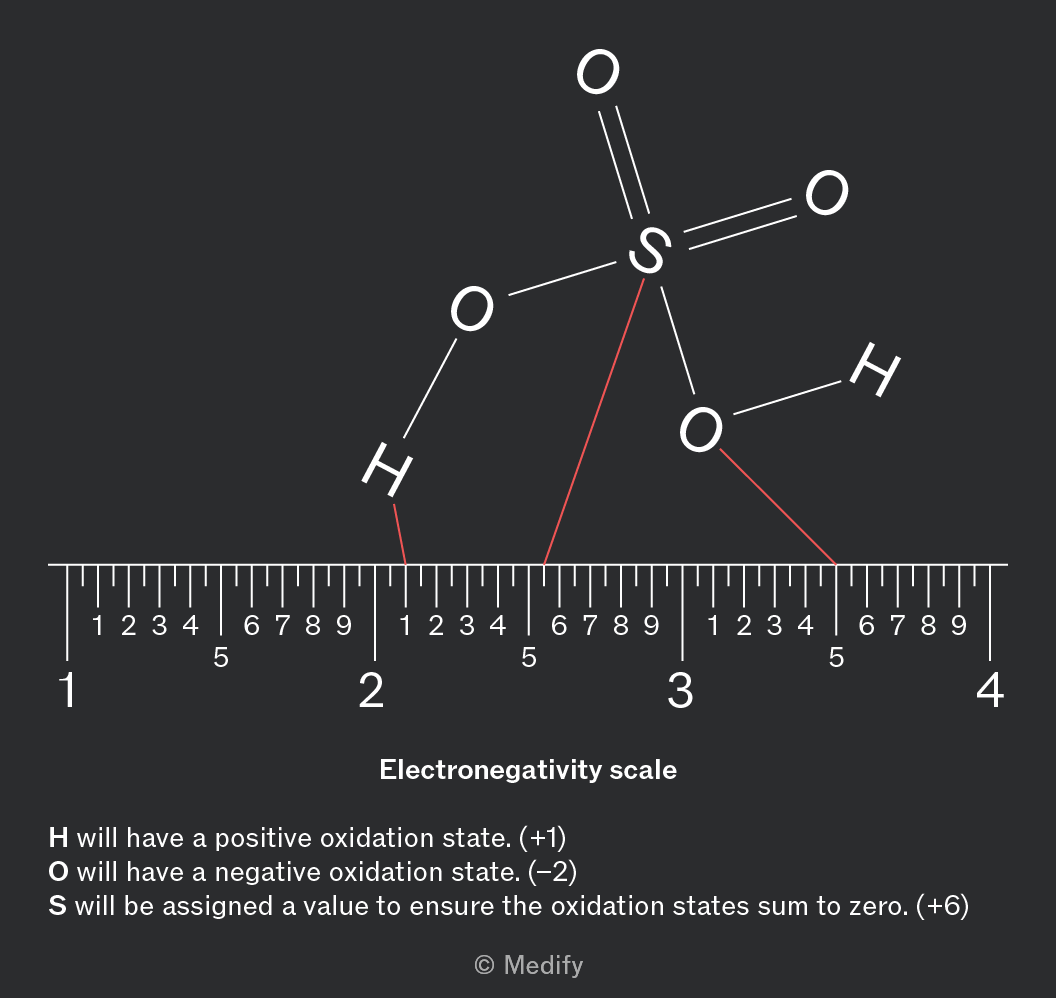
In an ionic compound the oxidation state of an ion is linked to its ionic charge.
Metals are generally less electronegative than non-metals; the metal has the positive oxidation number while the non-metal has the negative oxidation number.
- Group 1 metals always have the oxidation number +1.
- Group 2 metals always have the oxidation number +2.
- Transition metals can have variable oxidation states.
- Group 6 non-metals generally have the oxidation number -2.
- Group 7 non-metals always have the oxidation number of -1.
The sum of the oxidation numbers in an ionic compound equals zero.
Oxidising agent: An oxidising agent is a substance that gains electrons during a chemical reaction.
By accepting electrons, the oxidising agent is reduced.
The oxidising agent causes another substance to lose electrons and thus be oxidised.
Reducing agent: A reducing agent is a substance that loses electrons during a chemical reaction.
By donating electrons, the reducing agent is oxidised.
The reducing agent causes another substance to gain electrons, and thus be reduced.
Metals lose electrons to achieve a more stable electronic configuration, resembling the nearest noble gas configuration for main block metals.
This loss of electrons results in the formation of positively charged ions (cations). For example, sodium () loses one electron to form , and magnesium () loses two electrons to form .
When a metal atom loses electrons, its oxidation number increases. For example, sodium goes from an oxidation state of in to in .
Metals form positive ions through the loss of electrons, which leads to an increase in oxidation number.
Non-metals tend to gain electrons to achieve a stable electron configuration, often resembling the nearest noble gas configuration.
This gain of electrons results in negatively charged ions (anions). For example, chlorine () gains one electron to form , and oxygen () gains two electrons to form .
When a non-metal gains electrons, its oxidation number decreases. For example, chlorine goes from an oxidation state of in to in .
Non-metals generally form negative ions by gaining electrons, which leads to a reduction in oxidation number.
Whenever an acid reacts with a metal, the products are a salt and hydrogen.
metal + acid → salt + hydrogen
This is a redox reaction.
The metal is oxidised whilst the acid is reduced.
In the reaction of magnesium metal with hydrochloric acid:
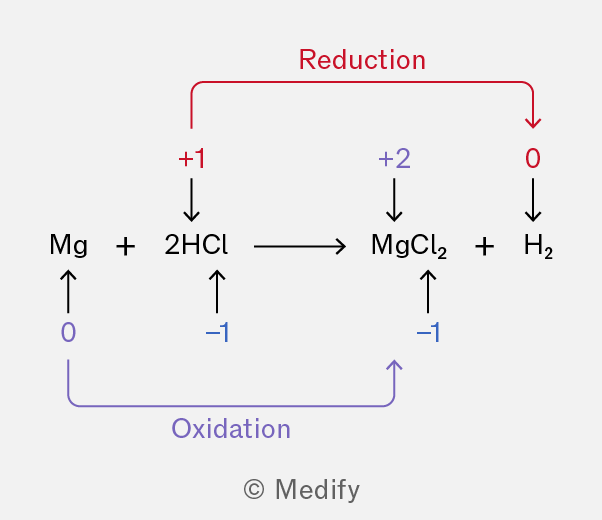
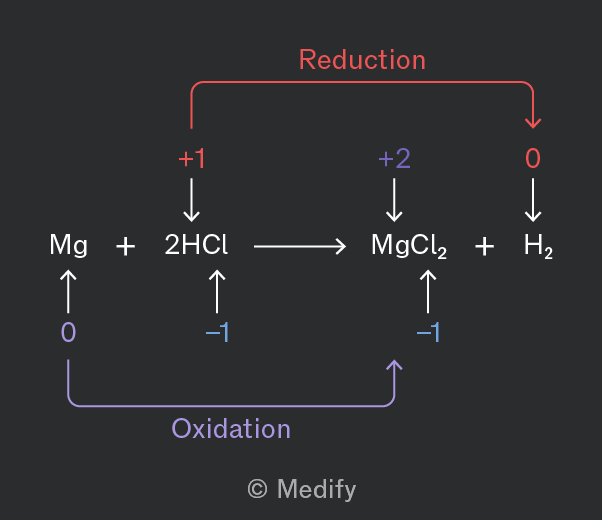
- The metal (magnesium) is oxidised.
- The oxidation number of magnesium increases from in to in as it loses 2 electrons.
- The acid is reduced.
- The oxidation number of hydrogen present in decreases from in to in . Each ion gains one electron.
Number of electrons lost by Number of electrons gained by two .
A disproportionation reaction involves a single element in one species undergoing both oxidation and reduction simultaneously.
Definition: The same element in a single species is both oxidised (loses electrons) and reduced (gains electrons) in the same reaction.
Example: A classic example is the reaction of chlorine with water:
Here, chlorine () is simultaneously:
- Reduced to chloride ions () in
- Oxidised to hypochlorite ions () in .
It is important to note that disproportionation requires an element that can exist in multiple oxidation states, allowing it to undergo both oxidation and reduction within the same reaction.
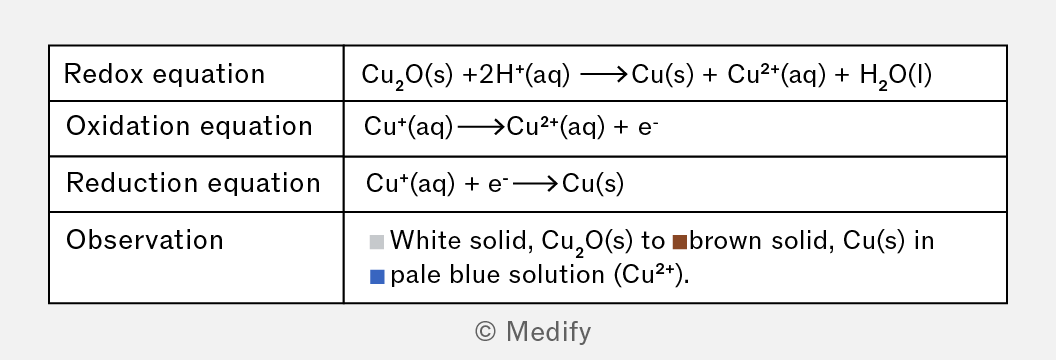
Disproportionation is a type of redox reaction which occurs when a species is simultaneously oxidised and reduced.
- Disproportionation of copper(I) oxide occurs with hot dilute sulfuric acid.
- In the oxidation state of copper is +1.
- Copper is then reduced to 0 in and oxidised to +2 in .
- has been simultaneously oxidised and reduced.
To interpret an electron transfer reaction:
- Identify the species involved: Determine which atoms or ions are present in the reactants and products.
- Determine the oxidation numbers of the relevant elements in both the reactants and products.
- Identify the species that is oxidised (loses electrons) and the species that is reduced (gains electrons).
- Determine the oxidising and reducing agents:
- The oxidising agent is reduced and gains electrons.
- The reducing agent is oxidised and loses electrons.
You could be expected to produce half-equations from a full redox equation.
Half-equations represent either the oxidation or reduction part of a redox reaction, showing the transfer of electrons explicitly.
1. Remove counterions: these need to be in (aq) state on both sides of the arrow.
2. Identify the species involved: Determine which species are being oxidised and reduced by examining changes in oxidation numbers.
Oxidation:
Reduction:
3. Balance and add electrons to form half-equations:
For ionic equations containing hydrogen, and/or oxygen, hydrogen ions (in acidic conditions), hydroxide ions (in alkali conditions), and water can be added back in to balance the equation.
You may be asked to write a full redox equation from half equations.
1. Identify the oxidation half-equation: This shows the loss of electrons.
2. Identify the reduction half-equation: This shows the gain of electrons.
3. Cross multiply the half-equations if necessary so that the number of electrons lost in the oxidation half-equation equals the number gained in the reduction half-equation.
gives
4. Merge the half-equations together: Combine the two balanced half-equations, cancelling out the electrons to form the overall redox equation.