
Energetics I (Topic 8)
On this page
Standard conditions refer to a set of predefined environmental conditions used as a reference point for measuring and comparing chemical reactions or properties.
Standard conditions are defined as:
- Temperature:
- Pressure:
Standard states are the specific physical states of substances under the standard conditions.
Enthalpy, which has the symbol , is the thermal energy stored within a chemical system.
Enthalpy change, often denoted as , is a measure of the heat energy transferred or exchanged during a chemical reaction or a physical change at constant pressure.
reflects the difference in enthalpy between the products and the reactants involved in a process.
In chemical reactions, the bonds can be broken and/or formed.
When bonds are broken, this requires energy from the surroundings and therefore energy is taken in.
When bonds are formed, this releases energy to the surroundings.
The overall energy change in a reaction depends on how much thermal energy is transferred overall during the reaction.
When thermal energy is taken in from the surroundings, the enthalpy change is positive; this is an endothermic reaction.
Examples of endothermic reactions include:
- Photosynthesis
- Thermal decomposition
- The reaction between sodium carbonate and ethanoic acid.
When thermal energy is released to the surroundings, the enthalpy change is negative; this is an exothermic reaction.
Examples of exothermic reactions include:
- Aerobic respiration
- Combustion reactions
- Neutralisation reactions.
An enthalpy profile diagram is a graphical representation used to illustrate the enthalpy changes that occur during a chemical reaction.
It plots the changes in the enthalpy of the system as the reaction progresses along the reaction coordinate, the progress of the reaction from reactants to products.
- The axis represents the reaction coordinate.
- The axis represents the enthalpy of the chemical system.
Key features typically included on an enthalpy profile diagram are:
- Reactants: the starting materials of the reaction, usually placed on the left side of the diagram.
- Products: the final substances formed as a result of the reaction, usually placed on the right side of the diagram.
- Transition State: this is the highest energy point along the reaction pathway, representing the point at which the old bonds are breaking and the new bonds are forming.
- Activation Energy (): this is the energy barrier that must be overcome for the reaction to proceed. It is typically measured as the energy difference between the reactants and the transition state.
- Enthalpy Change (): This is the difference in enthalpy between the products and the reactants.
The activation energy, , is the minimum energy required for a reaction to take place. It is often described as an energy barrier.
In enthalpy profile diagrams, the activation energy of a reaction is shown by the difference between the enthalpy of the reactants and the transition state.
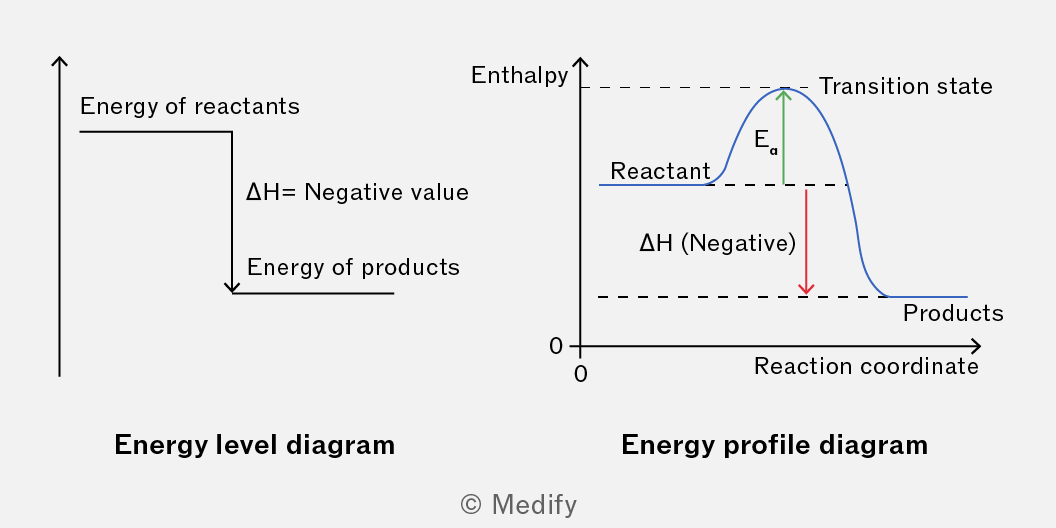
Here is an enthalpy profile diagram for an exothermic reaction:
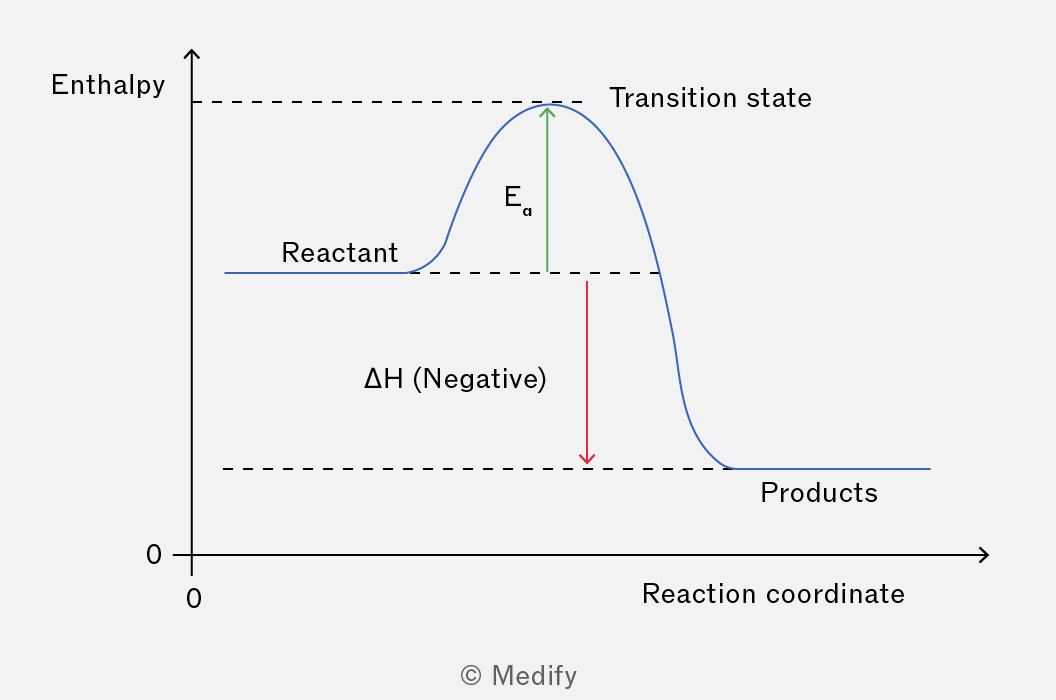
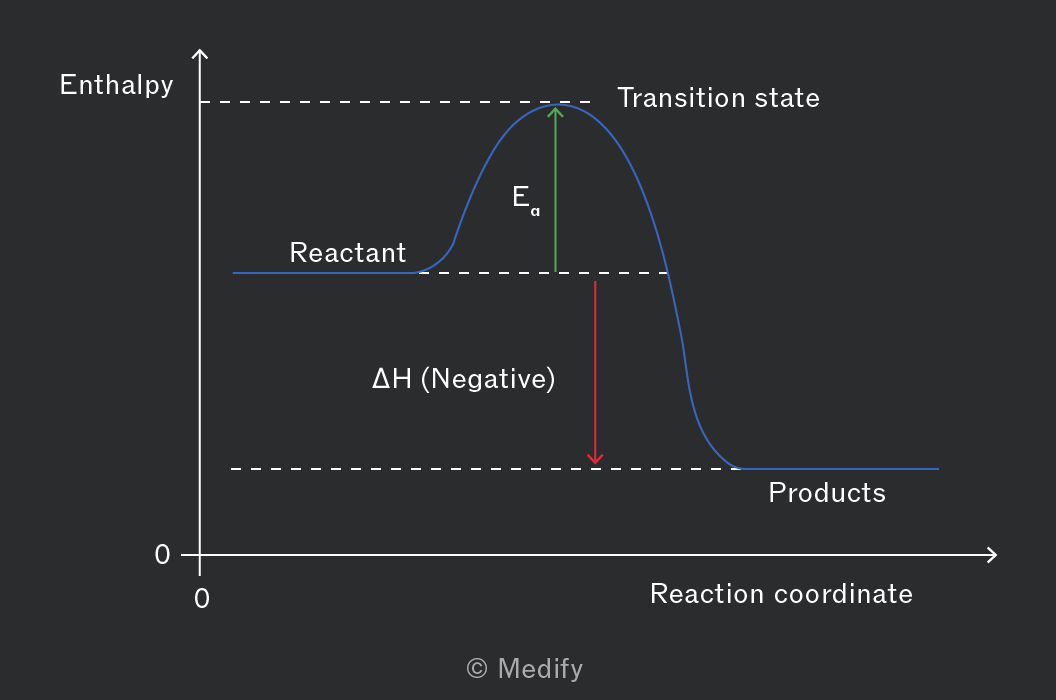
In enthalpy profile diagrams for exothermic reactions, the products are lower in energy than the reactants.
This illustrates that more energy is released during bond formation than is taken in for bond breaking.
Heat energy is therefore transferred to the surroundings, so these will warm up.
Here is an enthalpy profile diagram for an endothermic reaction:
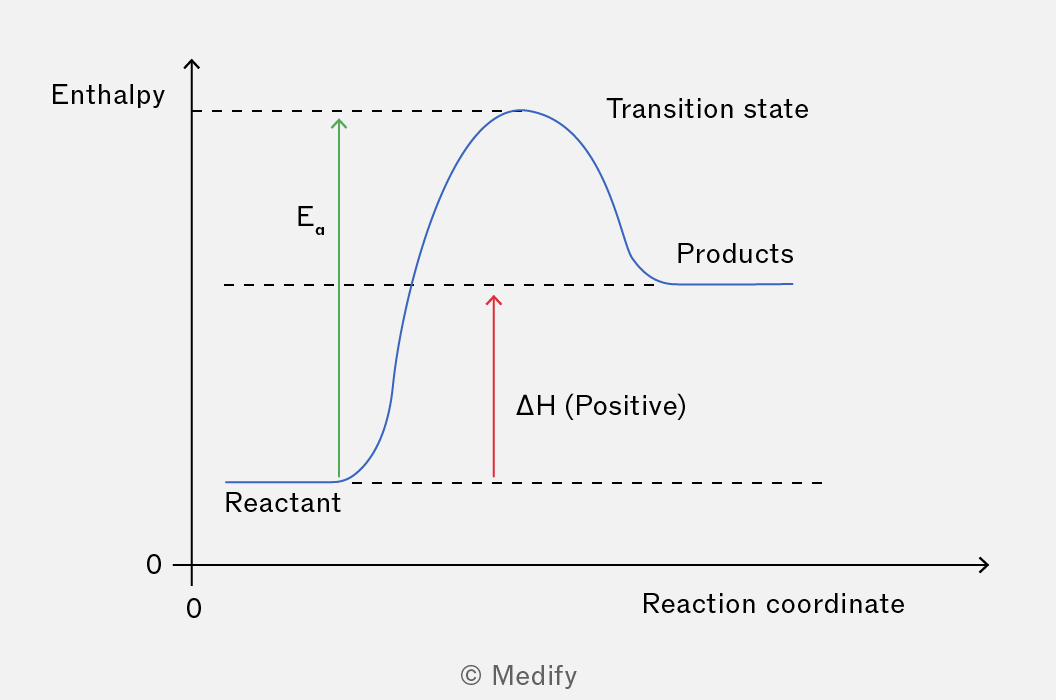
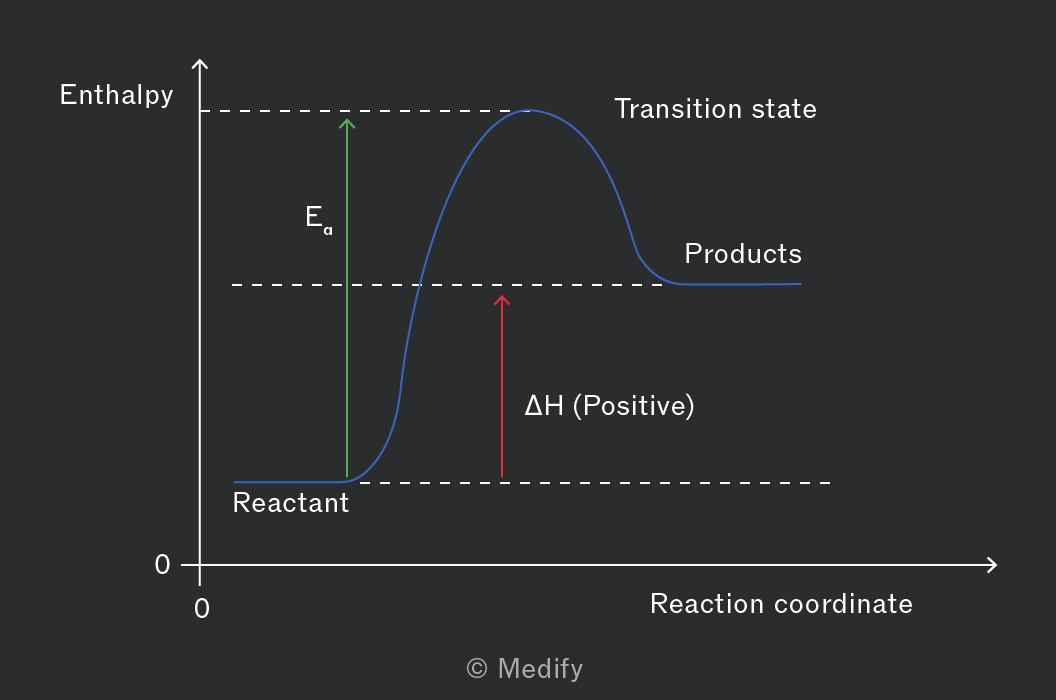
In enthalpy profile diagrams for exothermic reactions, the products are higher in energy than the reactants.
This illustrates that more energy is taken in for bond breaking than is released for bond making.
Heat energy is therefore taken in from the surroundings, so these will become colder.
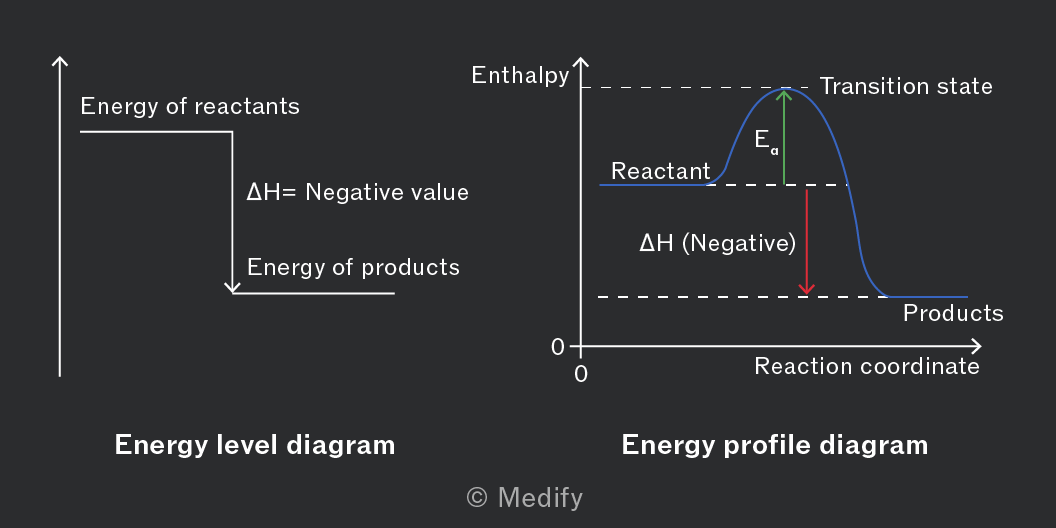
Energy level diagrams are more basic than energy profile diagrams as they do not show energy changes over the progression of a reaction. As a result, they often have no x axis.
Enthalpy change of reaction, , is:
“The enthalpy change when the reactants in the stoichiometric equation as provided react to give the products under standard conditions.”
For example:
The enthalpy change of reaction refers to the moles of reactants stated in the reaction stoichiometry exactly as given.
The enthalpy change of reaction can be either exothermic or endothermic.
Enthalpy change of formation, , is:
“The enthalpy change when one mole of a substance is produced from its constituent elements, with all reactants and products in standard states, under standard conditions.”
For example:
The reaction stoichiometry must always be adjusted to give one mole of product.
The enthalpy change of formation can be either exothermic or endothermic.
By definition, the enthalpy change of formation, , of an element in its standard state is zero.
Enthalpy change of combustion, is:
“The enthalpy change when one mole of a substance is completely combusted in oxygen, with all reactants and products in standard states, under standard conditions.”
For example:
The reaction stoichiometry must always be adjusted to show one mole of fuel.
The enthalpy change of combustion is always exothermic.
Enthalpy change of neutralisation, , is:
“The enthalpy change when one mole of water is produced in a reaction between an acid and alkali, under standard conditions.”
For example:
The reaction stoichiometry must always be adjusted to show one mole of water formed.
The enthalpy change of neutralisation is always exothermic.
Enthalpy changes cannot be measured directly; they require analysis of the temperature changes of the environment around a reaction.
Calorimetry is a method used to measure enthalpy changes experimentally. This can either be achieved through mixing reactants in solution within a calorimeter, or warming of water in a calorimeter above a combustion reaction.
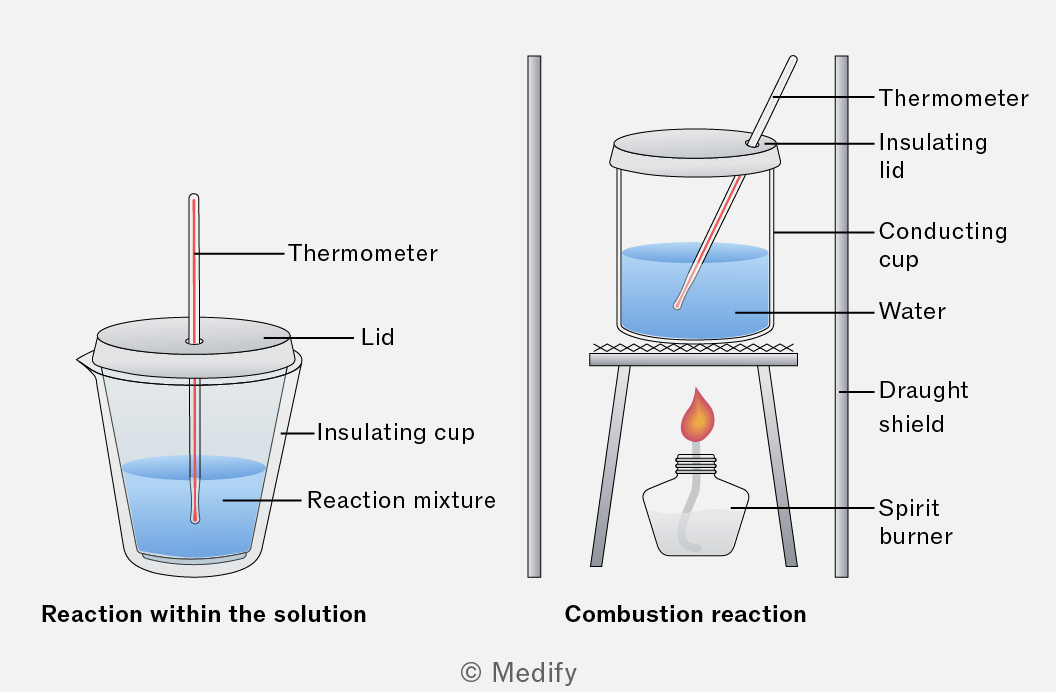
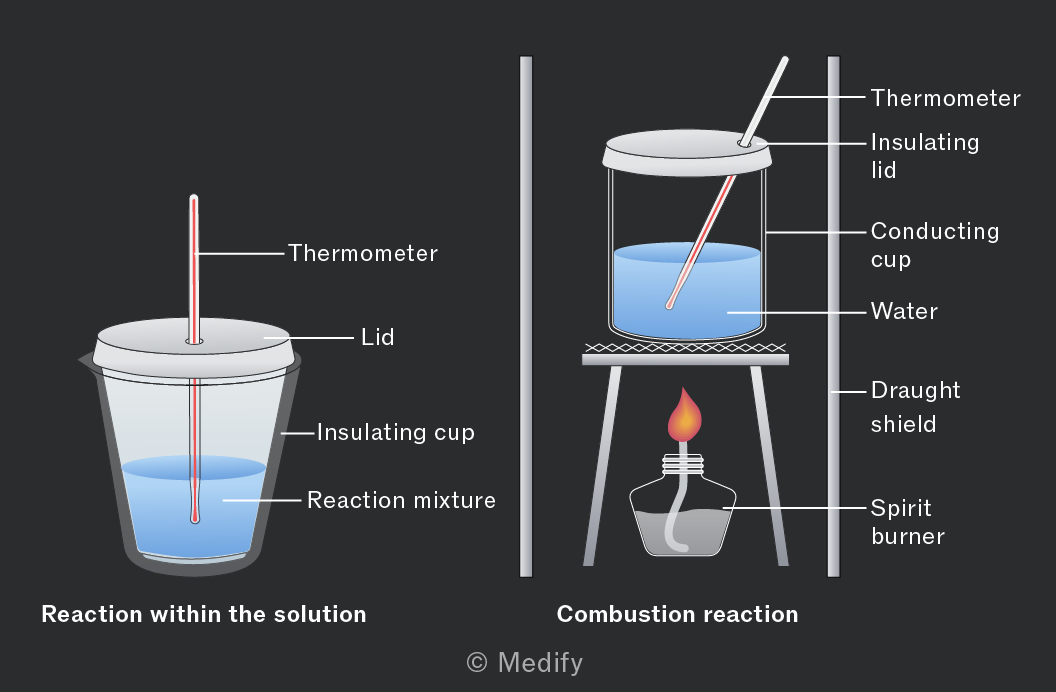
Calorimetry measures the temperature change in the surroundings of a chemical reaction over time.
Once the temperature change of the surroundings, , is determined experimentally, the energy change can be determined using the following equation:
Where:
- = energy change ()
- = mass ()
- = specific heat capacity ()
- = change in temperature ()
The energy change will depend on the specific heat capacity of the substance being heated.
The specific heat capacity of water is .
When using the equation consider what to include in the mass.
- In combustion experiments, use the mass of water in the metal cup.
- In neutralisation reactions, use the combined mass of the reacting solutions.
- Where a solid reactant is added to a solution, use the mass of the solution excluding the mass of the added solid.
Note that the exclusion of the mass of the added solid will be expected in calculations for Edexcel, regardless of the solubility of the solid. This differs from OCR.
Specific heat capacity is the energy required to heat of a substance by .
Once the energy change, q, has been determined, the enthalpy change in , can be determined using the equation:
Where:
- = enthalpy change ()
- = energy change ()
- = number of moles ()
Before using the equation, the energy change obtained from calorimetry, , needs to be converted from to by dividing by 1000.
The substance that provides the number of moles, , depends on the definition of the specific enthalpy being calculated.
In calorimetry calculations involving solutions, it is generally assumed that of the solution has a mass of .
It is also assumed that the specific heat capacity of the solution is , the same as the specific heat capacity of water.
Question walkthrough
Enthalpy of combustion
Use of the relationship q = mcΔT
Hess’s Law allows us to calculate a hard-to-measure enthalpy change indirectly, via consideration of an alternative route to that directly from reactants to products, using the idea of the conservation of energy.
Hess’s Law states that:
“The total enthalpy change in a chemical reaction is independent of the route by which the chemical reaction takes place as long as the initial and final conditions are the same.”
All reactions can be considered as reversible in enthalpy cycles.
Regardless of feasibility, the enthalpy change of a reverse reaction is equal in magnitude and opposite in sign to the forward reaction.
Put more practically, when you go the “wrong way” along an arrow in an enthalpy cycle, change the sign of .
When provided with details on the enthalpy of combustion, , of substances in a chemical reaction, the reaction can be considered as occurring via the combustion products, carbon dioxide and water.
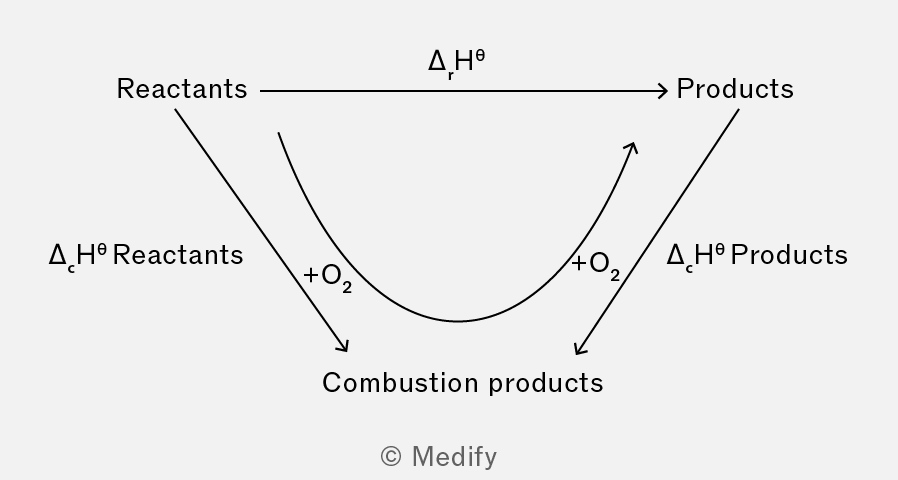
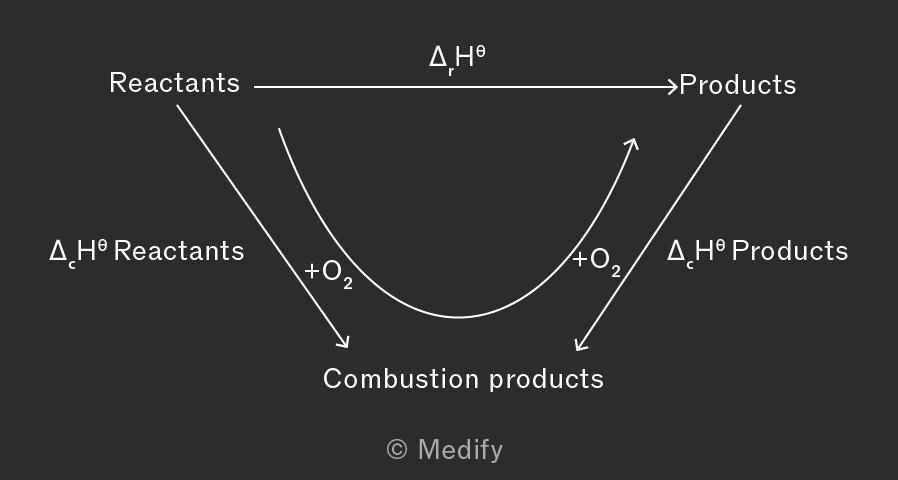
Following the alternative route of this enthalpy cycle, of the products needs to be considered as the reverse reaction – it is the hypothetical reaction from combustion products to fuel.
When you go the “wrong way” along an arrow in an enthalpy cycle, change the sign of .
As a result:
When provided with details on the enthalpy of formation, , of substances in a chemical reaction the reaction can be considered as occurring via the constituent elements in their standard states.
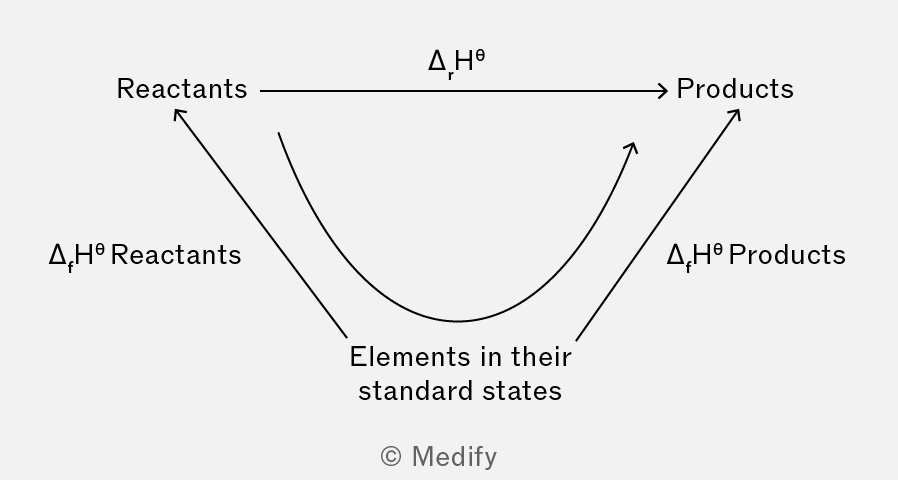
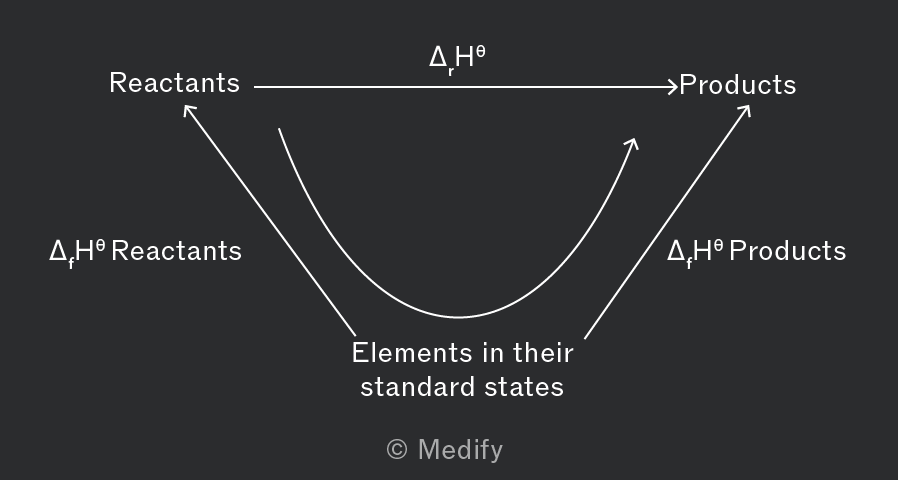
Following the alternative route of this enthalpy cycle, of the reactants needs to be considered as the reverse reaction – it is the hypothetical deformation enthalpy, from reactants to their constituent elements.
When you go the ”wrong way” along an arrow in an enthalpy cycle, change the sign of .
As a result:
Question walkthrough
Hess’s law
Using enthalpies of formation to establish enthalpy of combustion
The average bond enthalpy is:
“The predicted energy required to break one mole of a given bond in a gaseous molecule under standard conditions.”
The units of average bond enthalpy are and the value is, by definition, always endothermic.
Average bond enthalpies are measured over a wide variety of different gaseous molecules containing that bond. An actual bond enthalpy in a specific molecule may differ from the average value quoted in data books. Values of from average bond enthalpies will differ from those obtained through experimental results.
Average bond enthalpies can be used to determine the overall enthalpy change of a chemical reaction using the following equation:
The overall enthalpy is exothermic when the energy released from the bonds made is greater than the energy consumed by the bonds broken.