
Lattice energy (Topic 13A)
On this page
Lattice enthalpy, , is:
“The enthalpy change when one mole of an ionic lattice is formed from its constituent gaseous ions under standard conditions.”
For example:
where and are gaseous ions, and is the solid ionic lattice.
Calculating lattice enthalpy is a key step in understanding ionic compounds and their stability.
First ionisation energy, , is:
“The energy required to remove one mole of electrons from one mole of gaseous atoms to form one mole of gaseous ions with a +1 charge.”
For example:
The reactant in the first ionisation energy must always be a single gaseous atom, not a molecule.
Ionisation energy is always endothermic.
Enthalpy change of atomisation, , is:
“The enthalpy change required to form one mole of gaseous atoms from the element in its standard state.”
For example:
The reaction stoichiometry must be constructed to form one mole of atoms.
First electron affinity, , is:
“The enthalpy change when one mole of gaseous atoms gains one mole of electrons to form one mole of gaseous ions with a -1 charge.”
For example:
The reactant in the first electron affinity must always be a single gaseous atom, not a molecule. For chlorine it is not .
First electron affinity is exothermic for non-metals, as these form more stable anions.
The Born-Haber cycle is a complex thermochemical cycle that allows us to calculate the lattice enthalpy of an ionic compound using Hess’ Law and a series of composite enthalpies.
The enthalpies used in the construction of a Born-Haber cycle are:
- , lattice enthalpy
- , enthalpy of formation
- , enthalpies of atomisation
- , first ionisation energy (and subsequent ionisation energies if required)
- , first electron affinity (and subsequent electron affinities if required)
In a Born-Haber cycle the reaction stoichiometry is dictated by the composition of the ionic compound at the base.
It is crucial to adjust the enthalpy values used in line with the stoichiometry shown in the cycle.
In the cycle for there are two moles of gaseous chlorine atoms formed and two moles of ions formed using two moles of electrons. Both the and the must be doubled in the calculation.
It is useful to note that, while it is possible to draw Born-Haber cycles to scale, this is not necessary for their use. A rough sketch is sufficient in an exam.
The ionic compound in its standard state will be at the cycle’s lowest point. This can be created from its elements in their standard states () or from its constituent ions in their gaseous states ().
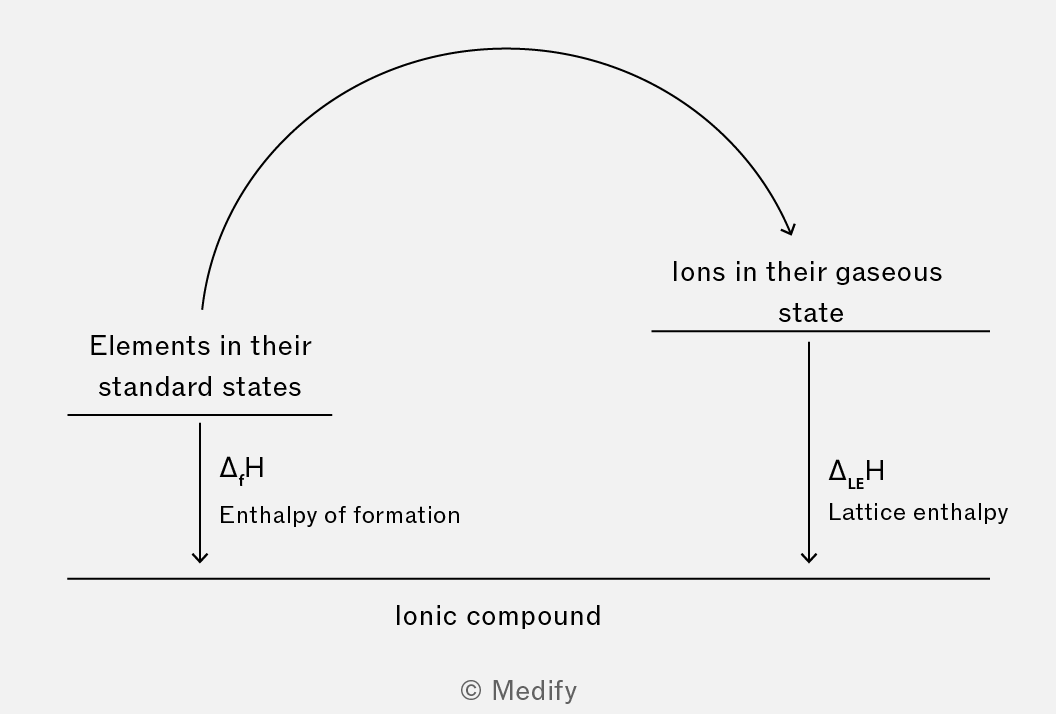
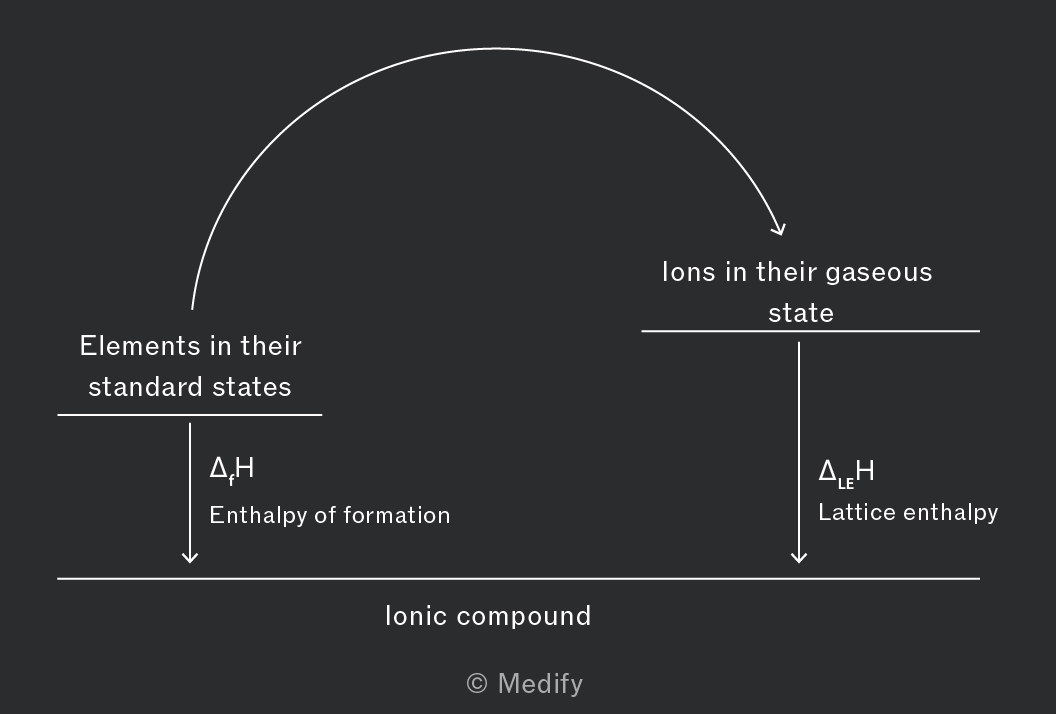
Note that both arrows follow the direction of the reaction described in the enthalpy definitions: towards the ionic compound.
The remaining enthalpies are used to connect the elements in their standard states to the ions in their gaseous states.
To connect the elements in their standard states to the ions in their gaseous states.
- Atomise each element, separately. This is endothermic, so the single gaseous species sits above the element in its standard state.
- Take electrons from the metal atoms to reach their preferred charge, This is endothermic so the gaseous cation will sit above its gaseous atom.
- Ionise the non-metal atoms to their preferred charge, This is exothermic, so the gaseous anion will sit below its gaseous atom.
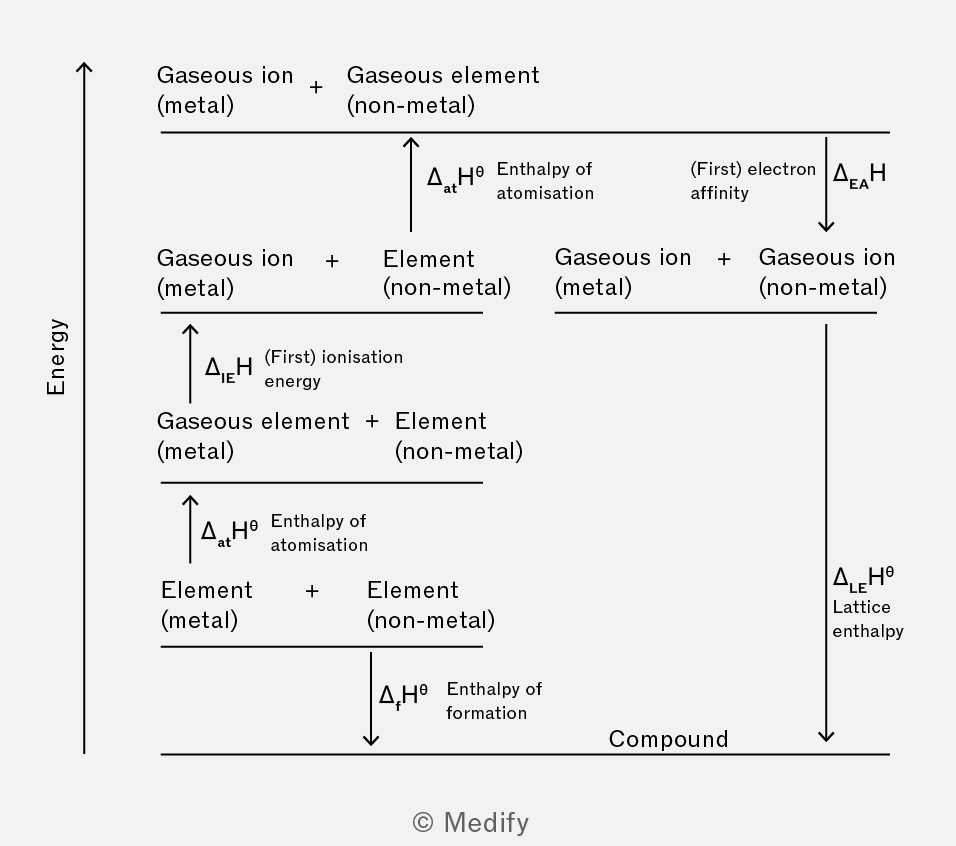
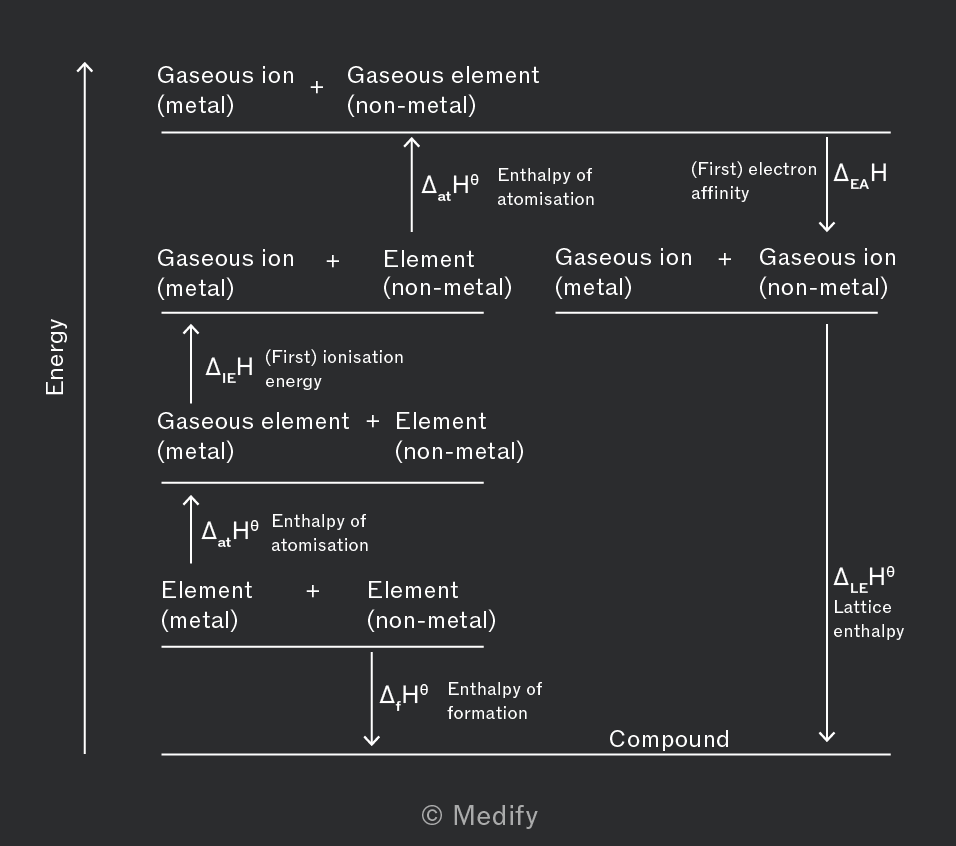
Born-Haber cycles can be used to calculate missing enthalpies.
Hess’s Law states that the total enthalpy change in a chemical reaction is independent of the route by which the chemical reaction takes place as long as the initial and final conditions are the same.
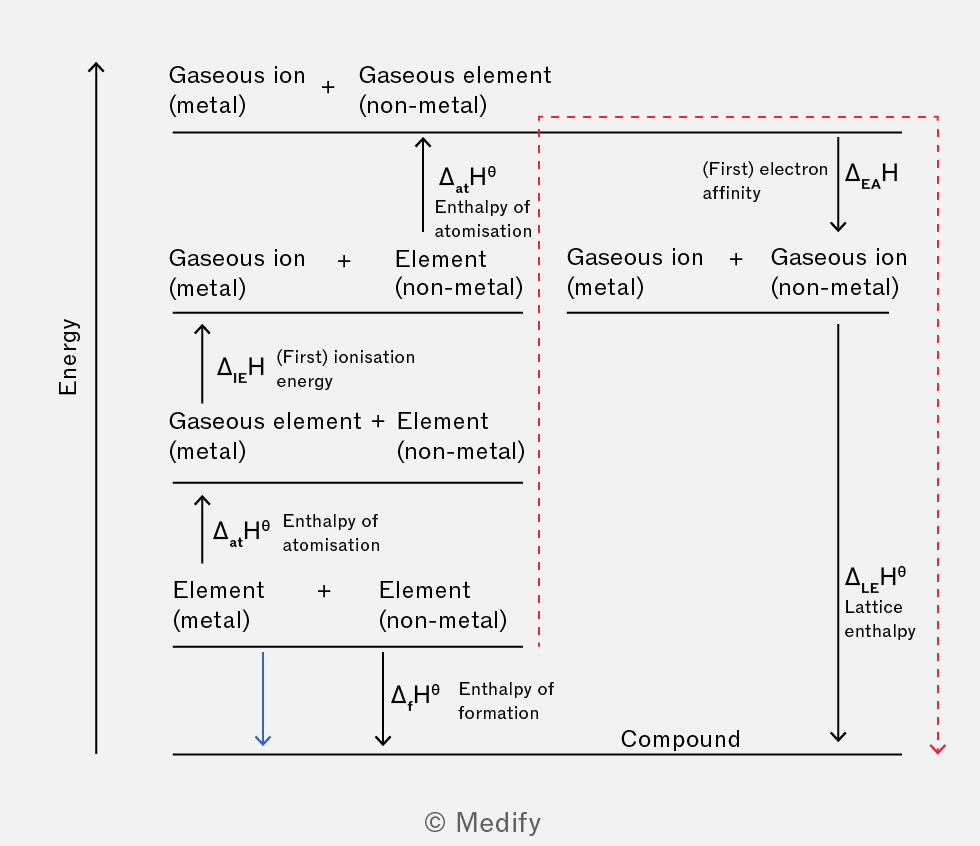
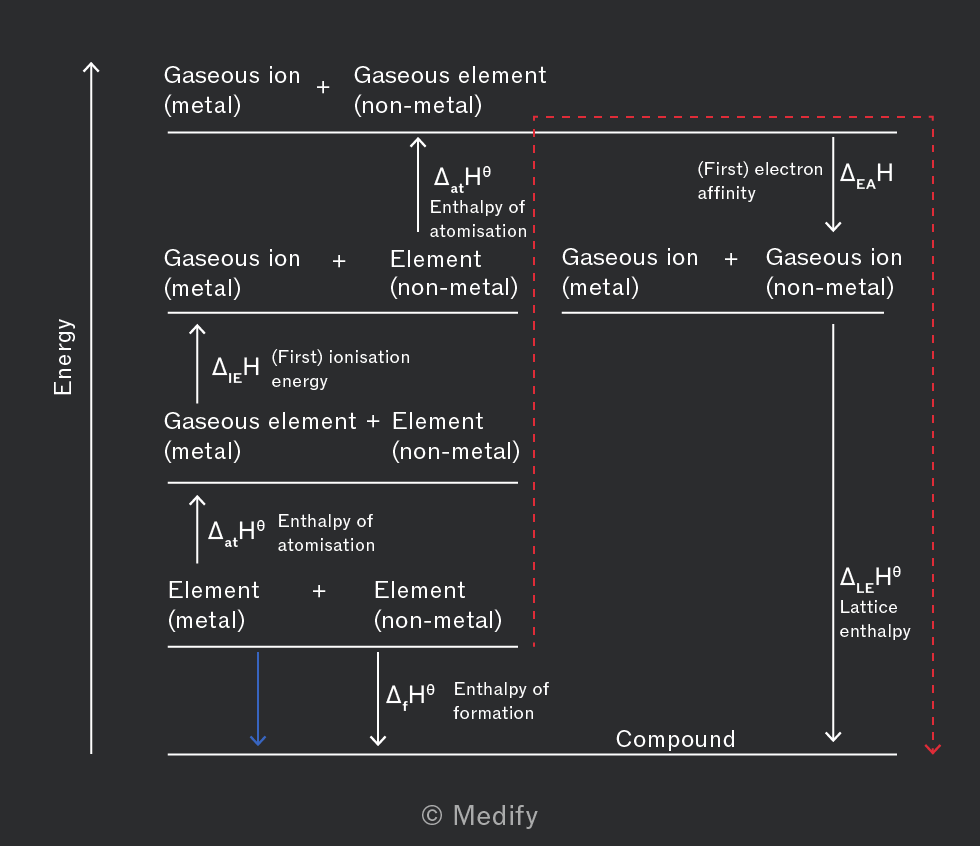
For a Born-Haber cycle this means, for example, that the formation enthalpy can be equated to the sum of the remaining enthalpies shown.
In this example, all arrows are followed in their forwards direction, so there is no need for sign reversal.
Lattice enthalpy, , is always a negative value because the process of forming the ionic lattice is one of making bonds which releases energy; it is an exothermic process.
The magnitude of the lattice enthalpy is a direct measure of the strength of the ionic bonds within the lattice.
High (more negative) lattice enthalpy indicates strong electrostatic forces of attraction between the ions, leading to a more stable ionic structure.
Low (less negative) lattice enthalpy suggests weaker ionic bonds and a less stable structure.
The strength of electrostatic attraction, and therefore lattice enthalpy, depends on two main factors; ionic charge and ionic radius.
Higher charge on the ions increases the strength of the electrostatic attraction between them.
Ions with a smaller ionic radius are packed closer together, which increases the electrostatic attraction between them.
Ions with a higher charge and/or a lower volume are described as having a higher charge density.
A compound with a high lattice enthalpy typically has a higher melting point and a higher boiling point; more energy is required to overcome the strong ionic bonds.
Lattice enthalpies can be more exothermic than predicted based on a purely ionic model.
In reality, there is polarisation of the ions, leading to a partially covalent nature to the bond.
The energy released when the partial covalent bonds are formed is greater than that from the electrostatic attraction alone. The degree of polarisation varies with the size and charge of the ions involved. The greater the polarisation, the larger the difference in lattice enthalpy compared to the purely ionic value.
Polarisation of ions is the electron cloud distortion around an anion due to proximity to cation of high charge density.
When an ion is highly polarised, there is a degree of electron sharing, and the bonding becomes partially covalent.
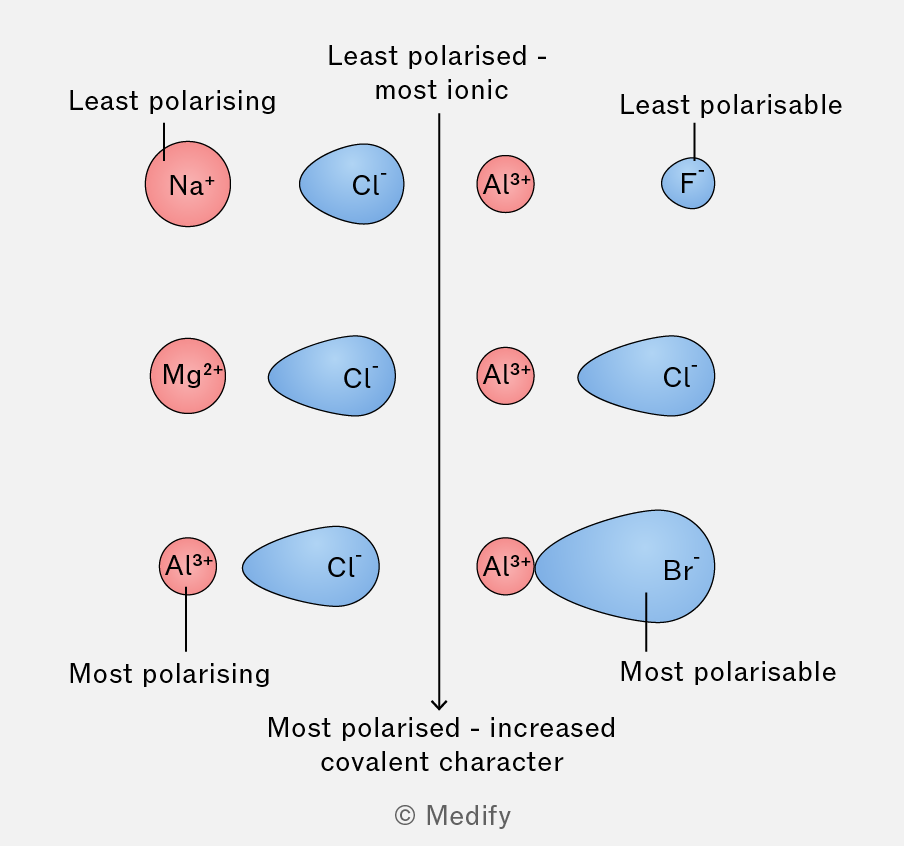
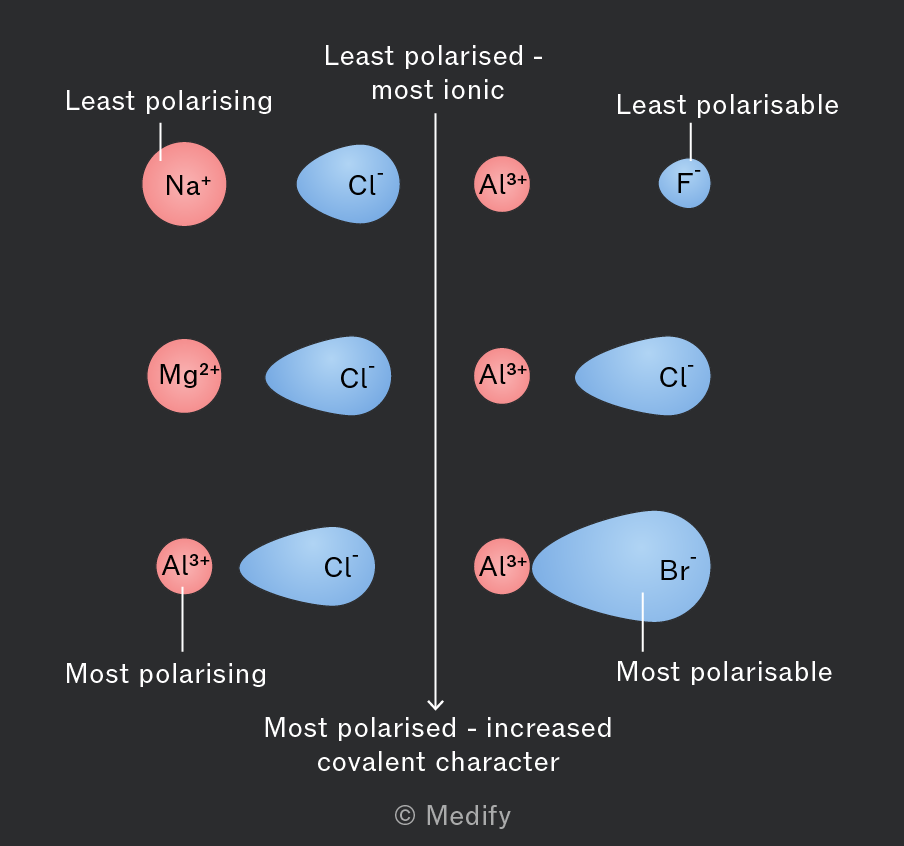
The most polarisable anions are large with a low charge; the charge density is low.
The most polarising cations are small with a high charge; the charge density is high.
When an ionic compound fully dissolves, it splits into its composite ions (the reverse of lattice enthalpy), and each ion is hydrated.
The overall enthalpy change of solution is the sum of the enthalpy changes of hydration minus the lattice enthalpy.
Both and are negative values. can be negative or positive depending on the relative magnitudes of and .
- If is negative, the dissolving process is exothermic, and the solution increases in temperature.
- If is positive, the dissolving process is endothermic, and the solution decreases in temperature.
The lattice enthalpy, the enthalpy of solution and the enthalpies of hydration can be connected in an enthalpy cycle.
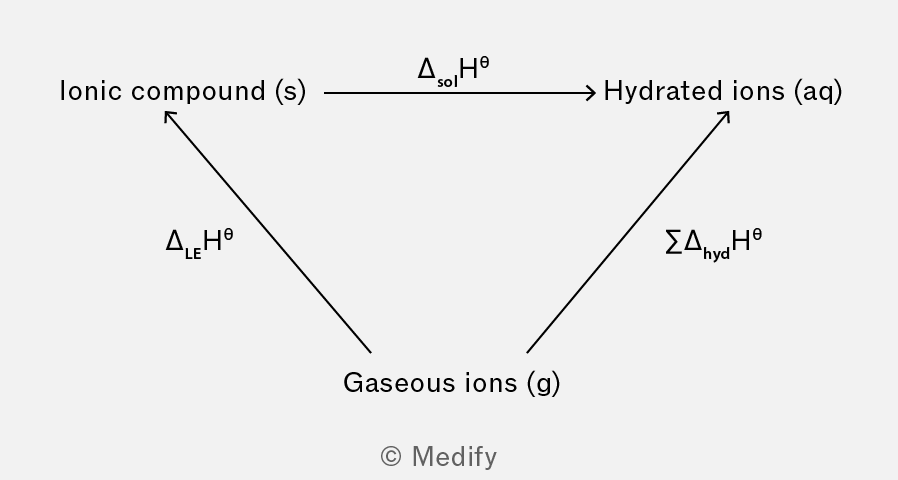
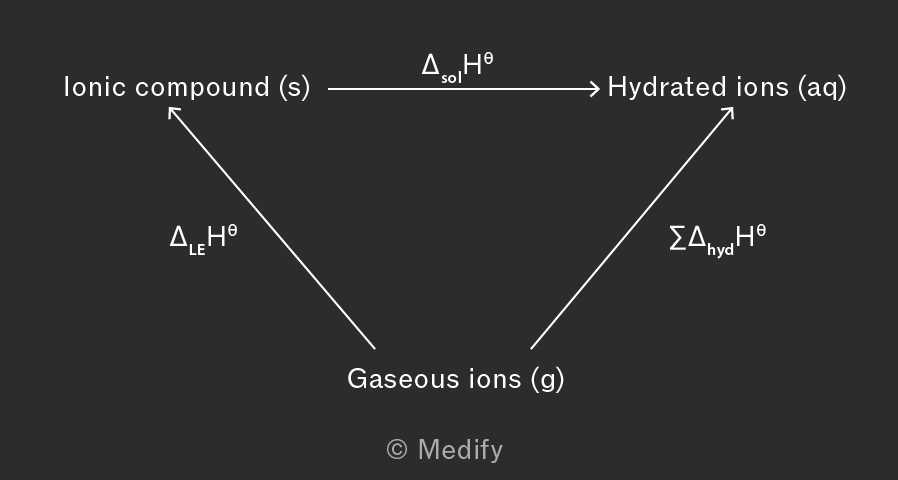
It is useful to know that this enthalpy cycle can be used to calculate a missing value given a subset of the data.
Water molecules, being polar, have a partial negative charge on the oxygen atom and a partial positive charge on the hydrogen atoms.
During hydration, when gaseous ions dissolve in water, the negative ions show intermolecular interactions with the positive sides of water molecules, whilst positive ions interact with the negative side.
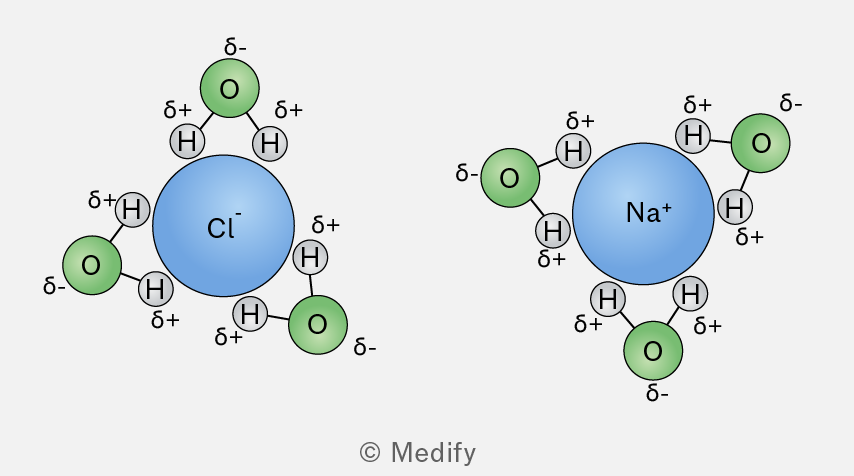
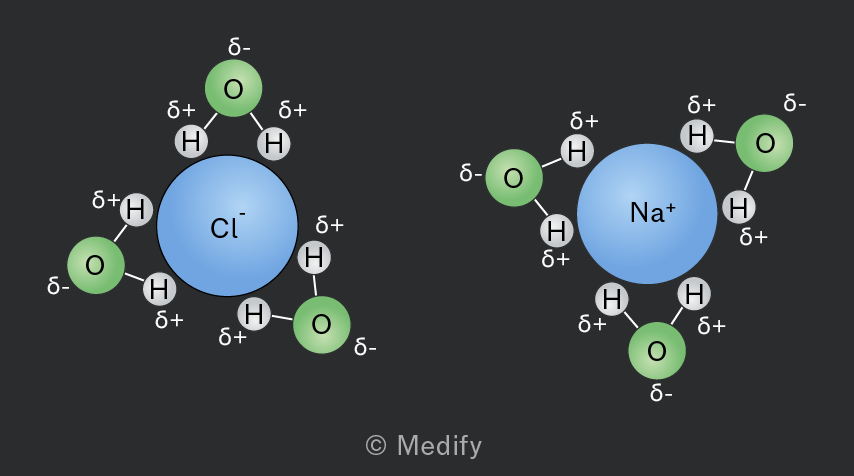
This interaction releases energy, making the hydration process exothermic.
The hydration enthalpy depends on the charge and size of the ion. Smaller, highly charged ions have a greater charge density and show higher due to stronger ion-dipole interactions.