
Principles of transition metal chemistry (Topic 15A)
On this page
The block that an element is defined by is the orbital where the outermost electrons reside.
In d block elements, the outer electrons reside in the d orbital.
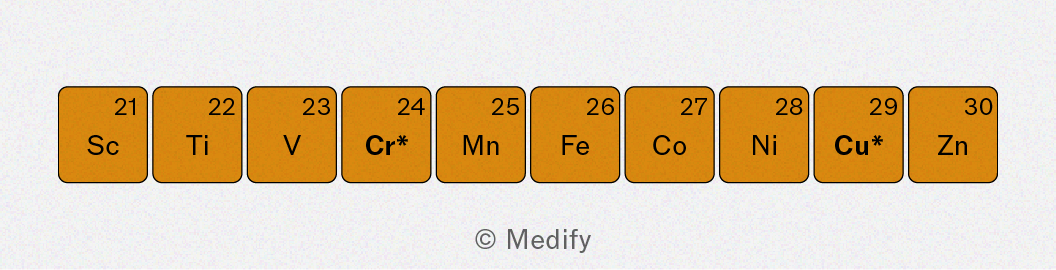
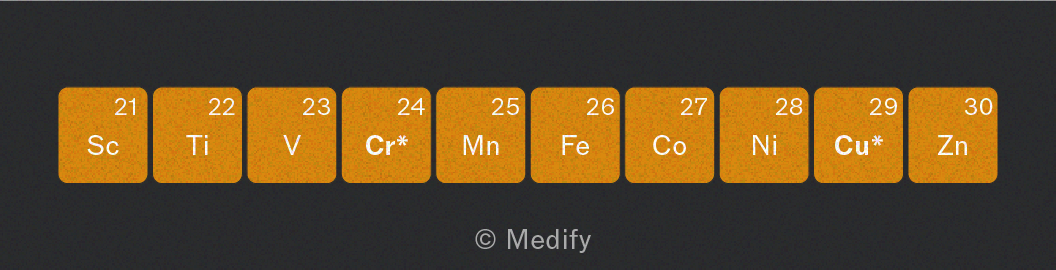
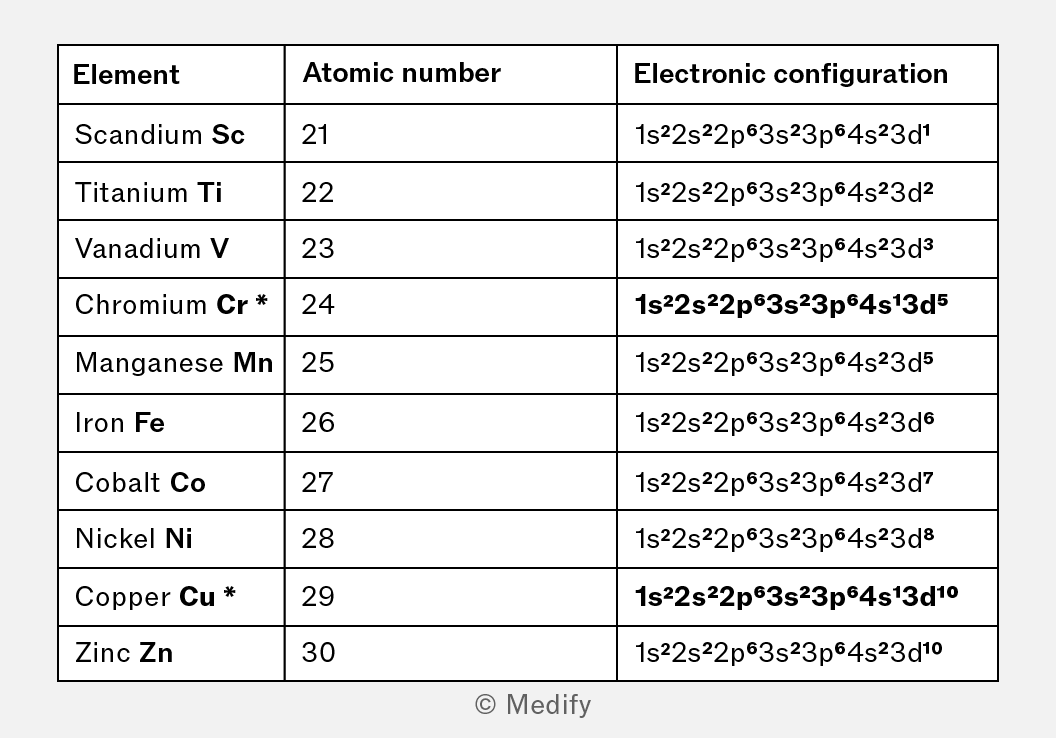
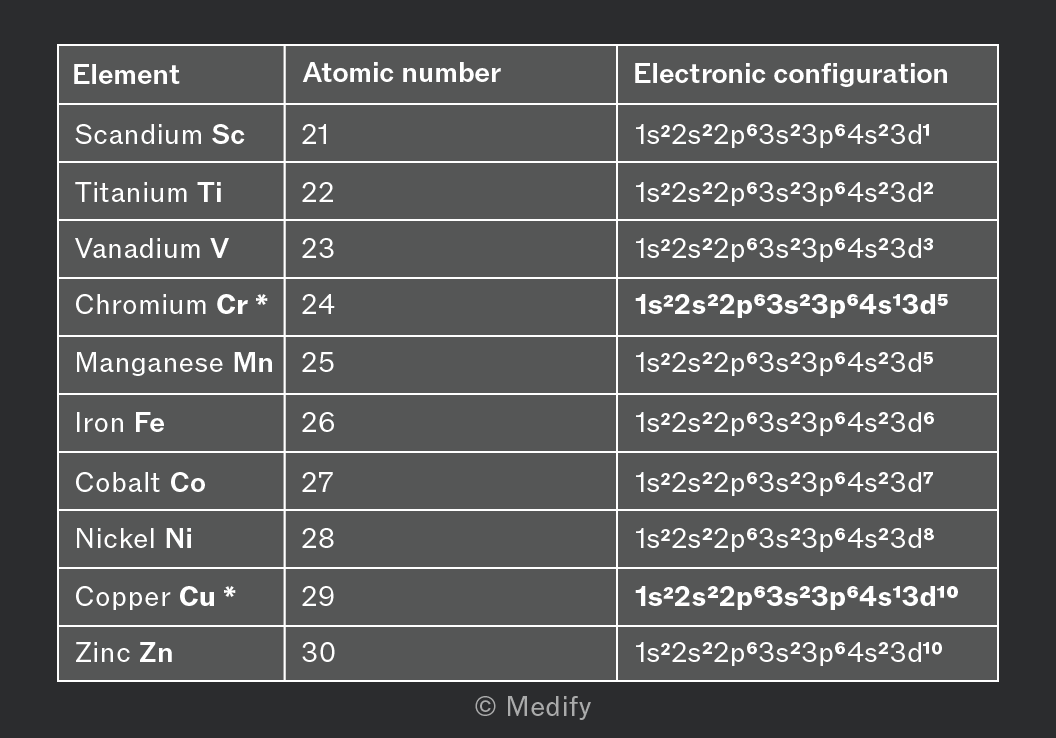
Following the rules of the Aufbau principle, the electrons in d-block elements fill the 4s orbital before the 3d orbital. The electron configurations for the neutral atoms are shown below.
Remember the order by which orbitals are filled: 1s–2s–2p–3s–3p– 4s – 3d –4p–5s
You can shorten the electron configuration using the previous noble gas to represent the central shells up until 3p6. Scandium’s configuration thus becomes [] 4s23d1
Chromium and copper do not follow the general trend for electron configuration.
![A section of the periodic table displaying elements from scandium (Sc, atomic number 21) to zinc (Zn, atomic number 30). Highlighted elements include chromium (Cr, atomic number 24) and copper (Cu, atomic number 29), with their electron configurations shown: Cr as [Ar] 4s1 3d5 and Cu as [Ar] 4s1 3d10.](https://d3nzlfkeryzt6j.cloudfront.net/grfe3j4xa74828zlnb50oyy04mis)
![A section of the periodic table displaying elements from scandium (Sc, atomic number 21) to zinc (Zn, atomic number 30). Highlighted elements include chromium (Cr, atomic number 24) and copper (Cu, atomic number 29), with their electron configurations shown: Cr as [Ar] 4s1 3d5 and Cu as [Ar] 4s1 3d10.](https://d3nzlfkeryzt6j.cloudfront.net/vqwmdgq9xou94l2z8tiud4wruoc4)
In chromium, an electron from the 4s orbital is promoted to the 3d orbital, this is due to the half filled 3d orbitals in chromium being more stable as electron pair repulsion is decreased.
Similarly, in copper, an electron from the 4s orbital is promoted to the 3d orbital. This results in a complete 3d orbital. This is more energetically stable therefore more favourable.
Electron configuration of d block element ions
When forming positive ions, electrons are removed from the 4s orbitals first and then the 3d orbitals.
Scandium usually forms a 3+ ion.
: 1s22s22p63s23p64s23d1
is: 1s22s22p63s23p6
The three electrons have been lost, from the 4s orbitals first and then the 3d orbitals.
Iron can form and ions.
1s22s22p63s23p64s23d6
1s22s22p63s23p63d6 The two electrons have been lost from the 4s orbital.
1s22s22p63s23p63d5 The three electrons have been lost, from the 4s first, then the 3d orbitals.
The definition of a transition metal is an element that has an incompletely filled d subshell in one or more of its oxidation states. These elements are all found in the d block but not all d block elements are transition metals.
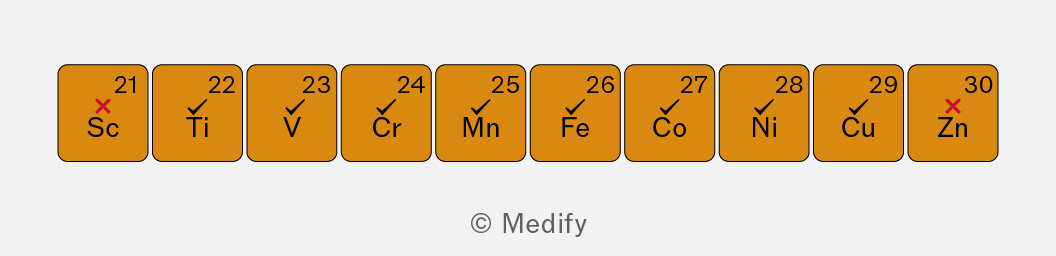
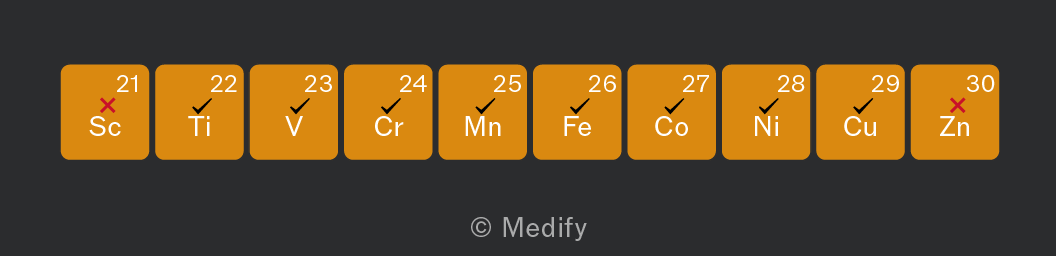
In accordance with this rule, scandium and zinc are not classed as transition metals.
Electron configuration for scandium:
: 1s22s22p63s23p64s23d1
Scandium only forms a 3+ ion.
The electron configuration for is: 1s22s22p63s23p6
All of the d electrons have been lost therefore scandium is not a transition metal.
Electron configuration for zinc:
: 1s22s22p63s23p64s23d10
Zinc only forms a 2+ ion.
The electron configuration for is: 1s22s22p63s23p63d10
All of the s electrons have been lost, and the d orbital is full therefore zinc is not a transition metal.
Transition metals show variable oxidation states.
The oxidation states of the transition metals are always positive. Due to the similar energies of the 4s and 3d orbital, the metal is able to form different cations.
The different oxidation states of a transition metal compound are shown using roman numerals. For example, iron(II) oxide shows iron as the ion, whereas iron(III) oxide shows iron as the ion.
You should be able to deduce the oxidation states of transition metal ion compounds from the charges of the ligands and the overall charge of the complex.
A ligand is an atom, ion, or molecule that can donate a pair of electrons to the transition metal to form a coordinate bond to a metal ion.
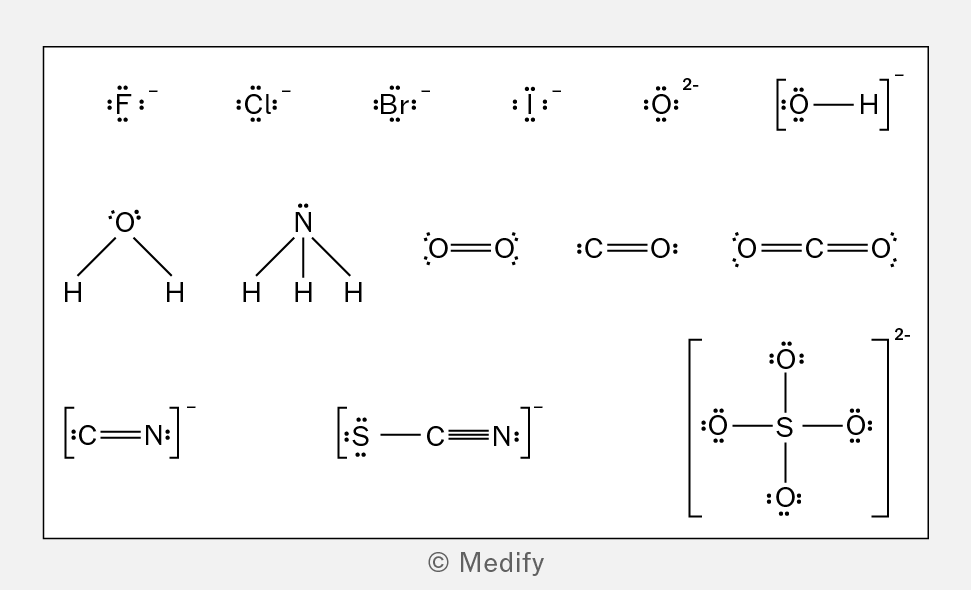
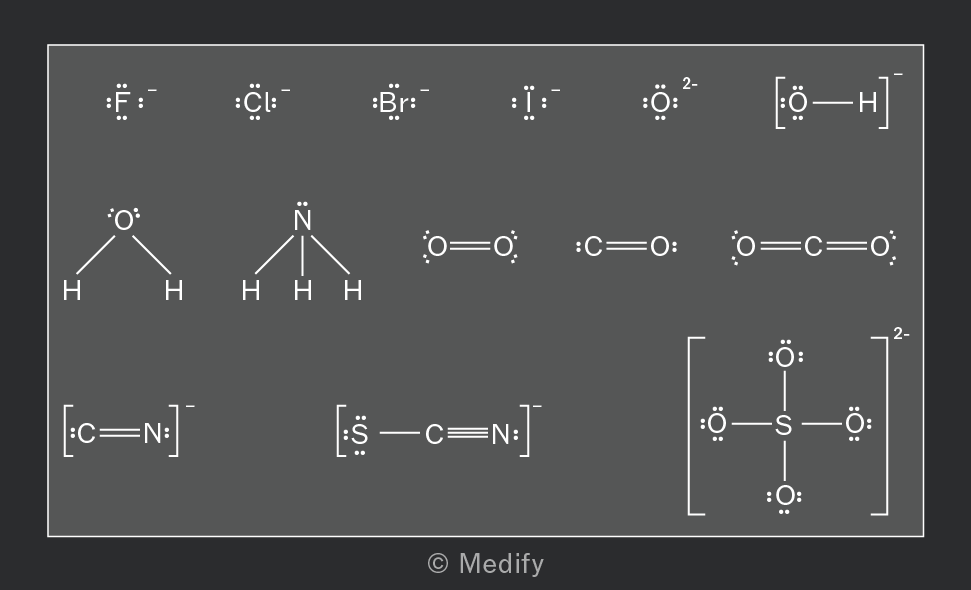
Ligands can be anionic or neutral but all must have available lone pairs.
A dative/coordinate bond is a covalent bond where both electrons in a shared pair come from one atom.
Ligands provide both electrons to the metal centres in coordinate bonds.
A complex ion is a transition metal coordinately bonded to one or more ligands.
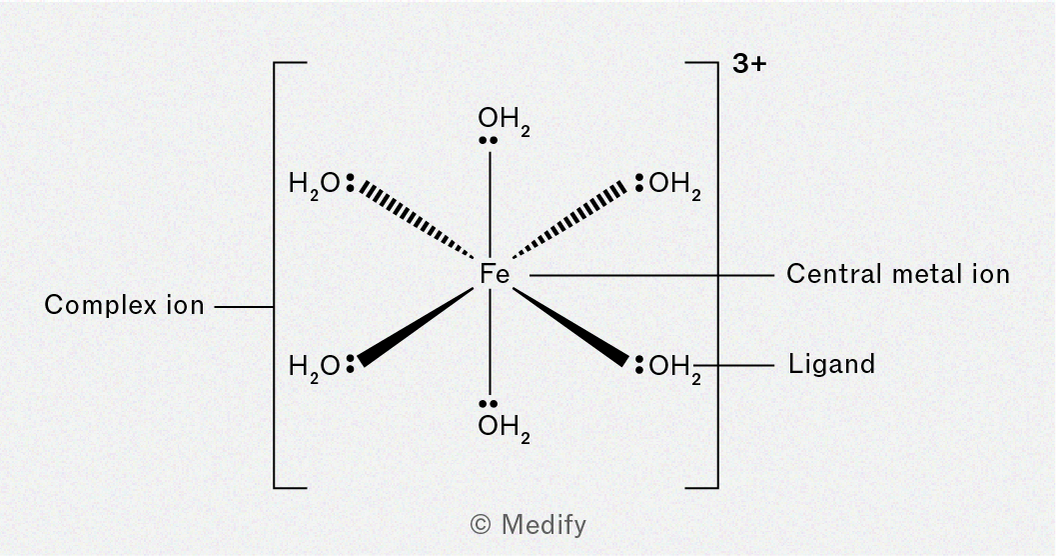
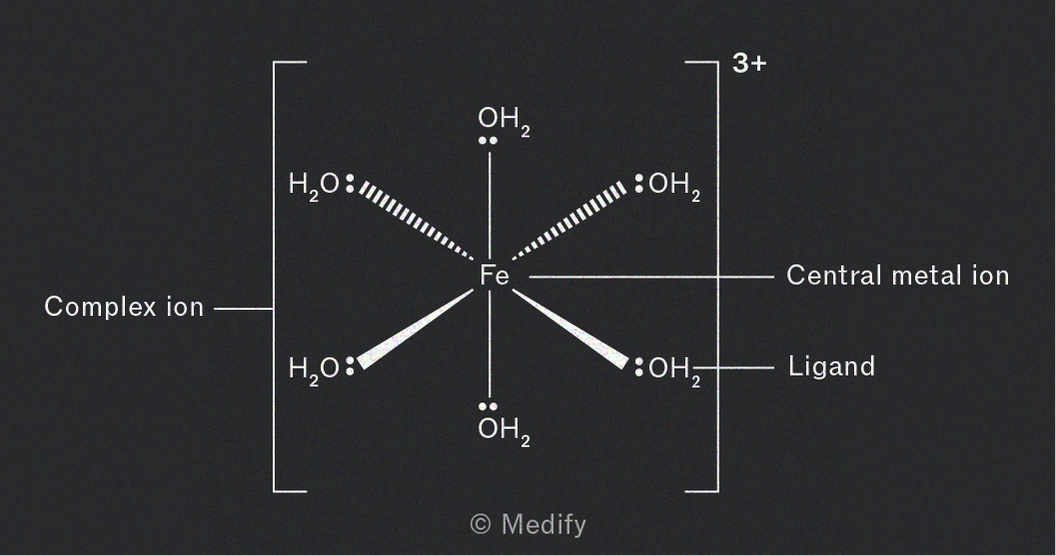
Complex ions have a net charge – the sum of the charges of the ligands and the oxidation state of the metal centre.
Transition metals can form complexes with ligands.
Coordination complexes consist of a central metal ion coordinately bonded to ligands. The complexes can be charged (complex ions) or neutral.
As transition metals have variable oxidation states, they can form complexes with different coordination numbers.
Below is a transition metal complex ion, .
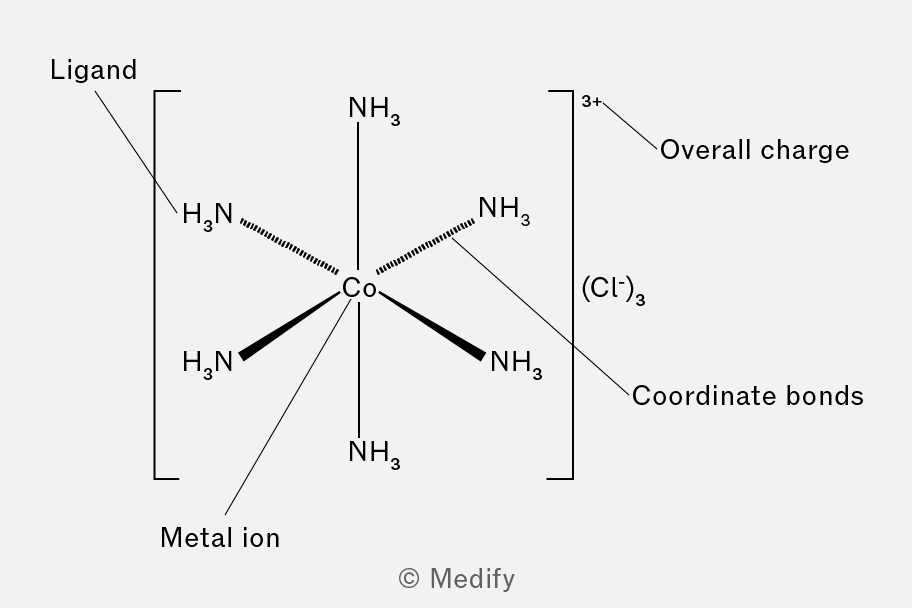
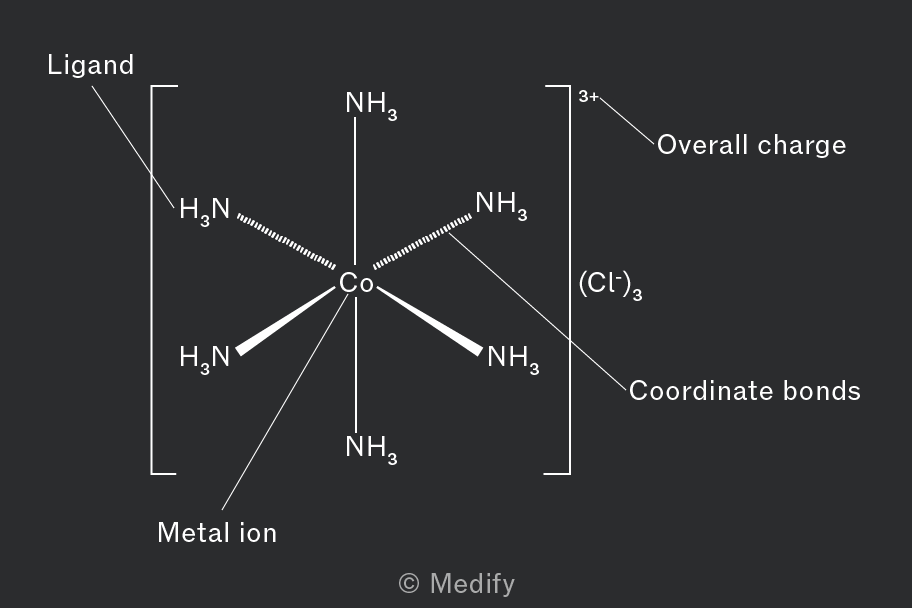
Square brackets are used to represent the complex ions.
Transition metals form coloured compounds.
The incompletely filled d orbitalof the transition metal ion results in transition metal complexes having distinct colours, depending upon the complex ion formed, e.g. copper(II) sulphate is blue.
Visible light can be absorbed by the partially filled d orbitals.
Colours in transition metals arise due to d–d electron transitions.
In a complex ion, orbital overlap with ligands splits the d orbital energies into two levels.
Visible light is absorbed to promote an electron from a lower to a higher d orbital.
The wavelength of the light absorbed is linked directly to the size of the energy gap between the d orbitals.
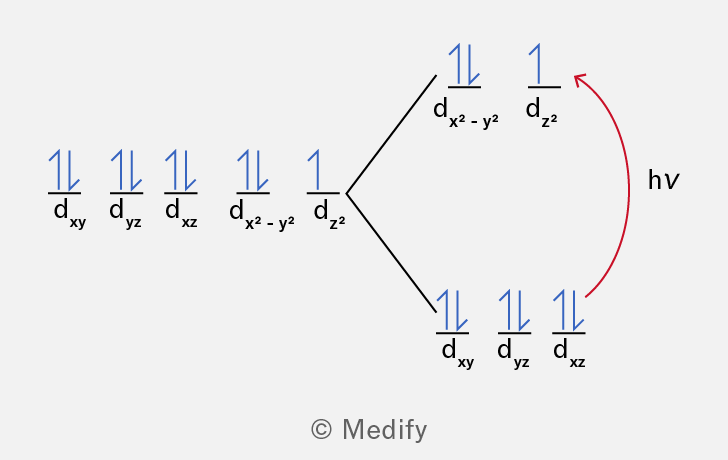
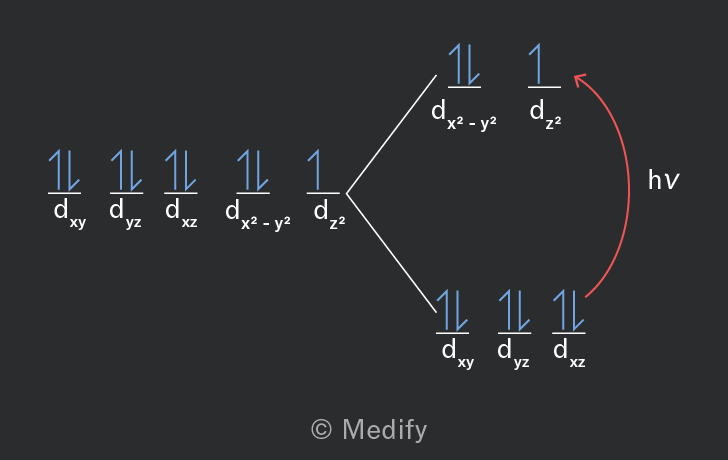
All the remaining light is observed.
The colour observed is the complementary colour of the light absorbed.
The colours in transition metals arise from the d–d transitions, when d orbital electrons move from a lower energy d orbital to a higher more excited state.
Some aqueous ions and complex ions are colourless.
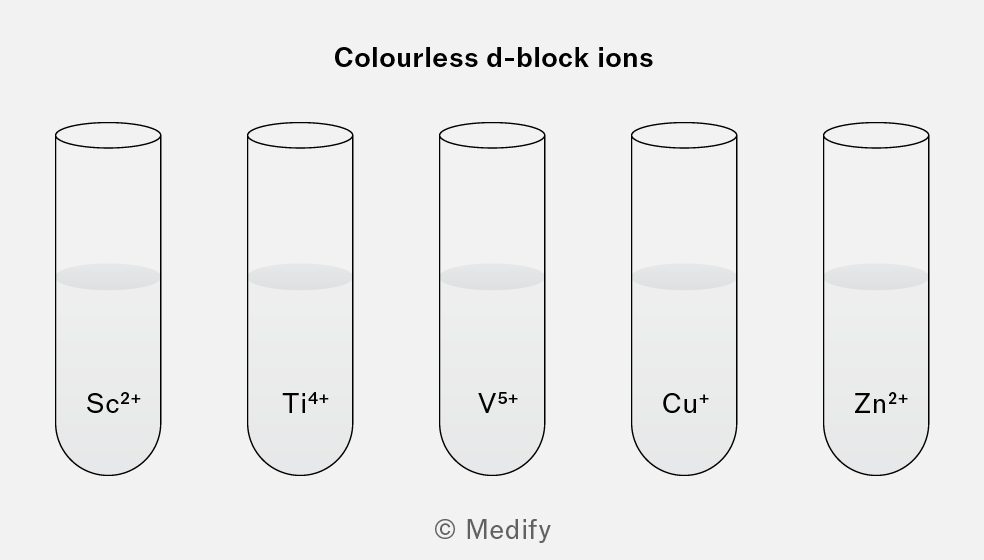
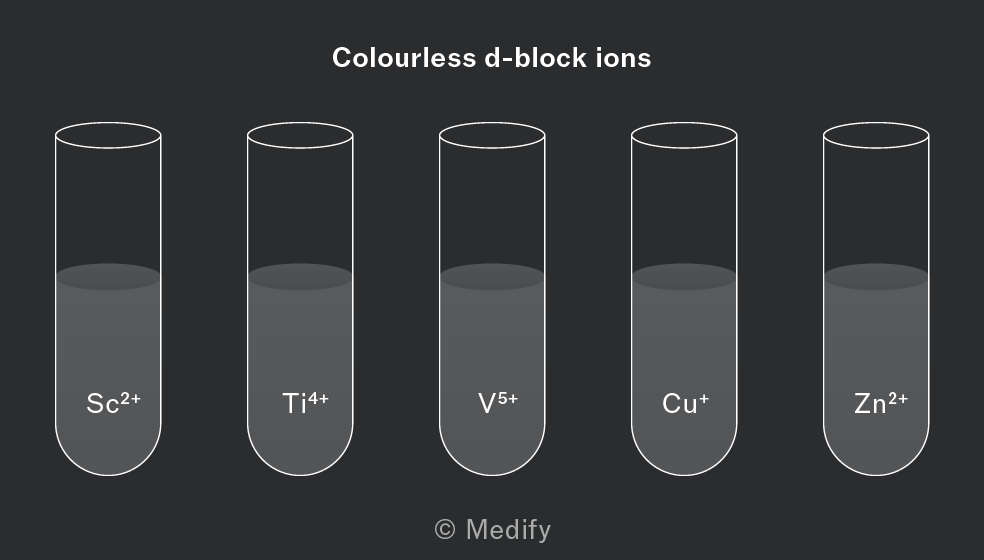
Zinc and scandium are d-block elements but not transition metals. They form colourless complexes.
In , there are no available empty orbitals for d–d transitions so no light is absorbed; all the d orbitals are full.
In , there are no electrons available to excite, so the ion is colourless; all the d orbitals are empty.
has fully occupied d orbitals like and is therefore also colourless.
and have no d electrons like and are therefore also colourless.
Factors altering , and therefore leading to colour changes in transition metal complexes, are:
- a change in oxidation state,
- a change in coordination number,
- a change in ligand.
A increase in oxidation state increases of d–d transitions:
- increases the positive charge on the metal ion, resulting in greater ligand attraction,
- causing a larger splitting of the d orbitals, increasing due to the increased repulsion between the ligands and the d electrons.
- and have different colours due to absorbing light at different wavelengths. The energy of a d–d transition is higher for than .
Change in coordination number alters of d–d transitions:
- Altering the coordination number changes the way the coordinate bonds overlap with the d orbitals.
- The energy levels of the d orbitals are directly related to overlap with the coordinate bonds.
- Different coordination numbers and/or shapes result in different of d–d transitions.
Ligand type alters ΔE of d–d transitions:
- Strong field ligands such as and create greater splitting of d orbitals leading to a higher of d–d transitions and absorption of light at shorter wavelengths.
- Weak field ligands such as and cause smaller splitting resulting in a lower and absorption of light at longer wavelengths.
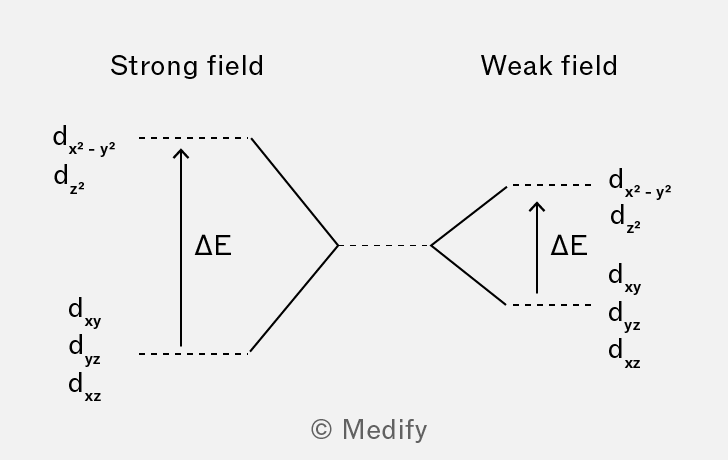
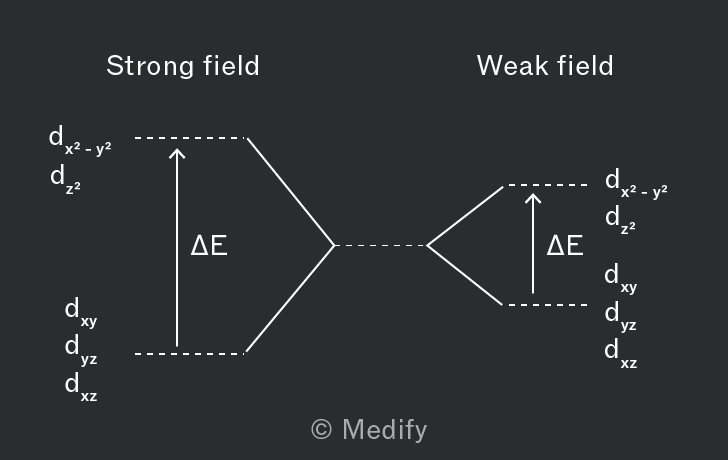
has weak field ligands, a smaller , and is green in colour.
has strong field ligands, a larger , and is yellow in colour.
The coordination number is the number of coordinate bonds formed between the ligand and the metal ion.
Ligands can be described as monodentate, bidentate, and multidentate, depending upon how many donor atoms have lone pairs that coordinately bond to a transition metal ion.
![Diagram illustrating the coordination complex [CoCl2(en)2]+, showing cobalt (Co) at the center bonded to two chloride (Cl) ions and two bidentate ethylenediamine (en) ligands, with annotations indicating the types of coordinate bonds: bidentate with 2 bonds and monodentate with 1 bond.](https://d3nzlfkeryzt6j.cloudfront.net/4qpp1e90ta9qarhe9ay5i81mr550)
![Diagram illustrating the coordination complex [CoCl2(en)2]+, showing cobalt (Co) at the center bonded to two chloride (Cl) ions and two bidentate ethylenediamine (en) ligands, with annotations indicating the types of coordinate bonds: bidentate with 2 bonds and monodentate with 1 bond.](https://d3nzlfkeryzt6j.cloudfront.net/2ezypr95jrpv1t1i28jupzrn58st)
The suffix dentate comes from the Latin word ‘dens’ meaning tooth. The denticity of ligands relates to how many points they can ‘bite’ with.
A monodentate ligand contains one donor atom with a lone pair of electrons and forms one coordinate bond with the metal ion.
Below is a table listing the common monodentate ligands and their charges.
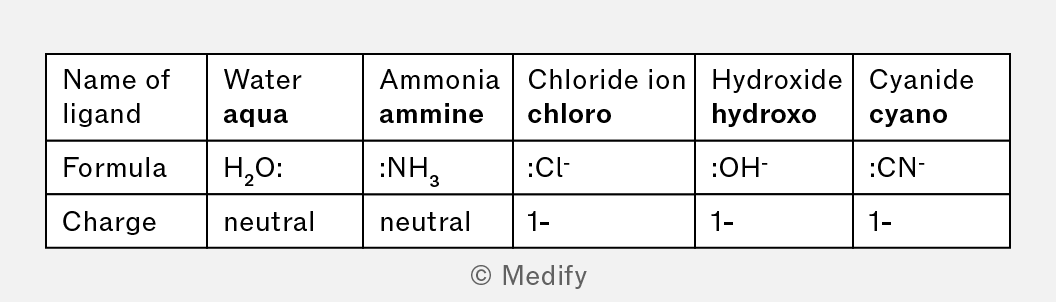
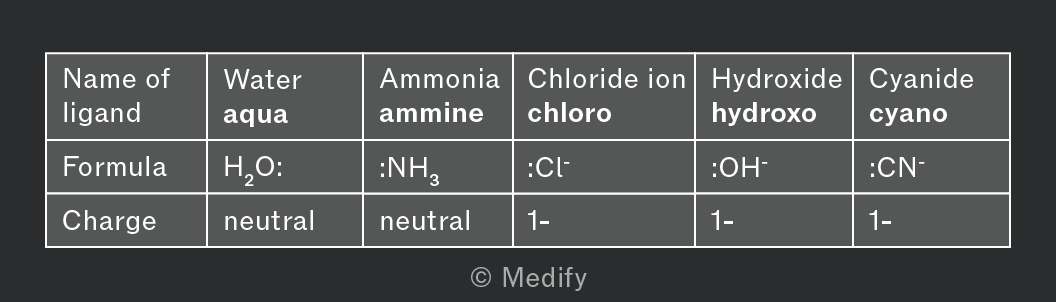
Monodentate: ‘one tooth’.
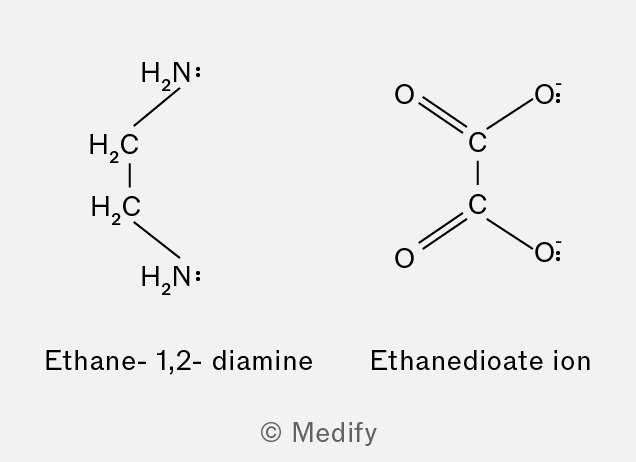
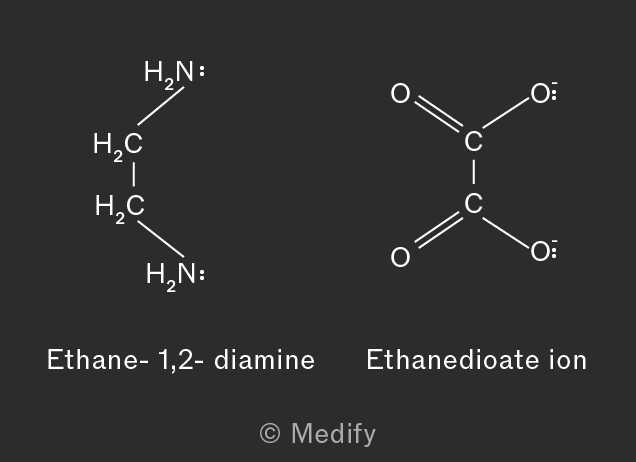
A bidentate ligand contains two donor atoms and forms two coordinate bonds with the metal ion.
Ethane-1,2-diamine (en) and ethanedioate ion are both examples of bidentate ligands.
Ethane-1,2-diamine bonds via the lone pairs on the amine groups and is a neutral ligand.
Ethanedioate bonds via the lone pairs on the oxygens and is an anion with a charge.
The image below shows the lone pairs available to form coordinate bonds and the spatial arrangement, allowing both pairs to orientate towards a central metal.
Bidentate: ‘two teeth’.
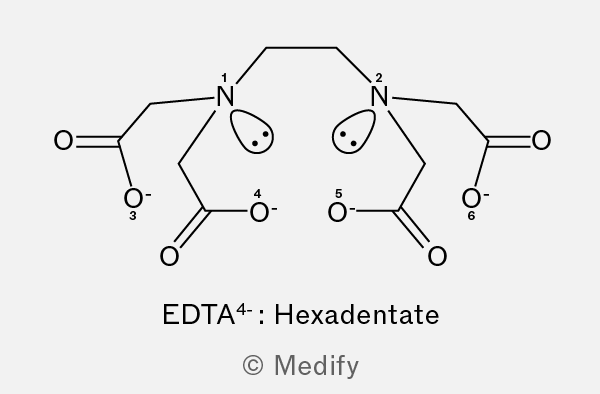
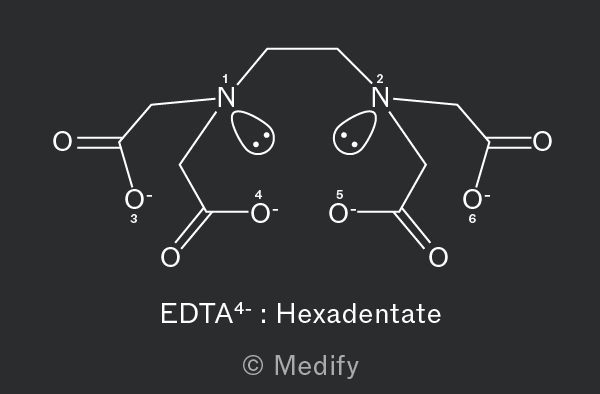
A multidentate ligand contains many donor atoms and forms many coordinate bonds.
EDTA is able to form six coordinate bonds.
Four-fold coordination
Transition metal ions with four coordinately bonded ligands can either adopt a tetrahedral or square planar geometry.
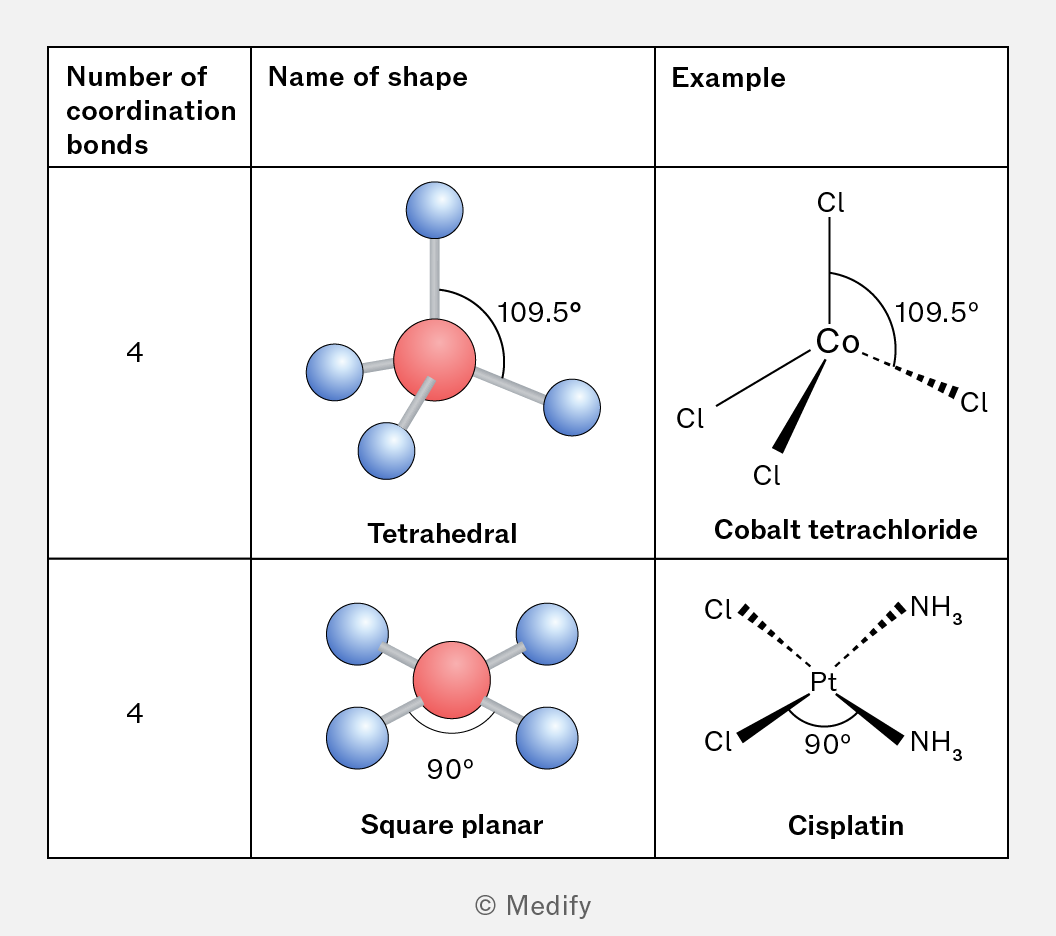
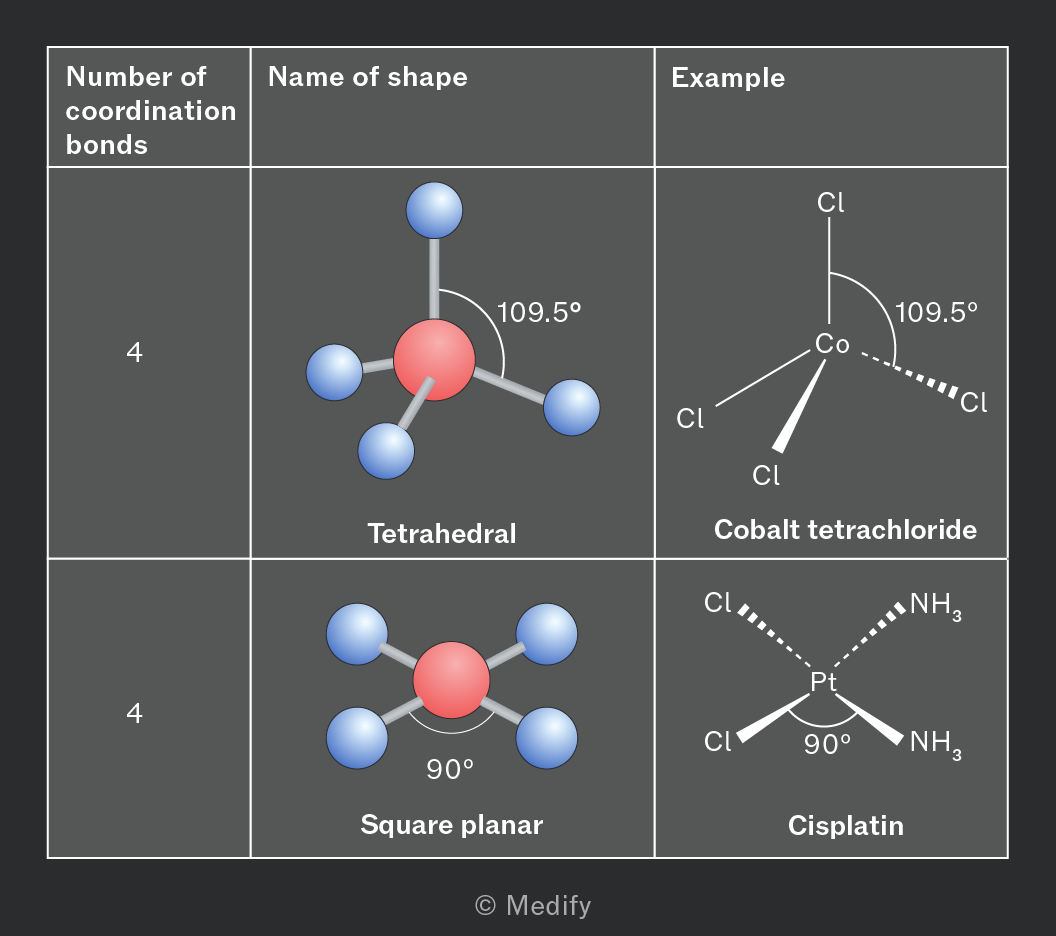
Most tetrachloro complexes are tetrahedral due to the large size of the chloride ion forcing a larger bond angle of 109.5°.
Square planar geometry is common in nickel and platinum complexes.
Six-fold coordination
Transition metal ions with six coordinately bonded ligands have an octahedral shape.
![A diagram illustrating the octahedral shape in coordination chemistry. It shows a central atom represented by a red sphere, surrounded by six blue spheres indicating ligands, with angles of 90 degrees between them. The table includes the number of coordination bonds (6), the name of the shape (Octahedral), and an example of the complex ion [Fe(H2O)6]3+ with water molecules as ligands.](https://d3nzlfkeryzt6j.cloudfront.net/kkq0hupmio0mem7w3iclba4ulnon)
![A diagram illustrating the octahedral shape in coordination chemistry. It shows a central atom represented by a red sphere, surrounded by six blue spheres indicating ligands, with angles of 90 degrees between them. The table includes the number of coordination bonds (6), the name of the shape (Octahedral), and an example of the complex ion [Fe(H2O)6]3+ with water molecules as ligands.](https://d3nzlfkeryzt6j.cloudfront.net/e7jbj452e6axzej3cjke921sctop)
Cis-platin is an effective anticancer drug.
It is only the cis isomer of the platinum complex that is effective.
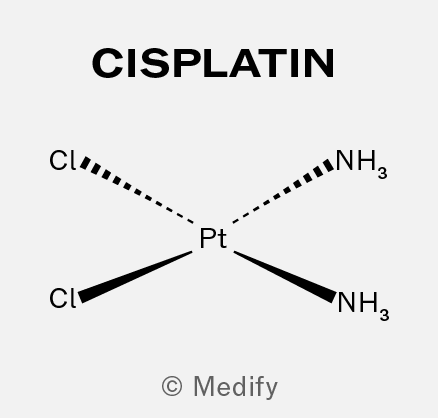
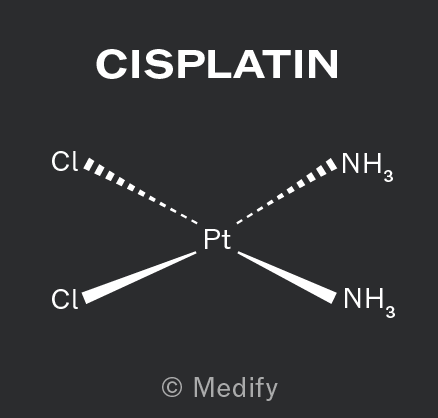
Trans-platin is not a suitable alternative or accompaniment for cis-platin; it is clinically ineffective but still produces toxic side effects.
Cis-platin is used as a single isomer in chemotherapy due to its ability to efficiently form effective cross links in cancer cell DNA, disrupting cell function and leading to cell death.
Trans-platin has a trans configuration, where the two chloride ions are opposite each other. This configuration does not allow effective cross-linking between adjacent DNA bases as the spatial arrangement of the ligands prevents it from forming the same types of bonds with DNA.
Not only is trans-platin ineffective, it also has similar side effects to cis-platin and so is excluded from the chemotherapy mixture completely.
Haemoglobin is an oxygen carrying molecule found in red blood cells.
The haemoglobin molecule contains four polypeptide chains, at the centre of each of these polypeptide chains is a haem complex.
In the centre of each haem complex there is an ion within a multidentate ligand.
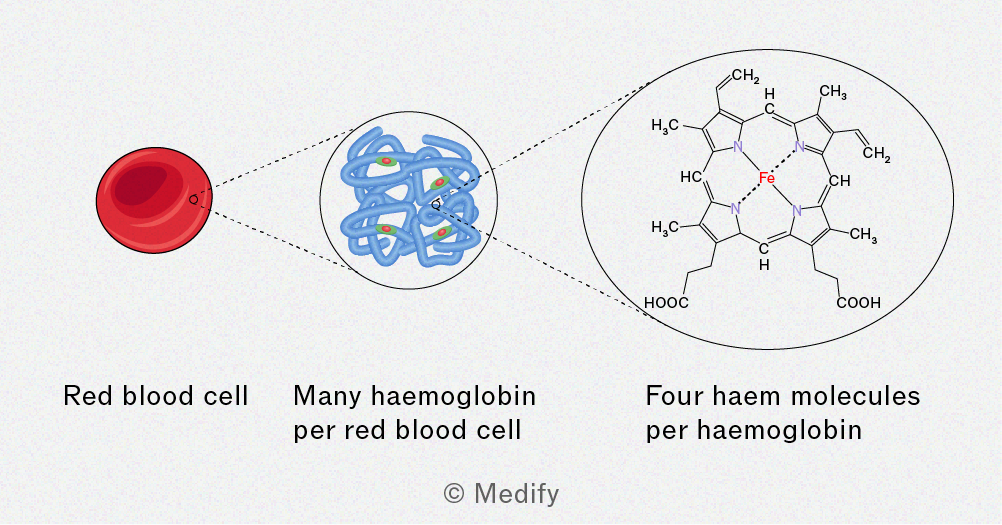
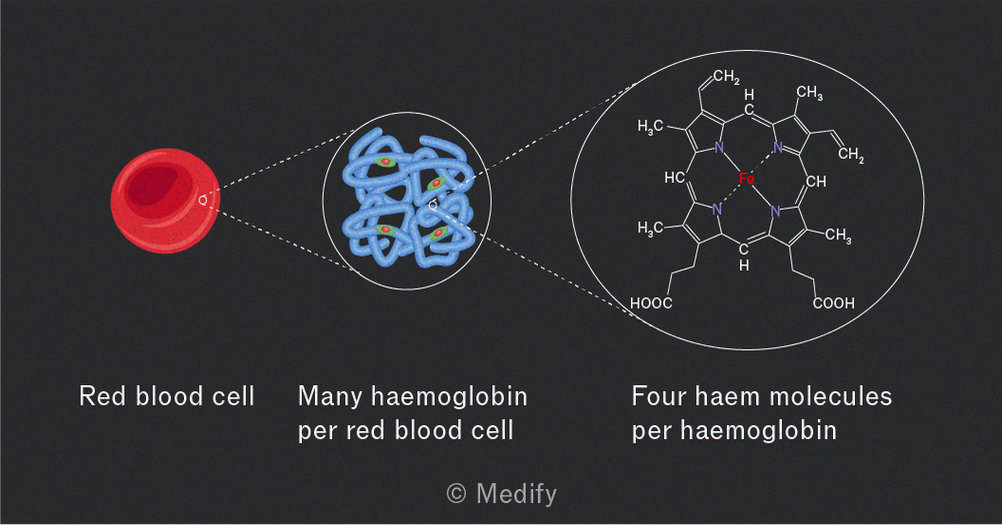
The role of iron in haemoglobin
The ions in the haem molecules bind reversibly with to form oxyhaemoglobin.
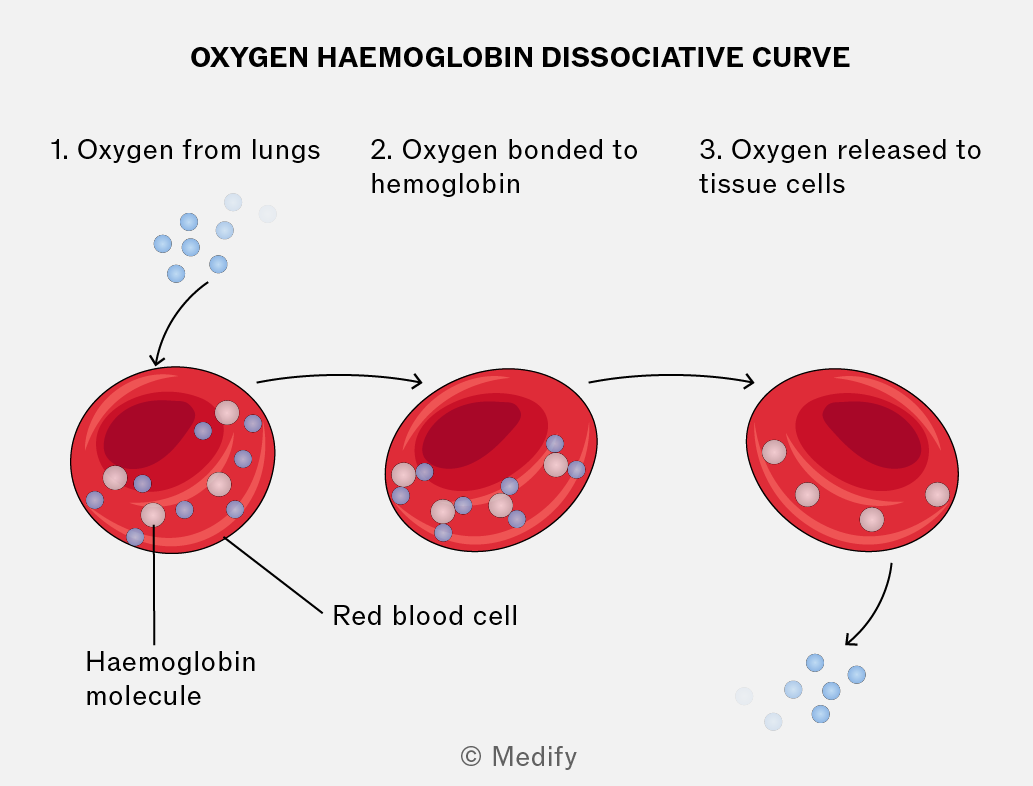
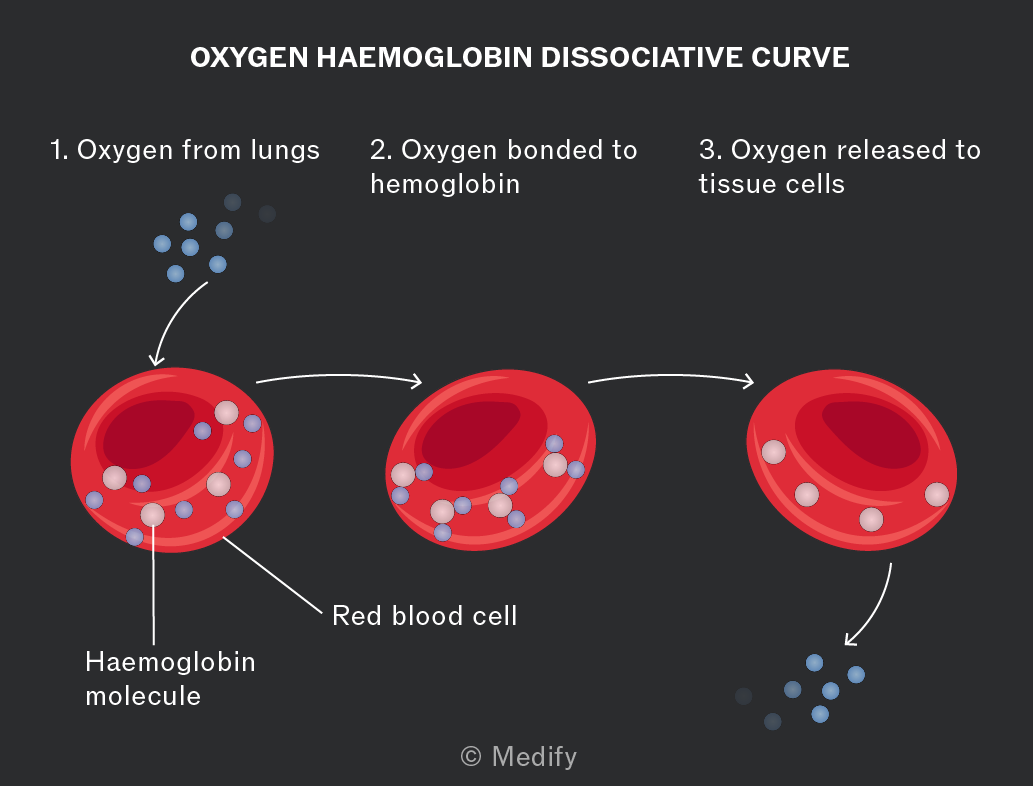
Each haemoglobin unit can bind to four molecules of oxygen. This exchange takes place in the lungs.
The oxygen acts as a ligand and forms a coordinate bond with the .
The oxygen is transported to the cells via haemoglobin, where it can be release.
Carbon monoxide () can also act as a ligand to haemoglobin. It binds to haemoglobin at the same binding site as oxygen.
The coordinate bond between carbon monoxide and haemoglobin is much more stable than the coordinate bond with oxygen.
Equilibrium sits towards the carboxyhaemoglobin product preventing dissociation.
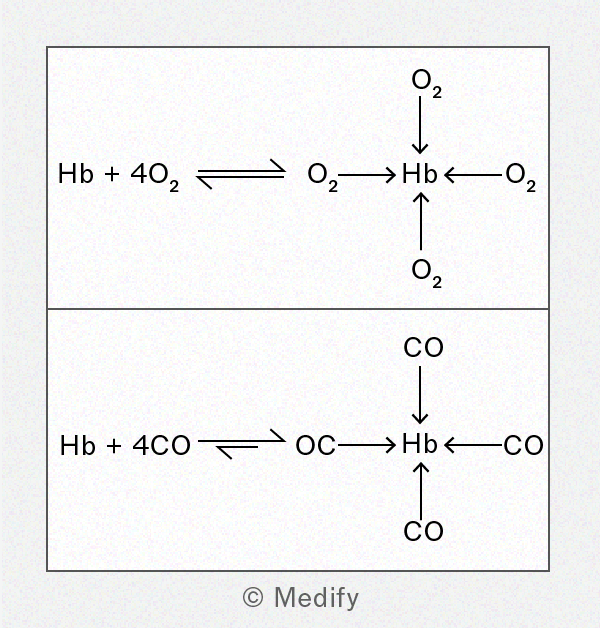
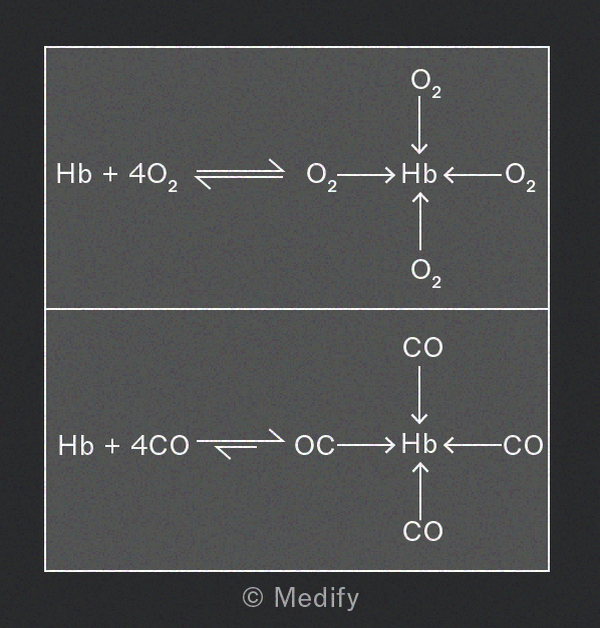
If the haemoglobin is occupied with carbon monoxide less oxygen is transported in the blood, which results in tissues being starved of oxygen and leads to carbon monoxide poisoning.