
Reactions of transition metal elements (Topic 15B)
On this page
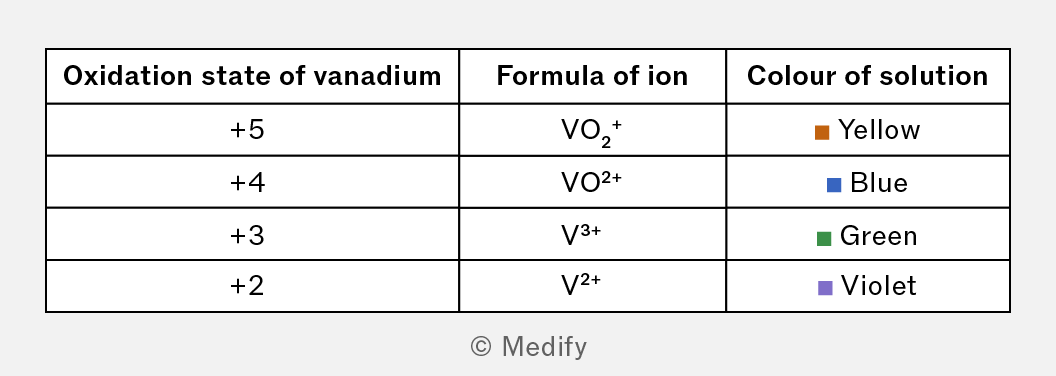
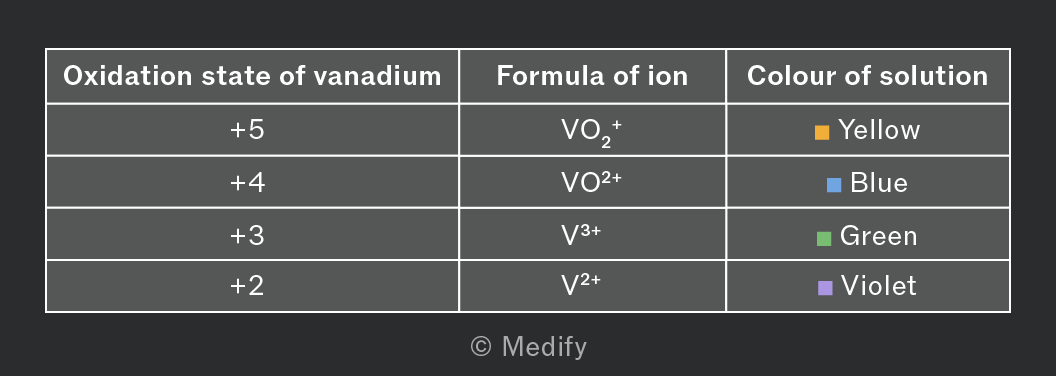
The variable oxidation states of vanadium can be observed when zinc is reacted with the vanadate ion, , under acidic conditions.
As the reaction progresses the vanadium species are successively reduced by zinc.
- Zinc is oxidised to and acts as a reducing agent.
- is colourless and therefore does not impact the solution colour.
- The reduction takes place in acidic conditions.
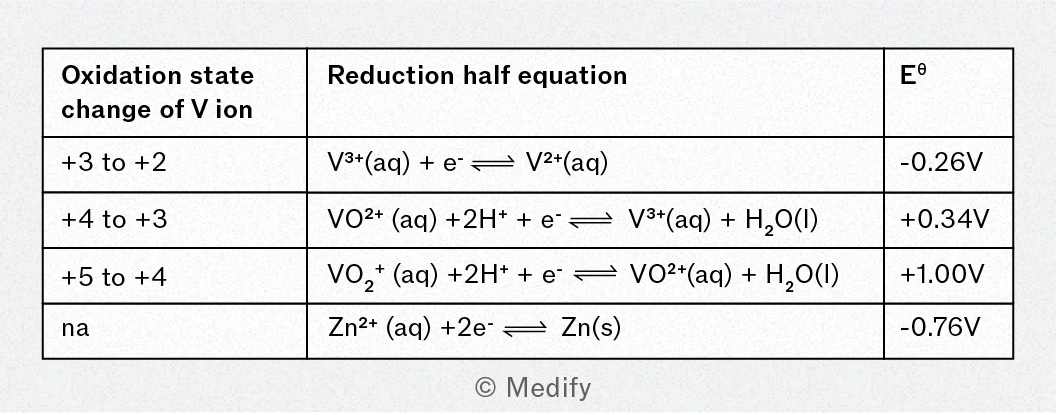
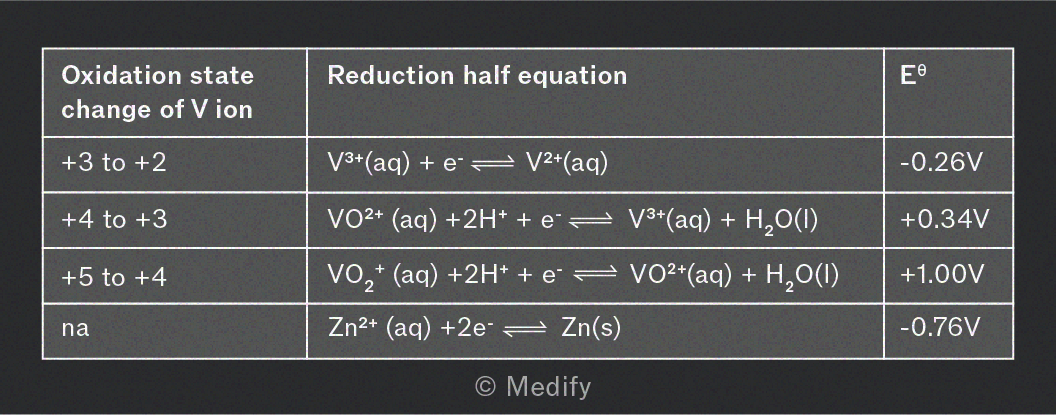
The electrode (redox) potential measures the tendency of a transition metal ion to be reduced, changing from a higher to a lower oxidation state.
When determining the oxidation and reduction reactions for redox, the values for the electrode potential can be used.
The reduction half equation with the more positive electrode potential () is favourable. This means that the ion is more easily reduced and is a stronger oxidising agent; this would be the reduction reaction.
The reduction half equation with a more negative electrode potential () is less favourable. This means that the ion is more easily oxidised and is a stronger reducing agent; this would be the oxidation reaction.
When combining the half equations, ensure the number of electrons are balanced.
In the oxidation of to by hydrogen peroxide:
- is oxidised to (oxidation state 6+).
- The hydrogen peroxide gains electrons and acts as the oxidising agent.
- The reaction requires heat and alkaline conditions.
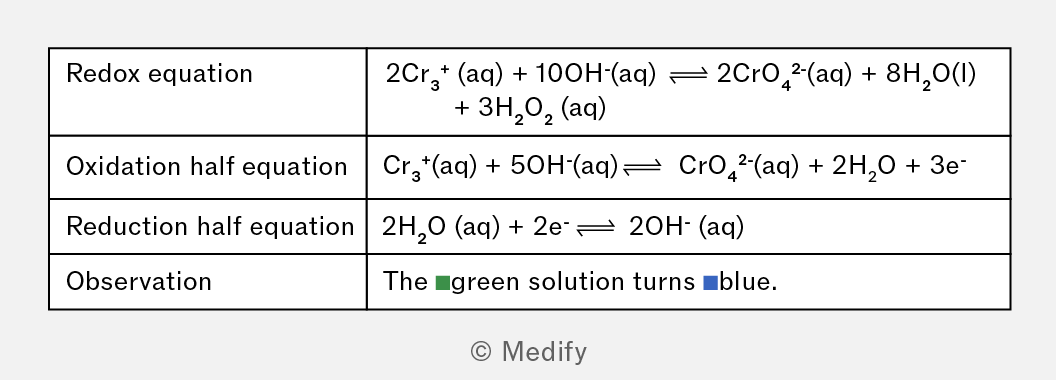
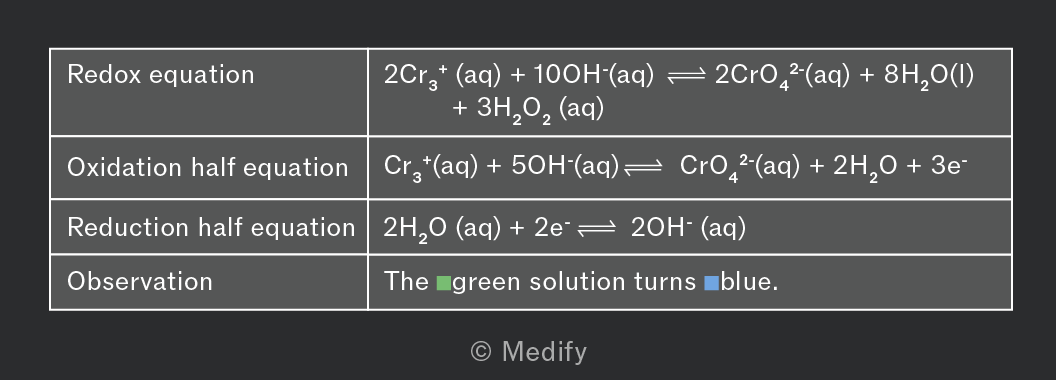
Balancing the electrons from the half ionic equations creates a balanced ionic equation.
The reaction with a more positive electrode potential () means that the ion is more easily reduced and is a stronger oxidising agent, so this would be the reduction reaction.
The reaction with a more negative electrode potential () means that the ion is more easily oxidised and is a stronger reducing agent, so this would be the oxidation reaction.
- Acidified dichromate (VI) ions () can be reduced to .
- Zinc (s) is used as a powerful reducing agent.
- The oxidation state of chromium in is 6+ and is reduced to 3+ in .
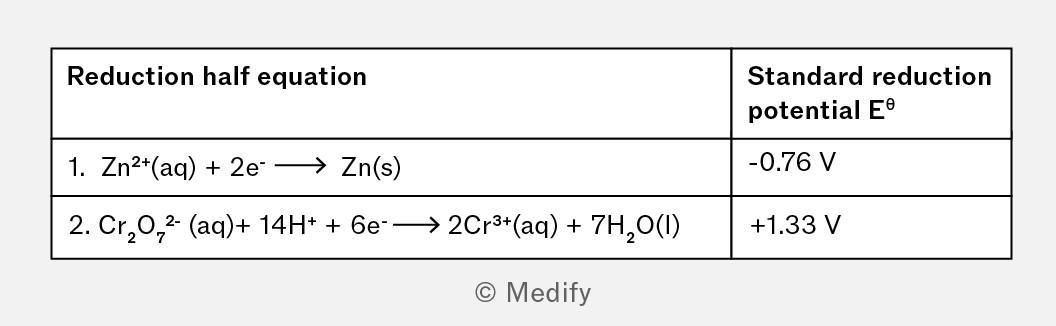
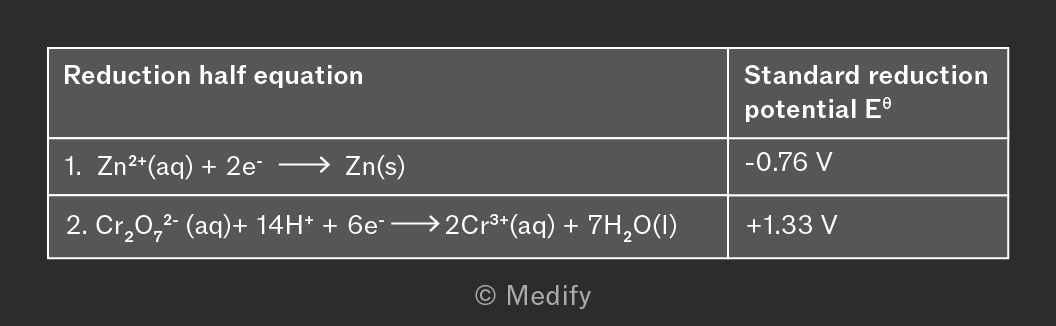
Half equation 1 has the least positive electrode potential and therefore we reverse this reaction to represent the oxidation reaction.
Half equation 2 has the most positive standard electrode potential and therefore represents the reduction reaction.
When combining half equations, the number of electrons should be the same, so the equations have been multiplied accordingly.
Overall redox reaction:
The orange solution turns green.
The reaction with a more positive electrode potential () means that the ion is more easily reduced and is a stronger oxidising agent, so this would be the reduction reaction.
The reaction with a more negative electrode potential () means that the ion is more easily oxidised and is a stronger reducing agent, so this would be the oxidation reaction.
Oxidation of to .
- Hydrogen peroxide in alkaline conditions is used as an oxidising agent.
- Chromium is oxidised from +3 oxidation state in to + 6 in .
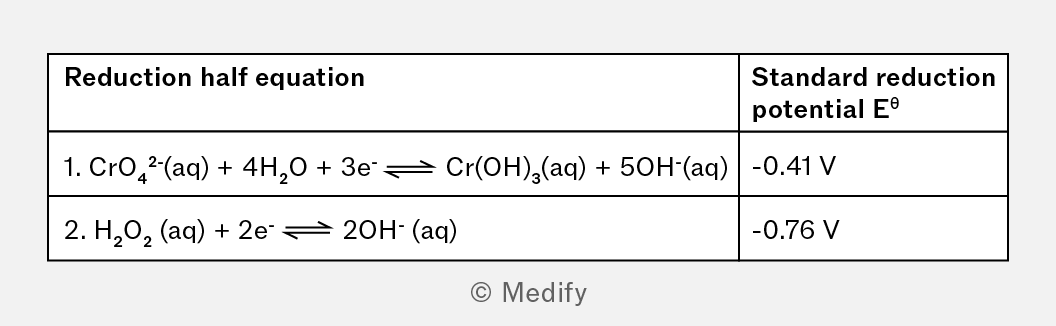
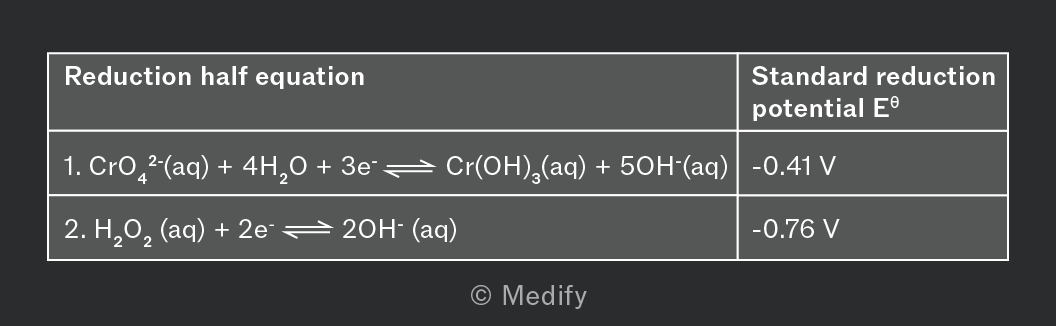
Half equation 1 has the least positive electrode potential and therefore we reverse this reaction to represent the oxidation reaction.
Half equation 2 has the most positive standard electrode potential and therefore represents the reduction reaction.
When combining half equations, the number of electrons should be the same, so the equations are multiplied accordingly.
Overall balanced redox reaction:
The equilibrium between chromate ions () and dichromate ions () is dependent upon
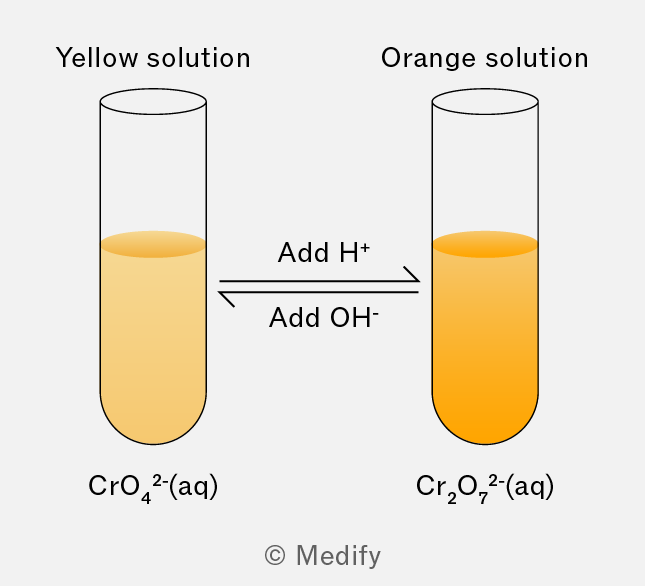
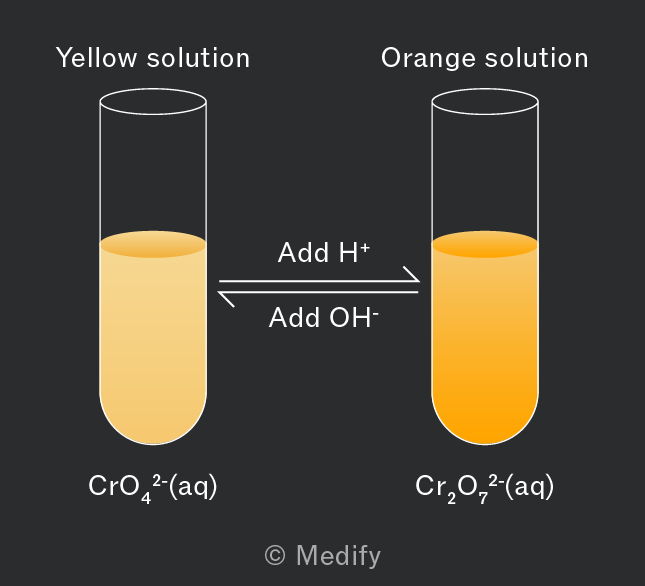
- In acidic conditions, the equilibrium shifts to the right forming dichromate ions.
- In alkaline conditions, the equilibrium shifts to the left to form chromate ions.
- The chromate ions are yellow and dichromate are orange.
- This is not a redox reaction as both ions have the oxidation number of +6. The colour change is linked to a change in the complex’s shape.
When is added dropwise to a pale blue solution of , a blue precipitate is initially formed, which is then converted to a deep blue solution as an excess of ammonia is added.
![A diagram illustrating the reaction of copper(II) ions with ammonia. The first test tube shows a pale blue solution of [Cu(H2O)6]2+(aq). The second test tube depicts a blue precipitate of Cu(H2O)4(OH)2(s) after adding a small amount of ammonia. The third test tube displays a deep blue solution of [Cu(NH3)4(H2O)2]2+(aq) after adding an excess of ammonia.](https://d3nzlfkeryzt6j.cloudfront.net/ijafpn0jl6fc1hhbv6yxzmo0mhk5)
![A diagram illustrating the reaction of copper(II) ions with ammonia. The first test tube shows a pale blue solution of [Cu(H2O)6]2+(aq). The second test tube depicts a blue precipitate of Cu(H2O)4(OH)2(s) after adding a small amount of ammonia. The third test tube displays a deep blue solution of [Cu(NH3)4(H2O)2]2+(aq) after adding an excess of ammonia.](https://d3nzlfkeryzt6j.cloudfront.net/p9nl0qbzvvggktjsz97kt30ewpkh)
Step 1: Ammonia acts as a base and deprotonates water.
Step 2: Ligand substitution with ammonia.
As , , and are all a similar small size all the copper complexes have a coordination number of six and an octahedral geometry.
When is added dropwise to a pale blue solution of , a blue precipitate is formed. This precipitate does not dissolve in excess .
The acts as a base and deprotonates two molecules of water in the complex, forming .
This uncharged complex is insoluble in water and therefore a precipitate is formed.
![A diagram showing the reaction between a pale blue aqueous solution of [Cu(H2O)6]2+ and NaOH, resulting in the formation of a blue precipitate of Cu(H2O)4(OH)2. The left test tube contains the pale blue solution, while the right test tube shows the blue precipitate.](https://d3nzlfkeryzt6j.cloudfront.net/pm3pt9caxan5onyo946t5vjrd4jp)
![A diagram showing the reaction between a pale blue aqueous solution of [Cu(H2O)6]2+ and NaOH, resulting in the formation of a blue precipitate of Cu(H2O)4(OH)2. The left test tube contains the pale blue solution, while the right test tube shows the blue precipitate.](https://d3nzlfkeryzt6j.cloudfront.net/dn0mmhstvna1z5aaj6un36sst9ax)
When an excess of is added to a pale blue solution of the solution turns yellow.
![A diagram showing two test tubes. The left test tube contains a pale blue solution labeled [Cu(H2O)6]2+(aq), and the right test tube contains a yellow solution labeled [CuCl4]2-(aq). An arrow indicates the reaction between the two solutions with concentrated HCl.](https://d3nzlfkeryzt6j.cloudfront.net/fjbla88j6rrh1qn5b5ydb2k9kx4r)
![A diagram showing two test tubes. The left test tube contains a pale blue solution labeled [Cu(H2O)6]2+(aq), and the right test tube contains a yellow solution labeled [CuCl4]2-(aq). An arrow indicates the reaction between the two solutions with concentrated HCl.](https://d3nzlfkeryzt6j.cloudfront.net/0f6k4gbqizqlbgzgjev445h2g6k4)
Chloride ions are larger than water ligands, so fewer chloride ions can fit around the copper ion. This is why the shape (octahedral to tetrahedral) and coordination number (6 to 4) of the complex ion changes.
When is added dropwise to a violet solution of , a grey-green precipitate is formed.
In excess the grey-green precipitate dissolves to form a green solution.
![A diagram illustrating the chemical reactions of chromium ions in aqueous solutions. The first test tube contains a violet solution of [Cr(H2O)6]3+(aq). The second test tube shows a grey/green precipitate of [Cr2O3(OH)3](s) after the addition of NaOH solution. The third test tube displays a green solution of [Cr(OH)6]3-(aq) after the addition of excess NaOH solution.](https://d3nzlfkeryzt6j.cloudfront.net/x7s7jkfk3a4a0mjuvblaiqfog4yd)
![A diagram illustrating the chemical reactions of chromium ions in aqueous solutions. The first test tube contains a violet solution of [Cr(H2O)6]3+(aq). The second test tube shows a grey/green precipitate of [Cr2O3(OH)3](s) after the addition of NaOH solution. The third test tube displays a green solution of [Cr(OH)6]3-(aq) after the addition of excess NaOH solution.](https://d3nzlfkeryzt6j.cloudfront.net/m3tsgs86onbt0u4hp5ryinj4k0i3)
Step 1: Sodium hydroxide acts as a base and deprotonates water molecules in the complex.
Step 2: In excess sodium hydroxide, more hydrogen ions are removed and the precipitate becomes an ion and dissolves.
Water and hydroxide ions are similar in size and therefore there is no change in coordination number or geometry during this reaction.
When is added dropwise to a violet solution of a grey/green precipitate is initially formed which is then converted to a purple solution as an excess of ammonia is added.
![Illustration showing the chemical reactions of chromium complexes in three test tubes. The first test tube contains a violet solution of [Cr(H2O)6]3+(aq). The second test tube shows a grey/green precipitate of [Cr(H2O)3(OH)3](s) after adding a small amount of ammonia, indicated as acting as a base. The third test tube displays a purple solution of [Cr(NH3)6]3+(aq) after an excess of ammonia is left to stand, illustrating a ligand exchange reaction.](https://d3nzlfkeryzt6j.cloudfront.net/9zy0lzxqn591u73v5eduqyf60wzc)
![Illustration showing the chemical reactions of chromium complexes in three test tubes. The first test tube contains a violet solution of [Cr(H2O)6]3+(aq). The second test tube shows a grey/green precipitate of [Cr(H2O)3(OH)3](s) after adding a small amount of ammonia, indicated as acting as a base. The third test tube displays a purple solution of [Cr(NH3)6]3+(aq) after an excess of ammonia is left to stand, illustrating a ligand exchange reaction.](https://d3nzlfkeryzt6j.cloudfront.net/2d3z65i0u7u4eiribbvk75c235q7)
Step 1: Ammonia acts as a base and deprotonates water.
Step 2: Ligand substitution with ammonia.
Water, hydroxide ions, and ammonia are similar in size and therefore there is no change in coordination number or shape during this reaction.
When an aqueous transition metal ion reacts with an alkali, a coloured precipitate is initially formed.
This is because the base initially deprotonates water to form an insoluble complex with a zero charge.
Where there is an excess of sodium hydroxide or ammonia, complex ions, from ligand exchange, can be formed in solution.
When or is added dropwise to a pale green solution of , a green precipitate of iron (II) hydroxide is formed.
![A diagram illustrating the transformation from a pale green solution of [Fe(H2O)6]2+(aq) to a green precipitate of Fe(OH)2(H2O)4(s). The left test tube shows the pale green solution, while the right test tube displays the green precipitate.](https://d3nzlfkeryzt6j.cloudfront.net/aqcbx1sxu82gs82bslapwn97t391)
![A diagram illustrating the transformation from a pale green solution of [Fe(H2O)6]2+(aq) to a green precipitate of Fe(OH)2(H2O)4(s). The left test tube shows the pale green solution, while the right test tube displays the green precipitate.](https://d3nzlfkeryzt6j.cloudfront.net/qmghyn8da44b7xma72uwscp8xc4b)
Ionic equation for the precipitation reaction of with or :
In excess or , the green precipitate does not dissolve.
In air, the turns rusty brown, as the ions are oxidised to .
When or is added dropwise to a pale pink solution of , a rusty brown precipitate of iron (III) hydroxide is formed.
In excess or , the rusty brown precipitate does not dissolve.
Ionic equation for the precipitation reaction of with or :
![A diagram illustrating a chemical reaction. On the left, a test tube contains a pale pink solution labeled [Fe(H2O)6]3+(aq). An arrow points to the right, where a second test tube shows a rusty brown precipitate labeled Fe(OH)3(H2O)3(s).](https://d3nzlfkeryzt6j.cloudfront.net/meir0cub7l5b31f46wh62s2bg0i6)
![A diagram illustrating a chemical reaction. On the left, a test tube contains a pale pink solution labeled [Fe(H2O)6]3+(aq). An arrow points to the right, where a second test tube shows a rusty brown precipitate labeled Fe(OH)3(H2O)3(s).](https://d3nzlfkeryzt6j.cloudfront.net/1wdcxiifp67rv88z260ienzfh8hb)
When is added dropwise to a pink solution of a blue precipitate is initially formed, this precipitate remains insoluble in excess .
On standing, the precipitate changes colour to brown.
Sodium hydroxide acts as a base and deprotonates the water ligands attached to the cobalt .
![A diagram illustrating the chemical reaction of cobalt ions in solution. The first test tube shows a pink solution labeled [Co(H2O)6]2+(aq). The second test tube displays a blue precipitate formed after adding NaOH solution, with an arrow indicating the reaction. The third test tube shows a brown precipitate that forms on standing, labeled [Co(H2O)4(OH)2](aq), indicating a color change over time.](https://d3nzlfkeryzt6j.cloudfront.net/8n1phablwz934gzksfkifa4iv20r)
![A diagram illustrating the chemical reaction of cobalt ions in solution. The first test tube shows a pink solution labeled [Co(H2O)6]2+(aq). The second test tube displays a blue precipitate formed after adding NaOH solution, with an arrow indicating the reaction. The third test tube shows a brown precipitate that forms on standing, labeled [Co(H2O)4(OH)2](aq), indicating a color change over time.](https://d3nzlfkeryzt6j.cloudfront.net/jlwvlyiw8m2y1akq5nkdt0i5bf3l)
Amphoteric hydroxides are metal hydroxides that can react with both acids and bases, displaying both acidic and basic properties.
Transition metal hydroxides are often amphoteric hydroxides. They are formed from the reaction of the hydrated metal ions with a base such as ammonia or sodium hydroxide.
In acidic conditions, the transition metal hydroxide will act as a base whereas in alkaline conditions, the hydroxide will act as an acid, and can form complex ions.
A ligand substitution reaction is one in which a ligand in a complex ion is replaced by another ligand.
If a ligand is substituted with another ligand of similar size, the coordination number and the geometry stays the same.
Ammonia and water ligands are similar in size and therefore ligand substitution does not result in a change in geometry.
The chloride ligand is larger than ammonia and water, therefore this ligand exchange can result in the coordination number and geometry changing; fewer chloride ions can fit around the complex ion.
Complexes with multidentate or bidentate ligands are more stable than complexes with monodentate ligands.
Ligand substitution reaction will occur to allow the substitution of monodentate ligands with those of higher denticity.
This is known as the chelate effect.
The enthalpy change for ligand substitution reactions is small.
Breaking bonds with monodentate ligands and forming bonds with multidentate ligands results in similar bond strengths therefore the enthalpy change .
However, the entropy change is significantly positive when multidentate ligands replace monodentate ligands.
There is more disorder in the system as there are more molecules in the products.
In terms of Gibbs free energy, the positive leads to a negative making the chelate effect thermodynamically favourable.
Aqueous iron(II) ions are used as a catalyst in the reaction between iodide ions and peroxodisulphate ions.
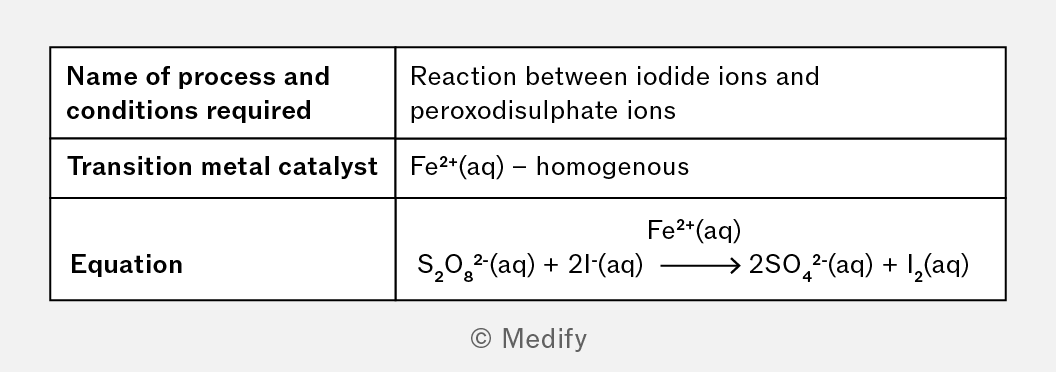
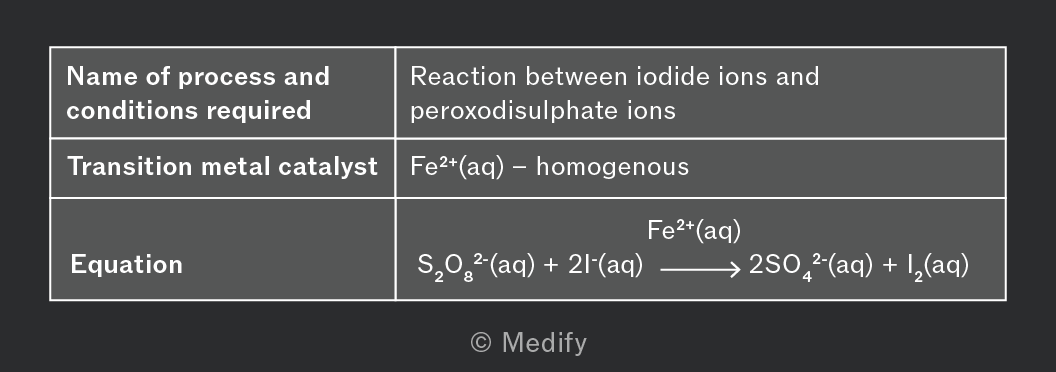
Homogeneous catalyst: The catalyst is in the same physical state as the reactants.
Autocatalysis occurs when one of the reaction products acts as a catalyst for the reaction.
In the redox titration between and , the ions act as an autocatalyst for the reaction.
Reaction equations:
The initial rate of reaction is slow. There is repulsion between the reacting species which are both negatively charged.
As soon as the is formed, the reaction rate increases. is oxidised to by .
can also oxidise ions. This reaction has a lower activation energy as the reactants are oppositely charged and do not repel.
The autocatalyst is regenerated in the reaction.
With heterogeneous catalysis the reaction occurs at active sites on the surface of a solid catalyst.
A support medium is used to:
- Maximise the surface area: By dispersing the catalyst onto a support medium such as alumina, the surface area available for the reaction is significantly increased. A larger surface area allows more reactant molecules to interact with the catalyst, enhancing the reaction rate.
- Minimise cost: The support medium is usually less expensive than using a large quantity of the catalyst alone, this reduces the amount of catalyst required.
Mechanism for homogeneous catalysis:
- The catalyst interacts with the reactants to form an intermediate complex. This step lowers the activation energy required for the reaction to occur.
- The intermediate undergoes a transformation to form the products.
- The catalyst is then regenerated.
This significantly speeds up reactions allowing for increased rate of production and/or lower operating temperatures with reduced energy costs.
Contact process: Oxidation of sulfur (IV) oxide to sulfur (VI) oxide to produce sulfuric acid.
High temperature, low pressure, vanadium (V) oxide – heterogeneous catalyst.
The oxidation state of vanadium goes from +5 to +4 and then back to +5.
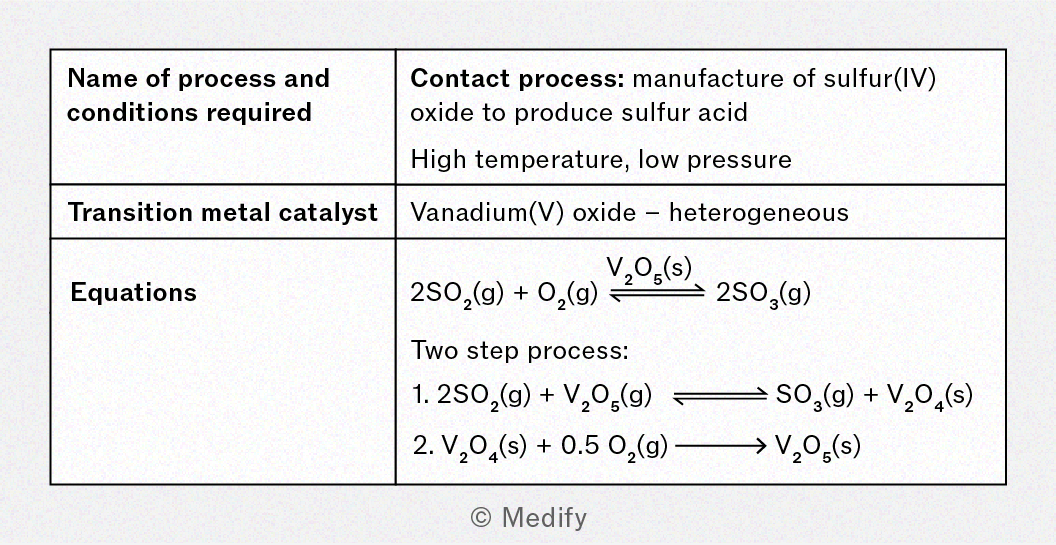
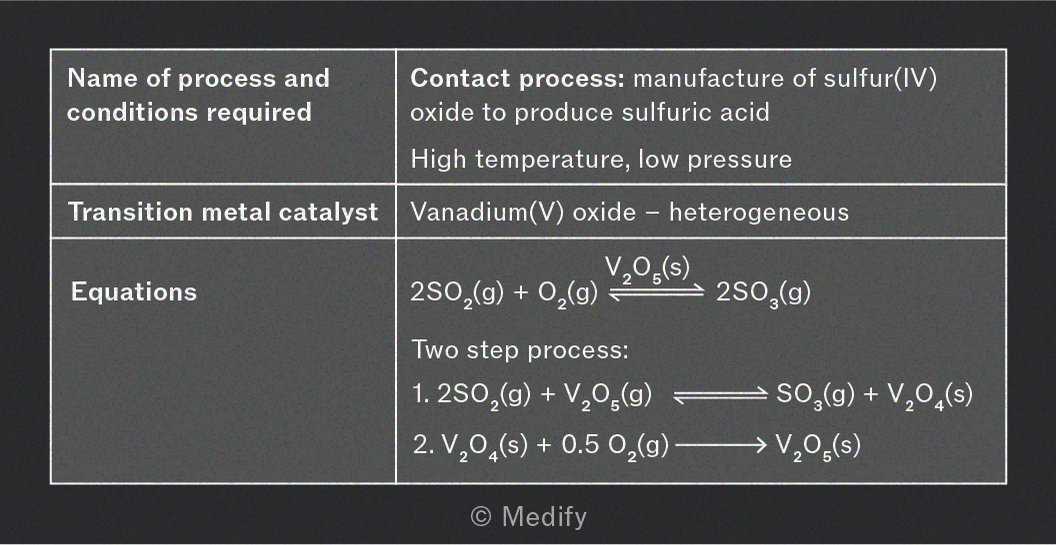
Heterogeneous catalyst: The catalyst is in a different physical state to the reactants and the reaction occurs at active sites on the surface.
Catalytic converters are heterogeneous catalysts. They reduce harmful emissions from vehicle exhaust gases, converting toxic pollutants into less harmful substances.
The pollutant gases like carbon monoxide, nitrogen oxides, and unburnt hydrocarbons are first adsorbed onto the surface of the catalyst.
Coordination to the catalyst then weakens the bonds of the pollutant gases, facilitating the necessary redox reactions:
- Carbon monoxide is oxidised to carbon dioxide.
- Nitrogen oxides are reduced to nitrogen and oxygen.
- Unburnt hydrocarbons are oxidised to form carbon dioxide and water.
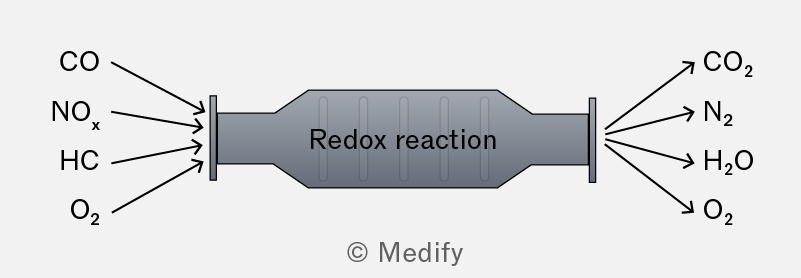
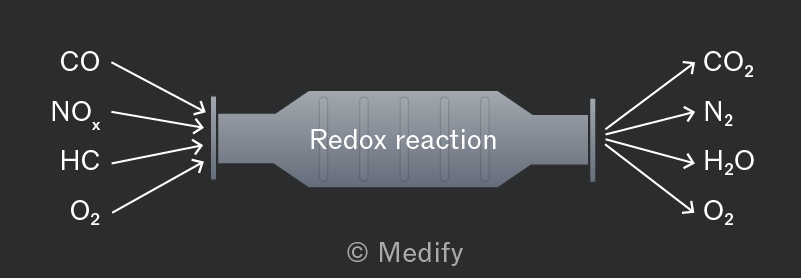
Once the reactions occur, the products are desorbed from the surface of the catalyst and are expelled through the exhaust.
Catalytic converters have a honeycomb structure of an alloy of platinum, palladium, and rhodium.