
Redox and electrode potentials (5.2.3)
On this page
Oxidising agent: An oxidising agent is a substance that gains electrons during a chemical reaction.
By accepting electrons, the oxidising agent is reduced.
The oxidising agent causes another substance to lose electrons and thus be oxidised.
Reducing agent: A reducing agent is a substance that loses electrons during a chemical reaction.
By donating electrons, the reducing agent is oxidised.
The reducing agent causes another substance to gain electrons, and thus be reduced.
You could be expected to produce half-equations from a full redox equation.
Half-equations represent either the oxidation or reduction part of a redox reaction, showing the transfer of electrons explicitly.
1. Remove counterions: these need to be in (aq) state on both sides of the arrow.
2. Identify the species involved: Determine which species are being oxidised and reduced by examining changes in oxidation numbers.
Oxidation:
Reduction:
3. Balance and add electrons to form half-equations:
For ionic equations containing hydrogen, and/or oxygen, hydrogen ions (in acidic conditions), hydroxide ions (in alkali conditions), and water can be added back in to balance the equation.
You may be asked to write a full redox equation from half equations.
1. Identify the oxidation half-equation: This shows the loss of electrons.
2. Identify the reduction half-equation: This shows the gain of electrons.
3. Cross multiply the half-equations if necessary so that the number of electrons lost in the oxidation half-equation equals the number gained in the reduction half-equation.
gives
4. Merge the half-equations together: Combine the two balanced half-equations, cancelling out the electrons to form the overall redox equation.
To interpret an electron transfer reaction:
- Identify the species involved: Determine which atoms or ions are present in the reactants and products.
- Determine the oxidation numbers of the relevant elements in both the reactants and products.
- Identify the species that is oxidised (loses electrons) and the species that is reduced (gains electrons).
- Determine the oxidising and reducing agents:
- The oxidising agent is reduced and gains electrons.
- The reducing agent is oxidised and loses electrons.
The basic methodology for redox titrations is similar to that of Acid-Base titrations.
A key difference is that the end point of a redox titration is sometimes shown by a colour change in the reacting species.
When iron(II) ions are titrated with potassium permanganate in acidic conditions, the end point is seen through a colour change from purple to colourless.
is purple whereas is colourless.
The 1:5 stoichiometric ratio of : can be used in the titration calculation.
The concentration of iodine in solution is often determined by titration with sodium thiosulfate.
A starch indicator is required. The end point is seen when the blue-black solution turns colourless.
Starch is blue-black in the presence of iodine () but colourless in the presence of iodide ions ().
The 1:2 stoichiometric ratio of : can be used in the titration calculation.
Question walkthrough
Redox titration
A complex calculation using the titration of Fe2+ with MnO4-
The standard electrode potential indicates how easily a species gains electrons (is reduced) compared to hydrogen.
A more positive value suggests a greater tendency to be reduced, making the substance a stronger oxidising agent.
Conversely, a more negative value indicates a greater tendency to lose electrons, making the substance a stronger reducing agent.
The electrochemical series is a list of standard electrode potentials () for various half-cells, arranged in order of their ability to gain electrons and therefore be reduced.
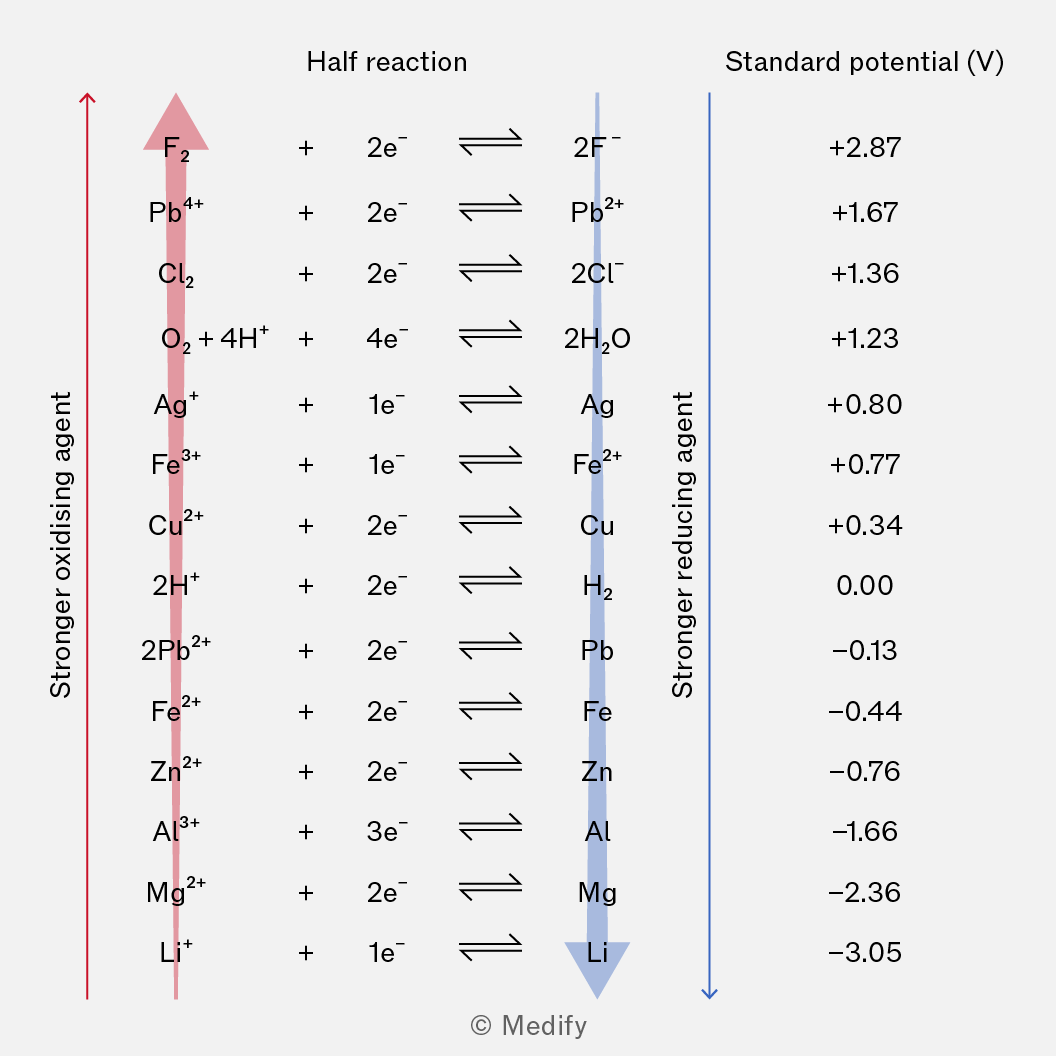
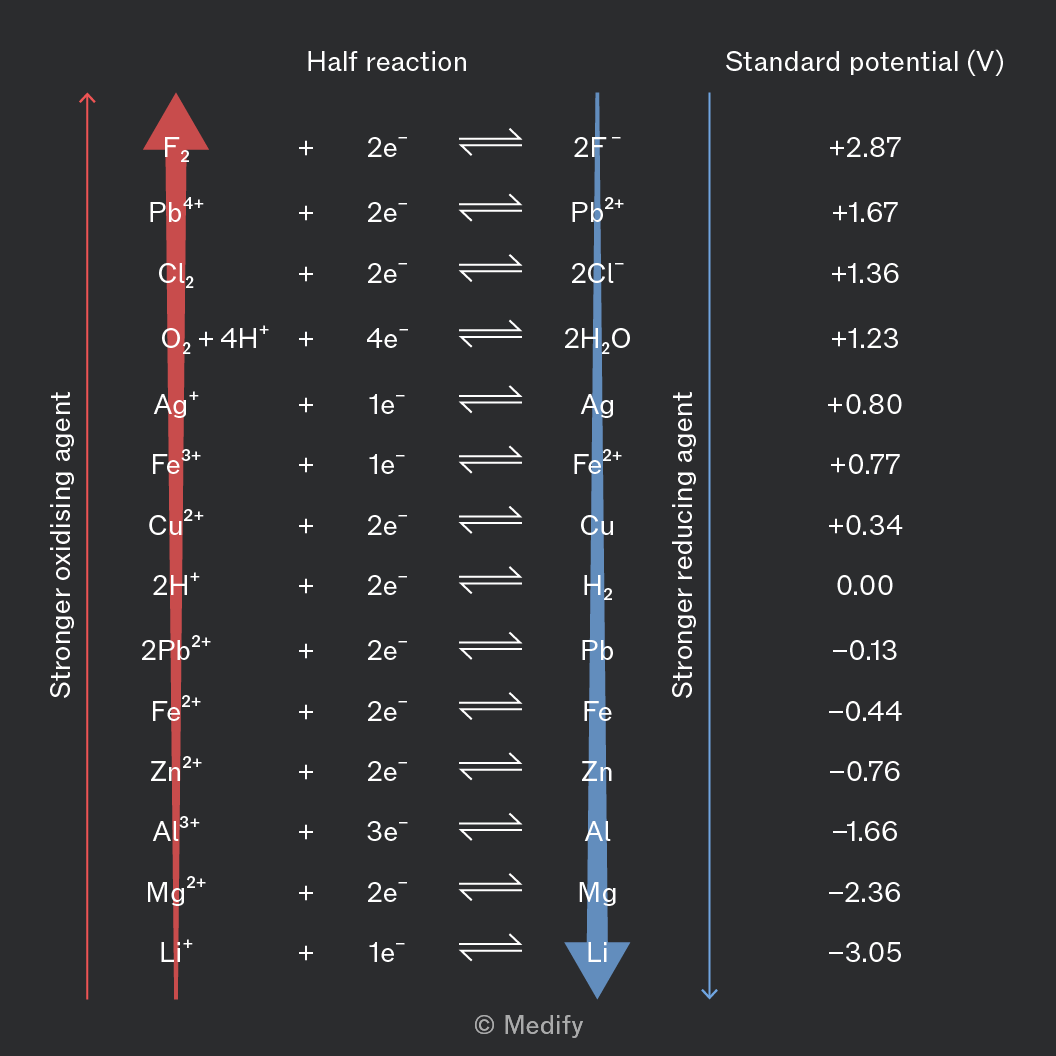
The electrochemical series is a key tool in predicting the redox reactions and understanding the reactivity of different species.
Standard electrode potential () is the potential difference between a half-cell and the standard hydrogen electrode (SHE) under standard conditions.
These conditions are:
Under non-standard conditions, the measured electrode potential will be different.
Changes to concentration, pressure and temperature will alter the actual electrode potential of a half-cell. Standard conditions must be applied for a reliable comparison.
The standard hydrogen electrode (SHE) is used as a reference electrode to measure the standard electrode potentials of other half-cells. The SHE is assigned a potential of by definition, under standard conditions.
- Hydrogen gas () at a pressure of .
- Platinum electrode coated with platinum black, which acts as an inert conductor.
- Acidic solution with ions at a concentration of
- Temperature
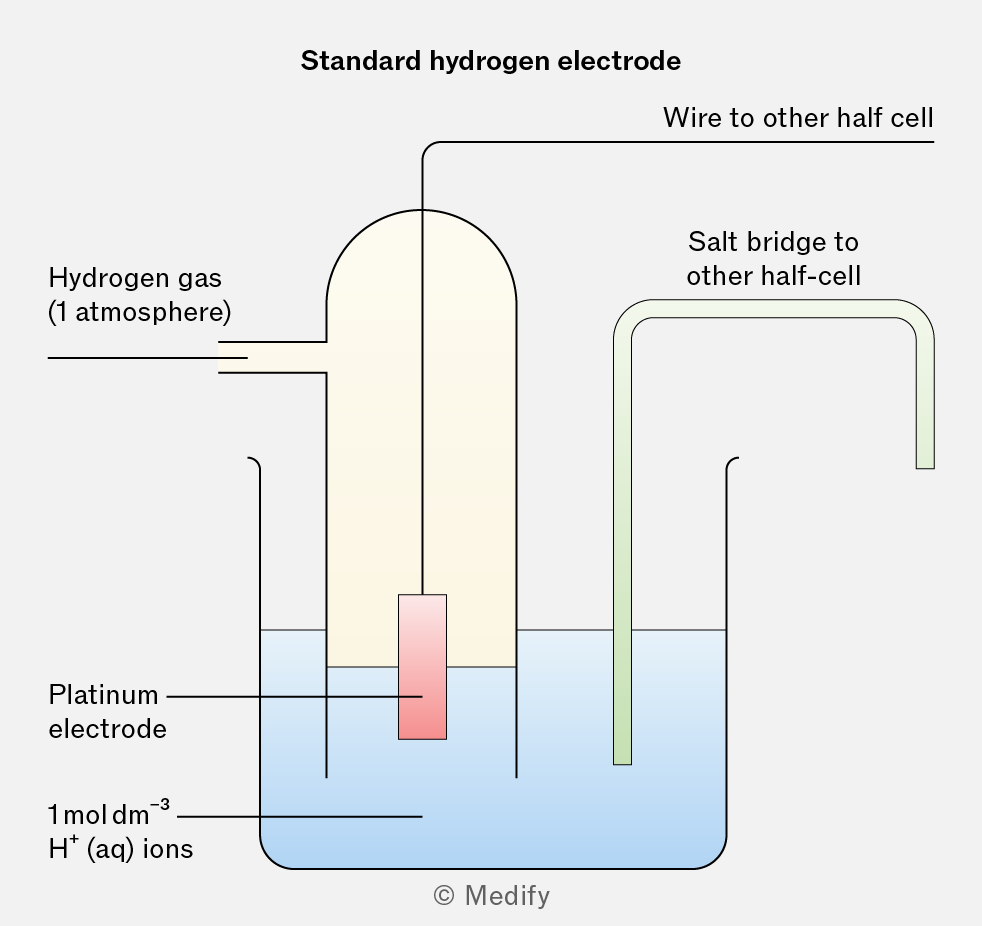
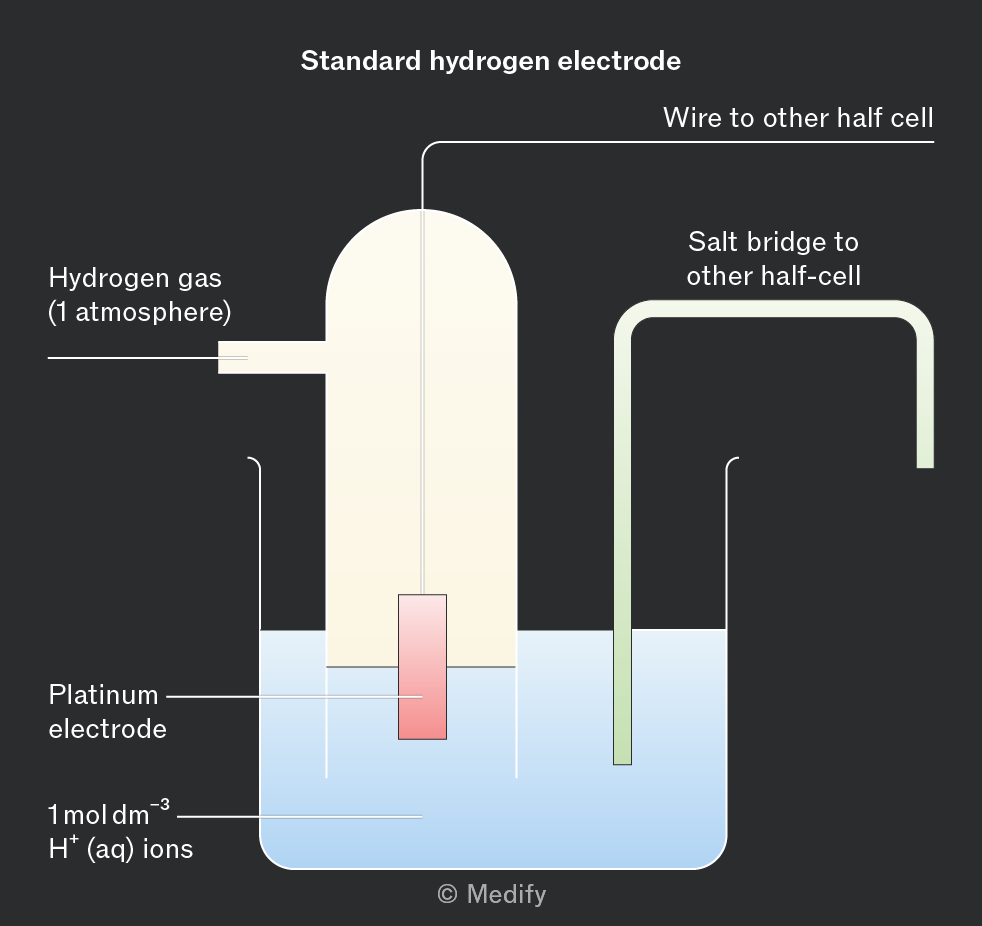
When a cell is set up to calculate the standard electrode potential:
- The half-cell of interest is connected to the standard hydrogen electrode (SHE).
- The two half-cells are connected by a salt bridge allowing ion transfer.
- An external cable with a voltmeter completes the circuit and measures the potential difference between the two half-cells.
- The potential difference recorded is the standard electrode potential () of the half-cell under investigation.
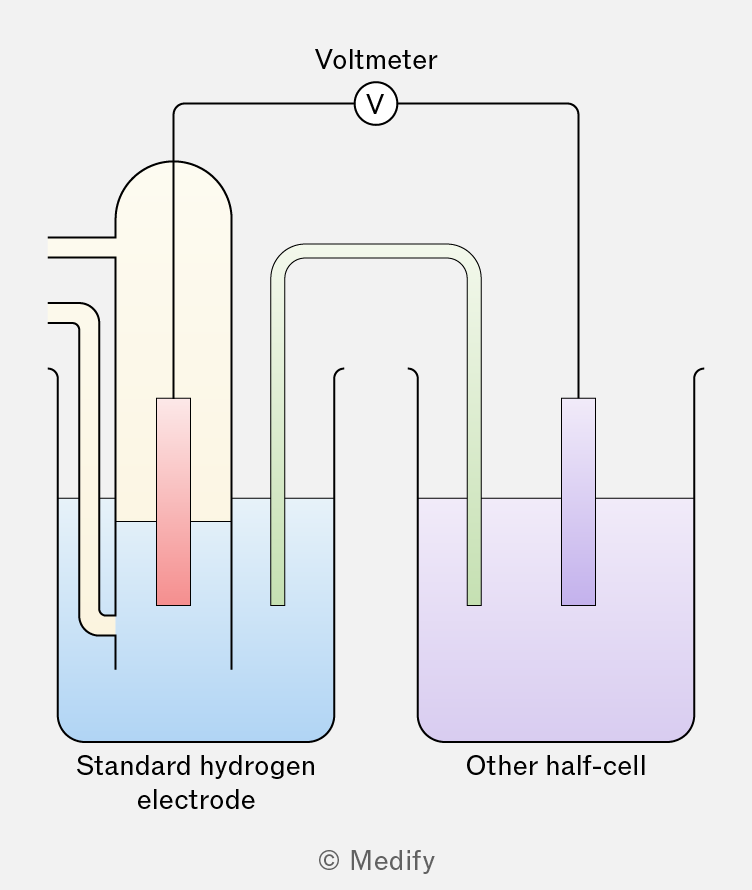
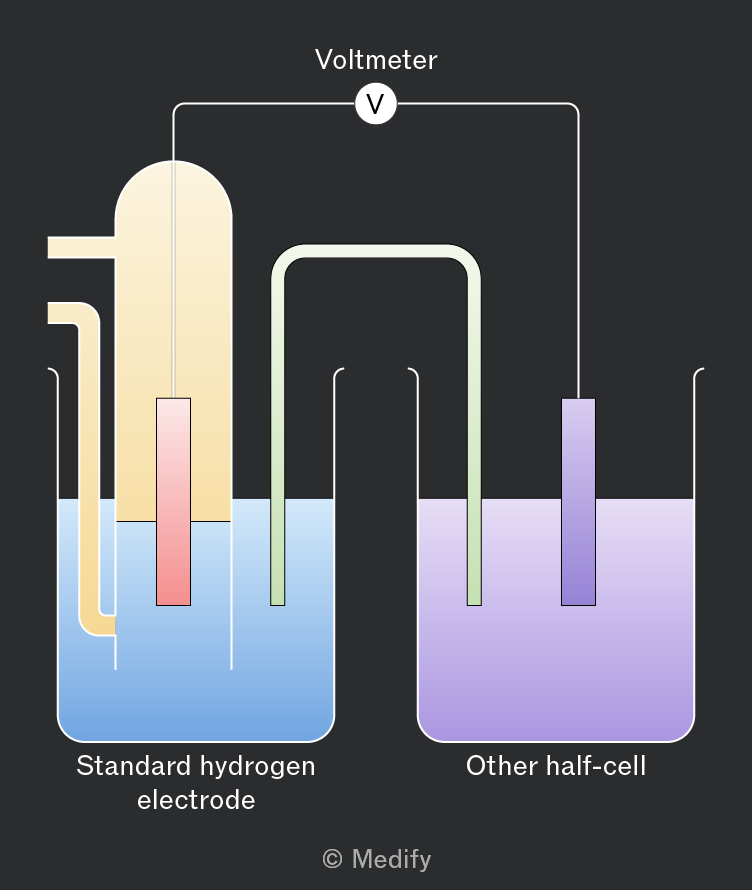
Measuring standard electrode potential of a zinc half-cell.
In this setup, the cell potential is measured for a solid electrode in contact with a solution containing its ions.
Electrode: A strip of zinc metal ().
Electrolyte: A solution of zinc sulfate () containing ions at concentration.
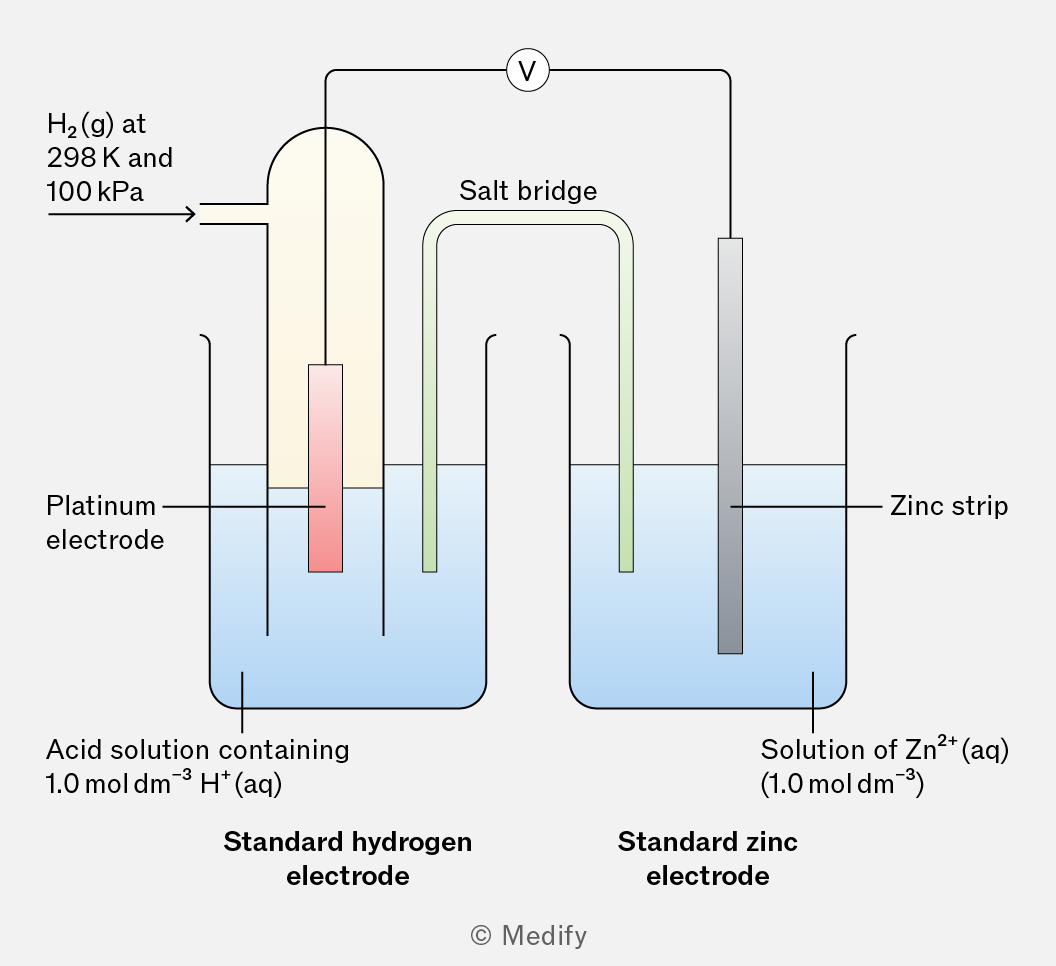
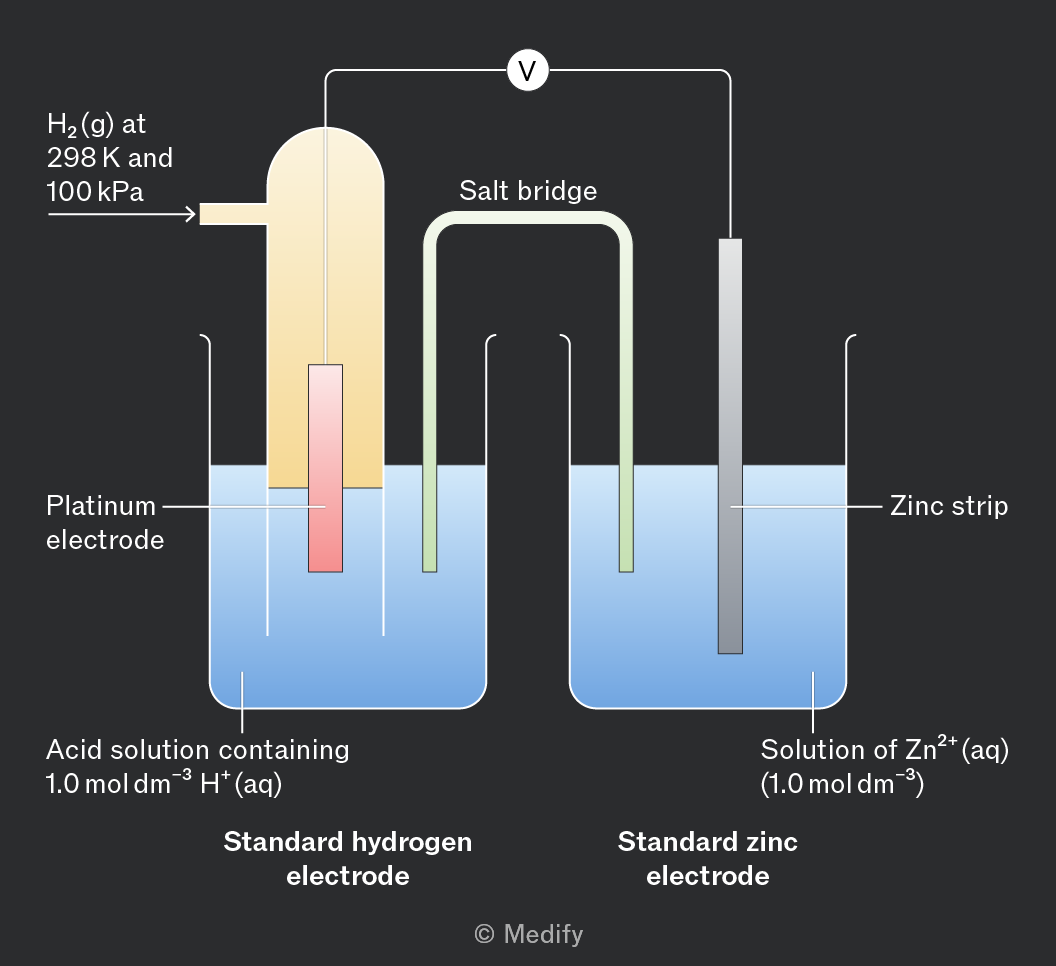
Procedure:
- Prepare the Half-Cell:
- Place the zinc strip in the solution.
- Ensure the solution concentration is to meet standard conditions.
- Connect to a standard hydrogen electrode (SHE):
- Connect the zinc half-cell to the SHE using a wire between the electrodes and a salt bridge between the electrolytes to maintain the ionic balance.
- Measure the cell potential:
- Use a voltmeter to measure the potential difference between the zinc electrode and the SHE.
The observed voltage is the standard electrode potential () of the zinc half-cell, relative to the SHE.
Measuring standard electrode potential of a chlorine half-cell.
In this setup, the cell potential is measured for a gaseous substance in contact with a solution containing its ions in the presence of an inert electrode.
Electrode: Platinum electrode (inert).
Electrolyte: A solution containing ions at concentration.
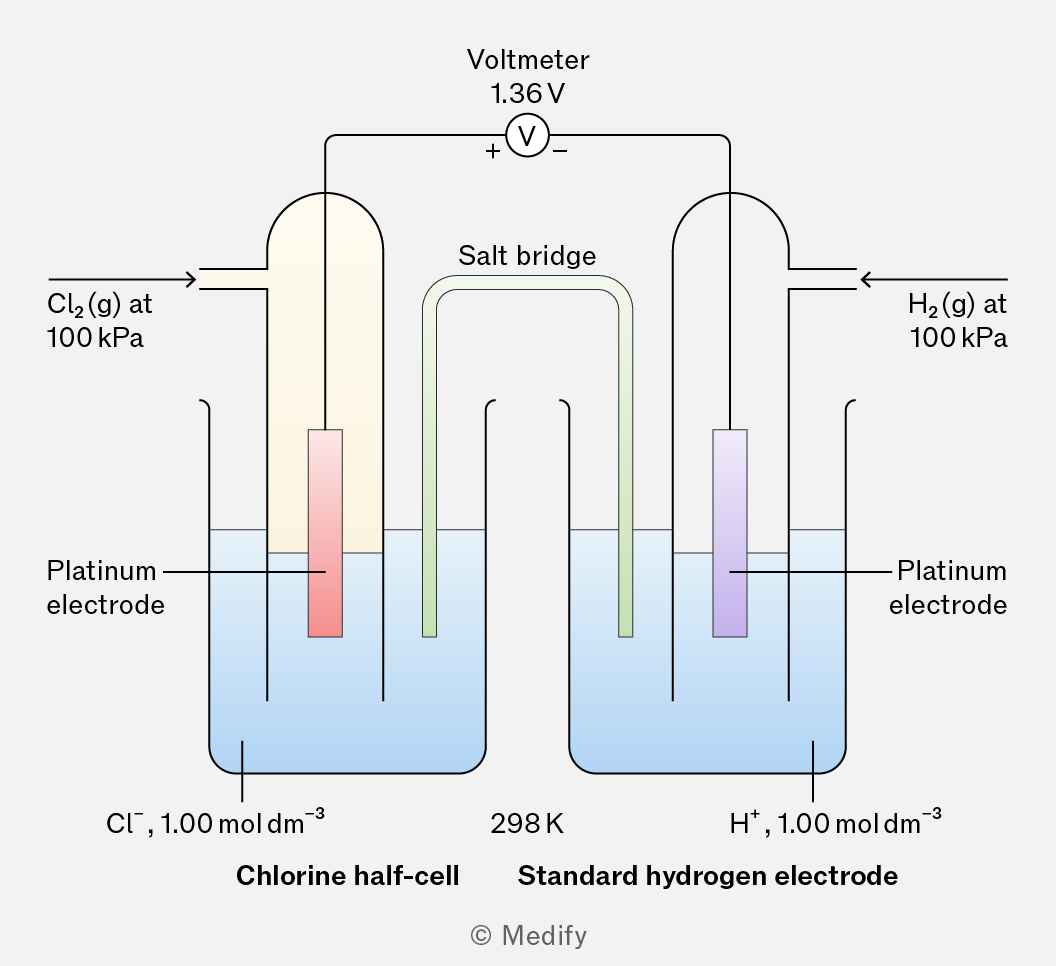
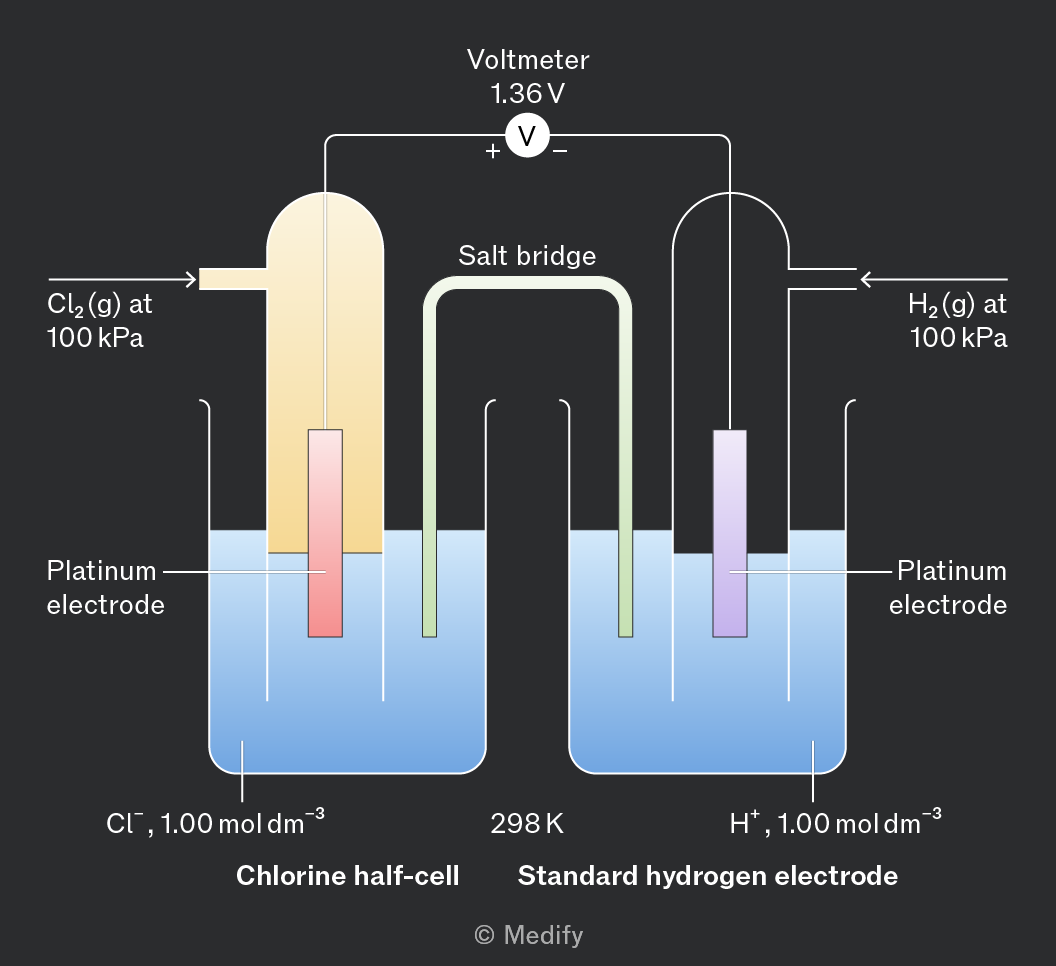
Procedure:
- Prepare the Half-Cell:
- Bubble chlorine gas into the aqueous solution containing ions. Ensure the solution concentration is to meet standard conditions.
- Immerse the platinum electrode in the solution.
- Connect to the SHE:
- Connect the chlorine half-cell to the SHE using a wire between the electrodes and a salt bridge between the electrolytes to maintain the ionic balance
- Measure the Cell Potential:
- Record the potential difference between the chlorine half-cell and the SHE.
The observed voltage is the standard electrode potential, , of the chlorine half-cell, relative to the SHE.
In this setup, the cell potential is measured for a redox system in which both species are in solution (homogenous half-cell), using an inert solid electrode to allow electron transfer.
Electrode: A platinum electrode is used because iron is not present as a solid metal, it provides a conductive surface for the redox reaction.
Electrolyte: An equimolar solution containing of and of ions.
Note that the total concentration of iron ions is .
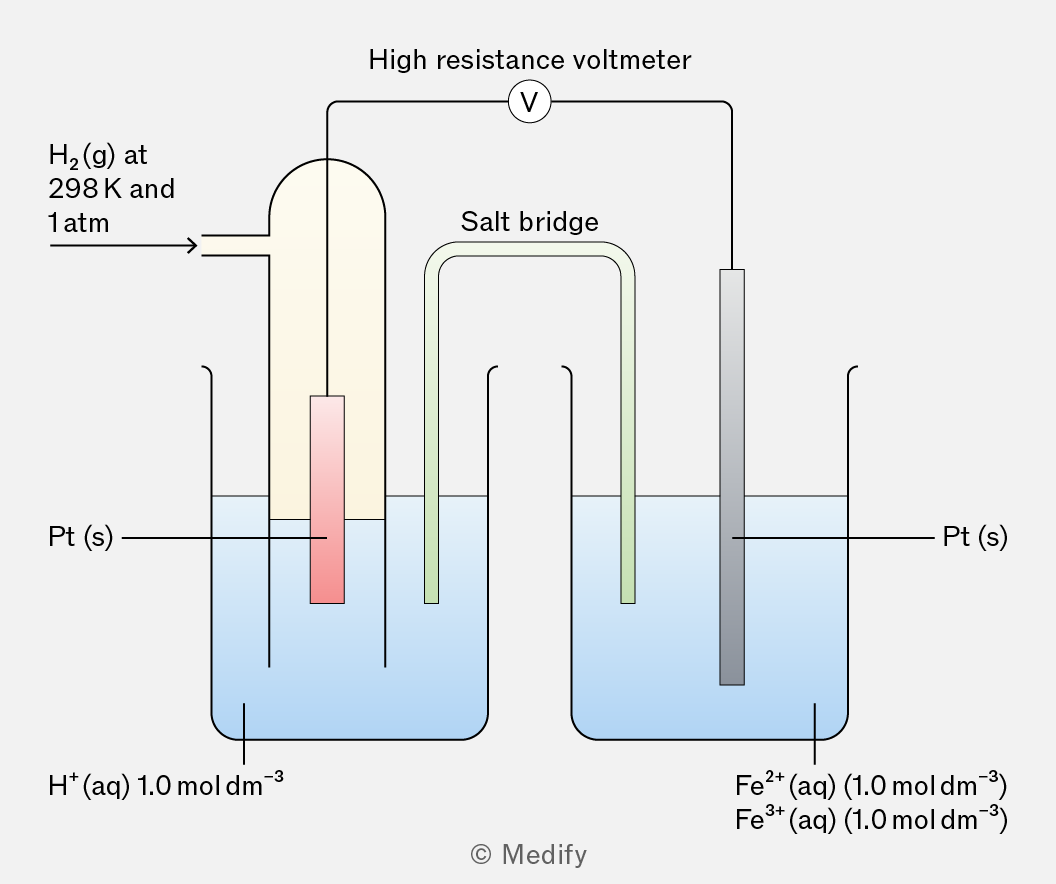
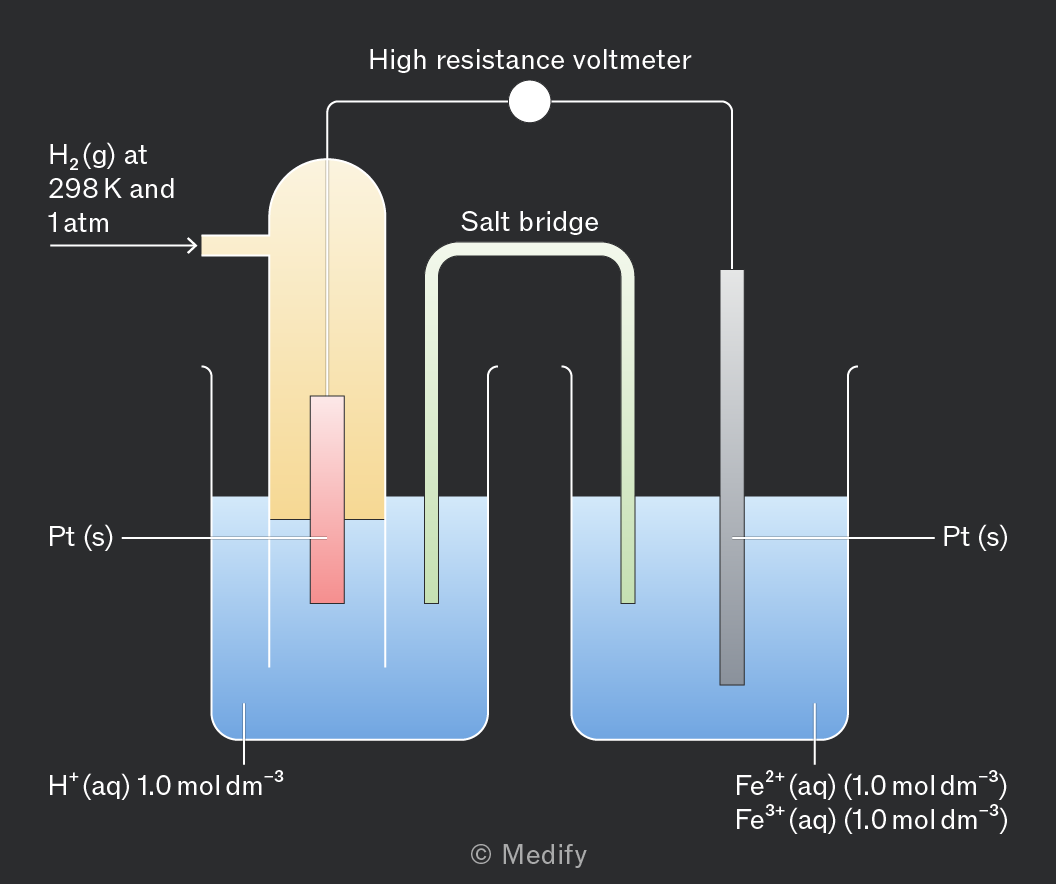
- Prepare the half-cell
- Place a clean platinum electrode into the solution.
- Ensure an equimolar solution of and of ions to meet standard conditions.
- Connect to the standard hydrogen electrode (SHE)
- Connect the half-cell to the SHE using a wire between the electrodes and a salt bridge between the two electrolytes to maintain ionic balance.
- Measure the cell potential
- Use a high-resistance voltmeter to measure the potential difference between the half-cell and the SHE.
The observed voltage is the standard electrode potential of the half-cell relative to the SHE.
When designing an experimental set-up to measure half-cell potential, consider the state of your reacting species.
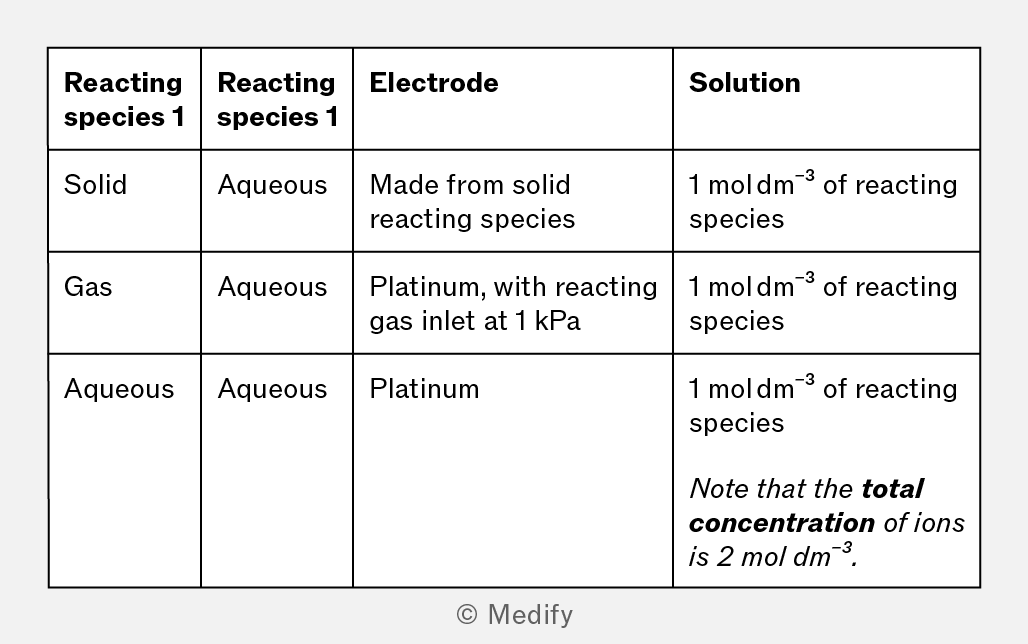
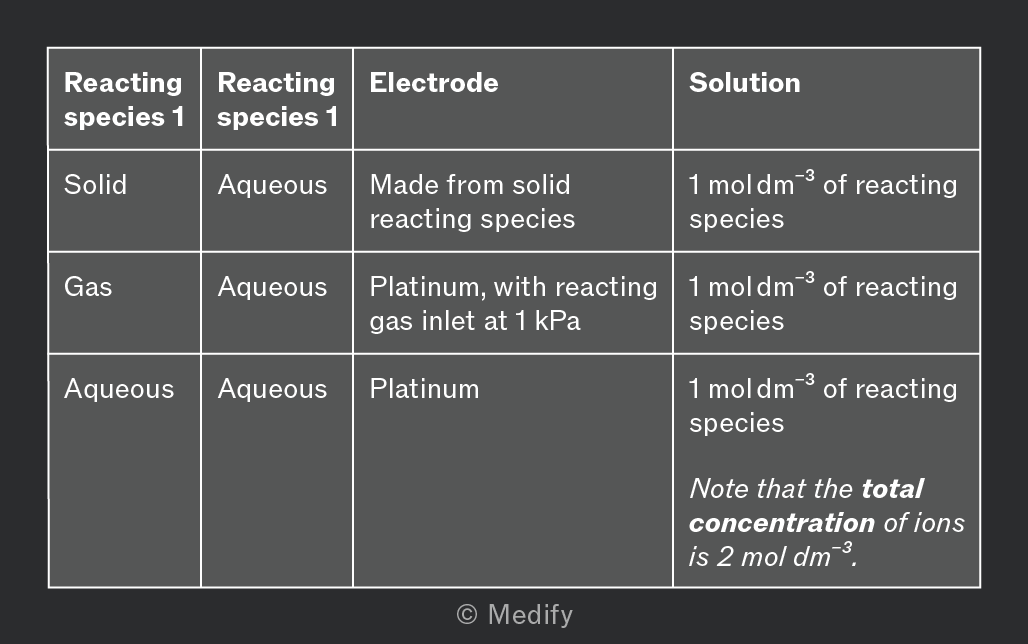
The half-cell to be quantified should be connected to a standard hydrogen electrode via a conductive wire and a salt bridge.
The standard cell potential (), is the electromotive potential (EMF) of the cell under standard conditions. This is the maximum potential difference possible between the two half-cells.
To calculate (), you need to know the standard electrode potentials of the two half-cells involved in the reaction.
Where:
- (anode) relates to the reaction at the positive electrode and is the standard electrode potential of the oxidation half-reaction.
- (cathode) relates to the reaction at the negative electrode and is the standard electrode potential of the reduction half-reaction.
Standard cell potential () is calculated by combining the standard electrode potentials of the two half-cells involved in the reaction.
The must be positive for a reaction that is thermodynamically feasible.
Where:
- (anode) is the standard electrode potential at the positive electrode; that of the oxidation half-reaction.
- (cathode) is the standard electrode potential at the negative electrode; that of the reduction half-reaction.
The most positive half-cell from the electrochemical series will always be the reduction half-reaction.
While is a useful indicator of reaction feasibility, it does not account for all factors that influence whether a reaction will actually proceed.
- Kinetics (Rate of Reaction): Even if a reaction has a positive , it may not occur in practice if the reaction is too slow due to, for example, a high activation energy.
- Deviation from standard conditions: Standard cell potentials are calculated under standard conditions . Predictions on feasibility based on may be invalidated by changes in concentration, pressure or temperature.
When the concentration of the solution in a half-cell is altered from (standard conditions) there is a shift in equilibria to maintain the equilibrium constant. This causes a change in the total amount of electrons moving through the cell.
The total cell potential is proportional to the current, and hence the number of electrons moving through the cell.
If there is an increased concentration of the species being reduced the total number of electrons in the cell will drop and the cell potential will also reduce.
Increasing the concentration of above will cause the equilibrium to shift to the right, the number of electrons in the cell to drop, and the cell potential to decrease.
Increasing the concentration of above will cause the equilibrium to shift to the left, the number of electrons in the cell to increase, and the cell potential to increase.
Electrochemical cells convert chemical potential energy into electrical energy through redox reactions. They are a source of electrical energy.
A spontaneous redox reaction causes electrons to flow from the anode (oxidation) to the cathode (reduction).
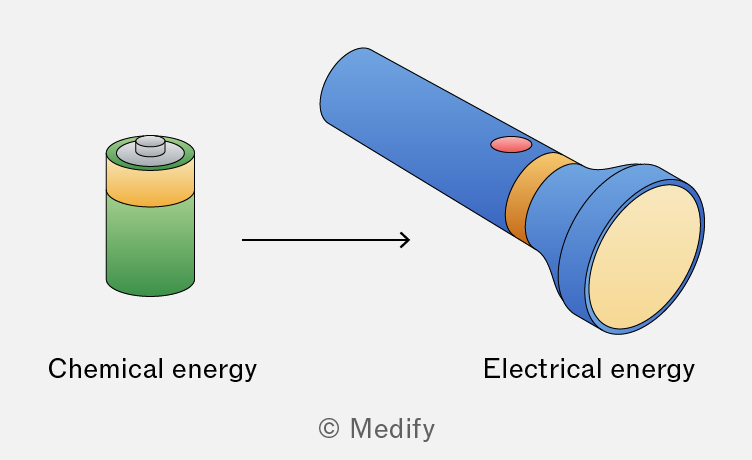
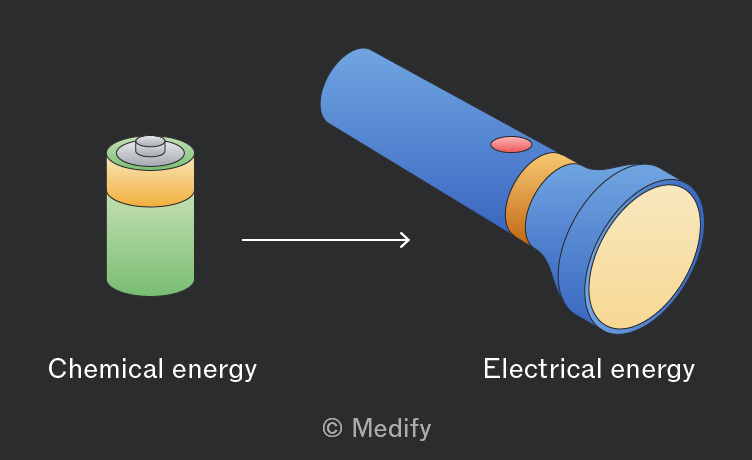
Electrochemical cells can be rechargeable or non-rechargeable.
The chemical reactions in rechargeable cells can be reversed by applying an external current, restoring the original reactants. Lithium-ion batteries are rechargeable.
When the reactants in non-rechargeable cells are used up, the cell stops producing electricity. The reactants cannot be regenerated by an external current. Alkaline batteries are an example of non-rechargeable cells.
Fuel cells are innovative devices that use chemical energy from a fuel, and oxygen, to produce a voltage.
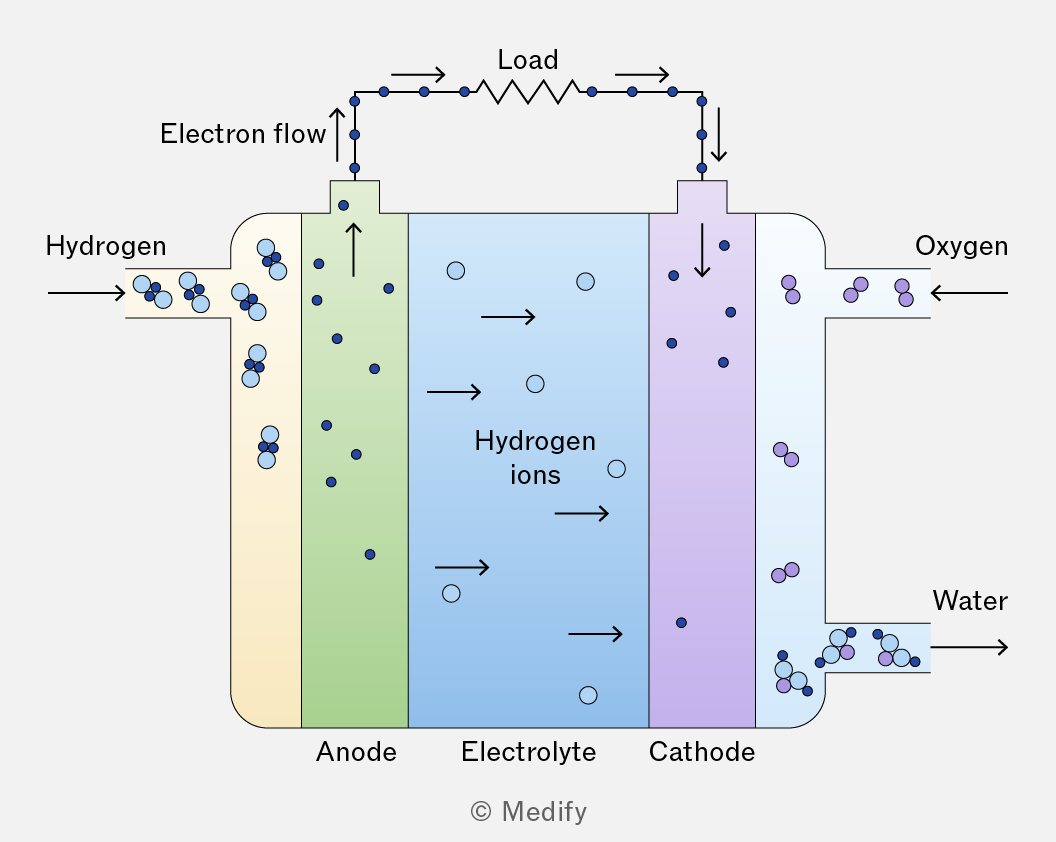
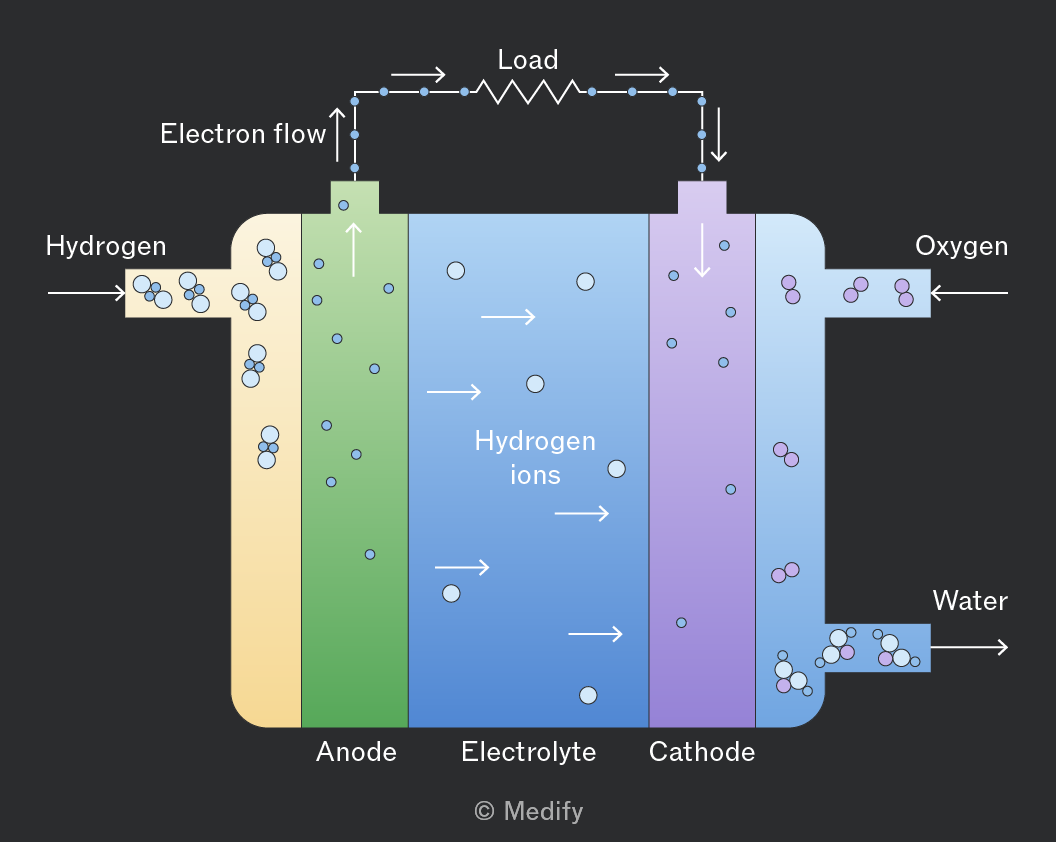
Fuel cells are assembled with:
- an anode where the fuel (e.g. hydrogen) is oxidised.
- a cathode where oxygen is reduced.
- an electrolyte allowing ions to move between the anode and cathode, while keeping the electrodes separate.
- a wire allowing the flow of electrons.
These are not combustion reactions. There is no direct contact between the fuel and oxygen.
The electrode reactions in a fuel cell differ with of the electrolyte.
When the electrolyte is alkaline:
Anode (fuel electrode)
- Fuel, such as hydrogen gas, is oxidised, releasing electrons.
- Reaction:
Cathode (oxygen electrode)
- Oxygen gas is reduced, gaining electrons from the external circuit.
- Reaction:
Overall cell reaction
The overall reaction combines both half-equations to form water as the main product.
The electrode reactions in a fuel cell differ with of the electrolyte.
When the electrolyte is acidic:
Anode (fuel electrode)
- Fuel, such as hydrogen gas, is oxidised, releasing protons ( ions) and electrons ().
- Reaction:
Cathode (oxygen electrode)
- Oxygen is reduced by gaining electrons and reacting with protons to form water.
- Reaction:
Overall cell reaction
The overall reaction combines both half-equations to form water as the main product.
Fuel cells, like other electrochemical cells, generate a voltage.
This voltage drives the flow of electrons (current), which can then power electrical devices.