Module 6: Particles and medical physics›Energy stored by capacitor (6.1.2)

Energy stored by capacitor (6.1.2)

Energy stored in a capacitor, W = ½QV, area under charge-voltage graphs, and energy storage applications in A-level Physics.
2 min

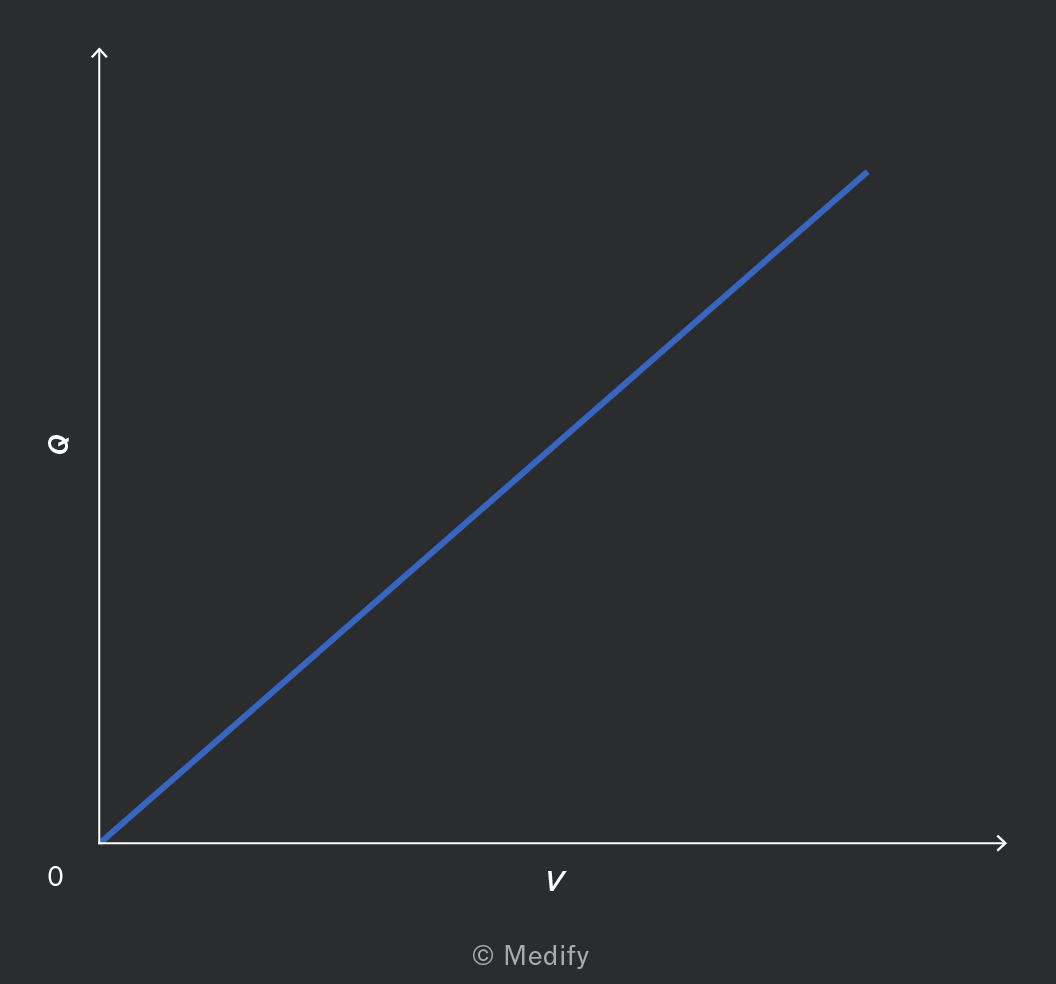
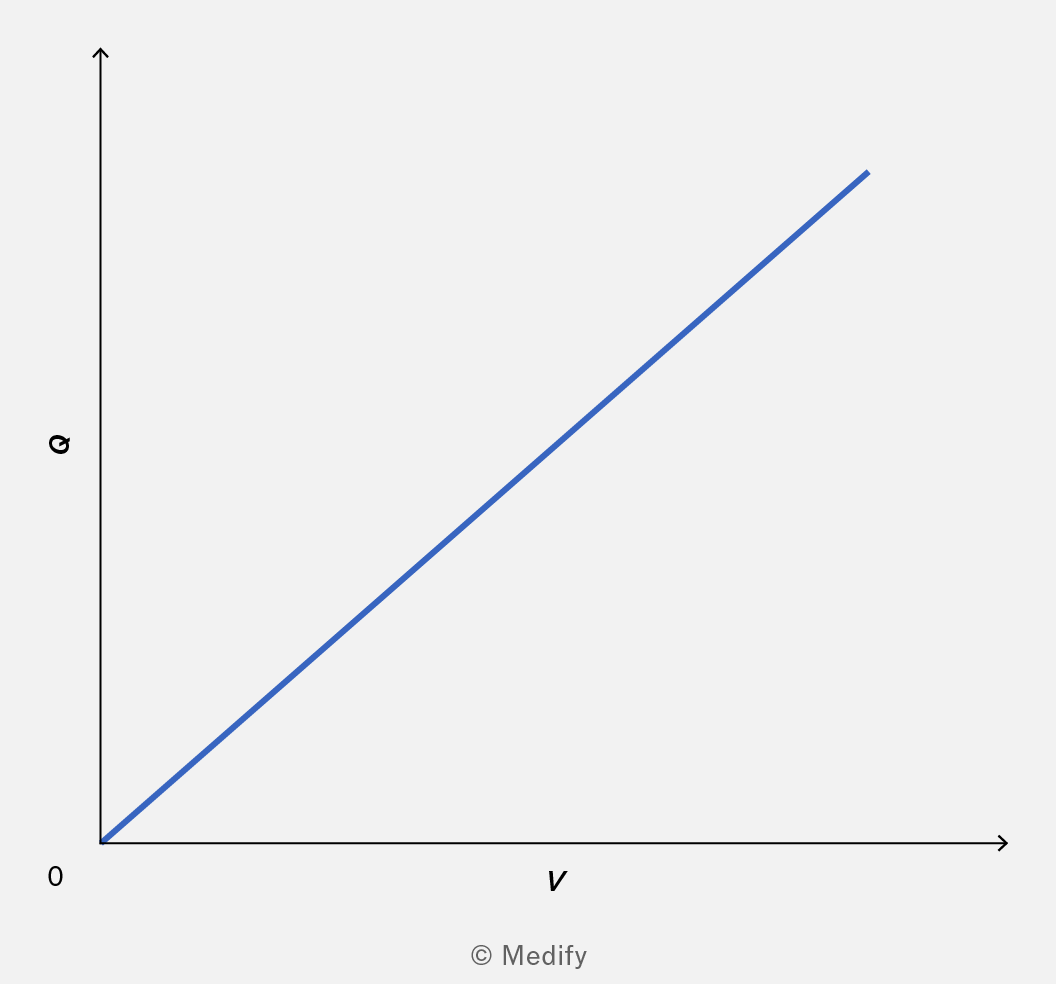
The potential difference across a capacitor is directly proportional to the charge it stores.
A line graph with the x-axis labeled 'ν' and the y-axis labeled 'σ'. The graph shows a single blue line starting from the origin at approximately (0, 0) and extending diagonally upwards to the right. There are no visible numeric tick values or plotted markers on the axes. The graph is annotated with '© Medify' at the bottom.

The gradient of the charge against voltage graph is equal to the capacitance of the capacitor:

It is important to note that while a capacitor is charging, the charge stored on the plates increases linearly with the voltage across the plates; therefore, a graph of charge against voltage will be a straight line passing through the origin.

Add to favourites

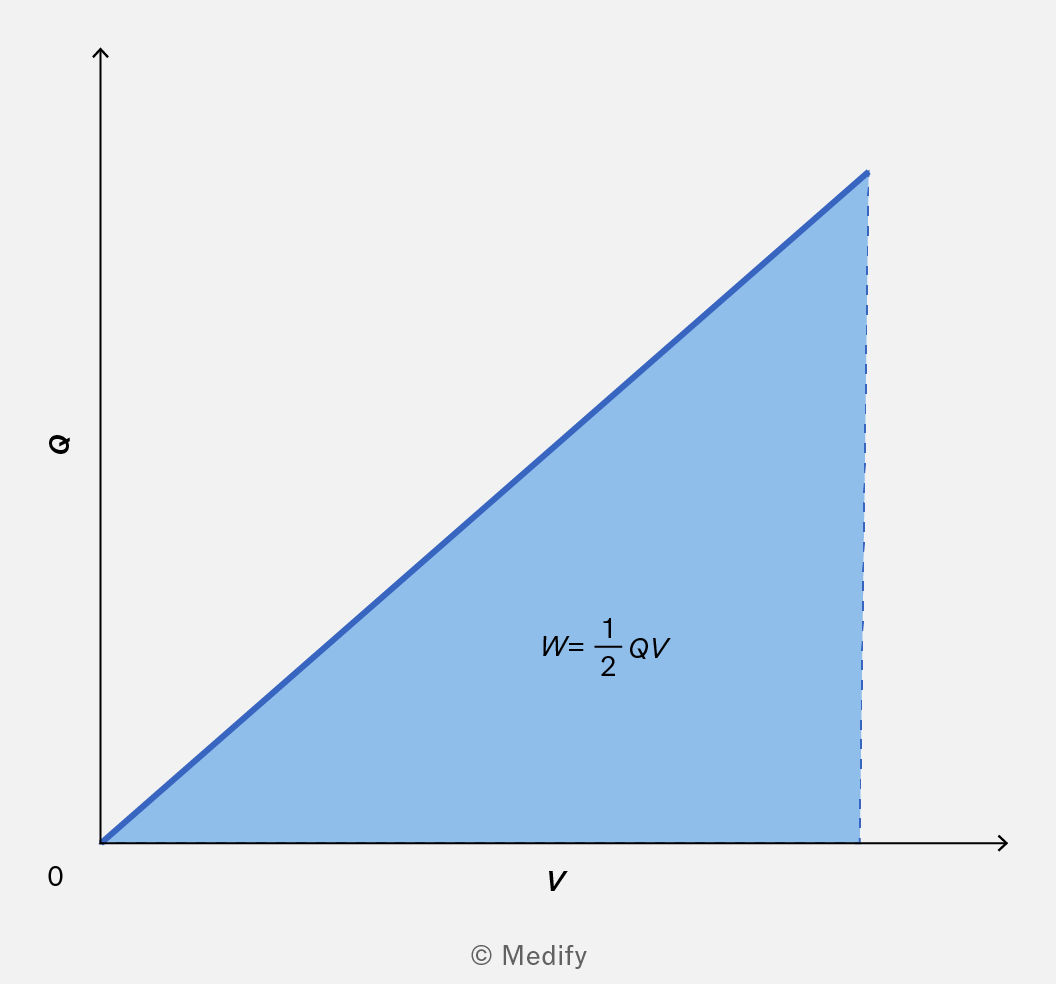
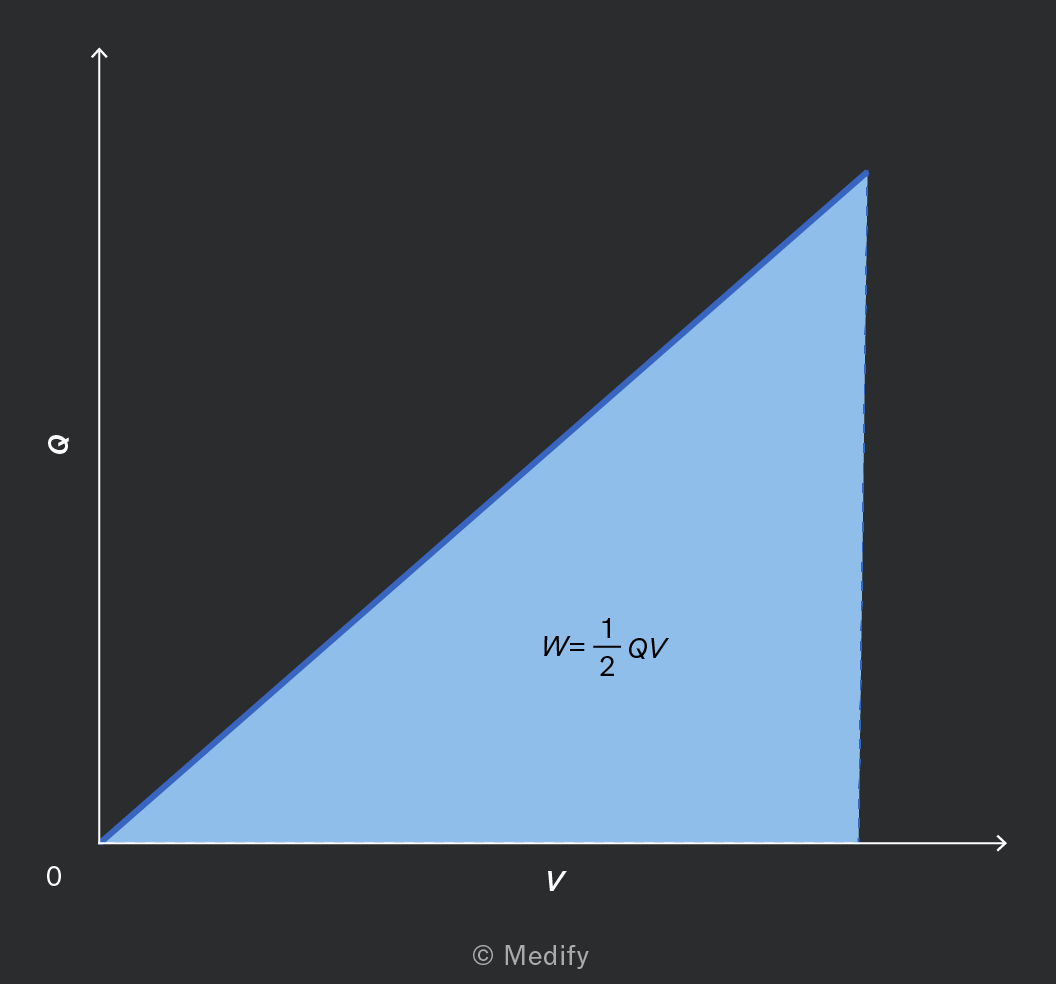
The energy stored by a capacitor \(W)\ is equal to the area under the charge–voltage graph for the capacitor.
A graph with a shaded blue triangle area. The x-axis is labeled 'V' and the y-axis is labeled 'Q'. The bottom left corner of the graph starts at the origin marked with 0. Inside the shaded area, there is an annotation 'W = 1/2 QV'.

The area under the graph is a triangle, so it is given by:

For a capacitor with a voltage across its plates storing a charge we have:

It is useful to know that generally, energy is given by:

the integral of the charge with respect to the potential difference. You will not need to know this calculus for your physics exam, but it could be helpful in your understanding or for future learning.

Add to favourites

It is important to note that the correct equation for the energy stored by a capacitor. Many students make this mistake in their exams, losing marks as a result.

Do

Calculate the area of the triangle underneath the charge–voltage graph to find the energy stored by a capacitor.

Don't

Assume that the energy stored by a capacitor is simply the product of charge and voltage

Add to favourites

Question walkthrough

Finding Energy and Capacitance from a V-Q Graph

Use the area under a voltage-charge graph to find energy stored, then find capacitance from the gradient.

The energy stored by a capacitor is given by:

Where:

  • is the charge stored by the capacitor, and
  • is the voltage across the capacitor.

Substituting where is the capacitance of the capacitor gives:

Substituting gives:

All three equations are equivalent and can be used to calculate the stored energy, depending on which two quantities (charge , capacitance or voltage ) are known.

Add to favourites

Question walkthrough

Finding Voltage from Capacitor Energy

Rearrange the capacitor energy formula to find the potential difference given the stored energy and capacitance.

Capacitors are used in various devices where rapid energy release is needed because of their ability to quickly discharge stored energy. Some common applications include:
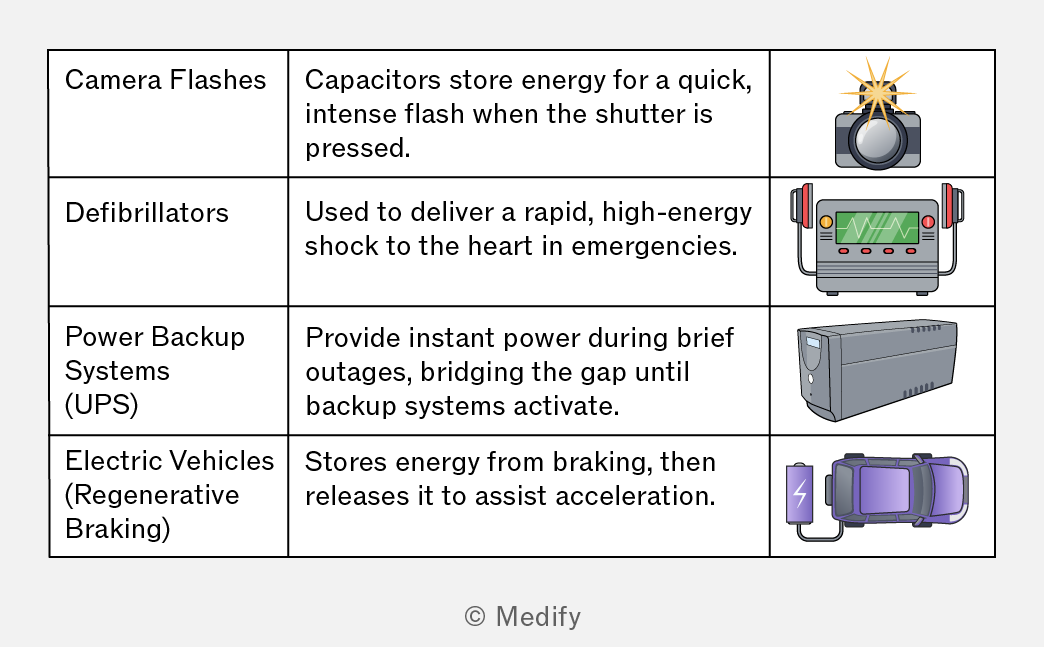
A table with four rows describing various applications and uses of capacitors. Row 1: 'Camera Flashes' - 'Capacitors store energy for a quick, intense flash when the shutter is pressed.' Image of a camera with a flash. Row 2: 'Defibrillators' - 'Used to deliver a rapid, high-energy shock to the heart in emergencies.' Image of a defibrillator. Row 3: 'Power Backup Systems (UPS)' - 'Provide instant power during brief outages, bridging the gap until backup systems activate.' Image of a UPS unit. Row 4: 'Electric Vehicles (Regenerative Braking)' - 'Stores energy from braking, then releases it to assist acceleration.' Image of an electric vehicle charging. © Medify.
Add to favourites

There are advantages and disadvantages to using capacitors instead of batteries in various practical applications.
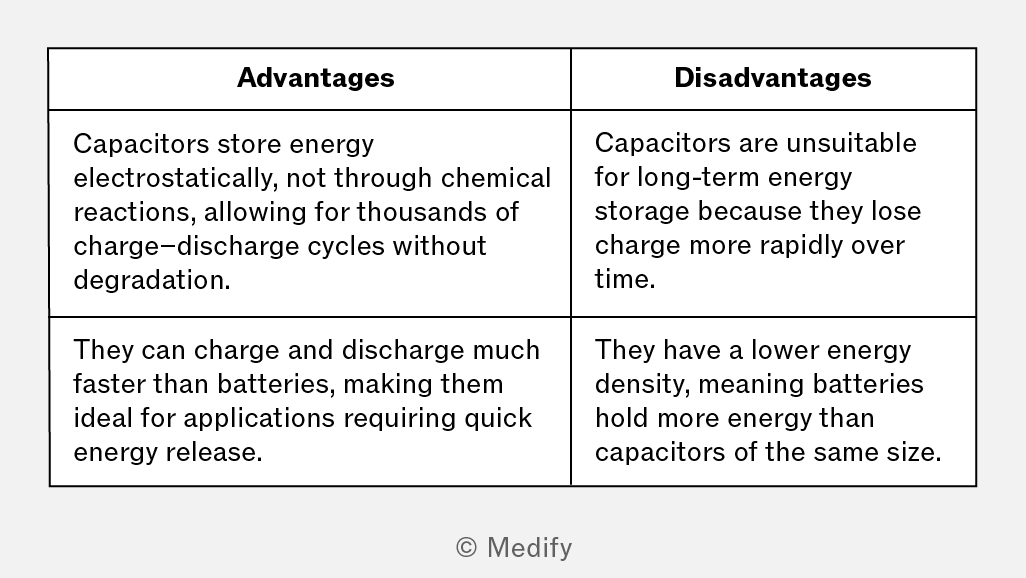
A table with two columns titled 'Advantages' and 'Disadvantages'. Under 'Advantages': 1. Capacitors store energy electrostatically, not through chemical reactions, allowing for thousands of charge–discharge cycles without degradation. 2. They can charge and discharge much faster than batteries, making them ideal for applications requiring quick energy release. Under 'Disadvantages': 1. Capacitors are unsuitable for long-term energy storage because they lose charge more rapidly over time. 2. They have a lower energy density, meaning batteries hold more energy than capacitors of the same size.
Add to favourites