
Write your essay: Finishing strong
On this page
The purpose of your body paragraphs is to present both sides of the issue as clearly and convincingly as you can. You can do this by using a defined structure for each paragraph and by giving well-reasoned, well-explained examples.
Begin each paragraph with a topic sentence that states the main idea you will explore. Keep it simple and direct. Your reader should understand immediately what aspect of the theme you’re addressing in this paragraph.
Make a point to support your topic sentence, then back it up with an example, followed by an explanation of how it proves your point. This point must link to one of the task comments.
You may include a second point with another example; however, it is not clear that this is absolutely necessary to get a high score in Section II. Focus on quality over quantity — it’s better to develop one relevant example thoroughly than to rush through two examples superficially.
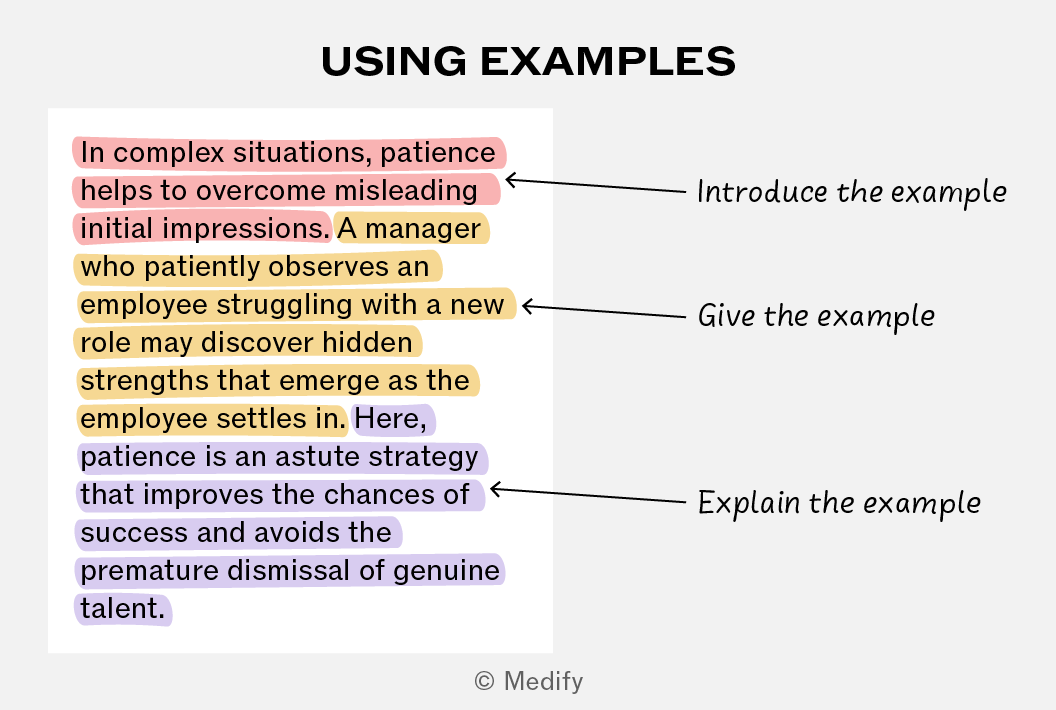
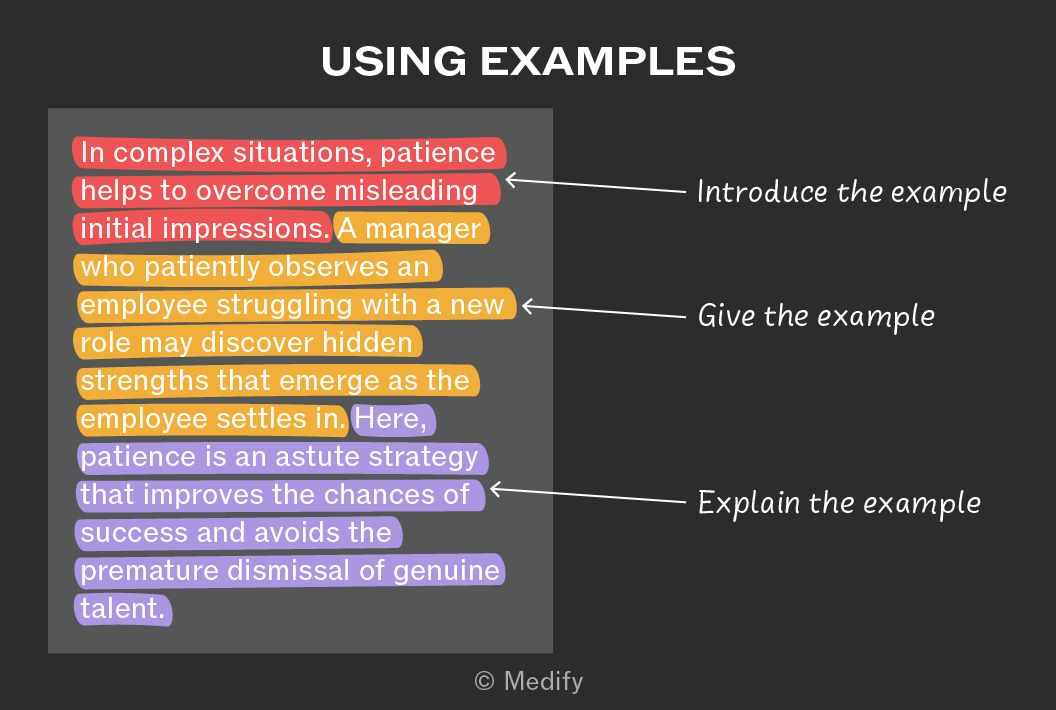
Follow this simple process for each example you use in your essay:
- First, introduce the example.
- Then, give the example.
- Finally, explain how the example illustrates the point you are trying to make.
This process ensures that you don’t just cite an example and move on, but rather use the example effectively to support your argument. The explanation is crucial — it’s where you show your thinking and connect the example back to your main point.
Think of the explanation as doing the thinking for your reader. You can’t assume that the reader will understand the significance of the example by themselves and reach the same conclusions you have. You need to spell it out for them so that your argument is convincing.
Each body paragraph must discuss at least one of the comments. Therefore, each point in the body paragraphs should include an example or illustration that relates to something from one of the comments in the task.
You could discuss aspects of two comments in the same body paragraph if they are connected or related, but this is not necessarily required. What matters is that you’re engaging meaningfully with the comments and using them to structure your argument.
In each instance, it should be clear which comment you are referring. You might refer to a comment by the name attributed to it, citing it as a direct quote or summarising its ideas using synonyms or paraphrasing. Make the connection explicit so your assessor can clearly see that you’re engaging with the task.


You may wish to end each body paragraph with a summing up sentence that ties it all together. This can be very short and to the point. However, in some cases, this may not be necessary.
You could instead end the body paragraph with your final analysis of the example, relating it back to one of the comments or the broader point you are making in the paragraph.
The key is to give a sense of closure to the paragraph before moving on to the next. This makes your essay structure clear, which will help readers understand the overall argument you are making.


The structure of your second body paragraph will largely be identical to that of the first body paragraph. The primary difference, of course, is that the content will explore the other side of the issue at hand.
Another key difference is that the topic sentence will need to display some sort of awareness of the previous paragraph. Linking or signposting words are an effective way to achieve this and help create a sense of flow that shows you’re building a balanced argument.


Walkthrough
Writing body paragraphs
Let's practise writing a body paragraph from an essay plan.
The purpose of the concluding paragraph is to assert your own opinion. You must come down on one of the two sides. You should not simply hedge and say something like ‘there are merits to both sides’ without stating your own stance.
Essays that don’t take a clear stance are weaker and less effective. GAMSAT is testing your ability to weigh evidence and come to a reasoned conclusion, not to sit on the fence indefinitely.
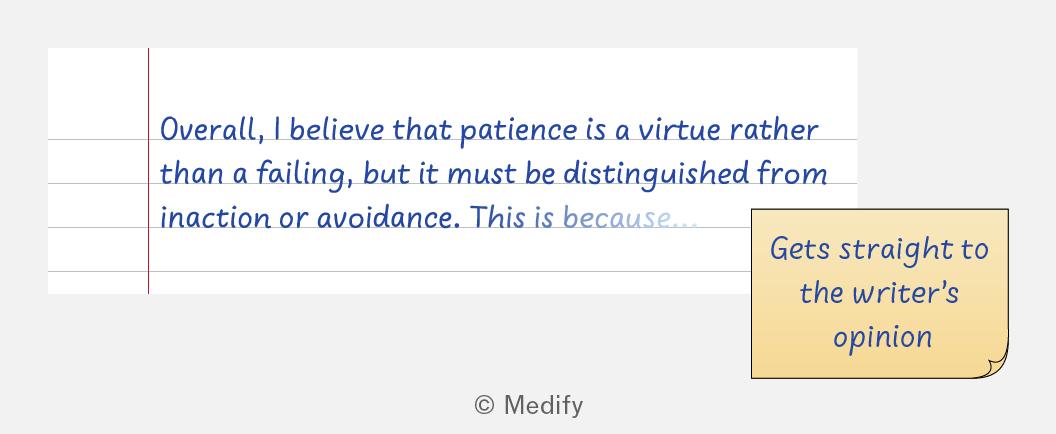
You could start the conclusion by directly stating your opinion. Then, give reasons as to why you come down on that side rather than the other.
This straightforward approach works well if you have a clear preference and can articulate strong reasons why.

Another way to structure your conclusion is to briefly summarise both sides first, then move swiftly to your opinion. This approach works well if both sides are compelling, but one side is stronger on balance.
In this approach, you still must be quite clear about which side you favour over the other.
You might say something like:
- ‘Whilst both perspectives have merit, the evidence suggests that…’
- ‘Although X raises valid concerns, Y provides a more compelling approach because…’
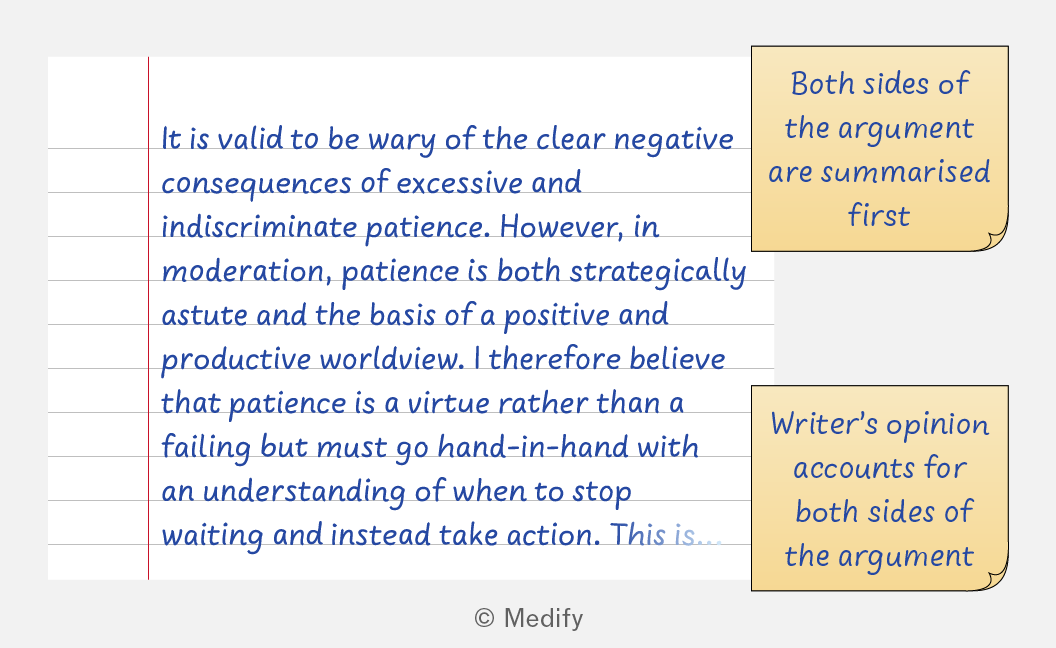
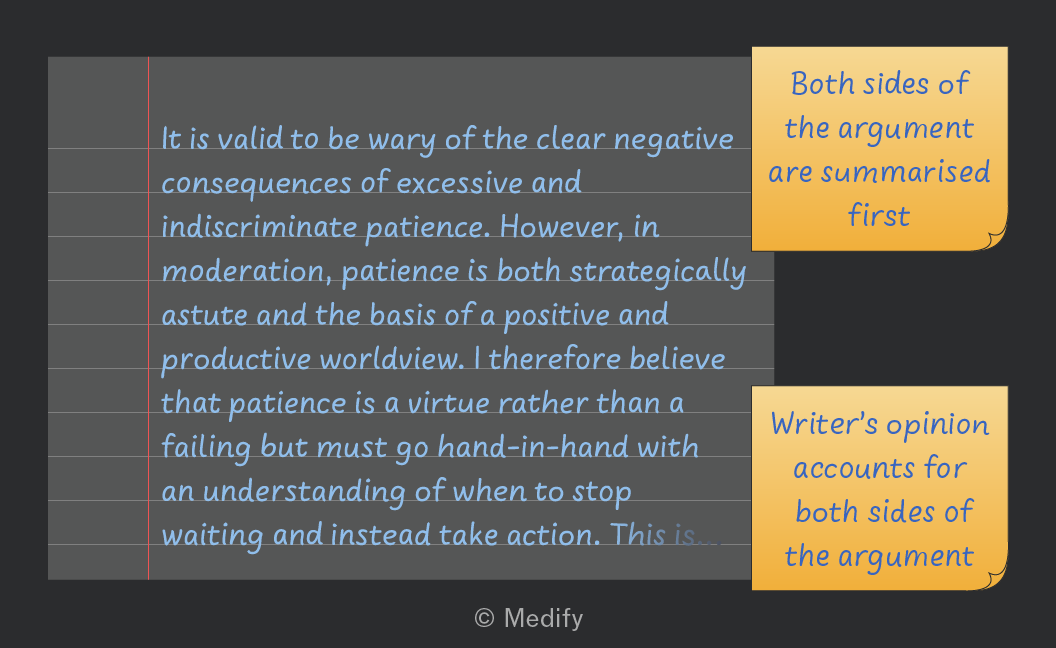
No matter exactly how you structure your conclusion, you must explain how your overall opinion relates to everything you have addressed so far in the essay.
You may wish to include another example or two in your conclusion, but be sure to follow the usual approach: introduce the example, give the example, then explain how the example illustrates your point.
The key thing is that your final paragraph should feel like a natural culmination of the argument you’ve been building, not like a sudden shift in direction. If you’ve explored both sides fairly, your reader should be able to see how you arrived at your conclusion.
Try to end your essay on a strong note. You could finish by wrapping up your explanation of your final example in a way that encapsulates the main thrust of your essay.
Or you might prefer to end with a pithy sentence or two that ties your opinion to the wider context of the theme.
The key here is to give a sense of an ending, and to indicate that you are in control of your logic and language right through the final sentence.
Walkthrough
Writing conclusions
Let’s have a go at writing a conclusion.