
The cell cycle
On this page
Reproduction, like metabolism, is a key feature of life. Prokaryotes and unicellular eukaryotes use cell division as a direct means of reproduction.
Multicellular eukaryotes use cell division to grow, renew and repair their tissues, and reproduce via specialised cells.
Cell division is a part of the cell cycle, which describes the life of a cell from its formation to its division. It can be divided into two parts:
- Mitotic (M) phase, during which cell division takes place.
- Interphase, during which cells grow and actively metabolise. Interphase accounts for about 90% of the duration of the cell cycle.
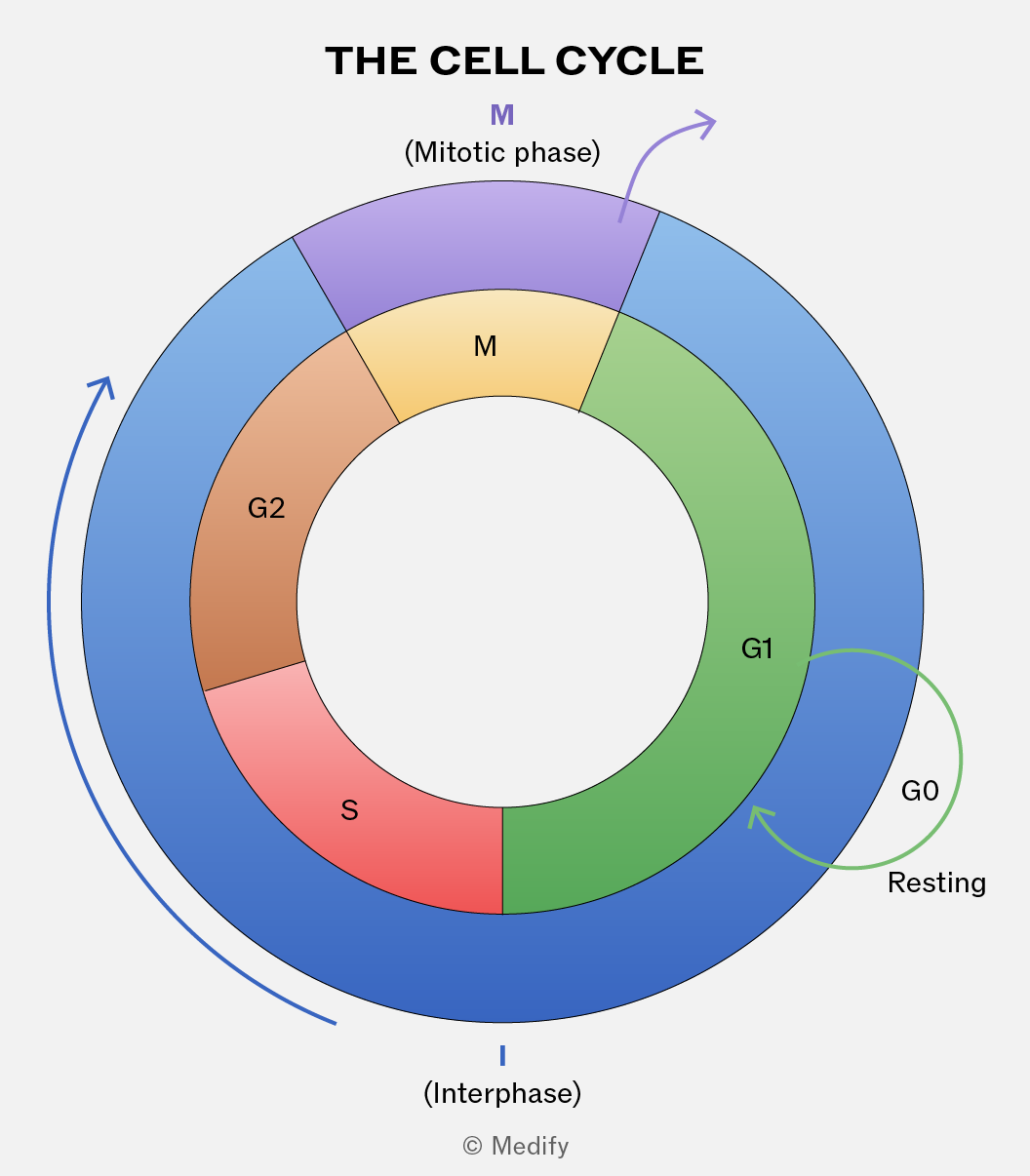
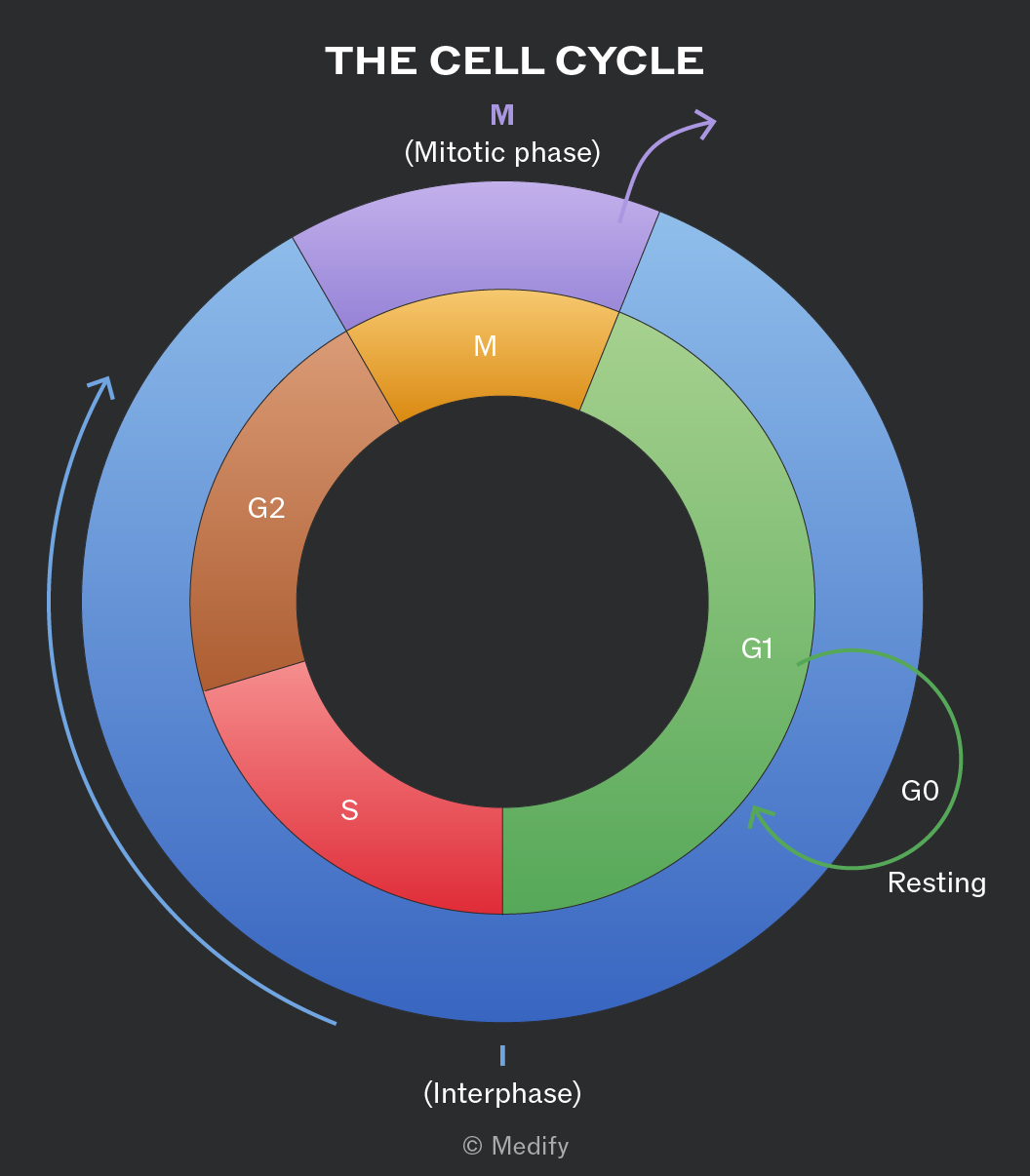
Interphase can be further subdivided into subphases:
- G1 phase (first gap) where the cell prepares for DNA synthesis.
- S phase (synthesis) where all chromosomes are replicated.
- G2 phase (second gap) where the cell prepares for mitosis, which includes the duplication of all its organelles.
Some cells may exit the cell cycle during G1 and enter the G0 phase (resting).
Cells in G0 are not preparing to divide, but they are actively functioning and metabolising.
Cells can enter and exit G0 as necessary, although some cells, such as erythrocytes, never divide and remain in G0 until they become senescent and die. In some cases, such cells may be replenished by division and differentiation of stem cells.
Progression of a cell through the cell cycle is controlled by cytoplasmic regulators and external factors:
Cytoplasmic regulators
- Cyclins are proteins whose concentration in the cell fluctuates periodically.
- Cyclin-dependent kinases (Cdks) are enzymes that associate with cyclins. Different cyclins activate different Cdks and determine which substrates become phosphorylated and activated. This regulates whether the cell can proceed to the next stage of the cycle.
Progression of a cell through the cell cycle is controlled by cytoplasmic regulators and external factors:
External factors
- Growth factors released by neighbouring cells can stimulate cell division.
- Density-dependent inhibition is a process that stops cell division if a given cell is surrounded by too many neighbouring cells.
- Anchorage dependence is a process that stops cell division if a cell is not attached to a substrate, such as the extracellular matrix of a tissue, or bottom of a cell culture flask.
Checkpoints are tightly regulated points of the cell cycle, normally when a cell is about to pass from one stage of the cycle to the next.
When a cell arrives at a checkpoint, internal and external factors determine whether the cell:
- proceeds to the next stage of the cell cycle
- arrests the cycle and waits
- initiates apoptosis (cell death).
There are three critical checkpoints: G1, G2 and the spindle checkpoint.
The G1 checkpoint is at the boundary between G1 and S phases. At this checkpoint, the cell commits to cell division, because after DNA has been replicated, it can no longer return to G1 or G0 phases. Cell division depends on the following:
- Has the cell grown large enough to divide?
- Does it have enough nutrients and energy for division?
- Is it receiving positive signals (growth factors) from neighbouring cells?
- Is any DNA damaged?
The G2 checkpoint at the boundary between G2 and M phases. At this checkpoint, the integrity of the DNA after it has been replicated is checked:
- Is any DNA damaged?
- Has all DNA been replicated during the S phase?
If DNA damage is found, the cycle is arrested until DNA repair enzymes fix the damage. If the damage is severe enough, the cell will undergo apoptosis.
The spindle checkpoint occurs during the M phase just before chromosomes are divided between daughter cells.
The cell cycle is one of the most tightly regulated processes in the cell.
Loss of this control leads to uncontrolled cell growth and division. This triggers the immune system, and such cells are eliminated. However, sometimes cells are not destroyed and they proliferate, forming tumours.
Loss of anchorage dependence allows such cells to spread to distant locations: this process is called metastasis.
Abnormal cells can impair the function of other organs by overcrowding, depleting nutrients from healthy cells and overwhelming the immune system, leading to cancer.