
Probability Question basics
On this page
The sixth and final Decision Making question type is Probability questions. The UCAT Consortium will usually call them by a longer name, such as ‘Probabilistic and Statistical Reasoning’.
In a Probability question, you must select the mathematically accurate answer from four choices.
You will likely have to do some calculations in most Probability questions, though in many cases, the calculations are simple enough to do in your head.
Every Probability question includes:
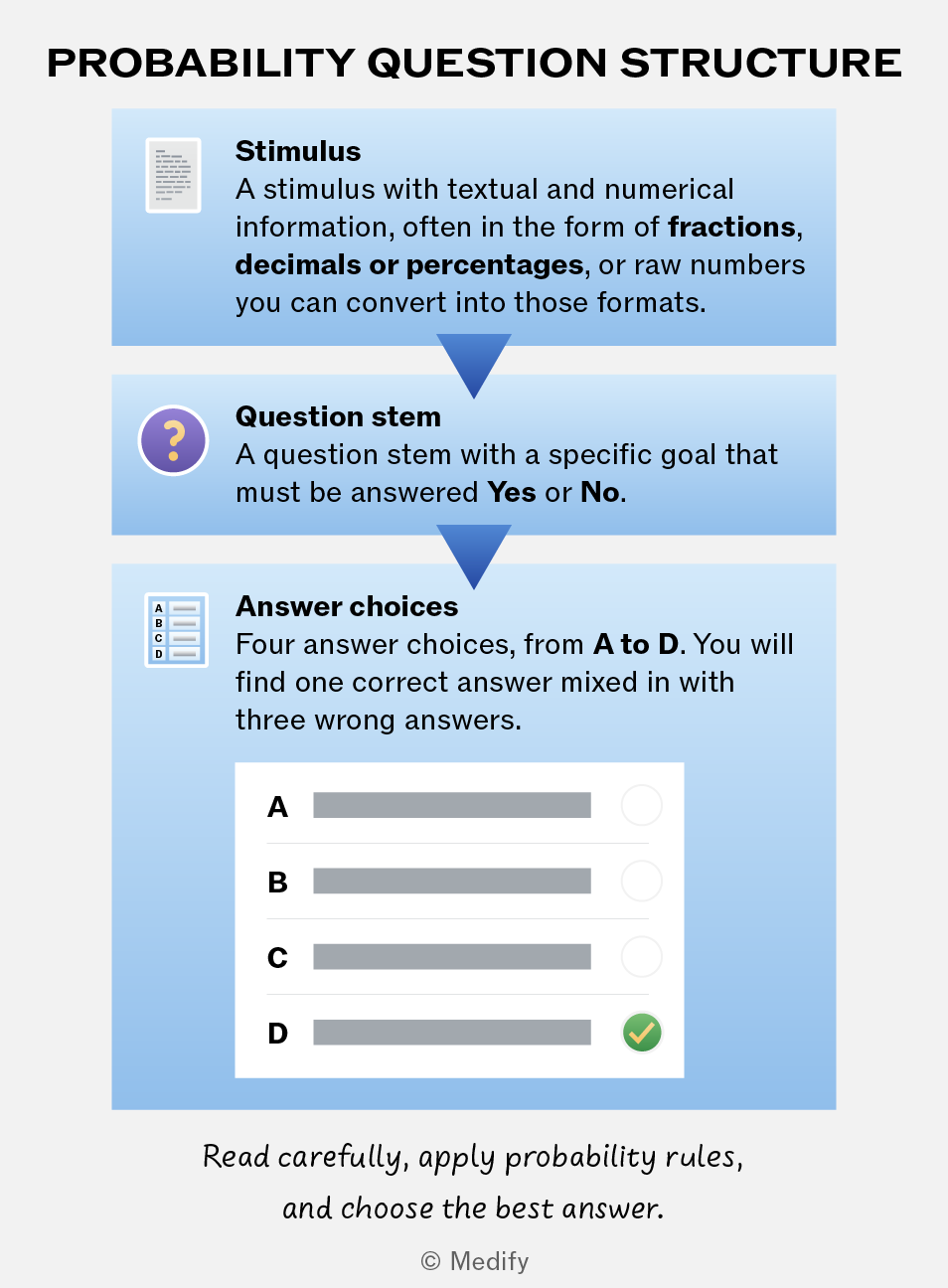
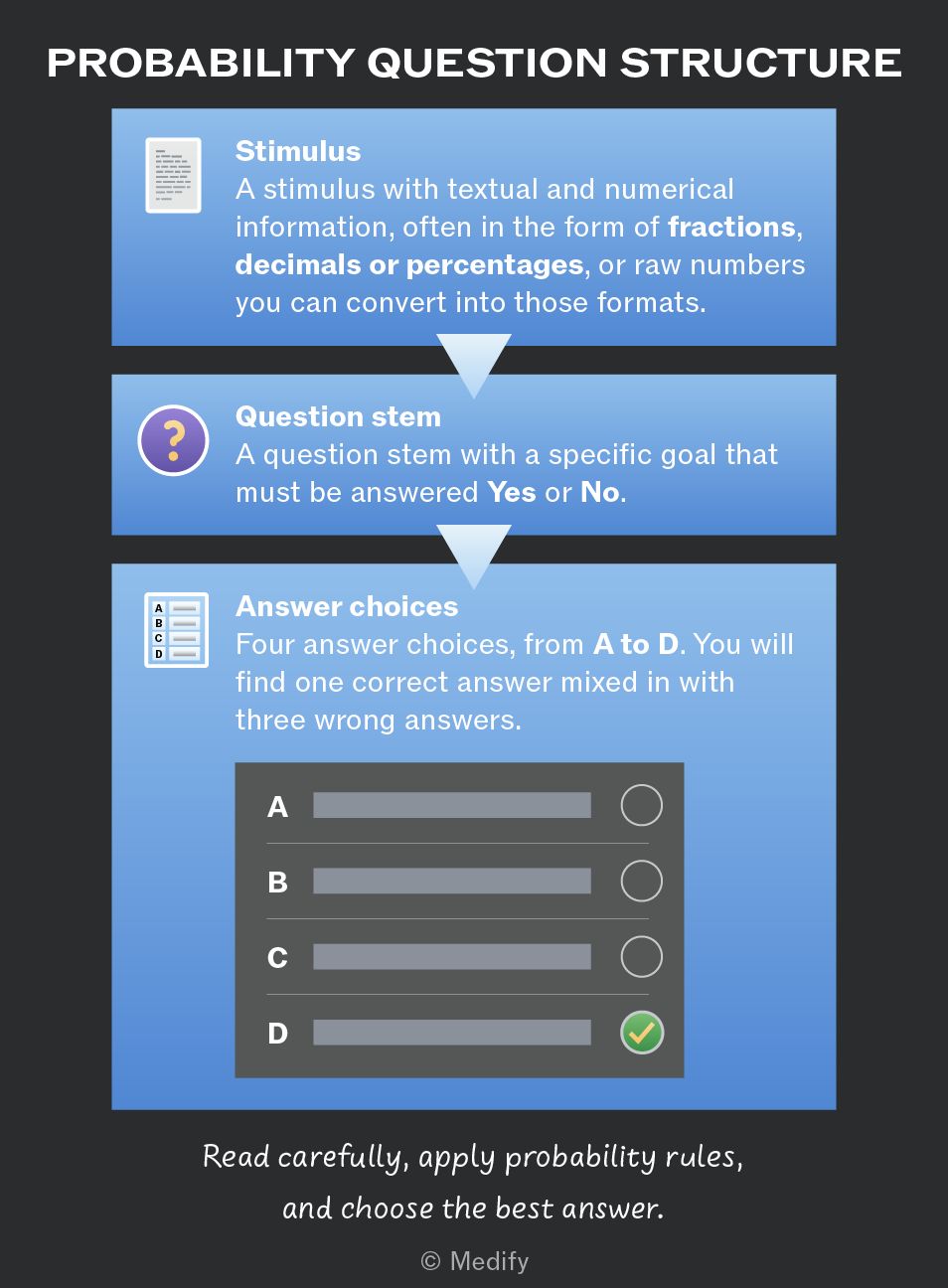
You can earn one mark per Probability question, regardless of difficulty.
In a Probability question, there are almost always 2 Yes and 2 No answers.
In the vast majority of official questions, you will see answers A and B starting Yes, whilst you will find answers C and D starting No.
Occasionally, this could be reversed, with A and B as the No answers, followed by C and D as the Yes answers.
Less commonly, you could see a Probability question with 3 Yes and 1 No answers, or with 1 Yes and 3 No answers.
The correct answer in a Probability question will be consistent in maths and logic with the numbers and facts in the stimulus. It applies accurate, coherent reasoning in a valid approach to finding the goal.
Wrong answers in a Probability question may commit any number of errors. They might:
- Use incorrect numbers in their calculations.
- Apply valid maths concepts but with a simple mistake or inversion, such as solving for or 1 – x instead of x.
- Commit a logical blunder in trying to apply maths concepts.
- Depend on a misreading or misunderstanding of the stimulus or question stem.
Notice that in the last two cases, the answers could be very obviously wrong if you have a solid understanding of probability. However, it is easier to fall for traps when working under the time pressures of Test Day.
The key task in Probability questions is to apply logic and maths concepts in order to select the valid answer.
Each question stem will be incredibly specific, so it will signal the steps required to determine the correct answer.
Wrong answers will often be utterly illogical, so it is better to think or calculate first, then use your rough working to ‘zero in’ on the correct answer.
Once you start to think or calculate, you will often find that you can eliminate wrong answers as they will clearly contradict your initial maths or logic.
Probability questions almost always involve probabilities, which you may need to manipulate or convert between decimal, fraction and percentage form.
Many questions will use a synonym for probability, such as ‘chance’, ‘odds’ or ‘likelihood’.
These words simply mean ‘probability’, so use your usual maths knowledge to answer based on the probabilities involved.
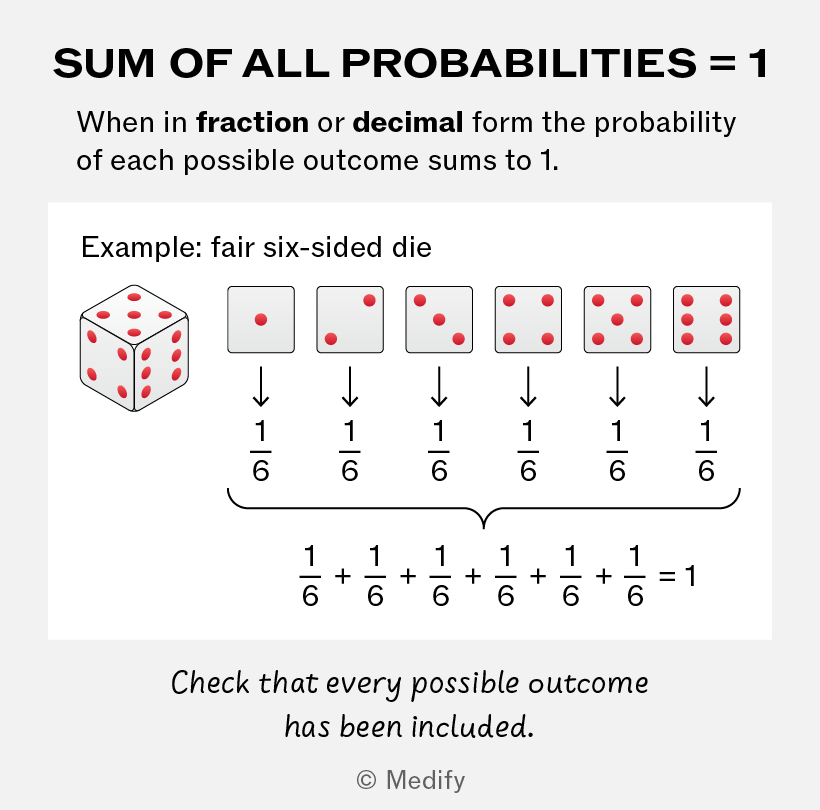
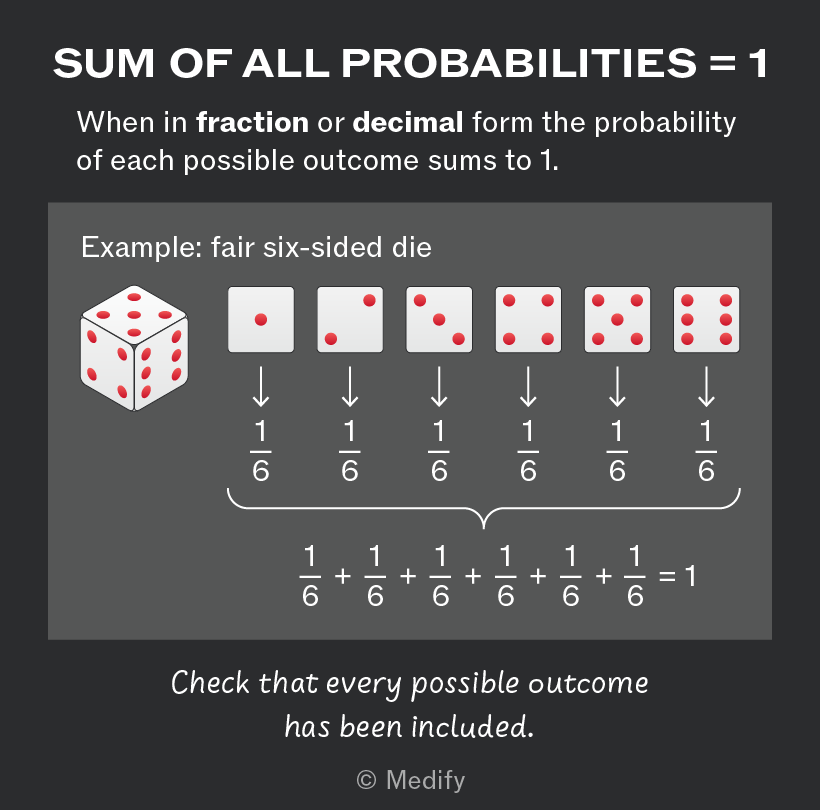
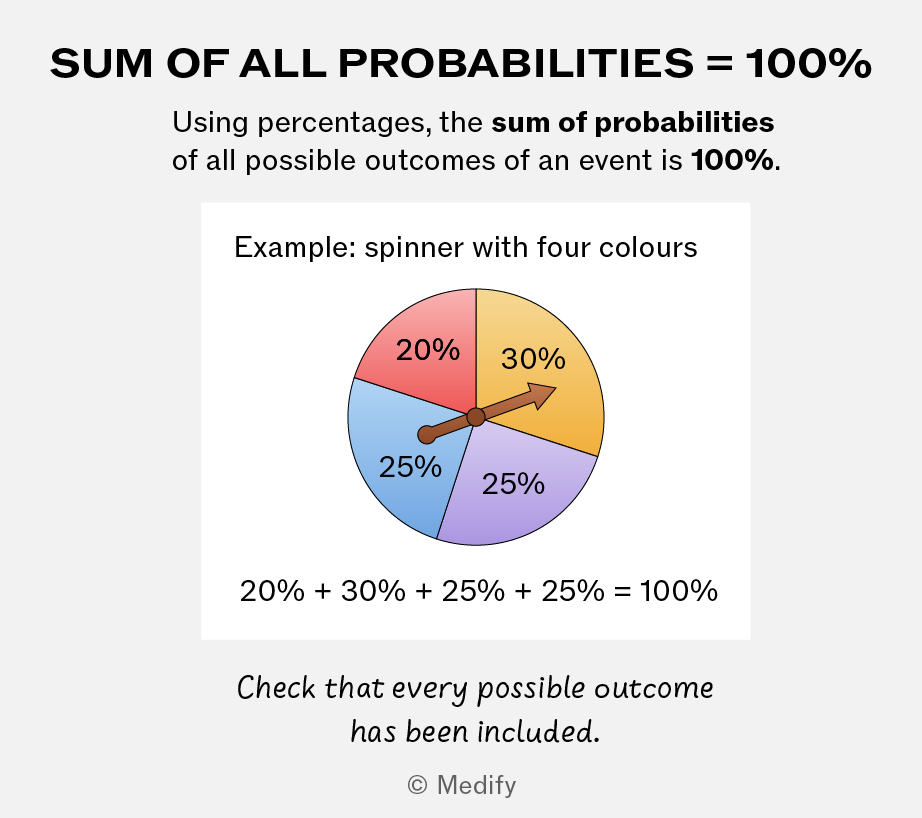
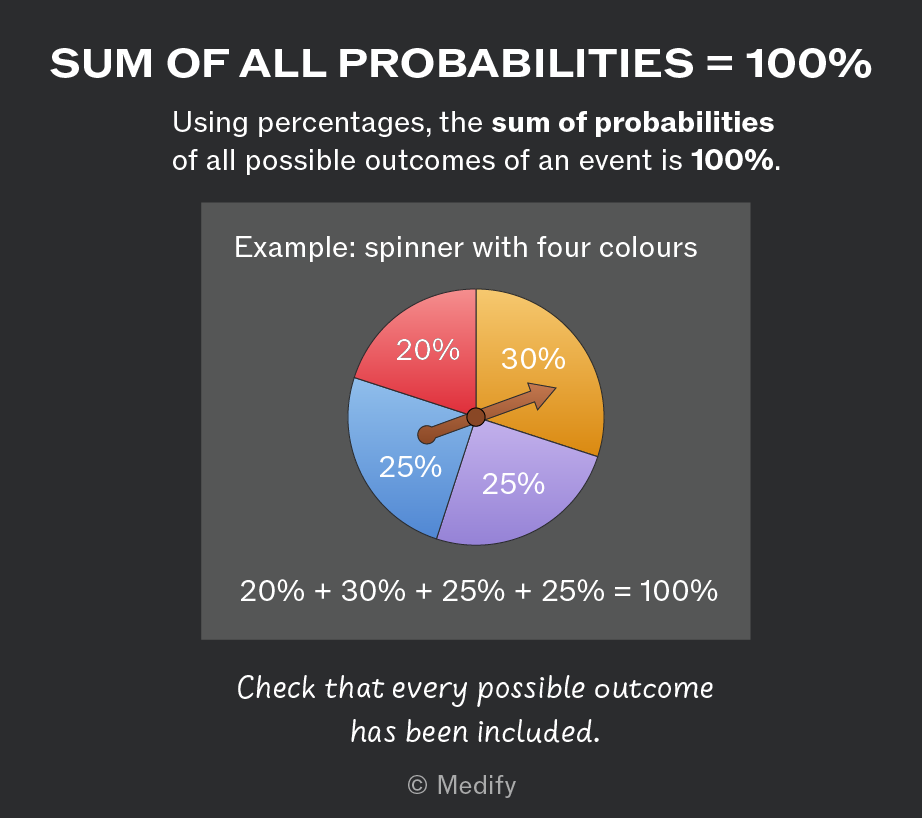
Remember, the sum of probabilities of all possible outcomes of an event is 1.
Some questions will not mention probability, with a focus instead on percentages or rates.
These questions usually compare two possible outcomes which add up to 100%. So they are conceptually adjacent to probability, requiring very similar maths as you calculate and solve.
Less commonly, you may have to apply simple statistical concepts such as sampling bias or identify other errors in a survey leading to results that are not representative.
On Test Day, you should aim to answer Probability questions in 30 seconds.
If a question is shorter or simpler, push yourself to answer it in 15 seconds or less.
This approach will take practice, but it will ensure you can bank time for the five-part questions as those are worth two marks each.
The Medify Top Tips will help make quicker work of every Probability question in your UCAT revision and on Test Day:
1. Read the question stem first, before you look at the stimulus. This way, you can focus on the goal and do only the maths needed to solve.
2. Select relevant data and calculate. Let the goal guide your work, as you will likely need to check for a very specific possibility or outcome. Pick out the numbers you need, then do the maths in your head or using the calculator.
3. Keep an eye on the answer choices as you do the maths. Many answers will be clearly wrong as they are based on incorrect logic, such as confusing the numbers or doing calculations poorly.
4. Eliminate and select, even based on partial work. Wrong answers in these questions will generally be very wrong, so you may be able to ‘see’ the correct answer a bit more readily. Some questions may be purely conceptual, so you can simply knock out illogical answers that misapply basic maths rules and properties.
In a Probability question, the question stem is always quite focused and specific.
It will guide you to the logic or maths required to:
- Answer either Yes or No.
- Confirm the reason given that supports the accurate Yes or No answer.
Thus, you must verify the claim in the question stem (if Yes is correct) or disprove it (if No is correct), along with the valid reason why it is Yes or No.
Some questions will be pure logic based on common probability concepts – and, far less often, on basic statistical principles.
If you must calculate, be ready to use the calculator. In some questions, however, the maths is so simple – working with fractions like and – that you may prefer mental maths. Practise doing the maths in your head so you can avoid common errors that could lead to wrong answer traps.
In most Probability questions, you will need to calculate, but it’s generally best to do your rough working – whether in the calculator, in your notebook, or in your head – as a straightforward attempt to answer the question, rather than working backwards from the answer choices.
This will help you avoid distractors in the wrong answers, which could be extremely illogical. In some cases, the wrong answers in a Probability question may seem like almost random words that do not align with the goal in the question stem.
The question stem will indicate the logic or maths required to determine if the answer is Yes or No.
You often must compare values to decide if it is Yes or No.
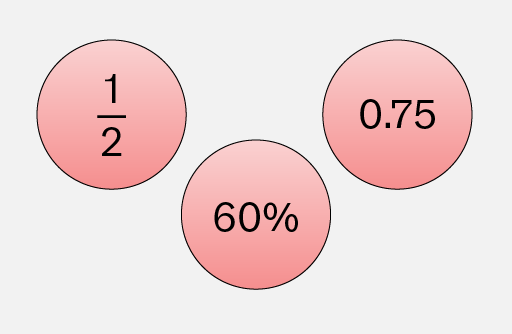
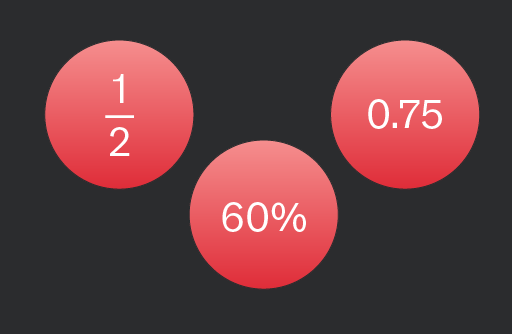
Be prepared to work with fractions, decimals or percentages. You may need to put all the values in the same format in order to compare or to do basic maths like addition or multiplication.
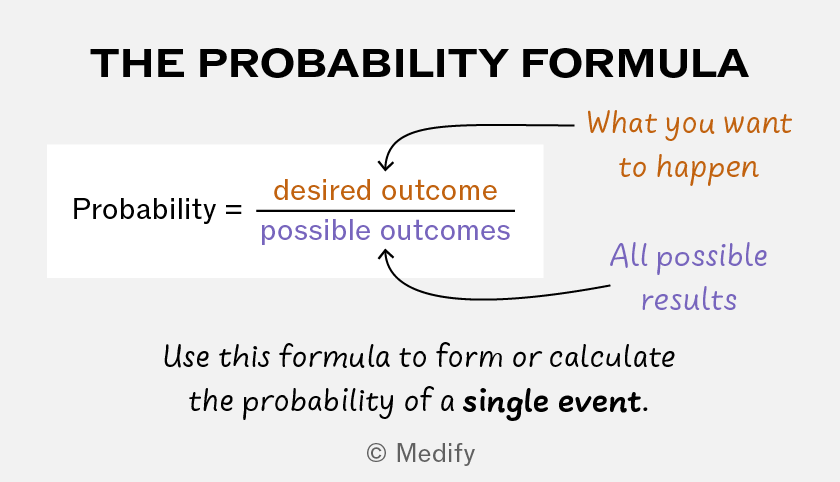
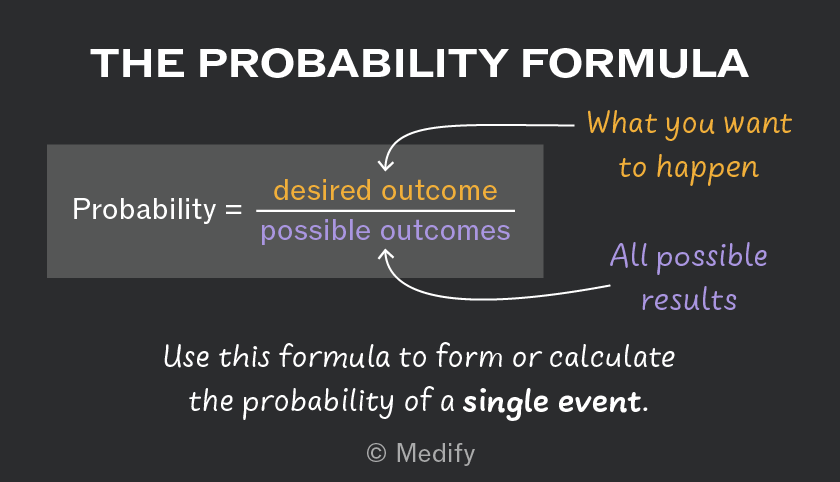
Use the probability formula to form or calculate the probability of a single event:
Many questions will use a synonym for probability, such as ‘chance’, ‘odds’ or ‘likelihood’.
You can form or calculate the probability of a single outcome the same way when you see these synonyms.
Probability questions will often include multiple outcomes that you must consider.
The probabilities of all outcomes of an event add up to 1. If working with percentages, they sum up to 100%.
Sometimes, it is faster to subtract the outcomes you don’t want from 1 (or from 100%) rather than calculating the precise probabilities of all acceptable outcomes.
You will probably need to use all the numbers in the stimulus in your rough working, so it will be important to use the right numbers at the right time.
Watch out for information from the question stem that may give you additional values.
Sometimes, you may find essential values that are given in words rather than numerals. These could appear in the stimulus or the question stem. Otherwise, you may struggle to answer a Probability question.
Once you are working through the logic or maths in a Probability question, you may be able to quickly eliminate any wrong answer that is clearly far from correct.
Some answers will be effectively nonsense, though this may become clearer once you have done a bit of rough working.
Other answers will make maths errors, such as using the wrong numbers or doing the incorrect calculation. Common errors in wrong answers include:
- Using the wrong values to form a probability fraction
- Working with the reciprocal of the correct fraction
- Mistakenly subtracting from 1 (or from 100%)
You will frequently find that you must do all the maths in a Probability question to confirm the correct answer.
But look out for opportunities to eliminate wrong answers based on partial work, especially when you are pressed for time.
Some questions will be purely logical, involving simple concepts from probability or statistics. In these questions, wrong answers may jump out as being quite strange – they will often assume that someone does not understand the basic concepts involved.
If an answer seems really very wrong – it almost certainly is. Eliminate it briskly and keep working with the remaining answers.
Walkthrough question
Medify Top Tips - Probability Qs
Let's take a look at a Probability question.