
Independent and dependent events
On this page
Many Probability questions will involve independent events.
Events are independent when the outcome of one event has no effect on the outcome of the other event.
The same task repeated with no changes is a good indicator of a series of independent events.
Different tasks with no causality or reliance on each other are independent events.
A common example of independent events in Probability questions involves a repeated action such as flipping a coin or rolling a dice.
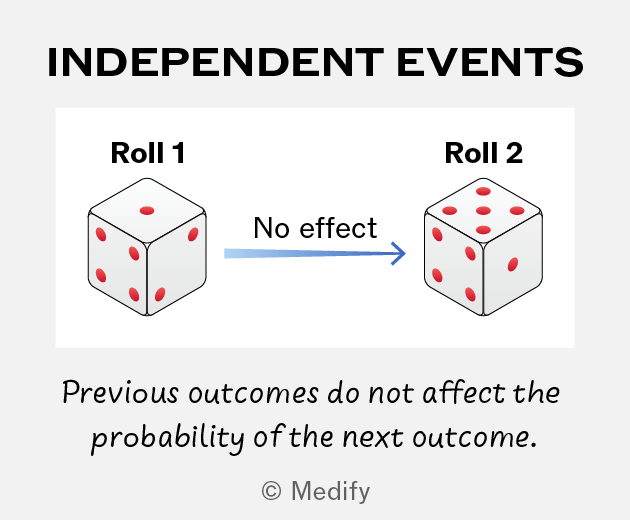
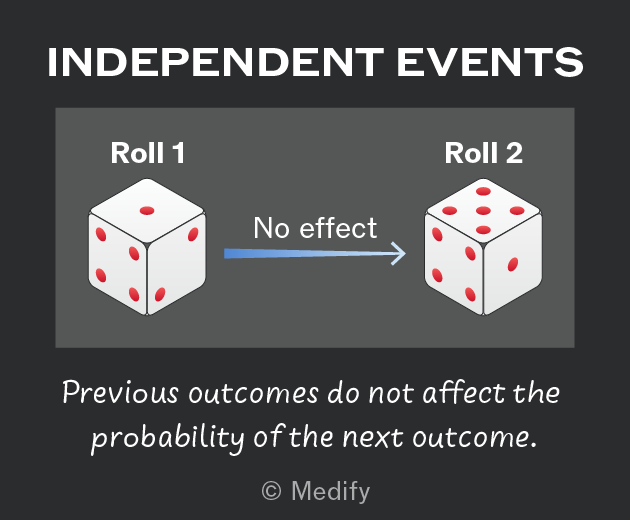
Each flip or roll is a separate outcome. Thus, the outcome of a previous flip or roll does not change the probability of subsequent outcomes. They are independent events.
With independent events, you must multiply the probabilities of each event to find the overall probability.
If flipping the same coin or rolling the same dice, you must multiply the same probability by itself multiple times – once for each flip or roll.
You could also think of the maths involved as raising a fraction to a power, where the power represents the number of times the same coin is flipped or the same dice is rolled.
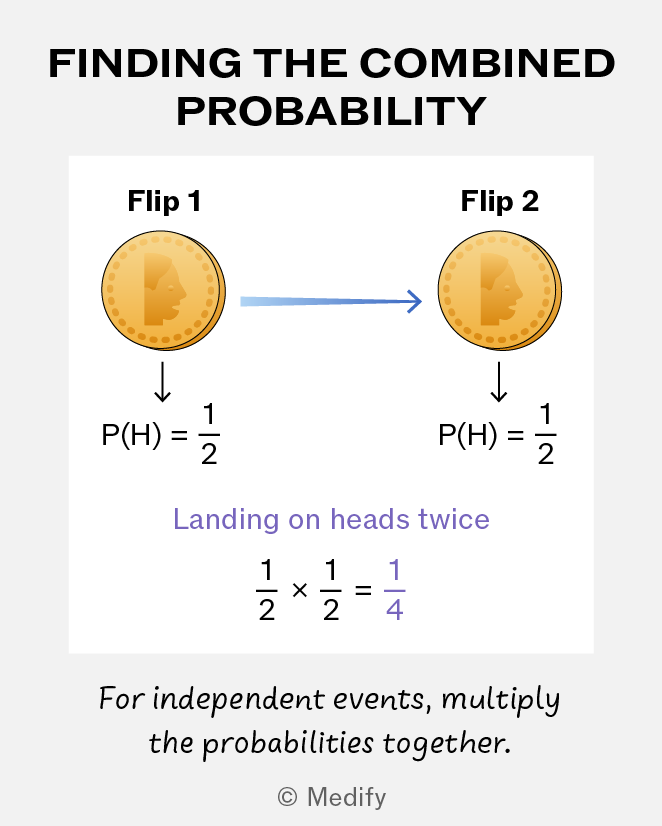
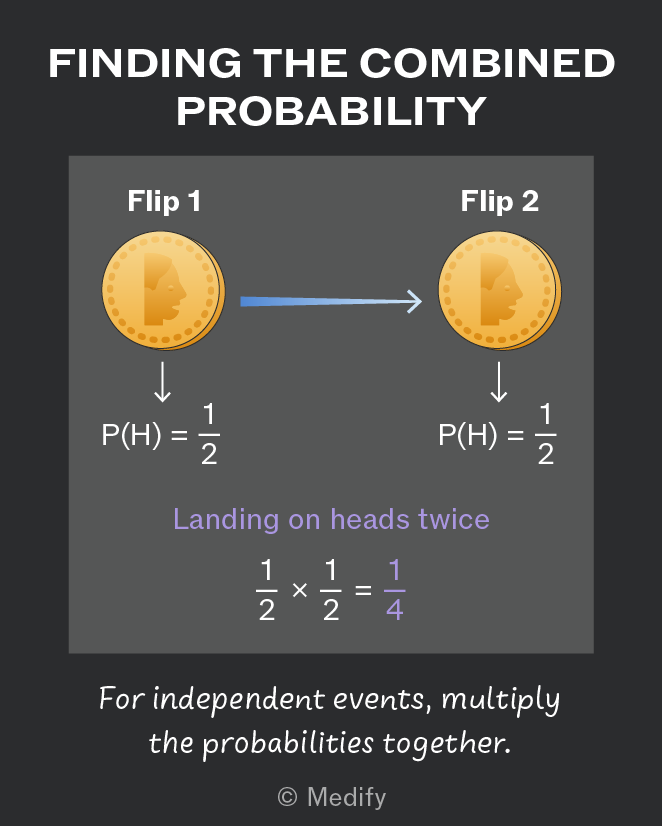
Note that the UCAT will usually say ‘dice’ to mean a single die – although we say ‘die’ in everyday English for just one. Thus, we follow the UCAT style in these study notes.
Probability questions will often involve a fair item, such as a coin or a dice, which means it has equal odds of each possible outcome.
You may be told that an item – such as a coin, dice or spinner – is biased. This usually means that one outcome is more likely than the others.
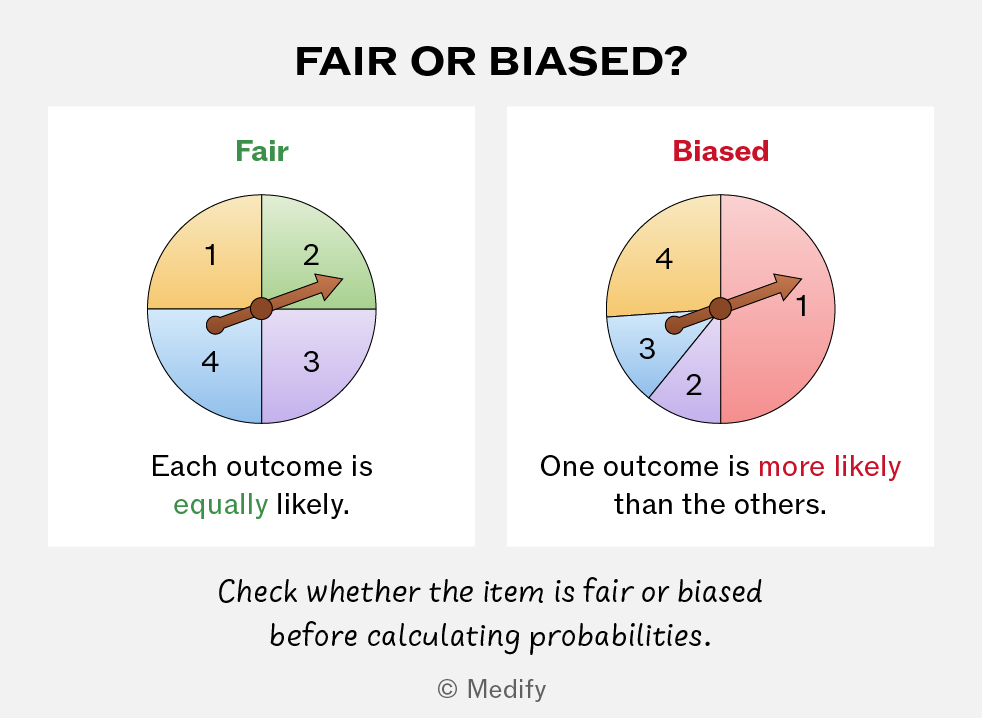
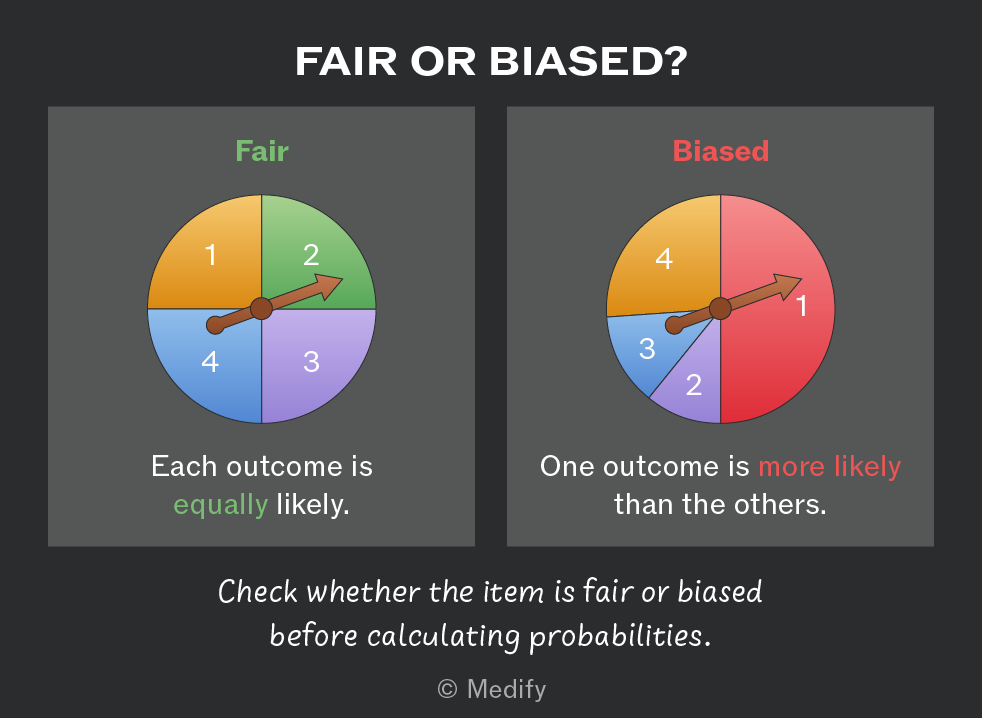
To find the probability of the other, less likely outcomes:
- Subtract the probability of the biased outcome from 1.
- Divide that value by the number of less likely outcomes.
This approach works well with items like a dice or spinner, where there could be any number of less likely outcomes.
With a coin – which normally has two sides – you will need just the first step, since the second step involves dividing by 1.
Take care to exclude past events when you calculate probability.
If an event has already happened, we know the outcome with 100% certainty. Find the probability for future events only.
Walkthrough question
Independent events
Attempt this Probability question involving independent events.
If the independent events have different probabilities, you will still need to multiply them.
Take care to use accurate values for each independent probability when these are different. You may need to subtract from 1, or you might have to form a fraction using numbers provided in the stimulus or question stem.
Some Probability questions will give you decimal values between 0 and 1. It may help to think of these as percentages, just divided by 100 and written with a decimal point.
Watch out for maths errors or potential wrong answer traps waiting for anyone who misinterprets decimal values.
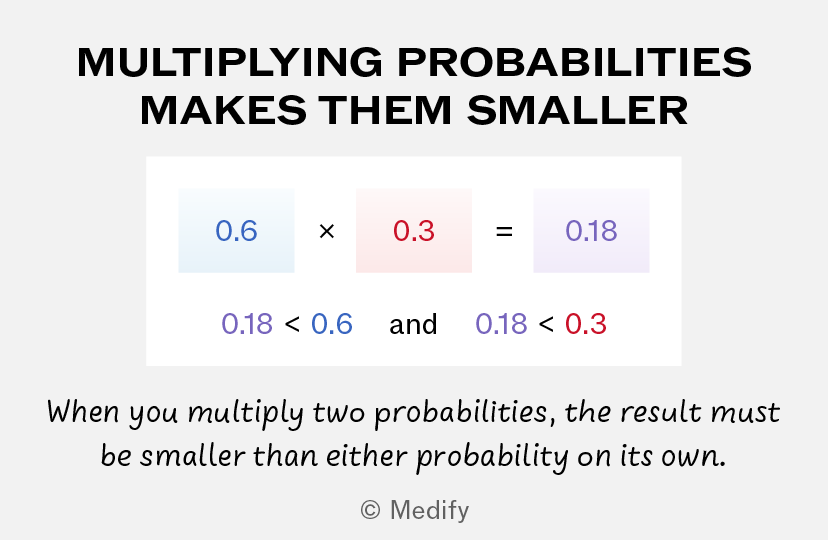
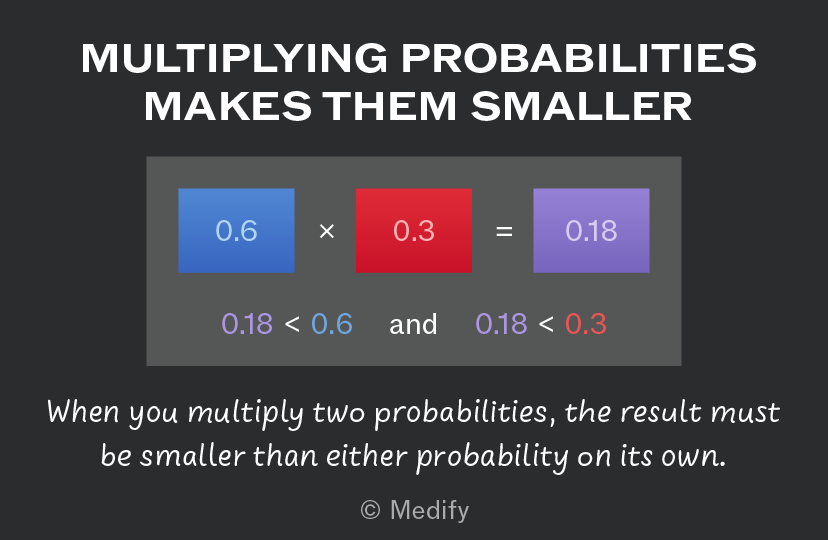
Beware of answers suggesting their product could be larger – this is a somewhat common trap for those who are working a bit too quickly.
Take care to ensure you are comparing like with like, since the wording in some questions will give you the wrong probability for one of the events.
A common challenge is to turn negatives to positives (or vice versa) so you can follow the same logic in the probability for each event.
Be ready to subtract from 1 (or from 100%) for one event in order to multiply the accurate values for the right combination of each independent event.
Occasionally, a Probability question will ask about mutually exclusive events. This is a variation on independent events where:
- an event has two or more outcomes that cannot both happen at the same time.
- you must factor in both possible outcomes in your probability calculation.
The key point is that you must add the probabilities of each outcome to find the overall probability. You will likely first have to multiply to find the probability of each individual outcome before adding them to find the mutually exclusive probability.
Walkthrough question
Independent events
Let's look at a question with mutually exclusive events.
You may see a Probability question about dependent events. In these questions, the probability is different for a subsequent event than the one that came before.
The most common example is when items are selected at random but not replaced after each selection.
As a result, the number of possible outcomes decreases after each random selection. The number of desired outcomes could change as well.
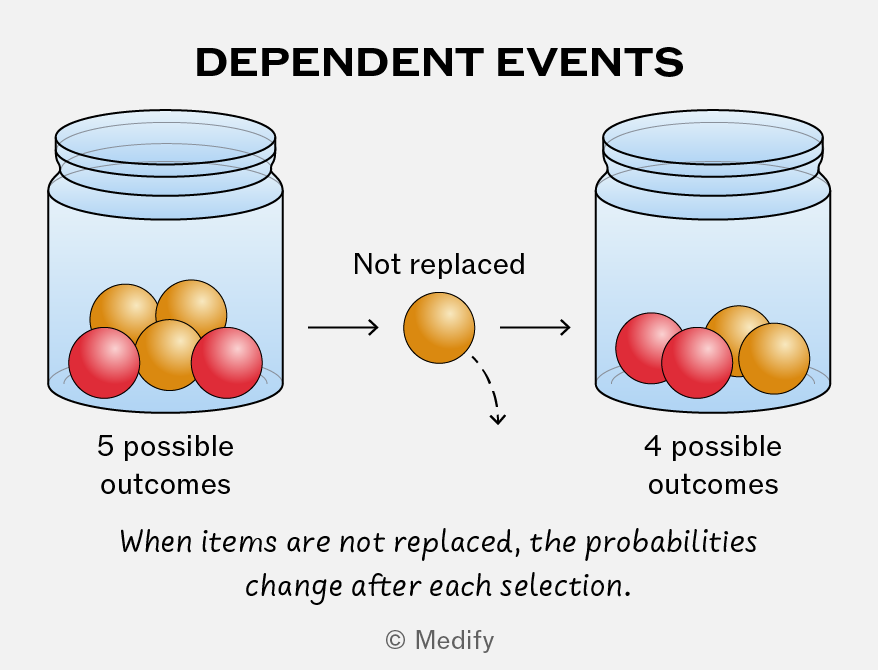
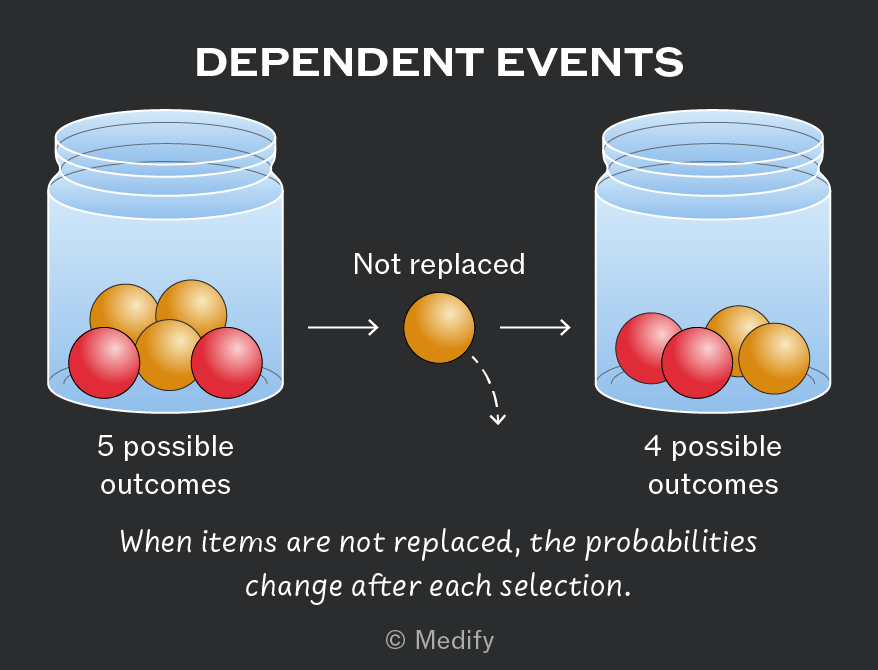
Be ready to use the probability formula to form a new probability for each random selection in a question with dependent events.
It may help to jot down each fraction on scrap paper – or in your notebook on Test Day – to ensure you remember them. This will also make it easier to compare your fractions to the ones in the answer choices.
Probability questions with dependent events will usually compare the initial probability before any selections are made with a later probability after one or more items have been removed.
You must count up the removed items and:
- Subtract the total removed items from the possible outcomes
- Subtract the desired removed items from the desired outcomes
In most cases, the desired items removed are of a particular colour, but there may be additional colours also removed in the initial selections. This can result in a lower denominator to your new probability fraction.
You will almost always see probability fractions in lowest terms in the answer choices.
Get in the habit of simplifying fractions by reducing common factors from numerator and denominator as you form them for your initial and later probabilities.
This will make it easier to compare your fractions to the answer choices.
Less commonly, you may see a Probability question involving a fictional game with relatively simple rules about how a player wins or loses.
Such games will usually involve dice or a spinner; less often, they may involve cards with numbers or letters that are drawn or played.
A game could potentially involve independent or dependent events:
- Drawing or playing cards is likely to be a series of dependent events, since each card that is drawn/played will leave one fewer card available; there could also be finite cards with each number/letter, thus reducing the possible outcomes with each card that is played.
- Rolling dice or spinning a spinner is likely a series of independent events, since all options are available for the next player – they could still roll or spin every possible number with the same probability.
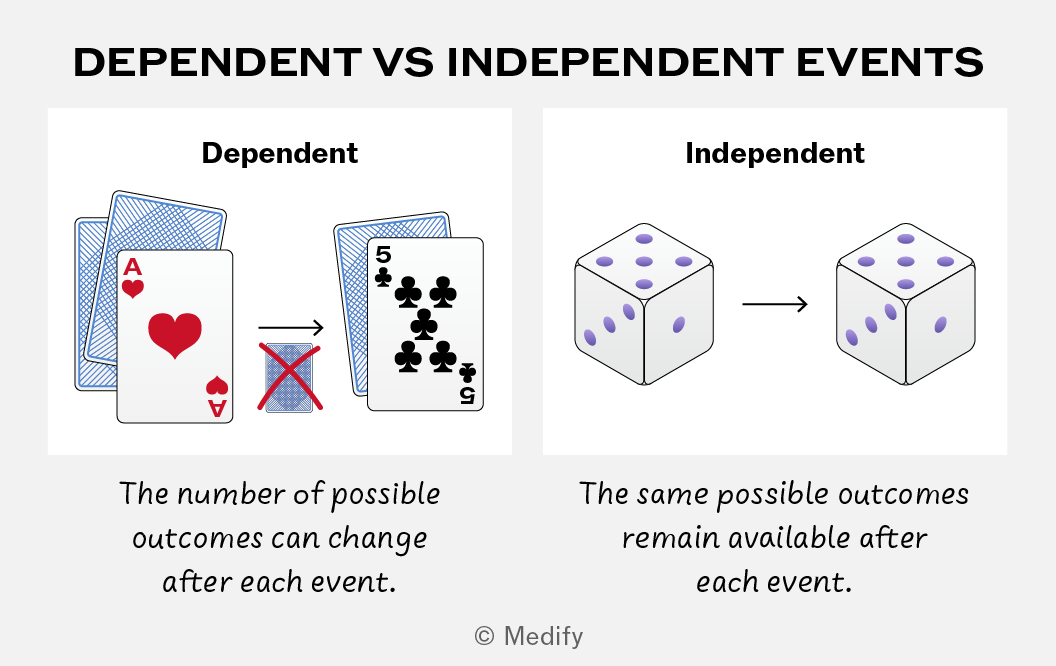
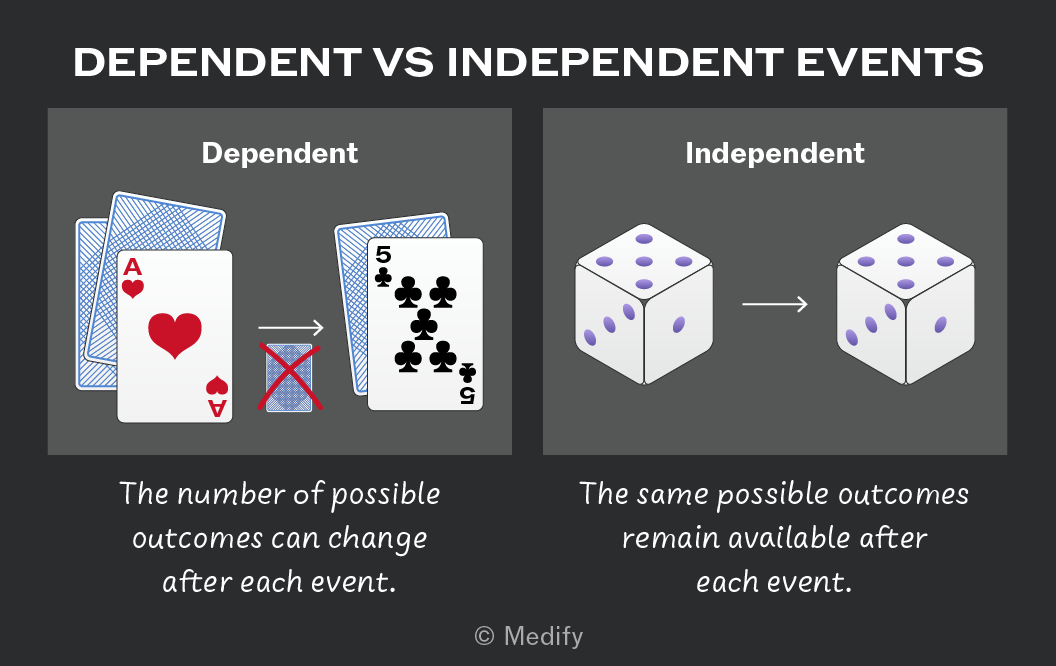
If a Probability question includes a fictional game with dice or a spinner, take a moment to consider whether the game itself is a series of dependent events.
This could be as simple as the structure for taking turns.
For example, if Player 1 has a chance to win the game on their first turn, they would have a higher chance of winning overall than Player 2 – since Player 2 might not even get a turn.
You are highly unlikely to need to know exactly how to calculate Player 1’s chance of winning (or Player 2’s chance of losing) in this example. It should be enough to see that one player has a greater probability of winning, despite the rules otherwise being fair.
This is a less common but powerful example of dependent events – each subsequent turn will depend on the outcome of the previous turn, and the game could stop at any point.
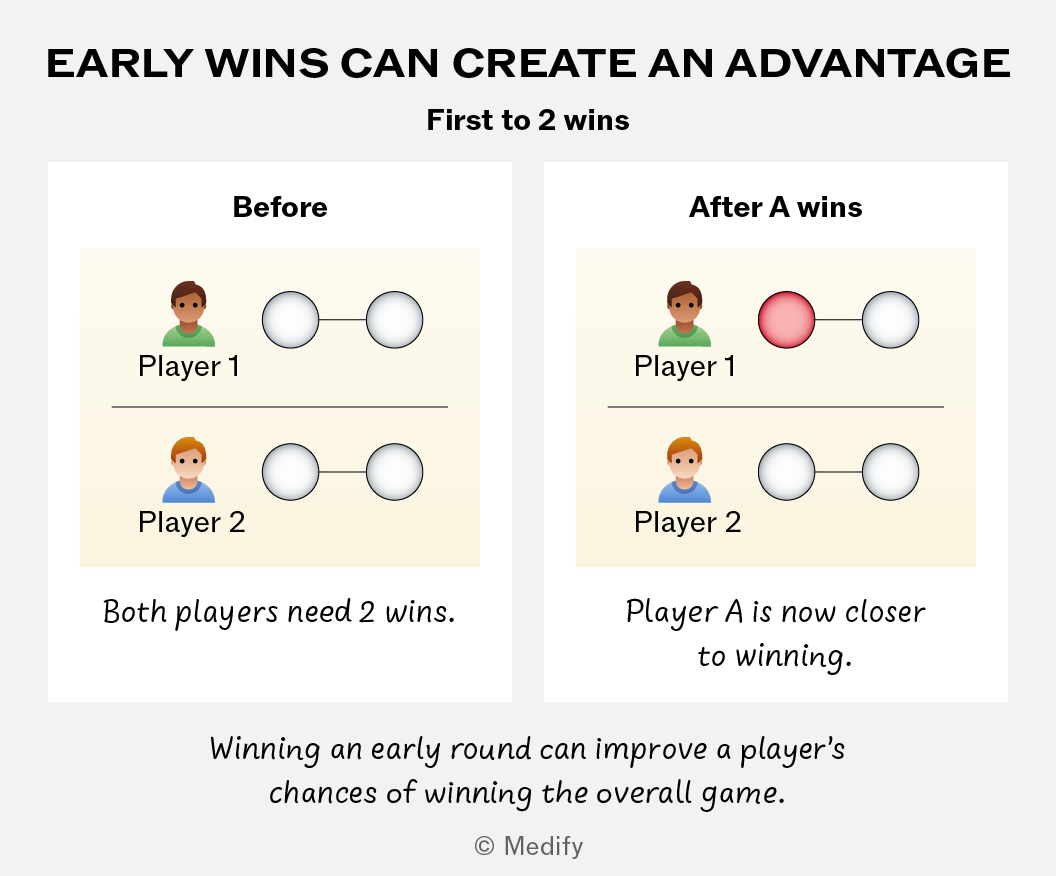
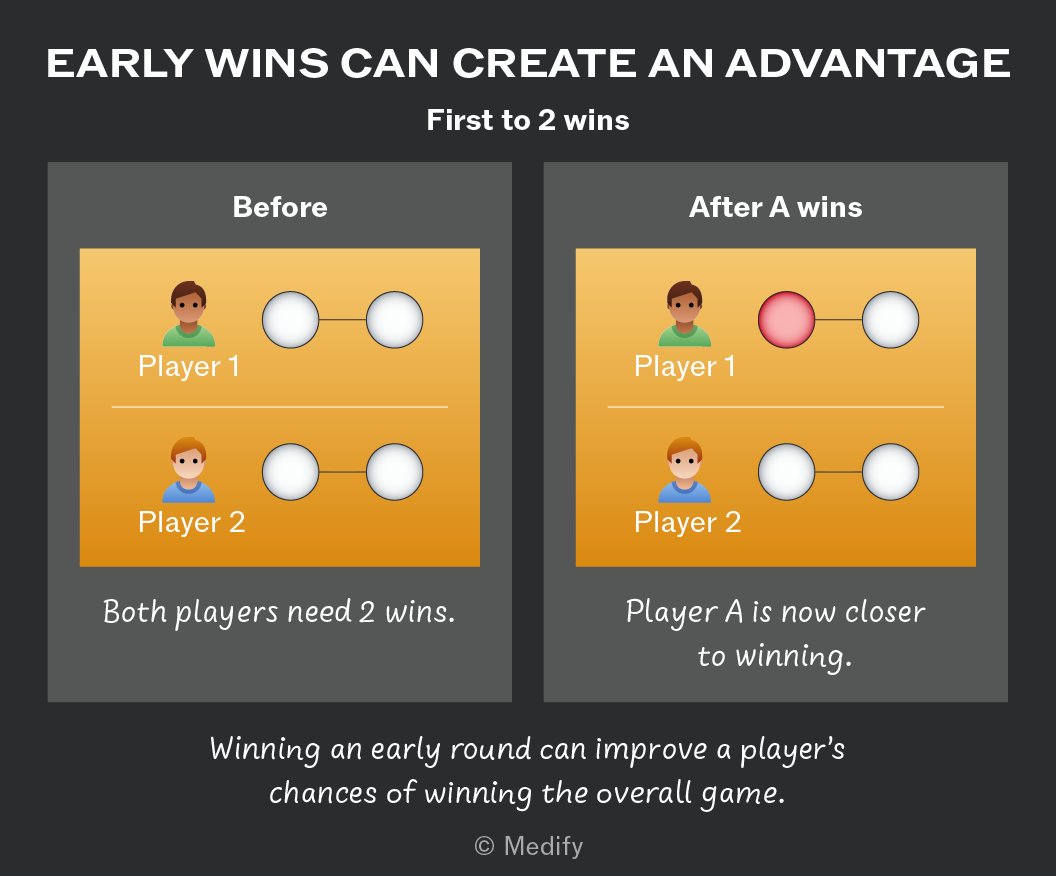
A fictional game in a Probability question could also require a player to win a certain number of rounds in order to win the game.
Whoever wins the first round will have an advantage over the other player – and thus be closer to winning overall. The probabilities are therefore dependent.
This is known as first player advantage when the player who goes first has better odds of winning for that reason.
You don’t need to know that term for the UCAT, but it can help if you are ready to recognise the concept in a Probability question. It may be all you need to select the correct answer.
If you are unsure if the probabilities are independent or dependent, ask yourself:
- Is it like flipping a fair coin repeatedly? Each individual flip will have the same probability of occurring, no matter how many times in a row you flip the coin. Each event is independent of the others in the sequencing.
- Is it like randomly picking marbles from a bag without replacing them? With at least two colours of marbles in the bag, each marble you select will leave a different number of that colour in the bag, along with a new total number of marbles remaining. Each marble’s selection has a different probability, so the odds of picking each marble is dependent on any previous selections.
Walkthrough question
Dependent events
Now let's see what a question with dependent events looks like.