
Logic Puzzle basics
On this page
The second question type in Decision Making is Logic Puzzles. Sometimes, these questions are also called ‘Logical Puzzles’.
You must combine information from the stimulus to make one or more deductions.
You will have to rearrange or link up people, things or other entities – like prices or colours – as you make deductions.
Be prepared to write in your notebook as you work. You may find it helps to notate the rules individually or in combination. You may also want to make a sketch to track the relationships and see what else you can fill in.
Each Logic Puzzle includes:
- The set-up for the puzzle in the first sentence or two of the stimulus, establishing the broad context and often listing out the entities involved.
- The rules for the puzzle, usually given in a list following a blank line after the set-up. You will use the rules to combine entities and find what must be true.
- Four answer choices, from A to D. You will find one correct answer along with three wrong answers.
Each Logic Puzzle is worth one mark, regardless of difficulty.
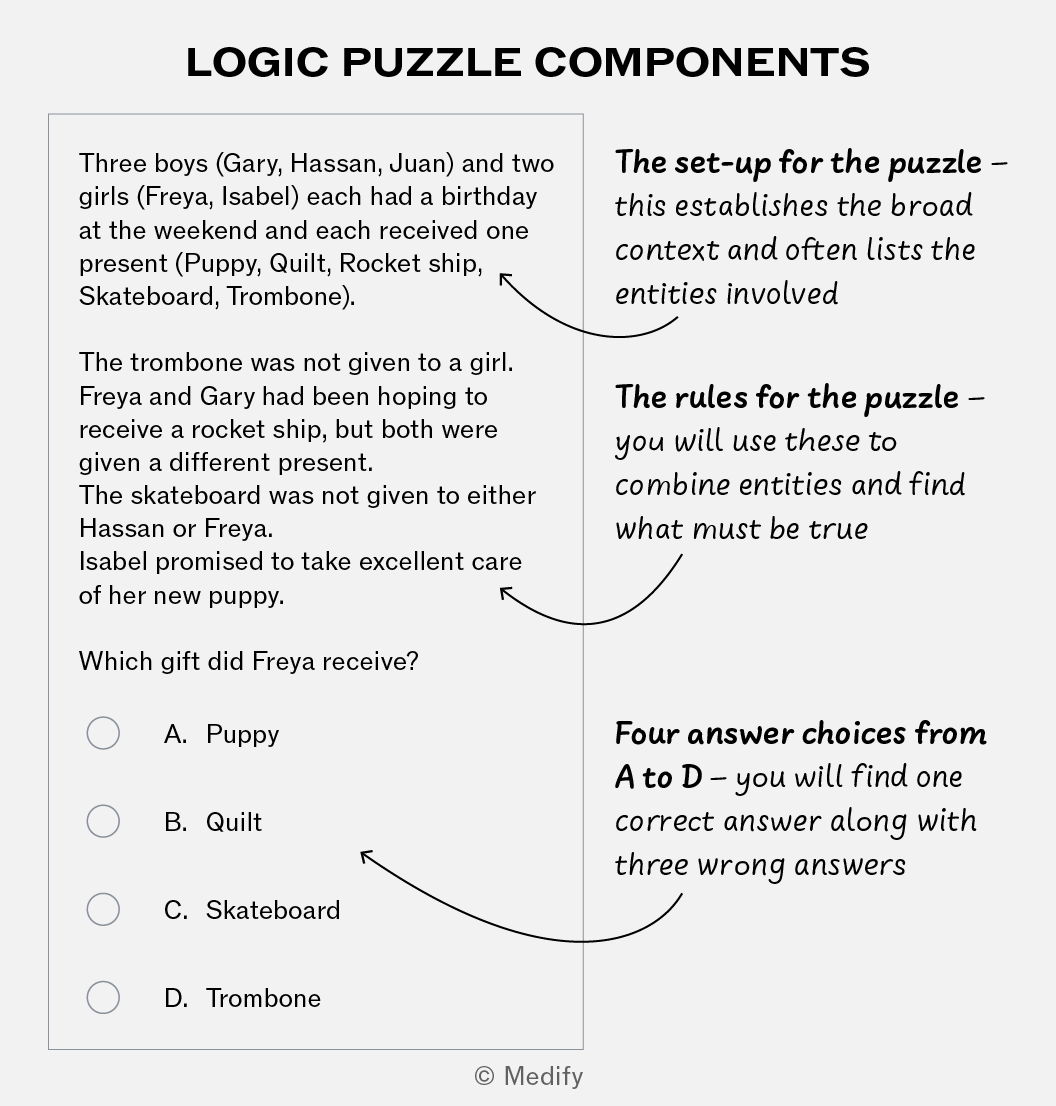
Logic Puzzles are all about deductive reasoning, with a few key tasks.
Logic Puzzles are all about entities: the individual people, places, things or other variables – like prices, colours, qualities or algebraic variables – you must use to solve.
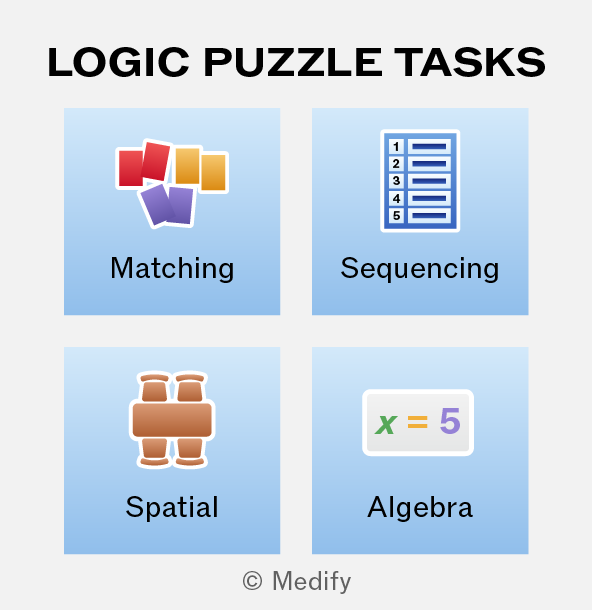
Matching: You will pair up two categories of entities.
Sequencing: You must arrange entities in a simple list, in absolute or relative order.
Spatial: You must ‘move’ or arrange entities in two or three dimensions.
Algebra: You must solve for an unknown by working with numbers, shapes or symbols.
Sometimes, a single Logic Puzzle will involve two tasks. Most commonly, you will see:
- Sequencing plus matching: You must pair up two categories of entities and also order them in a simple list.
- Double matching: You must pair up three categories of entities.
On Test Day, you have to answer Logic Puzzles in an average time of 1 minute each.
If a Logic Puzzle is fairly short and simple, push yourself to click an answer in 30 seconds or less.
However, you are sure to see at least a couple of Logic Puzzles that are far more complex, so try to keep to around 1 minute on the hardest ones.
If a Logic Puzzle seems super difficult or time-consuming, do not attempt it on a first pass through the DM section. Immediately skip it and flag for review. Just make tally marks in your notebook (or keep track in your head) of how many non-five-part questions you must complete on the second pass.
Use the Medify Top Tips for every Logic Puzzle in your UCAT revision and on Test Day:
1. Check the goal and the task: Take a quick look at the question stem to see the goal. Then, glance at the set-up – the first sentence or two at the top of the puzzle – to determine the task. Allow a few seconds to find the goal and the task, as they will guide your work.
2. Build simple facts into deductions: At first glance, many rules will seem quite challenging to untangle. You can attack the rules in any order. The first rule in the list may be the hardest to work with. Instead, use a ‘pick ‘n’ mix’ approach to select the simplest facts that you can use first. Get these basics in place, then they can guide you to make deductions from the information in the more complex rules.
3. Use your notebook: Train yourself to make a quick notation of each rule – or any key deductions – using abbreviations. If a rule allows multiple possibilities, write them with a slash. If a rule excludes a possibility, put an X next to it. For some questions, you will also likely want to make a sketch that combines your deductions in a clear, simple way.
4. Keep an eye on the answer choices: You may not have to deduce everything to prove the correct answer. Use partial work to eliminate wrong answers, as many answers will be clearly wrong before you have seen the reason why the correct answer is correct.
To focus your work in a Logic Puzzle, you need to know the goal.
The goal is simply what the question asks you to solve for. This could be:- The one answer that must be true.
- Something more specific that is the only possibility.
- An unknown value such as a number, shape or symbol.
The last case applies in an algebra task – you must simply solve for the unknown.
In all other tasks, the answer will normally be a word or statement that must be true. You can therefore eliminate answers as soon as you see they are false, or could be false.
Many question stems will simply be variations of: ‘Which of the following statements must be true?’ Sometimes, there will be extra words in the question stem that provide further context about the answer that must be true.
If there is further context in the question stem, use this to focus your work. It means you can stop working as soon as you have addressed the further context.
To guide your work in a Logic Puzzle, you need to know the task.
Any algebra task is fairly straightforward to identify – you must find an unknown value with basic maths or by solving a series of simultaneous equations.
The other tasks may seem challenging at first. Try to spot the key aspect of the work required to solve.
- Do you have to put people or things in a simple order in a line or list? The task is sequencing.
- Do you have to link up people, things or other entities? The task is matching.
- Do you have to arrange people or things in relative positions beyond a simple line or list? The task is spatial.
The task will drive your work, including any possible sketch or notations to help you solve for the answer.
Use the ‘pick ‘n’ mix’ approach to select rules or parts or rules to apply first:
- Cast your eyes briefly over the rules, looking for simple facts. Ideally, you want something you could assign or match definitively.
- Set aside the longest, most complex rule – you will likely want to apply it last.
- Continue to pick out the next simplest fact from the remaining rules.
- Do not hesitate to use only part of a rule as needed. Just remember to come back for the other part later.
This approach lets you combine simple facts to form a foundation that will allow for the bigger, harder deductions.
Be ready to notate each rule in your notebook.
- Use single capital letters for people, with a second, lowercase letter if two names start with the same letter.
- If there are both people and places, you may wish to use two or three letters for the places, to distinguish them from people.
- Use single lowercase letters for colours or things – again, with a second letter to avoid ambiguity. Think about how you will abbreviate blue and black if both appear – for example, ‘be’ for blue and ‘bk’ for black.
- Be sure you can distinguish similar letters and numbers in your handwriting in case you use them in the same question. Otherwise, it’s easy to confuse capital i, lowercase l and 1, or to mix up O and 0.
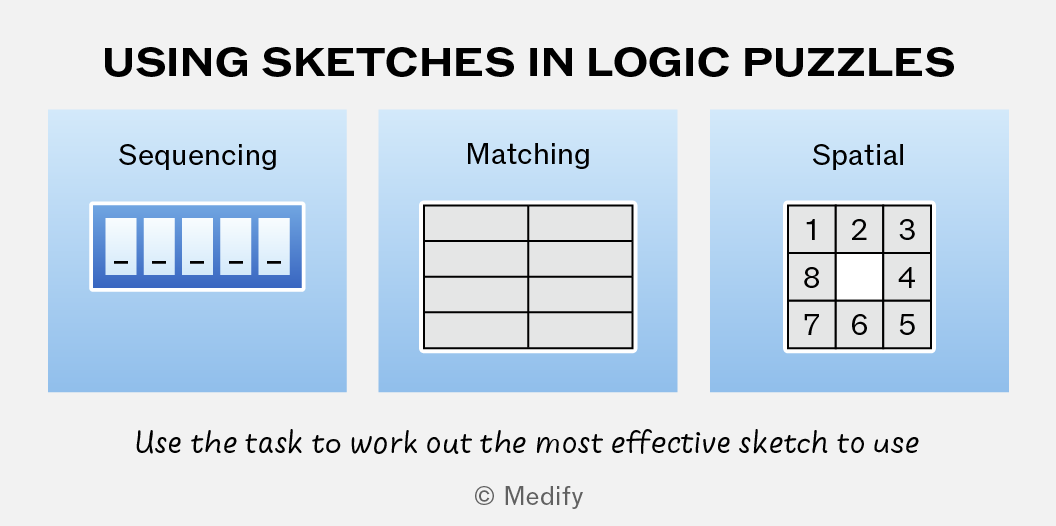
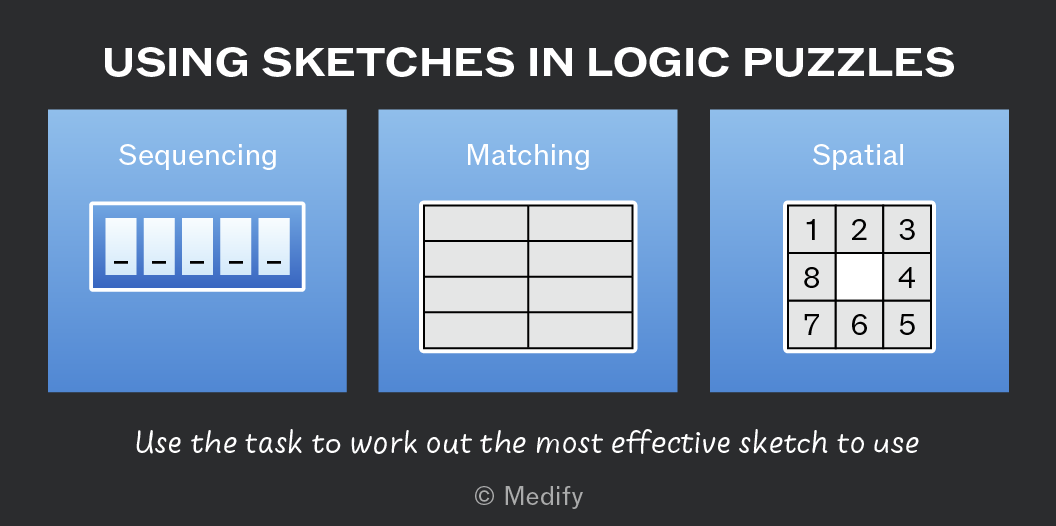
For some puzzles, the quickest approach is to make a sketch in the notebook. This way, you can build deductions directly into the sketch.
Use the task to guide the sketch:
- Sequencing: a simple row or column of slots to fill in with the people or things.
- Matching: a list or table to link up people or prices with the other categories.
- Spatial: a diagram that captures the relative relationships between people or things.
Some puzzles may include a diagram, though you may need to use your own sketch as you cannot write on the onscreen diagram.
Remember that you may need to notate individual rules first – it will often be unclear how to make deductions in order to put things into the sketch until you have more simple facts.
It’s essential that you do only the work required to confirm the correct answer.
Some Logic Puzzles will require you to make every possible deduction, with the final step matching the correct answer. In such cases, you must do all the work to prove the correct answer.
However, you will often disprove incorrect answers through earlier steps in such Logic Puzzles. Thus, with an eye on the answer choices, you can eliminate wrong answers along the way.
This opens the possibility that you could eliminate every wrong answer before you finish the deductions. When one answer remains, it must be correct.
Be careful not to try to work beyond the correct answer.
Occasionally, a Logic Puzzle will have a correct answer that is an earlier, simpler deduction that you can work out without solving all aspects of the puzzle. By keeping an eye on the answers, you can see as soon as you prove the correct answer. Even if further deductions are possible, they are unnecessary. Click your answer and move on.
Similarly, you may reach a point where you feel you have done everything but have not assigned every entity definitively. Take a moment to check the answers as it is possible you already deduced the correct answer in your earlier work.