
Logic Puzzle challenges – part 1
On this page
You may encounter one or more challenging algebra puzzles on Test Day.
In the official UCAT practice, there are three types of algebra puzzles:- Word problems can take almost any form; you will usually solve for a numerical value.
- Symbolism questions will include symbols or letters in a system of equations; the correct answer could be a symbol or a number.
- Shape equation questions will include shapes in a system of equations. The correct answer will usually be the certain shape that completes an unfinished equation.
Notice that all the algebra tasks in Logic Puzzles rely on your numeracy and algebraic skills, unlike other tasks that focus on sequencing, matching or spatial reasoning.
This means that algebra puzzles are all about doing the straightforward work. You may need to do some rough working in your notebook, but you are unlikely to draw a sketch.
Word problems in UCAT DM may require deductions, however these are essentially the same as deductions you would make in a conventional word problem in a maths exam.
Focus on the goal: what are you trying to solve for? What does the correct answer represent? A number of…what, exactly?
Use the details in the set-up to guide your work. Sometimes, you might have to solve for an unknown, then include this new value in your calculations for the correct answer.
Walkthrough question
Algebra puzzle challenges
Let's attempt a challenging word problem.
You may or may not see symbolism in any Logic Puzzles on Test Day. It’s a relatively recent addition to the official UCAT materials.
A symbolism question uses unusual symbols – ones normally not found in maths – in equations.
Think of each symbol as a variable, just using the symbol instead of a letter. In theory, it is possible that some questions in this format could simply use letters instead of symbols – each letter (or symbol) with a different numerical value.
In a symbolism question, you will see a system of simultaneous equations. We expect that the number of different symbols will equal the number of equations.
This means you can in theory solve for the value of each symbol. Each symbol will likely have a different numerical value.
The correct answer in a symbolism question could be:
- a symbol
- the numerical value of a symbol
- a number representing the result of some maths involving symbols, such as a sum or a difference
In a system of simultaneous equations, you can use shortcuts to avoid solving algebraically for the value of each variable, symbol or shape. Normal maths rules allow you to:
- Add or subtract one equation from another, taking care to group like terms and add or subtract them on the same side of the equal sign, forming a new equation.
- Multiply both sides of an equation by the same factor, then add or subtract one equation from another. This can help to ensure one variable has the same coefficient in two equations.
- Add or subtract your newly formed equation from any of the remaining original equations.
With these shortcuts, you can usually eliminate one or more variables by simply adding or subtracting two equations. This lets you quickly find the value of one symbol, which you can then plug into any equation from the original system to solve for another.
Walkthrough question
Algebra puzzle challenges
Now look at a question involving equations using symbols.
Shape equations are among some of the most challenging Logic Puzzles. They include a system of equations with shapes instead of numbers or variables.
Normally, the only maths operation is addition, though in theory subtraction is possible if less likely.
Think of each shape as a variable. Instead of seeing 3c in an equation, you will see ◯ + ◯ + ◯.
In the official examples of shape equation questions, you will usually find:
- Three complete equations in the stimulus, including four different shapes.
- One incomplete equation, with a question mark indicating a missing shape.
- The correct answer is the missing shape; it will make the last equation true.
- Each wrong answer is one of the other shapes in the first three equations.
Shape equation puzzles are vulnerable to two main techniques: you can either rewrite with variables or find the base shape.
To rewrite with variables, notate each equation using a different letter for each type of shape, counting up the shapes on each side of each equal sign. This will take a good 10-15 seconds, but it should help you see the algebraic steps to solve for the variables’ values more clearly.
To find the base shape, you must define three shapes in terms of the one with the smallest value. As a shortcut, the base shape may be the one that occurs most frequently in the three complete equations.
Think of the base shape as equalling 1. Then, the other shapes must have values greater than 1, which you can calculate by adding up multiple instances of the base shape on one side of an equation.
Since shape equations are a system of simultaneous equations, you can add or subtract the complete equations from each other in any combination, just as you could in a symbolism question. This approach could help you determine the value for one or more shapes, in terms of another shape (or in terms of the base shape that equals 1).
However, it may be difficult to combine equations by adding or subtracting the complete equations, for the simple reason that you will have three complete equations with four shapes. You should technically need four equations to solve for four variables.
This means there must be a shortcut to let you figure out the relative values of the variables.
Remember, you do not need a definitive value. You simply need to define each shape in terms of the base shape, which effectively equals 1.
The best shortcut to use in shape equations is partial substitution.
Look for a place where you can plug all or part of an equation into a small part of another equation.
Good options for partial substitution include:
- An equation has one shape on one side of the equal sign; you can substitute the other side of that equation for that shape in any other equation.
- A combination of shapes on one side of an equal sign in one equation is repeated as part or all of one side of another equation; you can substitute the shapes on the other side of the first equation for the equivalent combination in the second equation.
- All shapes on both sides of one equation appear on the same sides of the equal sign in another equation, but with extra shapes on both sides; you can subtract the first equation from the second, leaving only the non-repeated shapes on both sides.
In shape equations, take a second to note the least frequent shape.
It’s possible that a shape will appear only once in the three complete equations.
This means it’s very likely you must solve for the other three shapes first, then use their relative values (in terms of the base shape) to determine the least frequent shape’s value.
Notice as well – this approach eliminates one option as being the base shape. It would be impossible to quickly define the other three shapes in terms of a shape that appears only once in the three complete equations.
Logic Puzzles with a spatial task may seem straightforward when they include a diagram, since many puzzles will not provide a diagram.
However, the nature of spatial reasoning allows for more complexity in the rules and deductions. This is because you must think in multiple dimensions.
If a spatial puzzle does not include a diagram, you will want to draw a rough sketch to aid your spatial reasoning. Otherwise, it is easy to miss out relationships between people and things.
In a sequencing task, the relationships between people or things are usually just left to right or above or below. This makes for fairly simple positioning – you will put everything into a single row or column. In other words, you are sequencing in a straight line.
In a spatial task, you will normally make deductions in two dimensions. Be ready to consider whether people or things are:
- across from each other
- next to each other
- arranged clockwise or anticlockwise
Remember as well the power of negative rules. If people are not across from each other – or not next to each other – think: Who could be across from them? Who could be next to them?
In a spatial task, be careful to distinguish absolute and relative rules.
Absolute rules tell you the exact position of a person or thing. You can add them directly to your sketch. They are always the most concrete rule.
Relative rules tell you the position compared to another person or thing. These rules are useful in that they pair up people or things, but it means you may not be able to add them to a sketch until you have more information.
You may need to combine relative rules to make deductions. Try to start with the relative rules that are simpler or more specific. You want something that is more limiting to use as the basis for a deduction as you combine it with looser, less helpful relative rules.
Occasionally, a Logic Puzzle is very difficult because you cannot find an absolute rule or deduction. Without a single person or thing in a definite position, it can be very hard to work with the other rules.
This is more likely in a spatial task, so you may need to look for two options.
There may well be one person or thing who can go into exactly two positions in the spatial arrangement. So the fastest (if slightly cumbersome) approach is to:
- Assign the entity to one of two possible places (Option 1) and then see if you can fill in all the other entities on that basis. Do this in a quick, rough sketch.
- Assign the same starting entity to the other possible place (Option 2), then fill in the other entities on that basis. Again, do your work in a speedy sketch.
- Look for anything that is the same in both sketches. It is very possible you will end up with another entity in the same position in both options.
You may also wish to label your sketches, such as ‘Op 1’ and ‘Op 2’.
Walkthrough question
Spatial puzzle challenges
Let's see what a spatial puzzle with a diagram looks like.
Many Logic Puzzles will not include a diagram, but you will likely want to draw a diagram for spatial tasks and for many sequencing tasks as well.
Make a quick, simple sketch to help you organise the entities based on the logic of the task. You may find it easiest to orientate your sketch:
- horizontally if people or things are happening one after the other, with ‘earlier’ or ‘front’ to the left and ‘later’ or ‘back/rear’ to the right.
- vertically if people or things are being ranked, or if numbers are involved; put higher ranks above lower ones, but other numbers – such as prices – in descending value from top to bottom, so higher prices are above lower ones.
- two-dimensionally if people or things have more than a simple left-right or above-below relationship; most likely, you may need to draw a round or rectangular table.
If people are arranged around a table – whether circular, rectangular or some other shape – you may need to allow for clockwise and anticlockwise possibilities.
This can affect:
- two people sat next to each other
- one person sat between two other people
These are very relative positions in terms of the seats and also in terms of clockwise/anticlockwise orientation. They could potentially go either direction.
You will have more clarity if you know:
- someone is sat to someone else’s left or right
- someone is sat directly opposite or across from someone else
These are relative positions in terms of the other person, but they can help you to avoid clockwise/anticlockwise errors. Use them to guide your orientation and start filling in your sketch.
Whether or not a Logic Puzzle includes a diagram for a seating arrangement, you will want to make a quick sketch so you can notate it directly.
Start by drawing the table, which is usually circular or rectangular. But don’t take time to draw every little seat.
We at Medify recommend that you draw lines linking directly opposite seats, rather than sketching the individual seats. This will help you focus on who must, could or cannot be seated directly across from each other.
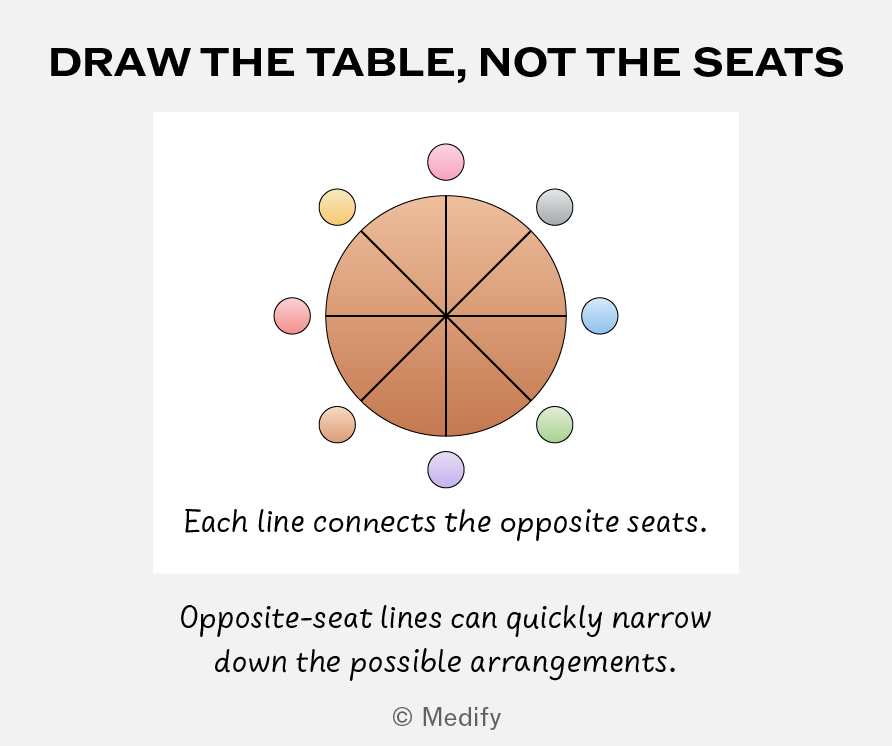
Rules about people who are directly opposite or across from each other are very powerful, as they limit the options for who can take other seats. They can also help you find where a sequence of two or three people in a row can fit into the diagram.
Walkthrough question
Spatial puzzle challenges
Now try this spatial puzzle without a diagram.