
Syllogism challenges
On this page
A valid deduction must be true, meaning that it follows the logic of the stimulus without exception. Sometimes, it will directly repeat something stated in the stimulus.
Most times, you must analyse the logic of new statements to see if it’s Yes because:
- The new statement is a perfect fit with the original logic in the stimulus.
- The new statement combines groups or relationships from the stimulus in a way that must be true.
- The new statement is proproportionately accurate to stimulus. This means that you can only be as absolute or relative as the stimulus will support.
If you can safely deduce a new statement, the answer is Yes.
An invalid deduction is anything that does not follow the logic of the stimulus.
Many times, a new statement is invalid because it contradicts the logic of the stimulus, meaning that the new statement is logically impossible – it cannot be true.
Other times, invalid statements do not line up with the logic of the stimulus because:
- The new statement shifts the terms, groups or relationships from the stimulus.
- The new statement introduces new terms, groups or relationships for which you cannot make any deductions using the stimulus.
- The new statement does not clearly fit or contradict the logic in the stimulus.
- The new statement leaves doubt whether it is true or whether it fits the logic.
In Syllogisms, make your deduction for each statement, then drag and drop:
- Yes if the statement is true 100% of the time – no doubt, no exceptions
- No if the statement is false 100% of the time
- No if the statement is conditionally true, or true only some of the time.
A statement that could be true could also be false – so it cannot be a Yes.
The groups in a Syllogism are any individuals or categories you must consider when making deductions.
These groups could be:
- individual people or things: Amara, the biology teacher, this bird, the red car
- types of people or things: girls, teachers, robins and sparrows, cars and vans
- nonsense words representing animals or things: florb, zump, kenek
- colours or concrete qualities: pink or yellow, small or large, male or female
- ideas or abstract qualities: likes coffee, afraid of failure, promotes the company’s values, unqualified
You will often need to combine groups or relationships from multiple sentences in a Syllogism stimulus.
Be sure that you are linking the same terms and with the same certainty.
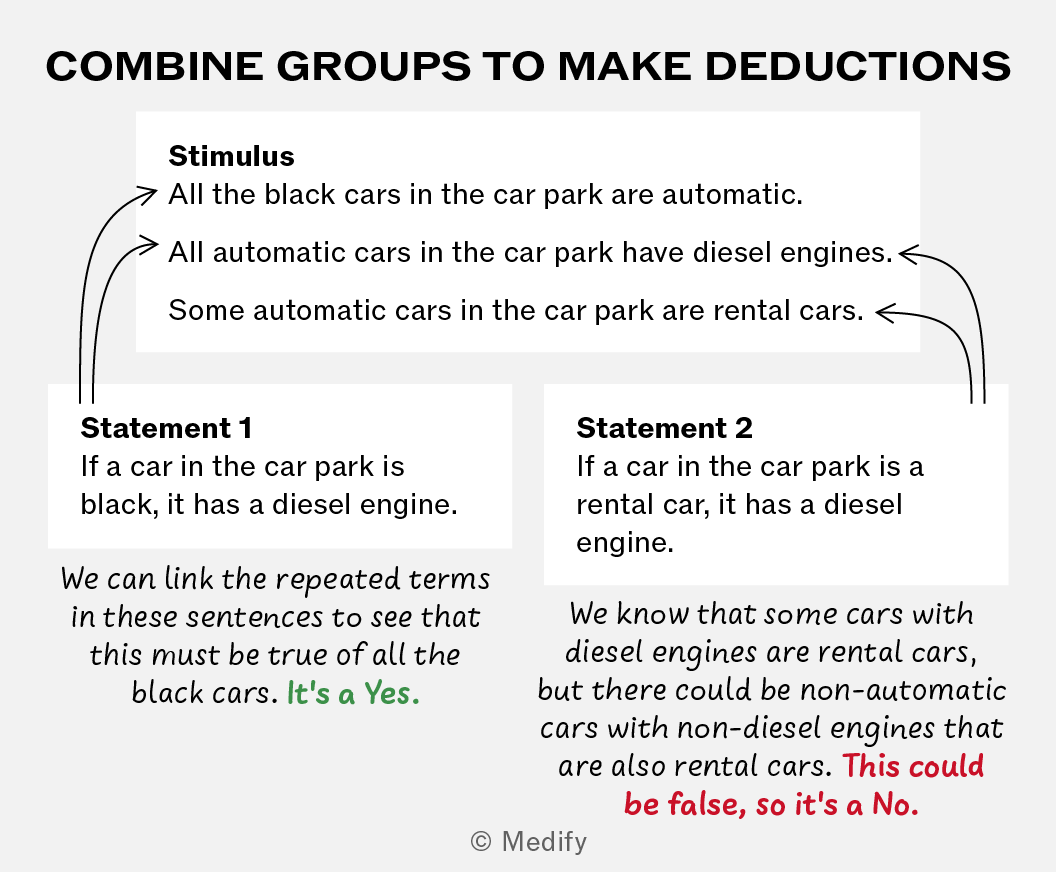
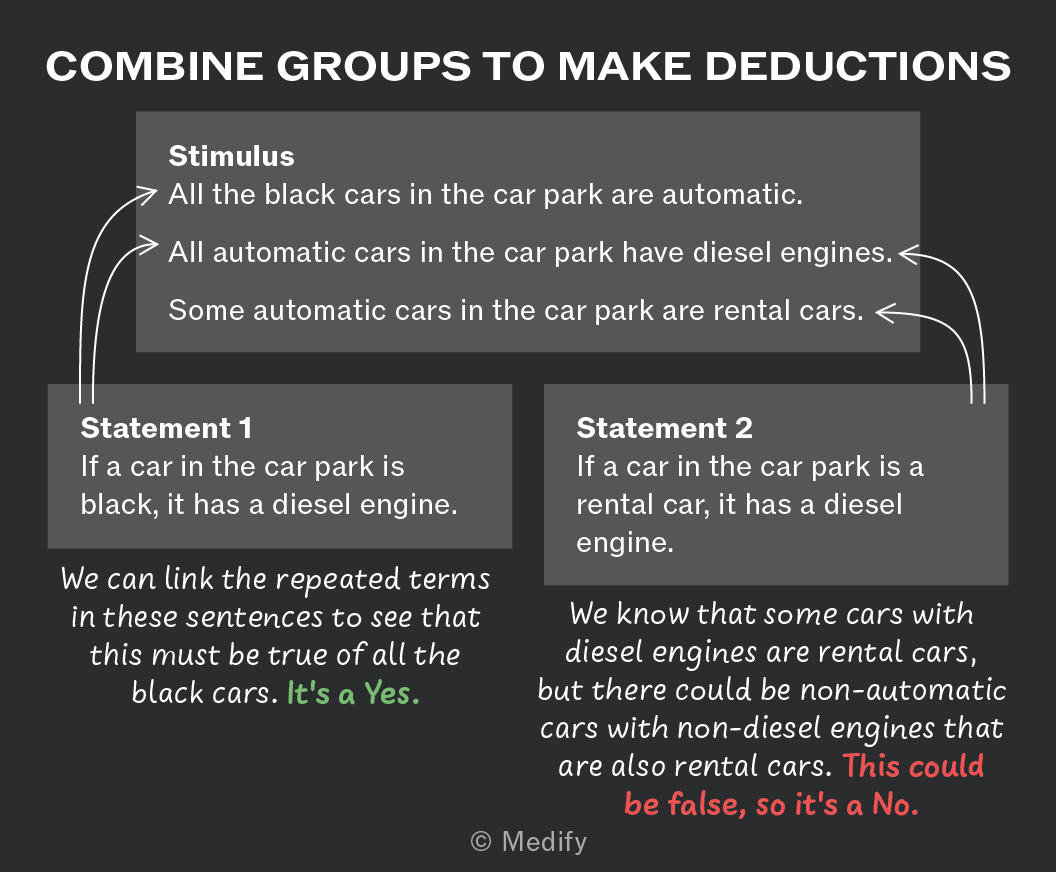
Look for any misalignment when linking statements. It could be that:
- Different sentences in the stimulus do not fit together.
- The groups in different sentences are partially or wholly different.
- Different groups allow a deduction in one direction, but the statement makes the deduction in a different direction.
Sometimes, a new statement may seem appealing at first glance. But if you look closely, the language is too strong or too weak compared to the stimulus.
To answer Yes, the new statement must be a perfect fit with the original logic.
- The groups or relationships must be the same.
- The absolute or relative proportions must match.
- There cannot be any wiggle room or counterexamples to disprove it.
- It cannot go further or make a more definitive claim than the stimulus.
- It could be a lesser point that fits the stimulus, but it cannot soften the logic when the stimulus does not allow exceptions.
If you spot any of the problems above, the answer is No.
A Syllogism may introduce a person or thing with ‘This’ in the stimulus: This animal, This student, This book.
The stimulus may limit the options to a binary choice. This bird is either a duck or a swan.
However, it may imply two options when in fact there could be further possibilities that are not explicitly mentioned in the stimulus.
Take care not to deduce beyond the certainty that the stimulus allows.
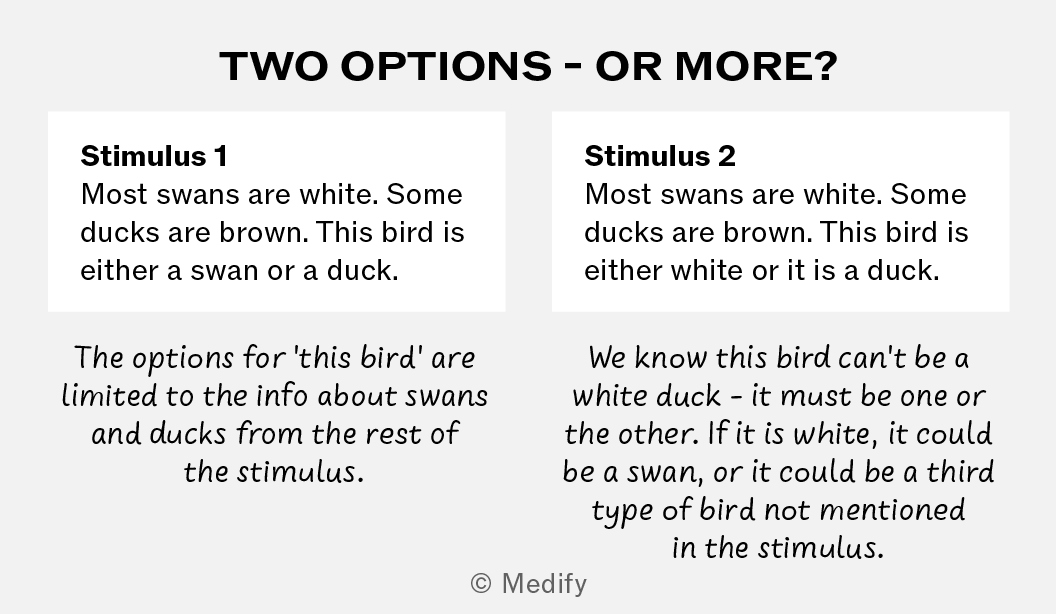
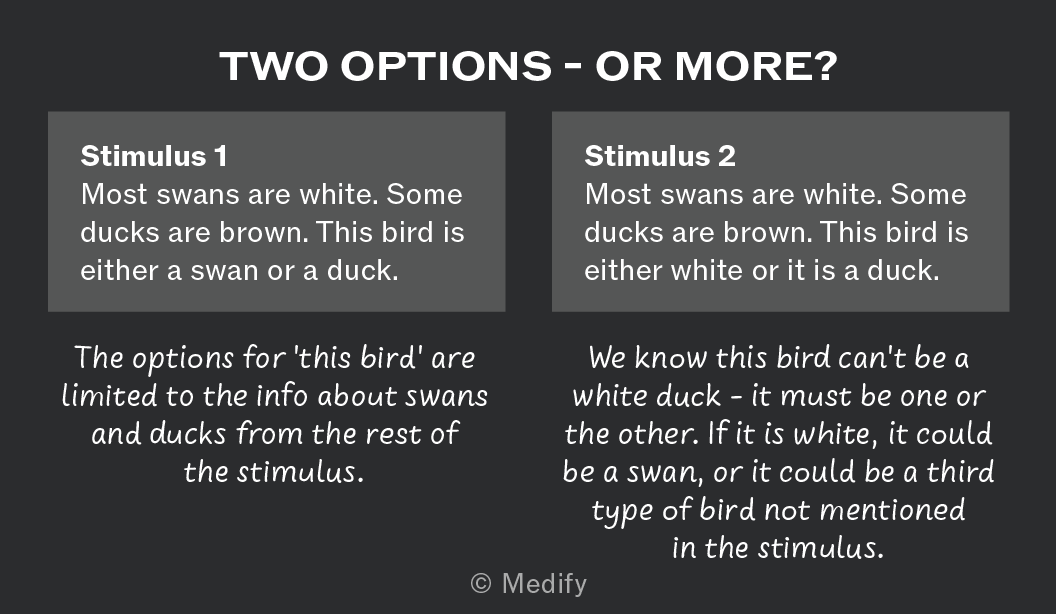
A stimulus may include two options or categories. Sometimes, this will be clearly limited to two possibilities, such as boys and girls.
Other times, there can be a third option not mentioned. It may even be the case that a third option is required.
You will often see a possible or required third option when a stimulus involves colours, though it could happen with any concrete or abstract qualities.
The third option could be anything – including a colour not mentioned in the stimulus – so long as it fits the logic in the stimulus.
Walkthrough question
Multiple colours
Take a look at this question involving different colours.
It is extremely unlikely that an official Syllogism will have 5 Yes or 5 No statements. There have been a few official examples with 4 Yes or 4 No, so that is possible.
Nevertheless, it is by far most common to have 3 Yes and 2 No or 2 Yes and 3 No. Don’t worry on Test Day if you find you must select just 1 Yes or No.
But you should expect in almost all cases to have 2 or 3 Yes and No in a Syllogism.
If you think that no statement is a Yes in a single Syllogism:
- Re-read the stimulus and look for any links or gaps across the sentences.
- Flag for review and come back to the question on a final pass through DM.
Every Syllogism is worth two marks.
- You earn two marks if you get 5 out of 5 statements correct.
- You get one mark if you answer 4 out of 5 statements correctly.
- You receive no marks if you get 3 or fewer statements correct.
You must master good pacing throughout the DM section to give yourself the chance to pick up both marks on all the Syllogisms.
You can earn two marks on every Syllogism regardless of difficulty.
A question with a brief stimulus and short, simple statements is worth two marks.
A question with a rambling stimulus and long, complex statements is worth two marks.
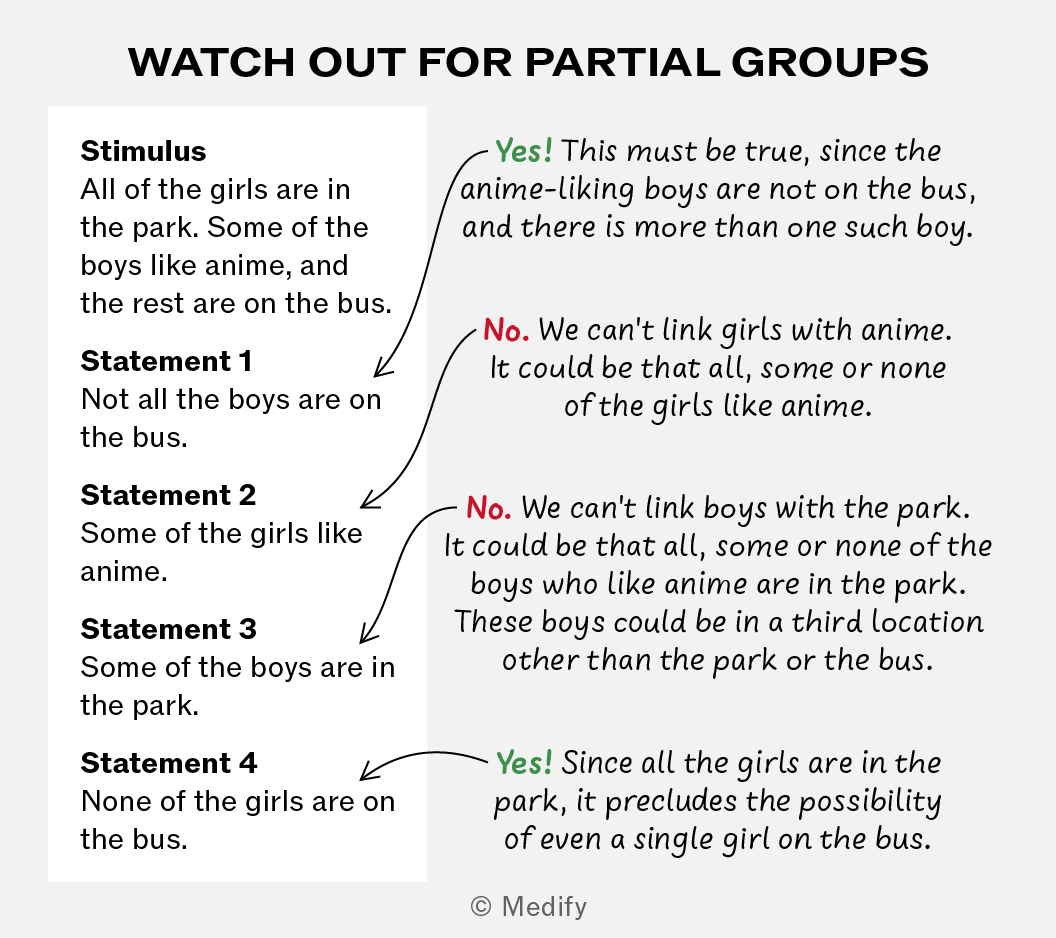
Watch out for ambiguities and non-overlapping groups.
You may know about part of one group and more of another group, but this can make it very tough to make solid deductions about:
- all of either group
- whether the further part of each group overlaps at all with another group
Ambiguities are ripe with potential for No statements. Be quick and confident when the logic does not hold up.
Walkthrough question
Ambiguous groups
Now try this question involving groups that may overlap.
Watch out for statements that are broader or narrower than the stimulus.
A narrower statement could be Yes if it involves an individual or subgroup that aligns with the logical groups and relationships in the stimulus. Otherwise, it’s likely to be No.
A broader statement will tend to be No, but it could be Yes if it somehow fits with deductions you can make from the logical groups and relationships in the stimulus.
Some statements will include new people or things, along with added details.
You must combine the new details in each statement with the logical groups and relationships in the stimulus to see whether the deductions follow.
Expect to see some faulty logic in such statements. You may even see some new details that do not line up with the stimulus, so you cannot apply the logic at all – it’s simply No.
You may improve your DM pacing if you triage across Syllogisms:
- First, answer questions with a very short stimulus – just one or two sentences. Lock in these marks quickly but carefully.
- Then, attack questions with a longer stimulus – if there are three or more sentences, you may need to do more work to apply the logic and answer each statement.
If you run out of time, it is better to do so on a longer, harder question. In the worst case, you may need to make a blind guess, but you can do so with the confidence of having locked in marks on all the other questions.
You can improve speed and accuracy in Syllogisms if you triage the statements in each question:
- Always read the first statement before you go to the stimulus.
- Try to answer this statement as you untangle the logic in the stimulus.
- Then, pick the simplest statement from the remaining four and answer it next.
- Continue in this manner until you answer all five statements, or until you flag for review so you can come back to the remaining hardest statements later.
Train yourself to leave the hardest or longest statement for last in every Syllogism.
If a statement suddenly seems difficult or impossible, STOP WORK immediately.
Go right to the next statement – whether you are doing them in original order, or in order of increasing length or complexity.
You may find that other statements help you see the logical links more clearly, which can then make faster work of the statement that you skipped.
Think about what to do if you attempt a Syllogism, then decide to leave one or more statements unanswered and flag for review.
Remember, the Review screen at the end of the DM section will:
- Show whether a question is flagged, incomplete or both.
- Let you select an individual question to review.
- Allow you to review only flagged questions or review only incomplete questions.