
Formal logic notation
On this page
You do not need to use formal logic to answer any UCAT questions.
However, many students have found it extremely helpful for untangling Syllogisms.
Formal logic language appears in many parts of Syllogism stimuli as well as in some of the new statements you must answer Yes or No.
You may find that formal logic helps you to break down the logic and use it to determine equivalent statements as well as invalid statements that do not follow the logic.
Formal logic is a set of mental tools you can use to analyse logical relationships.
Most technically, it is all about the distinction between necessary conditions and sufficient conditions.
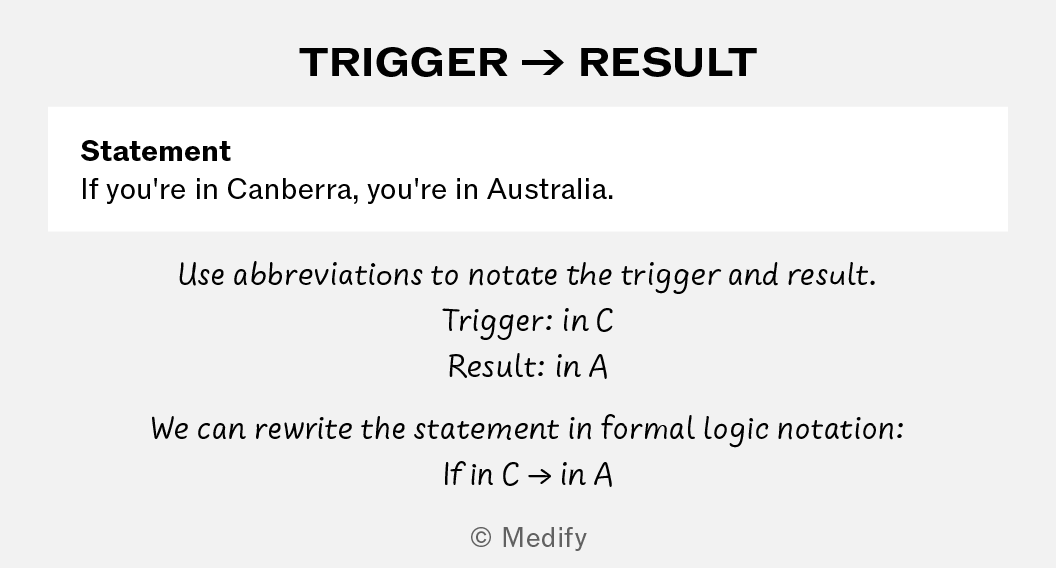
At its simplest, formal logic lets you break down if-then statements into two parts: the trigger and the result. You can then use these components to form comparable statements or to disprove illogical statements.
Formal logic statements include two clauses:
- an ‘if’ clause
- a ‘then’ clause
The ‘if’ clause is the trigger that forces a logical result to follow.
Think: Trigger → Result
Notate: If X → Y
X is the word, phrase or idea that is the trigger. Y is the word, phrase or idea that is the result.
If the trigger is present, the result must follow every time, no exceptions. If there are exceptions, you can’t use formal logic notation.
Note that the word ‘then’ is usually omitted in a full English sentence – the sentence structure implies the ‘then’."
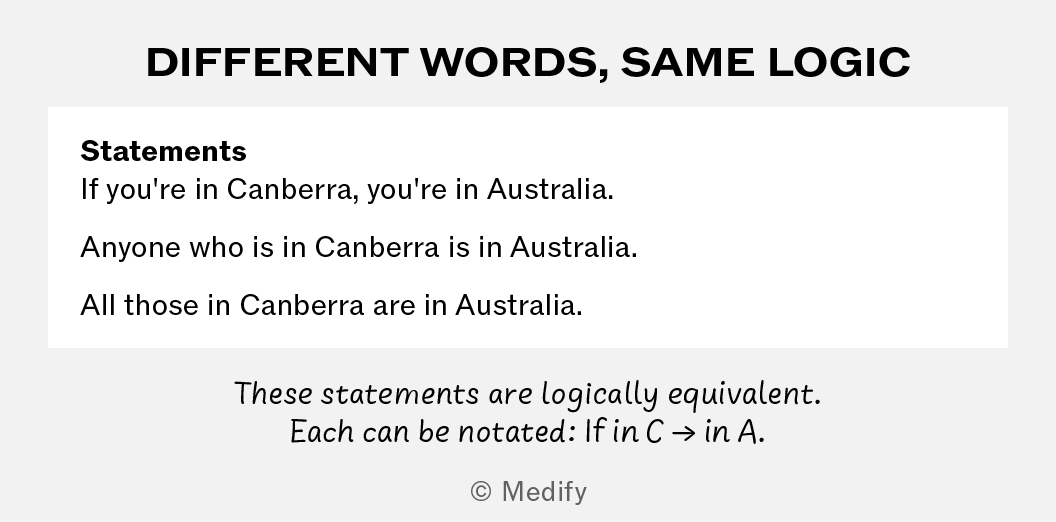
Any words that have the same logical force as ‘if’ and ‘then’ use the same formal logic.
‘All’ and ‘any’ work exactly like ‘if’.
‘Only’ (but not ‘the only’) works exactly like ‘then’.
We will cover these and more examples in greater detail – the key for now is to think in logical structures, whether you notate the structure in your notebook or break it out in your head.
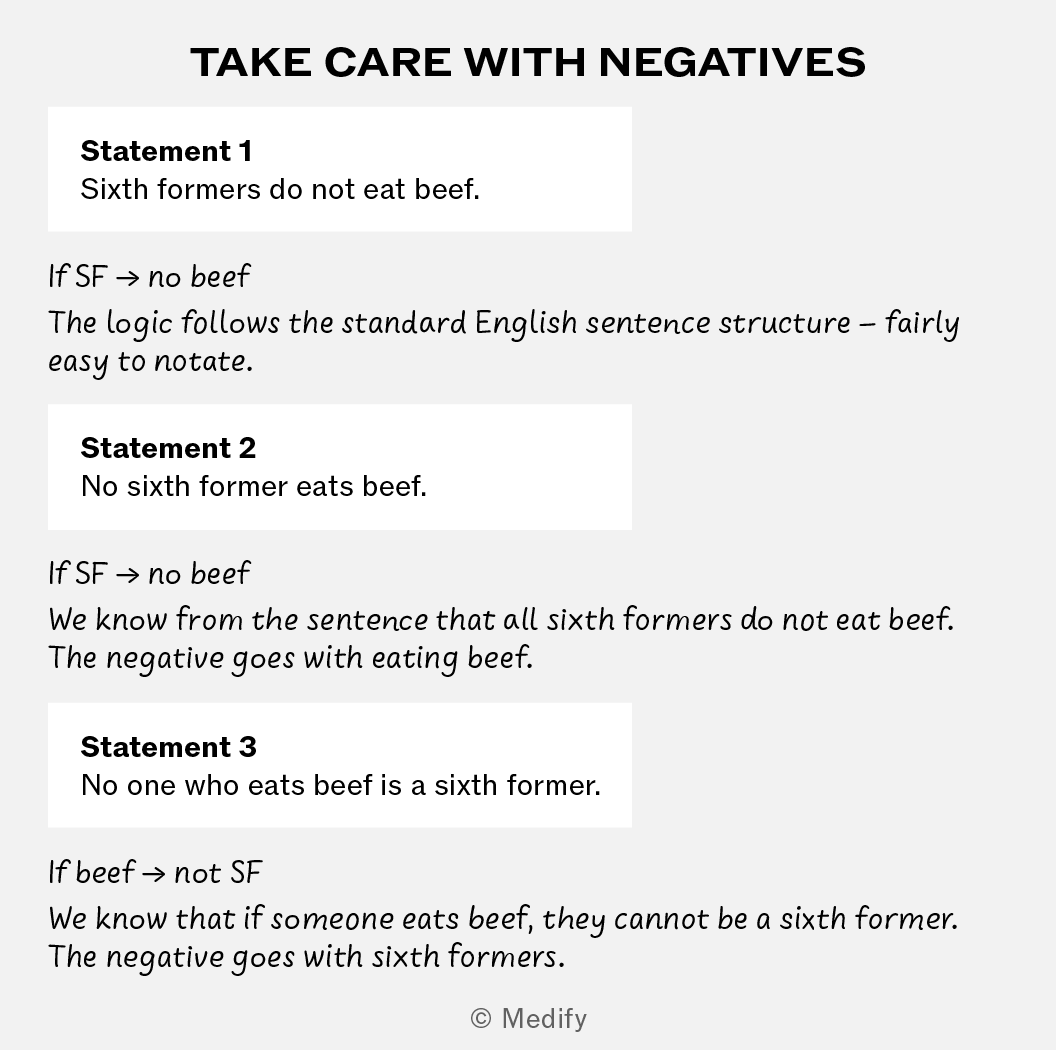
Take care with negatives since they can affect the logical structure.
The key point is whether the negative is part of the trigger or part of the result.
Think: Trigger → Result
Notate: If X → not Y
OR
Notate: If not X → Y
Notice that these notations are logically different depending where the negative goes.
Think about which part is definitely negative, meaning that it cannot have even one of the person, thing or quality.
This can be a bit challenging at first, but it becomes second nature with practice.
In technical terms, the ‘if’ clause is the sufficient condition.
This means that the term in the ‘if’ clause – if its condition is present – is sufficient to guarantee the result in the ‘then’ clause.
By comparison, the ‘then’ clause is the necessary condition.
It is the consequence that must occur if the sufficient condition is met. Without the necessary condition, you cannot have the sufficient condition.
However, the necessary condition does not guarantee the sufficient condition – you could potentially have the necessary condition without the sufficient condition.
You do not need to know the precise logical concepts of the sufficient and necessary conditions, but they are built into the formal logic concepts, such as notation and forming the contrapositive.
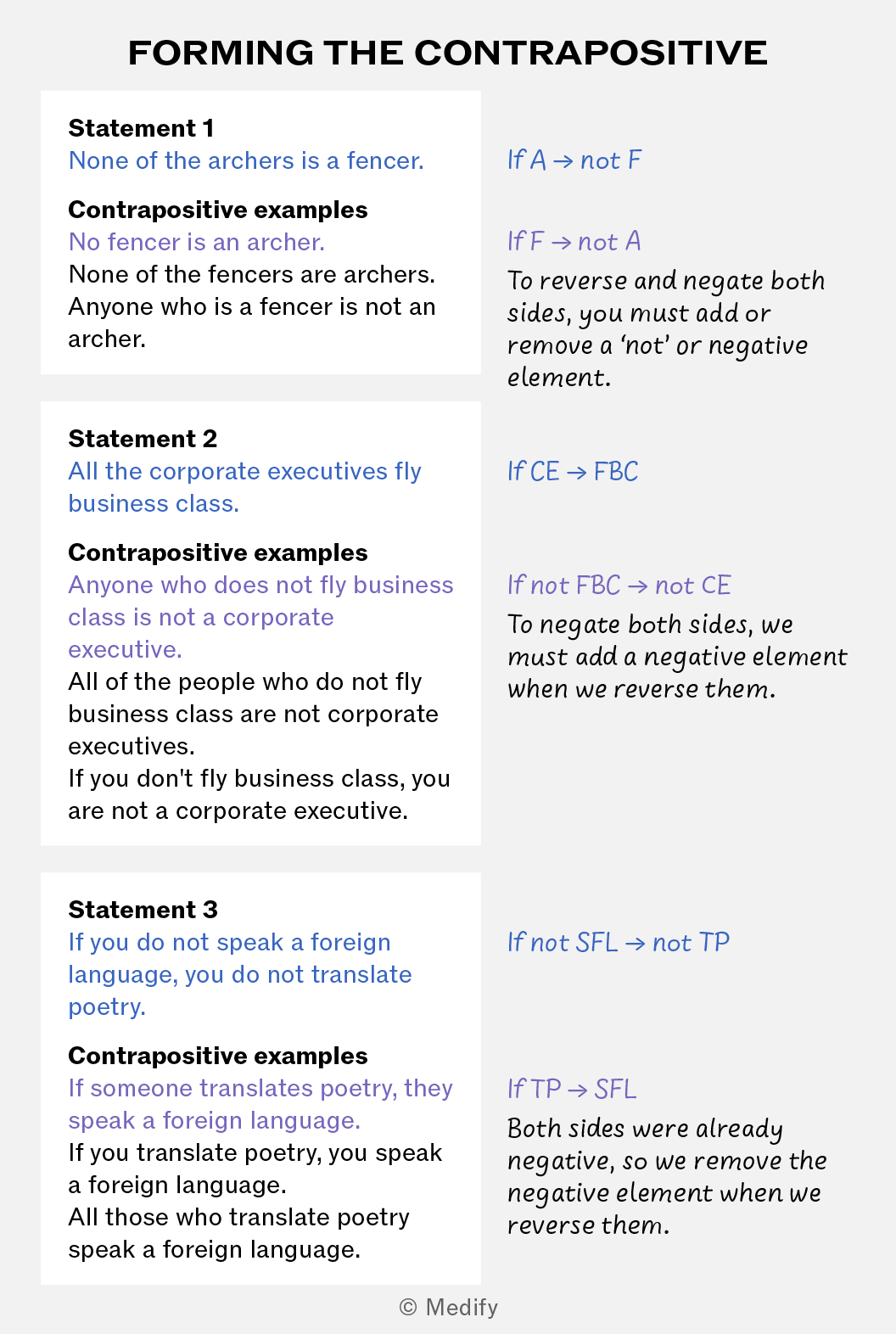
Once you notate the trigger and result, you can logically rearrange them to form a new statement that must be true. This new statement is called the contrapositive.
You can form the contrapositive for any formal logic statement if you:
- Reverse the trigger and result
- Negate the trigger and result
For the initial statement:
Think: Trigger → Result
Notate: If X → Y
For the contrapositive:
Think: Not Result → Not Trigger
Notate: If not Y → not X
The contrapositive must be true whenever the original statement is true. This means that the statements are logically equivalent.
If X → Y is the same relationship as If not Y → not X.
Many invalid statements will be No in a Syllogism question because they fail to form the contrapositive correctly.
Common logical errors include:
- Reversing the trigger and result without negating both sides (If X → Y ≠ If Y → X).
- Negating both sides without reversing the trigger and result (If X → Y ≠ If not X → not Y).
- Trying to reverse and negate both sides when it is not a formal logic statement (Some X are Y ≠ If not Y → not X)
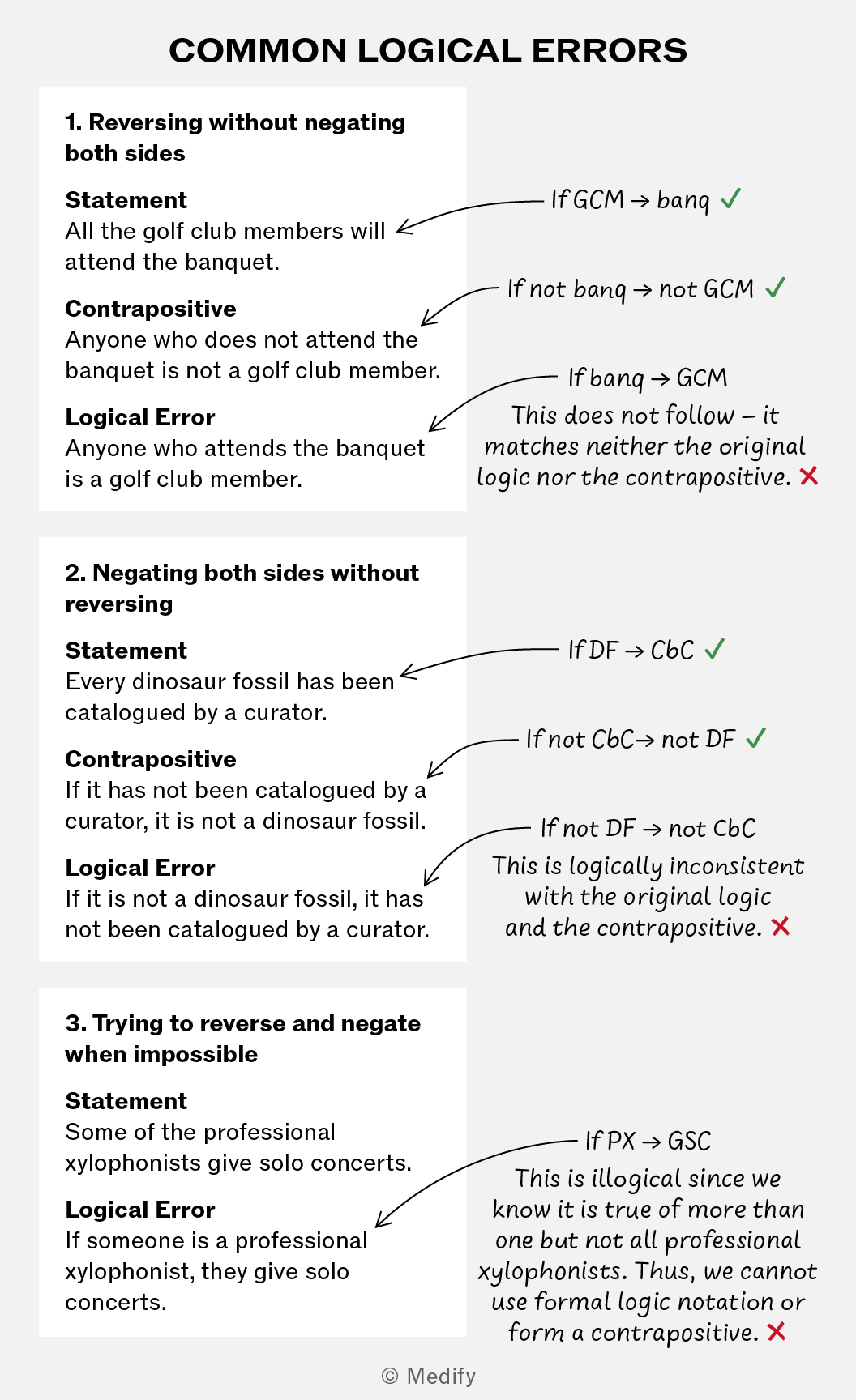
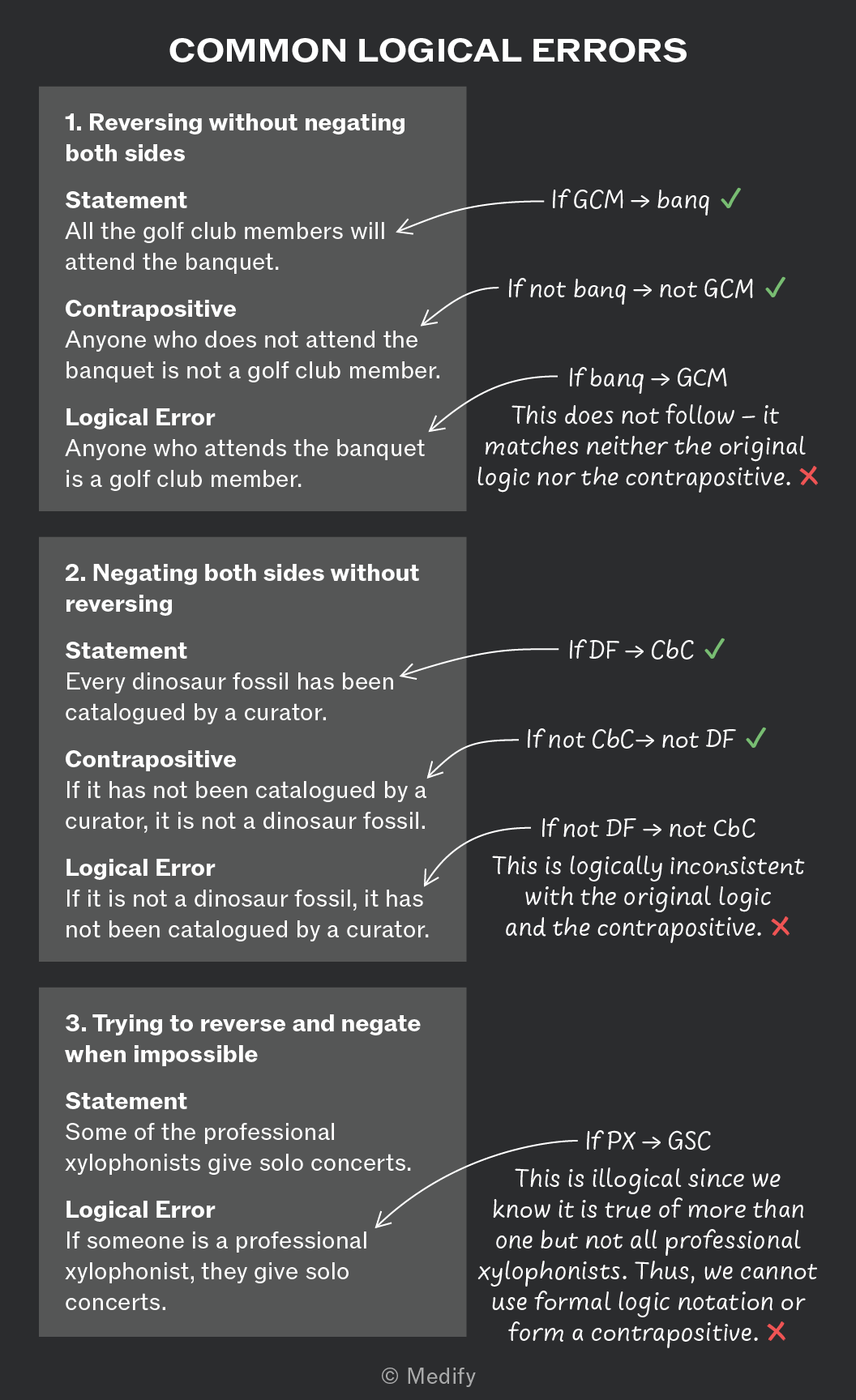
Remember – the UCAT does not require you to use formal logic notation or to form a contrapositive.
However, your formal logic skills can make quick work of Syllogism statements.
You might notice that a statement is logically equivalent or misaligned with the stimulus using formal logic notation.
Or you might notice that a statement tries but fails to form a contrapositive. Sometimes, you can even spot an incorrect contrapositive simply by comparing triggers and results.
A categorical statement must be true in every instance, with no exceptions.
Categorical statements start with a logical word like all or none that indicates that the statement applies universally.
These logical words from the DM definitions list could be used in categorical statements:
- All
- None
- Nothing
- Always
- Only
- Unless
In addition, there are logically similar words that also form categorical statements. These similar words also appear from time to time in official UCAT Syllogisms. Examples include no (functions just like none) and never (the opposite of always).
Syllogisms often include positive statements using all and similar words.
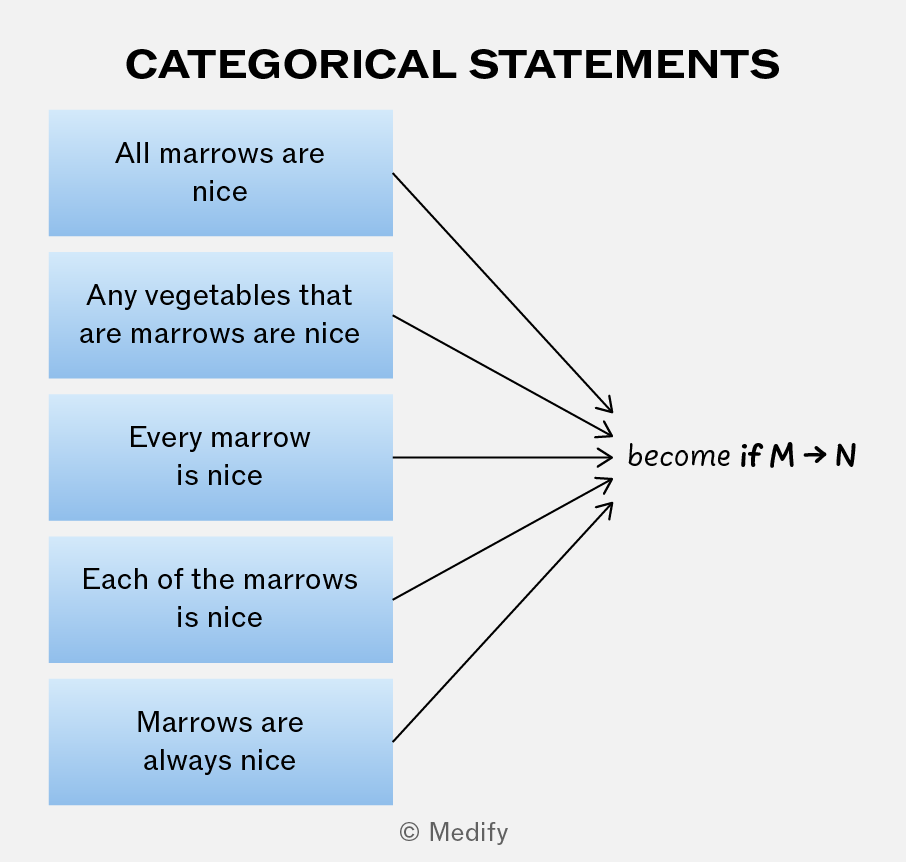
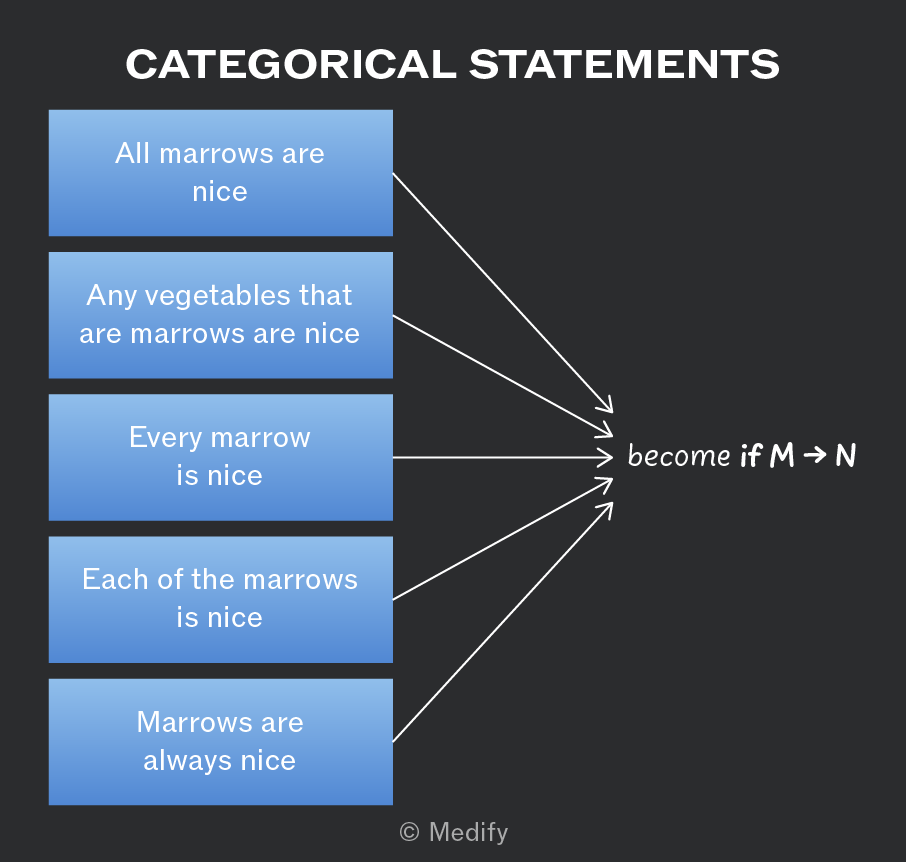
Notice that each of these structures is categorical and also logically equivalent, regardless of whether the logical word is ‘all’, ‘any’ or something else.
- All M are N becomes If M → N
- Any that are P are Q becomes If P → Q
- Every R is an S becomes If R → S
- Each of the T is a U becomes If T → U
- V are always W becomes If V → W
Any new statement using ‘all’, ‘any’, ‘every’, ‘each’ or ‘always’ that keeps the trigger and result in the right order – and in positive terms – is therefore logically the same.
Form the contrapositive of a categorical statement using ‘all’ or similar words by reversing and negating both sides.
- The contrapositive of If M → N is If not N → not M
- The contrapositive of If P → Q is If not Q → not P
- The contrapositive of If R → S is If not S → not R
- The contrapositive of If T → U is If not U → not T
- The contrapositive of If V → W is If not W → not V
You can turn the contrapositive back into words. Just take care to preserve the negatives and the directionality.
Let’s say you notate If M → N, then form the contrapositive If not N → not M.
You could put the contrapositive back into English as:
- Any that are not N are not M.
- All non-N are not M.
- Each one that is not N is non-M.
- All of the not N are not M.
- Non-N are always non-M.
Walkthrough question
Categorical statements
Try using formal logic to answer this question.
Categorical statements are powerful because they allow you to form a contrapositive.
By contrast, relative statements are not useful in simple formal logic because they do not translate into if-then statements that apply in every case.
Relative statements are all about exceptions – such as whether there is ‘more than one’ or ‘at least one’ that is not part of the group in the logical statement.
These logical words from the DM definitions list cannot be used in categorical statements:
- Few
- Majority
- Many
- Most
- Not all
- Some
Thus, you must compare carefully to see if the new statement matches the logic in the stimulus, rather than trying to use formal logic notation.
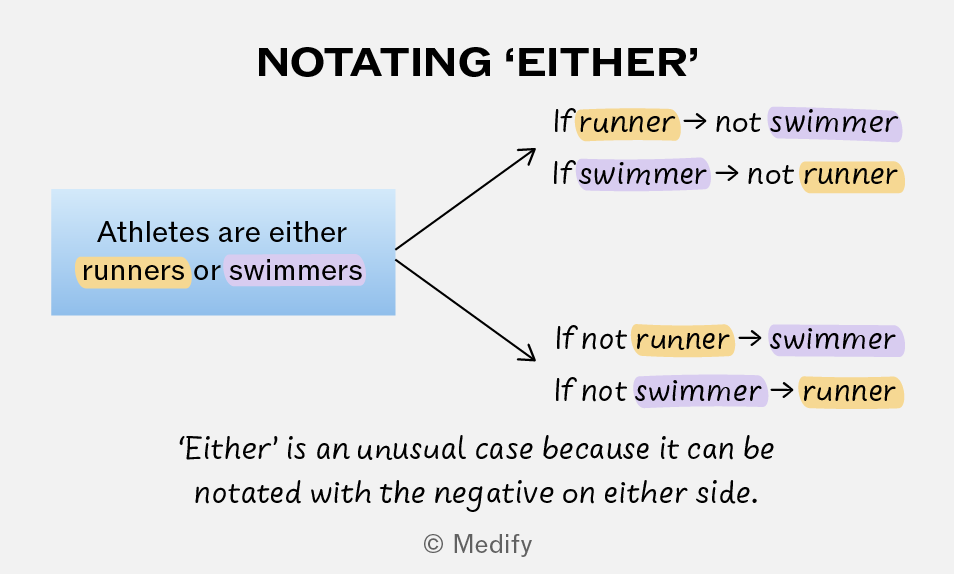
Among the DM definitions list, either is a special case.
It can be used to translate the ‘either’ claim into formal logic notation. But the logic works a bit differently to the other categorical statements.
Statement: Either it is X or it is Y.
Think: If X → not Y
Contrapositive: If Y → not X
But notice that you could also notate the following and it would be logically valid.
Statement: Either it is X or it is Y.
Think: If not X → Y
Contrapositive: If not Y → X
It’s an unusual case because it can be notated with the negative on either side. But in either case, you disprove it by showing that something could be:
- Both X and Y
- Neither X nor Y
- Both of the above possibilities
Walkthrough question
Relative statements
Use formal logic where possible to solve this question.
Some categorical statements in Syllogisms will be negative statements.
They will still apply in all cases without exception, but the trigger or result (or both) contains a negative logical word.
The most common negative words in Syllogisms are no, not and none.
You may occasionally see never or nothing, though the latter is quite rare.
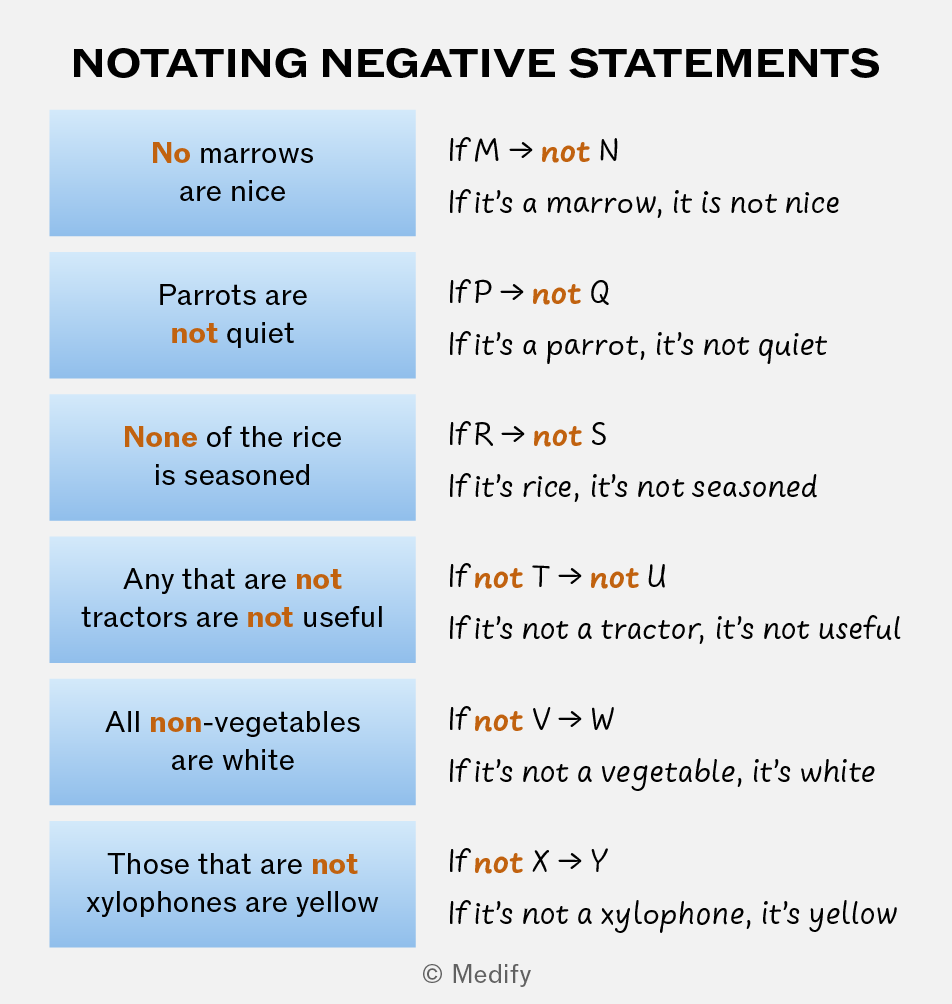
Syllogisms often include negative statements using no and similar words.
Notice that all these structures are categorical. However, some are logically equivalent and some are not, depending whether the trigger or result (or both) are negative.
- No M are N becomes If M → not N
- P are not Q becomes If P → not Q
- None of the R is an S becomes If R → not S
- Any that are not T are not U becomes If not T → not U
- All non-V are W becomes If not V → W
- Those that are not X are Y becomes If not X → Y
Each new statement using ‘no’, ‘not’, ‘none’ or a negative word or phrase that keeps the trigger and result in the right order – and maintains the negative terms – is therefore logically the same.
Form the contrapositive of a categorical statement using ‘all’ or similar words by reversing and negating both sides.
- The contrapositive of If M → not N is If N → not M
- The contrapositive of If P → not Q is If Q → not P
- The contrapositive of If R → not S is If S → not R
- The contrapositive of If not T → not U is If U → T
- The contrapositive of If not V → W is If not W → V
- The contrapositive of If not X → Y is If not Y → X
You can turn the contrapositive of a negative statement back into words. Just take care to preserve the negatives and the directionality.
Let’s say you notate If M → not N, then form the contrapositive If N → not M.
You could put the contrapositive back into English as:
- No N are M.
- No N is an M.
- None of the N is an M.
- All that are N are not M.
- Every N is not an M.
Walkthrough question
Negative statements
See if you can answer this question involving negative statements.
Watch out for specific words and phrases that include a negative prefix or that have a negative meaning in a binary sense.
You can remove the prefix to form the positive version of the word.
Similarly, you can use the antonym of a word with a negative meaning as the positive version.
You will see this occasionally in official Syllogisms – it is easy to miss out that a negative prefix or meaning implies a clear opposite.
This means you can negate the word or phrase when forming a contrapositive. You can also add a negative prefix or use an antonym of a positive word to negate it.
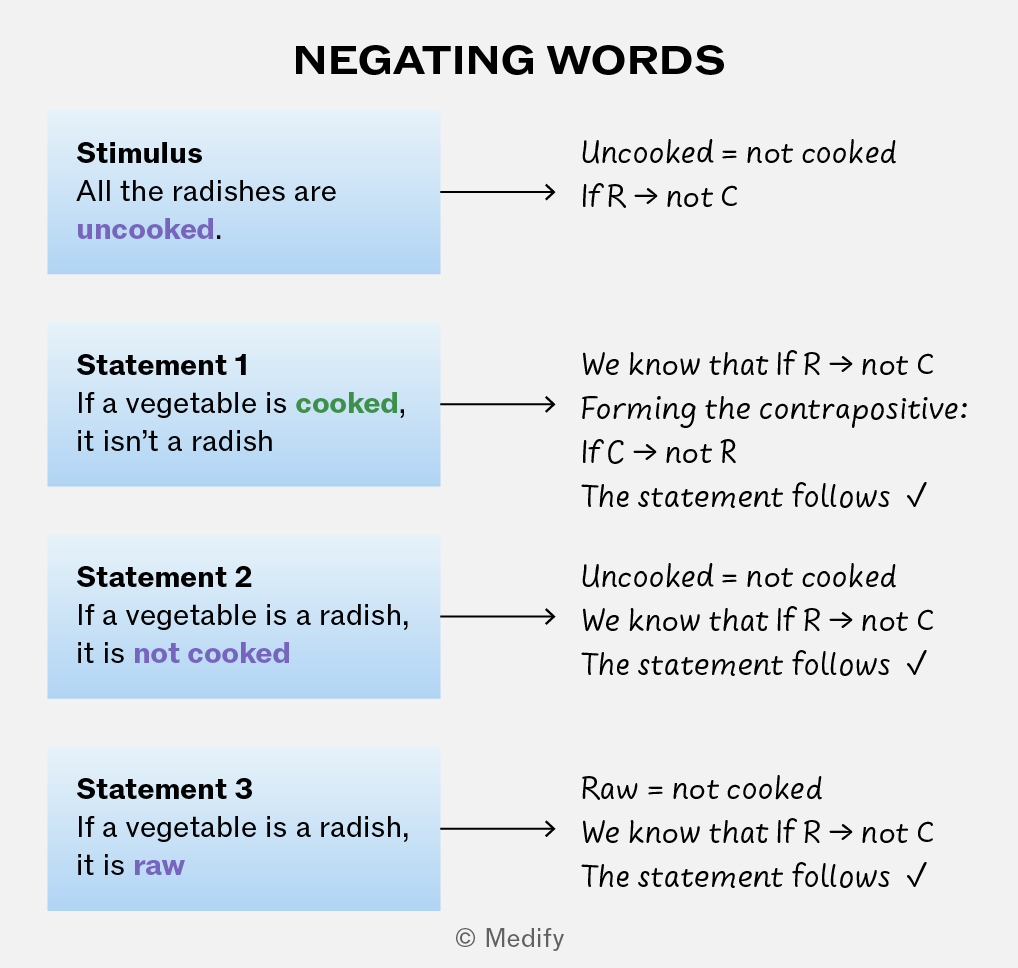
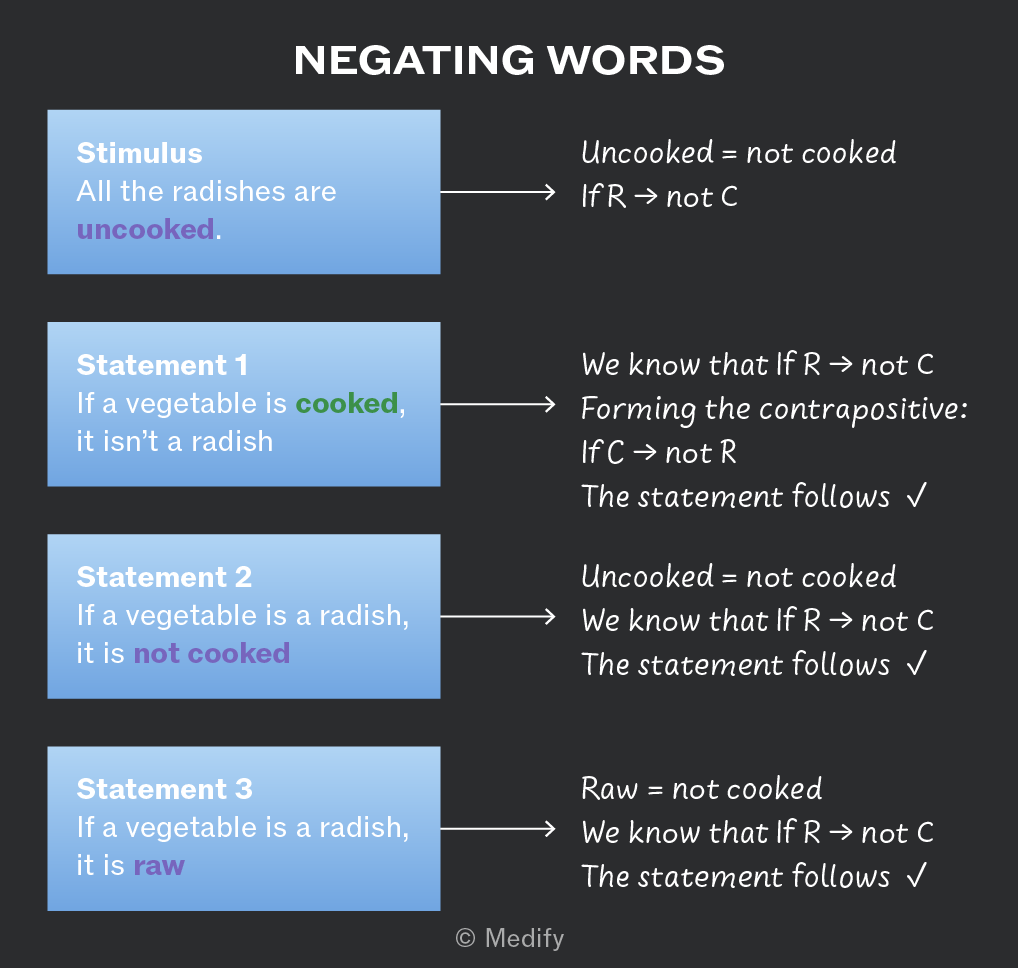
Be ready to negate a word or phrase in a Syllogism question. You must negate a term whether it is originally positive or negative.
Use your understanding of common English words to add or remove a negative prefix or to identify a binary opposite.
You can do this in any contrapositive, whether the original statement is positive or negative:
- Add a negative prefix or the word ‘not’, or use an antonym, to make a positive term negative.
- Remove a negative prefix or the word ‘not’, or use an antonym, to make a negative term positive.
If you negate a negative, it becomes positive. It’s the same principle as multiplying by –1 in maths.
Walkthrough question
Negative words and phrases
Try to form the contrapositive to help work through this question.
You may see a very difficult statement with a challenging formal logic word like only or unless. Thankfully, these are quite rare in Syllogisms. You may not see one on Test Day.
It’s trickier to untangle categorical statements with ‘only’ or ‘unless’ because:
- The logical order of trigger and result may be different from the order in normal English.
- You may have to add or remove a negative as part of the initial notation.
- There are multiple logical structures using ‘only’, so it can be especially confusing.
A logical statement with unless requires two special considerations:
- The part immediately after ‘unless’ is the result.
- The part before ‘unless’ is the trigger, but you must negate it in the initial formal logic notation. This is because of the negative logic of ‘unless’.
The notation varies depending whether the trigger in English includes a negative:
- No V unless W becomes If V → W
- X unless Y becomes If not X → Y
The most common logical structure with only requires unusual notation:
- The part immediately after ‘only’ is the result.
- The other part of the sentence is the trigger, but it often comes in the later part of the sentence in English.
The notation will usually reverse the order in English as the ‘only’ part is the result:
- Only X are Y becomes If Y → X
- Only girls play football becomes If plays football → girl
- Only children can attend the pantomime becomes If attend panto → child
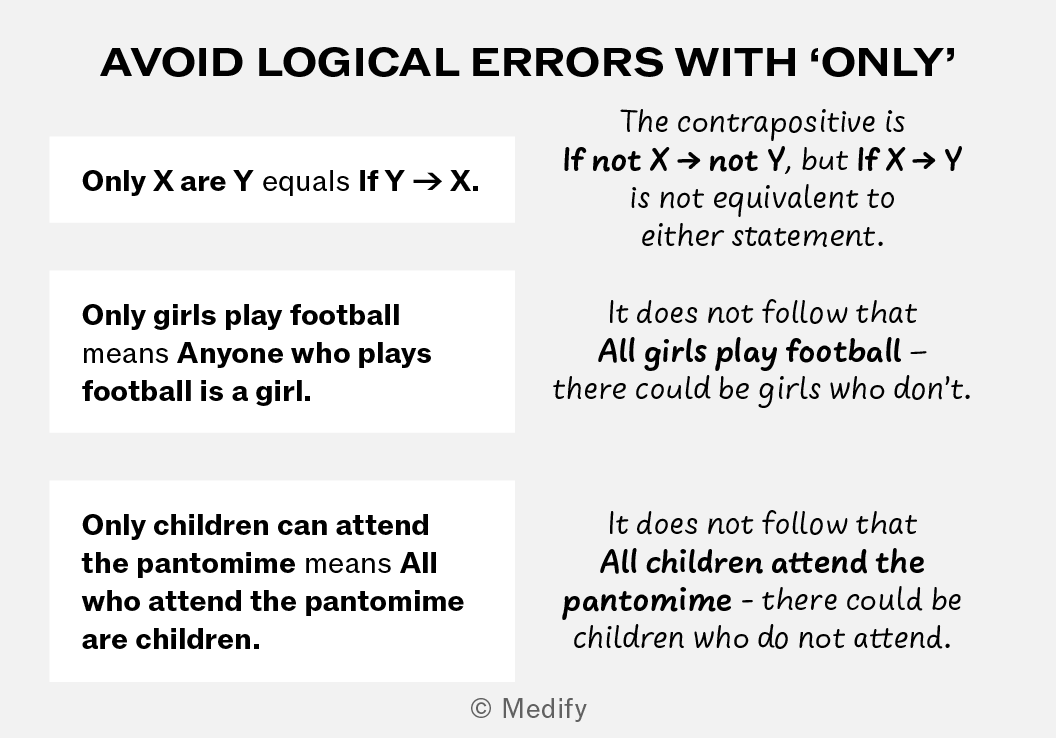
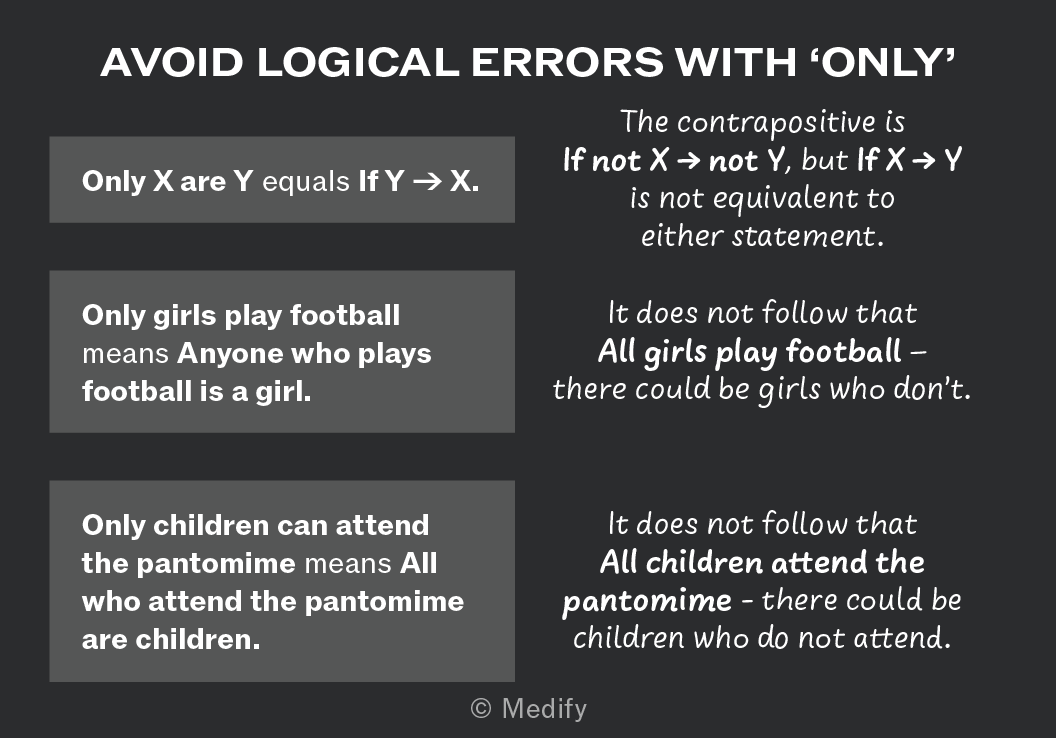
Notice that you will commit a logical error if you incorrectly reverse the trigger and result.
- Only X are Y equals If Y → X. The contrapositive is If not X → not Y, but If X → Y is not equivalent to either statement.
- Only girls play football means Anyone who plays football is a girl. But it does not follow that All girls play football – there could be girls who don’t.
- Only children can attend the pantomime means All who attend the pantomime are children. It does not follow that All children attend the pantomime – there could be children who do not attend.
Two other logical structures with only are far less common in the UCAT, though they could appear in Syllogisms.
Most common structure:
- Only X are Y becomes If Y → X
Less common structures:
- The only X are Y becomes If X → Y
- X only if Y becomes If X → Y
- Only if Y, X becomes If X → Y
It can help to distinguish these as ‘only’ (or ‘only “only”’), ‘the only’ and ‘only if’.
- Only (by itself, or ‘only “only”’) goes with the term that is the result; the other term (usually in the second part of the English sentence) is the trigger.
- The only follows the normal trigger → result structure in the English sentence and in formal logic notation. Note that ‘The only’ is roughly equivalent to ‘All’.
- Only if turns the entire logical phrase ‘only if’ into the arrow; the part immediately after ‘only if’ is the result. Note that this applies wherever it appears in the English sentence.
In other words, the ‘only’ structures challenge you to think carefully about whether the trigger comes after the result in English.
Try not to worry about these hardest logical words. You are now familiar with the basics of the logic involved.
You may see only by itself (‘only “only”) on Test Day and in your UCAT revision. You are far less likely to see the only or only if. Unless is similarly very rare.
By preparing for the most difficult statements, you will be ready in case they appear on Test Day. But you should focus your revision on the other logical words and simpler statements that occur far more frequently in the official practice questions.
Walkthrough question
Difficult statements
Let's look at a question using 'only if' and 'unless' definitions.