
Decision Making definitions
On this page
The UCAT uses very specific definitions for key words in Decision Making.
Whilst these apply throughout the DM section, you will use them heavily in Syllogisms.
Errors in applying these definitions in Syllogisms can lead to wrong answer traps.
Take time to learn by heart all the definitions and any logical nuances that they lead to. Invest this time in your UCAT revision, and it will help you increase your speed in timed practice – and on Test Day.
To aid revision, we at Medify like to think of the DM definitions as four groups.
- Group 1: all or none
- Group 2: most or few
- Group 3: some and similar words
- Group 4: other words that form logical links
You don’t need to always remember them this way, but it will likely help you to recall the distinctions as you integrate them into your DM practice.
Let’s start with the simple and powerful logical words in group 1.
These are absolute words, meaning that they allow no exceptions. As such, they make categorical statements that apply uniformly within the given category.
Use them to know what must be always true or never true about the groups and relationships involved.
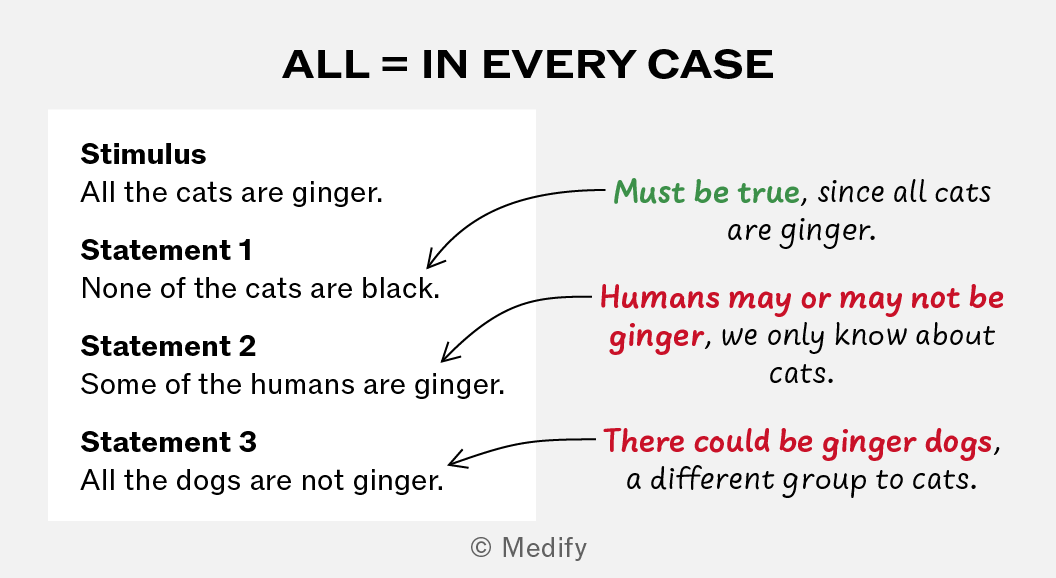
In DM, all means ‘an unspecified number referring to the whole of it/everything’.
An ‘all’ statement must apply to every group member or to each component in a relationship.
Watch out for statements that give counterexamples or exceptions.
Be careful not to apply the characteristic to a different group, as that could lead to a wrong answer trap.
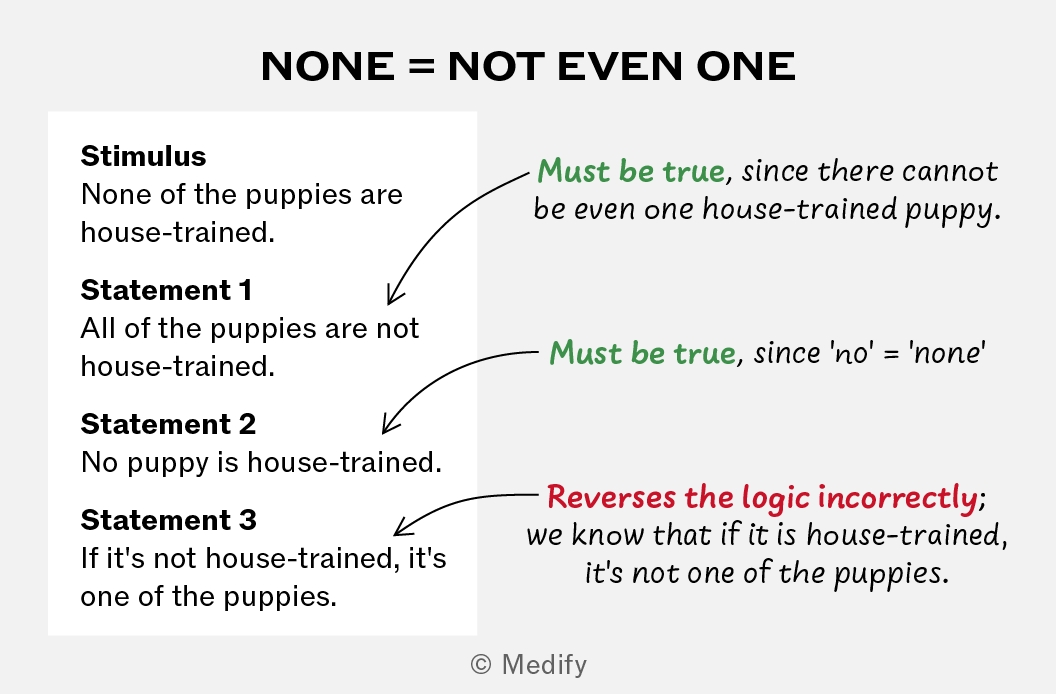
DM defines none as ‘not even a small amount/not even one’.
A ‘none’ statement must apply to every group member or every part of the relationship. All of these are excluded from the characteristic or condition.
You may also see ‘no’ instead of ‘none’ – the logical meaning is the same. ‘None of the X’ = ‘No X’.
Be careful not to invert the logic of ‘no’ or ‘none’ – it’s all members of the group immediately after ‘no’ or ‘none’ that cannot have the characteristic or condition.
In DM, nothing is ‘not a single thing. Of no value’.
Notice that this is logically parallel to the meaning of ‘none’ and ‘no’.
In official practice, you will see very few DM questions with ‘nothing’ – it may not come up at all on Test Day, whereas you are highly likely to encounter ‘none’ and ‘no’.
You are more likely to see it in explanations, particularly when a statement is a No.
Walkthrough question
'All', 'no' and 'none'
Try this question using 'all', 'no' and 'none' definitions.
The logical words in group 2 are relative words that compare a group to the majority.
As such, they use a clear benchmark that must be present in some way in the stimulus in order for a statement to be a Yes.
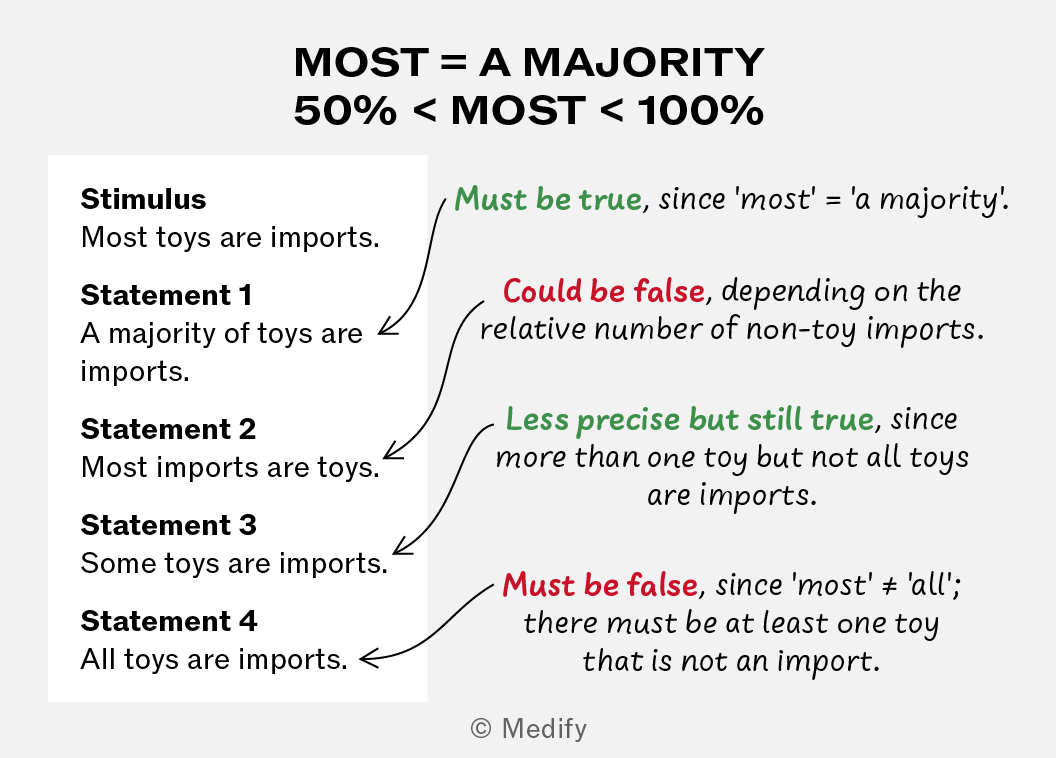
In DM, a majority is ‘a number that is more than 50% of the whole but not all’.
DM defines most as ‘an undetermined but majority number/largest part’.
Notice that these definitions are tightly linked. You must have more than half, even when this cannot be precisely quantified.
At the same time, ‘most’ or a ‘majority’ cannot be 100%. In such cases, DM requires ‘all’ instead of ‘most’ or ‘majority’.
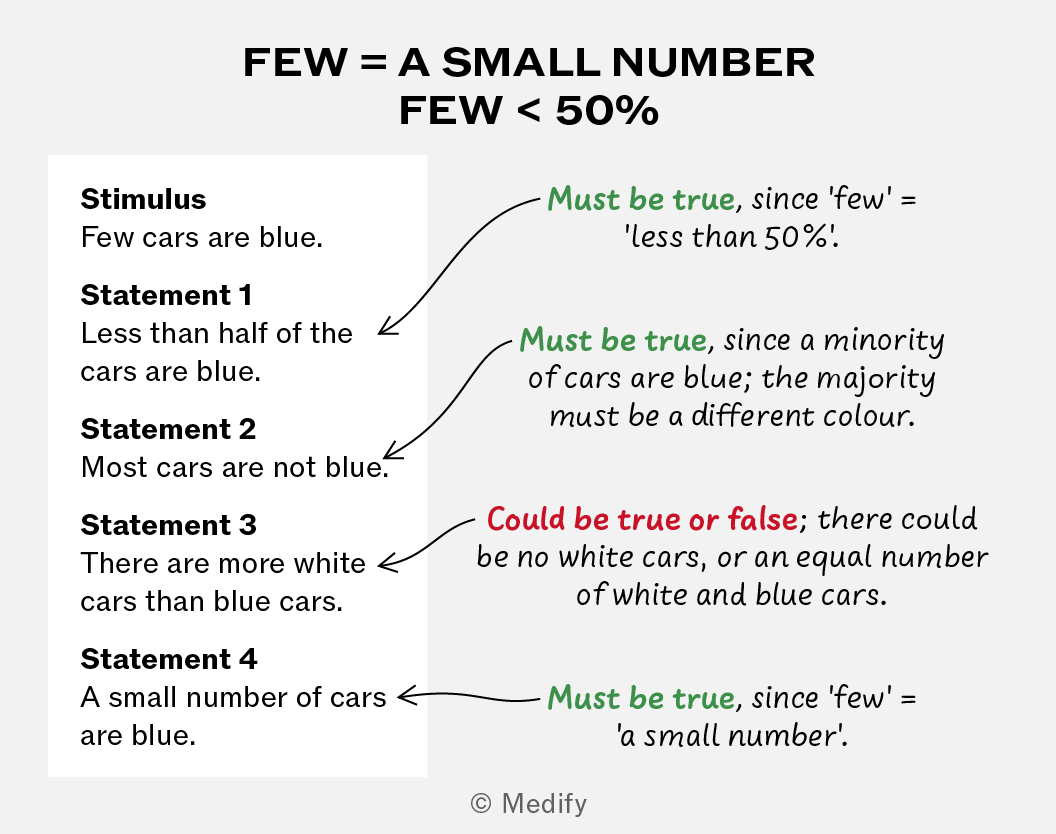
In DM, few means ‘a small number of, less than 50%’.
Note that this is quite unspecific. You could find that ‘few’ accurately describes anything from a group of 2 or 3 up to 49.99%.
In many cases, you will notice that ‘few’ simply describes the smaller portion when subtracting the majority (or ‘most’) from the whole.
100% – most = few
However, it may or may not be true that few + most = 100%
It depends whether the ‘few’ includes all of the people or things outside of the majority. Watch out for the possibility of an additional subgroup that is less than half but not explicitly mentioned in the stimulus.
Walkthrough question
'Most', 'majority' and 'few'
Let's look at question using 'most', 'majority' and 'few' definitions.
The logical words in group 3 are relative words that are rather imprecise about the numbers involved.
They do not specify a quantity in relation to a majority – so they may or may not align with ‘most’ or ‘few’.
Instead, these words simply prove the presence of the group or characteristic involved. As such, they are much looser than the words in group 1 or group 2.
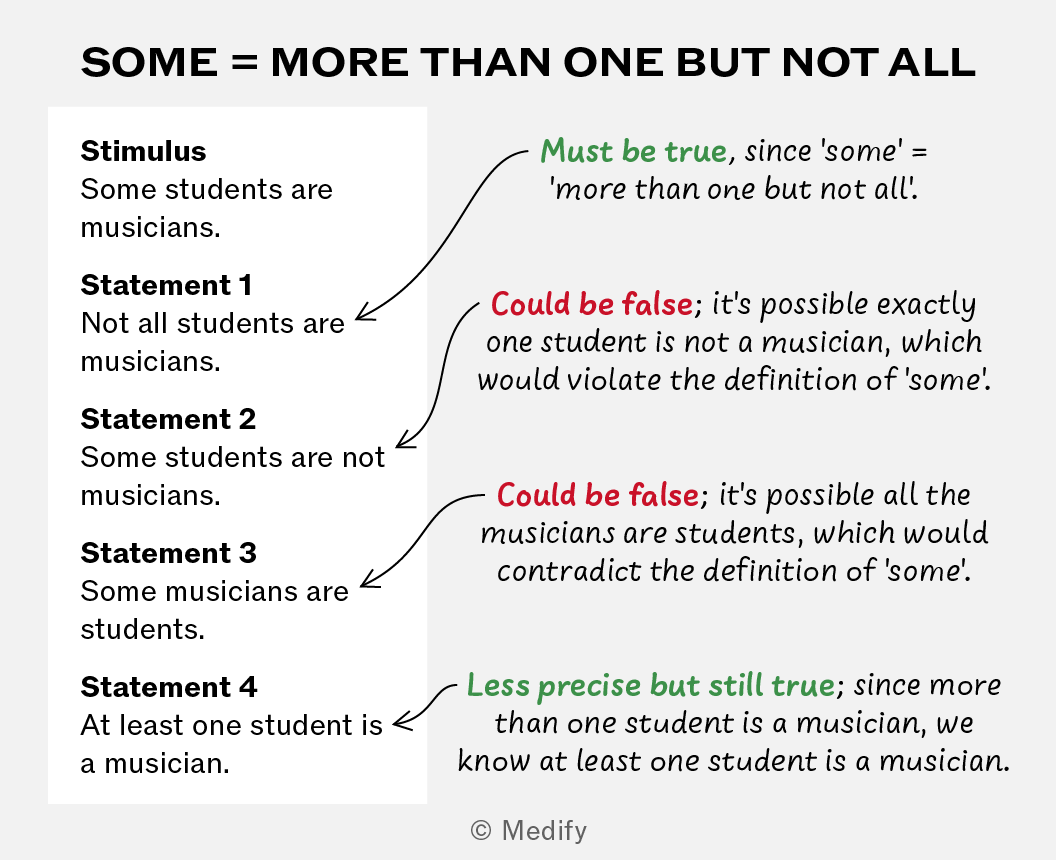
In DM, some means ‘an undetermined number being more than one but less than all. A part of it, not all of it’.
Use ‘some’ when there are at least two members of the group that share the characteristic or relationship, but when you know there is at least one that does not.
Notice that this is very specific in numeral terms compared to how we often use ‘some’ in everyday speech. We tend to be vague about numbers when we say ‘some’ – do not fall into this approach in DM, as it leads to wrong answer traps.
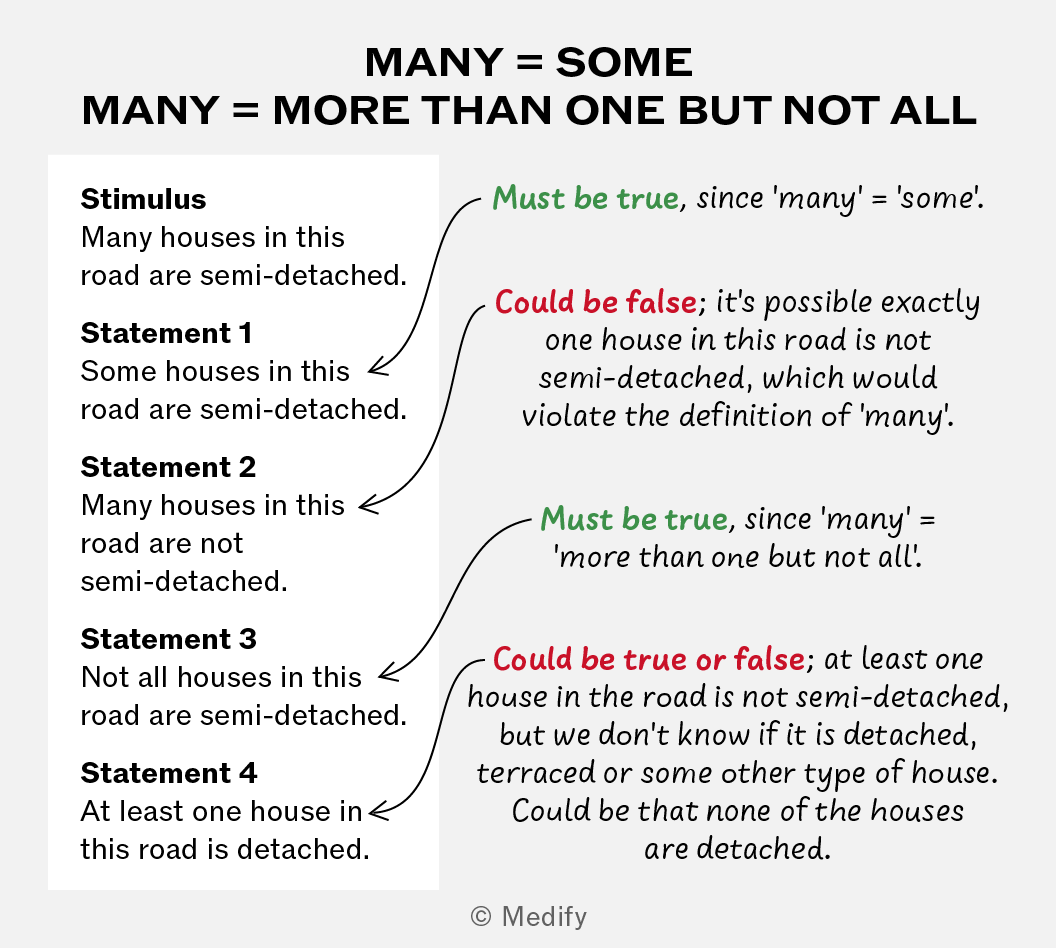
DM defines many as ‘an undetermined number similar to “some”. A part of it, not all of it’.
Remember that some = many. You must have at least two members of the group that share the characteristic or relationship, but also at least one that does not.
DM will occasionally use several as a synonym for ‘many’. Whilst ‘several’ is not included in the DM definitions, it is used with the same meaning as ‘some’ or ‘many’ in the official practice questions.
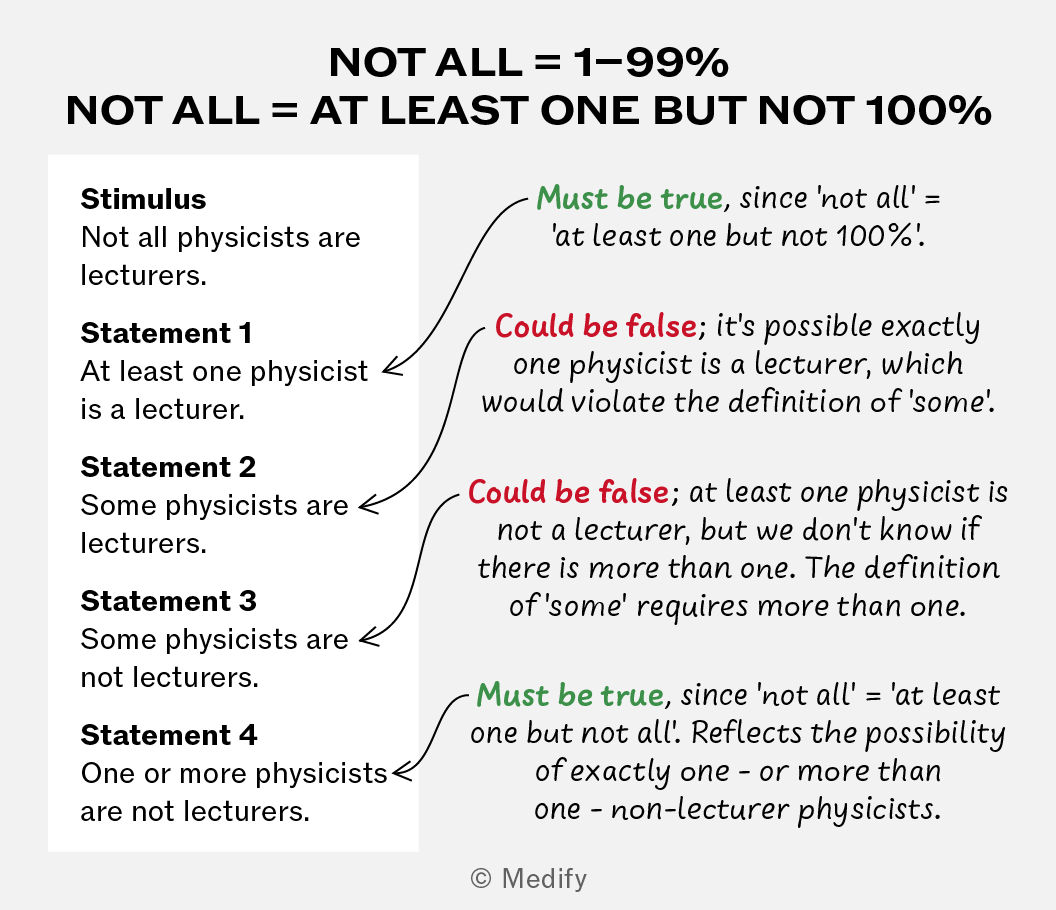
In DM, not all is defined as ‘1-99%’.
This means that ‘not all’ excludes:
- 0%, for which we would use ‘none’, ‘no’ or ‘nothing’
- 100%, for which we would use ‘all’
Hence, anything greater than 0% but also less than 100% can accurately be defined as ‘not all’.
As a result, you could have a Yes statement that uses ‘not all’ when there is only one example. This is fundamentally different from the meaning of ‘some’ or ‘many’, which require more than one example.
Walkthrough question
'Some', 'many' and 'not all'
Now try this question using 'some', 'many' and 'not all' definitions.
Group 4 includes all the other words from the DM definition list that form logical links between groups and conditions.
These words can be more challenging to apply under time pressure, but you can practise and improve them as you revise for Test Day.
In DM, always means ‘on all occasions, without fail’.
We can similarly define never as ‘on no occasions, without fail’.
It is very rare to see ‘always’ in Syllogisms, though ‘never’ occurs once in an official practice Syllogism.
Remember that ‘always’ and ‘never’ tend to describe actions rather than groups or characteristics, so they may seem trickier at first glance.
It’s simplest to think of these as matching terms from group 1:
- ‘always’ = ‘all’
- ‘never’ = ‘none’
If you encounter these terms in Syllogisms, that is likely all you will need to select Yes or No.
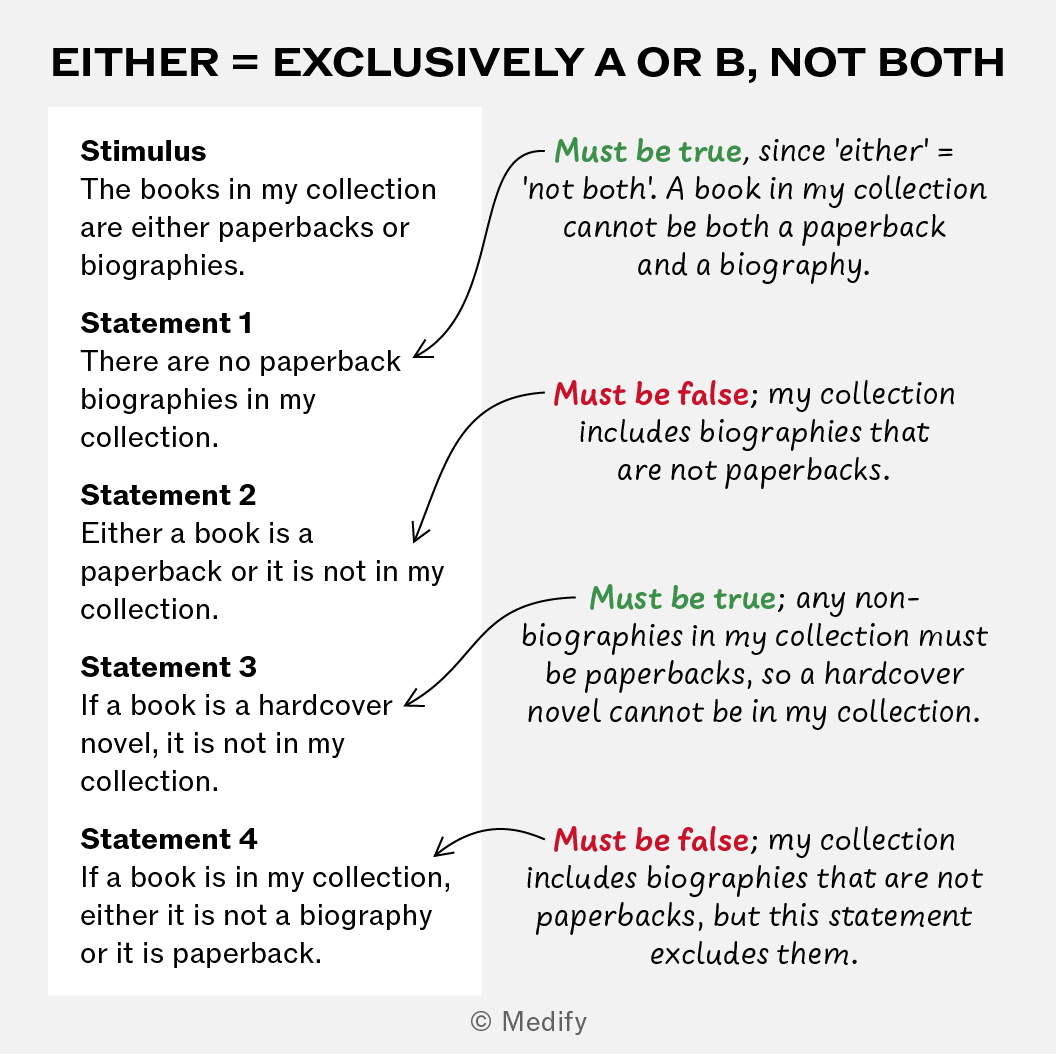
DM defines either as ‘exclusively A or B (not both)’.
Syllogisms use ‘either’ to indicate two possible groups or conditions. Remember that it is one or the other, since the definition excludes both.
Some statements may use ‘either’ incorrectly, when it is possible to belong to:
- both groups (‘both A and B’, rather than exclusively A or B)
- neither group (‘neither A nor B’, instead of just A or just B)
- just one group in some cases, but possibly neither or both groups in other cases
As always, take care in comparing the groups in the statement to the groups in the stimulus.
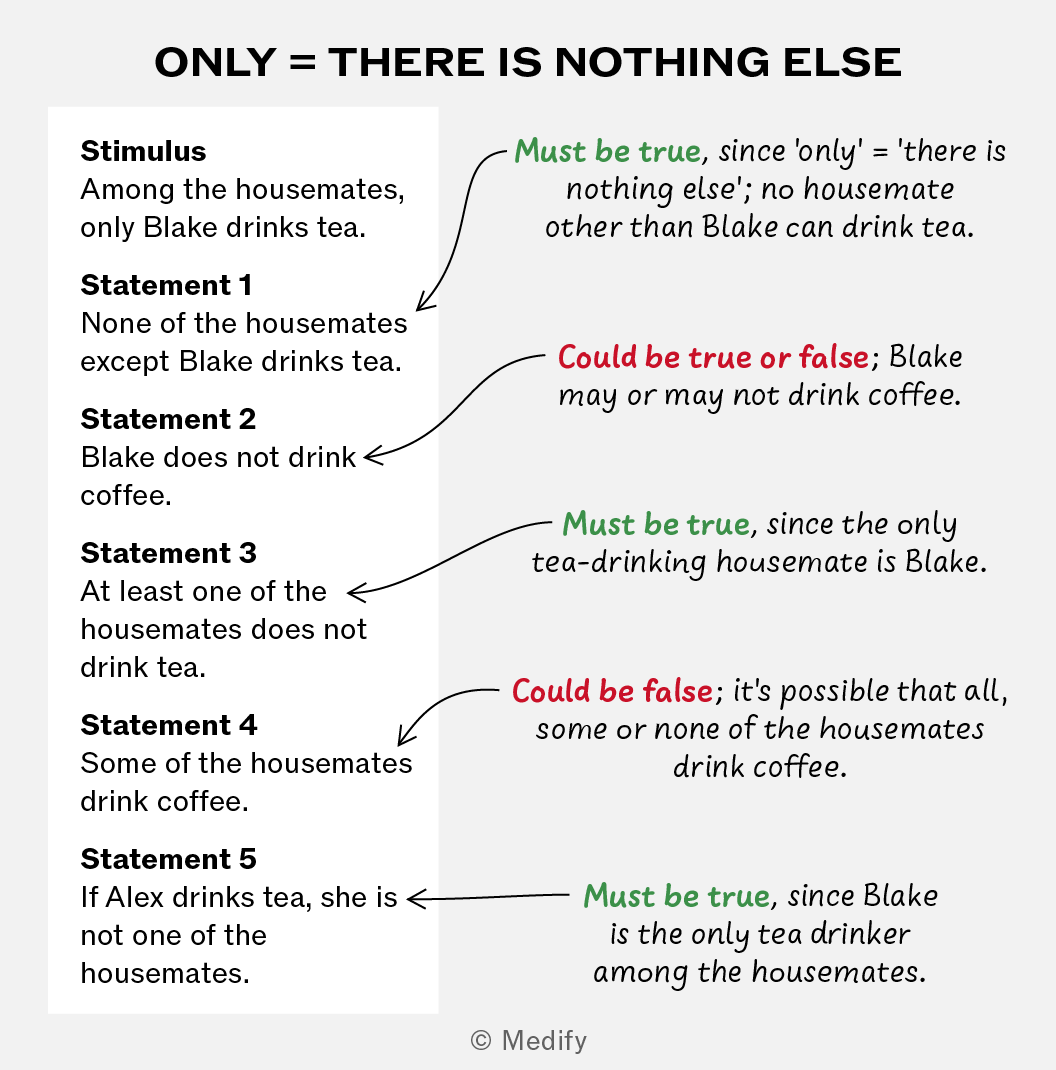
In the DM definitions, only can do two things:
- ‘introduces something which must happen before something else in the sentence’
- ‘indicates there is nothing else’
The second case is far more common in the official practice questions, so we feel strongly it is far more likely to appear on Test Day.
The first case is very rare and can be extremely challenging. It’s a good example of the value of learning formal logic for Syllogism notation.
In DM, unless ‘introduces the only circumstance which makes the statement not true or valid’.
Notice that ‘unless’ includes the concept of ‘only’, indicating it is challenging logic.
There is only one example with ‘unless’ in the official DM practice, so it is less likely to appear on Test Day.
As with ‘only’, you will find that formal logic helps you to understand the concept of ‘unless’ and apply it consistently and accurately.
Walkthrough question
'Either', 'only' and 'unless'
Let's look at a question with 'either', 'only' and 'unless' definitions.