
Adaptation, evolution and speciation (4.3, 4.4, 4.5)
On this page
A niche describes the role an organism plays in its ecosystem, or, the way it uses its environment.
This includes what it feeds on, where it lives, when it is active, and how it interacts with other species.
Each species occupies a unique niche, and no two species can occupy the same niche in the same habitat indefinitely.
Organisms in the same habitat that occupy the same niche will compete for the same resources.
The better adapted species will outcompete the other.
Two species can only coexist in the same habitat if they carve out different niches, reducing direct competition between them.
An adaptation is a feature that makes an organism specialised to exist in its environment. This makes an organism more likely to be successful, survive and reproduce.
Adaptations can be anatomical, behavioural, or physiological.
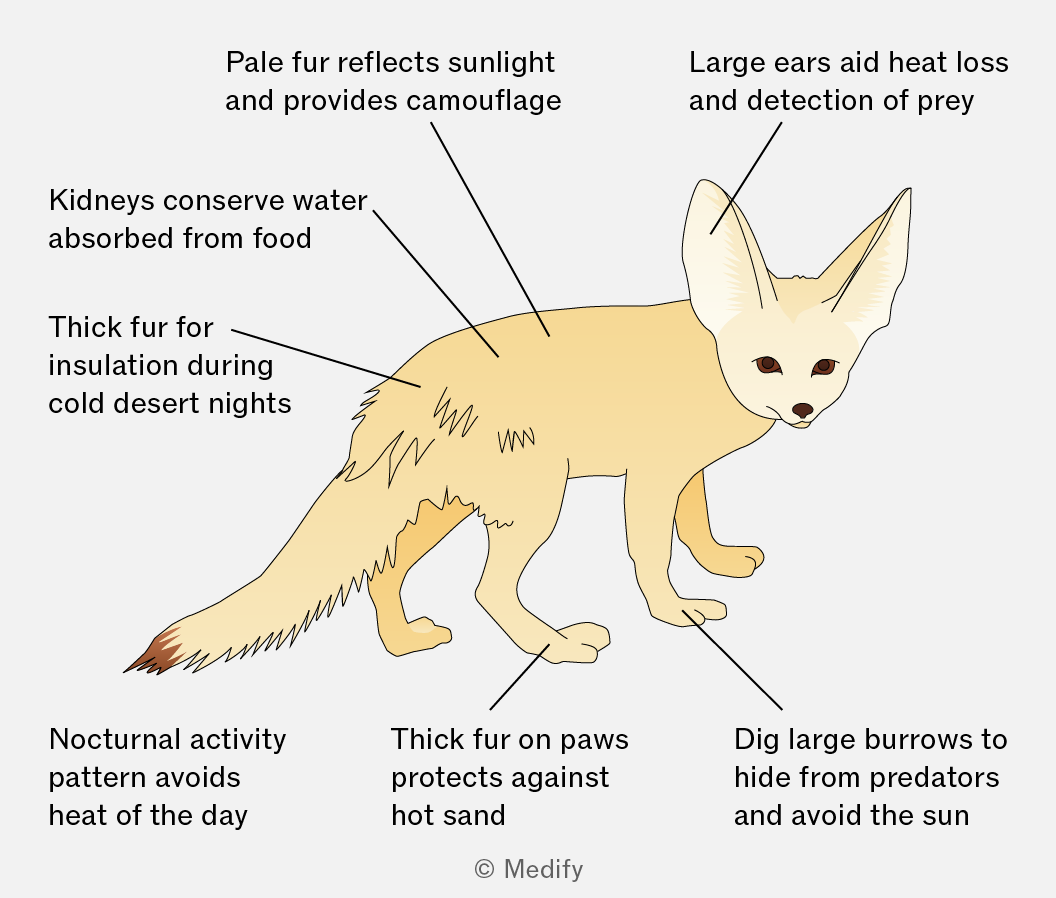
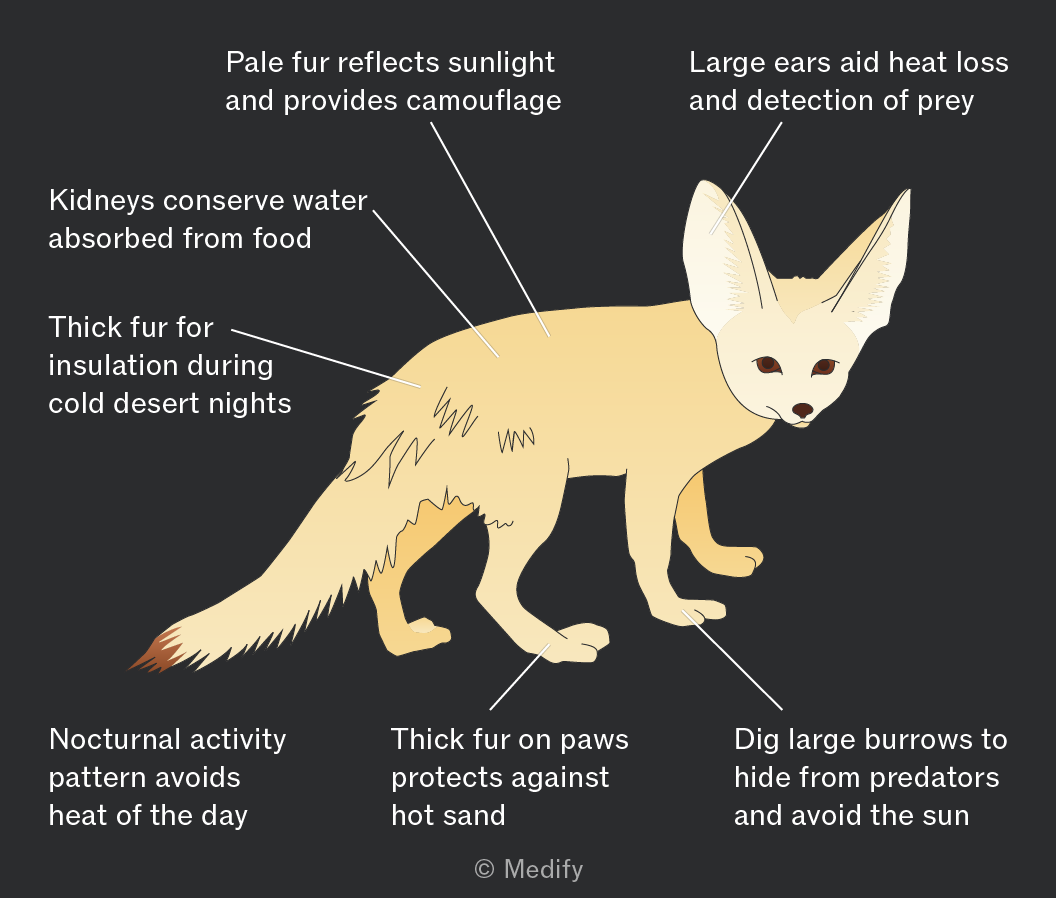
Anatomical (structural) adaptations are physical features of an organism that increase their likelihood of survival. They can be internal or external.
Examples include:
- Arctic hares have white fur in winter, which provides camouflage against snow and helps them avoid predators.
- Large ears in desert foxes facilitate heat loss.
- Spines on cacti reduce water loss and provide protection from herbivores.
Physiological (biochemical) adaptations are internal processes that increase chances of survival.
Examples include:
- Desert lizards make concentrated urine to conserve water.
- Bacteria in hot springs have heat–stable enzymes.
- Some plants produce antifreeze proteins to survive freezing temperatures.
Behavioural adaptations are ways an organism acts to aid survival. These can be learned or inherited.
Examples include:
- Swallows migrate south in winter to avoid food shortages in northern ranges.
- Nocturnal desert animals avoid daytime heat.
- Penguins huddle together to conserve heat.
In nature, organisms face struggles for survival, such as:
- Predation – being eaten by other organisms.
- Disease – caused by pathogens.
- Competition – for food, space, mates, etc.
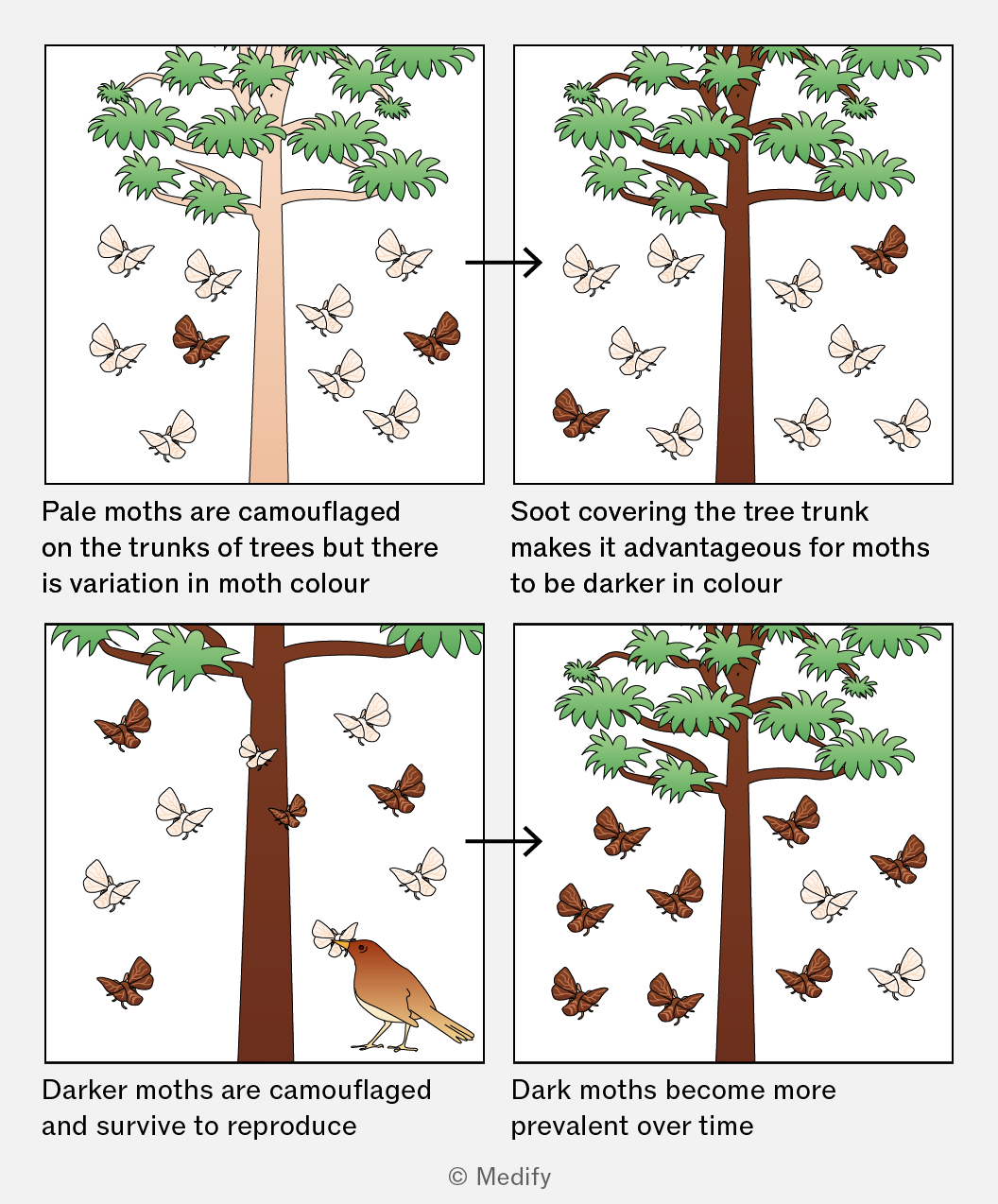
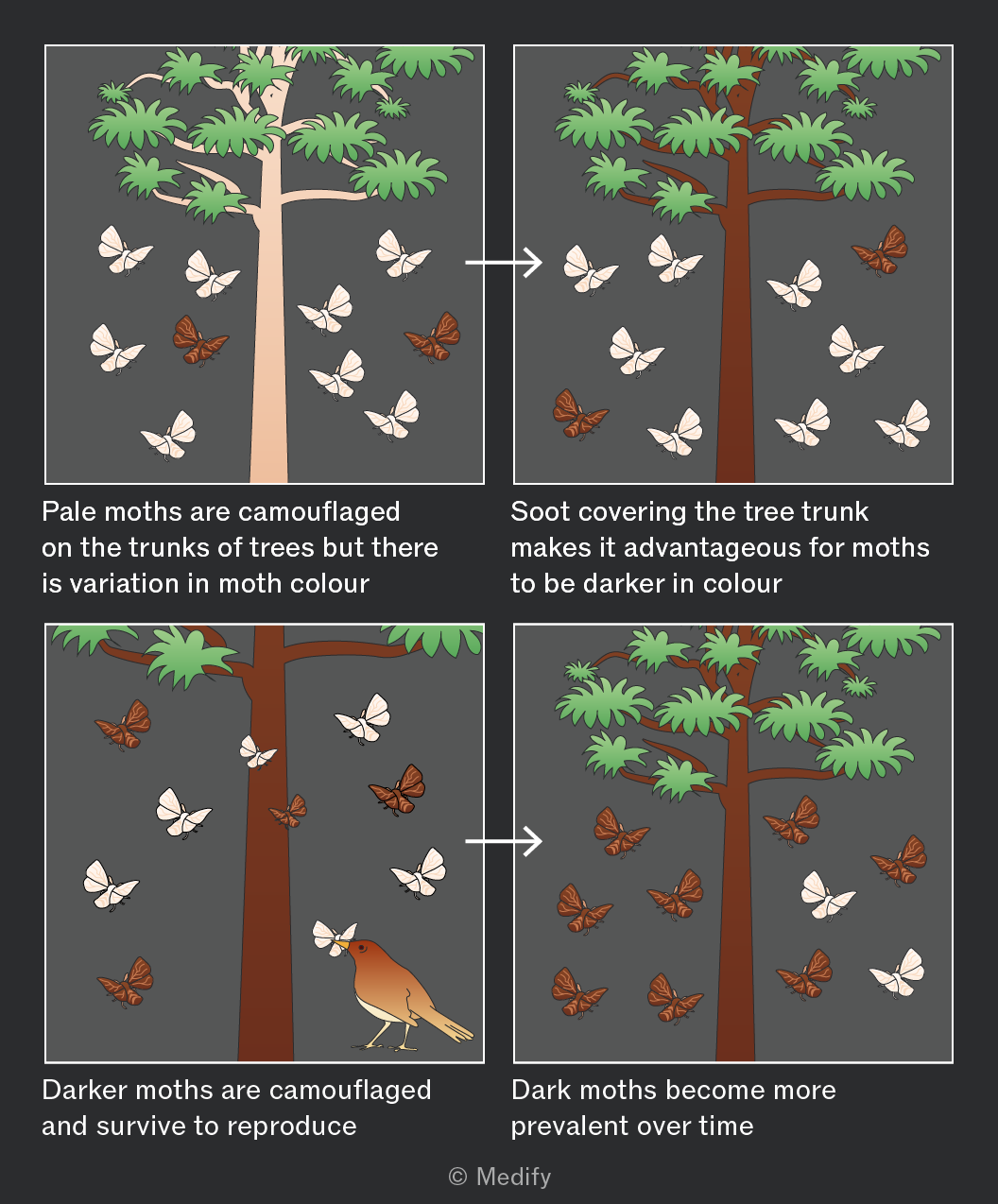
These pressures lead to differential survival and reproduction. Some individuals have advantageous alleles (better adapted). They are more likely to survive, reproduce, and pass on their alleles. Others are less likely to survive and reproduce. This process is natural selection.
Evolution is a change in allele frequencies in a population over time, driven by natural selection.
For natural selection to occur, genetic variation must exist – individuals must carry different alleles.
An allele that is neutral under one set of conditions can become advantageous if the environment changes, giving its carriers a survival and reproductive advantage. Over generations, this allele will increase in frequency as it is passed to more offspring.
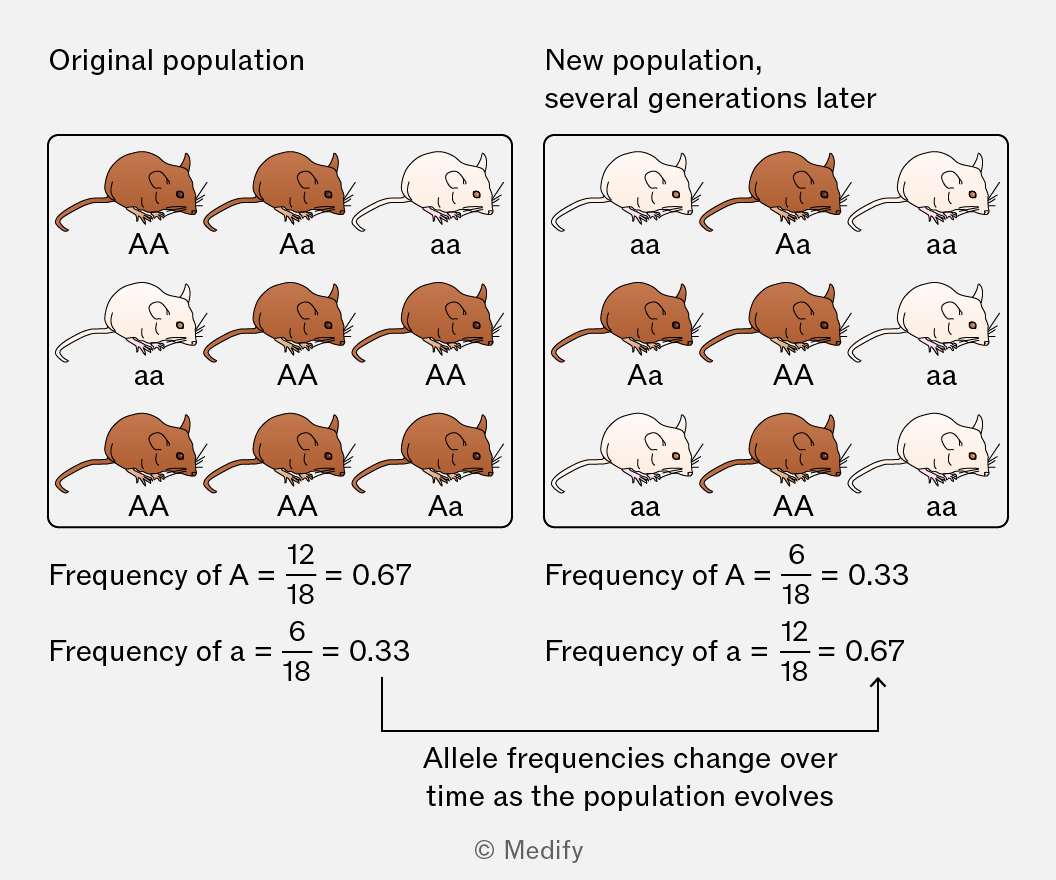
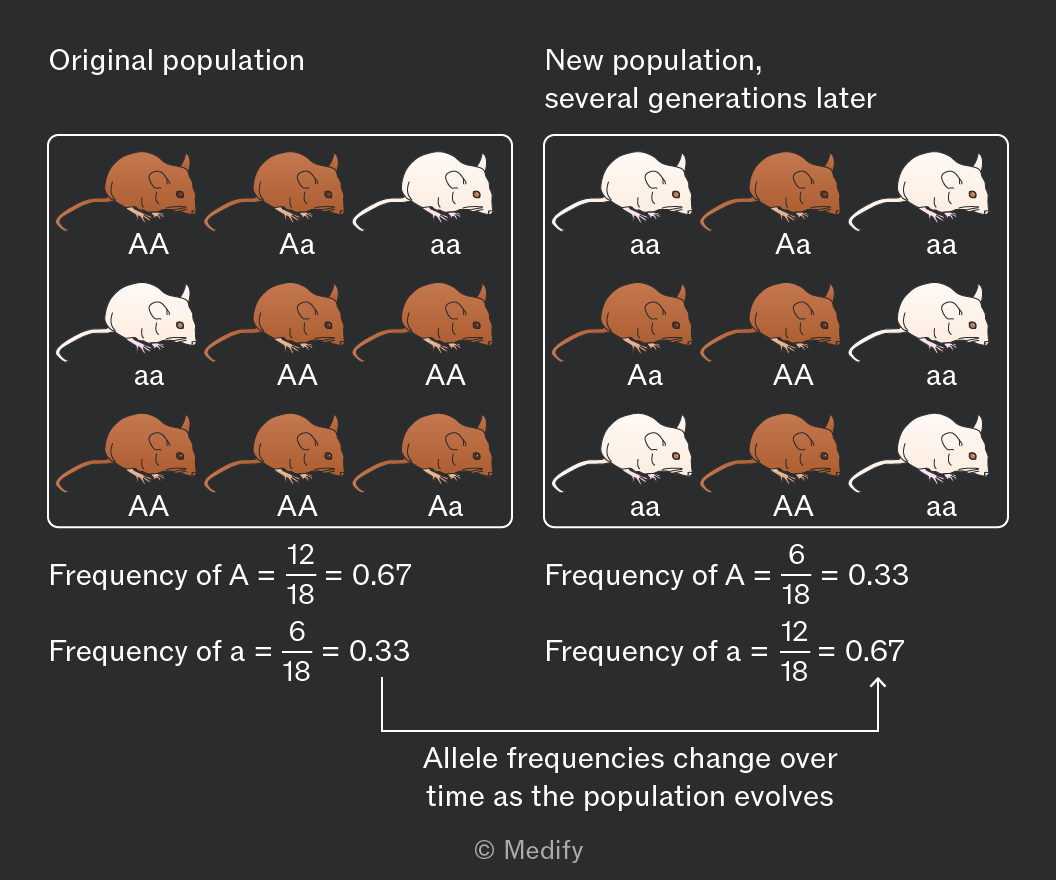
Over many generations, evolution changes the characteristics of a population.
The mechanism:
- Variation exists in a population.
- Selection pressure (e.g., climate, competition, disease) means some individuals are better adapted than others.
- These individuals are more likely to survive and reproduce.
- They pass on their advantageous alleles to offspring.
- Over time, the frequency of those alleles increases in the population.
The Hardy-Weinberg equations are used to calculate allele frequencies and to assess changes in frequencies over time.
To calculate allele frequencies:
Where:
- = frequency of dominant allele
- = frequency of recessive allele
To calculate genotype frequencies:
Where:
- = frequency of homozygous dominant genotype (AA)
- = frequency of heterozygous genotype (Aa)
- = frequency of homozygous recessive (aa)
New species can arise from populations of an existing species.
When populations are reproductively isolated from each other, they evolve independently. Their gene pools may be under different selection pressures or may experience different mutations or genetic drift.
Over time, changes to the allele frequencies in the separate populations accumulate to such a degree that they cannot interbreed to produce fertile offspring. They have become different species.
The ways that reproductive isolation between populations of a species can occur are varied. The most common are:
- Geographical barriers (e.g., mountains, rivers, distance) physically separate populations.
- Biological / behavioural barriers (e.g., different mating seasons or calls, different flower structures) mean populations in the same habitat do not breed together.