
Amount of substance in practical chemistry (5.12 - 5.15)
On this page
An analytical mass balance is required for measuring mass. This can be useful in preparing reactants, measuring product yield and tracking weight loss or gain over time.
When using a balance, the tare function allows the establishment of a ‘zero’ baseline mass. For example, this may be the empty balance or an unfilled beaker.
All glassware which is not tared should be weighed empty, so that its mass can be accurately accounted for.
When analysing results take care to consider what is included in each mass provided. You may need to subtract the mass of the glassware before using the value.
When solids are used to form a solution, the weighing vessel can be rinsed with the required solvent and the washings added to the solution.
Alternatively, the weighing dish can be reweighed to obtain mass successfully transfered.
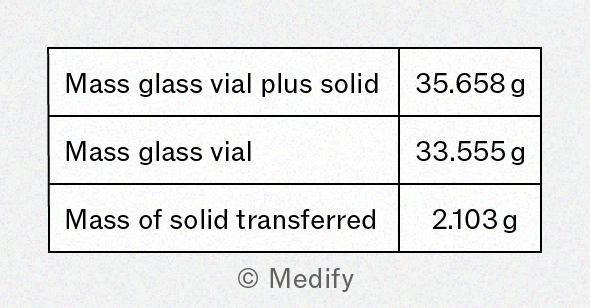
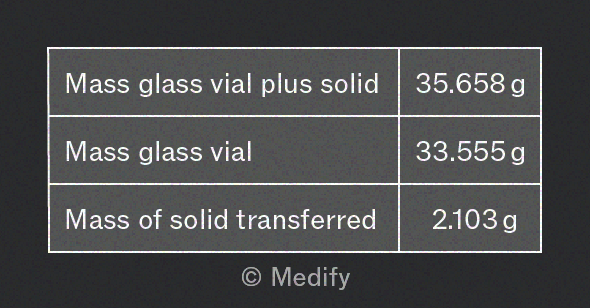
Note that accurate mass measurements become obsolete if the measured amount of substance is then not fully transferred to the reaction mixture.
The volume of solutions is measured using volumetric glassware such as a:
- burette for controlled delivery of precise volumes
- pipette for measuring fixed quantities of small volumes with extremely high precision
- measuring cylinder for less precise volumes
- volumetric flask for preparing a fixed volume of a chemical solution of known concentration called a standard solution.
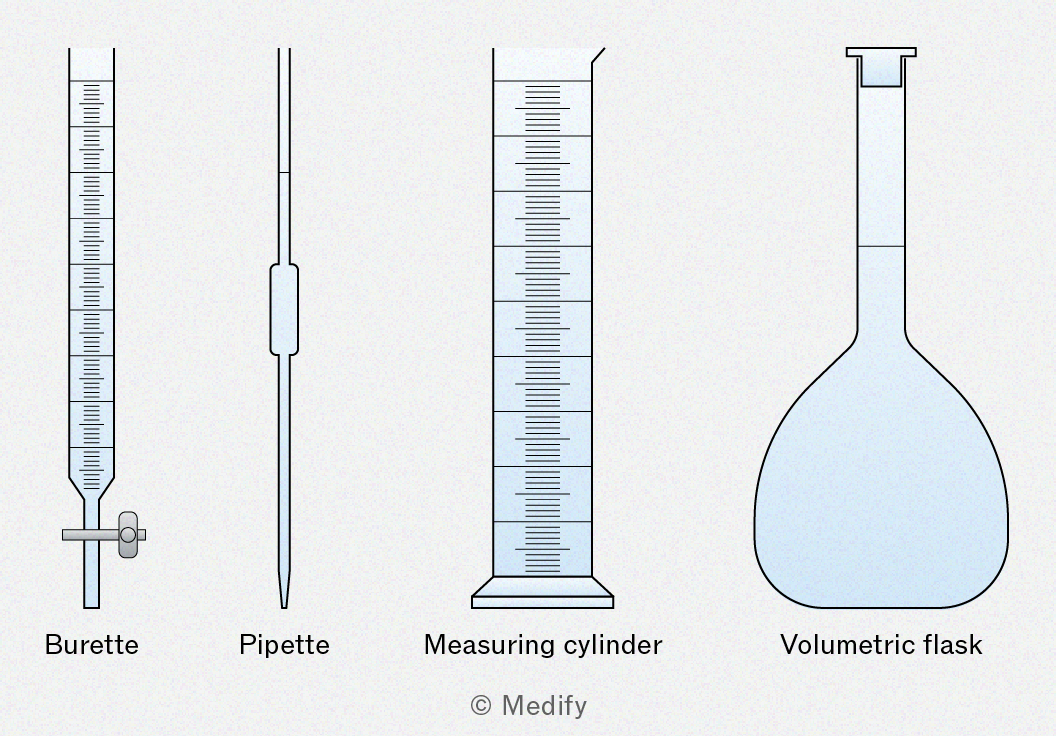
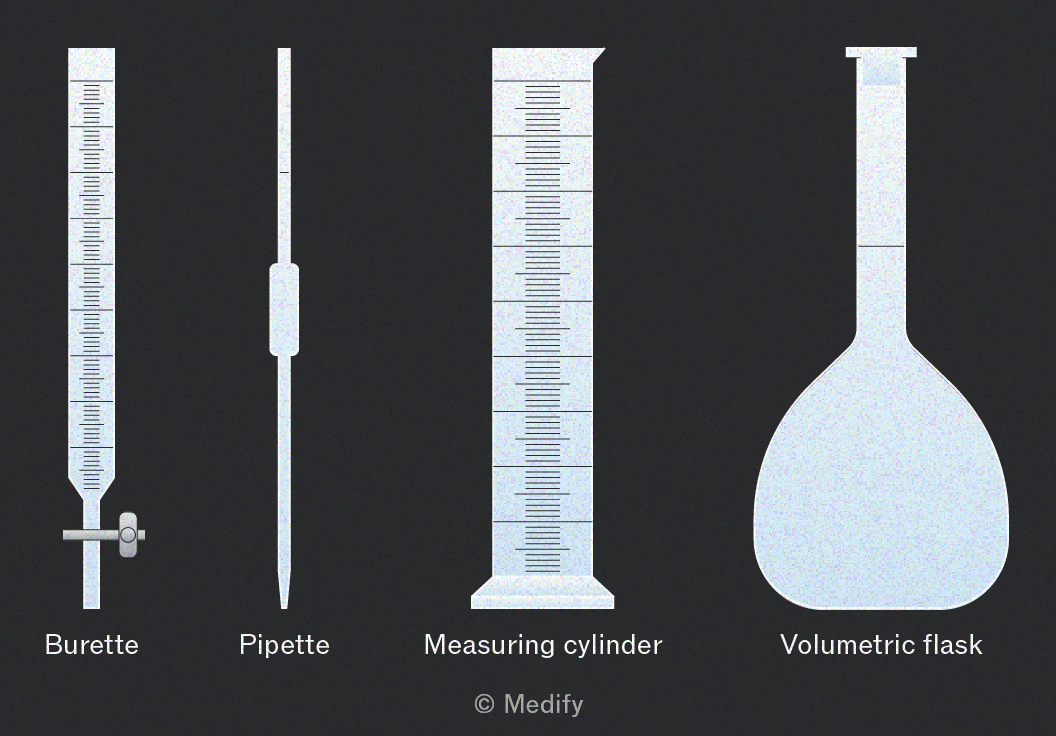
Note that solutions require the measurement of a final volume in a volumetric flask rather than addition of a set volume of solvent using a pipette.
The solution is ‘made up’ to the correct volume with the solvent.
Accuracy from volumetric glassware is only maintained if full transfer of the measured volume to the reaction mixture is achieved.
Burettes and pipettes should be rinsed with the solution they will hold prior to use, rather than used following a water rinse; this prevents a reduction in concentration within the glassware.
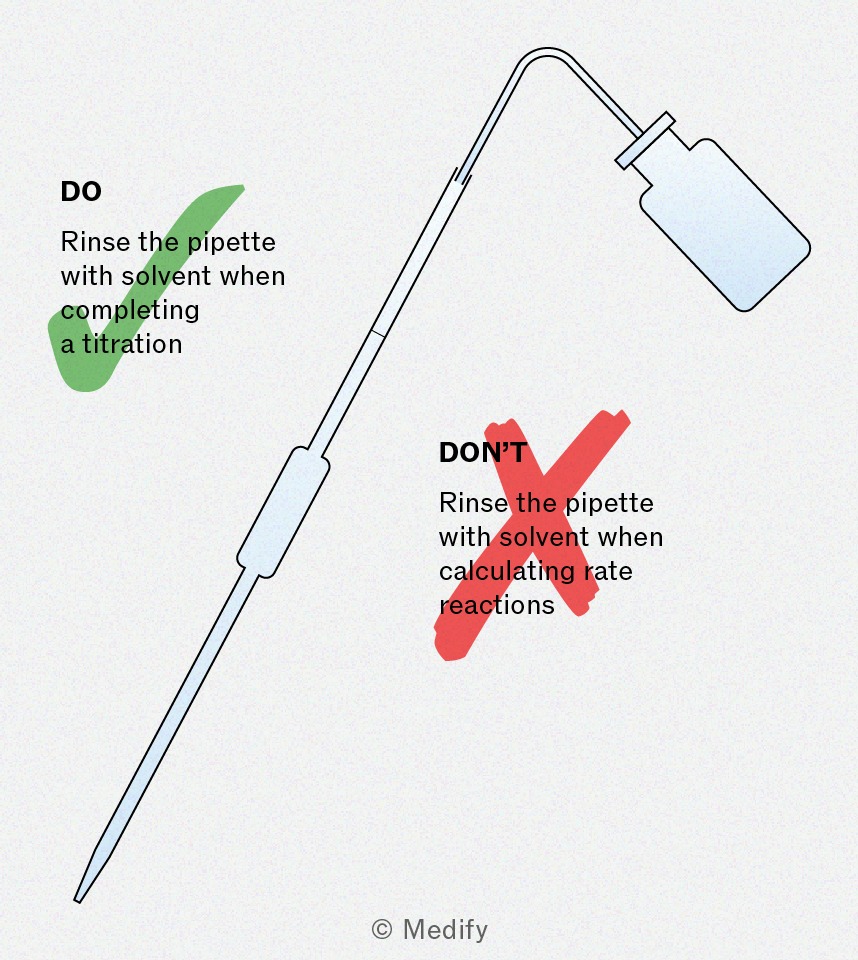
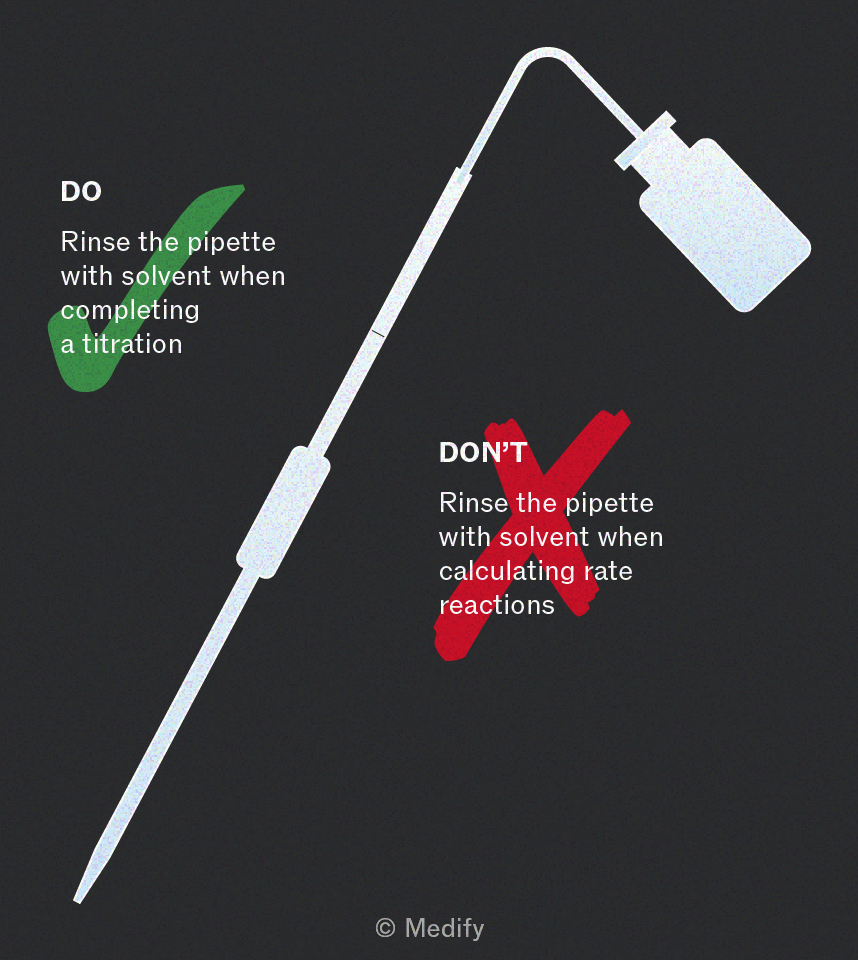
Where a known volume of solution is measured with a pipette to deliver a set amount of solute, the pipette can then be rinsed through with excess solvent to ensure full transfer. This is relevant for titration experiments.
Where reactant concentration rather than absolute amount is critical, for example, in rate experiments or electrochemical cells, rinsing will impact the validity of the experiment.
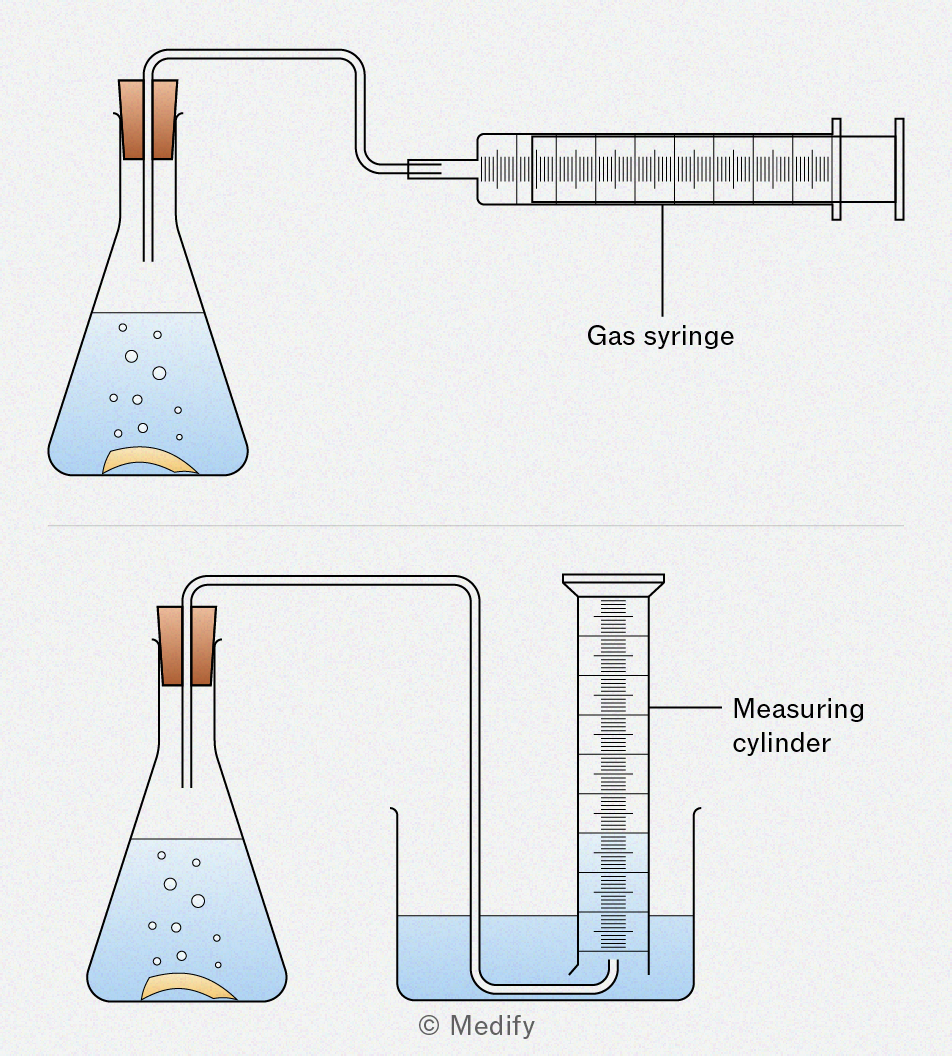
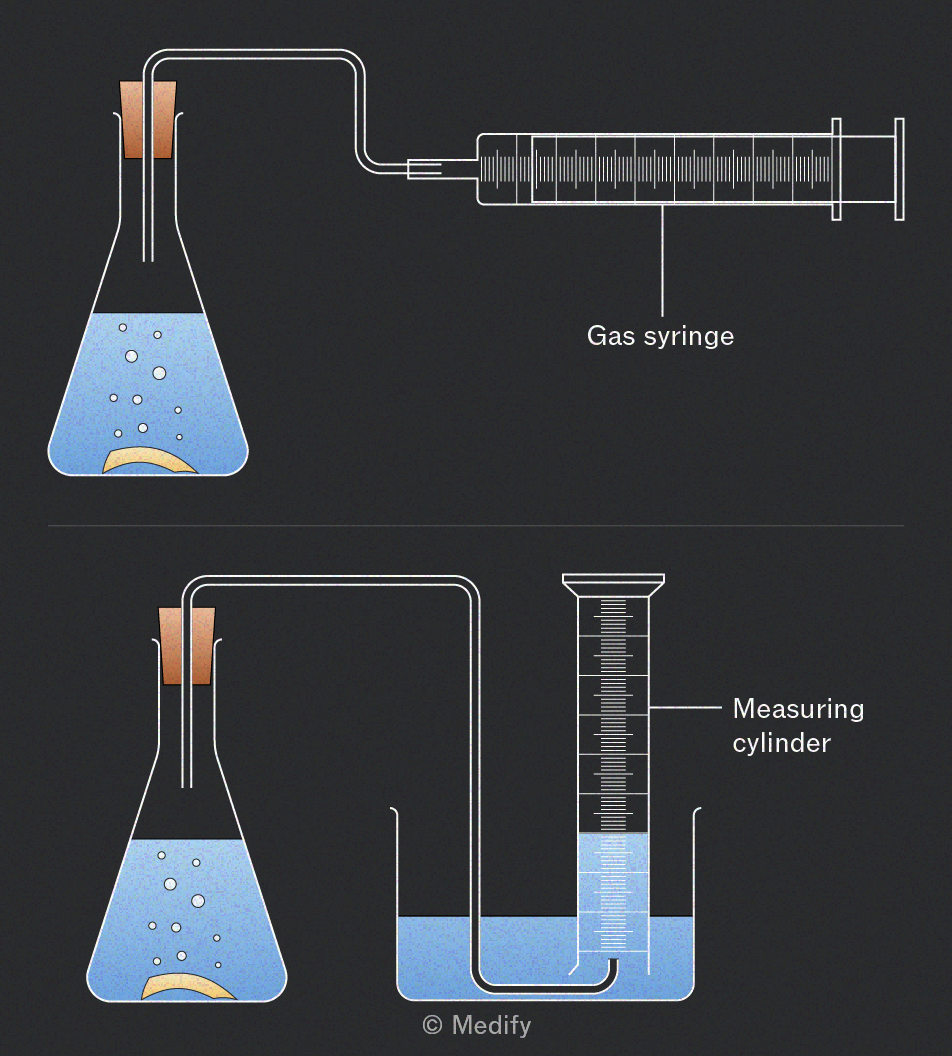
The volume of gases liberated in a chemical reaction is usually measured using a graduated gas syringe or, as a substitute, through collection in an inverted cylinder, filled with and submerged in water.
Percentage uncertainty is the relative uncertainty for a given measured value. It is useful for analysing equipment for appropriateness of resolution.
Total uncertainty is the uncertainty in the measurement, which could be due to instrument precision or human error. For example, on a ruler would give a total error of .
Measured value is the value you obtained from the measurement, for example, the length of an object measured to be .
If you measured a length of using a ruler with an uncertainty of , the percentage uncertainty would be:
Percentage uncertainty can be minimised by the following:
- Using more precise equipment
- Choose instruments with higher sensitivity. When measuring volumes, use a burette or a pipette rather than a measuring cylinder. Burettes and pipettes offer smaller divisions, leading to lower uncertainty. For mass measurements, use analytical balances that can measure to instead of top-pan balances that only resolve to .
- Using volumetric flasks. When preparing standard solutions, use volumetric flasks rather than beakers or conical flasks. Volumetric flasks are designed to have very precise volume measurements, reducing uncertainty in concentration calculations.
- Using larger quantities of reagents
- Minimise percentage errors by using larger quantities. When weighing substances, using larger masses reduces the relative uncertainty in mass measurements. For example, if you have a balance with an uncertainty of , weighing introduces a larger relative uncertainty compared to weighing . Thus, using more of a substance minimises the impact of equipment precision.
- Using larger volumes for titrations. When performing titrations, aim to use larger volumes of solutions (within safe and practical limits). For example, if a titration requires using of a titrant, doubling the analyte volume, if feasible, reduces the percentage uncertainty associated with the measurement.
Atom economy reflects the efficiency of a chemical reaction as written.
It denotes the mass of atoms of the combined reactants that are transferred into the desired product, assuming a yield.
When a chemical reaction occurs, some byproducts can be formed in addition to the desired product. This is considered waste.
Addition reactions, where multiple reactants form a single product, have an atom economy of .
Percentage yield reflects how well reactants are converted into the intended products.
Reaction conditions are often modified to maximise percentage yield.
Question walkthrough
Calculating percentage yield
Using reaction stoichiometry to determine the expected mass of a product and converting this to percentage yield.
One solution in a titration must be of known concentration.
A standard solution is a solution of known concentration. It must be accurately prepared using a volumetric glass flask.
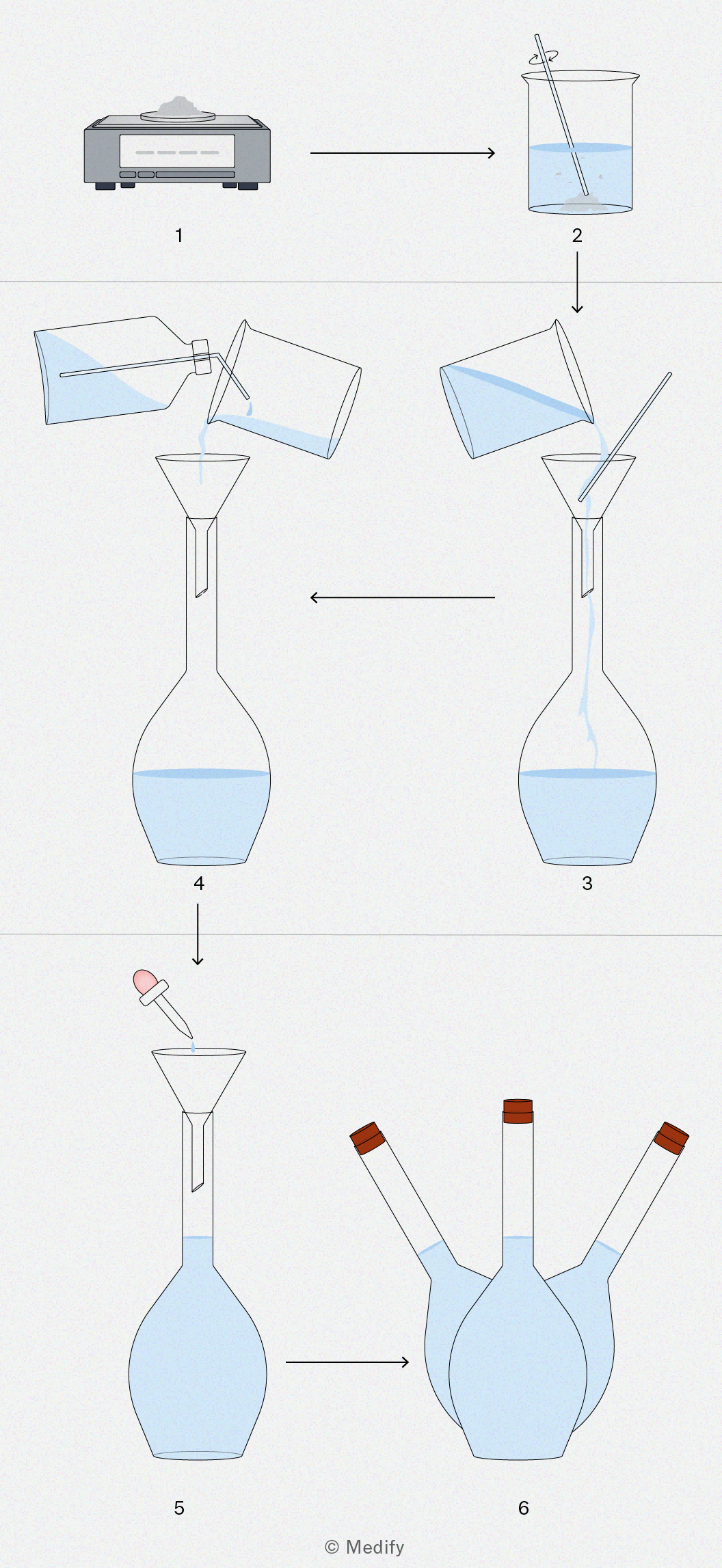
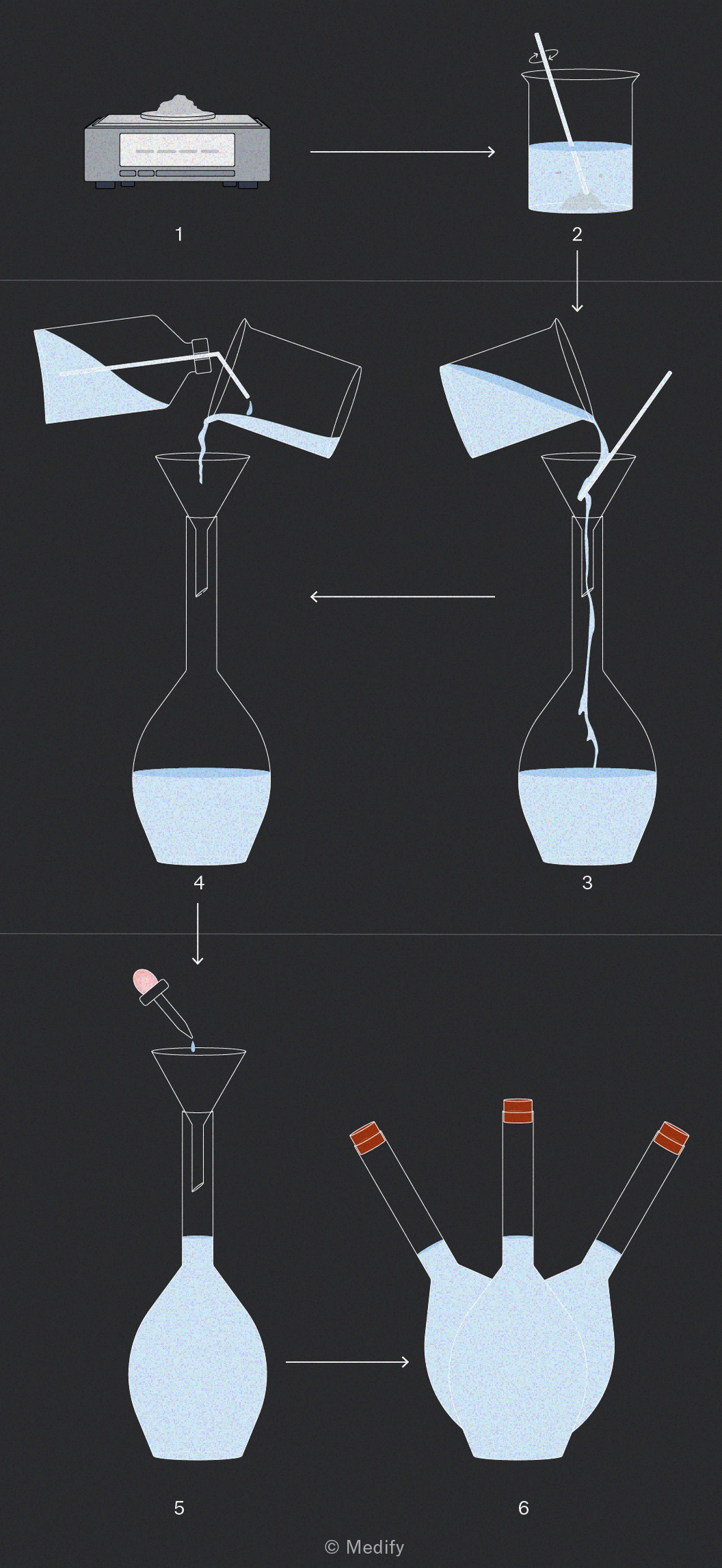
The preparation of a standard solution involves the following steps:
- Calculate the mass of solute required to achieve the desired concentration and weigh on an analytical balance.
- Transfer the solute to a clean beaker and add a small amount of solvent (distilled water). Stir until fully dissolved. Ensure all solute is transferred by reweighing the empty weighing dish.
- Transfer the concentrated solution to the volumetric flask using a glass funnel.
- Rinse the beaker, stirring rod and funnel with solvent (distilled water) and add washings to the volumetric flask. This ensures complete transfer of solute.
- Fill the volumetric flask with solvent to the fill line. Use a pipette for the final addition to improve accuracy. Ensure the meniscus is viewed at eye level while doing this.
- Stopper the volumetric flask and slowly invert sideways two to three times to thoroughly mix all the contents.
Core Practical 1: Measure the molar gas volume
Aim: Determine the volume of one mole of gas at room temperature and pressure (RTP).
Method: React a known mass of a metal (e.g. magnesium) with an excess of dilute acid (e.g. hydrochloric acid) to produce a gas (e.g. hydrogen). Collect the gas using a gas syringe or an inverted measuring cylinder in water.
Key Formula: Use the equation to establish the moles of gas collected and relate the volume collected to the molar volume using
Core Practical 2: part 1 – Prepare a standard solution from a solid acid
Aim: Produce an acidic solution of known concentration for use in a titration experiment.
Method:
- Weighing the solid acid. Accurately weigh a precise mass of a solid primary standard acid (e.g. anhydrous oxalic acid or potassium hydrogen phthalate) using an analytical balance. Record the mass to the nearest or better.
- Dissolving the acid. Transfer the weighed solid acid into a beaker. Add distilled water to the beaker and stir with a glass rod until the acid is fully dissolved.
- Transferring to a volumetric flask. Pour the dissolved solution into a volumetric flask using a funnel. Rinse the beaker, glass rod, and funnel with distilled water and add these rinsings to the volumetric flask to ensure all the acid is transferred.
- Dilution to the mark. Add distilled water gradually to the volumetric flask until the bottom of the meniscus touches the calibration line. Ensure the flask is at eye level to avoid parallax error.
- Mixing the solution. Stopper the flask securely and invert it multiple times to thoroughly mix the solution, ensuring homogeneity.
Key formula: Use the relationships and to establish the mass of solid required to achieve the target concentration.
Core Practical 2: part 2 – Use the standard acid solution to find the concentration of a solution of sodium hydroxide
Method:
- Setting up the burette. Rinse and fill a burette with sodium hydroxide solution of unknown concentration. Record the initial volume to the nearest .
- Pipetting the standard solution: Use a pipette to transfer a known volume (e.g. ) of standard acid solution into a conical flask. Add a few drops of a suitable indicator, such as phenolphthalein, which turns pink in alkaline conditions.
- Performing the titration. Titrate the sodium hydroxide from the burette into the conical flask, swirling continuously. As the endpoint approaches (pale pink persists), add the dropwise until the colour change just occurs.
- Recording and repeating. Record the final burette reading and calculate the volume of added. Repeat the titration until you obtain concordant results (within of each other).
Key formula: Use the relationship and the mole ratio of the reaction to calculate the concentration of the sodium hydroxide.
Core Practical 3: Find the concentration of a solution of hydrochloric acid
Method:
- Setting up the burette. Rinse and fill a burette with hydrochloric acid solution of unknown concentration. Record the initial volume to the nearest .
- Pipetting the standard solution. Use a pipette to transfer a known volume (e.g. ) of standard sodium hydroxide solution into a conical flask. Add a few drops of a suitable indicator (e.g. phenolphthalein, which turns pink in alkaline conditions).
- Performing the titration. Titrate the hydrochloric acid from the burette into the conical flask, swirling continuously. As the endpoint approaches (solution becomes colourless), add the dropwise until the colour change just occurs.
- Recording and repeating. Record the final burette reading and calculate the volume of added. Repeat the titration until you obtain concordant results (within of each other).
Key formula: Use the relationship and the mole ratio of the reaction to calculate the concentration of the hydrochloric acid.