
Amount of substance (5.01 - 5.05)
On this page
The mole () is the unit for measuring the amount of a substance.
There are two definitions for the mole.
- Classical definition: one mole of a substance is the amount of substance that contains the same number of particles as there are atoms in of carbon-12 isotope. Carbon-12 is used as a reference because its mass is exactly equal to 12 atomic mass units.
- Newer definition: one mole is the amount of a substance containing exactly (the Avogadro constant) of elementary entities.
The number represents the Avogadro constant . It is defined as the number of atoms in exactly 12 grams of carbon-12. It is the number of particles per mole of a substance.
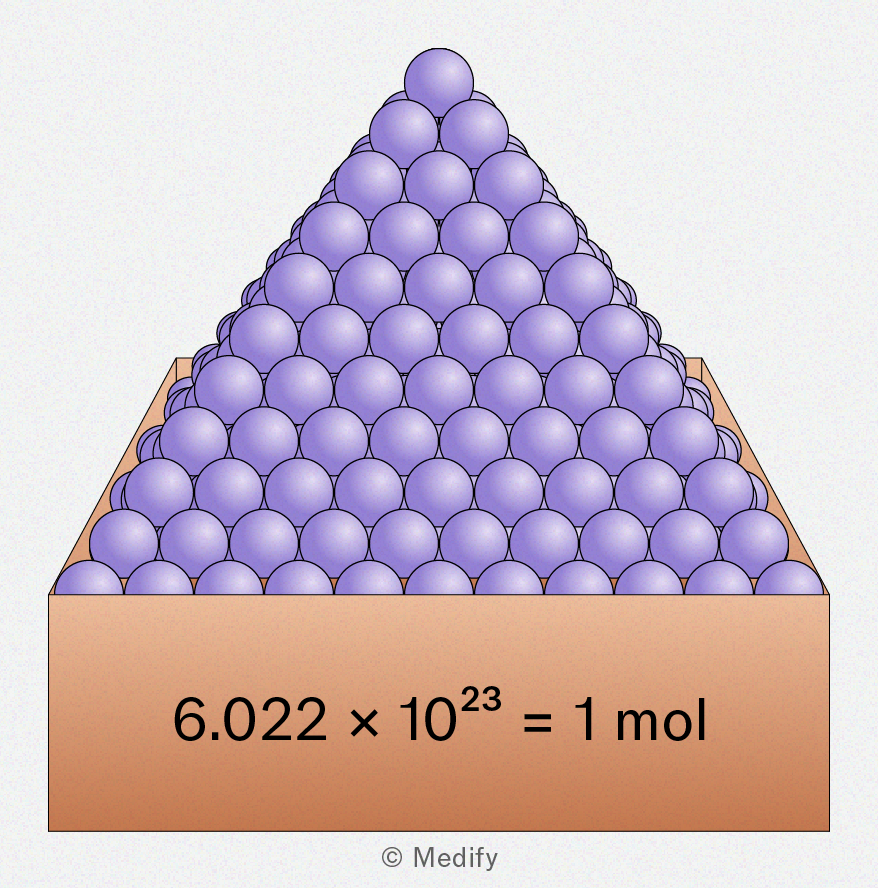
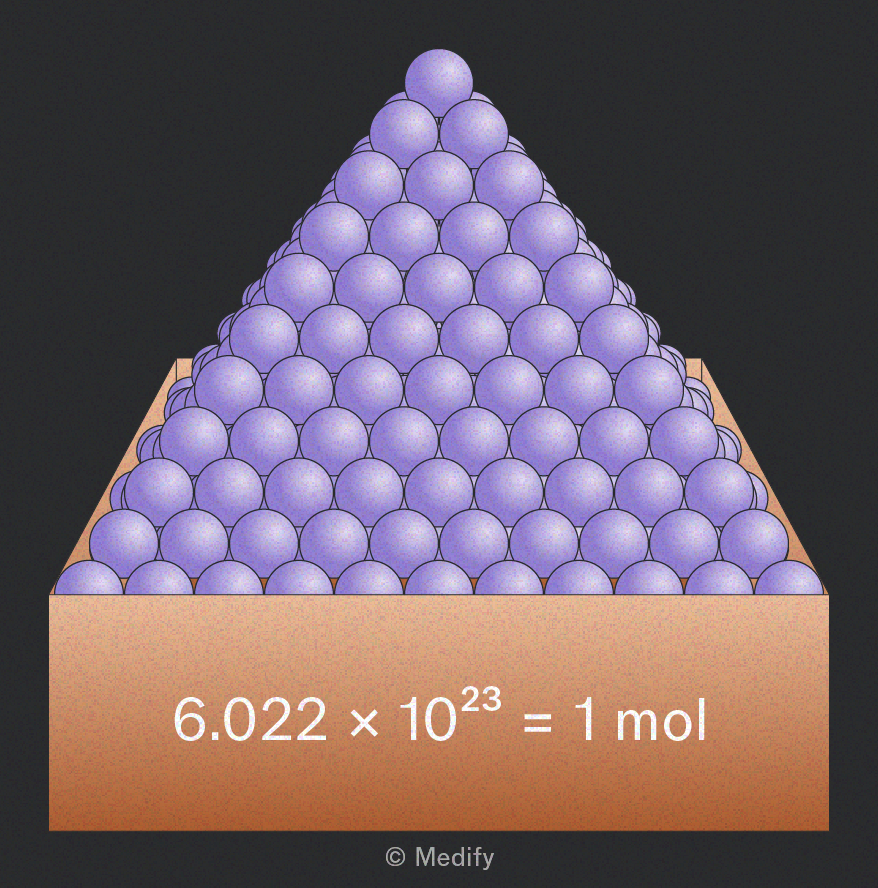
One mole of any substance contains particles regardless of its identity. This is akin to a dozen eggs and a dozen bricks both representing 12 units.
It is important to be precise about what you are counting when you describe a mole of something.
One mole of oxygen atoms contains atoms of oxygen.
One mole of oxygen molecules contains molecules of oxygen.
One mole of oxygen molecules contains atoms of oxygen.
It is important to note that in each molecule, there are two oxygen atoms. Therefore, one mole of oxygen molecules contains two moles of oxygen atoms.
The mass of one mole of a substance is known as its molar mass.
The units for molar mass are .
The relative molecular mass of a molecule is the sum of the relative atomic masses of all the atoms in its molecular formula.
Relative molecular mass is a comparative quantity; it compares the mass of a molecule to one-twelfth of the mass of a carbon-12 atom.
The relative formula mass of a compound is the sum of the relative atomic masses of all the atoms in its formula unit. It is used for ionic compounds and giant covalent structures, where there are no discrete molecules.
Like relative molecular mass, it is a comparative quantity that compares the mass of the formula unit to one-twelfth of the mass of a carbon-12 atom.
The empirical formula is the simplest whole number ratio of atoms of each element present in a compound.
The molecular formula shows the exact number of atoms of each element present in the molecule.
Once the empirical formula is determined, the molecular formula can be deduced using the empirical formula mass and the relative molecular mass of the compound.
The empirical formula can be calculated in two ways:
- By using the mass composition of elements present in a sample of the compound.
- By using the percentage composition by mass of elements present in the compound.
To calculate the empirical formula of the compound convert the contribution of each element to percentage, then divide by the relative atomic mass.
Then find the simplest mole ratio by dividing each number by the highest common factor, which is usually the smallest number of moles.
Molecular formulae can be calculated from the relative molecular masses of compounds alongside their empirical formula.
- Empirical formula mass is first calculated.
- Dividing the relative molecular mass by the empirical formula mass gives the multiplier, .
- Multiply all counts of atoms in the empirical formula by to get the molecular formula.
The ideal gas equation links the moles of gas to its volume at specified temperatures and pressures.
While performing calculations using the ideal gas equation, units throughout the equation must align.
The following conversion factors can prove helpful in converting units
Question walkthrough
Using the ideal gas equation
Using the ideal gas equation to identify the molar mass of an unknown substance