
Relating amount of substance to stoichiometric equations (5.06 - 5.11)
On this page
Balancing equations is a process to make sure there are the same number of atoms on each side of the symbol equation therefore obeying the law of conservation of mass.
When balancing equations ensure:
- the only numbers changes are the coefficients. These are placed in front of the formulae
- the formulae are not altered in any way, such as changing to to increase the number of oxygen atoms.
When balancing equations, we must:
- identify the number of atoms of each element in the reactants and products
- add the appropriate coefficient in front of the formulae to balance the number of atoms on each side
- make sure that the final balanced equation has the same number of each type of atom on both sides.
To convert a balanced (stoichiometric) symbol equation into an ionic equation we must:
- split compounds composed of aqueous ions into the individual ions, including any multiples
- leave intact in the equation any substance that does not contain aqueous ions or is covalently bonded
- cancel out spectator ions which appear on both sides of the equation and do not undergo any change.
Question walkthrough
Writing a balanced equation
Using a description of a reaction to construct a balanced equation
Question walkthrough
Constructing a net ionic equation
Identifying and removing counterions to produce a net ionic equation
The mole is related to mass, in grams, and molar mass of a substance by the formula:
The formula can be rearranged to find molar mass and mass.
Molar gas volume is defined as the volume occupied by one mole of a gaseous substance under specified conditions. It can be calculated by dividing the volume of gas in by the number of moles of gas present.
At room temperature and pressure (RTP)
One mole of a gas occupies at RTP.
The molar gas volume at RTP is therefore or .
of any gas can be assumed to contain one mole of the gas molecules at RTP.
Concentration is defined as the amount, in moles or grams, of a solute dissolved in a measured volume of the solution.
One mol of solute dissolved in a total of solution denotes a concentration of .
The concentration is related to volume of a solution by the number of moles of a dissolved substance as follows:
The volume units must match to use this formula. The volume of the solution is often given in and the concentration in . Here, volume must be converted into , dividing by 1000.
The concentration can also be expressed as the mass concentration, in where;
If the mass of one substance in a balanced chemical equation is given, we can find the unknown mass of another substance by converting to moles and applying the relevant mole ratio from the equation.
The formula relating moles, volume and molar gas volume is:
The above formula can be rearranged to find the volume of a gas or the molar gas volume.
Masses, volumes and concentrations can all be linked to the amount of a substance in moles.
Mole ratios are a critical part in more complex calculation questions. They provide the relationship between one substance and another.
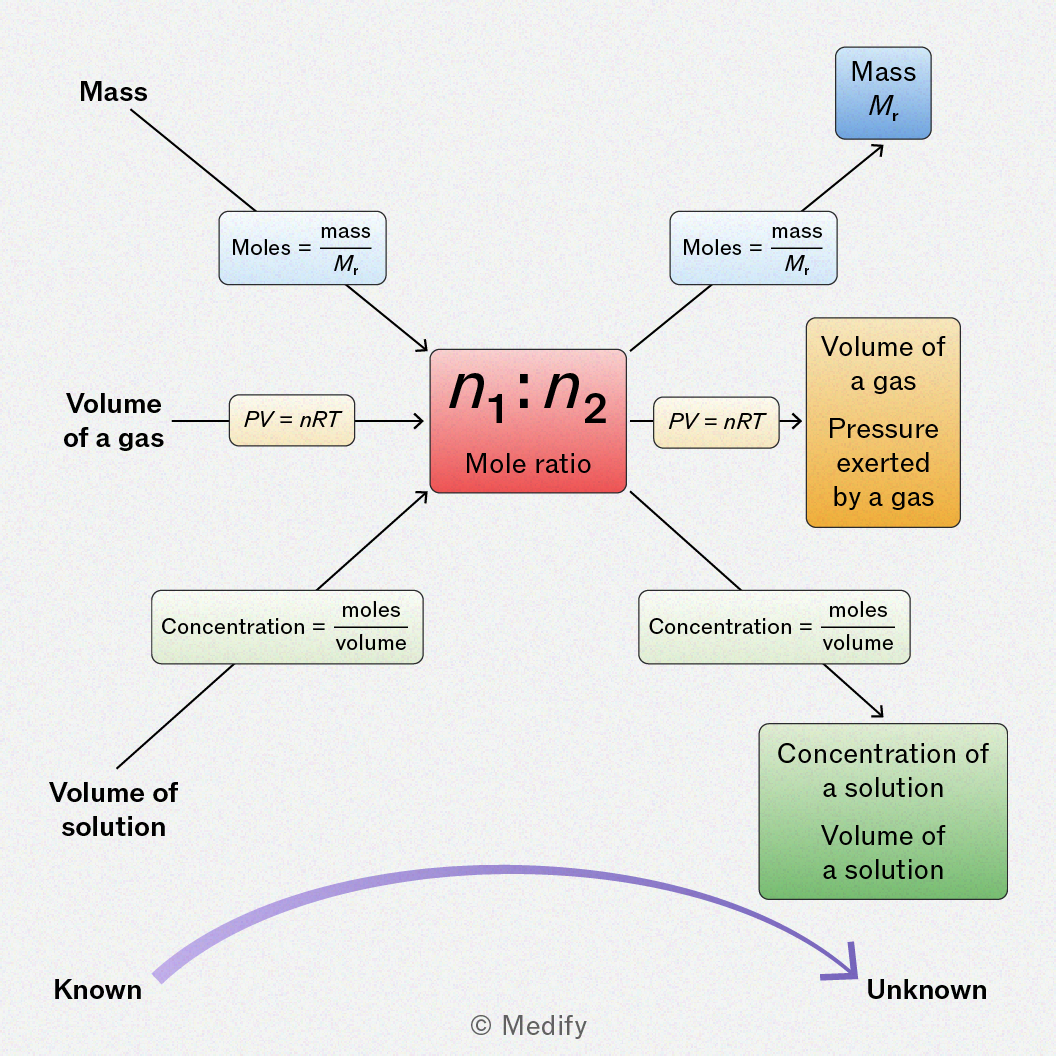
In stoichiometric calculations, the number of moles of the limiting reagent is used to find the unknown amounts of products formed.
Limiting reagent is the reactant that is fully consumed during an irreversible chemical reaction.
In contrast, the reactant left unused is described as being ‘in excess’. The moles of an excess reagent do not have a stoichiometric link to the products.
Question walkthrough
Using molar gas volume
Identifying the mass of reactant required to produce a given volume of gaseous product using the molar gas volume
Question walkthrough
Stoichiometric ratios with gaseous reactions
Using experimental data to identify a balanced chemical equation.
Question walkthrough
The concentration equation
Dilution of stock solution to produce a target concentration