Polyesters and polyamides (6.2.3)
On this page
Condensation polymerisation occurs when many monomers combine with the elimination of a small molecule, such as , or .
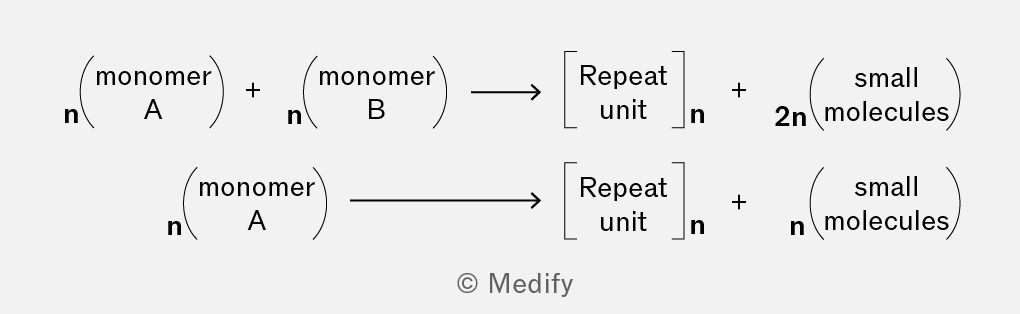
where = a whole number.
Condensation polymerisation can occur with one monomer or a pair of monomers.
The two classes of polymer formed by condensation polymerisation are polyesters and polyamides.
Polyesters have the ester group, , between monomers.
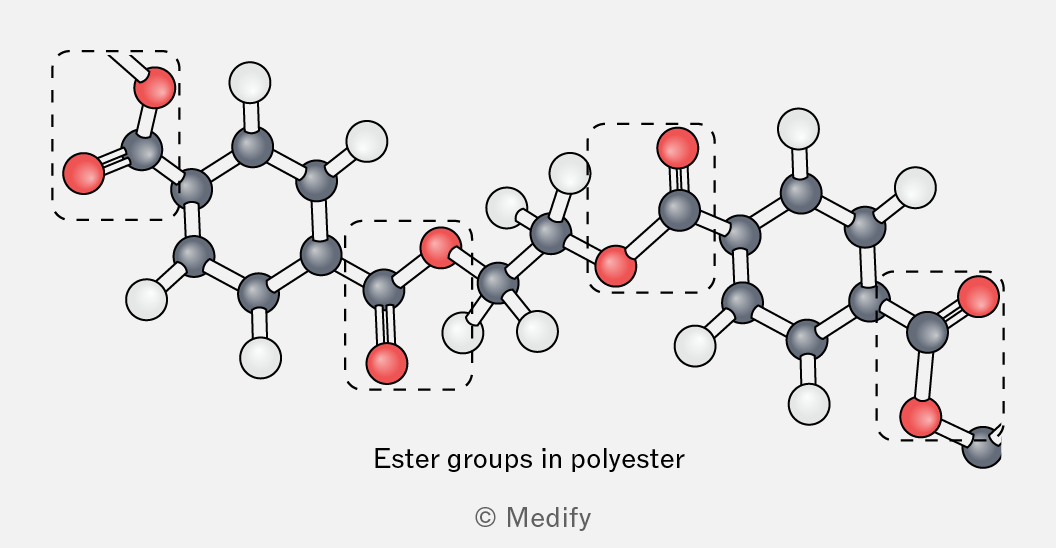
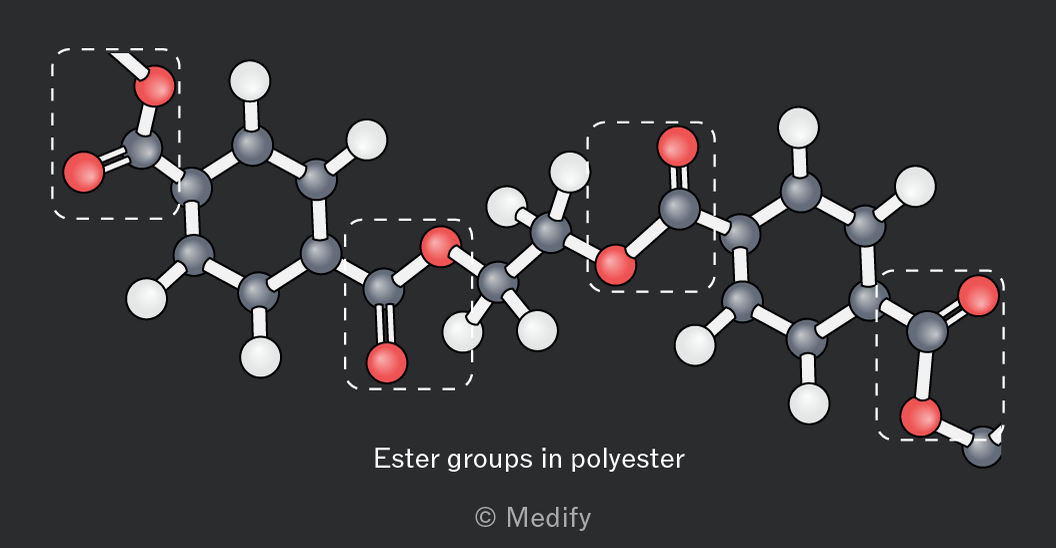
The group between monomers in a polyamide is the amide group,
Dicarboxylic acid monomers and diol monomers undergo condensation polymerisation to form polyesters, and water as a by-product.
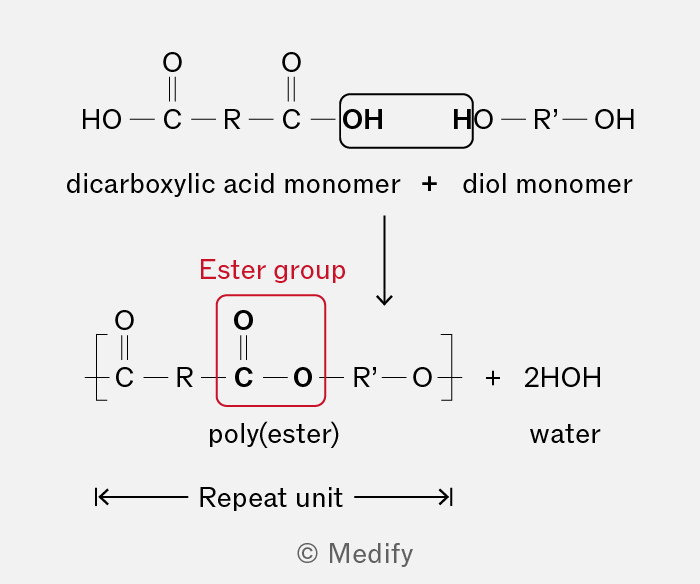
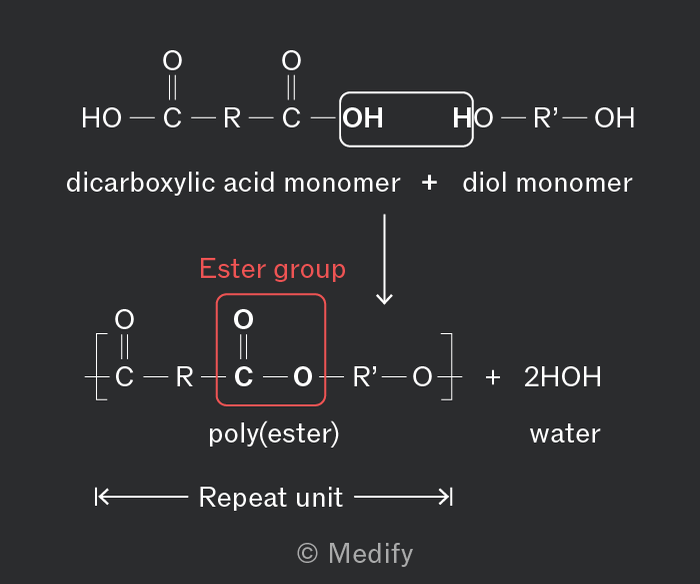
This is an example of two monomers synthesising a polymer product. The polyester formed from this reaction features an ester bond within the repeat unit.
Two molecules of water are produced for every repeat unit in the chain; there is an ester link formed within the repeat unit, as well as one connecting to the main chain.
Diacyl chloride monomers and diol monomers undergo condensation polymerisation to form polyesters, and hydrochloric acid as a byproduct.
The polyester formed from this reaction features an ester bond within the repeat unit.
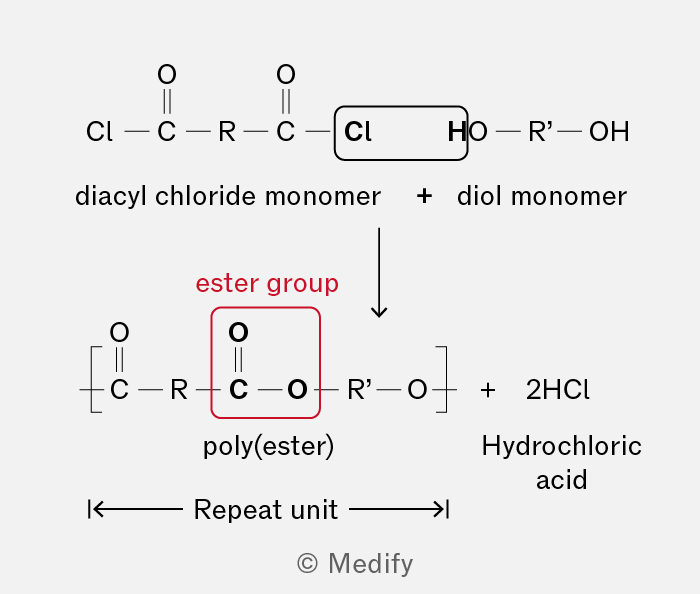
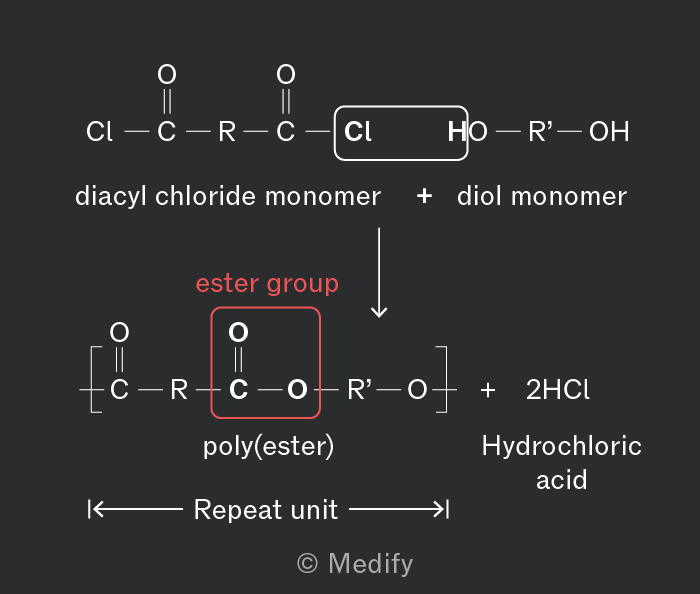
The use of a diacyl chloride will produce the same polyester as with a dioic acid, but the reaction will be faster.
This comes with the disadvantage of giving off toxic hydrochloric acid gas, (g), rather than water as a by-product.
Polyesters can be formed from a single monomer with both the carboxylic acid and alcohol group on the same carbon skeleton.
These monomers are known as hydroxycarboxylic acids.
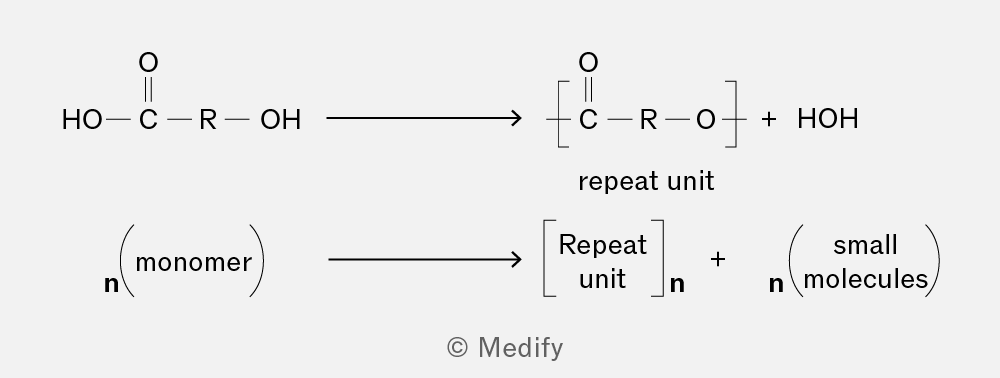
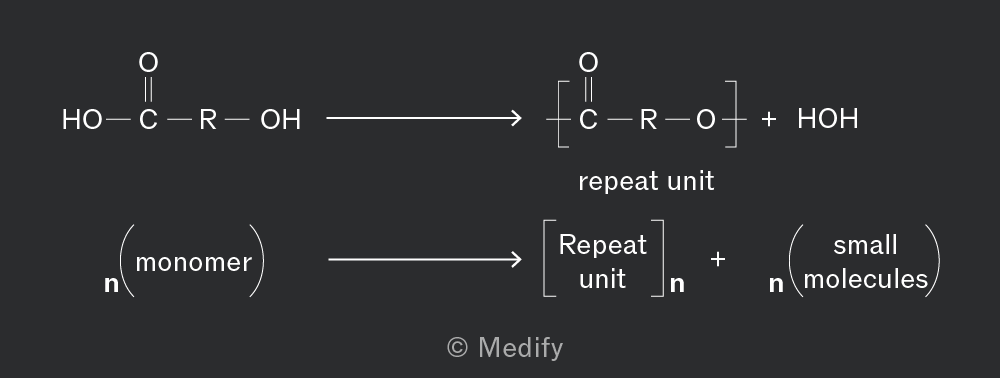
It is important to note that in this reaction the repeat unit does not contain an ester group.
Polyamides have the secondary amide group when the two functional groups react together.
Dicarboxylic acid monomers react with diamine monomers via condensation polymerisation, forming polyamides and water.
The dicarboxylic acid and the diamine have functional groups at both ends, so each monomer can form two amide links.
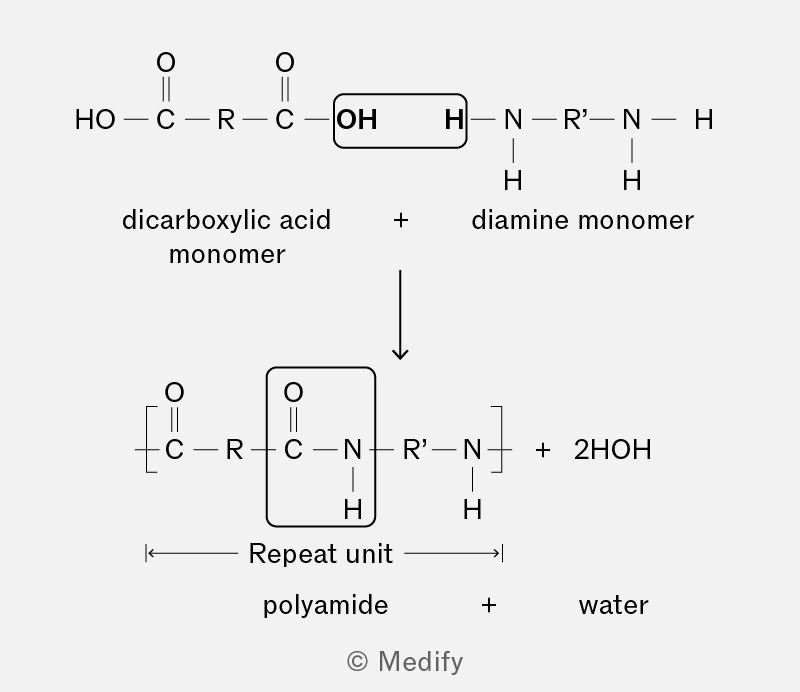
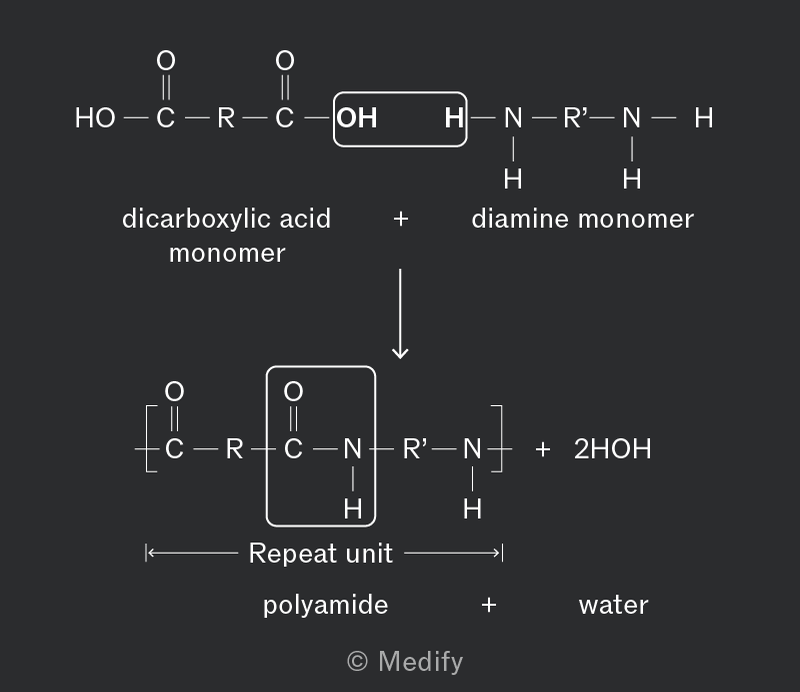
There is an amide group within the repeat unit, and two water molecules are produced per repeat unit formed.
Diacyl chloride monomers react with a diamine monomer via condensation polymerisation to form polyamides, and hydrochloric acid as a byproduct.
The diacyl chloride and the diamine have functional groups at both ends, so each monomer can form two amide links.
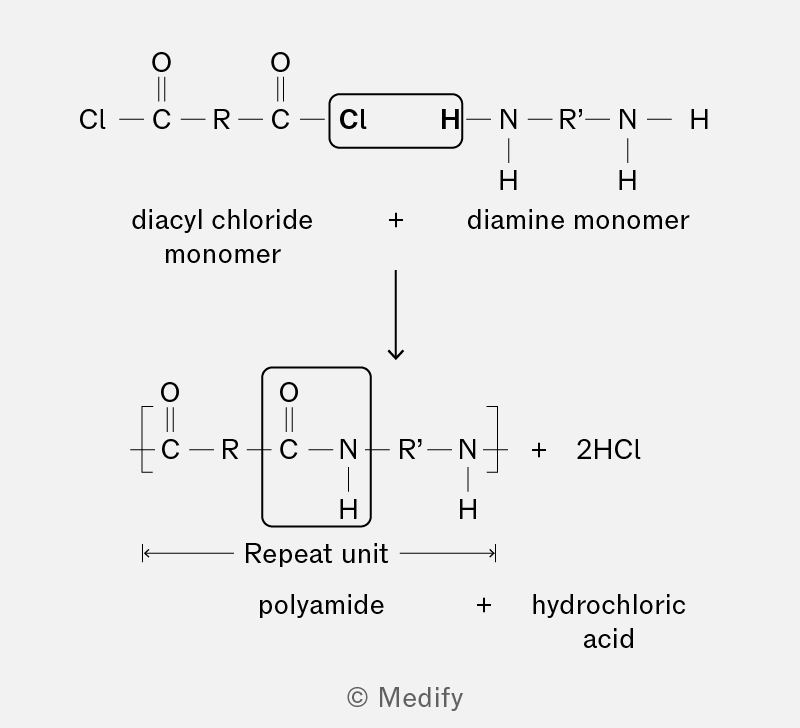
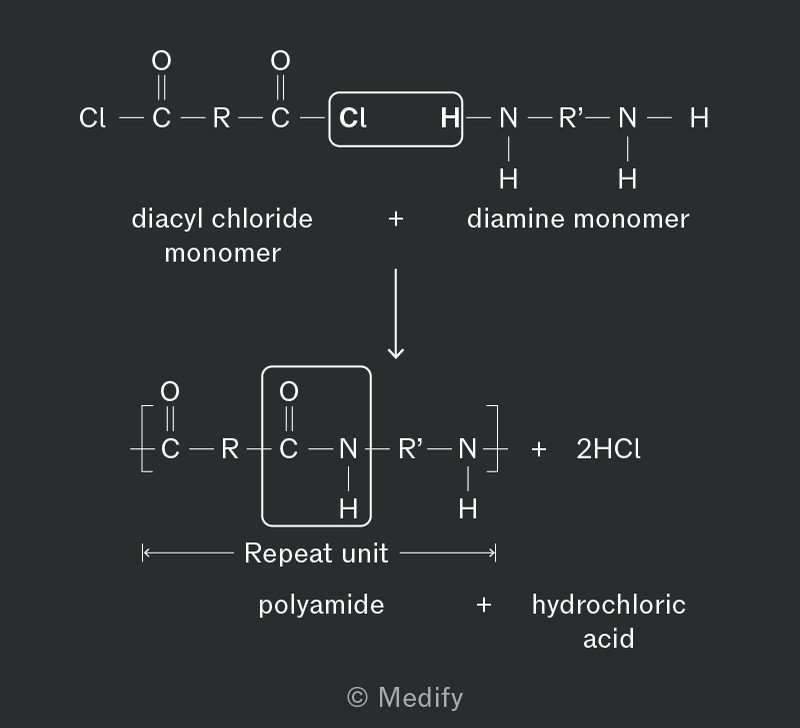
There is an amide group within the repeat unit, and two water molecules are produced per repeat unit formed.
Polyesters and polyamides are formed via condensation reactions, where two functional groups add together with the elimination of a small molecule.
The reverse reaction is to break up the polymer by adding back in the small molecule lost. If this is water, the reaction is called a hydrolysis (a reaction that involves the splitting of water molecules).
When polyesters are hydrolysed the ester bond splits to give a carboxylic acid and an alcohol.
In acidic conditions the products are protonated, whereas in alkaline conditions the carboxylic acid is deprotonated and the product is a carboxylate salt.
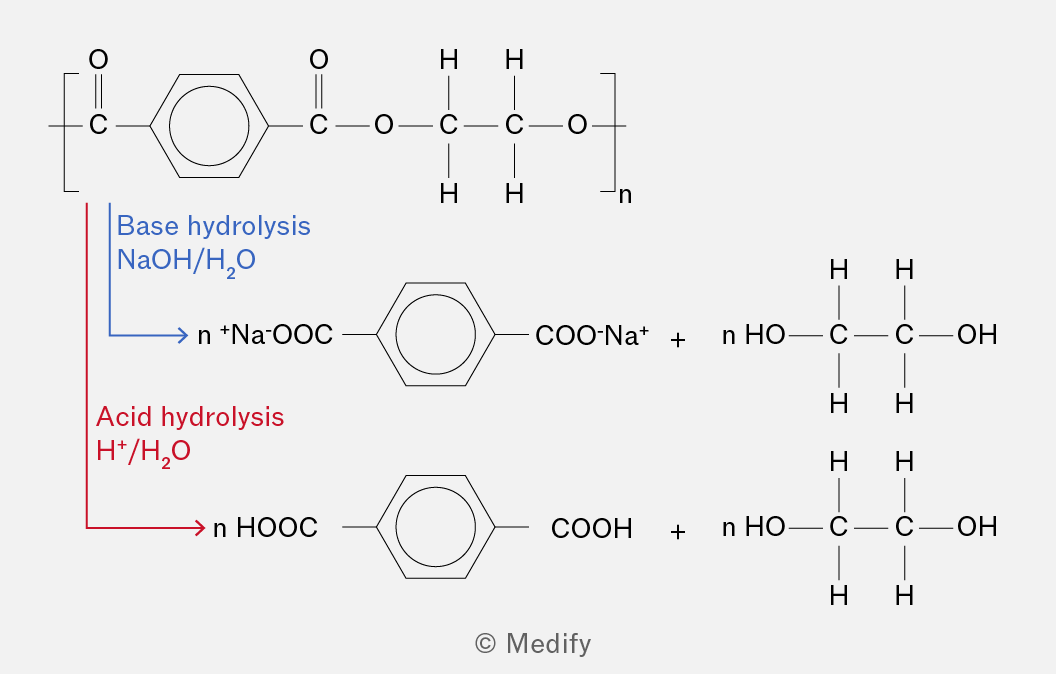
When stating the products of polymer hydrolysis, remember to consider the impact of on the functional groups.
When polyamides are hydrolysed the amide bond splits to give a carboxylic acid and an amine.
In acidic conditions the products are protonated and the amine is converted to an ammonium salt, whereas in alkaline conditions the carboxylic acid is deprotonated and the product is a carboxylate salt.
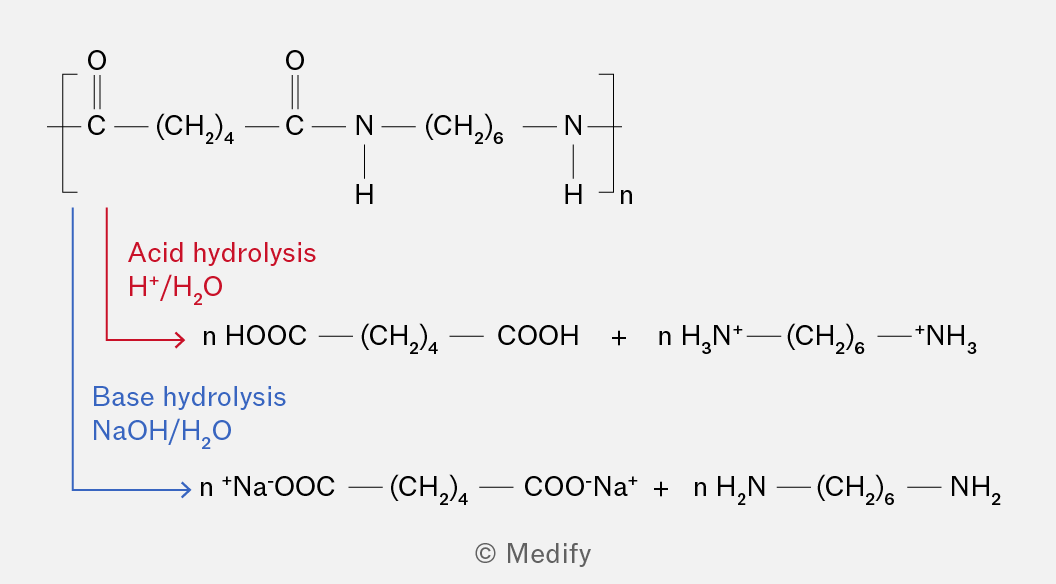
When stating the products of polymer hydrolysis, remember to consider the impact of on the functional groups.
A single repeat unit of a polymer contains all the detail needed to understand the structure of the chain. It is the building block within the polymer which repeats.
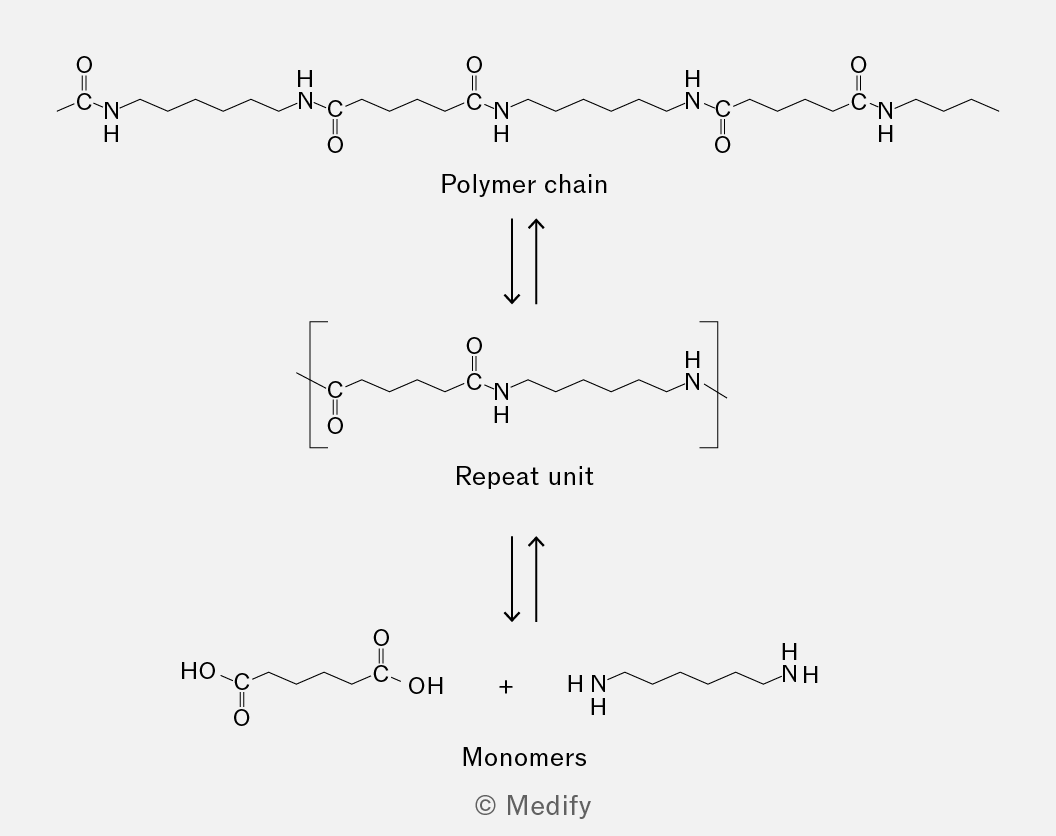
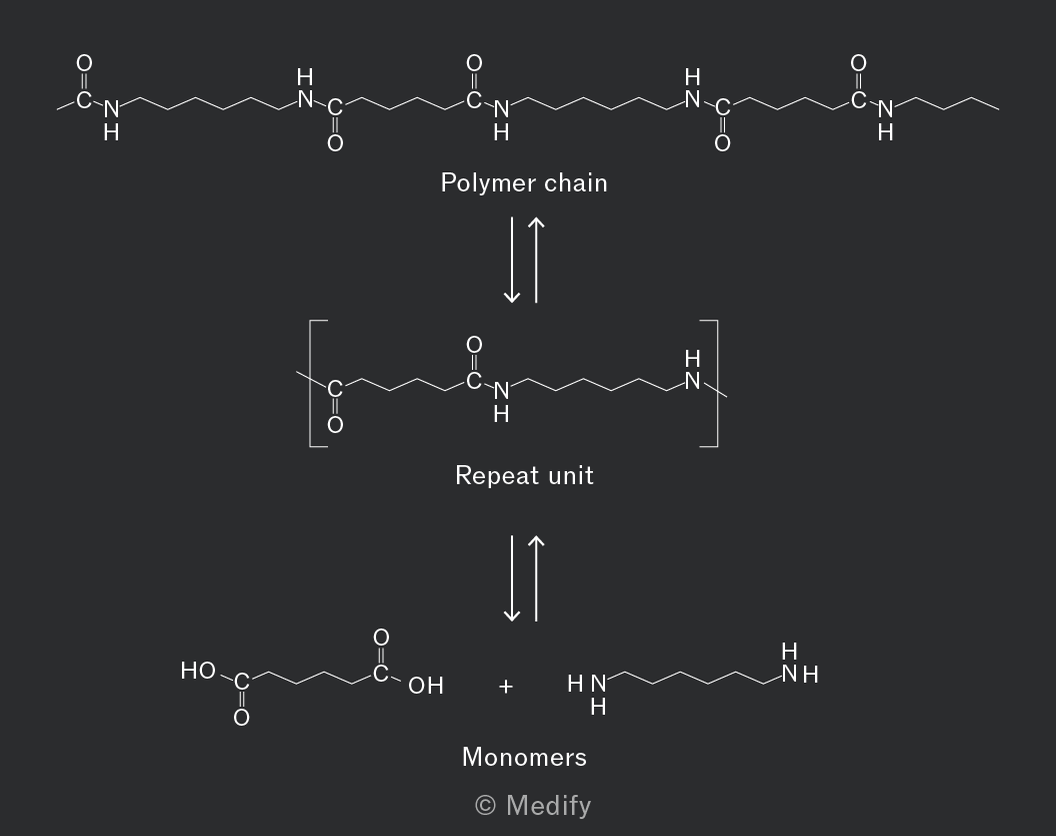
Repeat units can be deduced from the monomers used, or the polymer chain, in condensation polymerisation.
If a polyester is made from two different monomers, a dicarboxylic acid (or diacyl chloride) and a diol, the order of the ester connectivity will alternate across the polymer and both monomers must appear in the repeating unit.
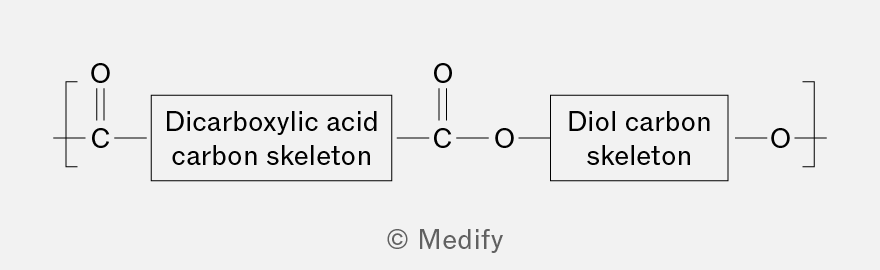
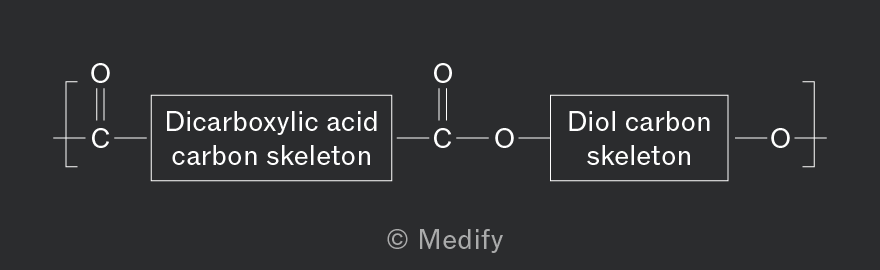
To draw the repeat unit:
- Draw the ester group in the middle of the structure.
- Add the dicarboxylic acid (or diacyl chloride) carbon skeleton to the left of the group, and terminate the left side with the last group, a trailing bond, and a repeat unit bracket.
- Draw the diol carbon skeleton on the right of the central from the ester and terminate on the right with the group, a trailing bond, and a repeat unit bracket.
If a polyamide is made from two different monomers, the order of the amide connectivity will alternate across the polymer and both monomers must appear in the repeating unit.
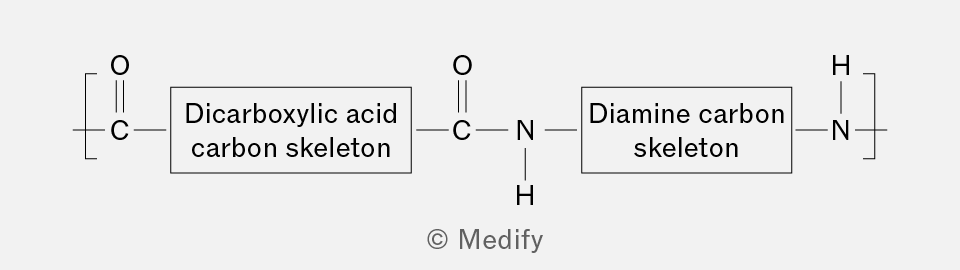
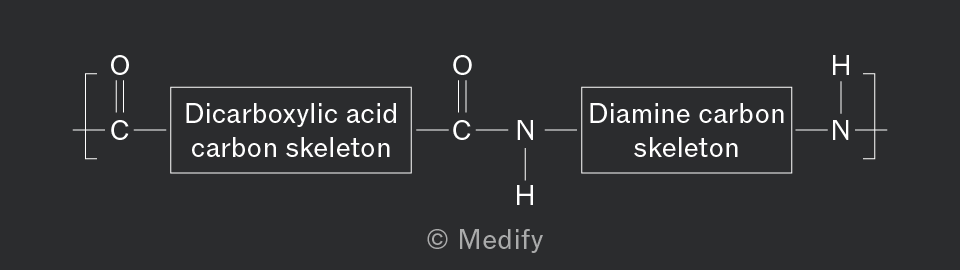
- Draw the secondary amide group in the middle of the structure.
- Add the dicarboxylic acid (or diacyl chloride) carbon skeleton to the left of the group, and terminate on the left with the group, a trailing bond, and a repeat unit bracket.
- Draw the diamine carbon skeleton to the right of the central from the amide group, and terminate on the right with the group, a trailing bond, and a repeat unit bracket.
If the polyester is made from a single monomer, the ester group will not be seen within the repeat unit and the order of connectivity of the ester group remains the same along the chain.
One side of the repeat unit ends with the carboxylic acid’s a trailing bond, and a repeat unit bracket, whilst the other ends with the alcohol’s a trailing bond, and a repeat unit bracket.
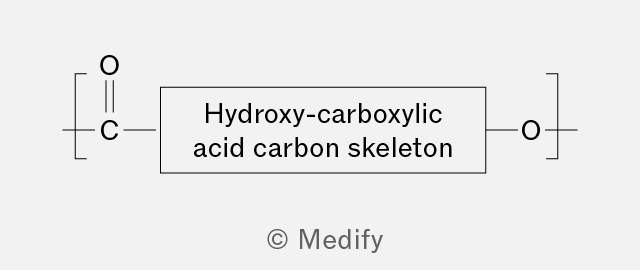
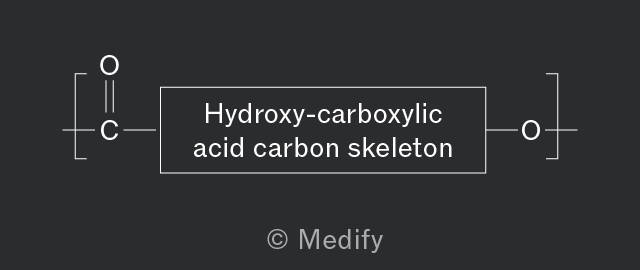
When amino acids join together they form polyamides. As there is a single monomer, the amide group will not be seen in the repeat unit and the order of connectivity of the amide group remains the same along the chain.
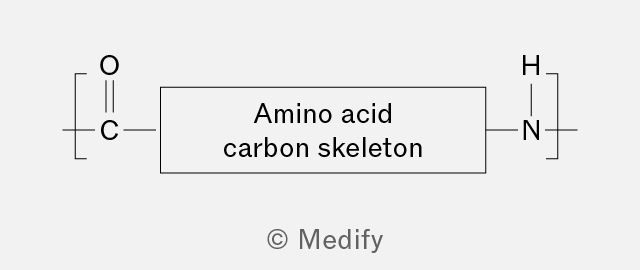
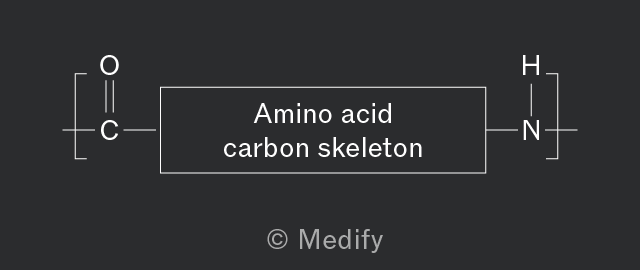
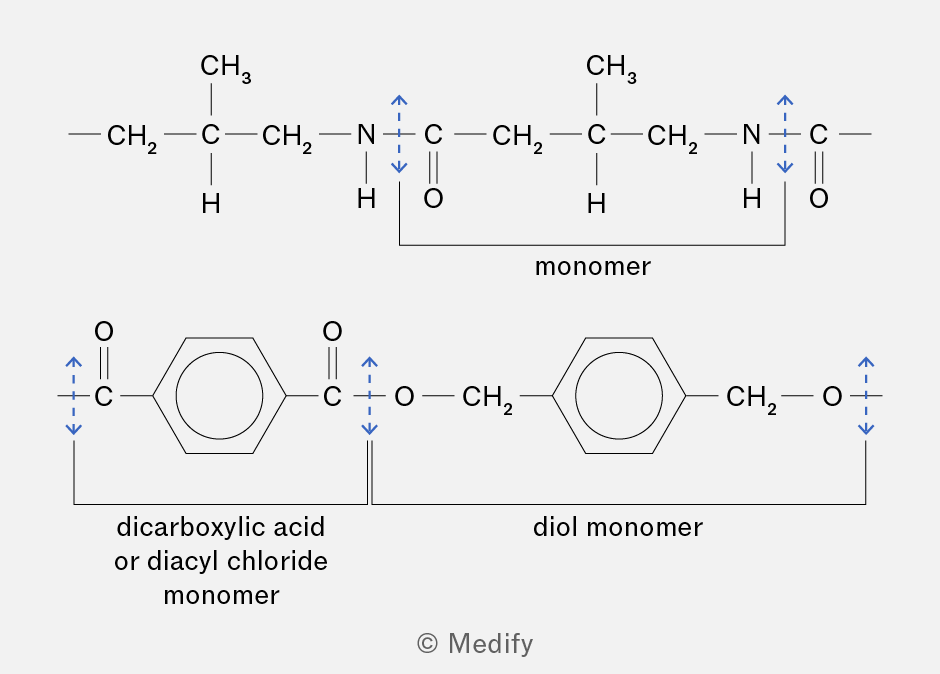
Repeat units can be used to identify monomers.
First, identify any ester or amide link within the repeat unit and break this bond at the hydrolysis site.
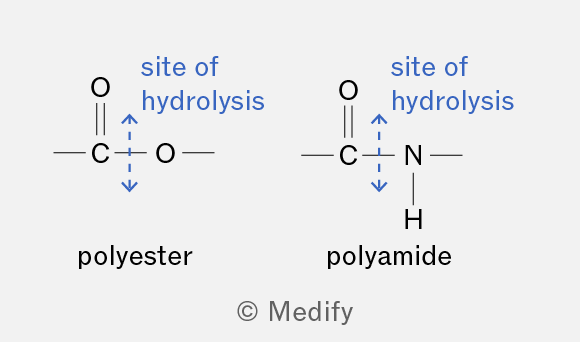
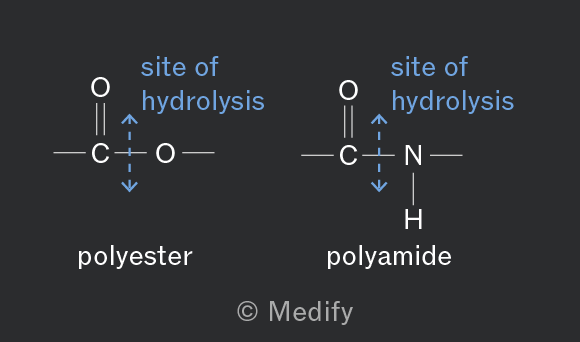
Next, complete the functional groups to obtain the structure of your monomer(s).
- becomes
- becomes
- becomes
Checking the order of the amide or ester connectivity will confirm if a polymer is formed from one or two monomers.
In these examples;
- The order of connectivity of the amide group in the polyamide remains the same, so a single monomer should be identified.
- In the polyester the order of connectivity in the ester group alternates, so two monomers must be identified.