
Organic synthesis across A level (6.2.5)
On this page
Distillation apparatus
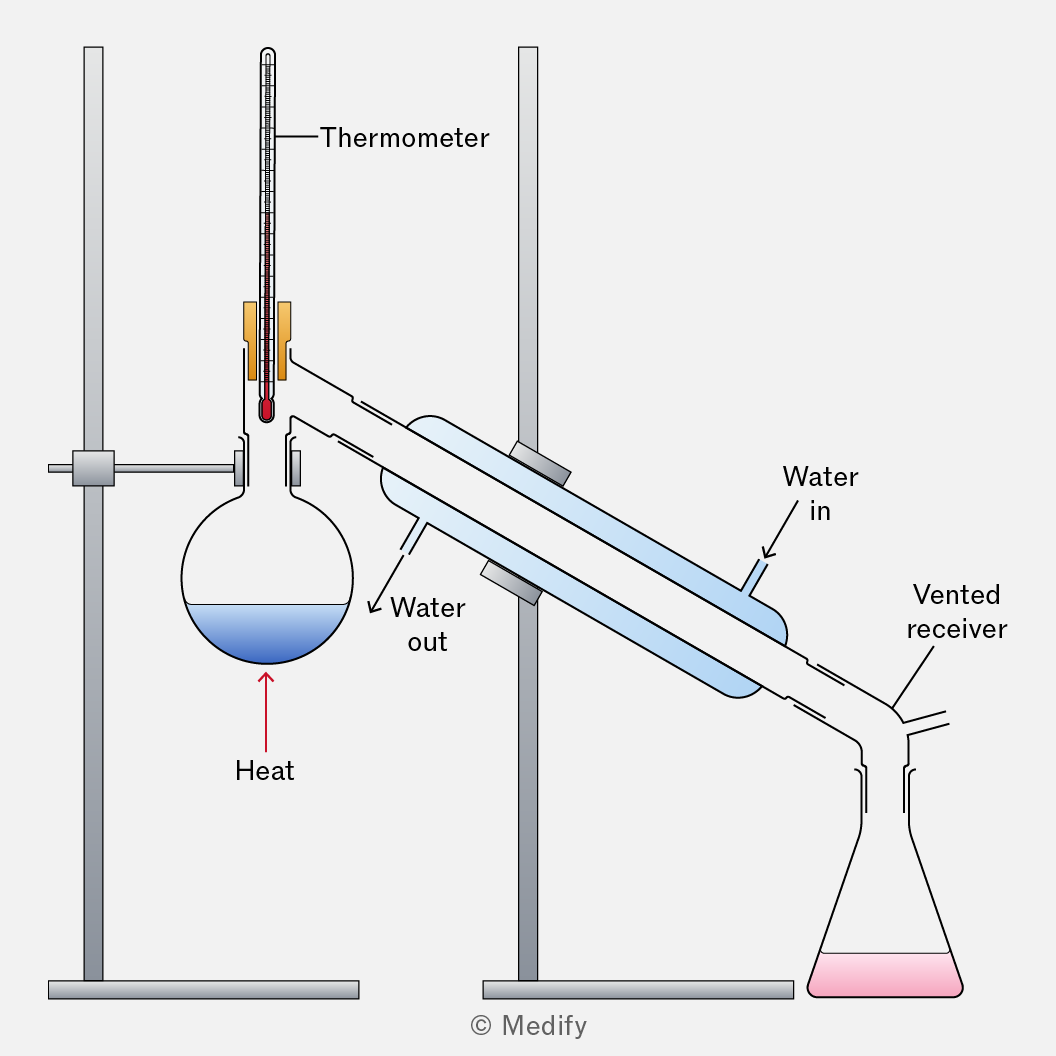
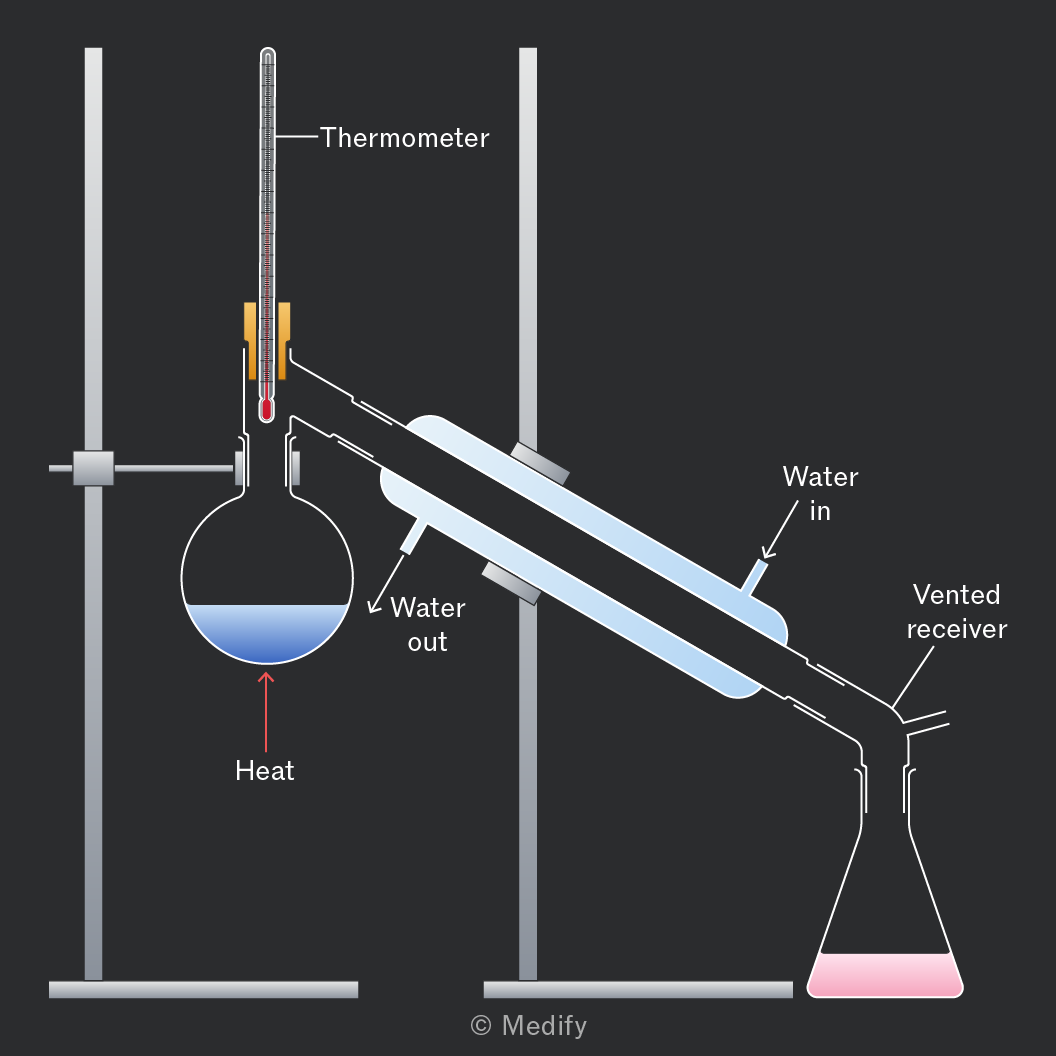
Distillation is used to separate liquids on the basis of a different boiling point.
In distillation a heated round-bottomed flask is fitted with a water-cooled condenser in a sloping position. A thermometer is attached in line with the mouth of the condenser to read off the vapour temperature. Water enters the condenser from the lower end.
Stands and clamps are used to support the glassware.
In ‘quick-fit’ apparatus, a vented receiving flask is used to collect the distillate. Alternatively, a conical flask can be placed below the mouth of the condenser.
SAFETY – The system cannot be fully sealed, or there can be a dangerous build-up of pressure. This is why the collection flask must either be vented or separated from the apparatus.
Reflux apparatus
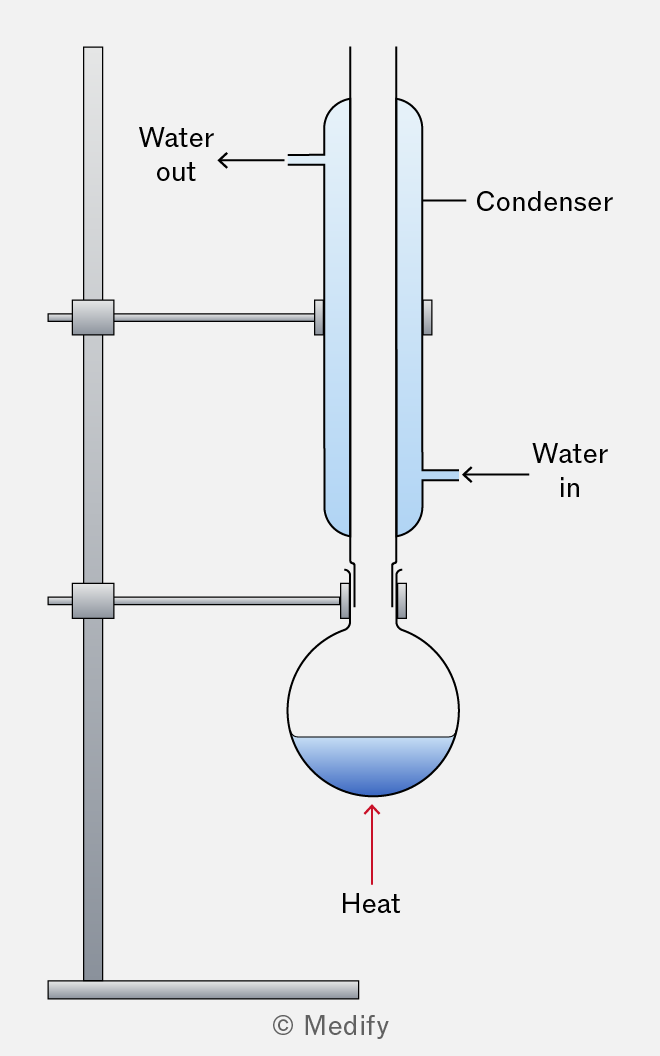
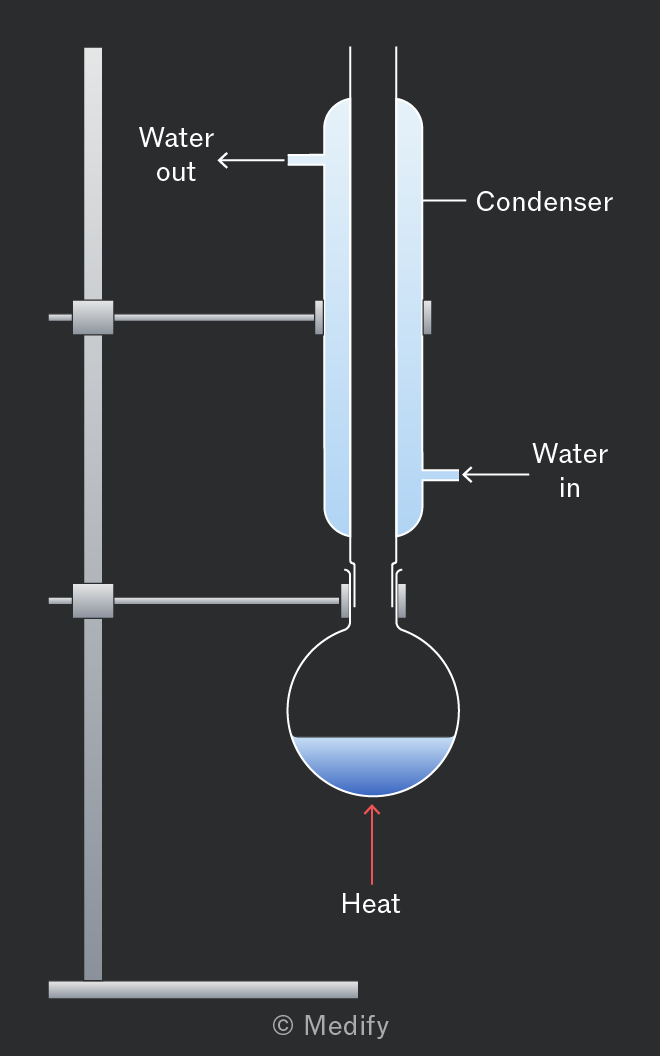
Refluxing is used to maintain liquids at their boiling temperature for periods of time without causing material loss.
In reflux, a heated round-bottomed flask is fitted with a water-cooled condenser in a vertical position. Water enters the condenser from the lower end.
SAFETY – The system cannot be fully sealed, or there can be a dangerous build-up of pressure. This is why the condenser does not have a stopper.
Vacuum Filtration
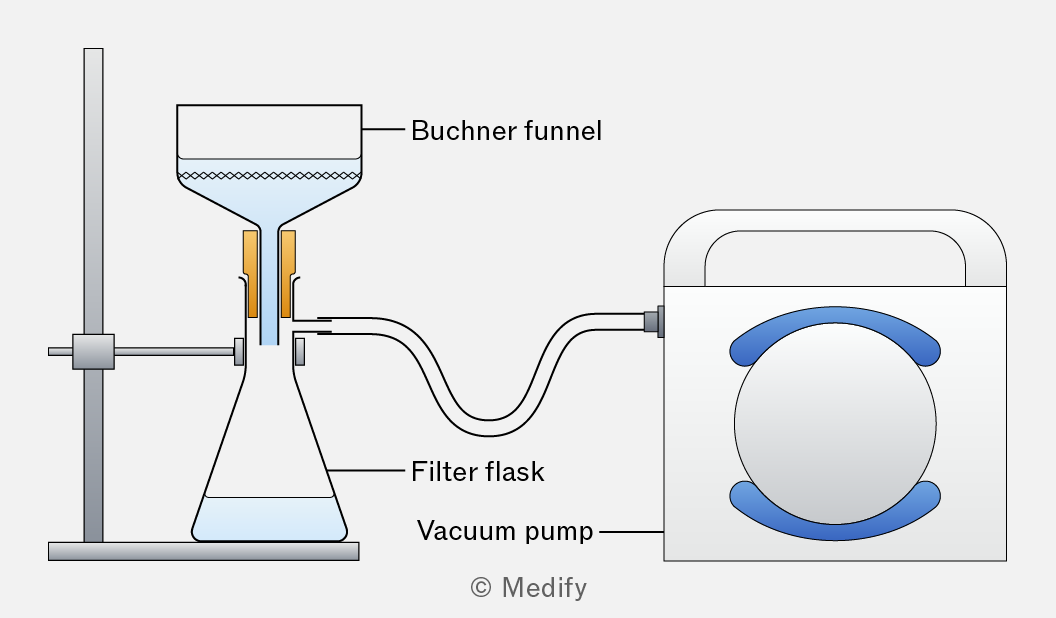
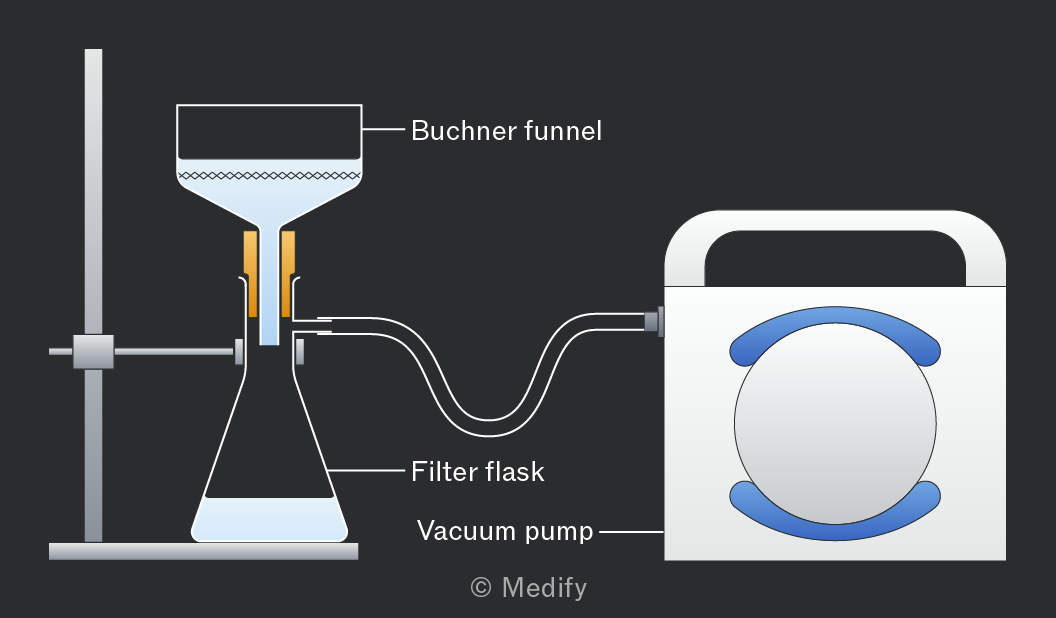
Vacuum filtration is filtration under pressure.
A porcelain Buchner funnel with a perforated plate is filled with a disk of filter paper. A vacuum is created in the filter flask using a pump. This causes a pressure difference to the external environment and the solution is pushed through the filter.
Filtration under pressure is an efficient, quick and simple way to filter large quantities of reaction mixture containing fine solid particles. It is used extensively in organic solid preparations.
SAFETY – do not allow the filter flask to fill up close to the air outlet, or liquid may be sucked into the pump.
Separating funnel
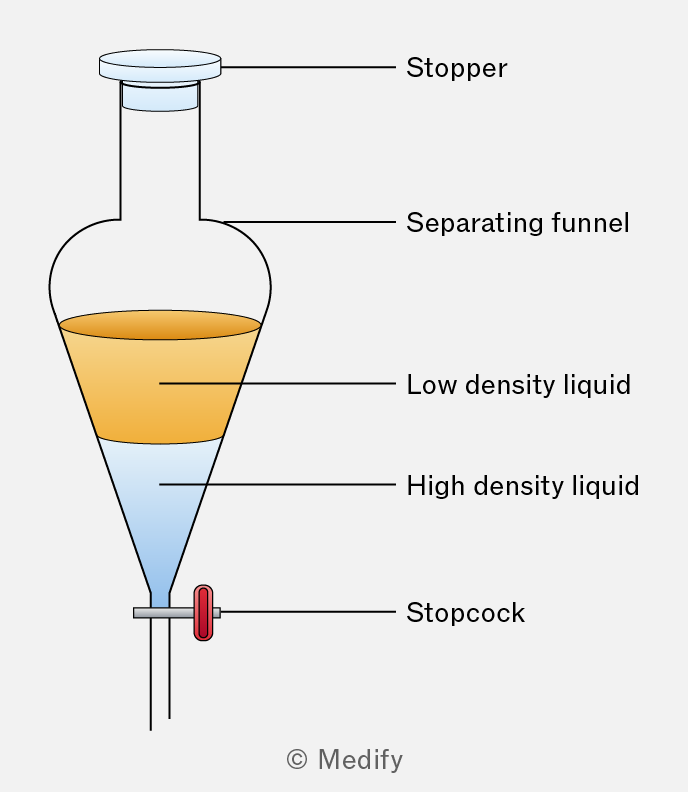
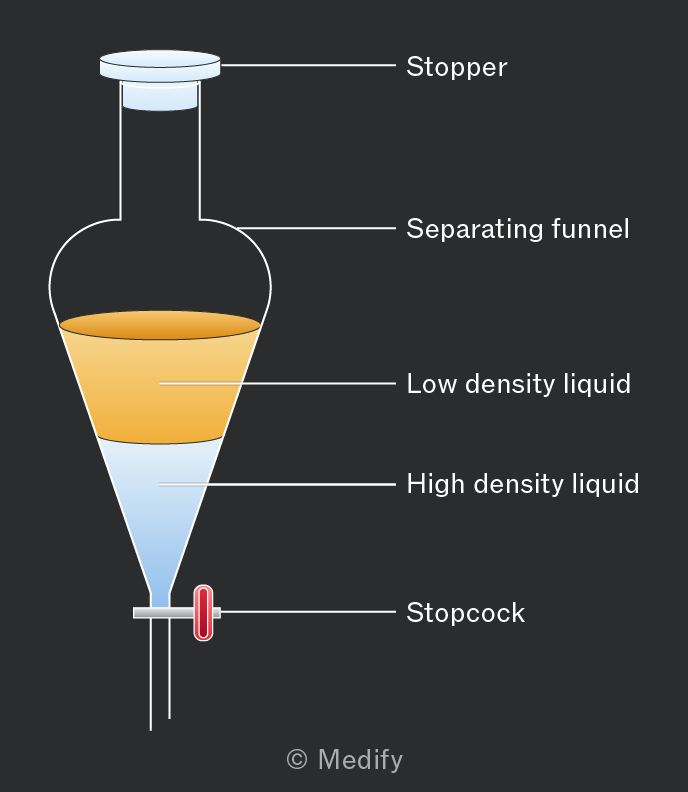
Separating funnels are stoppered funnels with taps, used for separating immiscible liquid mixtures.
When using a separating funnel the mixture is shaken and then allowed to settle. Care should be taken in identifying which layer contains the desired product.
SAFETY – the separating funnel is a sealed system; the tap must be opened intermittently to prevent the build-up of pressure.
Melting point apparatus
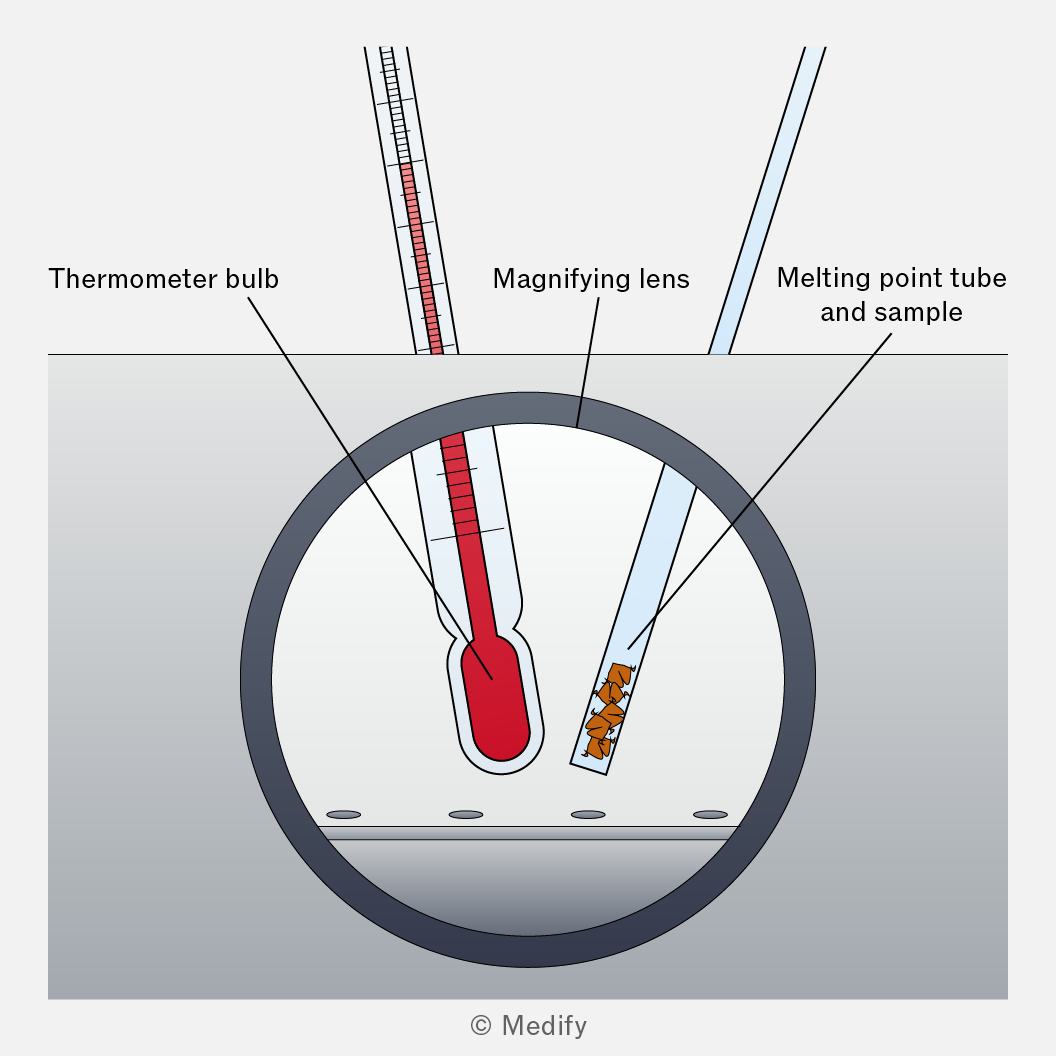
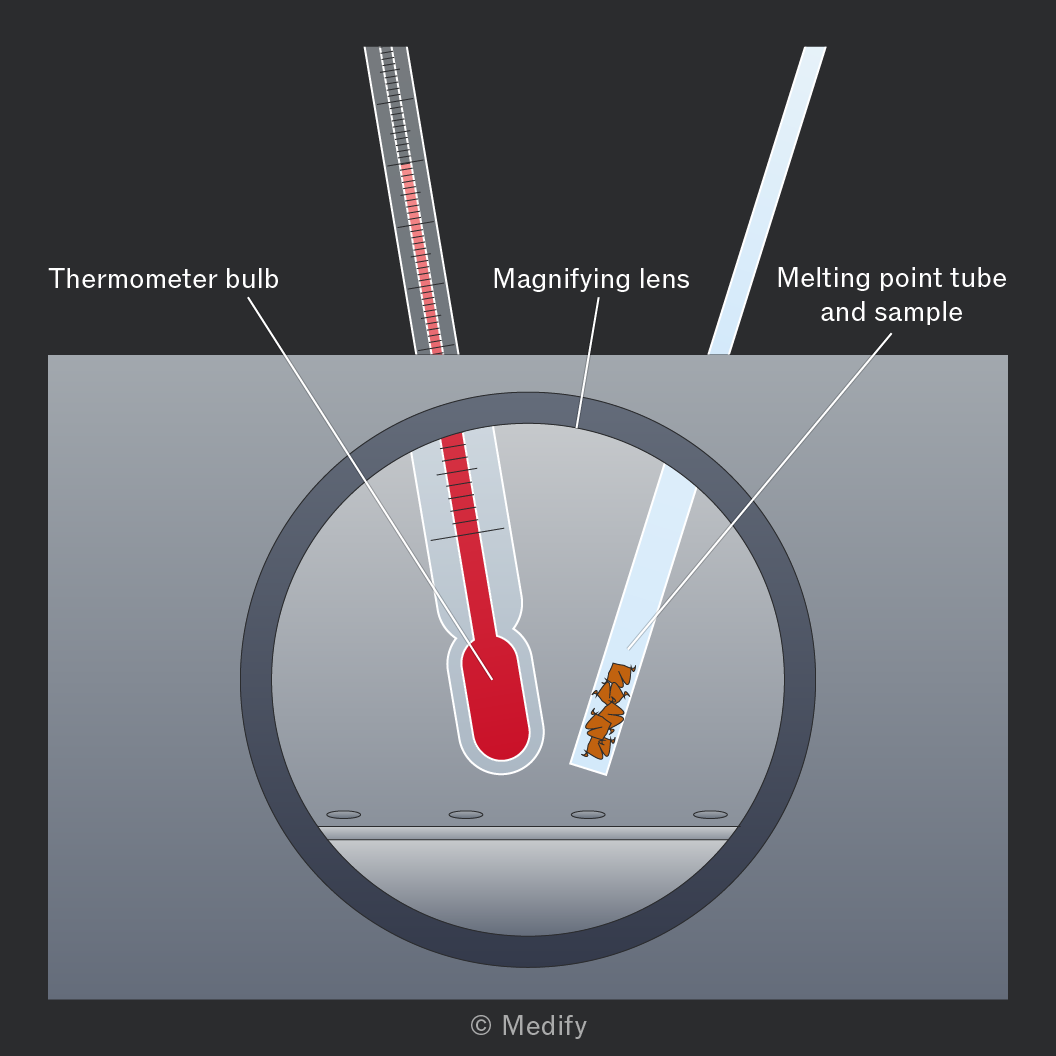
Melting point apparatus contains an electrically heated block of metal, in which the thermometer and sample tube are contained in close proximity.
There is a magnified observation lens, allowing the time at which melting starts, and is complete, to be noted and corresponding temperatures read off on the thermometer.
A pure substance will have a sharp melting point.
An impure substance will melt at a lower temperature and over a wider range of temperatures.
Thermostatic water bath
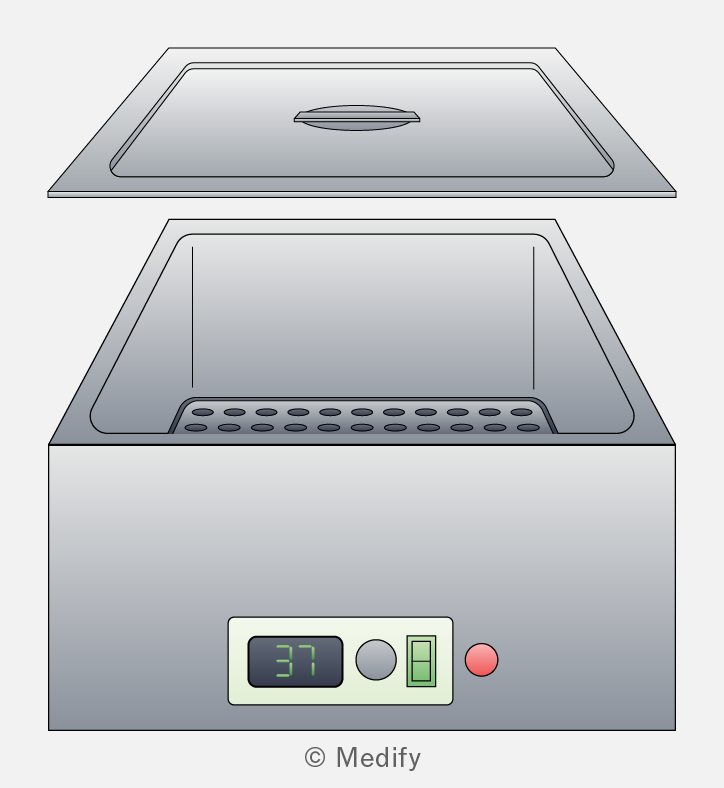
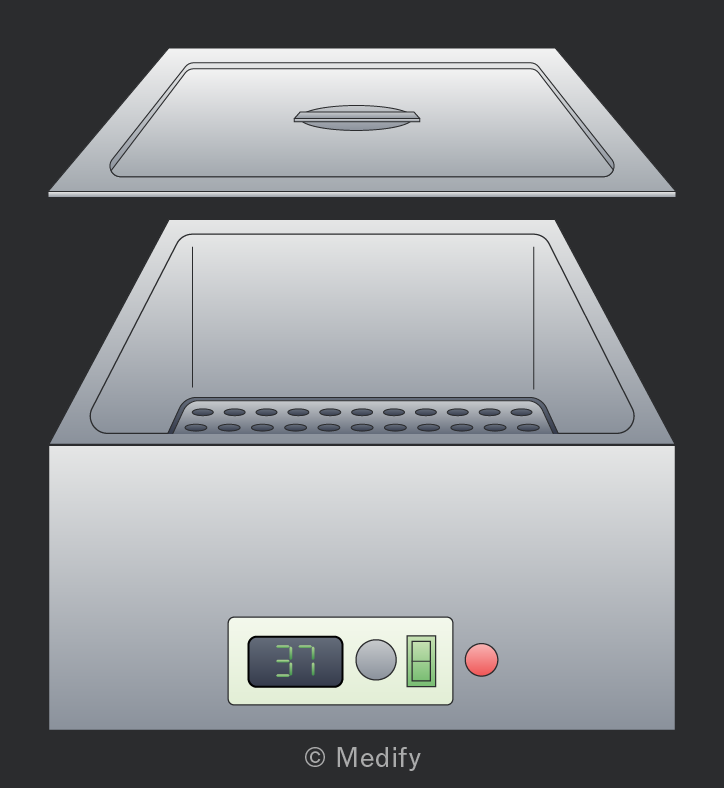
Water baths can be heated to a desired temperature and can be used for controlling reaction temperatures.
Electric heating mantle
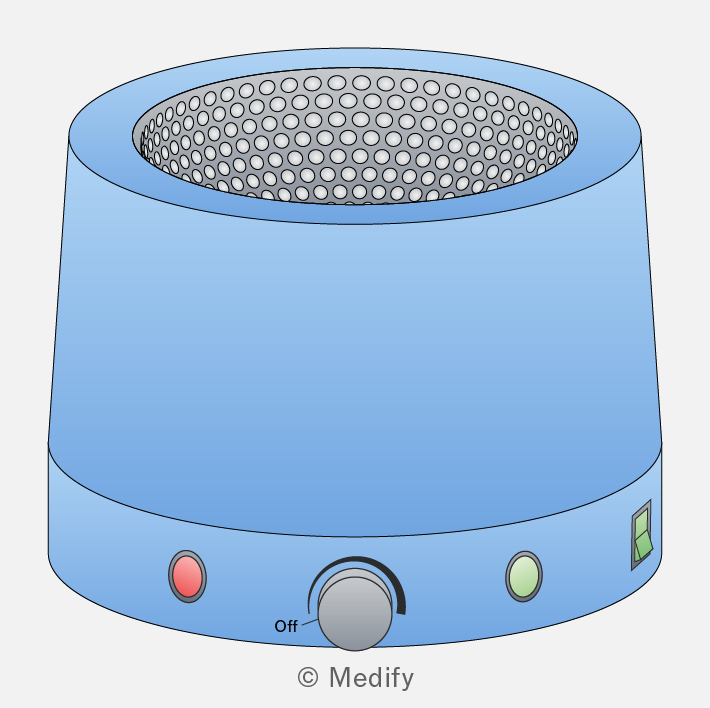

Electric heating mantles are thermostatically controlled and ideal for controlled heating of round-bottomed flasks for reflux or distillation.
Electric heaters are preferred over bunsen burners where flammable liquids are involved as there is no naked flame.
Hot plate


Hot plates are electrically heated plates ideal for warming several flat-bottomed containers at once. They are commonly used for heating solutions prior to recrystallisation.
Functional groups react in the same way whether they are the only group present in a small carbon skeleton, or in combination with other functional groups in a larger molecule.
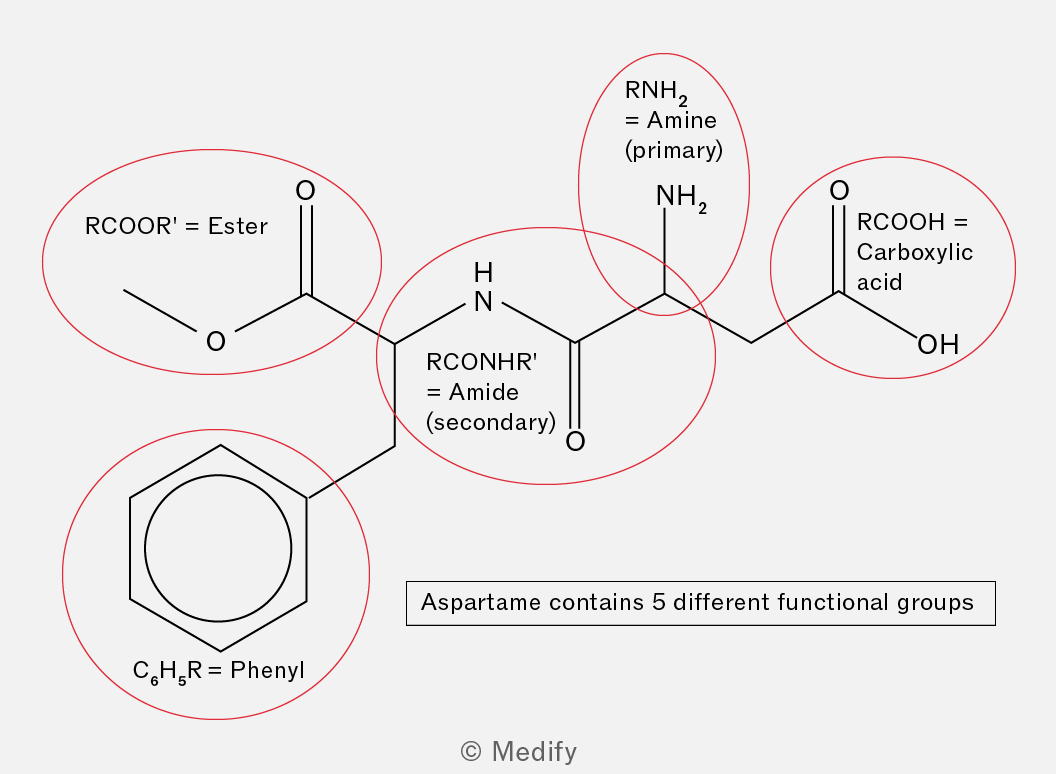
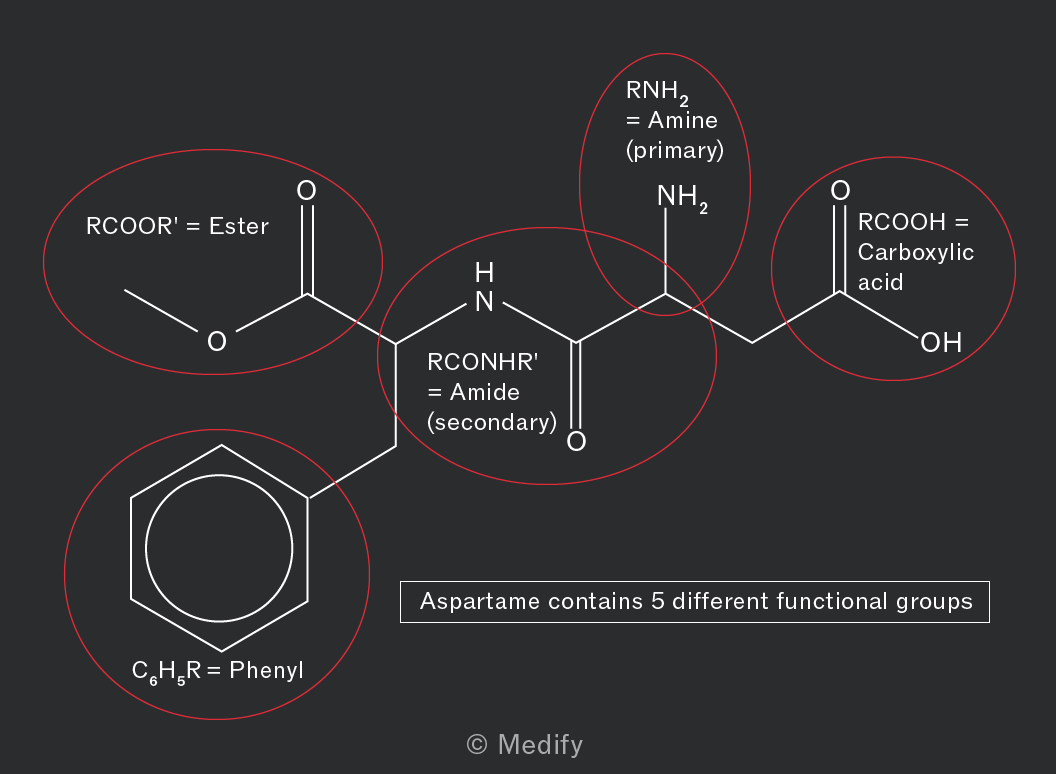
Questions frequently expect learners to recognise functional groups present in complex molecular structures.
Aldehydes and ketones can be easily confused when assigning functional groups.
In an aldehyde, the group carbon atom is always at the end of the chain.
In a ketone, the group carbon atom in a ketone is never at the end of the chain.
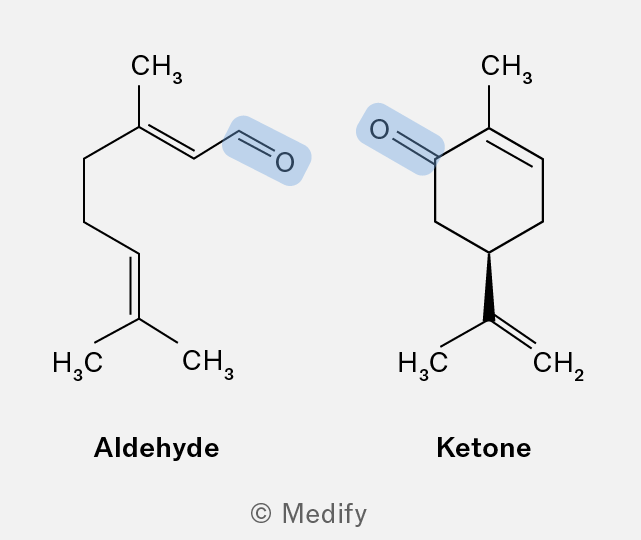
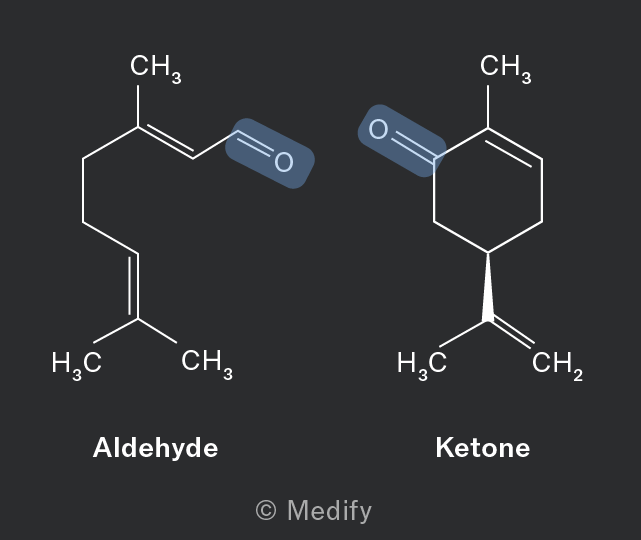
The ketone group is recognised by having carbon atoms bonded on either side of the carbonyl carbon, whereas the aldehyde carbonyl is bound to a hydrogen.
The ketone group can not be further oxidised, whereas the aldehyde group can.
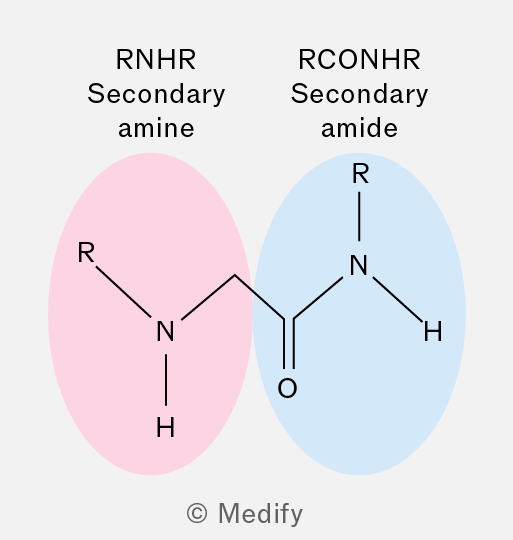
Secondary amines and amides are easily confused.
In a secondary amine, two alkyl carbon R groups are bonded to the with a single remaining hydrogen. The lone pair in an amine is basic.
In a secondary amide, a carbonyl group will always bond directly to the nitrogen atom. The amide group is susceptible to hydrolysis, and the nitrogen’s lone pair is not basic.
Question walkthrough
Identifying functional groups
Finding discrete functional groups in complex organic molecules
In organic synthesis, each step is regarded as a single reaction, with its own reactant, reagents, conditions, and product.
Generally, fewer steps give a more efficient process and a better yield as there are fewer transfers required.
The most environmentally friendly synthesis feasible within time, cost, and safety constraints, should be identified for use in the industry.
Catalysts are a good way of reducing energy, increasing reaction rate, and improving product specificity.
Higher percentage yield and percentage atom economy of each reaction step are key considerations in industrial synthesis. Where a co-product is formed, finding a use for it can make a process more viable.
Heat energy from exothermic reactions can be used to generate steam, which can then be used to heat other parts of the synthesis process.
To successfully develop reaction schemes, or to identify missing details in given reaction schemes, it is useful to commit the reactions covered across the specification to memory.
Fast recall here will save valuable time in the exam.
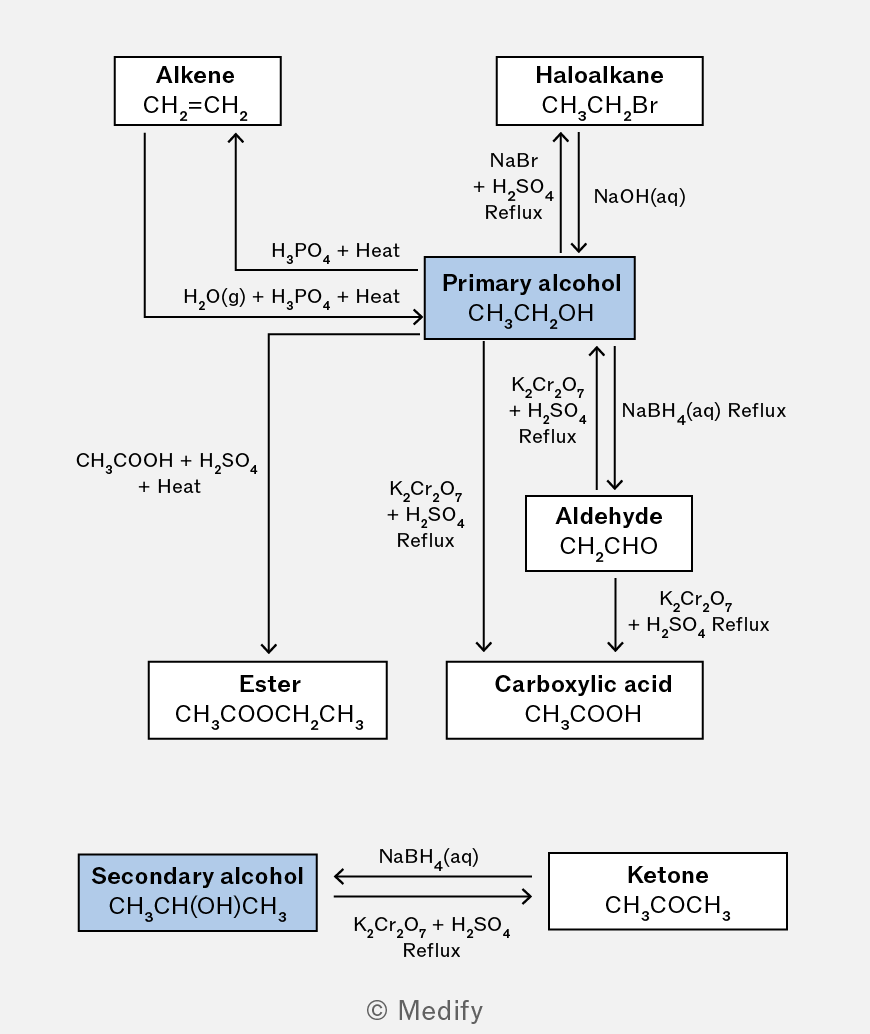
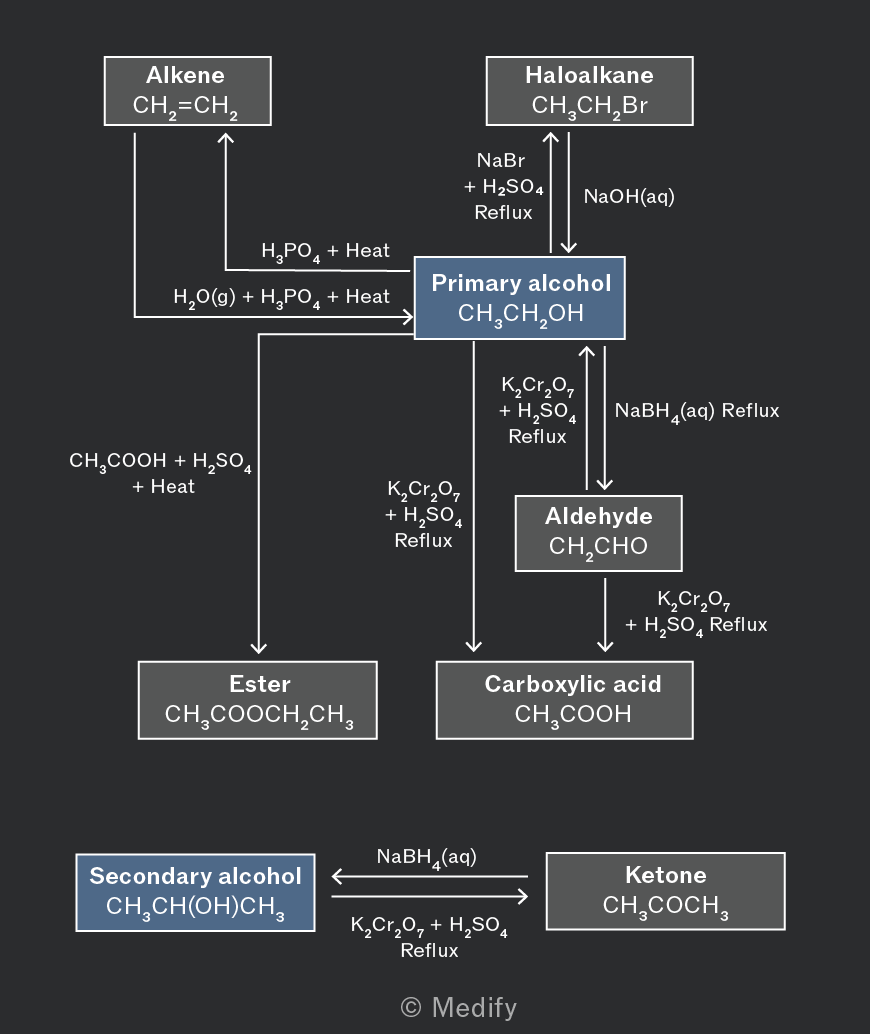
The scheme below highlights the reactions involving alcohols featured in OCR A-level chemistry.
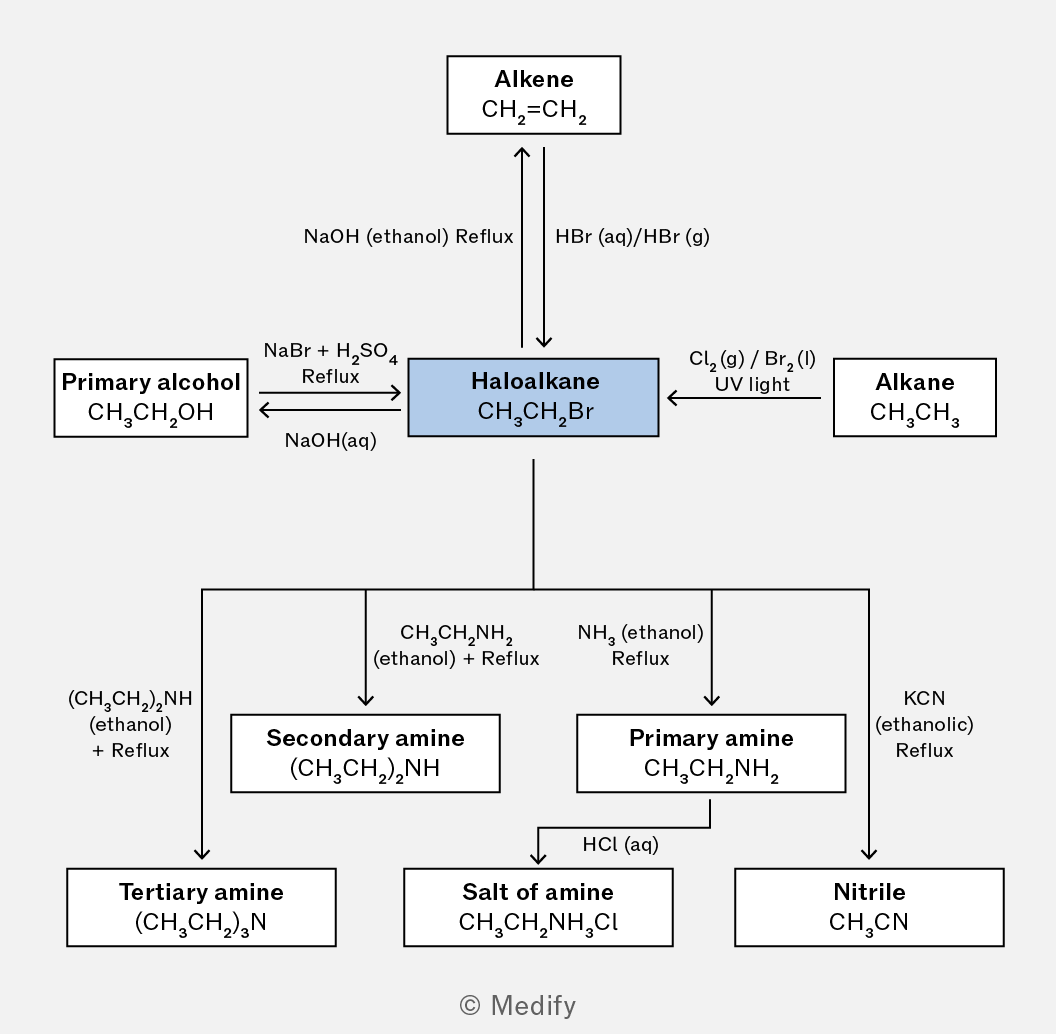
The scheme below highlights the reactions involving haloalkanes featured in OCR A-level chemistry.
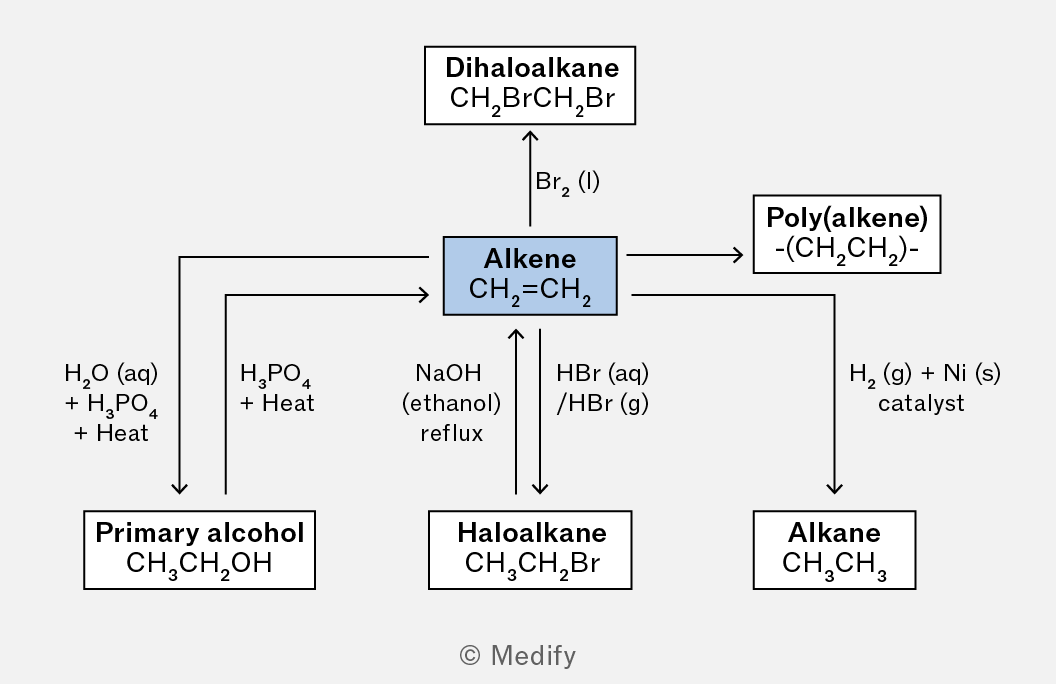
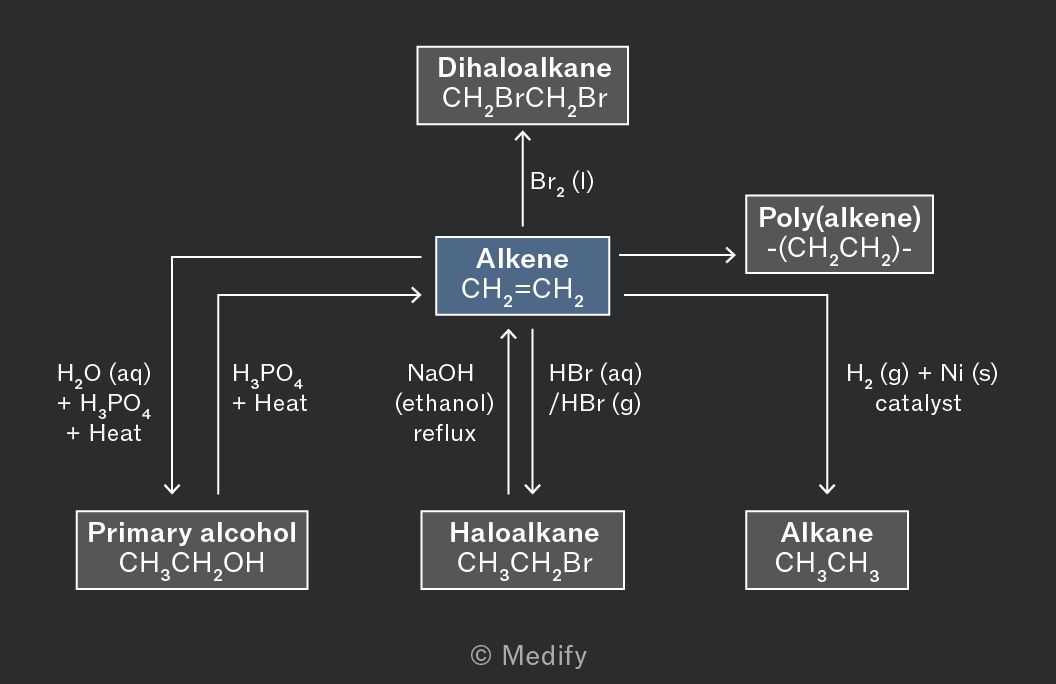
The scheme below highlights the reactions involving alkenes featured in OCR A-level chemistry.
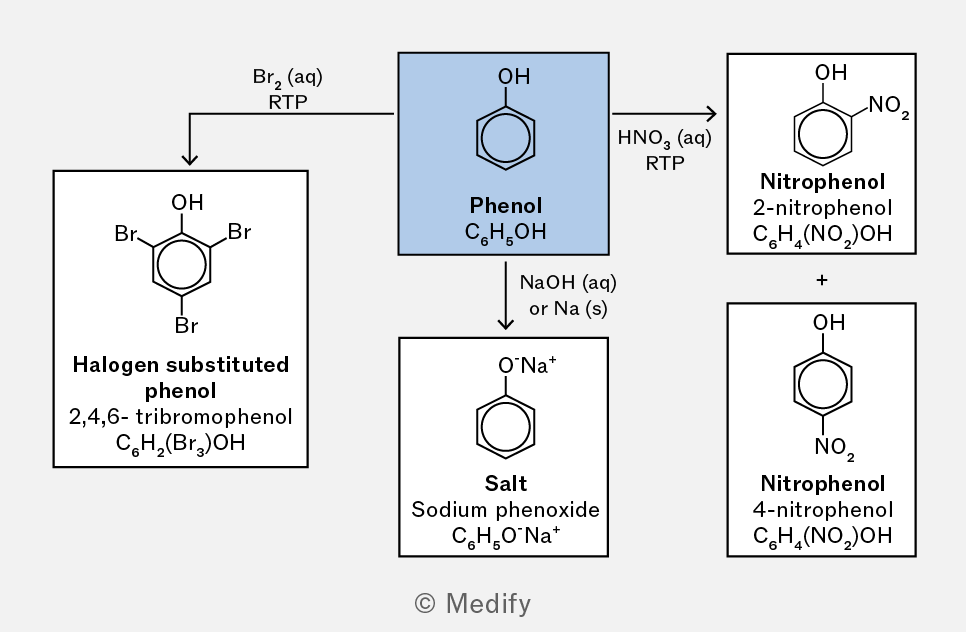
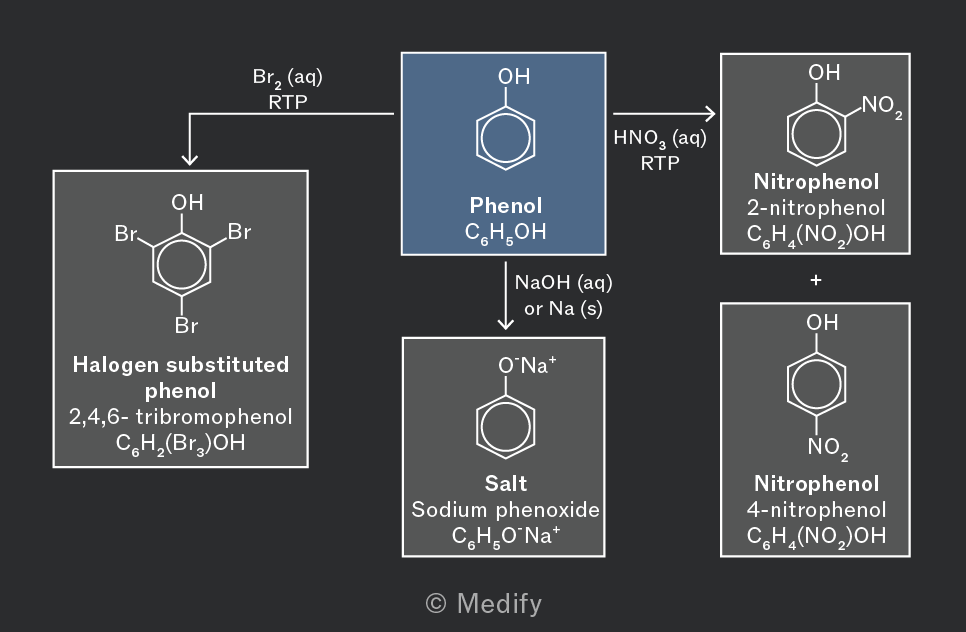
The scheme below highlights the reactions of phenol featured in OCR A-level chemistry.
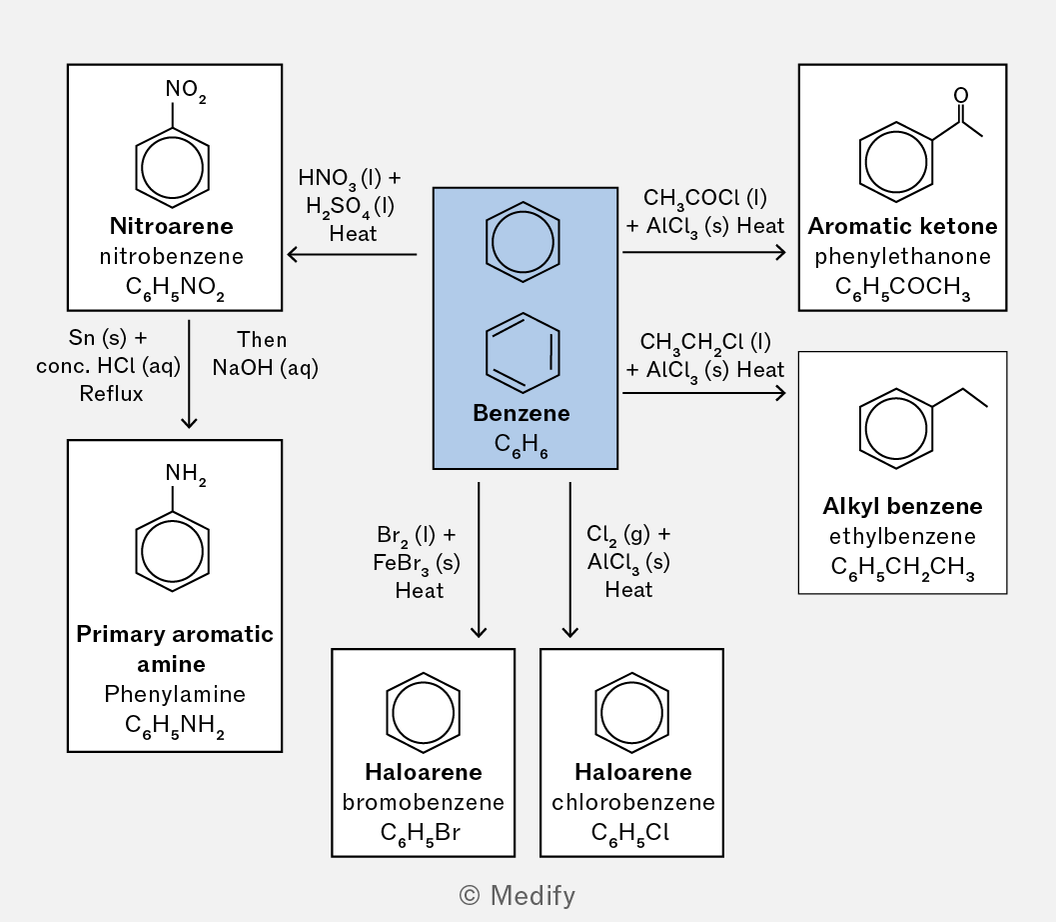
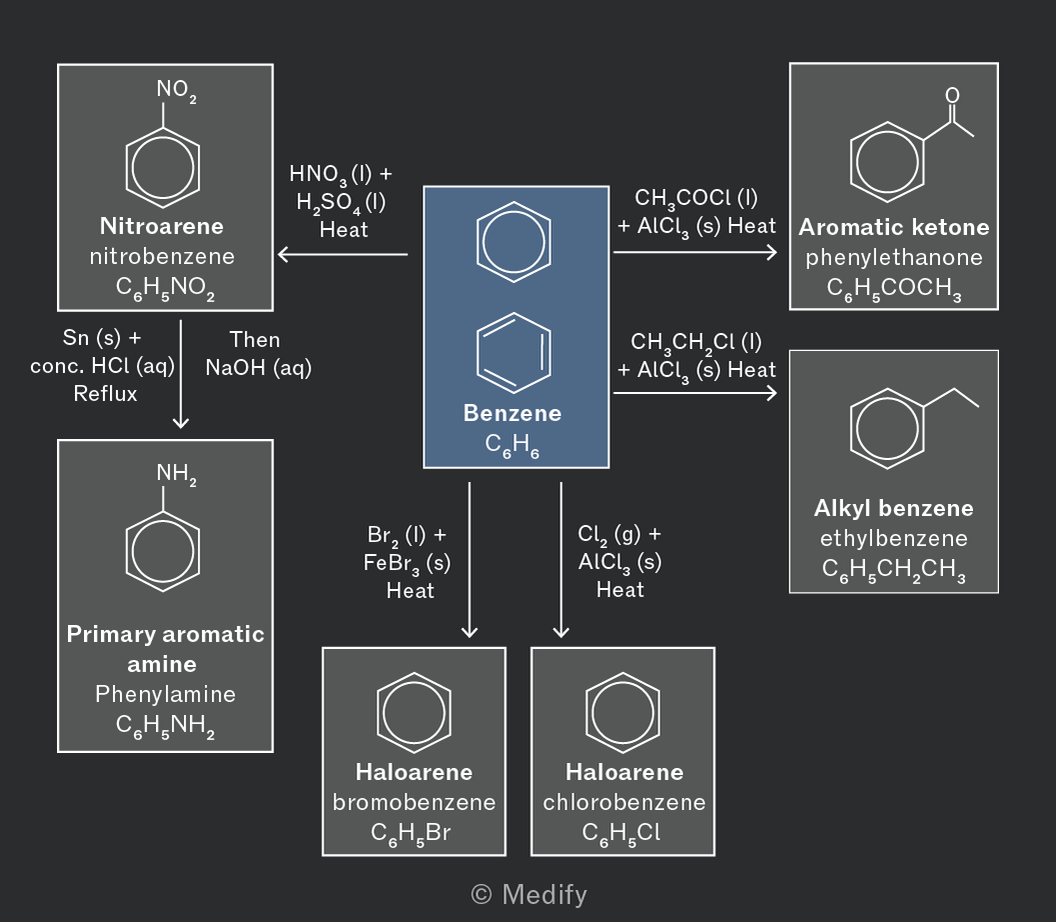
The scheme below highlights the reactions involving benzene featured in OCR A-level chemistry.
Question walkthrough
Identifying reagents and conditions
Looking at the functional group conversion in aliphatic molecules in order to identify the reagents and conditions required
Question walkthrough
Identifying reagents and conditions
Looking at the functional group conversion in aromatic molecules in order to identify the reagents and conditions required
Question walkthrough
Identifying missing information in a reaction scheme
Using knowledge of aliphatic reactions to complete a reaction scheme
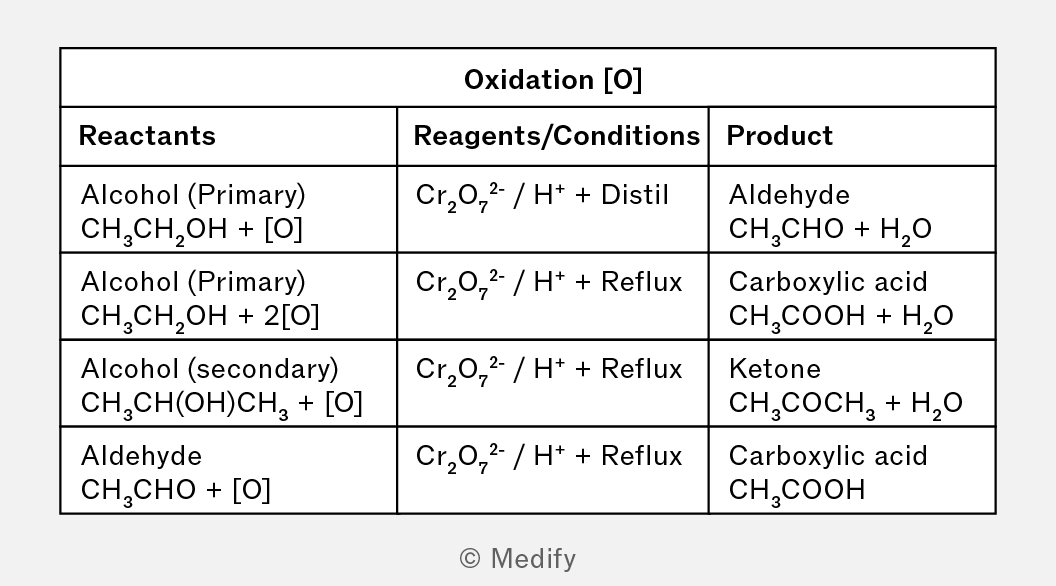
Acidified potassium dichromate VI is a commonly used oxidising agent.
It may be shown as
or
Evidence for oxidation is the reduction of the orange dichromate VI ion to the green ion.
Sodium borohydride solution, , and acidified tin, , are both used as reducing agents.
![A table titled 'Reduction [O]' displaying chemical reactions. The first column lists reactants: Aldehyde (CH3CHO + 2 [H]), Ketone (CH3COCH3 + 2 [H]), and Aromatic nitro (C6H5NO2 + 6 [H]). The second column outlines reagents and conditions: NaBH4 (aq) + Reflux for both Aldehyde and Ketone, and Sn / Conc HCl + Reflux for Aromatic nitro. The third column shows the products: Alcohol (1°) (CH3CH2OH), Alcohol (2°) (2CH3COOH), and Aromatic primary amine (C6H5NH2 + 2H2O).](https://d3nzlfkeryzt6j.cloudfront.net/62wyqdaq3agvqk5uh3ltjavzsixj)
![A table titled 'Reduction [O]' displaying chemical reactions. The first column lists reactants: Aldehyde (CH3CHO + 2 [H]), Ketone (CH3COCH3 + 2 [H]), and Aromatic nitro (C6H5NO2 + 6 [H]). The second column outlines reagents and conditions: NaBH4 (aq) + Reflux for both Aldehyde and Ketone, and Sn / Conc HCl + Reflux for Aromatic nitro. The third column shows the products: Alcohol (1°) (CH3CH2OH), Alcohol (2°) (2CH3COOH), and Aromatic primary amine (C6H5NH2 + 2H2O).](https://d3nzlfkeryzt6j.cloudfront.net/r0zj8dk740faaf5w914vvq2iev5r)
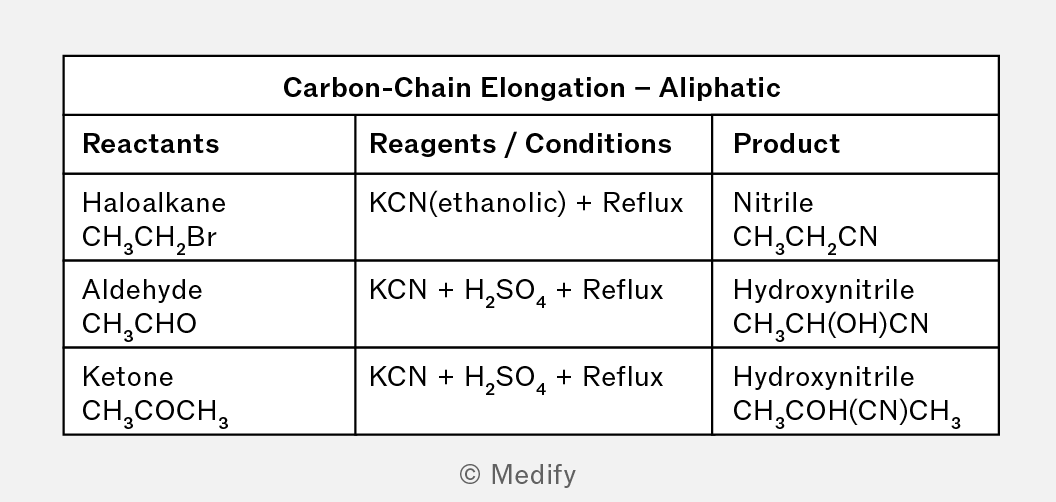
Reactions with are associated with creating new carbon-carbon bonds.
- Haloalkanes react with in a nucleophilic substitution reaction. The ion nucleophile is from an ethanolic solution of .
- Carbonyls (aldehydes and ketones) react with the nucleophile, in a nucleophilic addition reaction. The ions are made by the reaction of with a dilute acid, to avoid using the highly toxic .
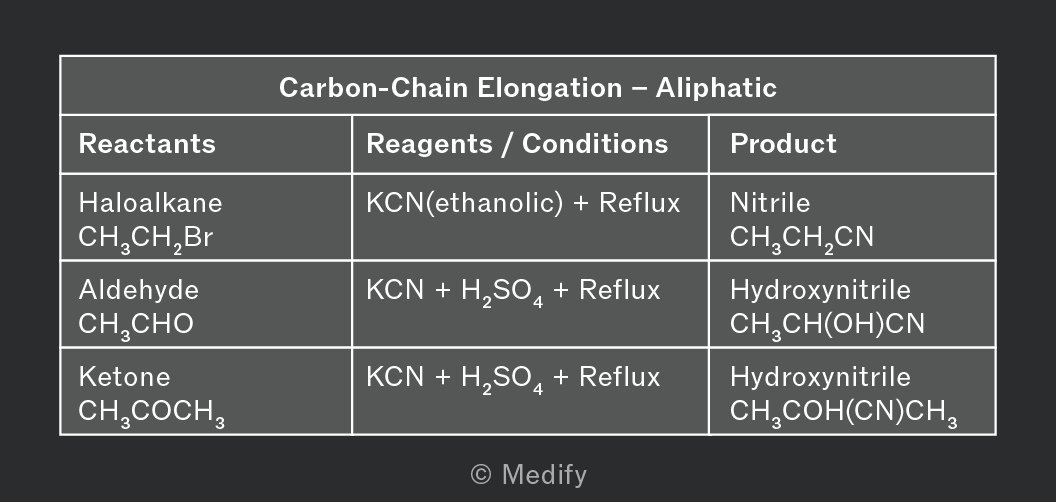
Friedel–Crafts reactions are used to create carbon-carbon bonds in aromatic compounds.
They are identifiable by the use of a Lewis acid catalyst, commonly , anhydrous aluminium chloride.
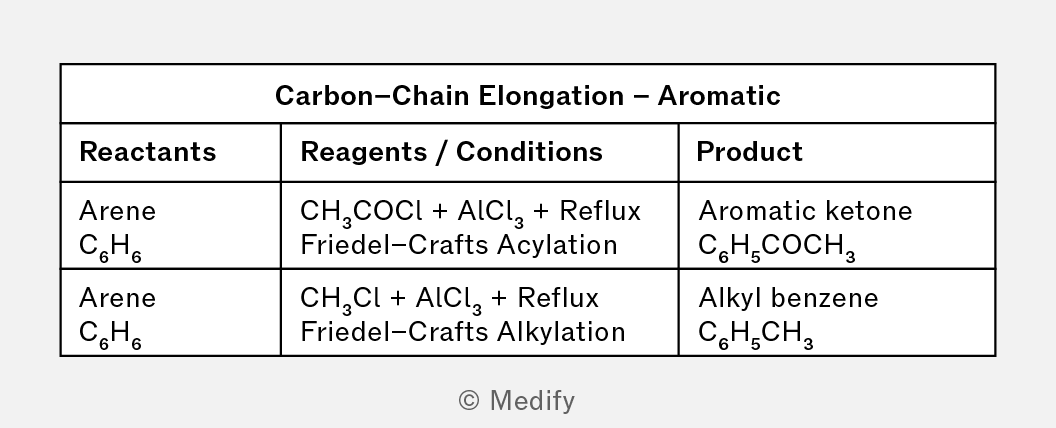
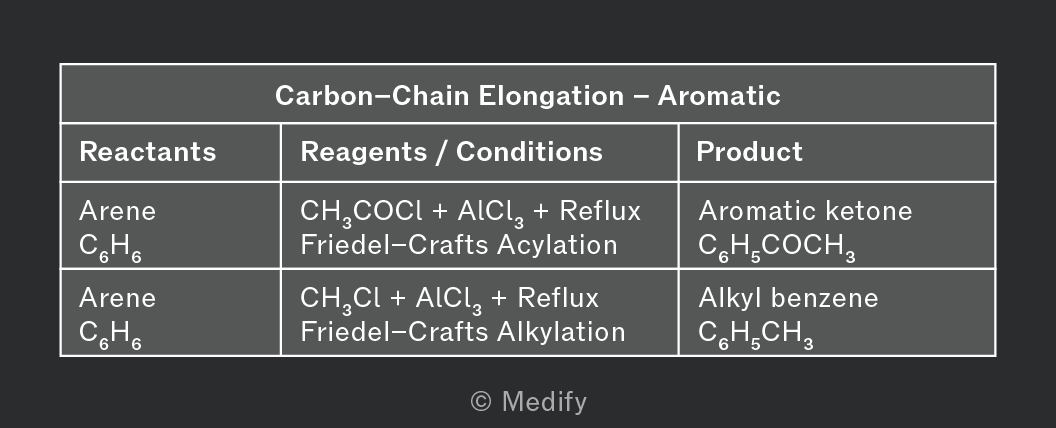
The catalyst generates the electrophiles necessary to attack, and substitute a carbon skeleton onto, the arene ring.
Hydrogen gas and a nickel catalyst, , are used for reduction of unsaturated compounds.
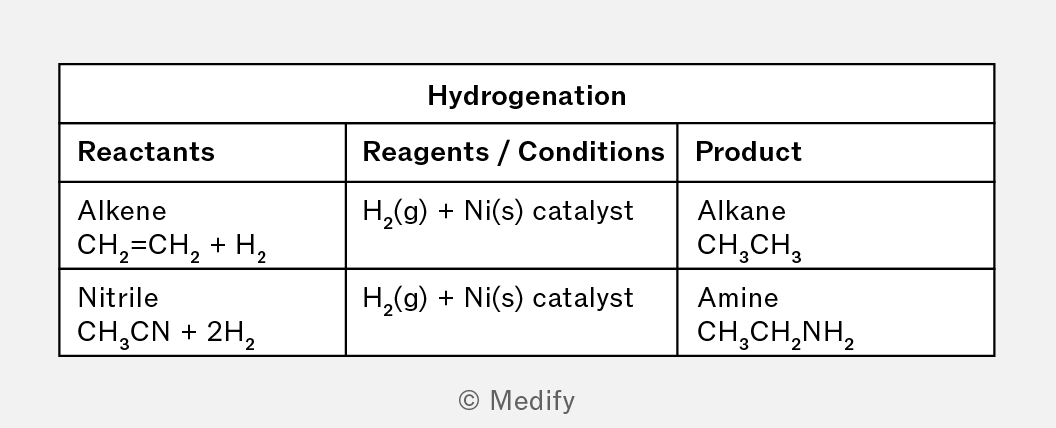
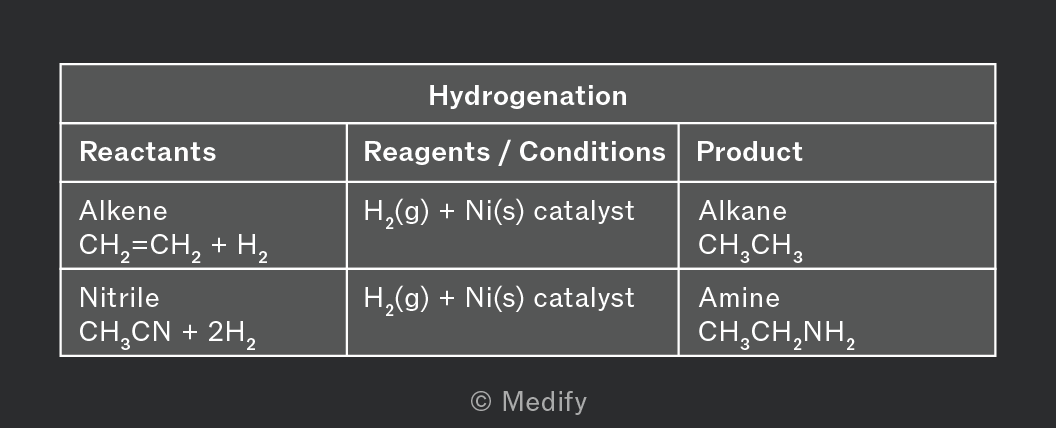
The use of an acid or base in aqueous solution can either indicate a neutralisation reaction, an electrophilic substitution (base only) or a hydrolysis reaction.
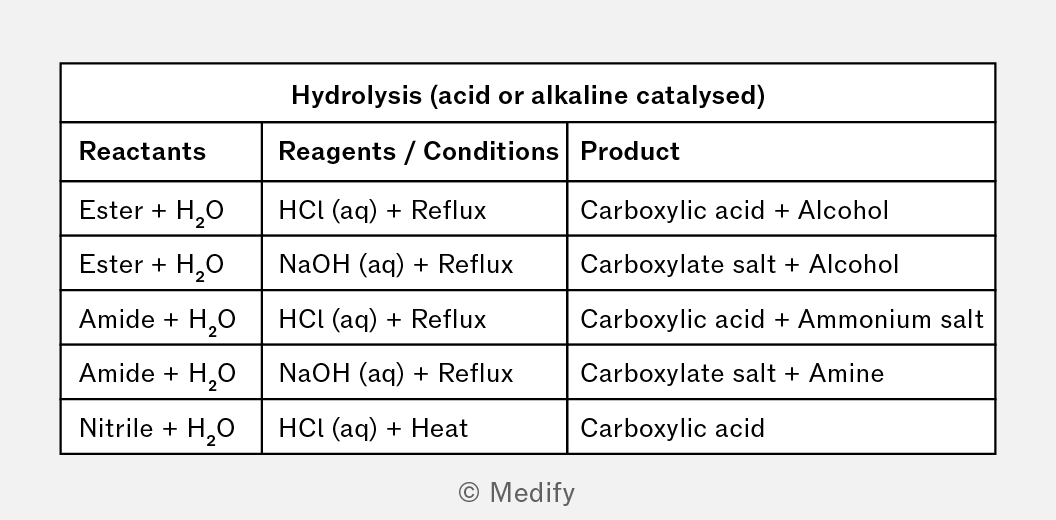
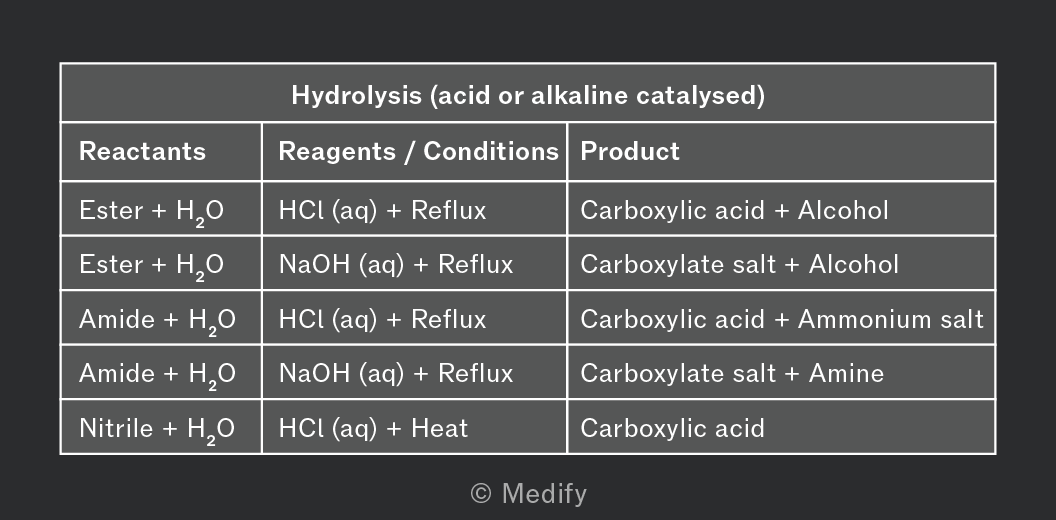
The nature of hydrolysis products is related to the reaction conditions;
- in acidic conditions basic products will be in their protonated form – amines become ammonium salts.
- in basic conditions acidic products will be in their deprotonated form – carboxylic acids become carboxylate salts.
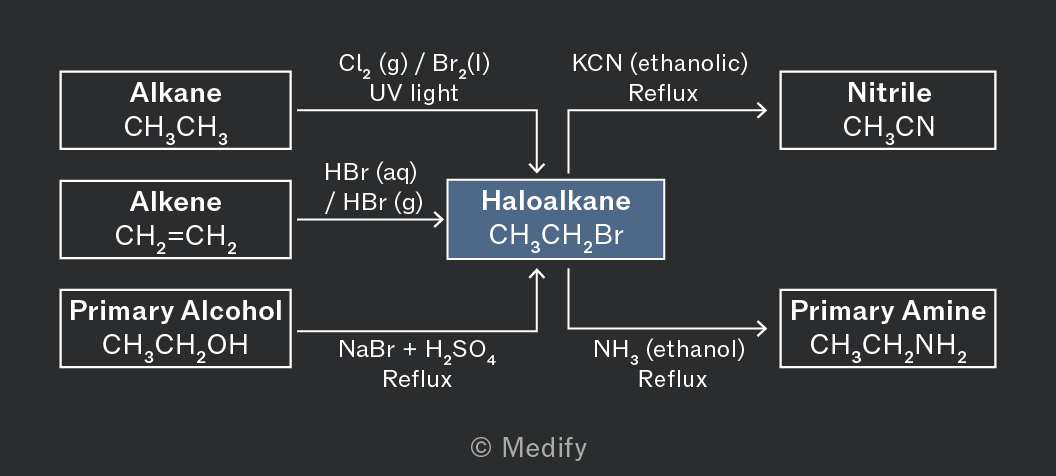
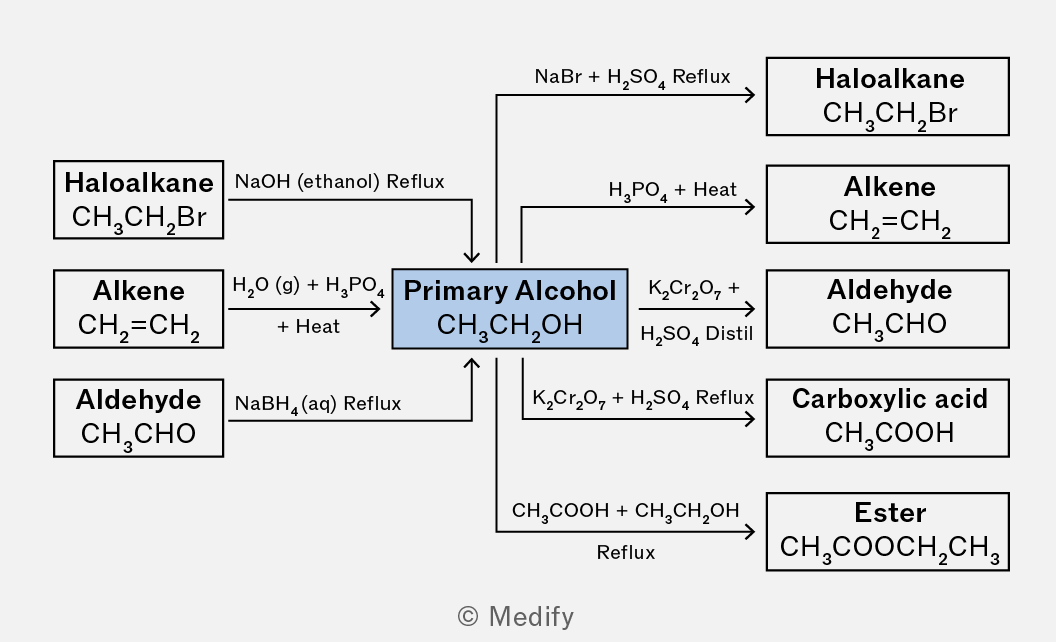
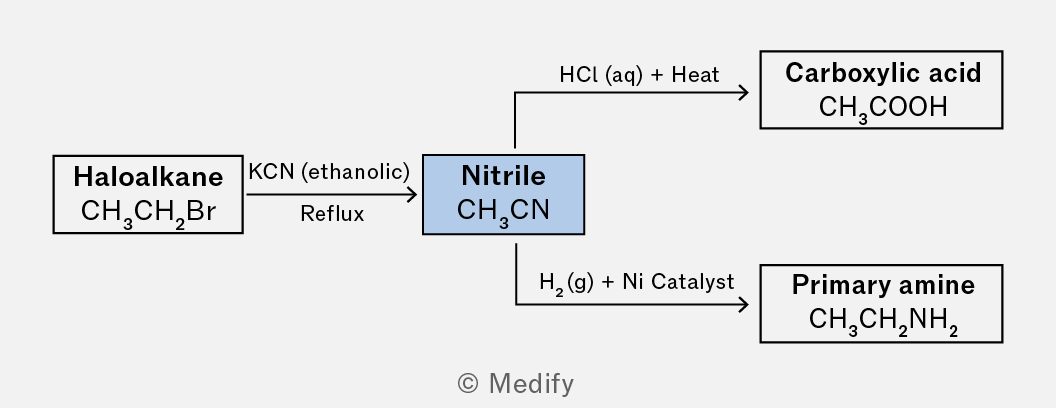
Many synthetic reaction sequences consisting of three or four-step conversions, pass through the same highly versatile functional groups.
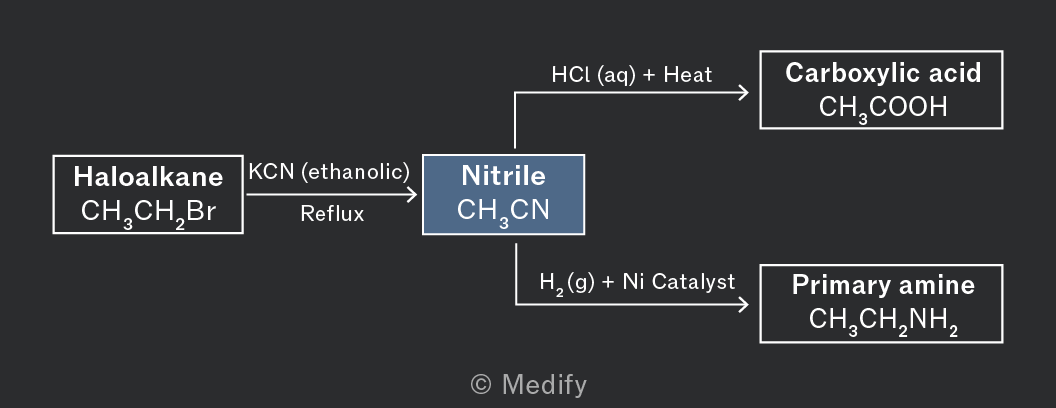
Haloalkanes, alcohols, and nitriles are commonly found in the middle of aliphatic reaction pathways.
Reaction schemes with a haloalkane intermediate.
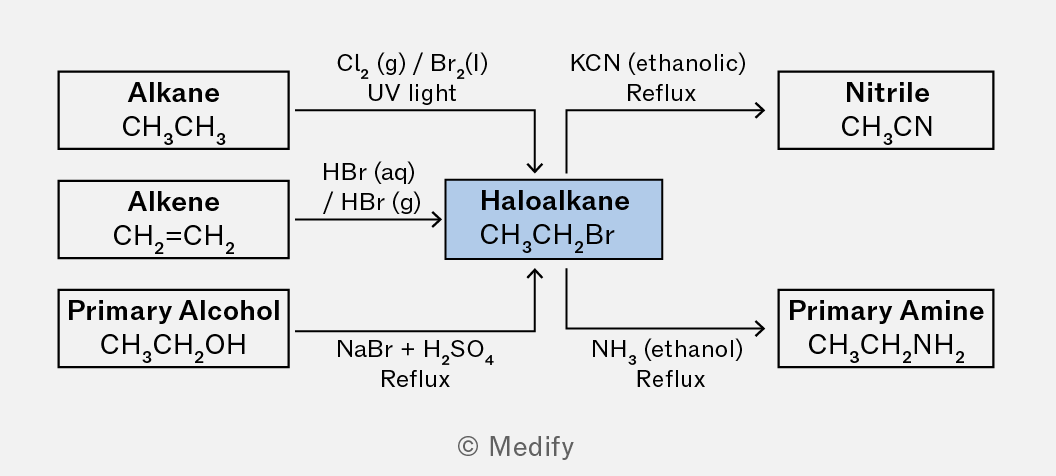
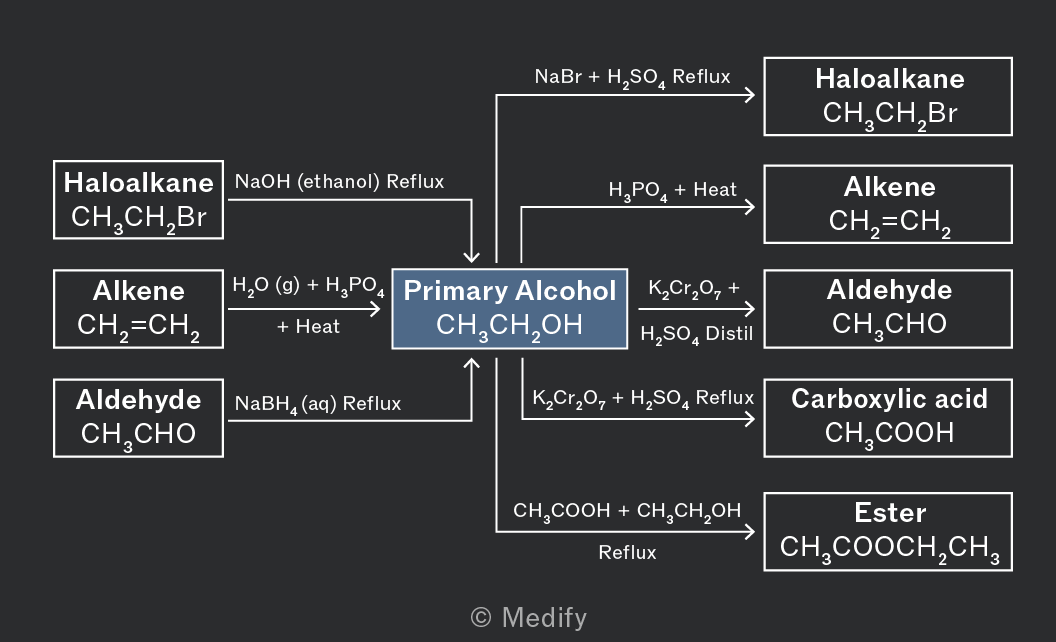
Reaction schemes with an alcohol intermediate.
Reaction schemes with a nitrile intermediate.
Question walkthrough
Planning a synthetic pathway
Linking reactions of aliphatic molecules to produce a four-step synthetic pathway
Question walkthrough
Planning a synthetic pathway
Linking reactions of aromatic molecules to produce a four-step synthetic pathway