
Carbonyl compounds (6.1.2)
On this page
Aldehydes are oxidised to carboxylic acids.
The oxidatising reagent is an acidified dichromate (VI) solution.
The mixture is boiled under reflux, using the apparatus below:
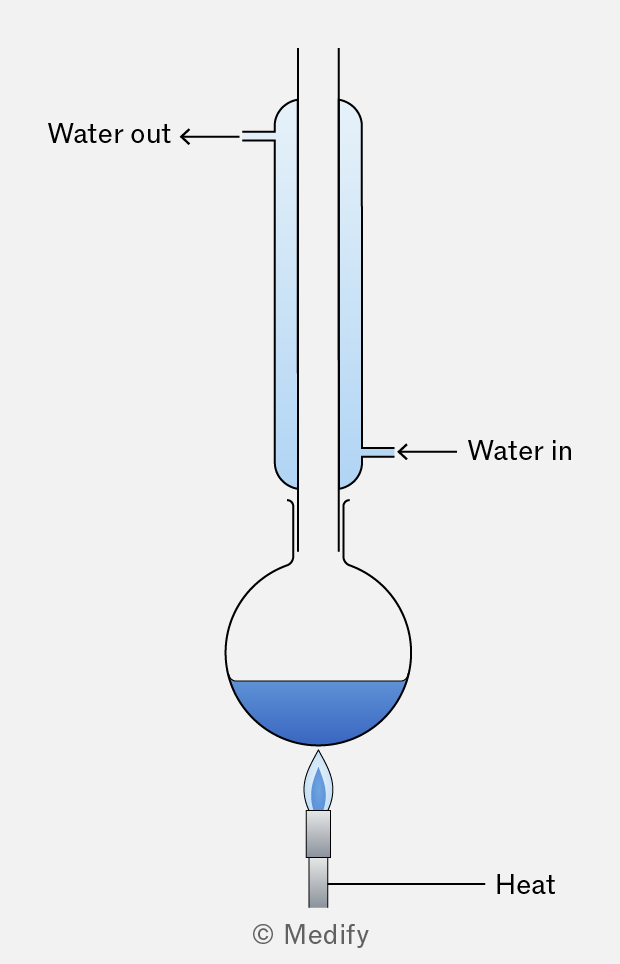
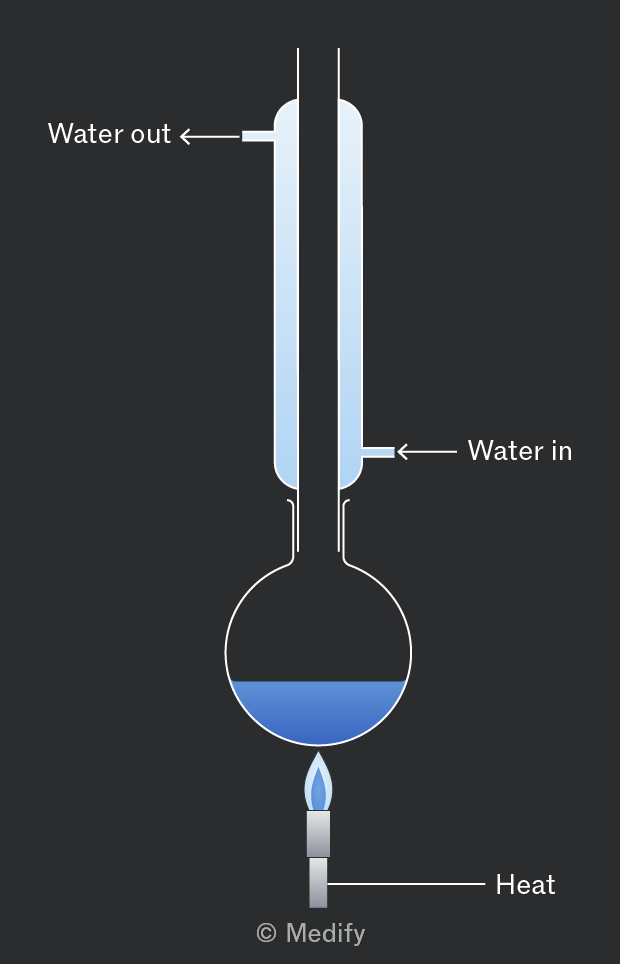
The volatile aldehyde is prevented from escaping the oxidation reaction as it is condensed and returned to the reaction flask. The product is a carboxylic acid.
The reaction is associated with the colour change from orange to green. This indicates oxidation has occurred, as the chromium species has been reduced from orange to green .
Using to represent the oxidising agent, the oxidation of ethanal to ethanoic acid would be:
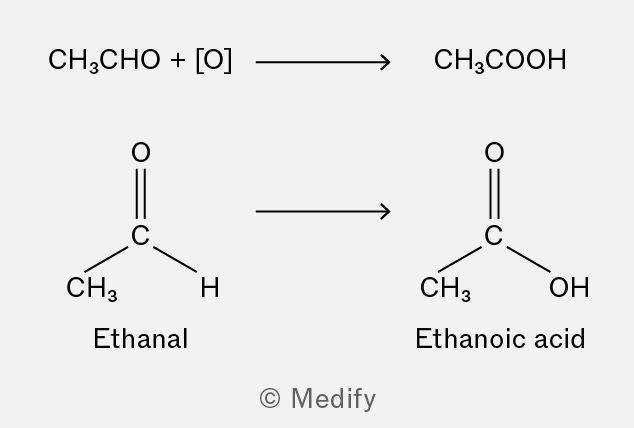
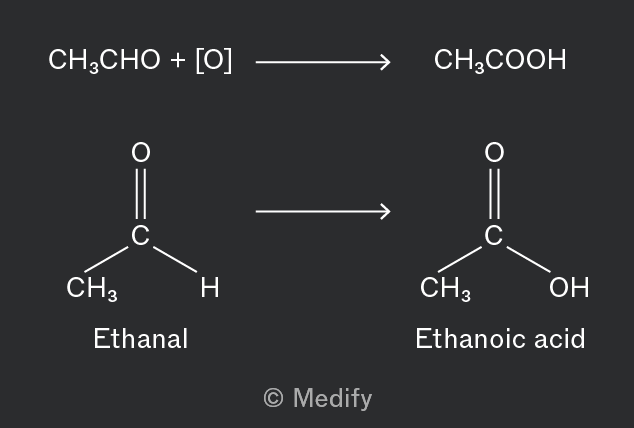
The oxidation number of the carbon increases by 1 therefore only 1 mole of is required per mole of ethanal.
Sodium borohydride, , in aqueous ethanolic solution, is a good reducing agent, and can reduce both aldehydes and ketones, but cannot reduce carboxylic acids.
The mechanism for carbonyl reduction is drawn in two key stages:
- Attack by the nucleophile, forming a new bond to the of the carbonyl group, alongside movement of pi bond electrons to the carbonyl oxygen.
- The electrons from of the intermediate ion attack a proton from a water molecule from the aqueous solution.
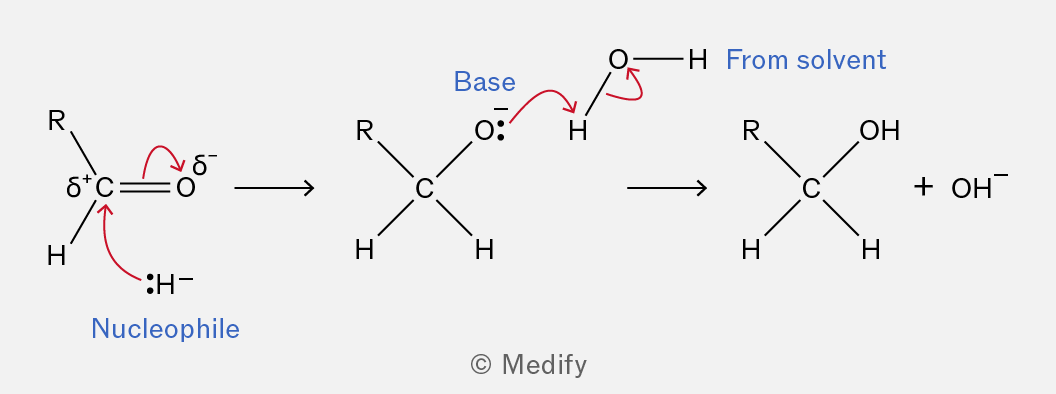
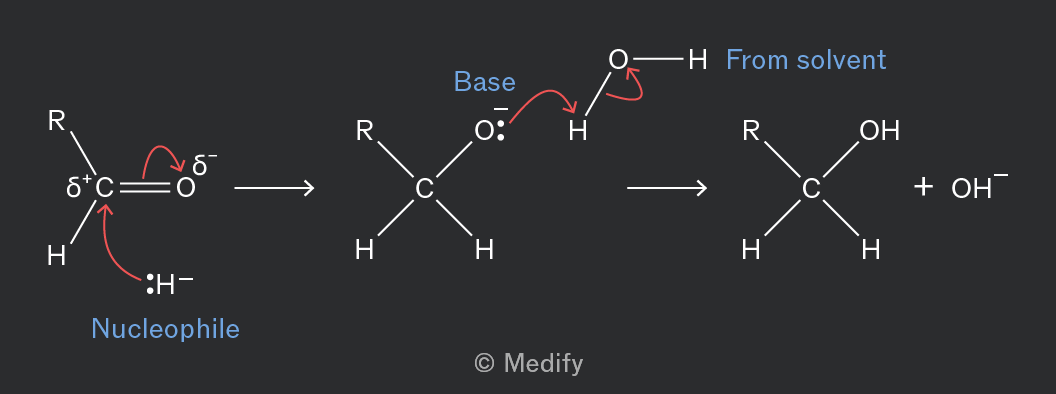
When drawing this mechanism, ensure the dipole is added to the carbonyl group and that all arrows clearly start from electrons (lone pairs or bonds) and go to atoms.
When heated under reflux with acidified solution, carbonyl compounds undergo nucleophilic addition reactions. This reaction is very useful in extending a carbon chain in organic synthesis reactions.
The lone pair of electrons on the carbon atom of the nitrile group, forms a new carbon-carbon bond with the carbonyl carbon. An ion then binds to the carbonyl oxygen forming an alcohol group. The reaction saturates the carbonyl bond. The product is a hydroxynitrile.
The product is 2-hydroxypropanenitrile.
The product is 2-hydroxy, 2-methylpropanenitrile.
(Note the nitrile group is a higher priority than the alcohol group, so is named in the suffix.)
The mechanism for nucleophilic addition of to a carbonyl is drawn in two key stages:
1. Nucleophilic attack by the lone pair nitrile ion, , forming a new bond to the of the carbonyl group, resulting in movement of pi bond electrons to the carbonyl oxygen.
2. The of the intermediate ion gaining a proton from the solvent water, or from the .
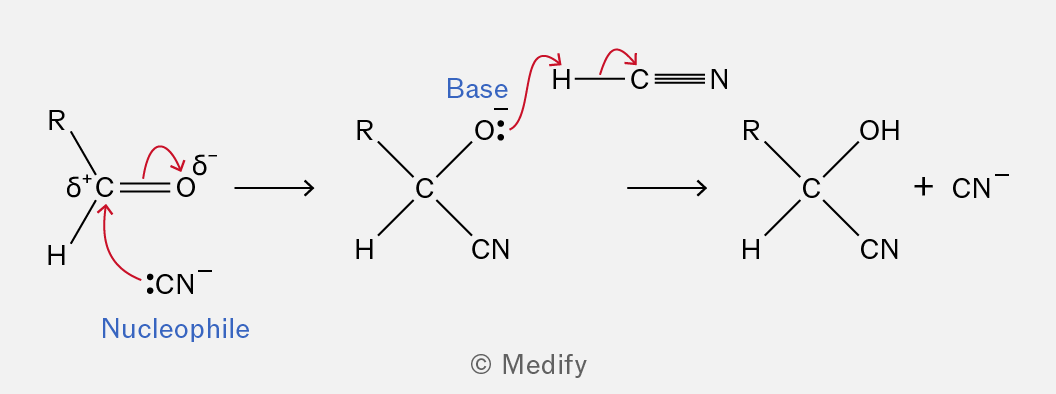
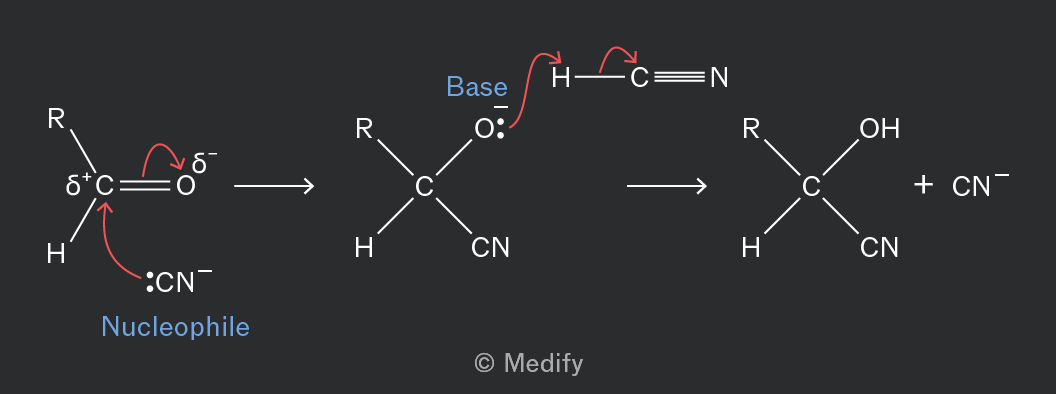
The organic products are hydroxynitriles which have both the group and the group now bonded to the same carbon.
Aldehydes and ketones will react with a solution of 2,4-dinitrophenylhydrazine () in methanol and concentrated sulfuric acid, to give a yellow or orange precipitate.
Alcohols and carboxylic acids DO NOT give a positive result with 2,4-DNPH making the reagent useful in distinguishing compounds containing carbon, hydrogen, and oxygen.
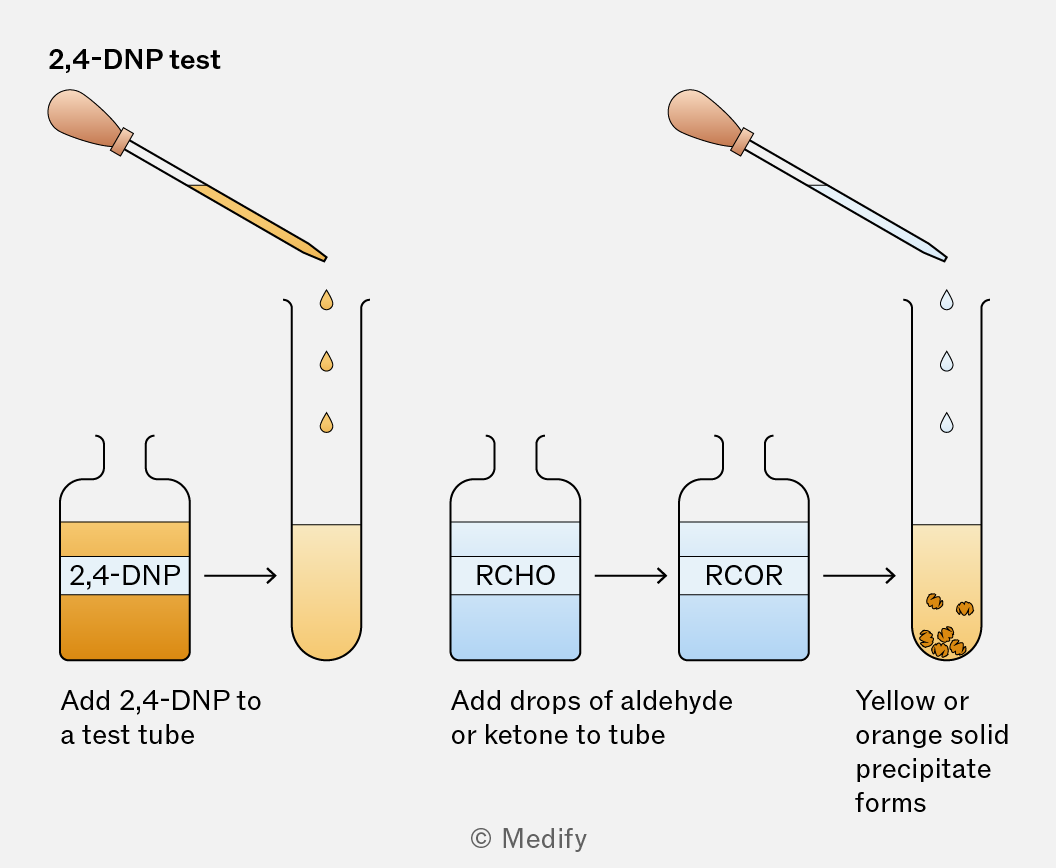
Following the identification of an aldehyde or ketone, the 2,4-DNPH test can also be used to identify a specific aldehyde or ketone.
The solid product is purified and its melting point is determined.
The melting point will be a sharp specific value which is unique to each carbonyl compound. This enables positive identification of the carbonyl compound by comparing the melting point of the derivative to a database of values.
The Tollen’s reagent test can be used to distinguish aldehydes from ketones.
The reagent is prepared on the day of use, as it is unstable. It consists of a colourless solution of ammoniacal silver nitrate, which is made from an alkaline silver nitrate reacted with concentrated ammonia solution.
The observation for aldehydes is the formation of a ‘silver mirror’. Ketones DO NOT give a silver mirror – the solution remains colourless.
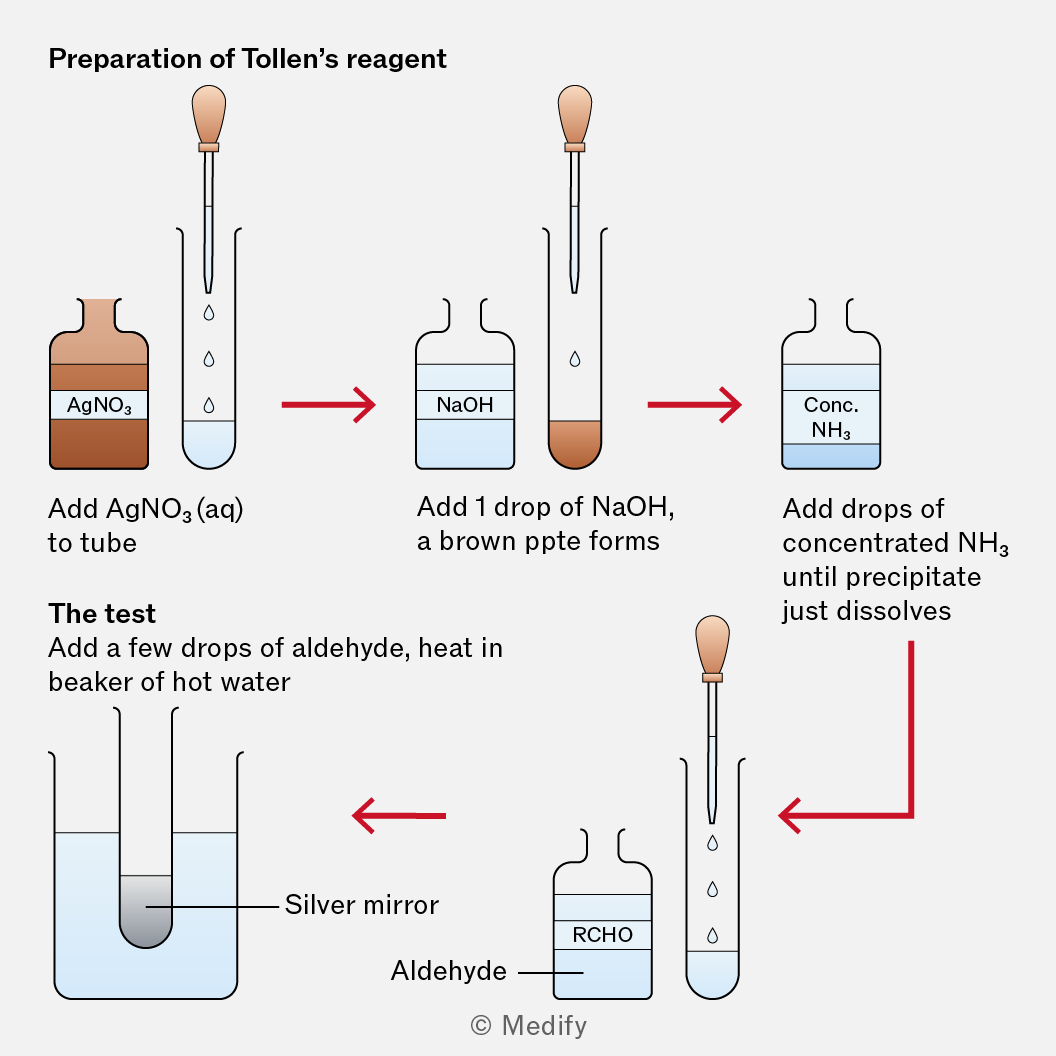
The silver mirror is formed as a redox reaction occurs with the silver ions reduced to silver metal, as the aldehyde is oxidised to a carboxylic acid salt.
Ketones cannot be further oxidised so do not support the reduction of Tollen’s reagent.