
Course overview
On this page
Welcome to the first stage of your GAMSAT journey. You’re embarking on one of the most significant steps in your journey into healthcare.


GAMSAT candidates come from diverse academic backgrounds. Nearly 30% of test-takers come from non-English speaking backgrounds, and many successful candidates complete the test without a science degree.
Your background isn’t a barrier. It simply determines where you need to focus your preparation efforts. Strategic planning matched to your starting point matters more than your degree subject.
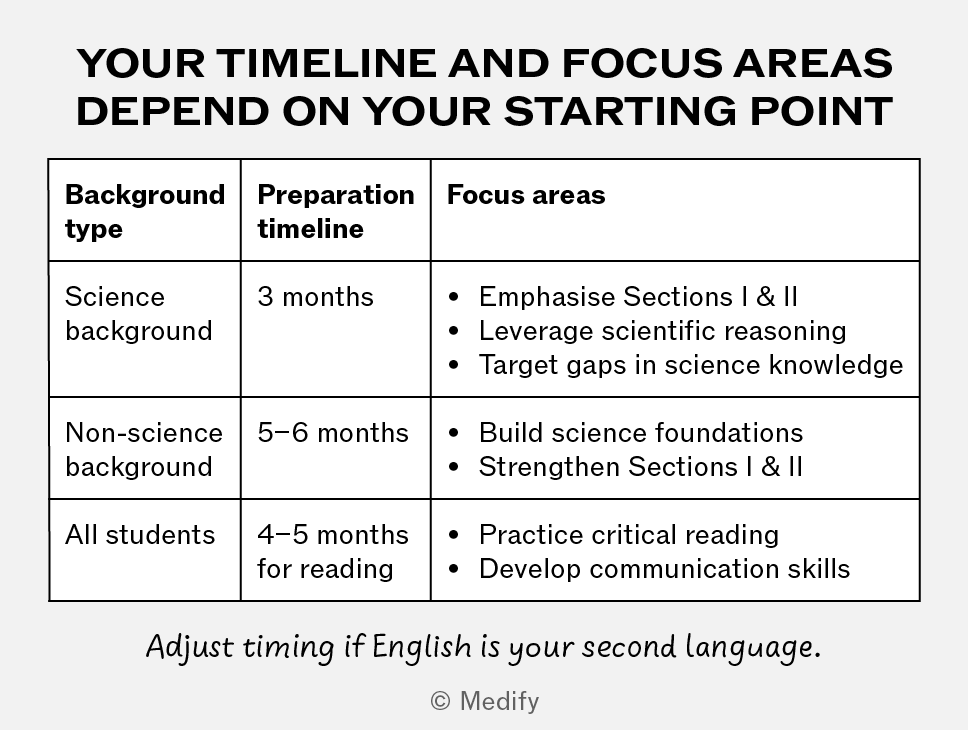
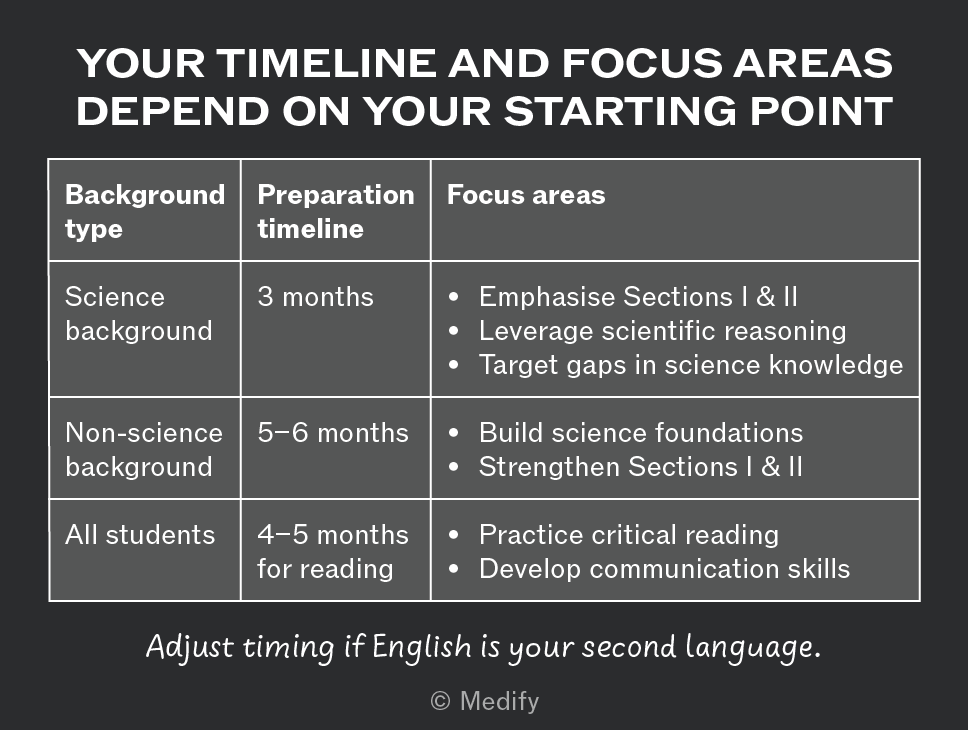
The GAMSAT exists to assist with selection into graduate-entry medical and health sciences programs.
The GAMSAT cohort consists almost entirely of high-achieving students, most of whom have demonstrated academic excellence in at least one area.
As such, the test is designed to differentiate among a group of talented and highly motivated students. The GAMSAT tests reasoning and critical thinking skills rather than pure content knowledge.
The GAMSAT will challenge you in ways other assessments do not.
Effective preparation involves developing strategies for a test designed to challenge high achievers and going beyond what has worked for other exams.
Productive GAMSAT preparation isn’t just about working hard. You need to develop a clear plan and an effective strategy to meet the specific challenges presented by the GAMSAT.
The Medify GAMSAT Study Notes provide comprehensive guidance for this journey. These materials break down complex skills into actionable strategies and explain techniques specific to different sections, set types and question types.
You will learn how to develop a toolbox of effective techniques that you can use on Test Day.
These Study Notes help you create a realistic and sustainable study plan.
Your GAMSAT journey has three key phases.
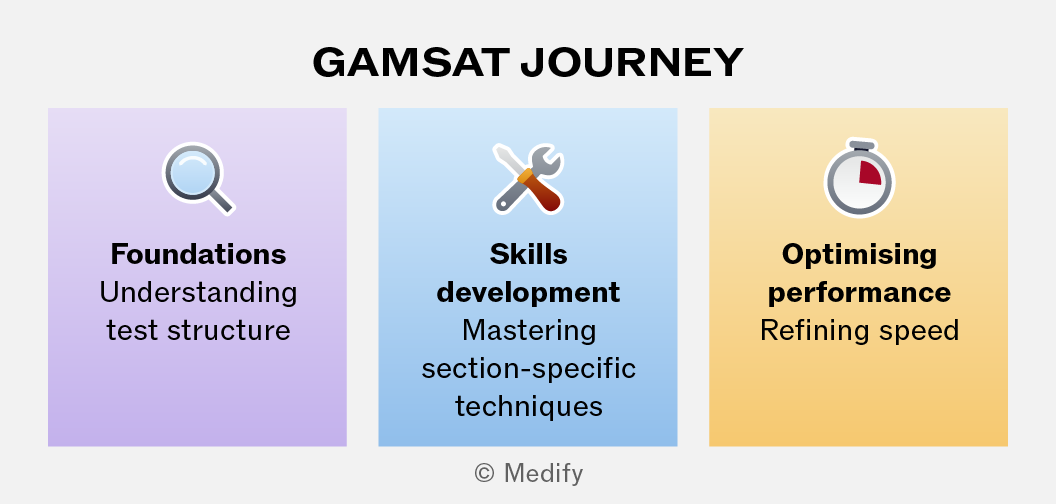
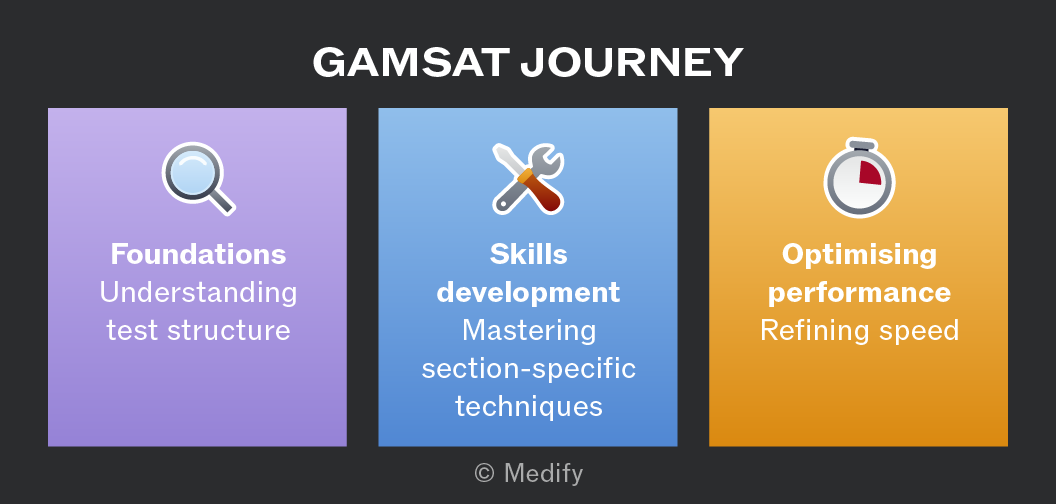
The GAMSAT demands more than intelligence. The key to being successful involves careful preparation, consistent practice, and honest self-assessment. You’ll need to:
- develop familiarity with every question type across all sections
- build efficient strategies that balance speed with accuracy
- practise under timed conditions to build endurance
- learn from mistakes through systematic review
- maintain perspective when progress feels slow
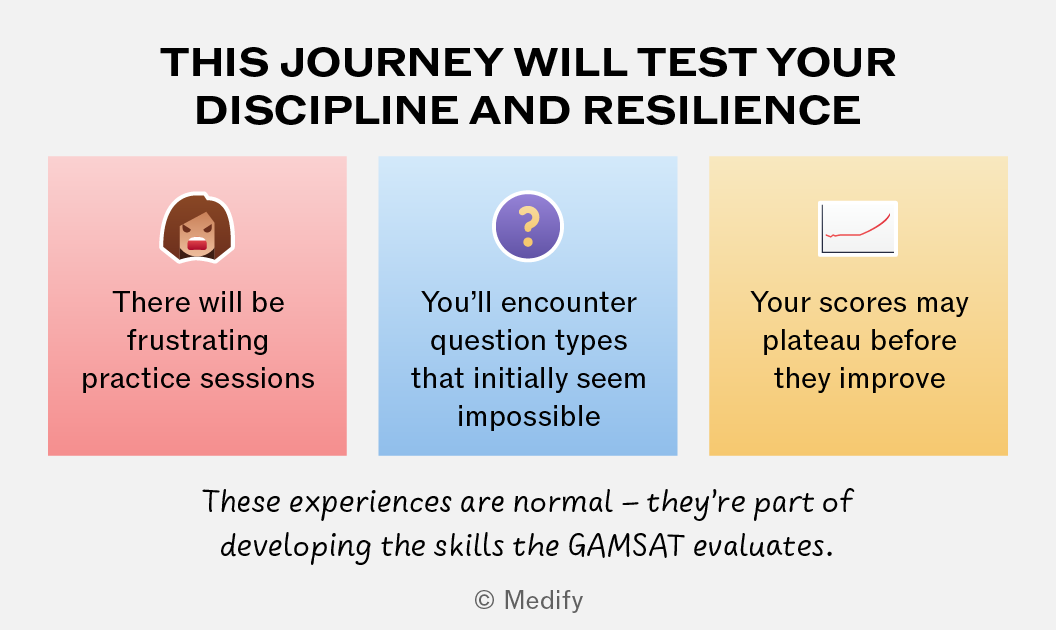
Remember: thousands of students successfully navigate the GAMSAT each year. Many feel overwhelmed at the start of their preparation.


The chapters ahead provide everything you need to understand the GAMSAT’s structure, develop effective strategies, and build confidence for Test Day. You’ll learn:
- how the test is scored
- what makes each section unique
- how to develop a preparation plan matched to your timeline and circumstances
Your GAMSAT journey begins now. The path ahead demands dedication, but it’s entirely achievable with the right approach and resources. These Study Notes are designed to guide you every step of the way.
Start by reading the upcoming chapters on test structure and scoring to understand exactly what you’re preparing for.
The GAMSAT was initially designed for candidates applying to Australian universities. However, the test is now also used by a number of universities in the UK and Ireland.
To sit the GAMSAT, you need an undergraduate degree or to be in your final or penultimate year of undergraduate study at the time of testing.
Some universities in the UK have specific alternative eligibility criteria. Be sure to check the admissions criteria for the universities that you want to apply to.
Register directly through the Australian Council for Educational Research (ACER), which develops and administers the test.
Registration windows open several months before each sitting, so plan ahead to secure your preferred date and location.


Check the specific requirements of your chosen medical schools. Some institutions accept only certain testing windows for particular admissions cycles.
Confirm deadlines early. If you miss a testing window, your application might be delayed by a full year.
The GAMSAT is entirely computer-based. It is administered at test centres in Australia, New Zealand, the UK, Ireland and Singapore.
Students living more than three hours from a test centre or in countries without test centres may sit the exam via remote proctoring.
ACER publishes an annual information booklet with essential details, such as:
- registration processes and deadlines
- testing locations and dates
- identification requirements
- permitted materials
- special provisions processes
Read ACER’s booklet carefully before registering. Requirements and procedures might change between testing cycles, so it is essential to consult ACER’s current documentation.
Don’t rely exclusively on information from previous years or secondhand accounts.
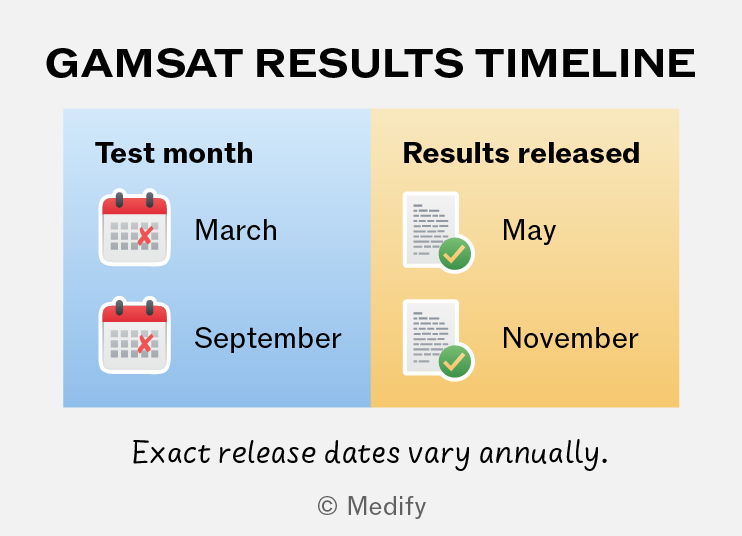
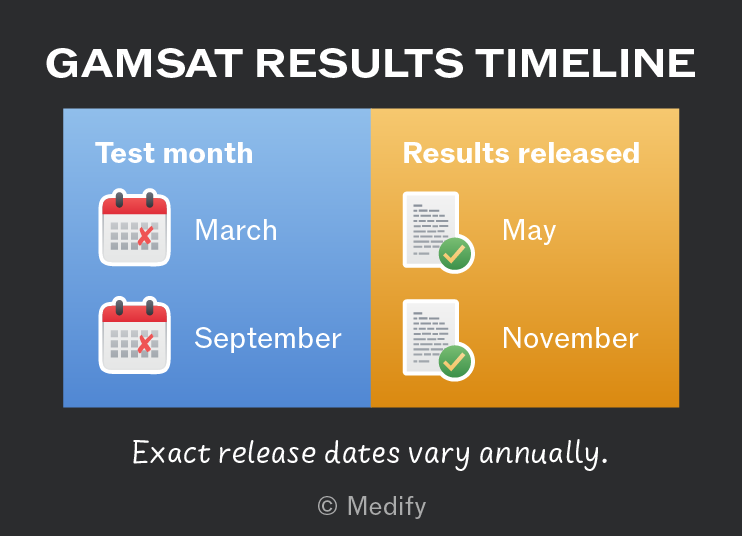
You may sit the GAMSAT multiple times without penalty. Each sitting requires separate registration and payment of the full fee.
If your March results don’t meet your goals, you can retake the test in September. You can also resit in subsequent years.
Some students use an initial sitting to gauge their performance level, although this approach requires paying the registration fee for each attempt. We endeavour to provide practice materials of sufficient quality and quantity to make this additional expense unnecessary.
While you can sit the GAMSAT multiple times, strategic timing matters more than frequency. Plan your test dates around application deadlines and allow adequate preparation time between attempts.
GAMSAT scores remain valid for:
- two consecutive years in the UK and Ireland
- up to four consecutive years in Australia
You can use any valid GAMSAT score from any sitting within these timeframes. This means that if you sat the GAMSAT in September 2025, March 2026 and in September 2026, you can use the best result from these sittings for admissions in 2027.
Universities access your GAMSAT scores through direct verification with ACER. You may receive emails asking you to specify which score to use if you’ve sat the test multiple times. Make sure to monitor your email, including your spam folder, and respond by any stated deadlines.
Individual universities determine how they use GAMSAT scores in admissions. Common approaches include:
- ranking candidates by combined GAMSAT score and academic performance
- setting minimum threshold scores for interview consideration
You should research the policies of your chosen universities because approaches vary significantly across regions and institutions.
The GAMSAT consists of three sections, commonly referred to as Sections I, II, and III, or Sections 1, 2, and 3.
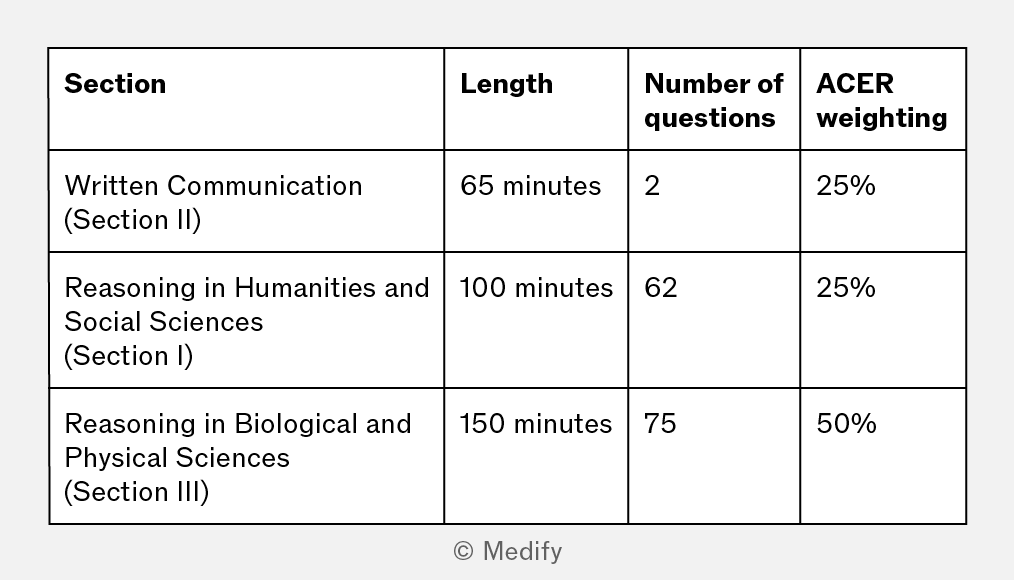
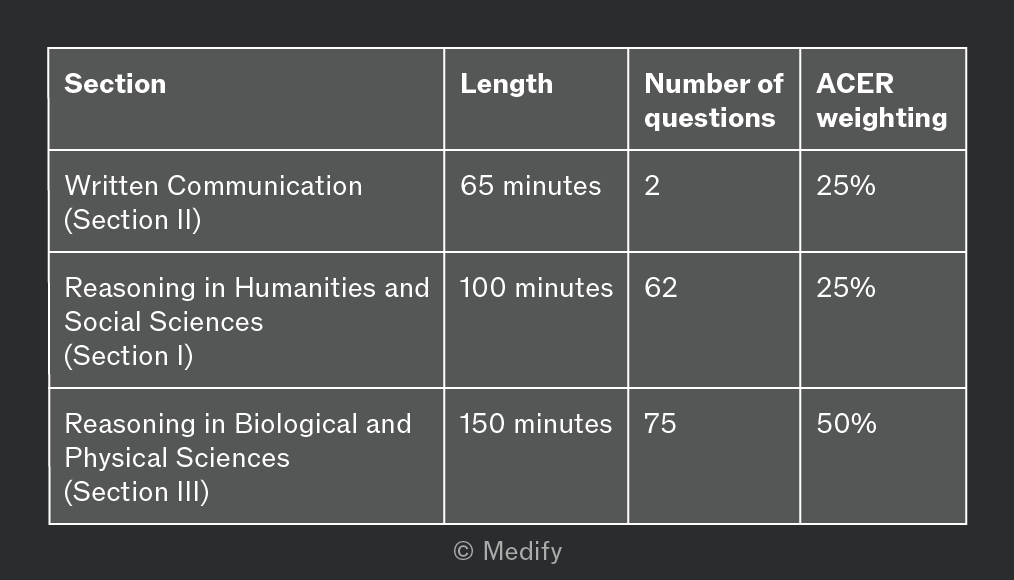
The section numbers reflect the order in which the sections were completed in a single sitting. Section II is now the first test, and is remotely proctored. You will then complete Section I, followed by Section III on Test Day.
Note: Different universities may apply different section weightings to those used by ACER.
The first section you will complete is Written Communication (Section II). This section is issued remotely and takes place approximately three weeks before Test Day. You will need to write two essay responses based on the common theme from the prompt material.
The section allows five minutes of reading time and assumes 30 minutes will be spent planning and writing each response.
Reasoning in Humanities and Social Sciences (Section I) is the first section you complete on Test Day.
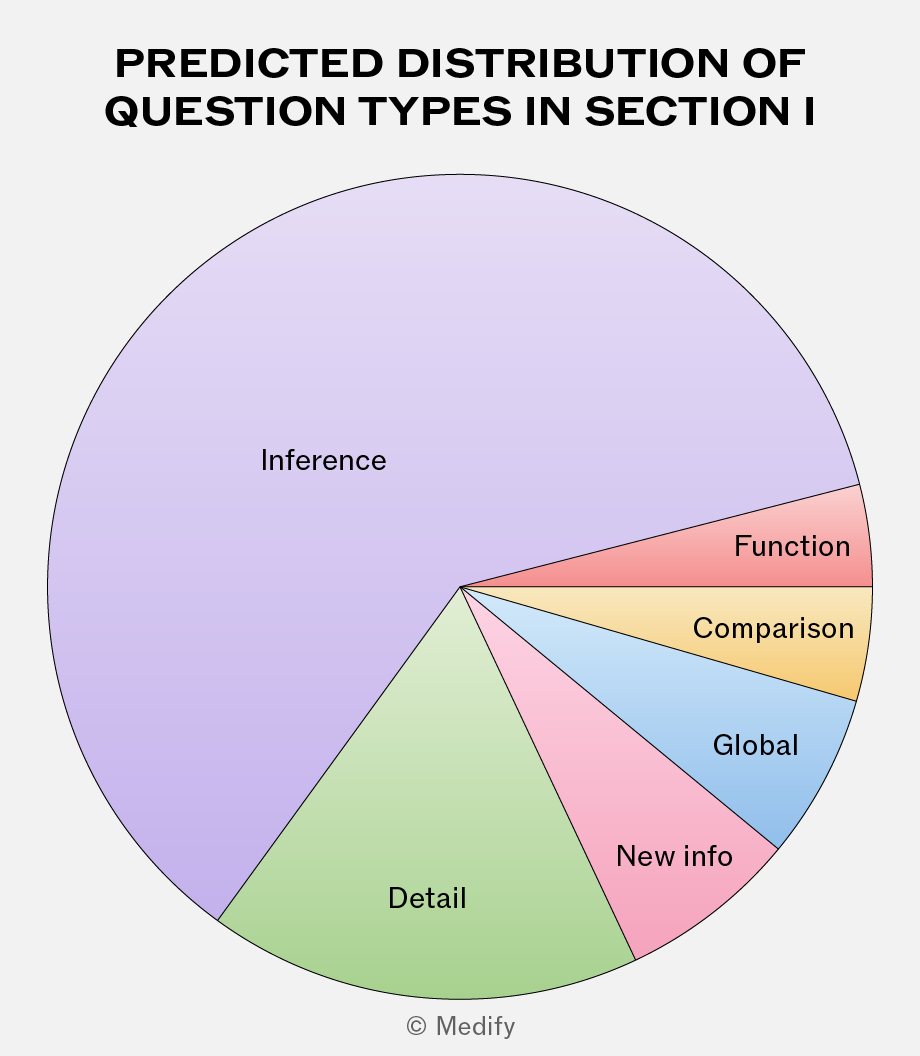
Section I contains 62 multiple-choice questions. Most questions are grouped into sets based on a common stimulus. You will also see a few standalone questions, typically in Proverb, Quotation and Cartoon sets.
ACER does not specify the distribution of different set types in the Humanities and Social Sciences section. Medify align their distribution of stimulus types in mocks to ACER practice tests.
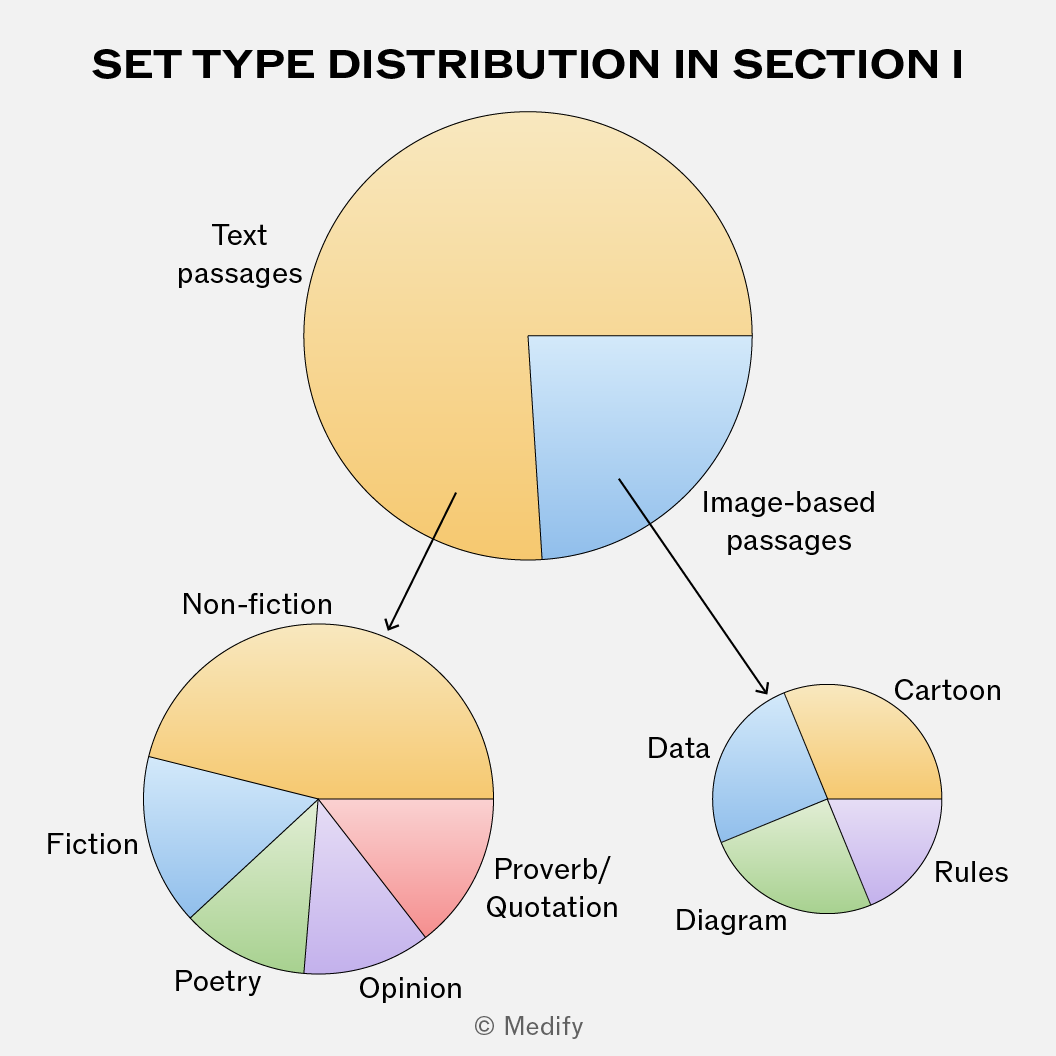
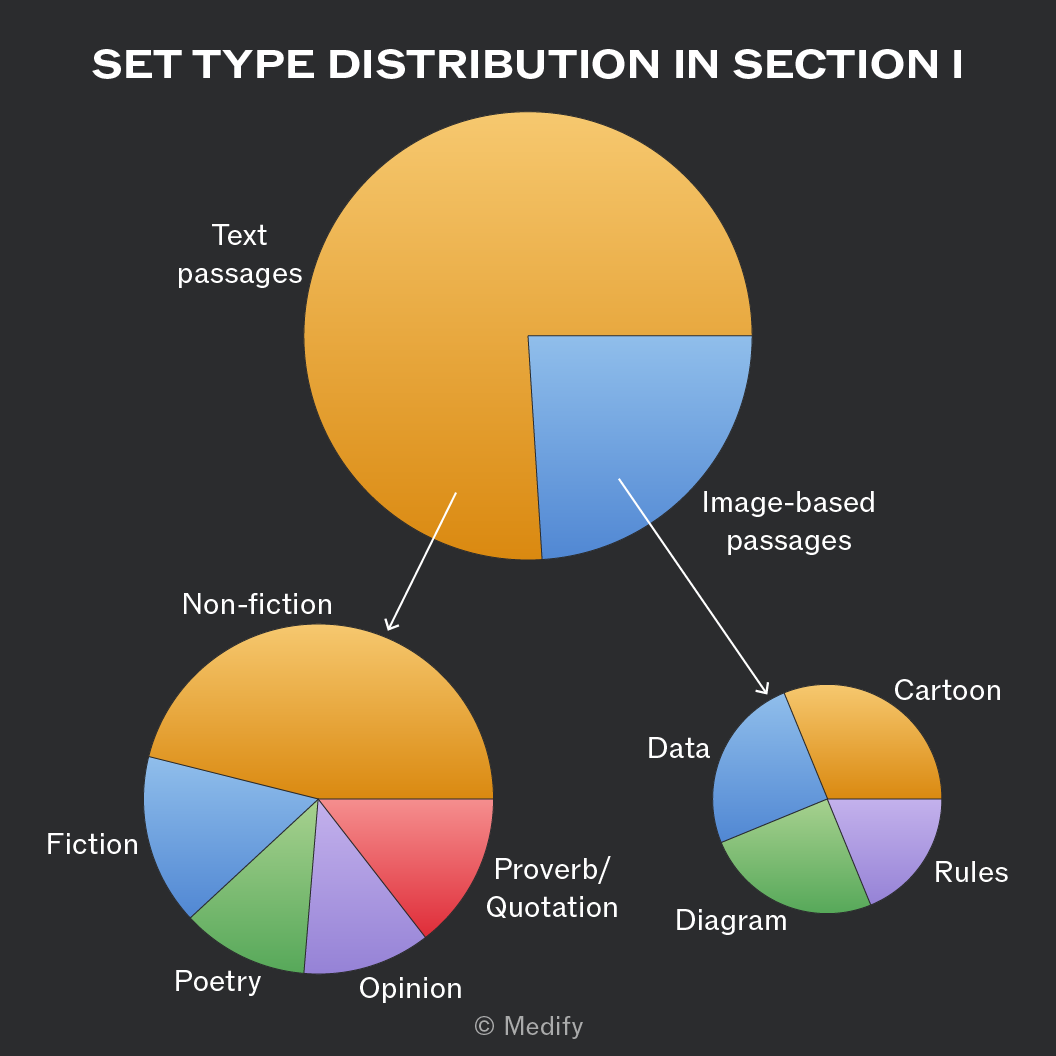
Questions within each set for Section I can be categorised according to the skills they use.
Reasoning in Biological and Physical Sciences (Section III) is the second section you complete on Test Day.
Section III contains 75 multiple-choice questions. The context for the questions is divided between Biology, Chemistry and Physics in a fixed ratio of 30:30:15.
Within these questions, the route to obtaining the correct answer is linked to using one or more skills.


Medify has consolidated the extensive list of skills required to secure a strong score in Section III into four core areas. These skills can be tested in combination or independently within any scientific context.


A standardised test is an assessment administered and scored in a consistent, predetermined manner across all test takers. The GAMSAT is a prime example: every candidate faces the same conditions, time limits, and scoring criteria, regardless of location or date. Standardisation extends beyond just the test itself: it includes how questions are developed and involves panelling, trial testing, and detailed analysis.
Standardisation is crucial for fair and equitable medical school admissions, allowing universities to compare thousands of applicants across different test dates and locations (e.g., Melbourne in March versus London in September).
This consistency gives GAMSAT scores their validity and allows universities to trust them as a genuine measure of candidate ability.
Your raw score is simply the number of questions you answered correctly. While this seems like a fair measure, it has a fundamental problem:
Different GAMSAT sittings have different difficulties.
ACER uses different questions in different sittings of the GAMSAT, even in the same test window. A student taking the exam on Saturday morning can potentially receive a very different paper from a student sitting it on Sunday afternoon.
Suppose two candidates both answer 50 questions correctly, but one sat a harder test. Are they equally capable? Raw scores alone cannot answer this question.
Furthermore, raw scores are not interval measures. For instance, the ability difference between 40 and 45 correct answers is not equivalent to the difference between 60 and 65, because higher performance ranges typically demand a greater increase in ability for the same numerical improvement.
You will receive a scaled score from 0 to 100 for each GAMSAT section.
- For Sections I and III, your raw number of correct answers will be converted to a scaled score.
- For Section II, you will be assigned a scaled score based on your integration of ideas and control of language in responding to each topic.
Your performance in each GAMSAT section determines your scaled score in that section. This means that the scaled scores are part of your GAMSAT results that you can control.
Remember, there is no negative marking in GAMSAT multiple-choice questions. You are not penalised for incorrect responses. More correct answers lead to a higher scaled score. For this reason, you must be sure to answer every question.
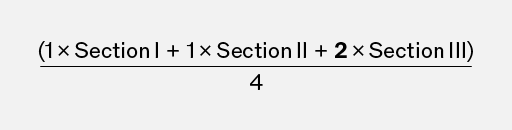
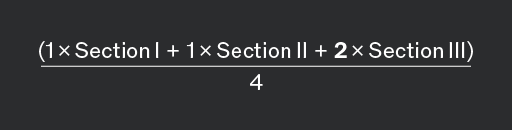
ACER uses a weighted scoring formula to determine your overall score for the GAMSAT:
Your scaled scores from each of the three sections determine your overall score. Notice that this means that Section III counts twice as much as each of the other sections in the overall score.
For example, if you scored:
- Section I: 60
- Section II: 65
- Section III: 70
Your overall score would be: (60 + 65 + 140) ÷ 4 = 66.25 = 66
The overall score is calculated to several decimal places before rounding. Importantly, this calculation occurs before individual section scores are rounded, making it impossible for test takers to replicate the exact process.
Most universities will simply use the overall score provided by ACER based on the scaled scores from each section.
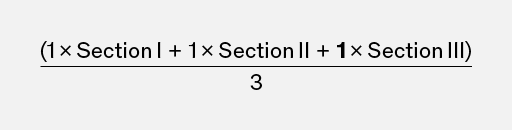
However, a few universities in Australia prefer an alternative formula to determine the overall score:
ACER has not released much information about the exact process used to determine GAMSAT scaled scores, but we can infer a fair amount from publicly available information.
The transformation from raw to scaled scores:
- accounts for differences in test difficulty between sittings.
- places all test versions on a single comparable scale.
- ensures that the higher the score, the better the performance, regardless of which test version was taken.
The result is that a scaled score of 65 always represents the same level of ability, whether achieved in March or September, in Melbourne or Manchester.
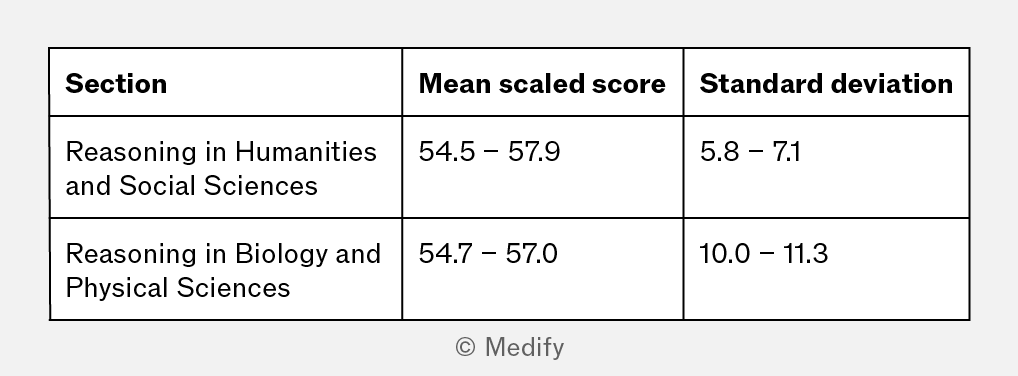
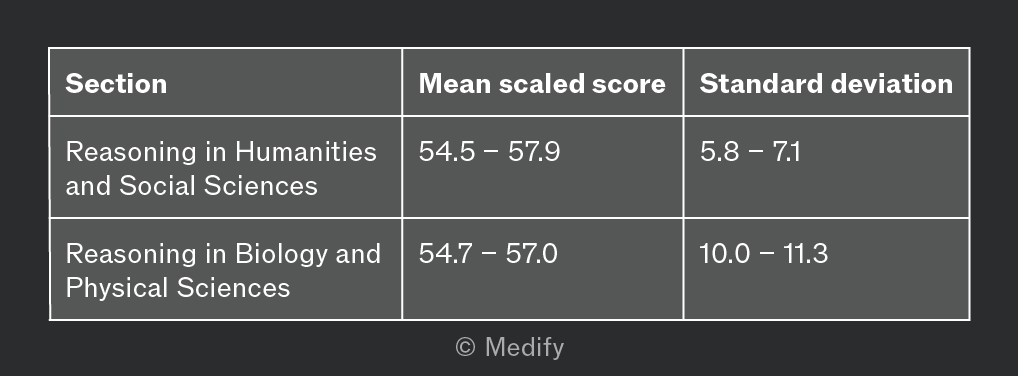
According to Mercer et al., 2015, the mean scaled scores of the official exam range from 54.5 to 57.9 for Section I, with a standard deviation of 5.8-7.1, and between 54.7 and 57.0 for Section III, with a standard deviation of 10.0-11.3.
GAMSAT scores follow a roughly normal distribution. Most candidates cluster around the mean, with fewer candidates at the extremes.
Section III has a higher standard deviation than Section I. This means that Section III scores are more spread out, indicating greater variation between high and low performers. Practically, this makes Section III a strong differentiator between candidates, particularly due to its double weighting.
Reference
Mercer, A., Crotty, B., Alldridge, L., Le, L., & Vele, V. (2015). GAMSAT: A 10-year retrospective overview, with detailed analysis of candidates’ performance in 2014. BMC medical education, 15, 1-9.
Your GAMSAT statement of results will not specify your percentile ranking, but ACER will include a percentile curve that you can use to find your percentile rank. ACER produces a different percentile curve for each test.
Your percentile rank indicates the strength of your overall score relative to that of other candidates who attended the same GAMSAT sitting.
Here is an example of the percentile curve from a recent GAMSAT sitting:
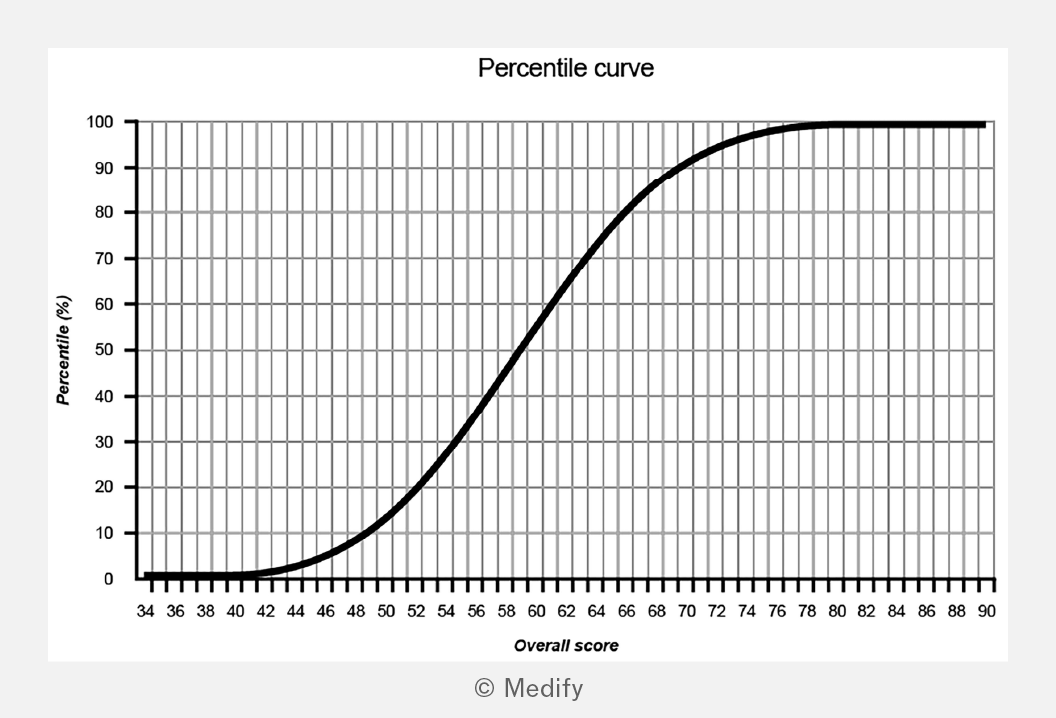
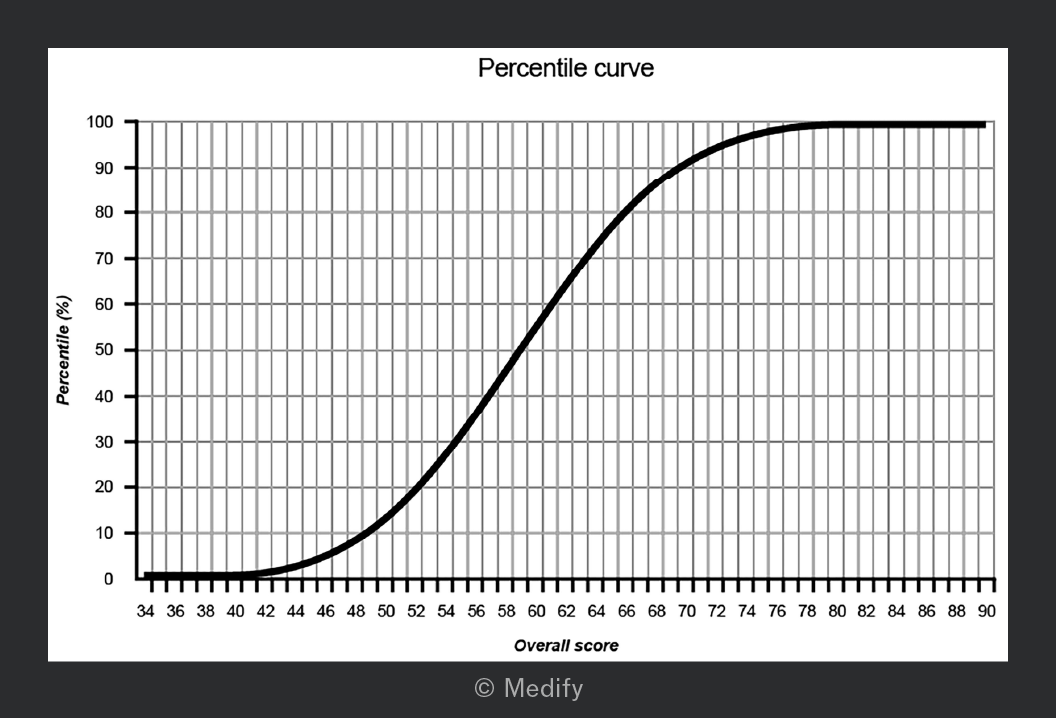
The percentile curve illustrates the relationship between overall scores and the percentage of test-takers who achieved that score or higher.
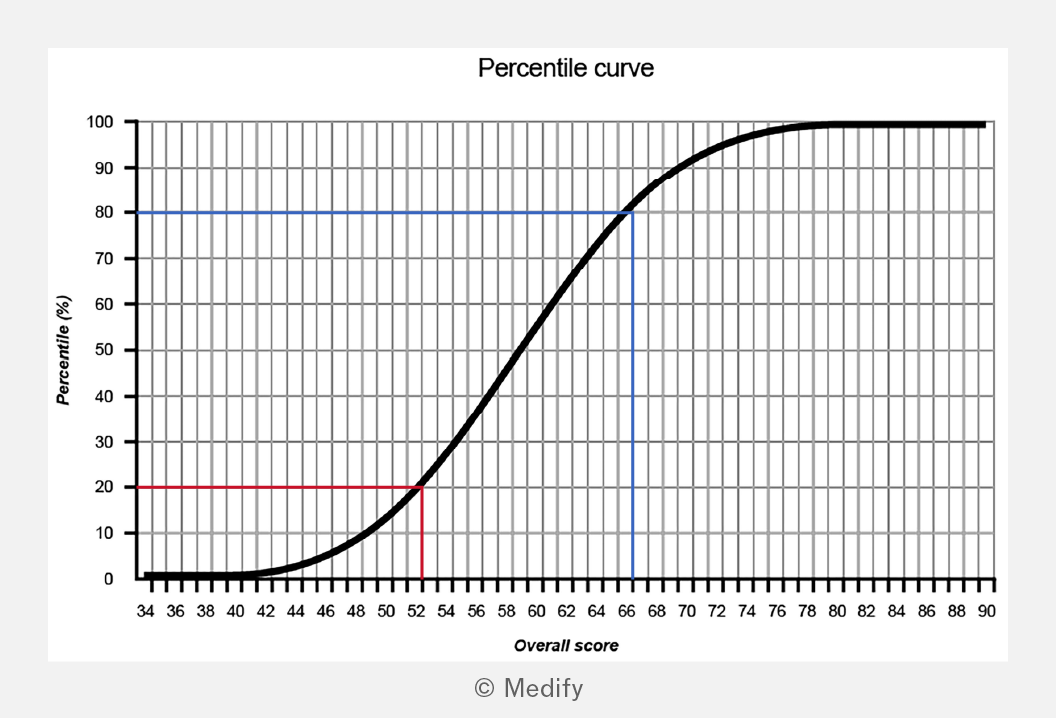
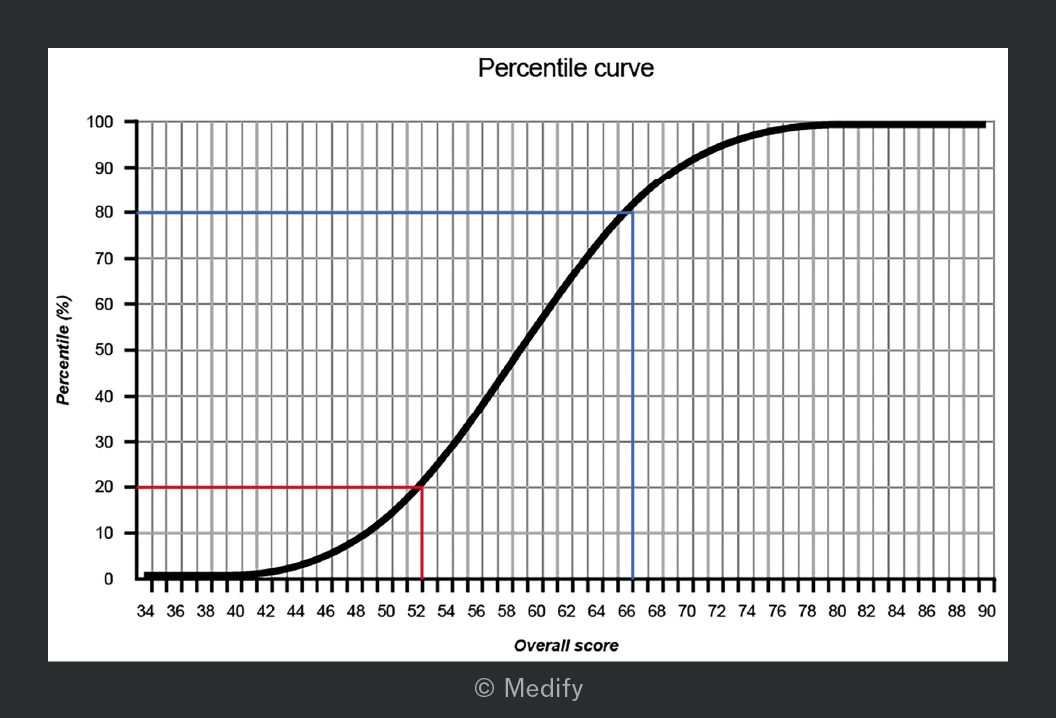
- An overall GAMSAT score of 66 roughly equates to the 80th percentile. This means the candidate scored equal to or above 80% of others on the same test.
- A candidate scoring 52 is placed in the 20th percentile, meaning their score is equal to or higher than only 20% of other test-takers.
Low GAMSAT scores show a flattening of the percentile curve. Scores below 48 were in the bottom 10th percentile.
The 1st percentile covers scores from 34, and the 2nd percentile corresponds to 42. The curve then steepens quickly, with 48 marking the 10th percentile.
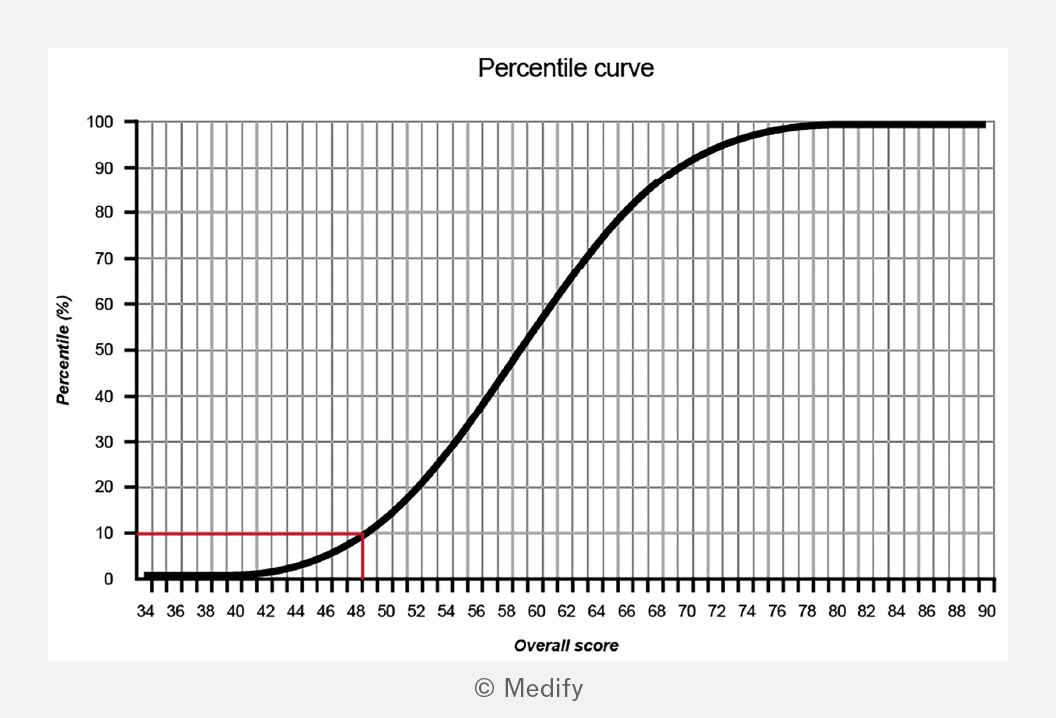
At the lowest percentiles, multiple overall scores share the same percentile. This means that a significant overall GAMSAT score increase is needed to see a rise in percentile.
High GAMSAT scores show a flattening of the percentile curve, with scores ranging from 80 to 90 all falling into the 100th percentile.
Overall scores of 70 or higher corresponded to the 90th percentile with the curve dropping more steeply as scores descended below 70.
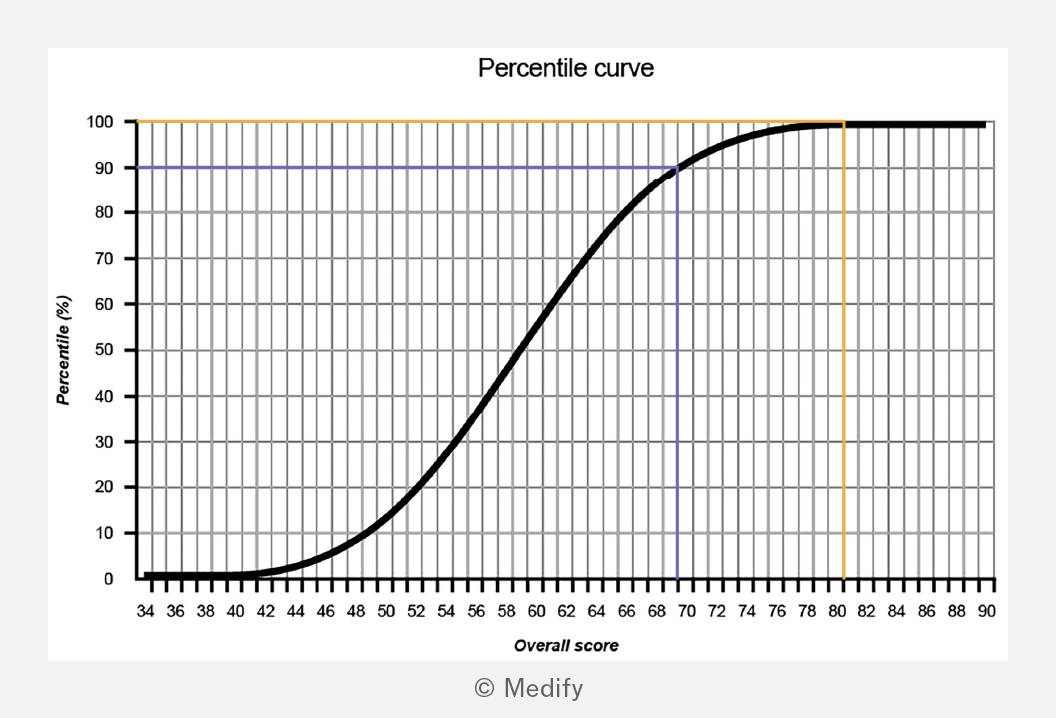
At the highest percentiles, multiple scores achieve the 100th percentile. Near the top of the curve, further increases in overall score do not raise your percentile ranking.
This means you could have scored in the 100th percentile in this GAMSAT sitting without needing a perfect score in any section. The highest achieved overall score by any test-taker was 90, not 100. However, an overall score of 80 resulted in the 100th percentile, the same as an overall score of 90.
We can use the percentile curve to find the middle half of GAMSAT scores from this particular test. The middle half includes all GAMSAT students who scored between the 25th and 75th percentiles. This approach can be useful for determining the scoring range that excludes the outlying highest and lowest scores.
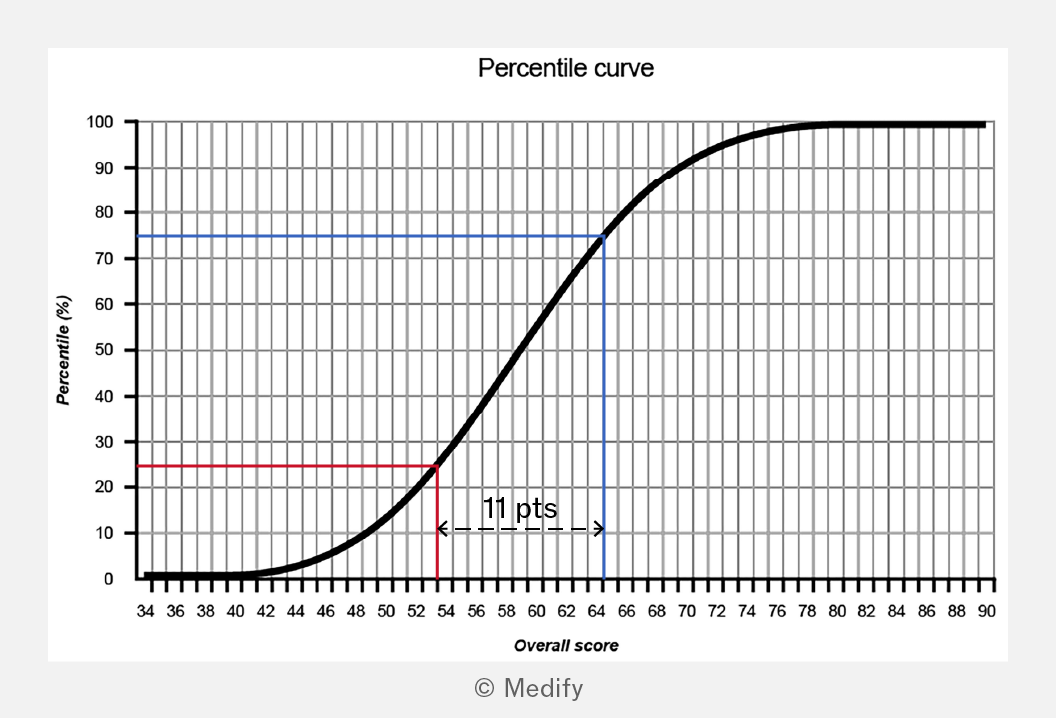
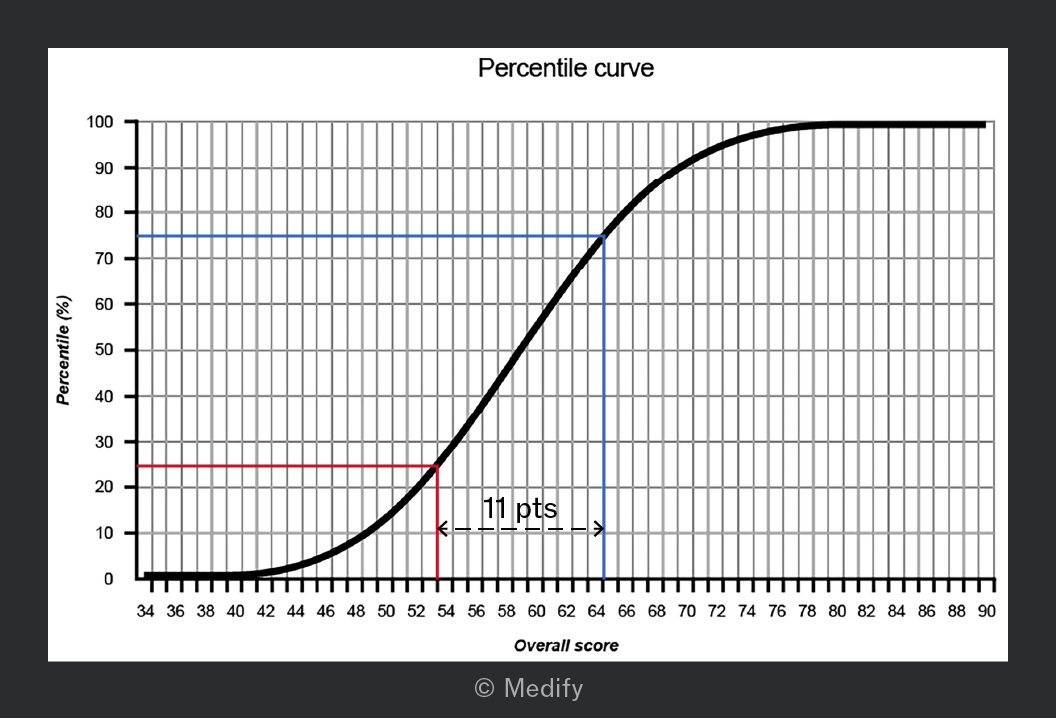
The 25th percentile corresponds to an overall score of 53 while the 75th percentile corresponds to an overall score of 64.
The scores achieved by the middle 50% of students taking this specific exam span a narrow range of just 11 points.
This means that even minor enhancements to your GAMSAT proficiency can disproportionately improve your percentile ranking at this level.
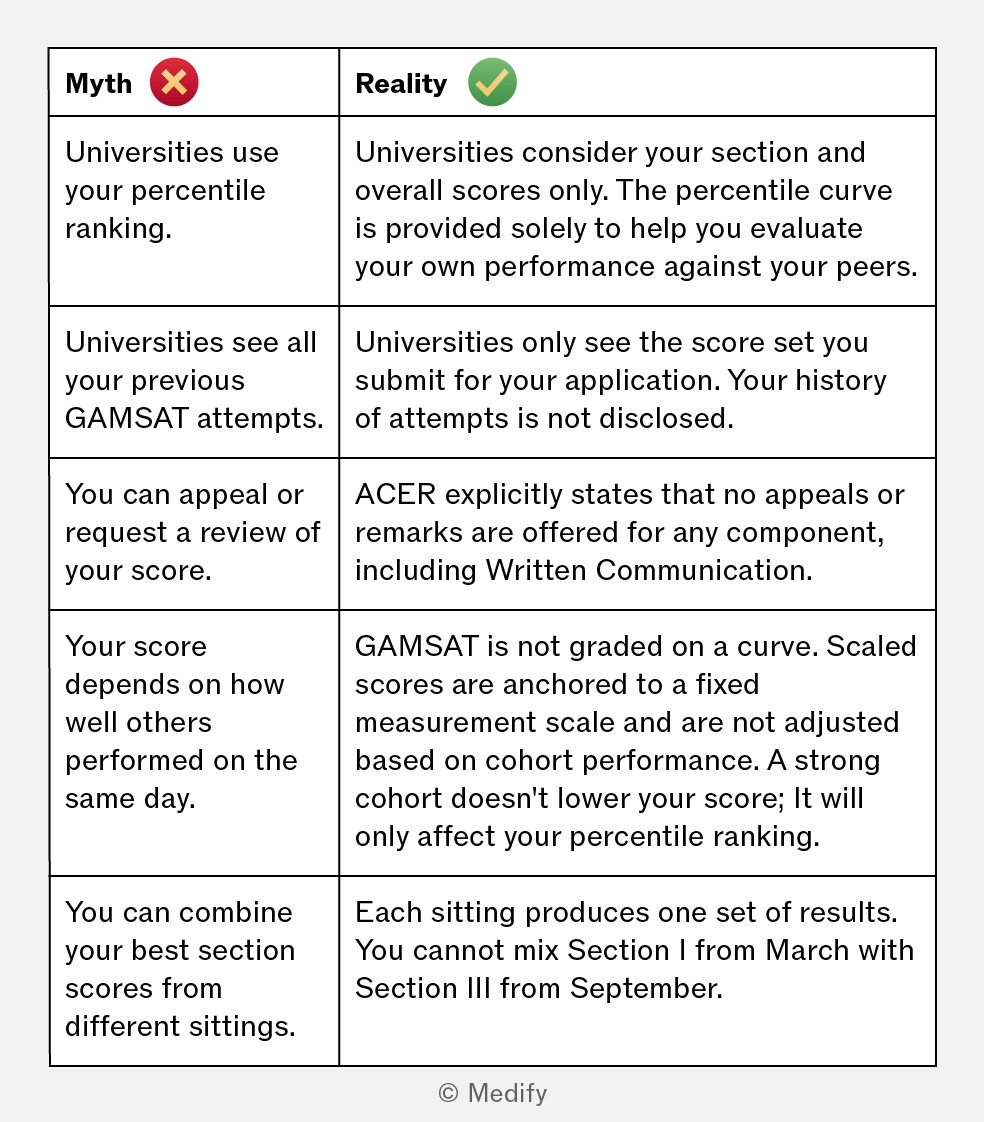
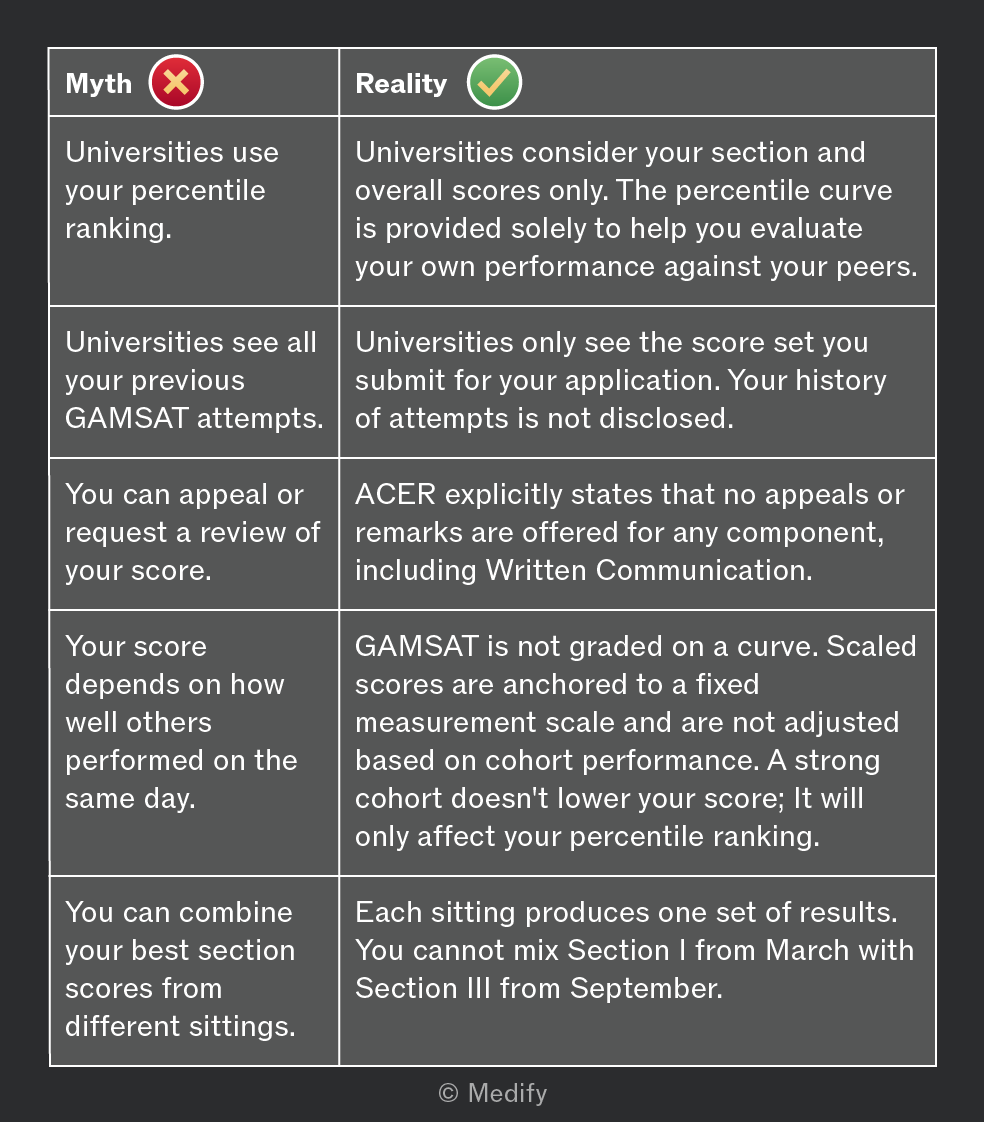
Several key misconceptions persist about the scoring system for the GAMSAT:
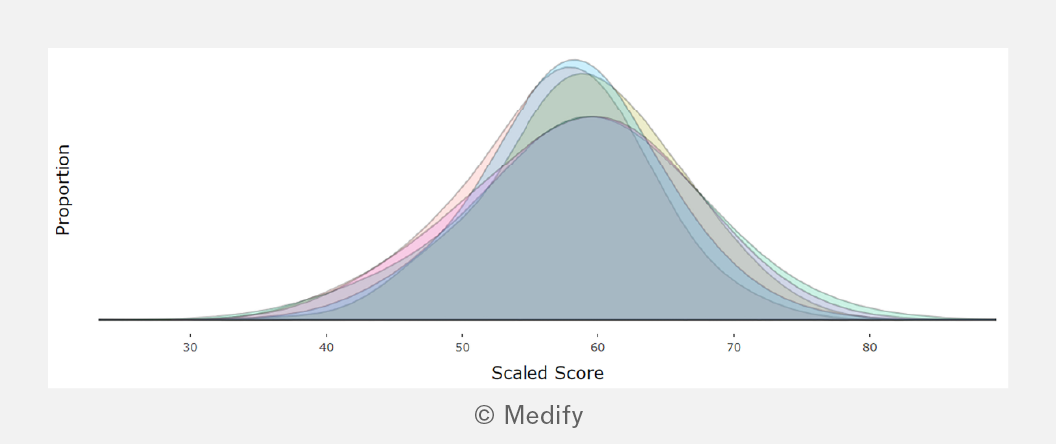
At Medify, we work with statistical experts to perform analysis on our real mock attempt data. We have used this approach, to produce scoring tables which align closely with the official ACER statistics. We update the scoring tables based on real data from our users.
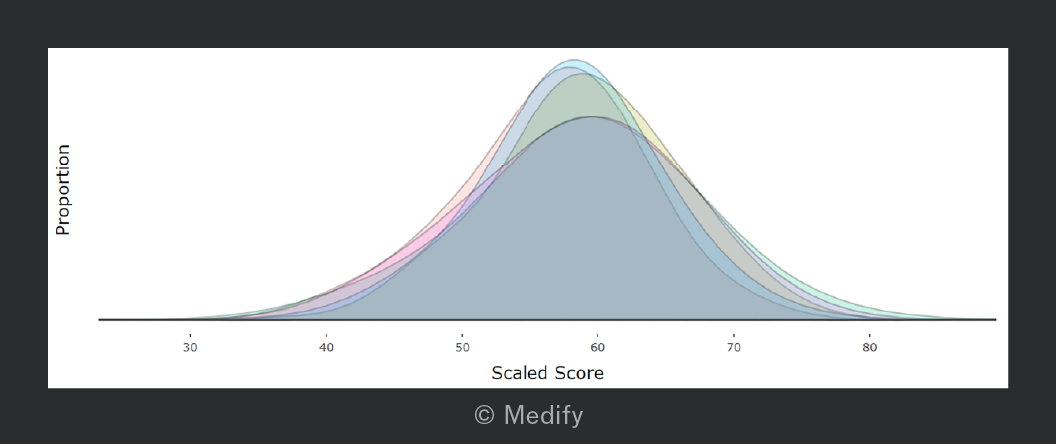
The graph below shows the distribution of scaled scores across 5 Medify mocks:
ACER use a process called Item Response Theory (IRT), which enables them to ensure the scaled scoring is consistent across different GAMSAT sittings. Some test items are repeated within different exam sittings. If a test item is consistently answered correctly by students who score well in the entire exam (suggesting higher ability/knowledge), it is likely to be weighted more highly. Consequently:
Raw scores are not directly proportional to scaled scores
At Medify, we also utilise IRT analysis to evaluate the performance of our questions both in terms of appropriate difficulty and correlation with overall performance. This data is used to drive improvements in our mock examination content as part of our ongoing commitment to quality.
Medify continuously develops new resources to support your GAMSAT preparation.
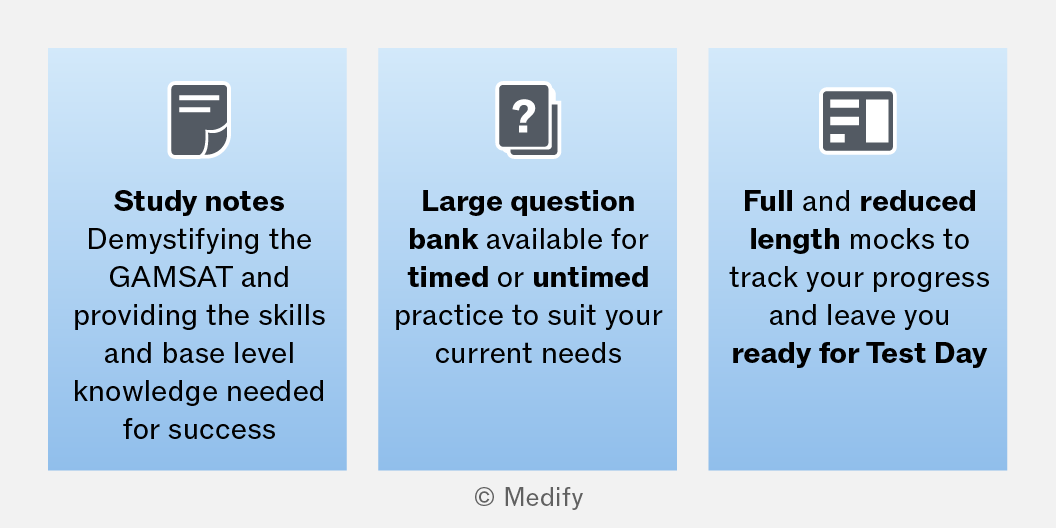
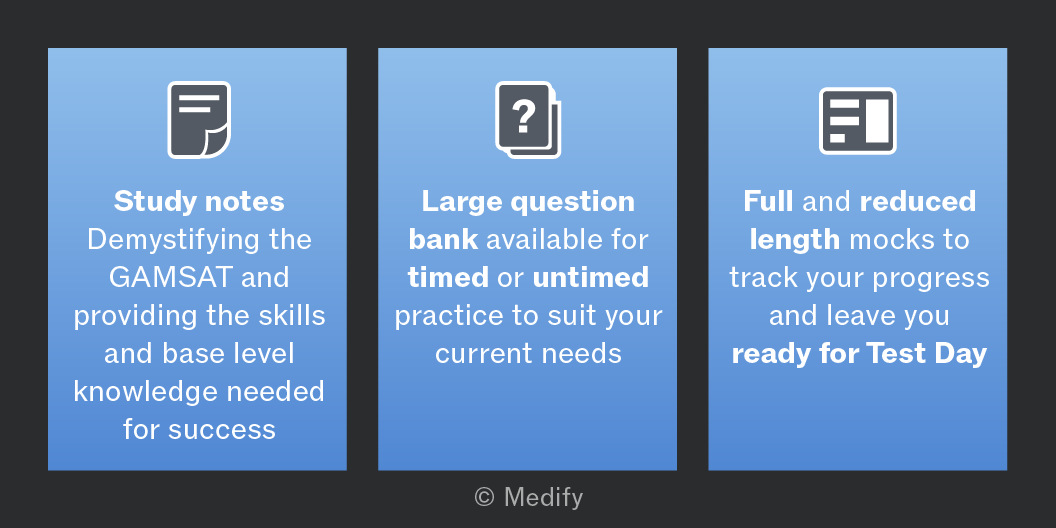
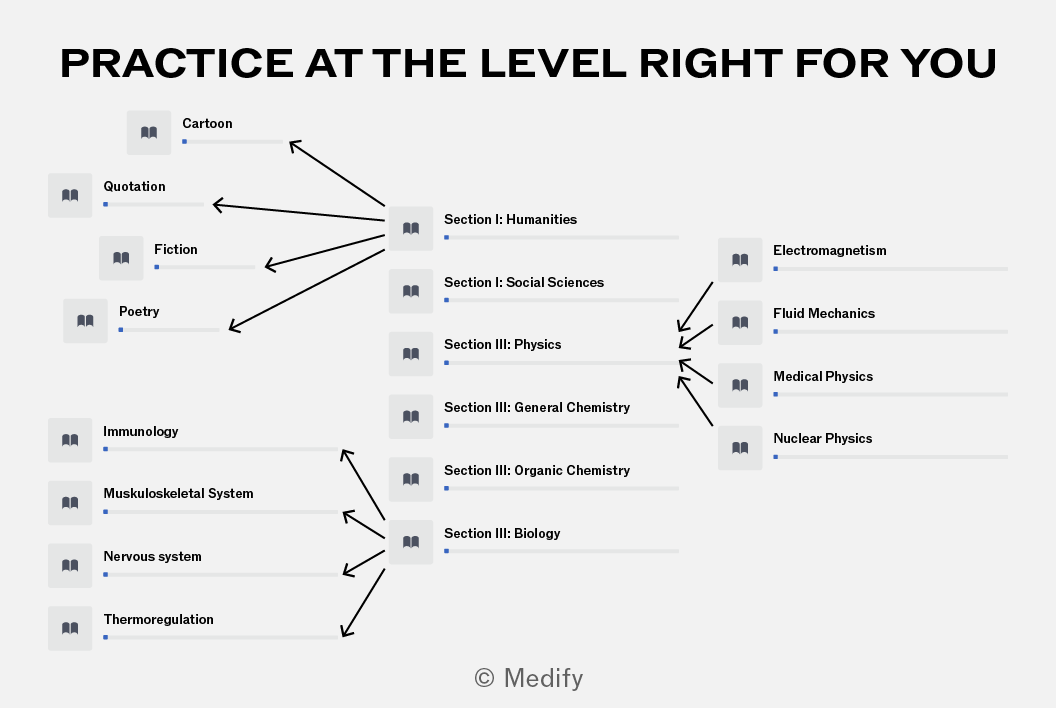
Mixed practice is available at a subject level, or more specific practice sessions can be completed at a topic level.
Untimed practice allows you to select a number of sets to be completed from the subject or topic you have chosen.

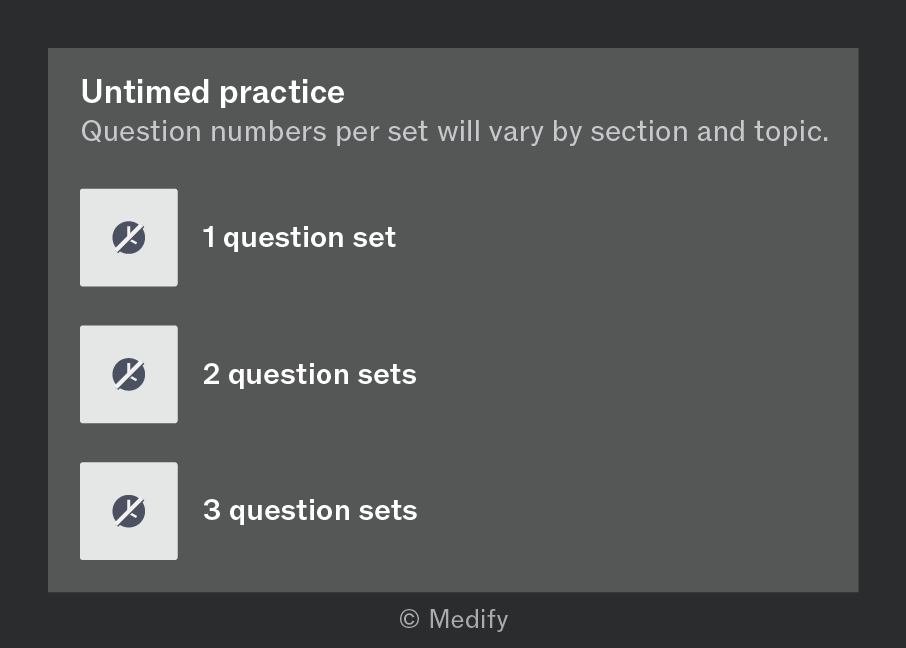
Untimed practice is effective when your goal is to improve your ability to select the correct answer without the pressure of having to think quickly or find shortcuts. It is useful when you are trying to bridge a gap in your base-level comprehension.
Timed practice is available at a subject level but not at a topic level.
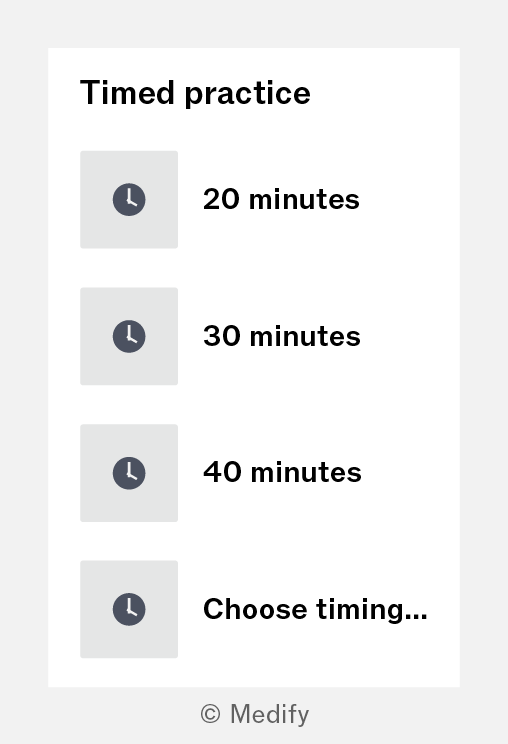

Timed practice enables you to refine your skills in striking a balance between speed and accuracy. Switch your focus in timed mode: narrow down answer options rather than seeking to confirm correctness.
Timed practice sessions contain enough questions to match the exam’s required answering rate.
This is around 1 minute 40 seconds in Section I and 2 minutes per question in Section III.
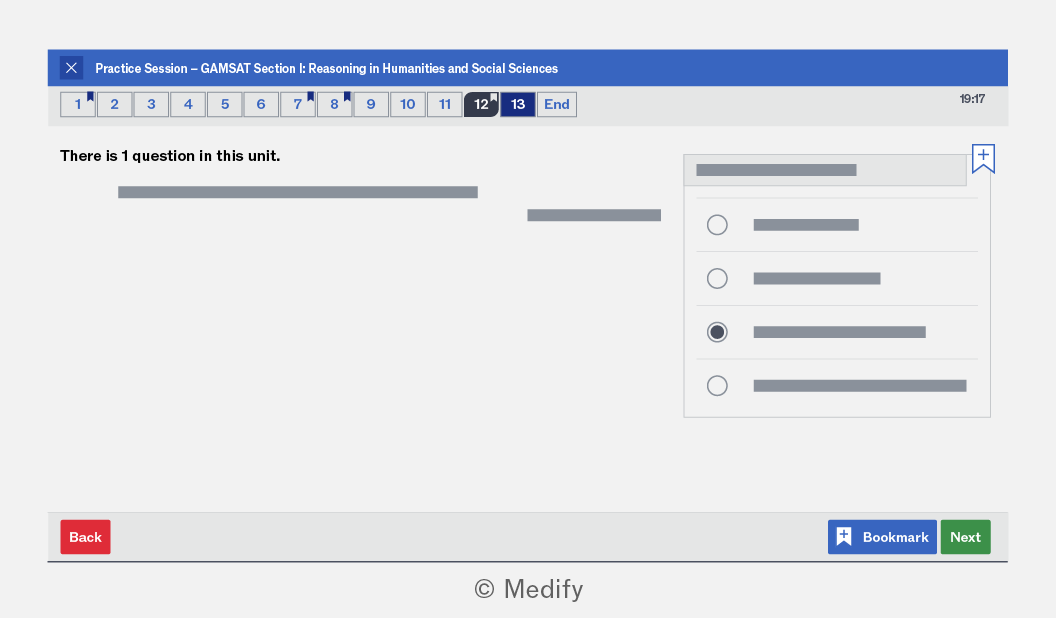
You can use timed practice to explore different triage strategies and to get used to the question navigation and bookmarking facilities available in a mock exam.
Mocks for Sections I and III are available at full length and as shortened tests designed to represent the balance of material present in the full section.
These are great for building stamina and getting a snapshot of your performance at a given time.
All the questions provided on Medify are paired with explanations, guiding you toward the best ways to eliminate incorrect answers and identify the correct one.
You can choose to have explanations permanently visible, or hidden by default if you prefer to find your own mistakes before viewing our guidance.
The Medify team love it when you interact with our review screen. Your feedback helps us make the content we provide even better, and your alternative methods for obtaining the correct answer can inform improvements to the learning experience for future students.