
Nuclear physics
On this page
In 1911, Rutherford’s alpha-particle scattering experiment proved that atoms contain a small, positively charged nucleus at the centre.
An alpha particle is a helium-4 nucleus — consisting of two protons and two neutrons.
In Rutherford’s alpha particle scattering experiment, a beam of alpha particles was fired at a thin sheet of gold foil.
The angles at which the alpha particles were scattered by the gold foil were measured by a circular fluorescent screen.
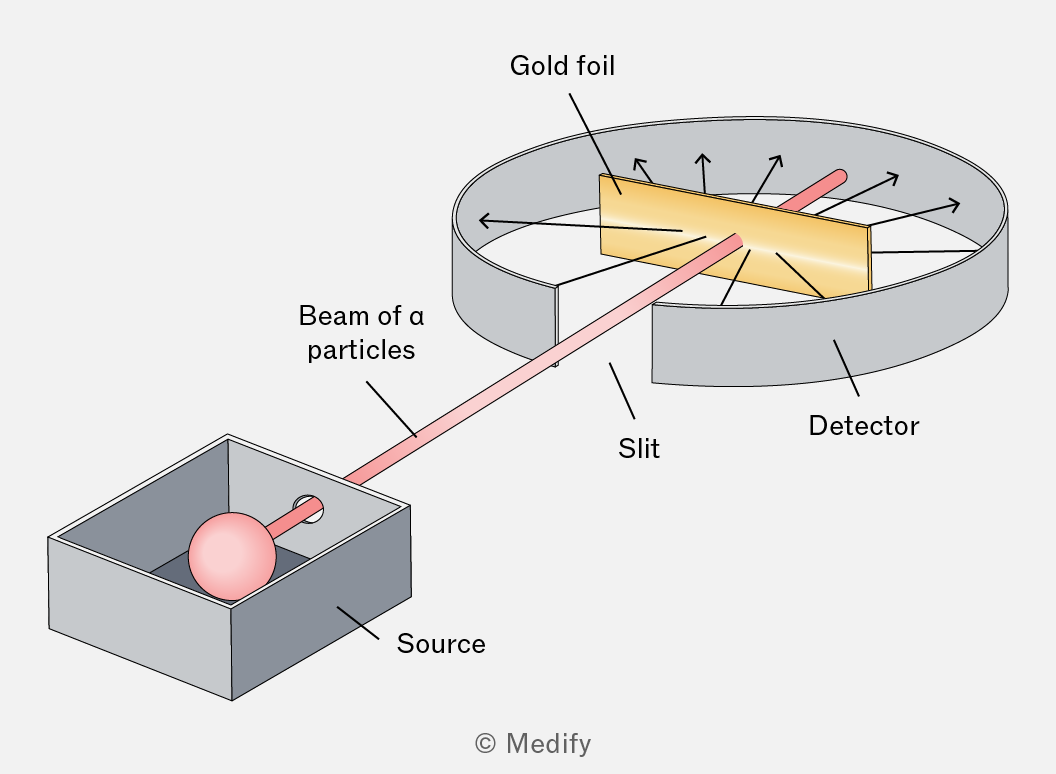
The following observations were made from the alpha particle scattering experiment:
- Most of the alpha particles passed straight through the gold foil (approximately )
- A small fraction of the alpha particles were scattered by an angle greater than (approximately )
- An even smaller fraction of the alpha particles were deflected back toward the source (approximately )
The alpha-particle scattering experiment led Rutherford to the following conclusions about the atom:
- Most of the atom is empty space, since most of the alpha particles passed straight through.
- Most of the mass of the atom is concentrated in the nucleus since the alpha particles had a relatively high momentum and some were still reflected back toward the source.
- The nucleus was positively charged since it repelled the positive alpha particles that passed nearby and caused them to deflect.
The alpha particle scattering experiment determined the existence of the atomic nucleus:
- In 1917, Rutherford determined that the hydrogen nucleus was a single proton.
- Chadwick discovered the neutron in 1933.
- These discoveries led to the nuclear model of the atom, which features a nucleus at the centre surrounded by electrons.
- Niels Bohr later improved this simple model by suggesting that electrons orbit the nucleus at certain distances from the nucleus in electron shells.
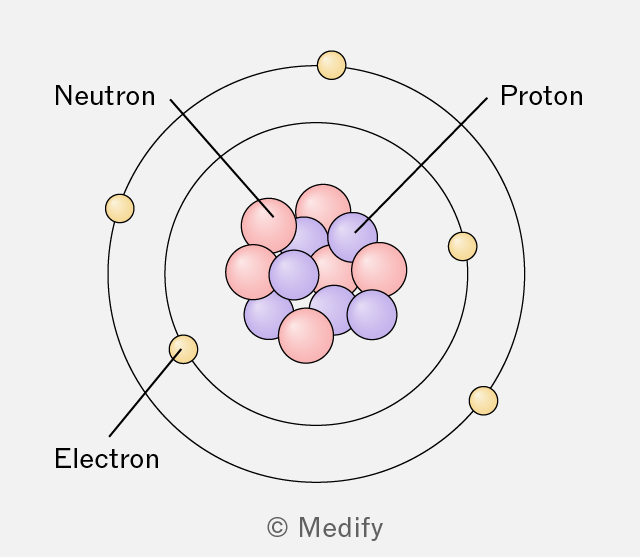
The atomic nucleus consists of protons and neutrons:
- Protons are positively charged and neutrons have zero charge so the overall charge of the nucleus is always positive.
- Protons and neutrons have approximately the same mass.
Electrons occupy quantised or discrete energy levels (shells) within the atom.
- For every atom the number of electrons is always equal to the number of protons so the overall charge is zero.
- The mass of the electron is equal to approximately that of the proton.
It is useful to note in the quantum model, they are found in orbitals rather than fixed circular orbits as described in Bohr’s model of the atom:
In the alpha particle scattering experiment, Rutherford used the distribution of alpha particles to determine an upper limit on the radius of a gold nucleus as having magnitude
An alpha particle and a gold nucleus are both positively charged, so they repel each other.
When an alpha particle is fired directly at a gold nucleus, it will reach a point of closest approach and then travel back in the opposite direction.
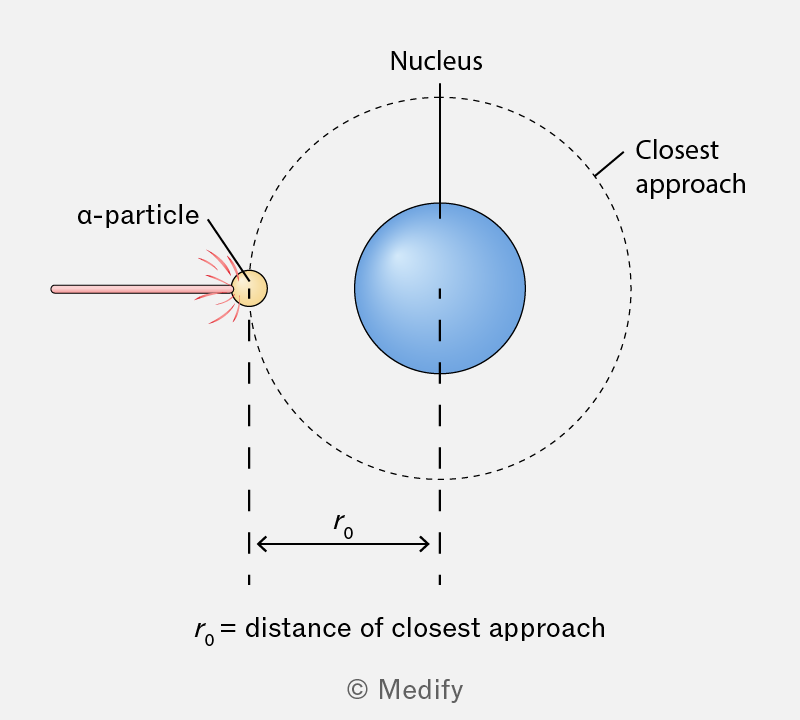
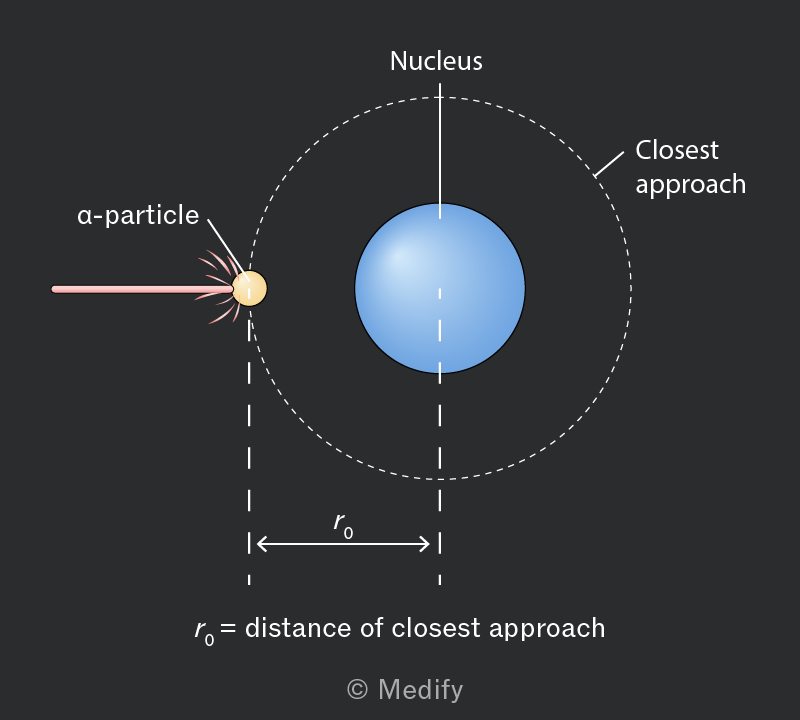
When an alpha particle is fired directly at a positively-charged atomic nucleus, the distance of closest approach can be determined using the principle of conservation of energy.
The alpha particle has maximum kinetic energy when it is fired from a source.
As it travels closer toward the nucleus, the alpha particle experiences a stronger repulsion.
When the alpha particle reaches the point of closest approach, it comes to a stop so its kinetic energy is zero: all of its initial kinetic energy has been converted to electric potential energy
The decrease in kinetic energy is equal to its increase in electric potential energy, so that the sum of the two quantities remains constant and that energy is conserved.
Nuclear radii have now been measured as ranging between to
In the years following the alpha scattering experiment of 1911, X-ray diffraction measurements showed that the atomic radius is approximately five orders of magnitude larger than the nuclear radius.
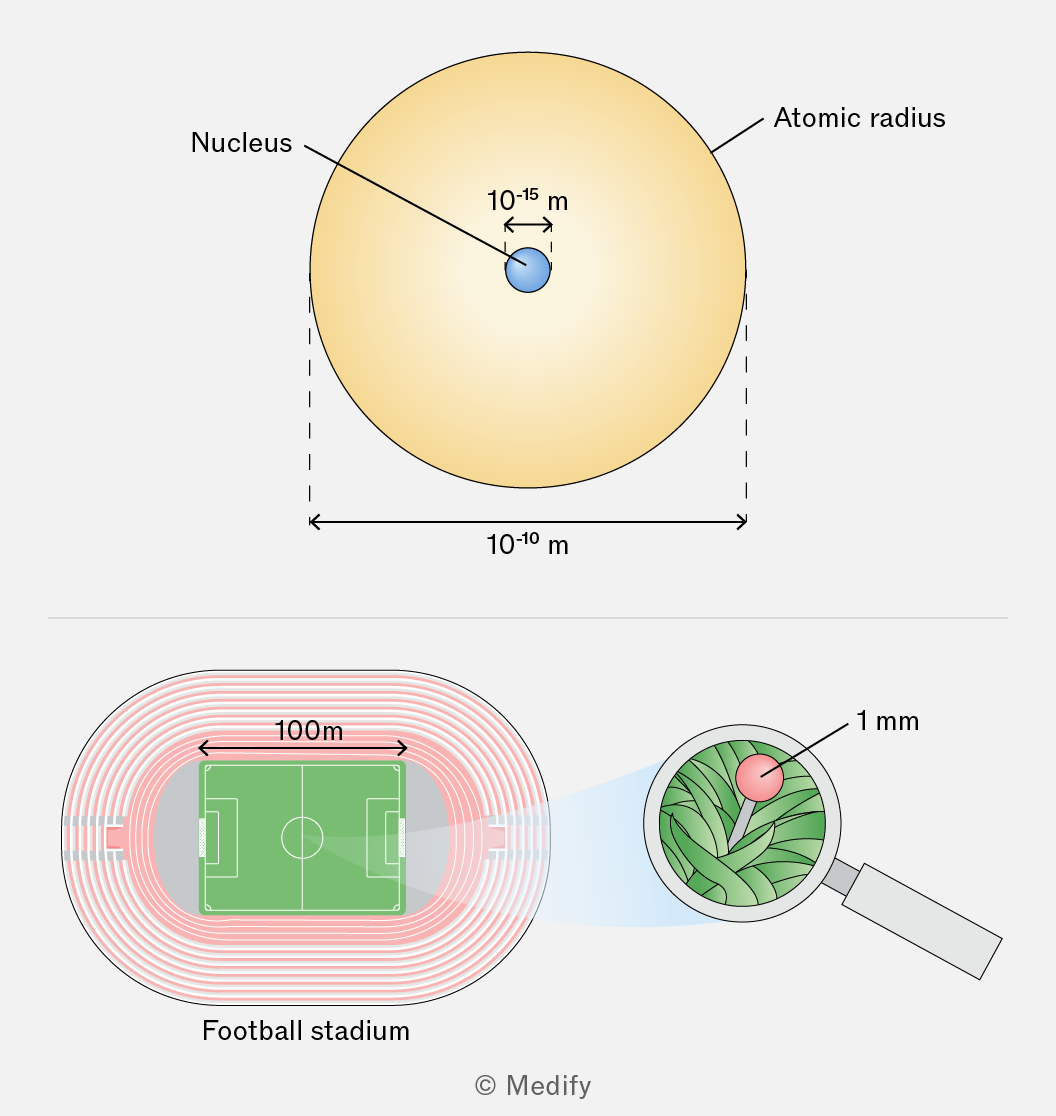
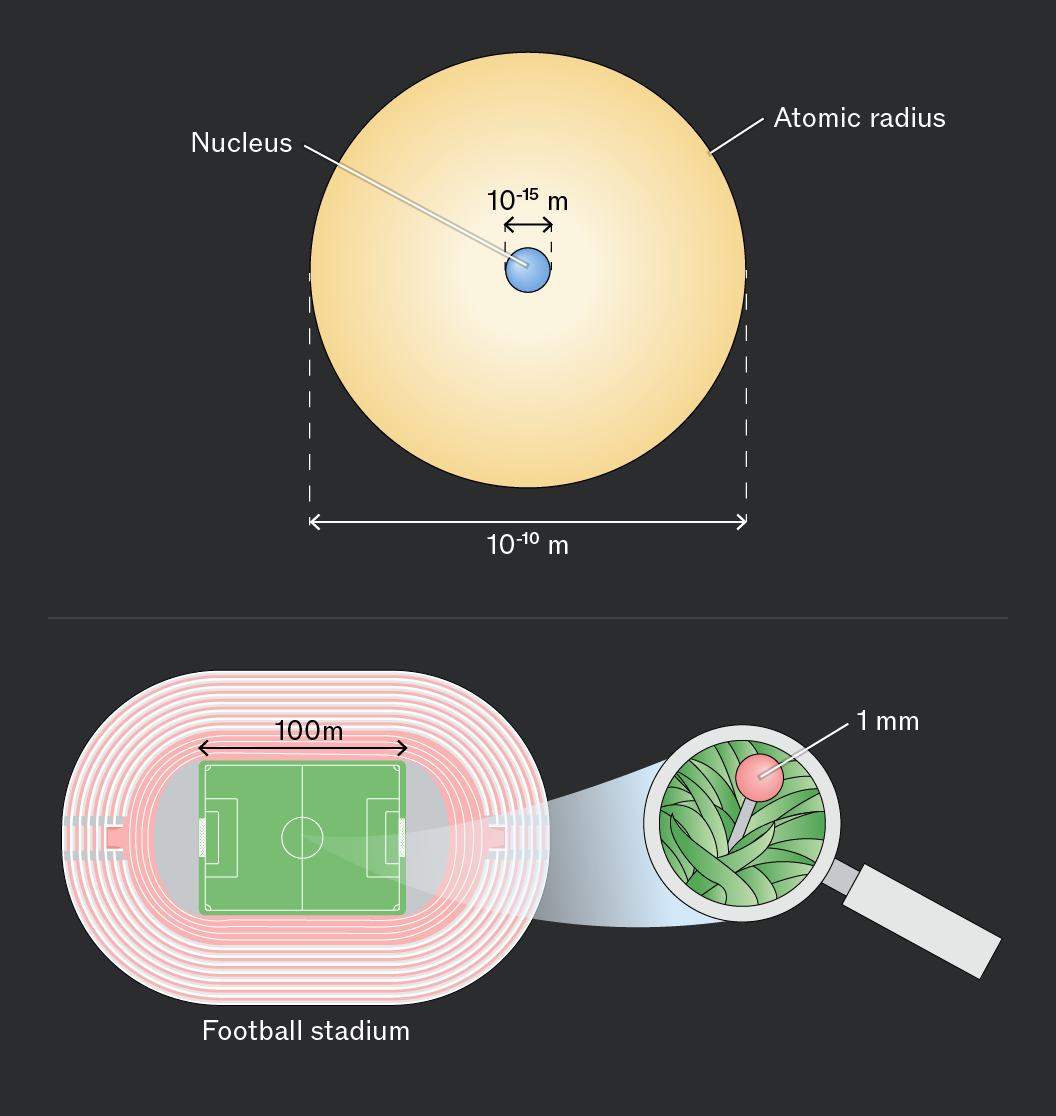
If the nucleus of an atom were the diameter of a needle head, then the atomic radius would be the length of a football field.
The term nucleon refers to particles inside the nucleus: protons and neutrons:
- The proton and the neutron have approximately the same mass.
- The proton has a charge of where is the elementary charge.
- The neutron has no charge.
An atom has no net charge and has the same number of protons as electrons.
For an element the nucleus of an atom of that element can be represented by nuclear notation.


Where:
- is the nucleon number: the total number of protons and neutrons. is also known as the mass number, since it gives the mass of the nucleus in units of the proton (or neutron) mass.
- is the proton number: the number of protons. is also known as the atomic number, since it determines the type of atom.
Isotopes are atoms of the same element that contain a different number of neutrons in their nuclei.
For example, carbon exists in three naturally occurring isotopes: carbon-12 (six neutrons), carbon-13 (seven neutrons) and carbon-14 (eight neutrons).
- Isotopes of a given element have the same number of protons and hence the same number of electrons, meaning they have the same chemical properties.
- Isotopes of a given element have different masses, meaning they have different physical properties, such as melting point and density.
When using nuclear notation, always label the element with the nucleon and proton numbers.
For example, carbon-14 has six protons and eight neutrons.




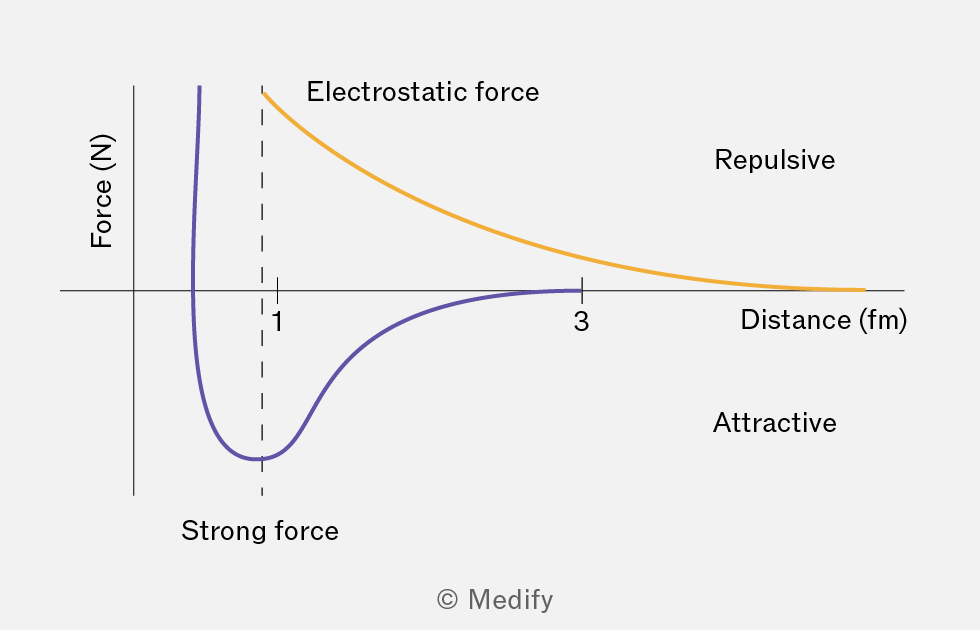
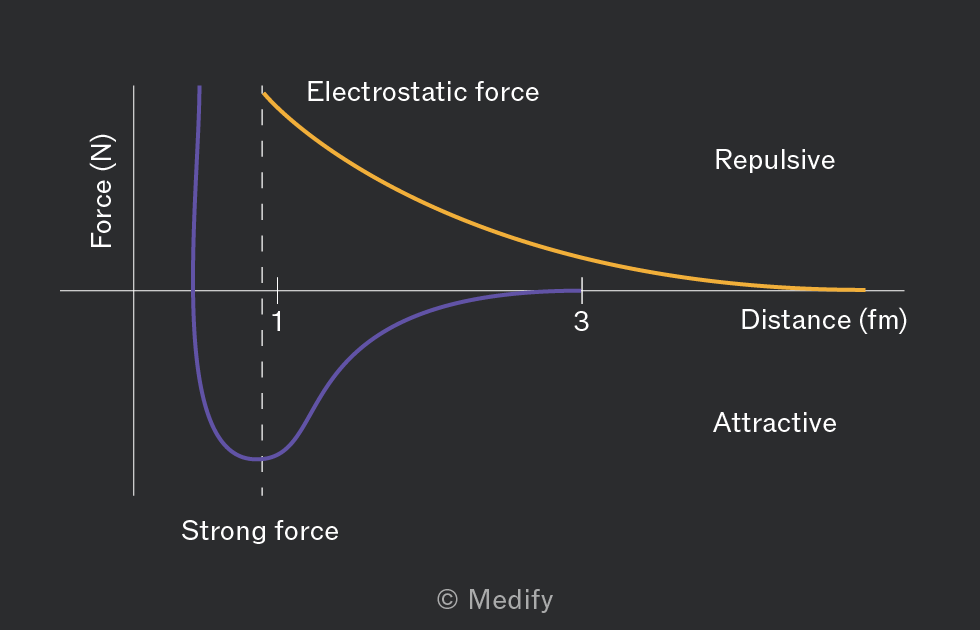
Protons are positively charged. Like charges repel, so protons in the atom should repel each other.
The electrostatic force of attraction between two like charges is inversely proportional to the square of the distance between them:
Therefore, as becomes small, such as the spacing between protons in the nucleus, the electrostatic force of repulsion becomes extremely large.
The size of the nucleus is approximately All protons in an atom are squeezed within this small space. This distance of separation corresponds to extremely large electrostatic forces between protons of about
The electrostatic repulsion between protons in the nucleus is balanced by the strong nuclear force. Colloquially referred to as the strong force:
- The strong nuclear force acts between all nucleons (protons and neutrons) equally.
- The strong force is exclusively a short-range force and becomes practically zero when nucleons are separated by distances of about where is a femtometre, or
- The strong force is repulsive at extremely short distances, meaning that the nucleus does not crush itself.
- The strong force is attractive between distances of approximately and
Electrons moving near the speed of light have de Broglie wavelengths of which is small enough to determine the size of nuclear radii, with size of or by electron diffraction.
This correlates to the scales where the strong nuclear force, which binds the nucleons within an atom, is attractive.
The equation for the approximate radius of a nucleus has been determined by electron diffraction experiments.
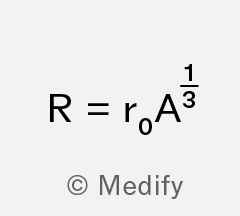
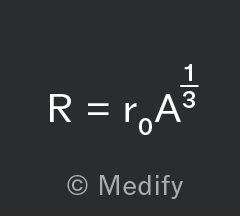
Where:
- is the nucleon number of the nucleus,
- and is a constant.
Nuclei have an extremely large density, of order The density of a nucleus is defined as its mass (in ) divided by its volume (in ).
The density of atomic nuclei is many orders of magnitude greater than the density of everyday materials. For example:
- the density of air is
- the density of water is
- and the density of lead is
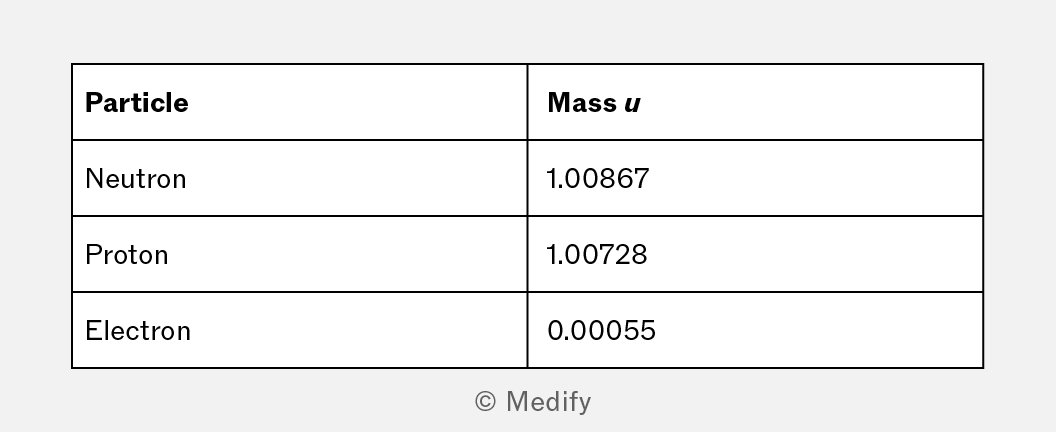
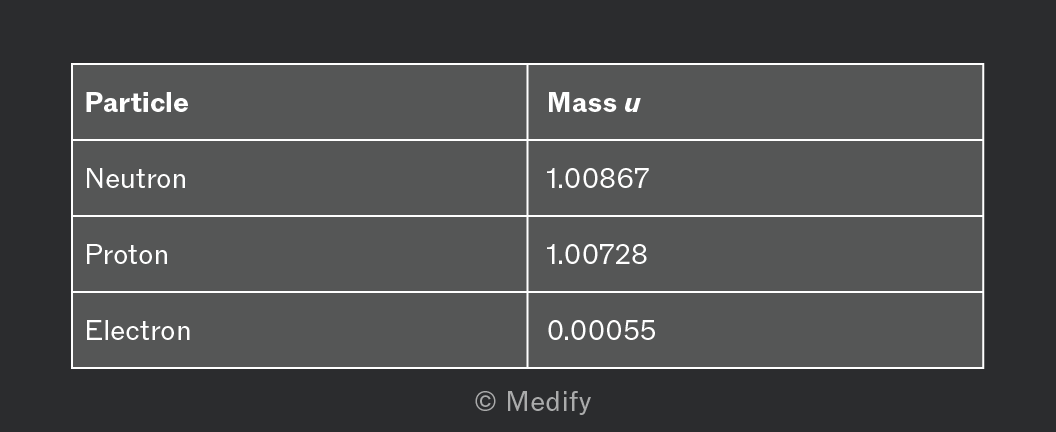
Atomic mass units are used to express the mass of atoms and nuclei.
One atomic mass unit is equal to the mass of a neutral carbon-12 atom divided by 12:
- the small difference in mass between the proton and neutron has a significant impact on the binding energy of nuclei.
- it is essential to make accurate calculations of the average atomic mass of an element that exists in a mixture of isotopes.
The mass of a nucleus is approximately given by its nucleon number multiplied by the atomic mass unit, since the proton and neutron each have a mass of approximately
The electron has a mass of approximately
Unstable atomic nuclei can break down by radioactive decay. Radioactive decay releases radiation from the nucleus in the form of photons, matter or antimatter particles.
After the decay, the remaining nucleus, called the daughter nucleus, is more stable than the original nucleus.
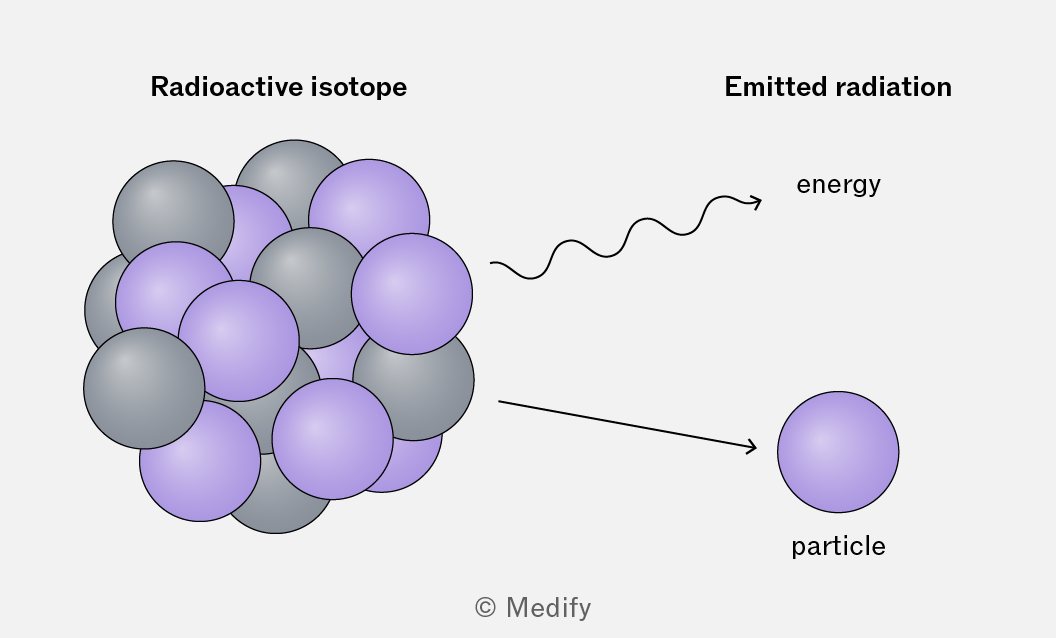
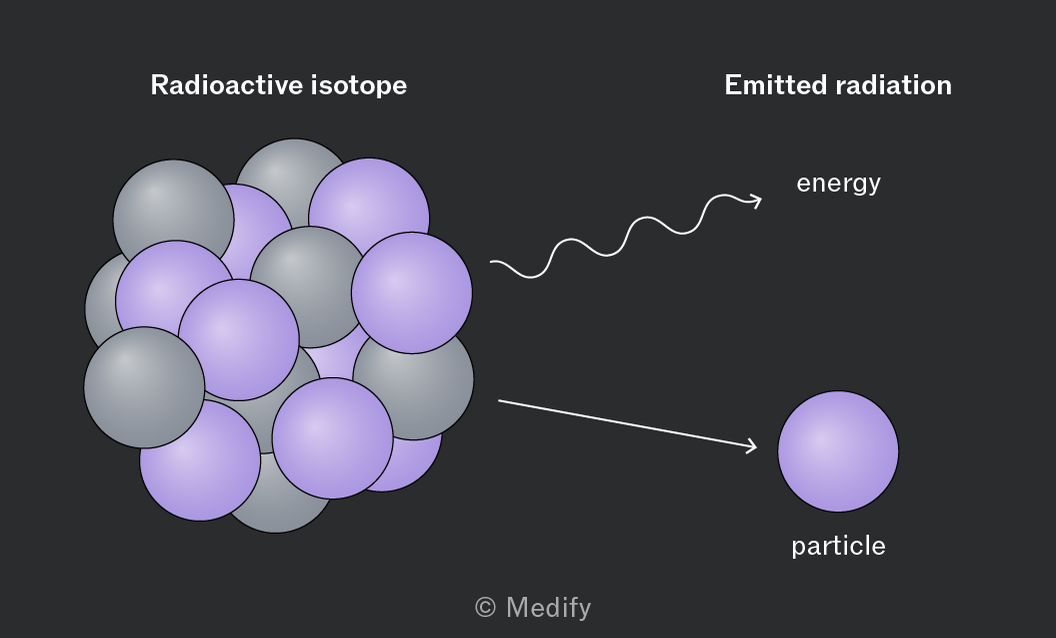
Radioactive decay is a completely random process: in a sample of radioactive nuclei, it cannot be known which nucleus will decay first.
Radioactive decay is spontaneous: the decay of the nuclei in a radioactive sample is not affected by the presence of other nuclei or any external factors. For example, heating up a sample or increasing its pressure will not make the nuclei decay faster.
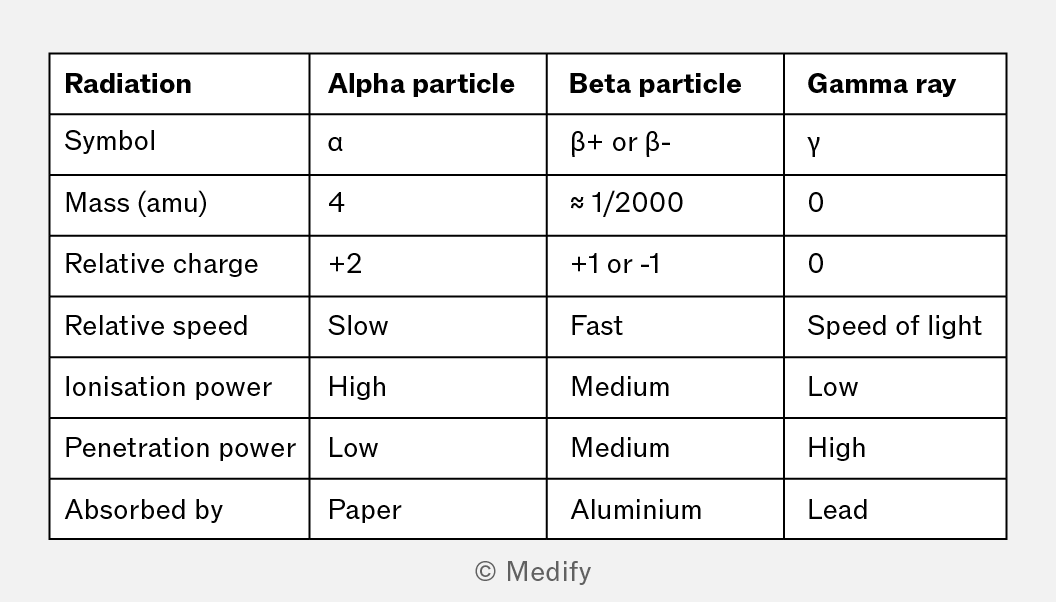
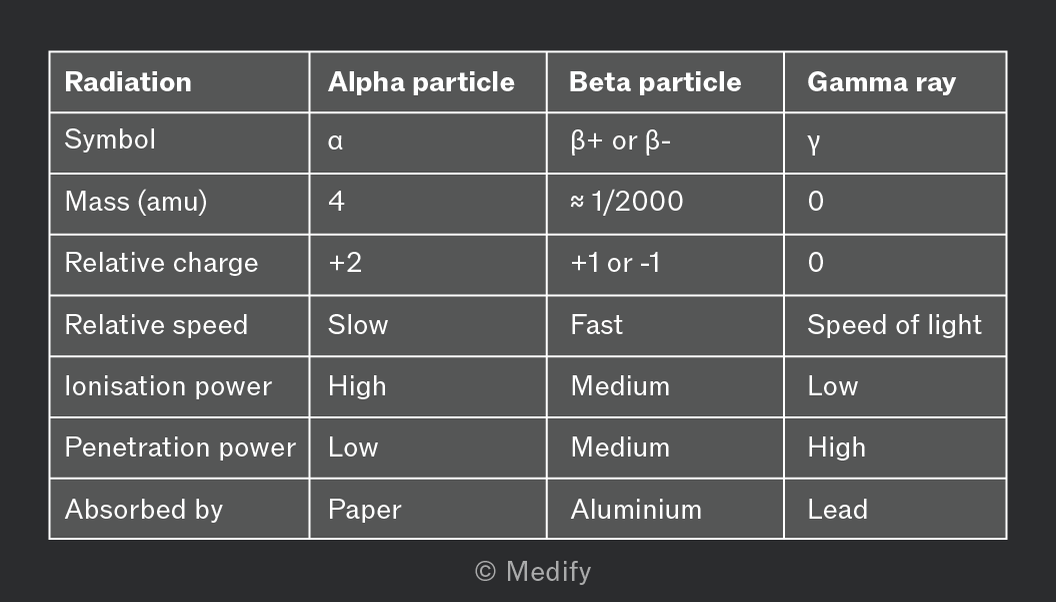
Ionising radiation includes three main types: alpha particles, beta particles and gamma rays, which have sufficient energy to remove electrons from atoms:
- The ionisation power of radiation is the ability to ionise atoms: a greater mass leads to a greater ionisation power.
- Penetration power of radiation is the ability to penetrate through matter: a smaller mass leads to a greater penetration power.
The table below summarises some of the properties of each type of radiation.
Alpha particles
- Made of two neutrons and two protons: a helium nucleus
- Emitted from nuclei that are too large to be stable
Beta particles
- Beta-minus particles are high-energy electrons, emitted from nuclei with too many neutrons to be stable.
- Beta-plus particles are high-energy positrons, emitted from nuclei with too many protons.
Gamma rays
- High energy electromagnetic waves
- Emitted from a nucleus that has excess energy after alpha or beta decay
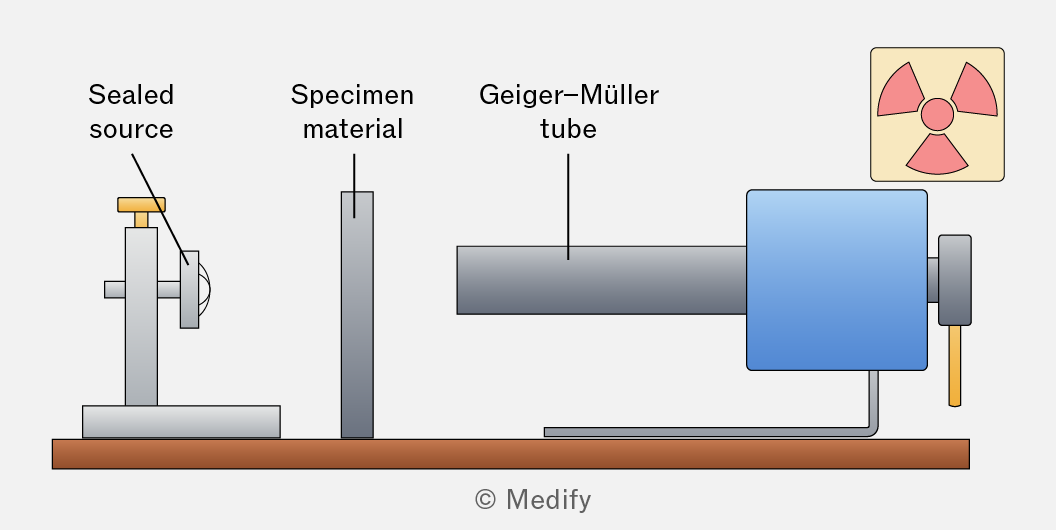
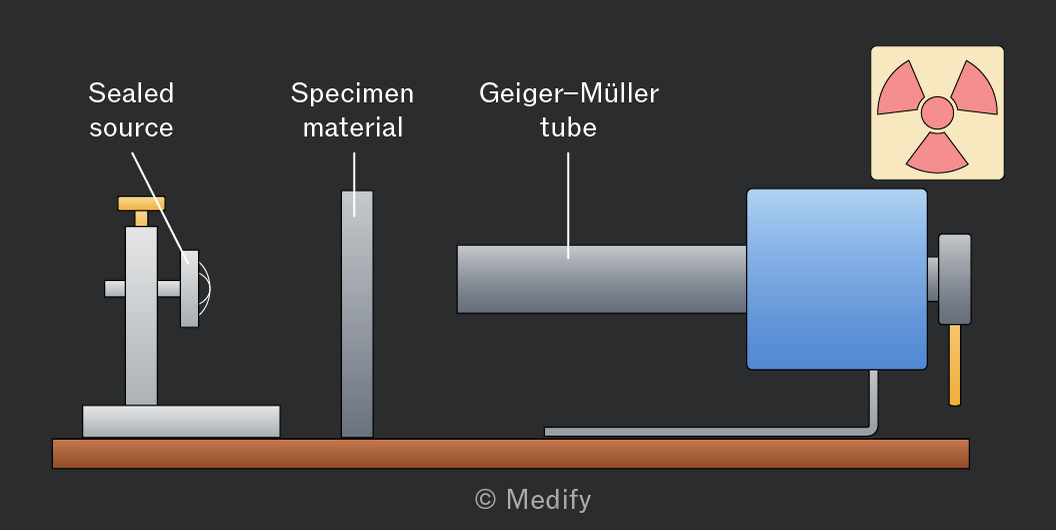
This tip details an experiment to investigate the penetration of different forms of radiation using a radioactive source and Geiger–Müller tube (the sensing element of a Geiger counter):
- Independent variable: specimen absorber material.
- Dependent variable: count rate.
- Controls: distance between source and Geiger counter, background radiation and the sealed source.
Method:
- Without the source, measure the background count rate three times for one minute and take the average.
- Place the sealed source a fixed distance of from the Geiger–Müller tube and take another reading. Note that the source should be sealed in a lead box and only moved with tongs.
- Now place a specimen material between the source and Geiger–Müller tube. The specimen materials used are: paper, aluminium sheets and lead.
- Using one specimen material at a time, take three count rate readings over one minute and calculate an average.
On the periodic table, all elements are represented by nuclide notation:
Where:
- is the nucleon number: the total number of protons and neutrons. is also known as the mass number, since it gives the mass of the nucleus in units of the proton (or neutron) mass.
- is the proton number: the number of protons. is also known as the atomic number, since it determines the type of atom.
Radioactive decay of a nucleus alters the nucleon number and/or the proton number.
Alpha decay occurs when a nucleus has too much mass, which makes the nucleus unstable.
In large nuclei with more protons, the larger electromagnetic repulsion between the protons becomes larger compared to the strong nuclear force holding the nucleus together and makes the nucleus unstable.
The daughter nucleus will have a lower mass number by four and a lower proton number by two.
Beta minus decay releases a high speed, high energy electron.
Beta minus decay occurs in nuclei with too many neutrons: a neutron in the nucleus is converted to a proton, an electron, and an electron antineutrino.
The daughter nucleus will have an increased proton number since the beta minus particle has a −1 proton number. The lepton number must be conserved, hence an antineutrino is also emitted.
Beta plus decay releases a positron – the antiparticle of an electron – which has a positive charge.
Beta plus decay occurs in nuclei with too many protons; a proton in the nucleus is converted to a neutron, a positron and an electron neutrino.
The daughter nucleus will have a decreased proton number since the beta plus particle has a +1 proton number. The lepton number must be conserved, hence a neutrino is also emitted.
Gamma decay occurs following decay from alpha and/or beta decay, where the daughter nucleus still has too much energy to be stable. No particles are released.
The daughter nucleus will have a preserved nucleon and proton number. Only energy is expelled through gamma decay.
Radioactive decay is spontaneous and random. Therefore, radioactivity is described through an average decay rate.
Although it is impossible to know when a specific radioactive isotope will decay, radioactive samples have many, many nuclei, which makes the decay behaviour follow statistical patterns. For example, one gram of hydrogen contains nuclei.
The activity of a sample is the number of decays per unit time, and is measured in becquerels . An activity of of a beta radiation source means there are 1000 beta particles released per second.
Activity depends on the decay constant and the number of nuclei in the sample:
The decay constant, is the probability that a given nucleus will decay per second. It has units of inverse seconds , and a larger value results in a higher level of activity.
The half-life of a radioactive sample is the time taken for half of the nuclei to decay: this can be measured from experimental trials.
For any radioactive sample, the product of the half-life and the decay constant is :
This equation shows that half-life and the decay constant are inversely proportional, since the above equation can be rearranged to:
Therefore, the shorter the half-life, the larger the decay constant and the faster the decay.
The nuclei in a radioactive sample decay at a rate proportional to the total number of nuclei, Mathematically, this is exponential decay: the number of undecayed nuclei decreases exponentially with time.
For an initial number of unstable nuclei the number of unstable nuclei remaining after a time can be found through the following equation:
Where is the decay constant. Substituting this into the equation for activity,
where the initial activity has been written as:
Radioactive decay is a random and spontaneous process:
- It cannot be known when a particular nucleus will decay.
- The rate of decay is unaffected by external conditions.
Radioactivity can be modelled by rolling a large number of dice:
- Every die represents an unstable undecayed nucleus in a sample.
- Roll each dice and remove those that land on one.
- The dice with a one have decayed into a stable daughter nucleus (of a different element)
- Remove the ‘decayed’ dice from the sample
- Repeat this rolling procedure several times.
- Record the number of ‘undecayed’ dice remaining after each roll.
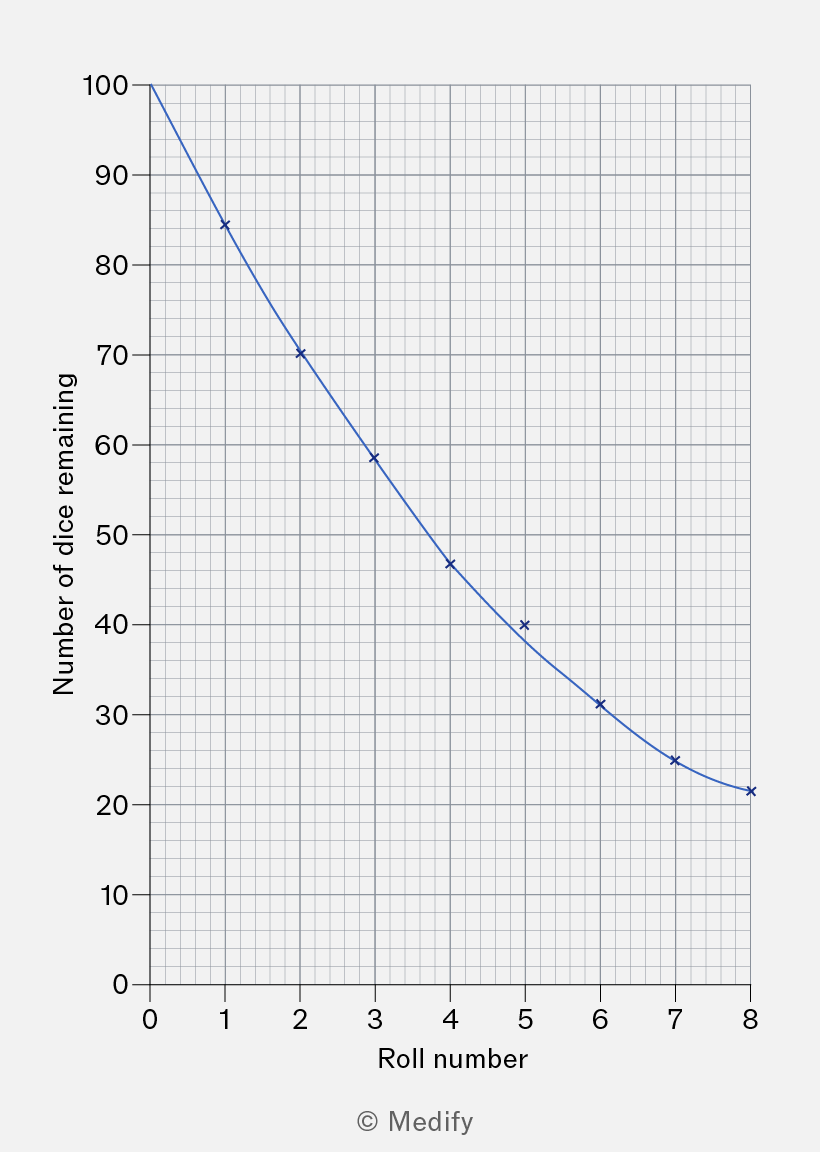
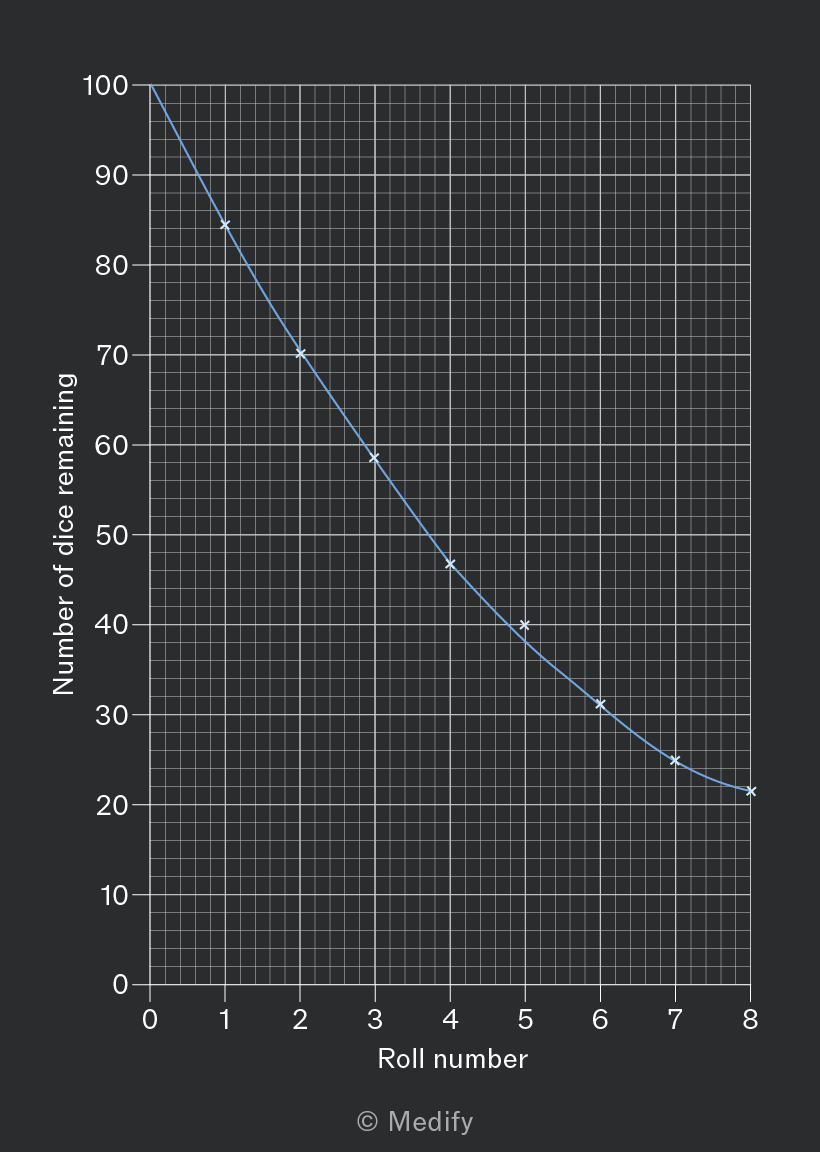
The example plot above of the number of dice remaining against roll number for the method outlined above follows the same exponential decay curve as the activity of a radioactive source.
If the roll number corresponds to the time in seconds, then the probability of rolling a one is , which corresponds to the decay constant: the probability of decay of a given nucleus per second.
The activity of a radioactive sample is:
Activity is defined as the number of decays per unit time, which can be written as:
Where:
- is the change in the number of nuclei in a short time period, and
- represents the time inverval. It must be short in comparison to the half-life so that the activity can be assumed to be constant. There is a minus sign because the number of nuclei remaining decreases.
Combining these two equations gives:
By selecting a small time interval the decrease in the number of undecayed nuclei in a radioactive sample can be modelled by:
Where is the number of undecayed nuclei at the start of the time interval. Note that the negative sign is not included as is defined as the decrease in the number of undecayed nuclei.
The equation can be used over successive time intervals to find the approximate number of undecayed nuclei over time. This method is referred to as iterative modelling. The number of undecayed nuclei is given exactly by which can be compared to the values obtained by the iterative modelling method.
The table below shows the results of the iterative modelling method compared to the true values for and which corresponds to
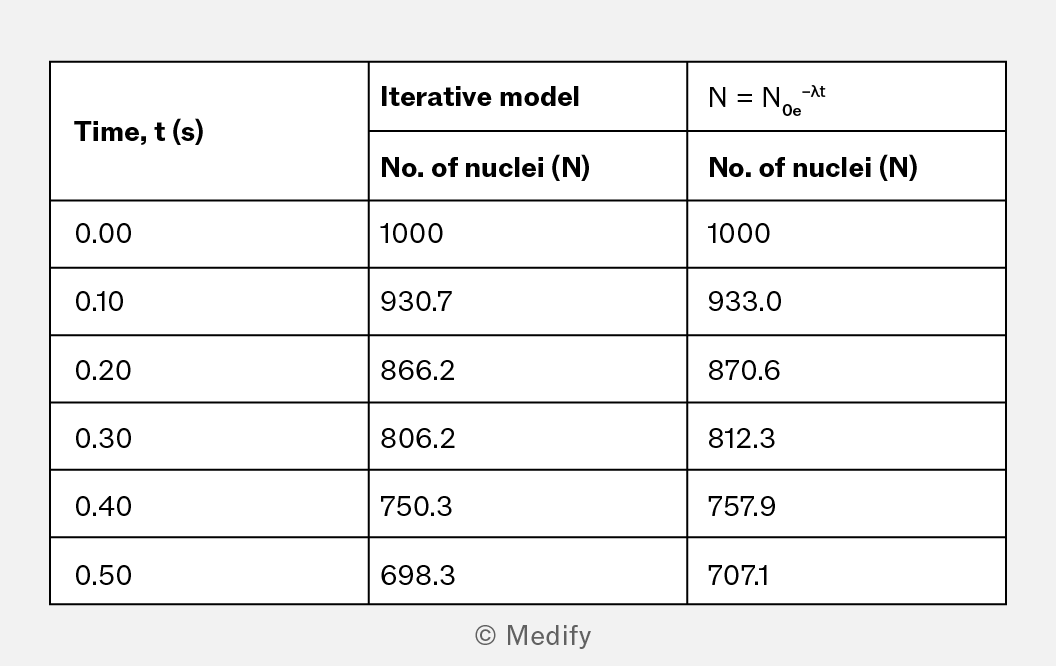
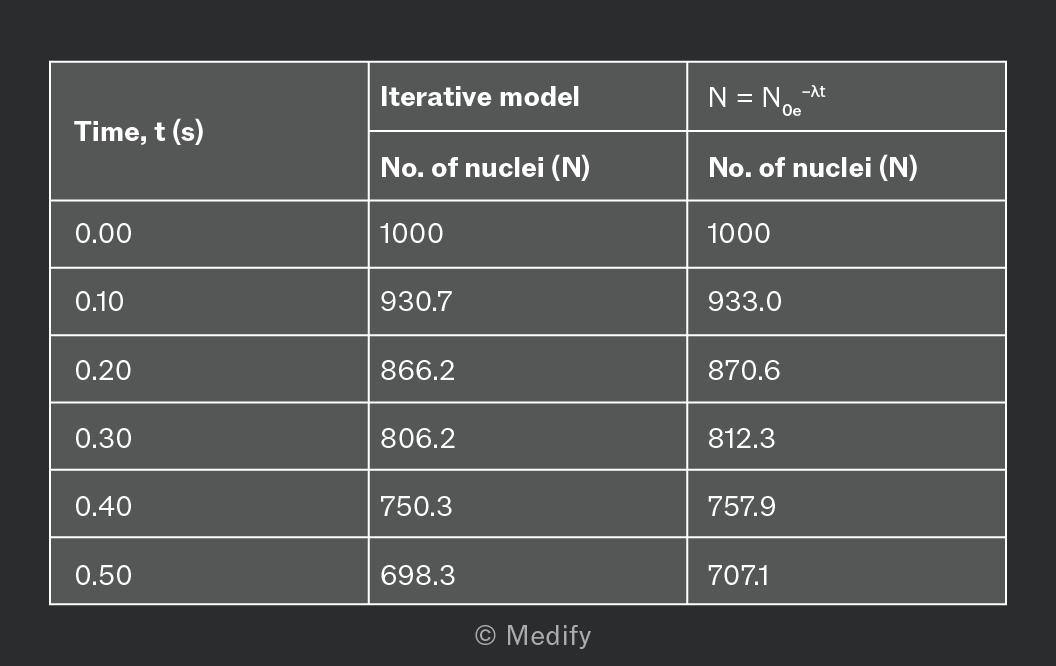
The two models show good agreement, even with the large time interval of (compared to the half-life). Using a smaller time interval would make the iterative model even more accurate.
In a radioactive sample, the number of unstable nuclei decays exponentially with time
Exponential decay shows a characteristic downwards curve, which can be used to calculate the half-life.
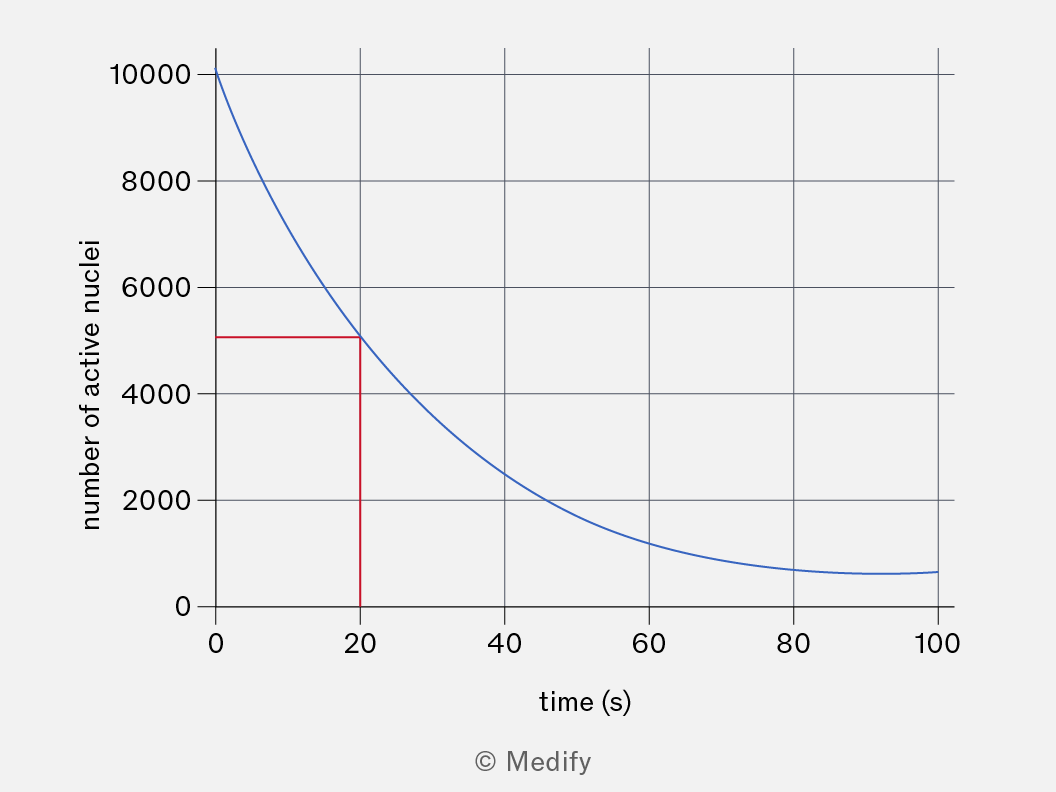
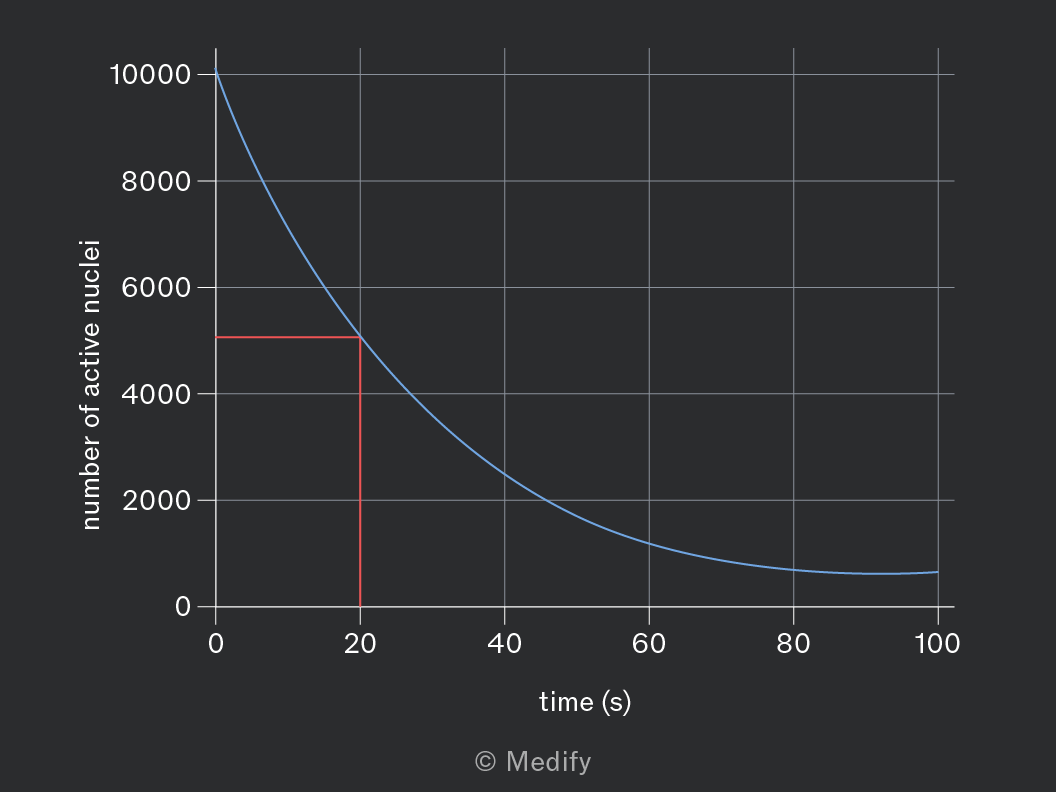
The half-life can be found by finding the time at which the initial number of unstable nuclei falls to ; shown in red as 20 seconds for the curve above.
After two half-lives, the number of unstable nuclei remaining will be . Therefore, multiple values of the half-life can be calculated and averaged to obtain a more accurate value.
An exponential graph can be plotted on a logarithmic scale to produce a straight line graph, which is useful for calculating the half-life. Rearranging
1) Take logarithms of both sides, remembering that
2) Rearrange into the equation of a straight line,
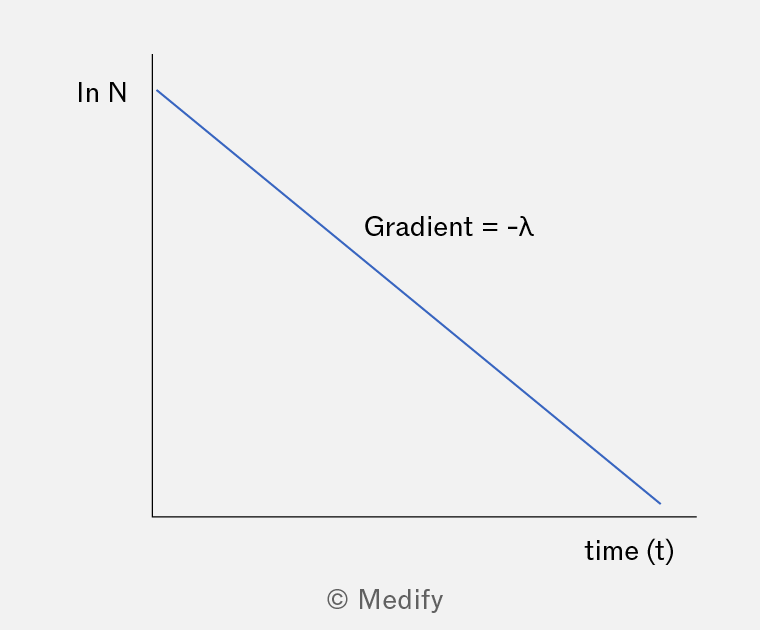
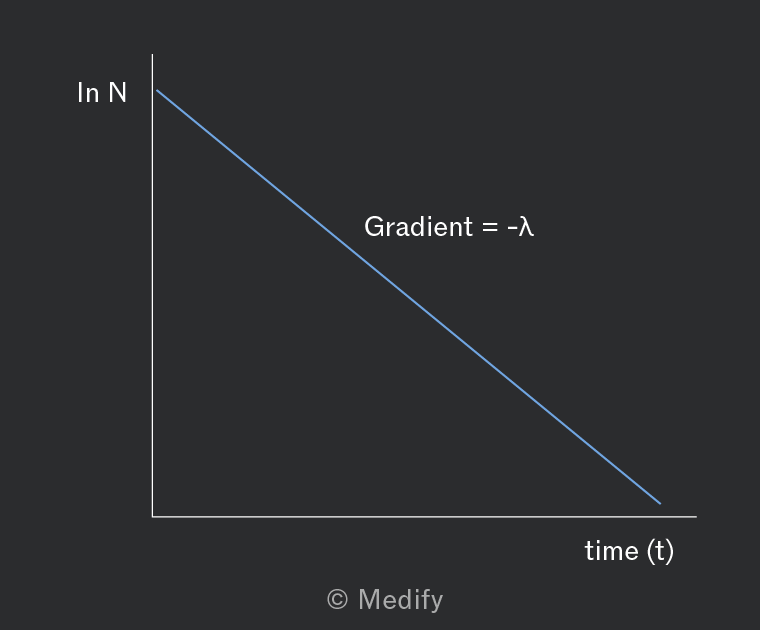
Plotting against gives a straight line with equal to the negative of the gradient.
The half-life can be calculated from:
Carbon exists as three naturally occurring isotopes: C-12, C-13 and C-14. C-14 is radioactive and decays with a half-life of via beta decay.
The ratio between C-14 and C-12 in the atmosphere is approximately constant:
Living organisms absorb carbon through photosynthesis or by eating other carbon-rich organisms. The ratio of C-14 to C-12 will match atmospheric ratios. After an organism dies, it will no longer absorb carbon but the C-14 it contains will continue to decay.
Dead tissue samples can be tested to measure the C-12 to C-14 ratio and by comparison to atmospheric levels, the time since death can be estimated. This is known as carbon-dating.
There are negatives to using carbon-dating to find the age of a dead organism:
- The method assumes a constant C-14 to C-12 atmospheric ratio, ignoring possible fluctuations with time.
- Small organisms might have undetectable traces of C-14 compared to background radiation.
- For organisms around 40,000 years old, less than 1% of their C-14 remains, which is often too small to detect.
Albert Einstein proposed that energy and mass are interchangeable and demonstrated this with his famous equation:
Where:
- is energy ,
- is mass , and
- is the speed of light in a vacuum .
The equation tells us that mass and energy are essentially the same thing and therefore equivalent, but have different forms. When we multiply mass by the speed of light squared, we get the amount of energy equivalent to that amount of mass.
An example of mass–energy equivalence is the annihilation of an electron–positron pair. When the two particles collide, they annihilate and produce two photons. The mass of the electron and positron is converted into two photons, i.e., energy.
When there is a change in the mass of an object or system, then there is an equivalent change in the amount of energy represented by Einstein’s equation:
A moving object possesses kinetic energy. Thus, the equation implies that the object’s mass when it is moving is greater than its mass while at rest (rest mass).
During radioactive decay, unstable nuclei decay by ejecting radiation in the form of particles such as alpha particles or high-energy photons in order to transition to a more stable state.
For example, during alpha decay, the initial nucleus (the parent nucleus) is unstable and emits an alpha particle (a helium nucleus) to become more stable, resulting in a more stable daughter nucleus:
The daughter nucleus recoils in the opposite direction to the alpha particle’s trajectory, so that mass, momentum and energy are conserved.
Energy is released during nuclear decay reactions. Therefore, there must also be an equivalent decrease in the total mass of the system.
This means that the total mass of the daughter nucleus and alpha particle combined must be less than the mass of the parent nucleus, i.e. the decrease in mass is equivalent to the amount of energy released from the reaction
This principle is also true for beta-minus and beta-plus decay:
In some nuclear reactions, energy may be absorbed. This occurs when there is an increase in the total mass of the system, i.e. the total mass of the products is greater than the total mass of the reactants.
This increase in mass, is equivalent to the amount of energy absorbed in the reaction, For example, this occurs in the fission of light elements and the fusion of heavy elements (heavier than iron).
All particles have a corresponding antiparticle. They are similar in every aspect, except that they have opposite charges. When a particle and its corresponding antiparticle collide, they annihilate each other: all of the particle’s mass is converted into energy, typically in the form of photons.
An example of the process of annihilation is electron–positron annihilation:
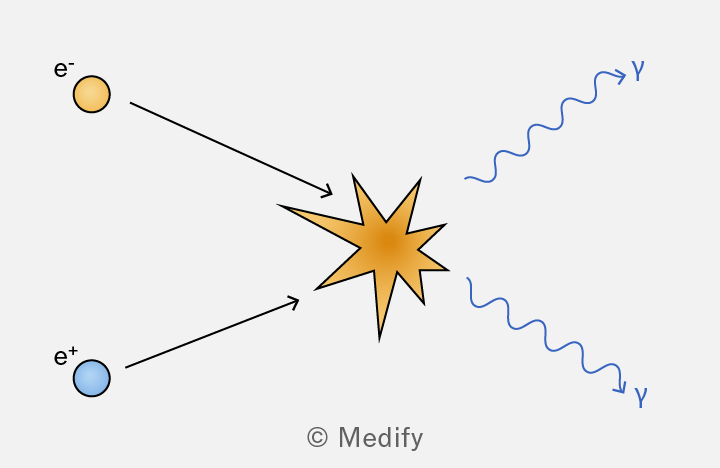
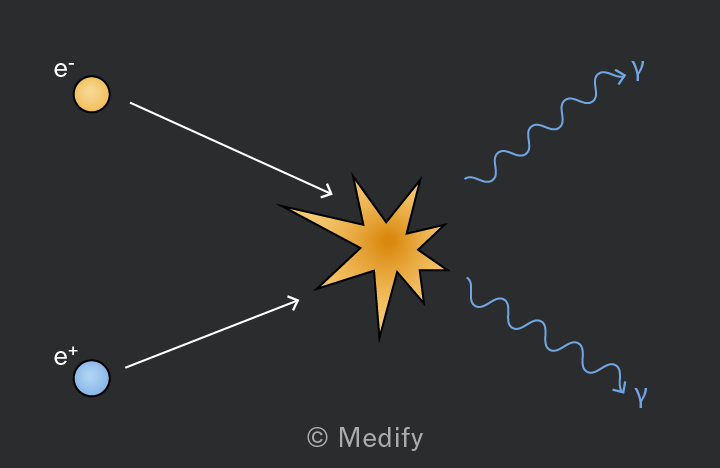
The electron has an associated antiparticle known as the positron . The electron and the positron are similar in every aspect, except that they have the opposite charge. When an electron and positron collide, they annihilate and all their mass is transformed into energy in the form of two identical photons.
A process opposite to annihilation can occur, in which a photon transforms into a particle-antiparticle pair: this is known as pair production.
For example, a photon may create an electron–positron pair, provided the photon has an energy that is equal to at least twice the rest-mass energy of the electron i.e.
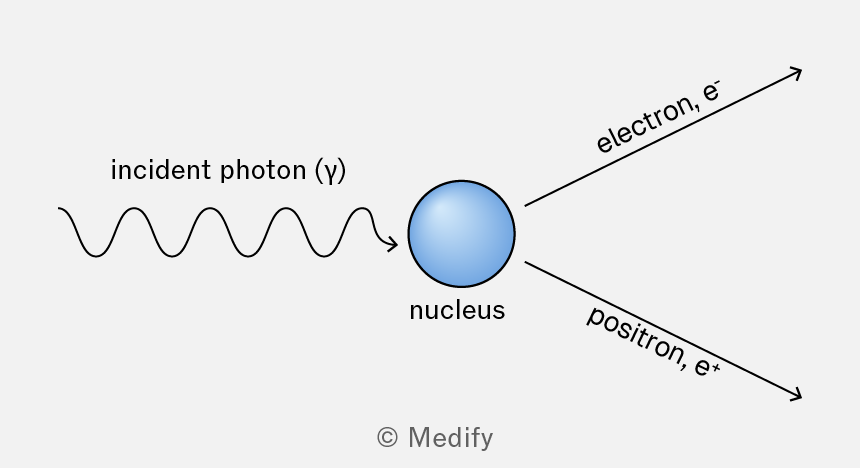
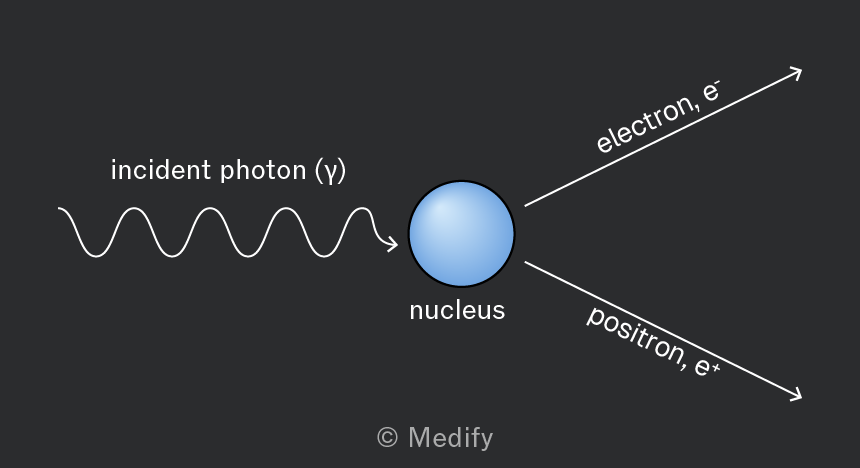
For pair production to occur, a photon must enter into the Coulomb field of a nearby atomic nucleus: it cannot happen in free space. This is because the reaction requires energy and momentum to be conserved.
In free space, the momentum of the electron and positron combined would not equal that of the photon’s initial momentum. Therefore, the nucleus absorbs some of the photon’s initial momentum, thus obeying conservation laws in the reaction.
In order to split nuclei apart, we need to supply energy in order to overcome the strong attraction between the nucleons due to the strong nuclear force.
According to Einstein’s mass–energy equation, which states mass and energy are equivalent, the total mass of the split nucleons must be greater than the mass of the bound nucleus itself. This is because the energy is supplied in order to break the nucleus apart.
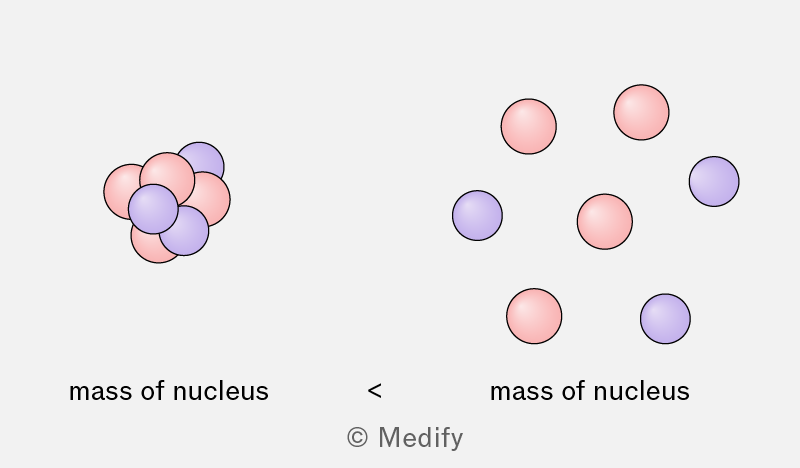
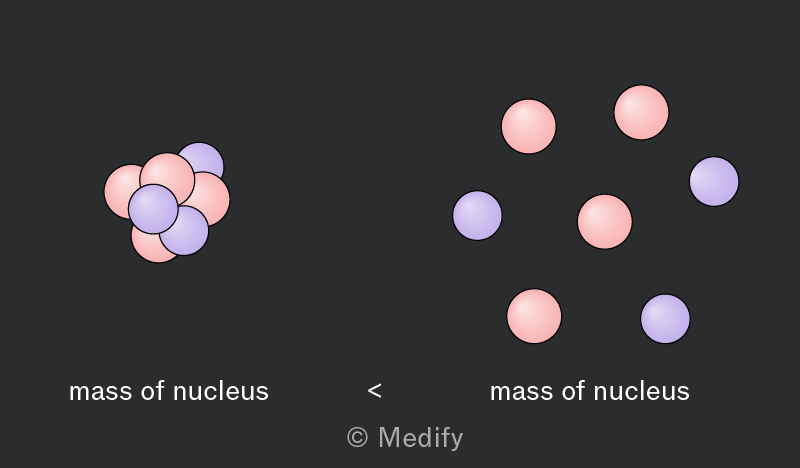
The definition of the mass defect of a nucleus is the difference between the mass of the separated nucleons and the mass of the bound nucleus.
The mass defect of a nucleus can be converted into a corresponding amount of energy using Einstein’s equation. This energy represents the binding energy of the nucleus.
The definition of the binding energy of a nucleus is the minimum energy required to completely separate a nucleus into its constituent protons and neutrons.
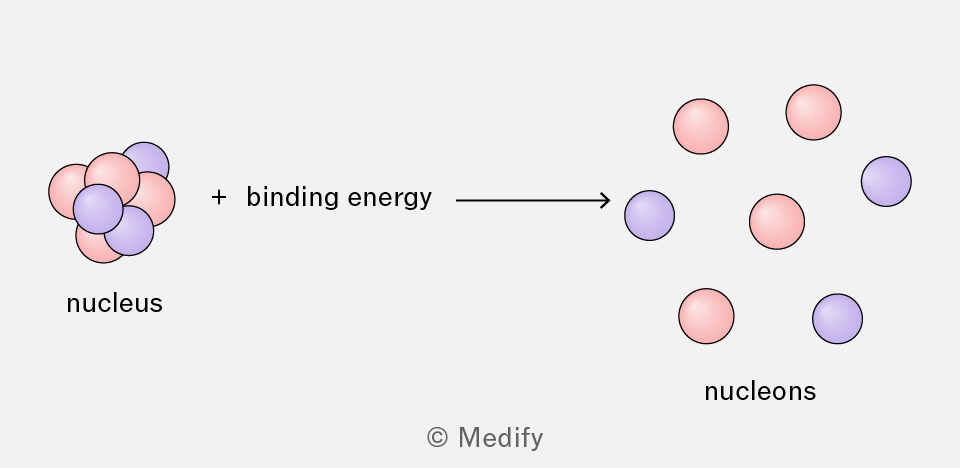
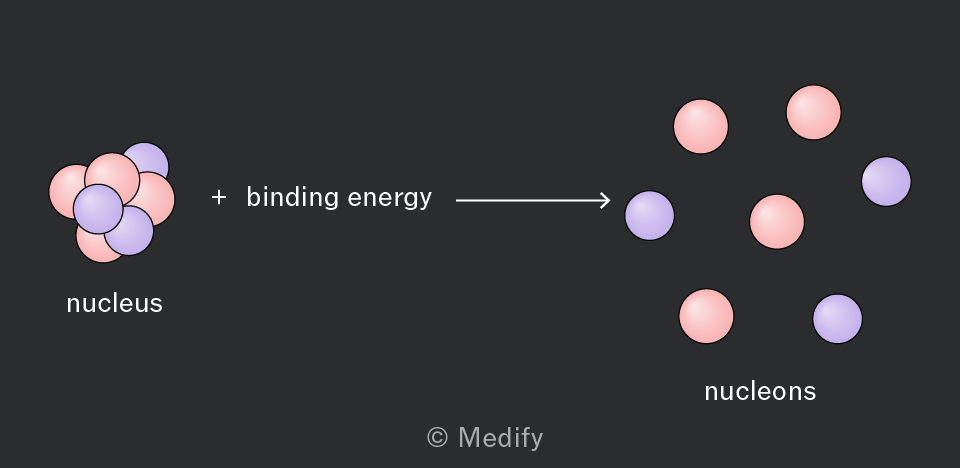
The more tightly bound a nucleus is, the harder it is to separate the nucleons and split them apart. Remember, the binding energy is what holds the nucleus together and not the entire atom.
We can measure how tightly bound a nucleus is and make comparisons with other nuclei by considering the average binding energy per nucleon.
The average binding energy per nucleon is defined as the total binding energy of a nucleus divided by the number of nucleons it contains. It represents the energy required to remove a single nucleon, on average, from the nucleus.
The greater the average binding energy per nucleon, the more tightly bound the nucleus. The more tightly bound the nucleus, the more stable it is.
By plotting the average binding energy per nucleon against the atomic mass for all elements in the periodic table, we can visualise which elements have the most tightly bound nuclei and see how this changes as the size of the nucleus increases.
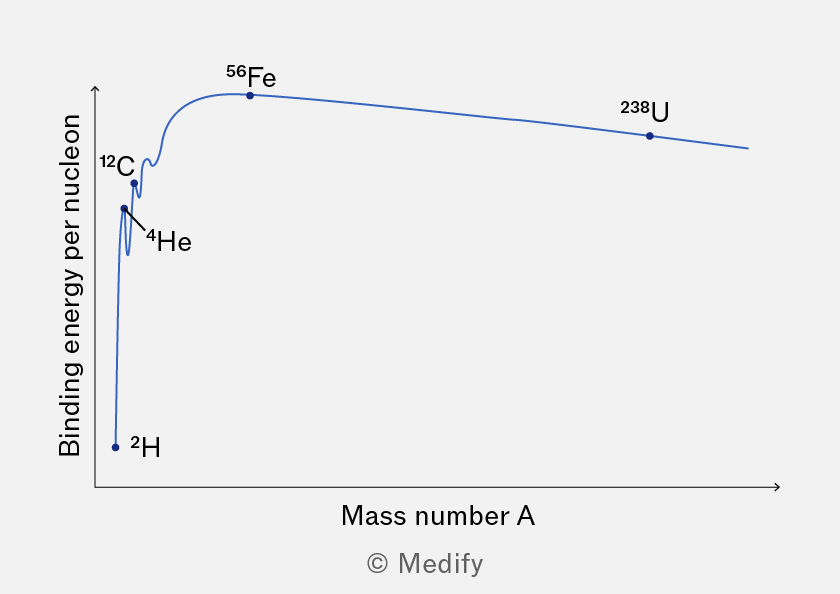
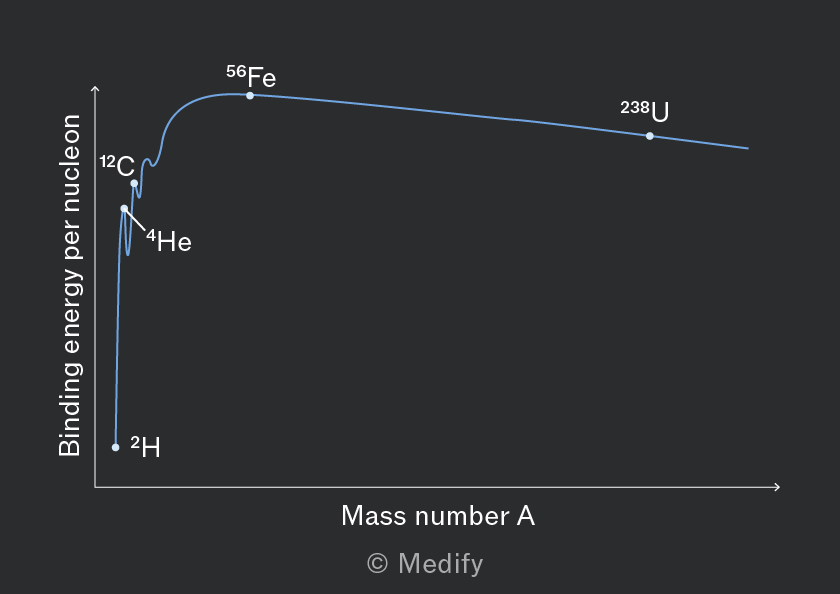
The binding energy per nucleon increases as the atomic mass increases up to the isotope iron-56. From iron-56 onwards, the binding energy per nucleon starts to decrease slightly. Since the curve peaks at iron-56, this means that this is the most stable (and tightly bound) nucleus in nature.
Energy is released in radioactive decay, and this can be shown using the binding energy per nucleon plot. If a nucleus spontaneously alpha-decays, the binding energy of the parent nucleus is less than the binding energy of the daughter nucleus and the alpha particle.
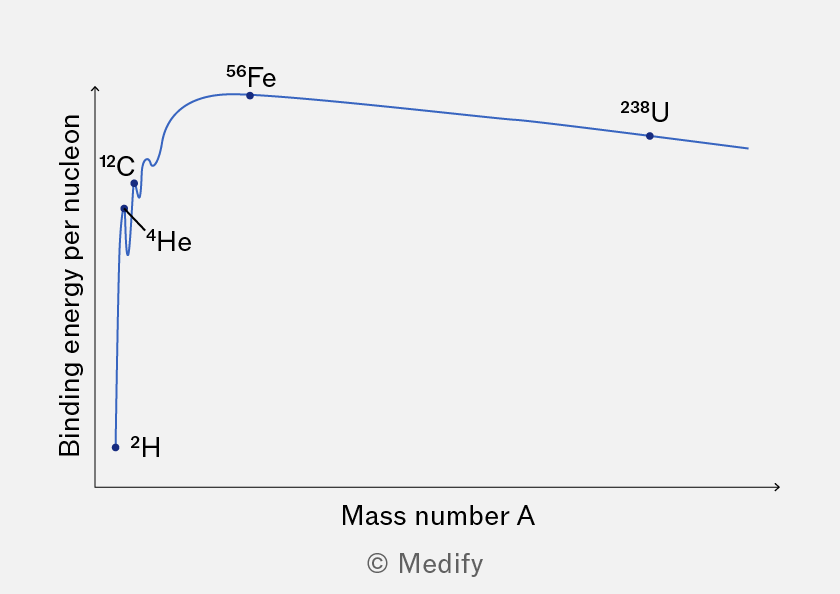
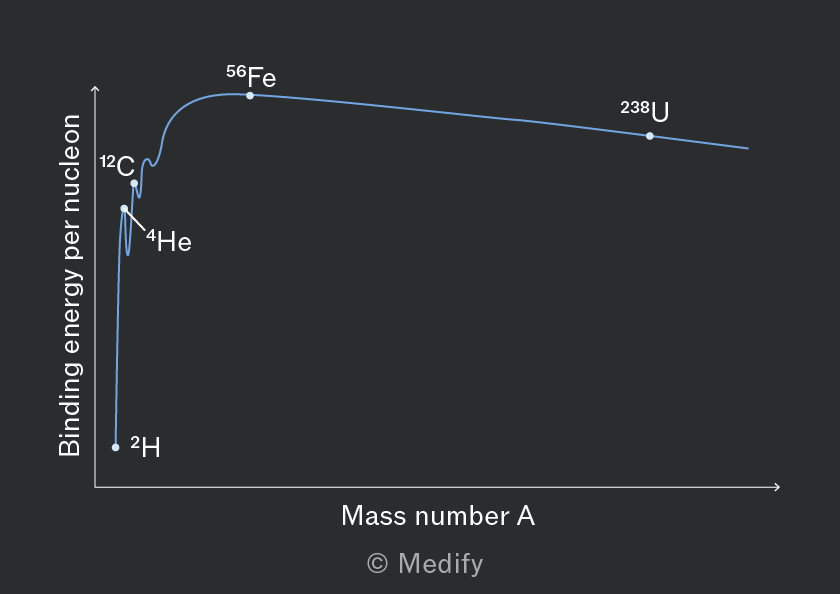
For example, uranium-238 alpha-decays into thorium-234. The resulting thorium-234 has a lower mass number and, according to the binding energy per nucleon against nucleon number curve, it has greater binding energy per nucleon than uranium-238. The excess energy is released in the decay in the form of kinetic energy of the thorium nucleus and the alpha particle.
We can use Einstein’s mass–energy equation to calculate the binding energy of a nucleus:
We can get a measure of how tightly bound a nucleus is by looking at the average binding energy per nucleon. The greater the average binding energy per nucleon, the more tightly bound the nucleus and the more energy that is needed to completely split the nucleus apart.
Uranium is the most common fuel used in nuclear power stations. The isotope uranium-235 readily undergoes fission when absorbing a low-energy neutron. These low-energy neutrons are known as thermal neutrons.
As uranium-235 undergoes fission when absorbing a low-energy neutron, there will be a mass defect between the parent nuclei and the daughter products. This mass defect is converted to useful energy for our power stations.
Whereas, the isotope uranium-238 requires high-energy, fast neutrons to fission, which are less common in nuclear reactors. U-238 nuclei are more likely to capture a neutron to form uranium-239 because the probability of fission with low-energy thermal neutrons is low. The unstable nuclei will then quickly decay into plutonium-239 and not fission.
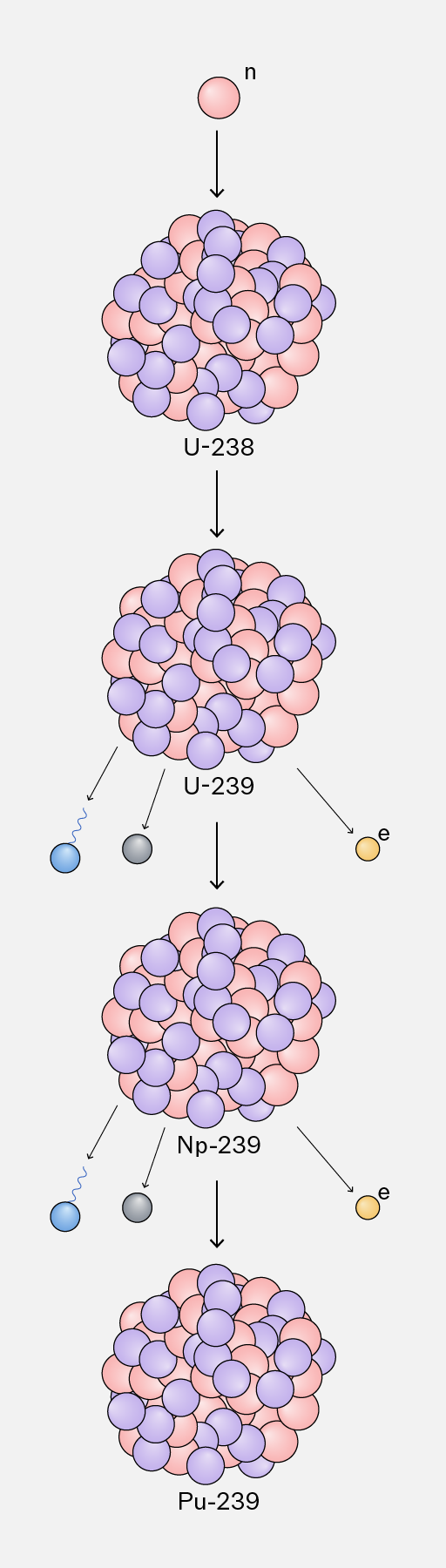
Both uranium-235 and uranium-238 can spontaneously undergo nuclear fission without the need for neutrons, but this process is rare. When uranium-235 absorbs a neutron, it becomes uranium-236 and has a much greater chance at spontaneously fissioning.
When the uranium-236 fissions, it releases fission products and neutrons. These products have very high kinetic energy, which is utilised in a nuclear reactor. They transfer their kinetic energy via collisions to a coolant, which increases the coolant’s temperature. The coolant is then used to heat and boil a circuit of water to create steam to drive a generator turbine, resulting in electricity. This is the basic operating principle of a nuclear power station.
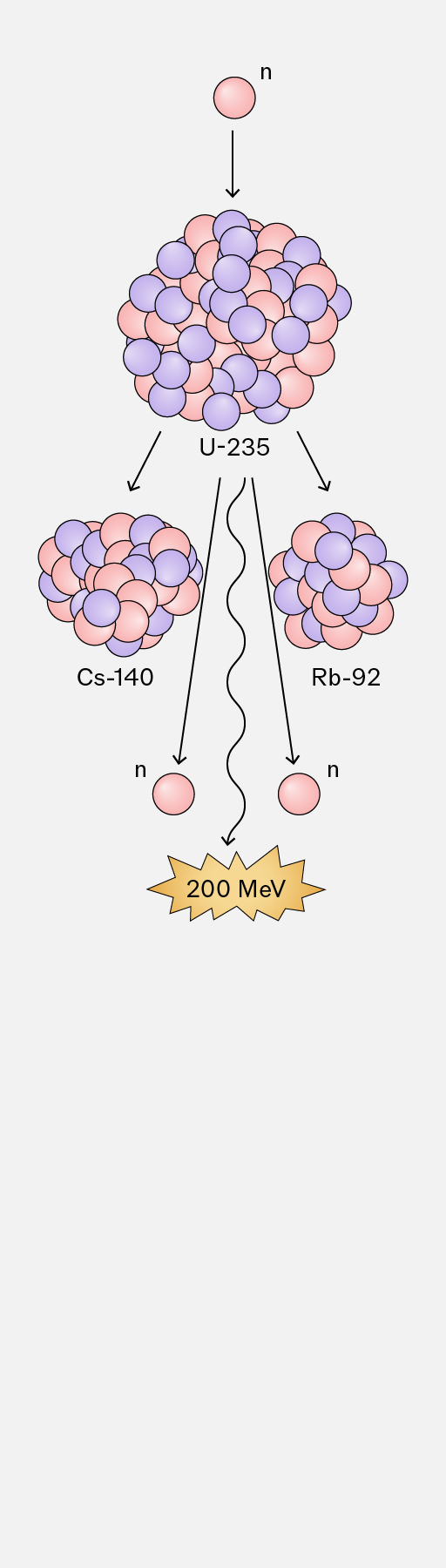
Below is an example of a typical neutron-induced fission reaction of uranium-235:
The uranium-235 nucleus absorbs a thermal neutron to become uranium-236. The highly unstable uranium-236 fissions almost immediately to produce the two daughter nuclei barium-141 and krypton-92. Three fast (high energy) neutrons are also released in the reaction.
The total mass of nuclear fission products is less than the total mass of the particles before fission due to the total binding energy of the products being greater than the total binding energy of the particles before fission.
The difference in mass corresponds to the difference in binding energy , and is the energy released in the reaction.
The energy released is in the form of kinetic energy of the fission products and energy of any other particles produced, such as photons.
The three neutrons produced in a uranium-235 fission reaction are fast neutrons. If they are slowed to lower energies to become thermal neutrons, then they may go on to cause further fission of other nearby uranium-235 nuclei. This is known as a chain reaction, as shown below.
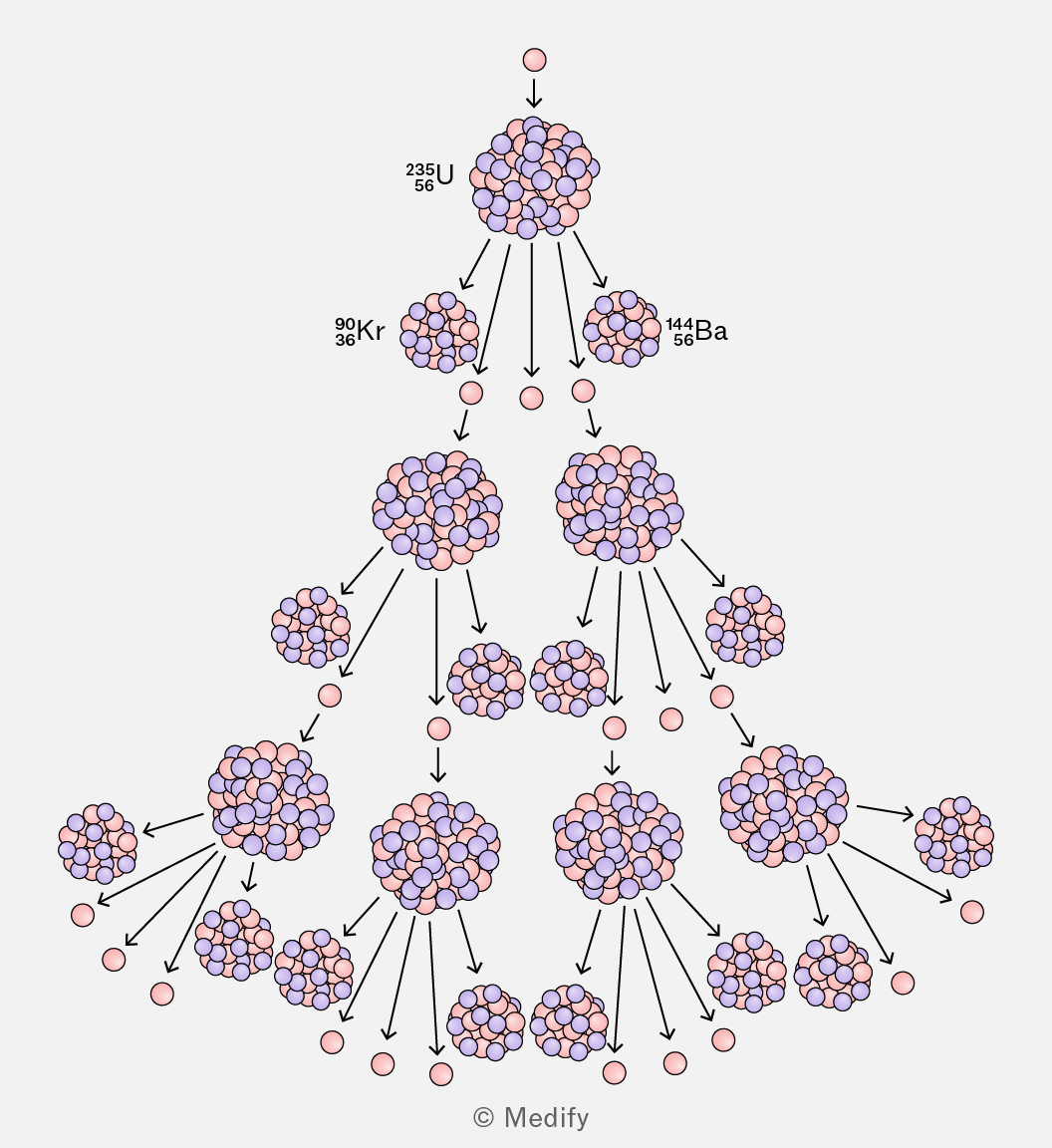
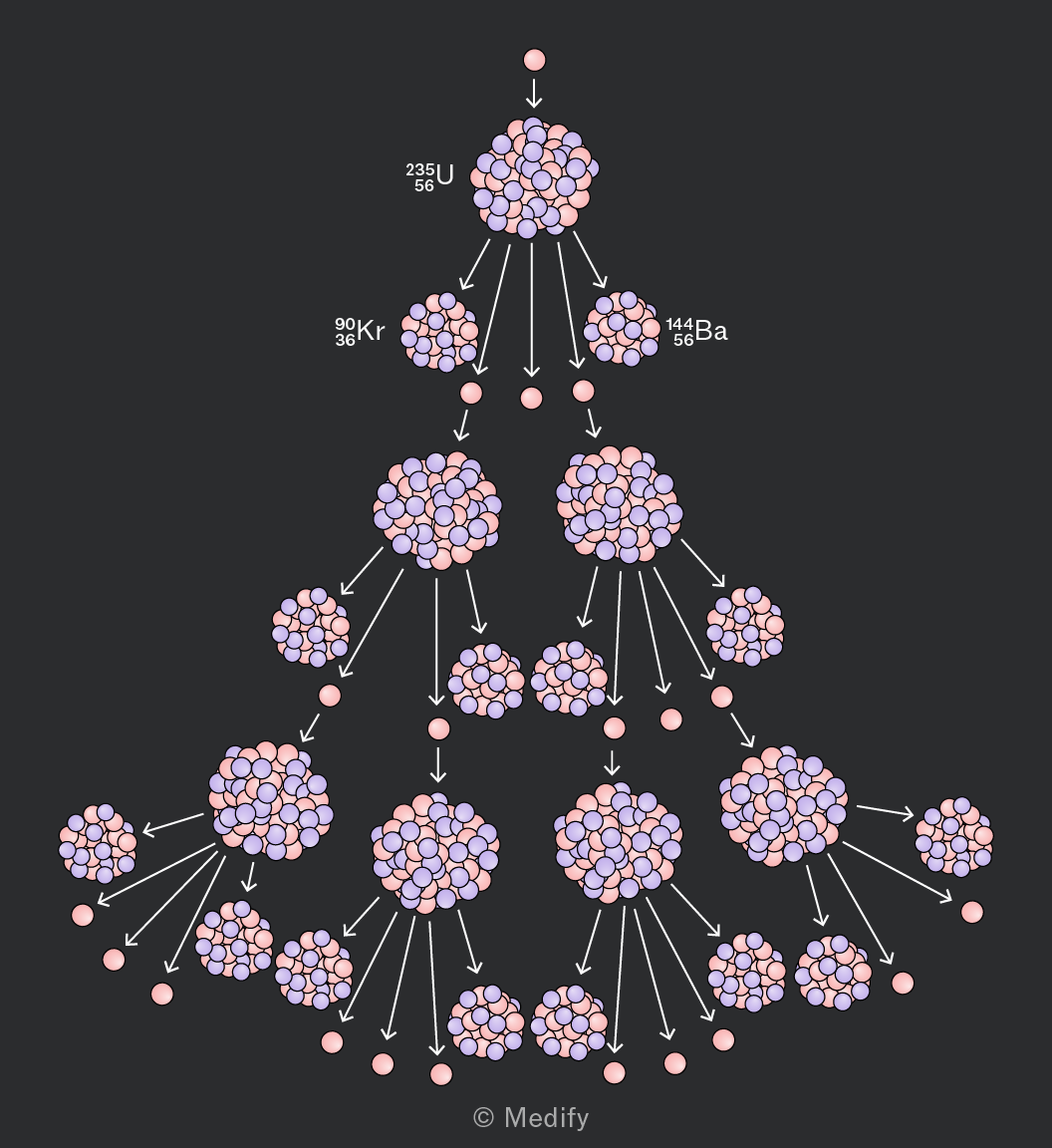
Further fissions release more neutrons, which cause further fissions and so on. After fission events, there will be neutrons, so the growth of neutrons is exponential.
Nuclear reactors are able to control this reaction to produce a steady output of power.
Nuclear fusion is the process of combining small nuclei into larger nuclei, releasing several of energy per reaction. This process is what occurs in the cores of stars.
In order for nuclei to fuse, they have to be brought very close together within a few femtometres, At these short distances, the strong nuclear force takes effect and overcomes the electrostatic repulsion between the protons created by the Coulomb force.
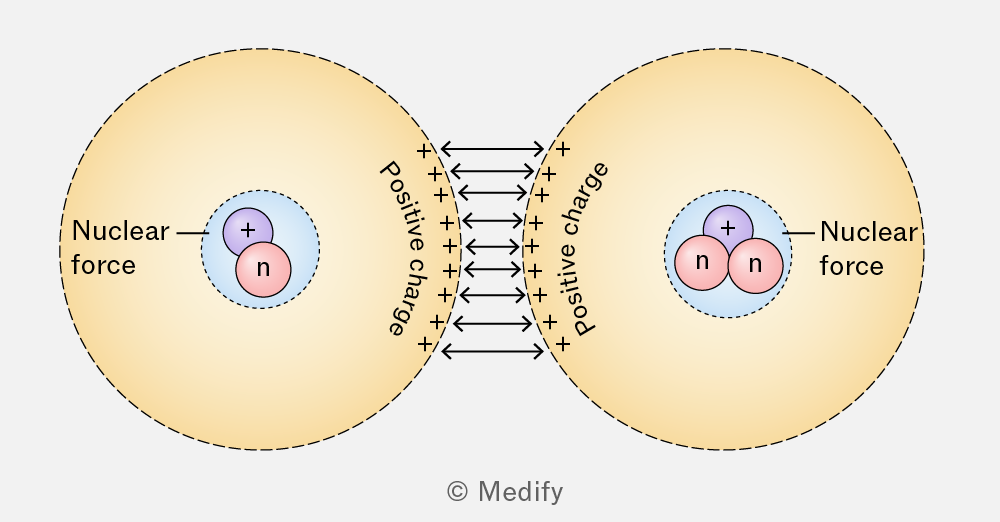
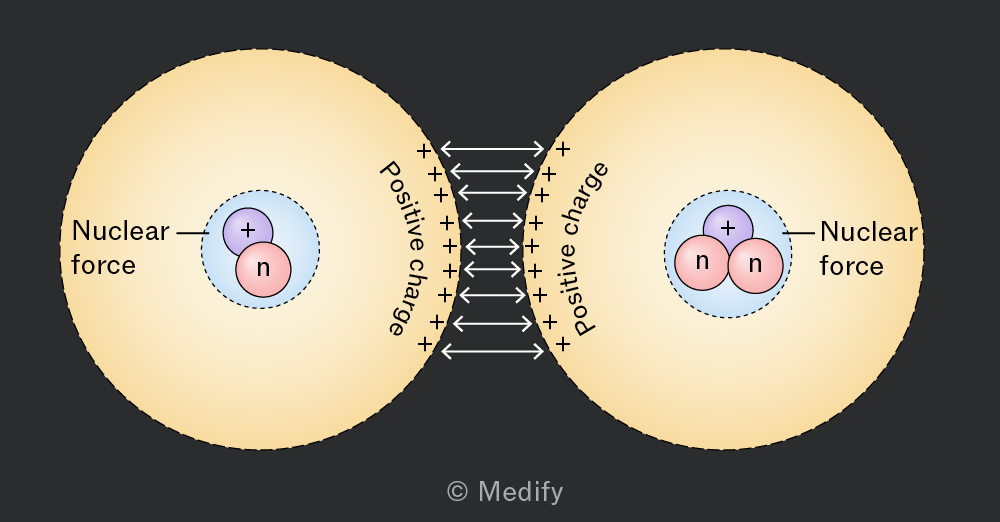
Fusion requires very high temperatures in order for the nuclei to have enough kinetic energy to get close enough for the strong nuclear force to take effect. The conditions in stars are ideal for fusion due to the very high temperatures and their very high density.
There are multiple fusion reactions that can occur and are often sequential reactions. For example, the production of helium-3 in stars results from the proton–proton chain:
The cycle is repeated again with the two protons produced at the end. Each reaction releases energy.
When balancing nuclear transformation equations, it is important to remember to conserve the following quantities on either side of the equation:
- Mass number,
- Atomic number,