
Amount of substance (3.1.2)
On this page
The mass of one mole of a substance is known as its molar mass.
The units for molar mass are .
The relative molecular mass of a molecule is the sum of the relative atomic masses of all the atoms in its molecular formula.
Relative molecular mass is a comparative quantity; it compares the mass of a molecule to one-twelfth of the mass of a carbon-12 atom.
The relative formula mass of a compound is the sum of the relative atomic masses of all the atoms in its formula unit. It is used for ionic compounds and giant covalent structures, where there are no discrete molecules.
Like relative molecular mass, it is a comparative quantity that compares the mass of the formula unit to one-twelfth of the mass of a carbon-12 atom.
The mole () is the unit for measuring the amount of a substance.
There are two definitions for the mole.
- Classical definition: one mole of a substance is the amount of substance that contains the same number of particles as there are atoms in of carbon-12 isotope. Carbon-12 is used as a reference because its mass is exactly equal to 12 atomic mass units.
- Newer definition: one mole is the amount of a substance containing exactly (the Avogadro constant) of elementary entities.
The number represents the Avogadro constant . It is defined as the number of atoms in exactly 12 grams of carbon-12. It is the number of particles per mole of a substance.
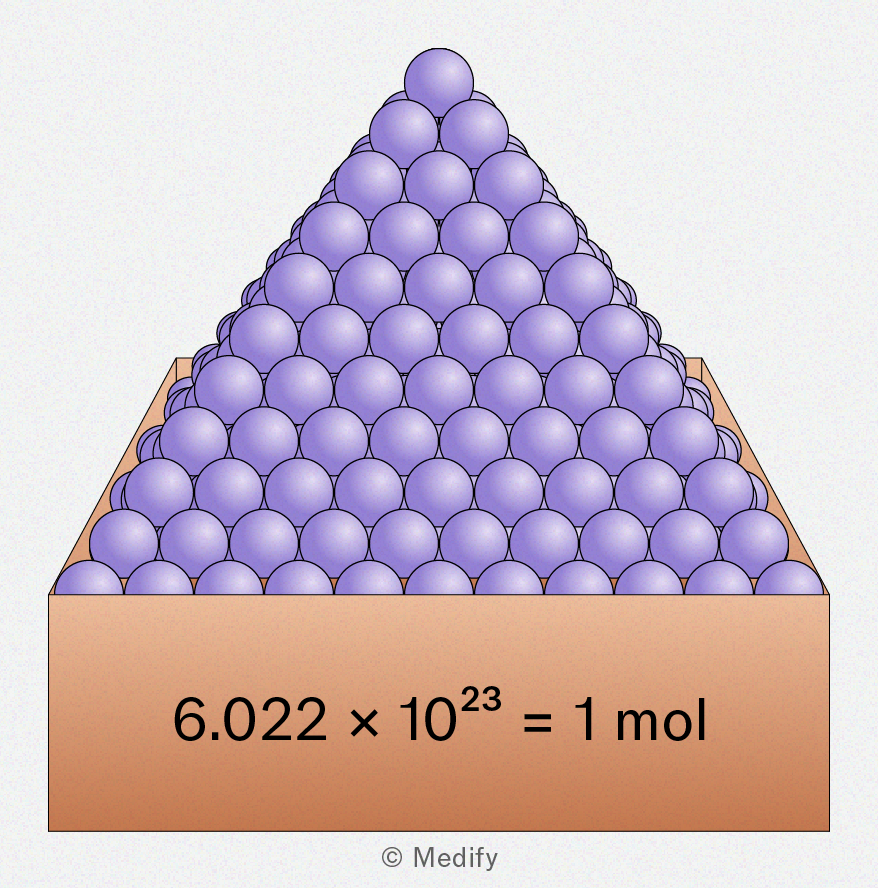
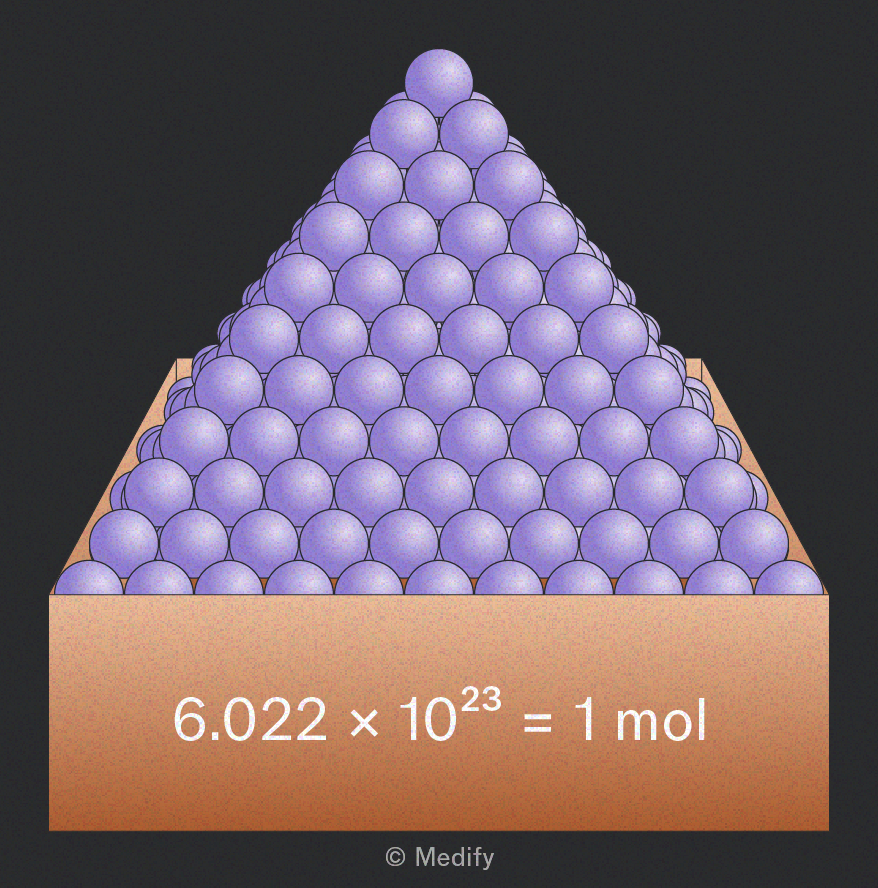
One mole of any substance contains particles regardless of its identity. This is akin to a dozen eggs and a dozen bricks both representing 12 units.
It is important to be precise about what you are counting when you describe a mole of something.
One mole of oxygen atoms contains atoms of oxygen.
One mole of oxygen molecules contains molecules of oxygen.
One mole of oxygen molecules contains atoms of oxygen.
It is important to note that in each molecule, there are two oxygen atoms. Therefore, one mole of oxygen molecules contains two moles of oxygen atoms.
The mole is related to mass, in grams, and molar mass of a substance by the formula:
The formula can be rearranged to find molar mass and mass.
Concentration is defined as the amount, in moles or grams, of a solute dissolved in a measured volume of the solution.
One mol of solute dissolved in a total of solution denotes a concentration of .
The concentration is related to volume of a solution by the number of moles of a dissolved substance as follows:
The volume units must match to use this formula. The volume of the solution is often given in and the concentration in . Here, volume must be converted into , dividing by 1000.
The concentration can also be expressed as the mass concentration, in where;
Question walkthrough
The concentration equation
Dilution of stock solution to produce a target concentration
The ideal gas equation links the moles of gas to its volume at specified temperatures and pressures.
While performing calculations using the ideal gas equation, units throughout the equation must align.
The following conversion factors can prove helpful in converting units
Question walkthrough
Using the ideal gas equation
Using the ideal gas equation to identify the molar mass of an unknown substance
The empirical formula is the simplest whole number ratio of atoms of each element present in a compound.
The molecular formula shows the exact number of atoms of each element present in the molecule.
Once the empirical formula is determined, the molecular formula can be deduced using the empirical formula mass and the relative molecular mass of the compound.
The empirical formula can be calculated in two ways:
- By using the mass composition of elements present in a sample of the compound.
- By using the percentage composition by mass of elements present in the compound.
To calculate the empirical formula of the compound convert the contribution of each element to percentage, then divide by the relative atomic mass.
Then find the simplest mole ratio by dividing each number by the highest common factor, which is usually the smallest number of moles.
Molecular formulae can be calculated from the relative molecular masses of compounds alongside their empirical formula.
- Empirical formula mass is first calculated.
- Dividing the relative molecular mass by the empirical formula mass gives the multiplier, .
- Multiply all counts of atoms in the empirical formula by to get the molecular formula.
When salt crystals form from aqueous solutions, a fixed number of water molecules per inorganic salt unit, are present in each solid lattice.
These solid crystals incorporating a specific number of water molecules are known as hydrated salts.
The number of water molecules present in each formula unit of the salt is known as the water of crystallisation.
It is often denoted by writing after the formula unit of the salt.
Dehydration results in the anhydrous salt, denoting the solid crystal free of any water of crystallisation.
Mass loss during dehydration is directly related to the amount of water removed.
The presence or absence of water changes the chemical environment of the crystal structure and thus its interaction with light. Therefore, the solid hydrated and anhydrous salts often exhibit different colours.
Balancing equations is a process to make sure there are the same number of atoms on each side of the symbol equation therefore obeying the law of conservation of mass.
When balancing equations ensure:
- the only numbers changes are the coefficients. These are placed in front of the formulae
- the formulae are not altered in any way, such as changing to to increase the number of oxygen atoms.
When balancing equations, we must:
- identify the number of atoms of each element in the reactants and products
- add the appropriate coefficient in front of the formulae to balance the number of atoms on each side
- make sure that the final balanced equation has the same number of each type of atom on both sides.
If the mass of one substance in a balanced chemical equation is given, we can find the unknown mass of another substance by converting to moles and applying the relevant mole ratio from the equation.
Molar gas volume is defined as the volume occupied by one mole of a gaseous substance under specified conditions. It can be calculated by dividing the volume of gas in by the number of moles of gas present.
At room temperature and pressure (RTP)
One mole of a gas occupies at RTP.
The molar gas volume at RTP is therefore or .
of any gas can be assumed to contain one mole of the gas molecules at RTP.
The formula relating moles, volume and molar gas volume is:
The above formula can be rearranged to find the volume of a gas or the molar gas volume.
In stoichiometric calculations, the number of moles of the limiting reagent is used to find the unknown amounts of products formed.
Limiting reagent is the reactant that is fully consumed during an irreversible chemical reaction.
In contrast, the reactant left unused is described as being ‘in excess’. The moles of an excess reagent do not have a stoichiometric link to the products.
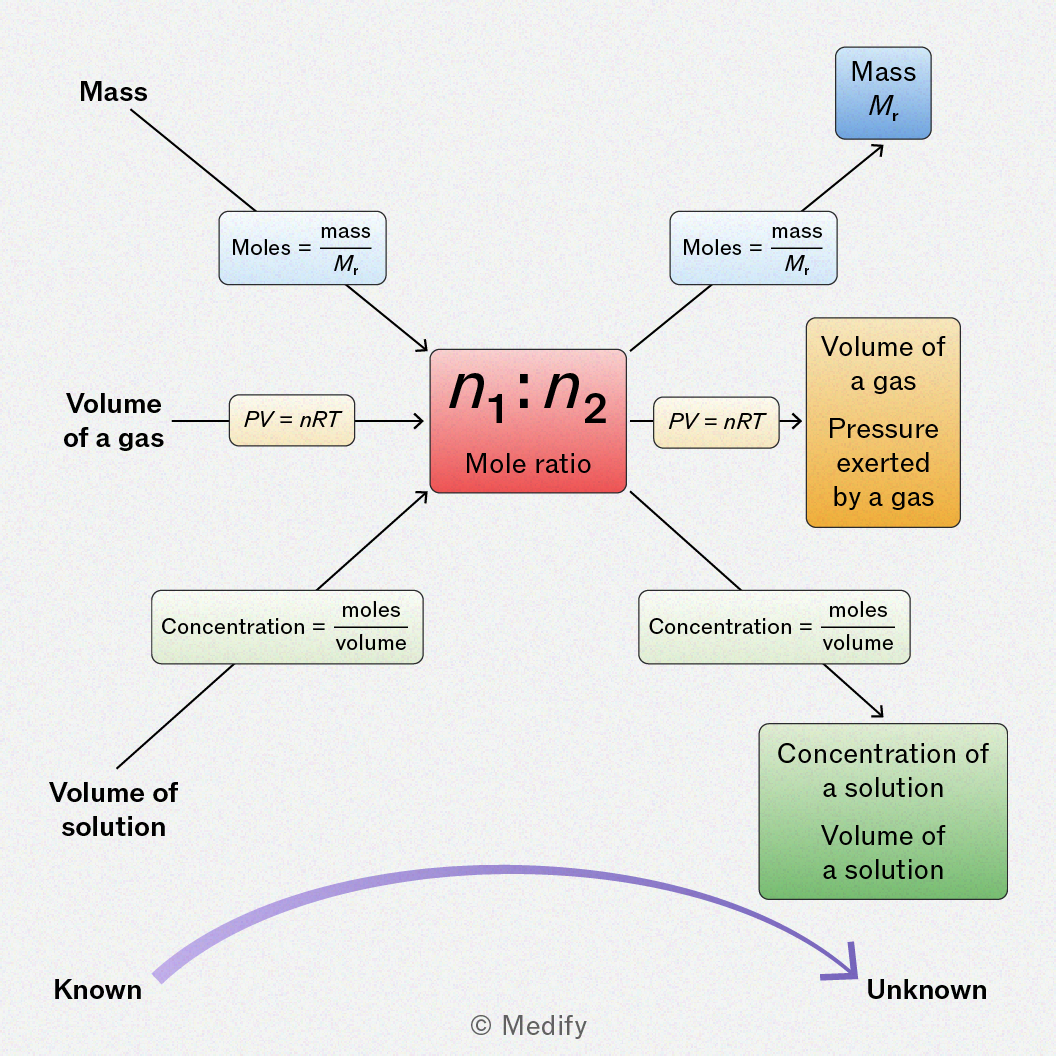
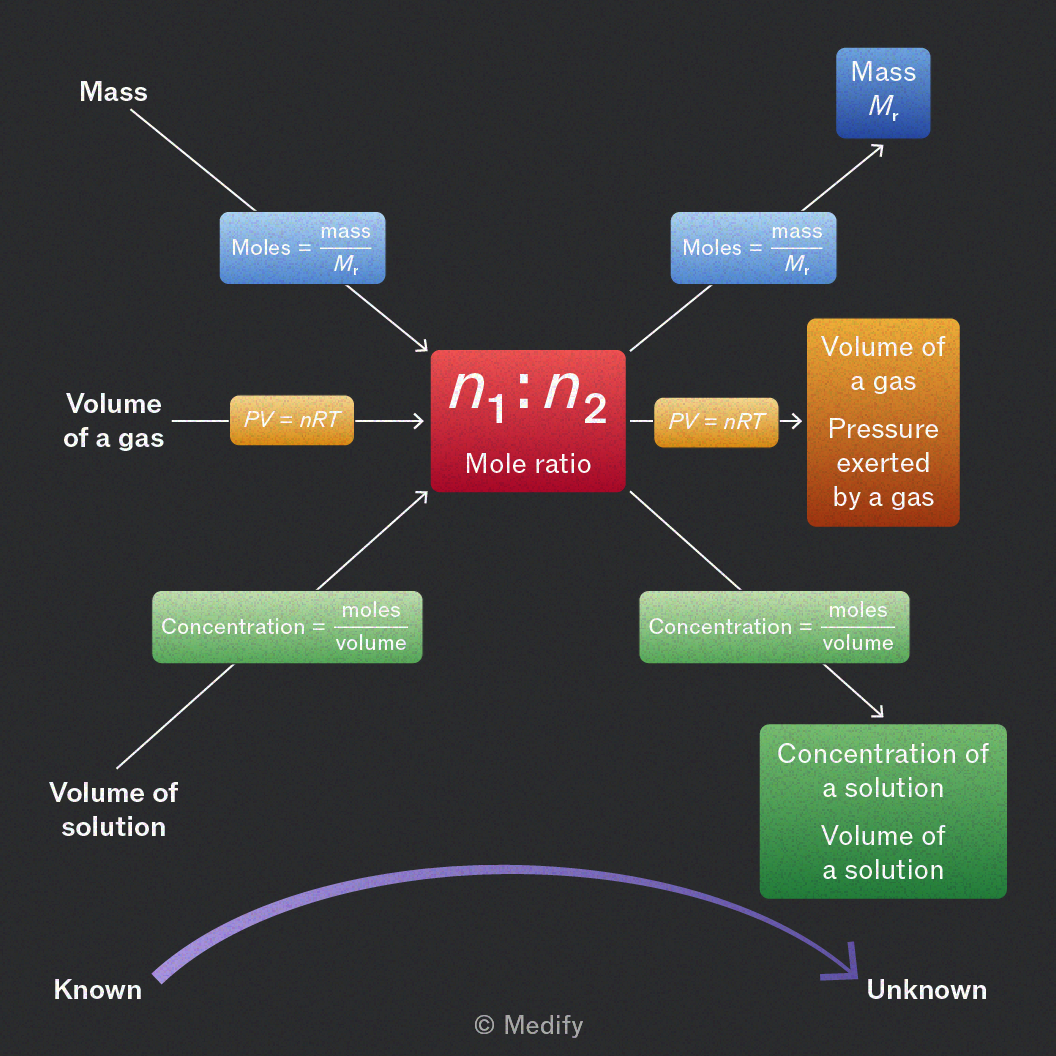
Masses, volumes and concentrations can all be linked to the amount of a substance in moles.
Mole ratios are a critical part in more complex calculation questions. They provide the relationship between one substance and another.
Question walkthrough
Writing a balanced equation
Using a description of a reaction to construct a balanced equation
Question walkthrough
Constructing a net ionic equation
Identifying and removing counterions to produce a net ionic equation
Question walkthrough
Calculating percentage yield
Using reaction stoichiometry to determine the expected mass of a product and converting this to percentage yield.
Question walkthrough
Using molar gas volume
Identifying the mass of reactant required to produce a given volume of gaseous product using the molar gas volume
Question walkthrough
Stoichiometric ratios with gaseous reactions
Using experimental data to identify a balanced chemical equation.
Question walkthrough
Balancing redox equations
Balance an ionic redox equation based on oxidation states, charge and H+/H2O.
Atom economy reflects the efficiency of a chemical reaction as written.
It denotes the mass of atoms of the combined reactants that are transferred into the desired product, assuming a yield.
When a chemical reaction occurs, some byproducts can be formed in addition to the desired product. This is considered waste.
Addition reactions, where multiple reactants form a single product, have an atom economy of .
The higher the atom economy of a chemical reaction, the lower the inherent waste of the process. Improving the atom economy helps to improve the reaction sustainability and reduce environmental impact.
Some economic benefits of developing chemical processes with a high atom economy include:
- reduced waste and cost of waste disposal
- a cut down on the cost /volume of raw materials.
An industrial process generally involves a series of chemical reactions. Thus, monitoring the atom economy of each step can help chemists select the most suitable reaction steps.


Atom economy must be considered alongside other factors such as process safety, ease of controlling the reaction, energy requirements and toxic byproducts.
Percentage yield reflects how well reactants are converted into the intended products.
Reaction conditions are often modified to maximise percentage yield.