
Acids and bases - AL only (3.1.12)
On this page
Not all hydrogen-containing substances are acidic, although all conventional acids contain hydrogen in their formulae.
is known as a hydrogen ion or a proton. It is formed when a hydrogen atom loses an electron.
The hydrogen in a molecule must be releasable as a proton in aqueous solution for a substance to be a Brønsted–Lowry acid.
Brønsted–Lowry acid–base reactions involve the transfer of protons.
A Brønsted–Lowry acid is defined as a chemical species which donates protons.
An example of this is the reaction between sulfuric acid and water.
A Brønsted–Lowry base is a chemical species which accepts protons.
An example of this is the reaction between a hydrogen ion and ammonia molecule, where a proton is accepted by the ammonia molecule:
Note that does NOT release hydroxide ions. It produces an excess of hydroxide ions by deprotonation of water in solution.
The chemical reaction of an acid with a base produces water. This is known as the neutralisation reaction.
The ions from the acid react with ions from the alkali, producing water (a neutral substance).
The final solution has a of at s.t.p.
Brønsted–Lowry acids are chemical substances that release ions in an aqueous solution.
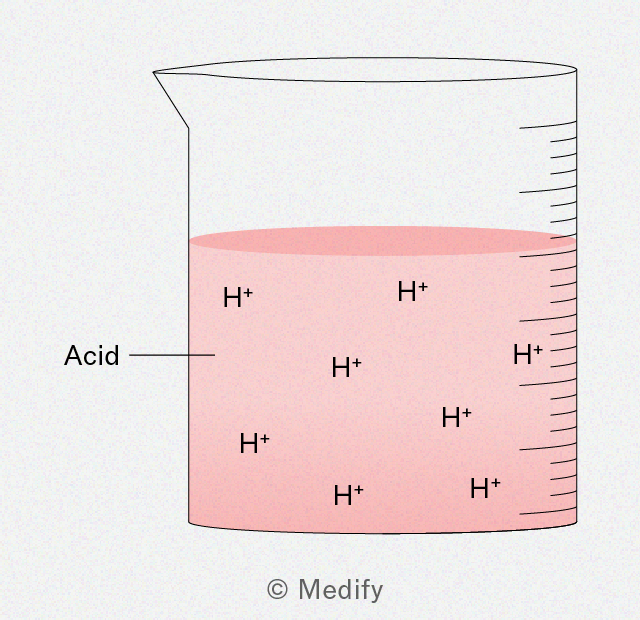
dissociates in water releasing ions as follows:
The ions further combine with molecules forming hydronium ( ) ions:
The overall equation for the dissociation of in water (with state symbols) is:
The scale is a logarithmic scale used to measure the acidity or basicity of a solution. It is based on the concentration of hydrogen ions, , in the solution.
The of a solution is defined as the negative logarithm of the hydrogen ion concentration:
where:
- is the measure of the acidity or basicity of the solution.
- [] is the concentration of hydrogen ions in .
The hydrogen ion concentration can be calculated from the using the inverse logarithmic function:
The concentration of hydrogen ions [] in a solution of a strong monobasic acid, is equal to the initial concentration of the acid, since it fully dissociates.
Water undergoes slight dissociation into and ions.
The ionic product of water, , is a special equilibrium constant that applies to the self-ionisation of water.
It quantifies the extent to which water dissociates into hydrogen ions () and hydroxide ions () at a given temperature.
Water molecules self-ionise according to the following equilibrium reaction:
The equilibrium constant for this dissociation, the ionic product of water, , and is defined as:
At (), the value of is:
This value changes with temperature; as temperature increases, increases because the dissociation of water is an endothermic process.
Calculating the of a strong base requires the use of the ionic product of water.
At ()
- Determine the concentration of hydroxide ions from the concentration of the strong base.
- Rearrange the equation for , making the subject.
- Use the value obtained for [] to calculate pH.
Question walkthrough
Kw calculations
Using Kw to calculate the pH of a strong base
A strong acid, , completely dissociates in aqueous solution to form and .
In strong acids:
Prominent examples of strong acids are , , and .
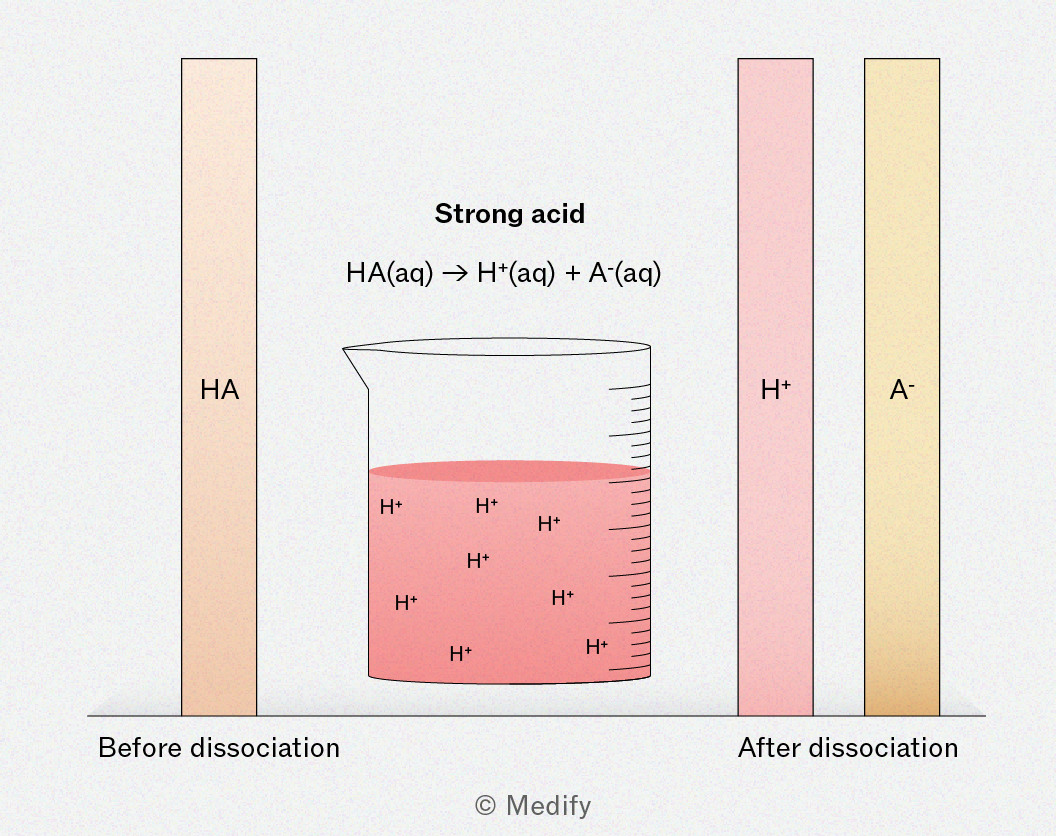
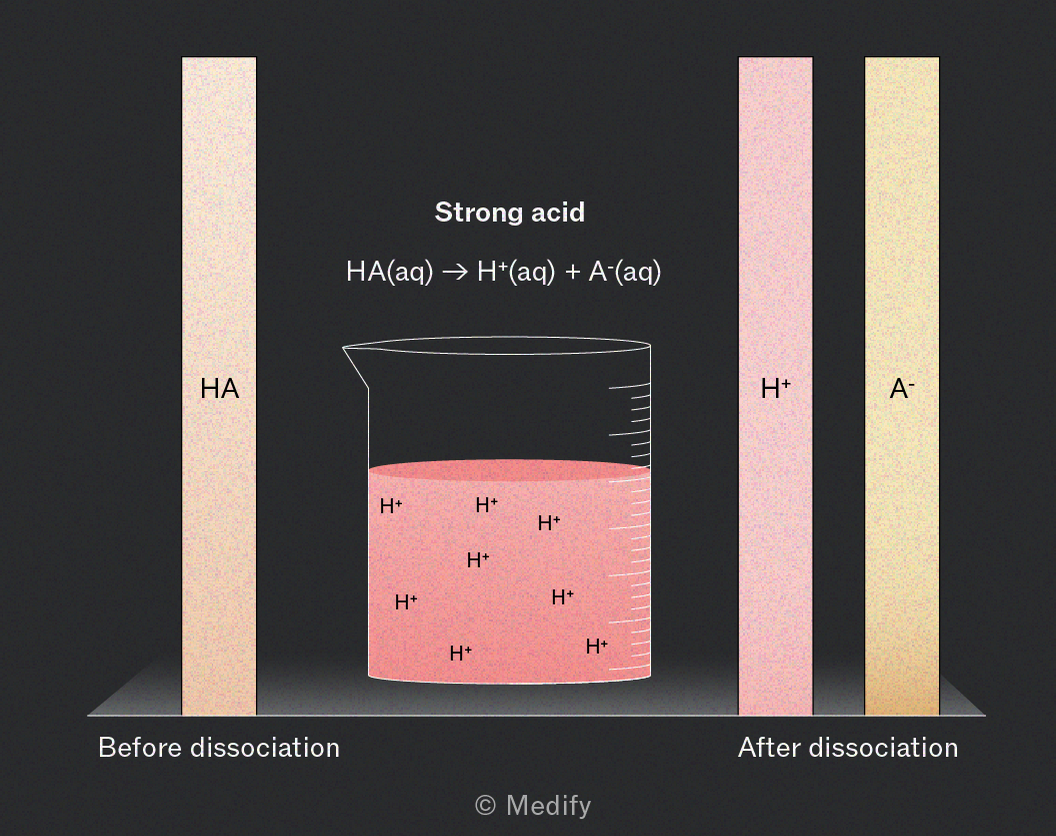
Both concentration (the total amount of the acid per unit volume) and strength (the degree of dissociation) of the acid impact the overall of a solution.
Strong acids will have a lower than weak acids when matched by concentration.
Weak acids only partially dissociate in water (usually less than 10%), releasing a limited number of their ions.
The partial dissociation can be identified by use of a double headed arrow (⇌) showing reversibility.
In weak acids:
Carboxylic acids, such as acetic acid, are weak acids.
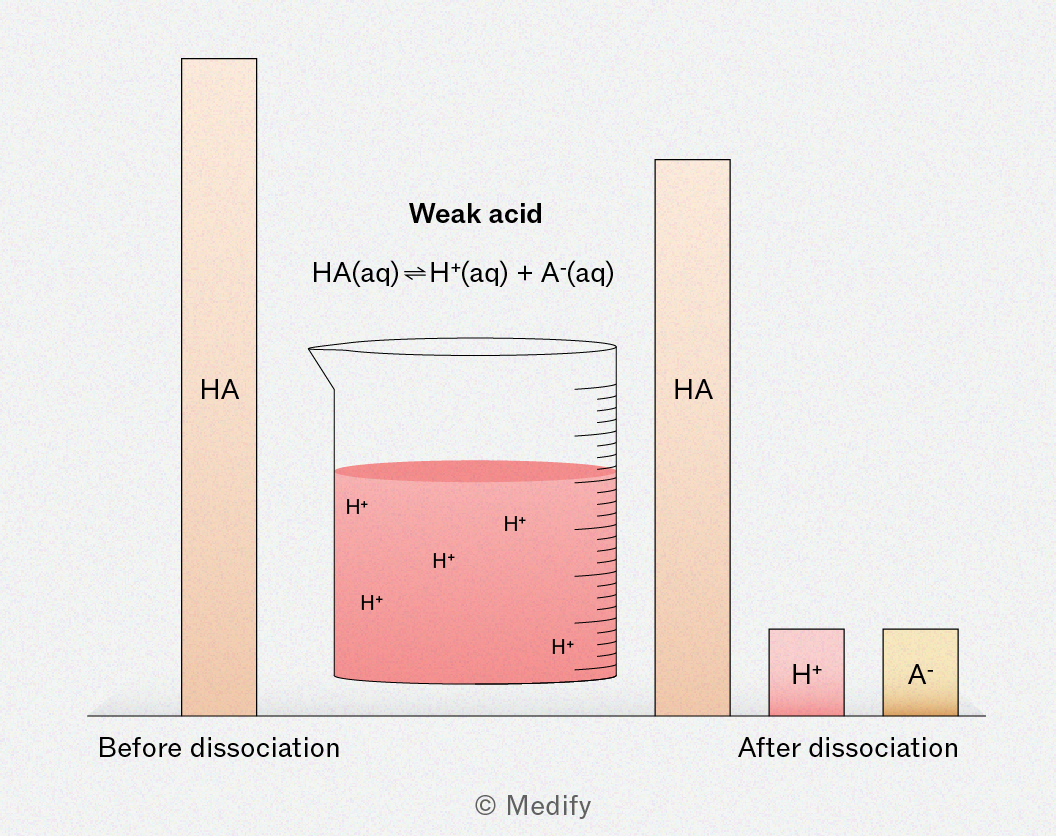
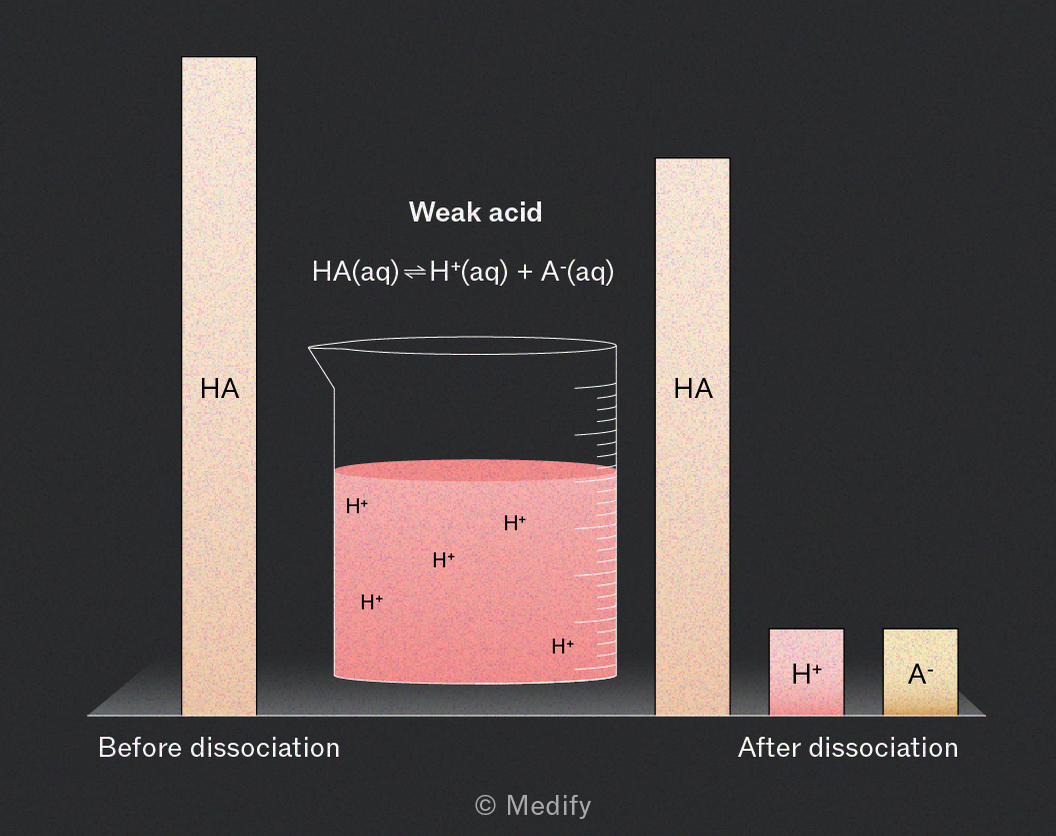
The acid dissociation constant, , measures the strength of a weak acid by quantifying its degree of dissociation in aqueous solution.
The is the negative logarithm of the acid dissociation constant :
The scale is used as values, like [], cover many orders of magnitude. This relationship provides a more convenient way to express acid strength on a logarithmic scale, which compresses the range of values.
For a generic weak acid , which partially dissociates into and , the equilibrium can be represented as:
The equilibrium constant for this dissociation is given by:
Where:
- is the concentration of hydrogen ions.
- is the concentration of the conjugate base.
- is the concentration of the undissociated acid.
A higher value indicates a stronger acid, which dissociates more in solution, producing more ions per mole of acid.
A lower is derived from a higher value, thus a lower indicates a stronger acid.
Approximations are required to calculate the of a weak acid.
The concentration of the undissociated acid remains almost the same at equilibrium because the dissociation is minimal.
The concentration of hydrogen ions is approximately equal to the concentration of the conjugate base formed. This is due to the negligible dissociation of compared to the amount of hydrogen ions produced by dissociation of the weak acid.
For a weak acid dissociates as follows:
The acid dissociation constant is:
Using the approximations:
Which rearranges to give:
Allowing pH to be calculated from :
To calculate the for a weak acid, given the of a solution containing a known mass of acid, follow the steps below:
Determine initial concentration, using the mass and molar mass of the weak acid () to find initial concentration:
Convert the pH to the hydrogen ion concentration []:
Write down an expression for for weak acids applying the appropriate approximations:
Input the values to calculate .
Question walkthrough
Ka calculations with weak bases
Calculating the concentration of a weak base using Ka approximations
Titration is a laboratory technique used for quantitative chemical analysis.
It is used to accurately calculate the concentration of one solution through reaction with another solution of known concentration. To do this, the volume of each solution at the endpoint must be determined; this is where neither solution is in excess.
An indicator is a chemical substance that undergoes a chemical or a physical change to mark the endpoint of the titration.
In acid–base titrations, indicators used sharply change colour with the change in pH of the reaction mixture at the point of neutralisation. The colour change marks the end point of the titration, indicating the ratio of volumes required for neutralisation.
In titration calculations, the volume of a standard solution of substance A at the endpoint can be used to calculate the moles of substance A involved in the reaction.
The stoichiometric mole ratio from the balanced chemical equation can then be used to find the moles of substance B.
The concentration of B, is determined using the calculated moles and the volume of solution B at the endpoint.
The number of moles () of an acid or base in a solution are related to the solution volume () and concentration () by the formula:
where:
- = number of moles (in ),
- = concentration (in ),
- = volume (in ).
You often need to convert from to for these questions by dividing by 1000.
titration curves represent the change in as an acid is incrementally neutralised by a base, or vice versa.
Titration curves are crucial for understanding the neutralisation process and for selecting appropriate indicators to determine the endpoint of a titration.
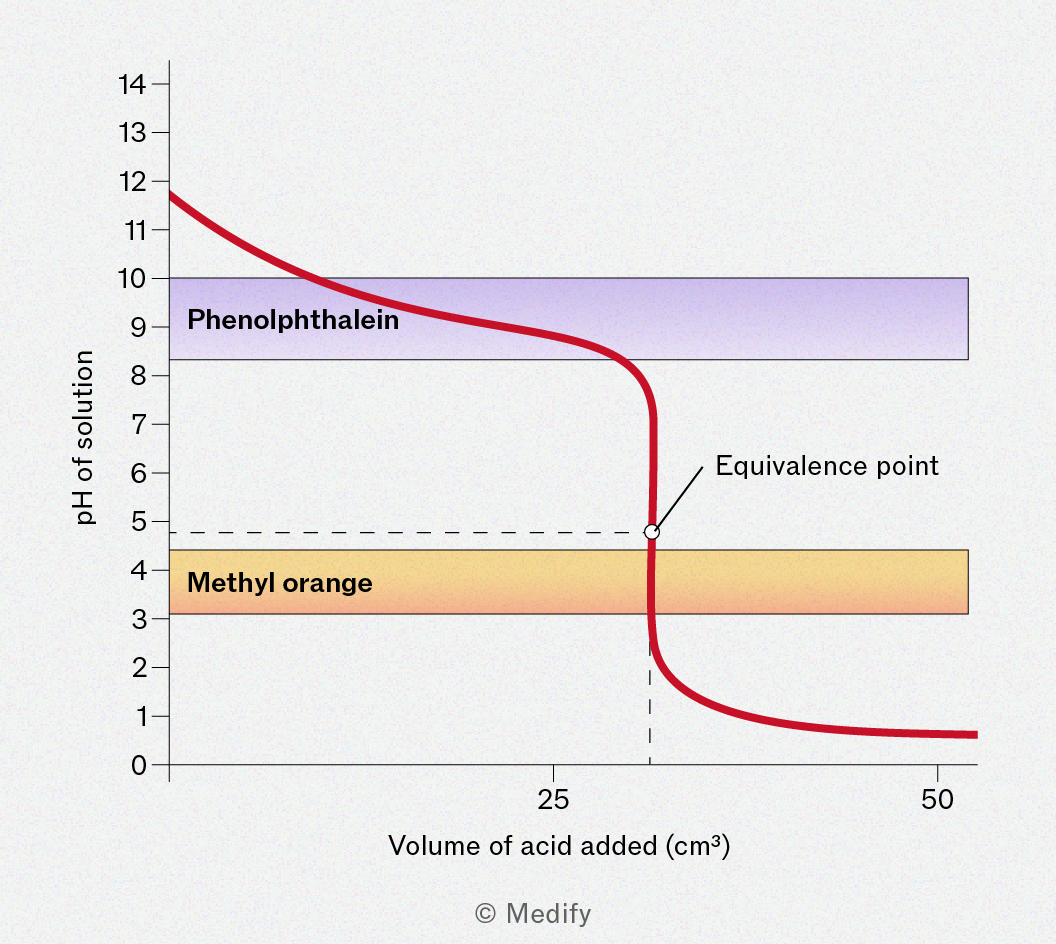
Strong acid with strong base
Example: Hydrochloric acid () titrated with sodium hydroxide ().
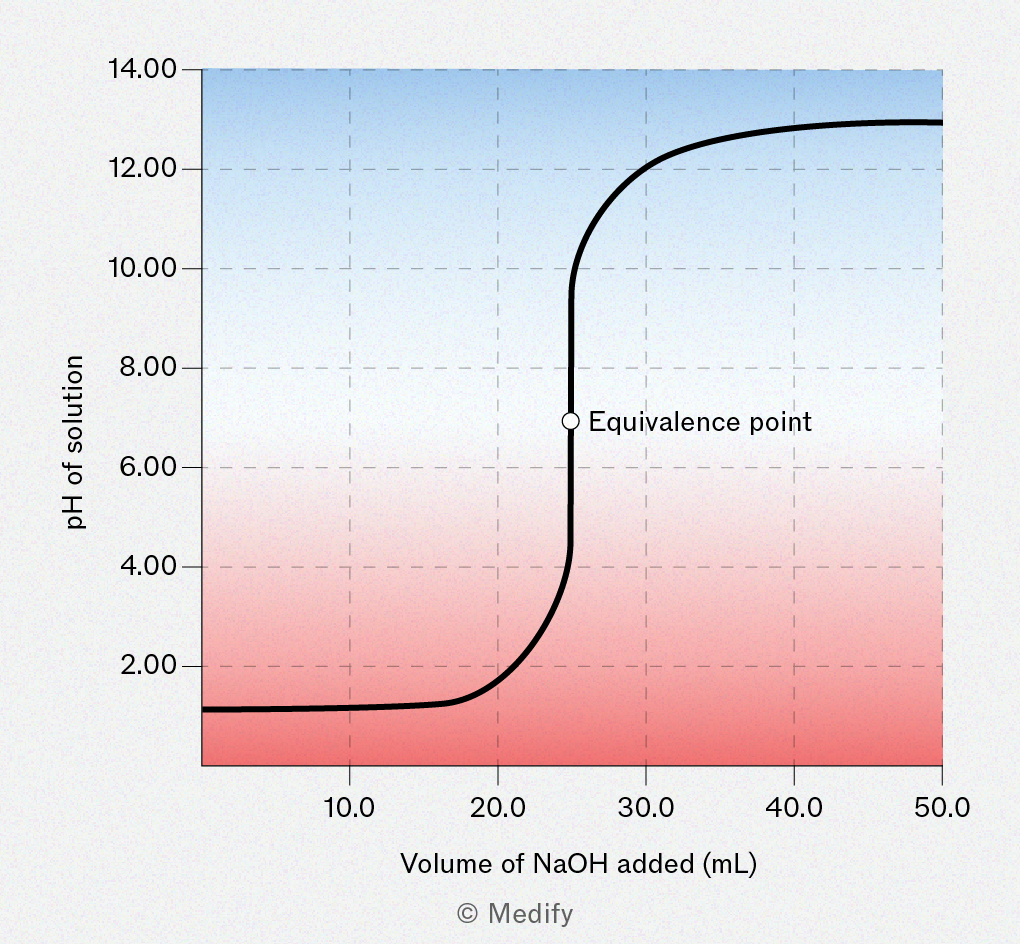
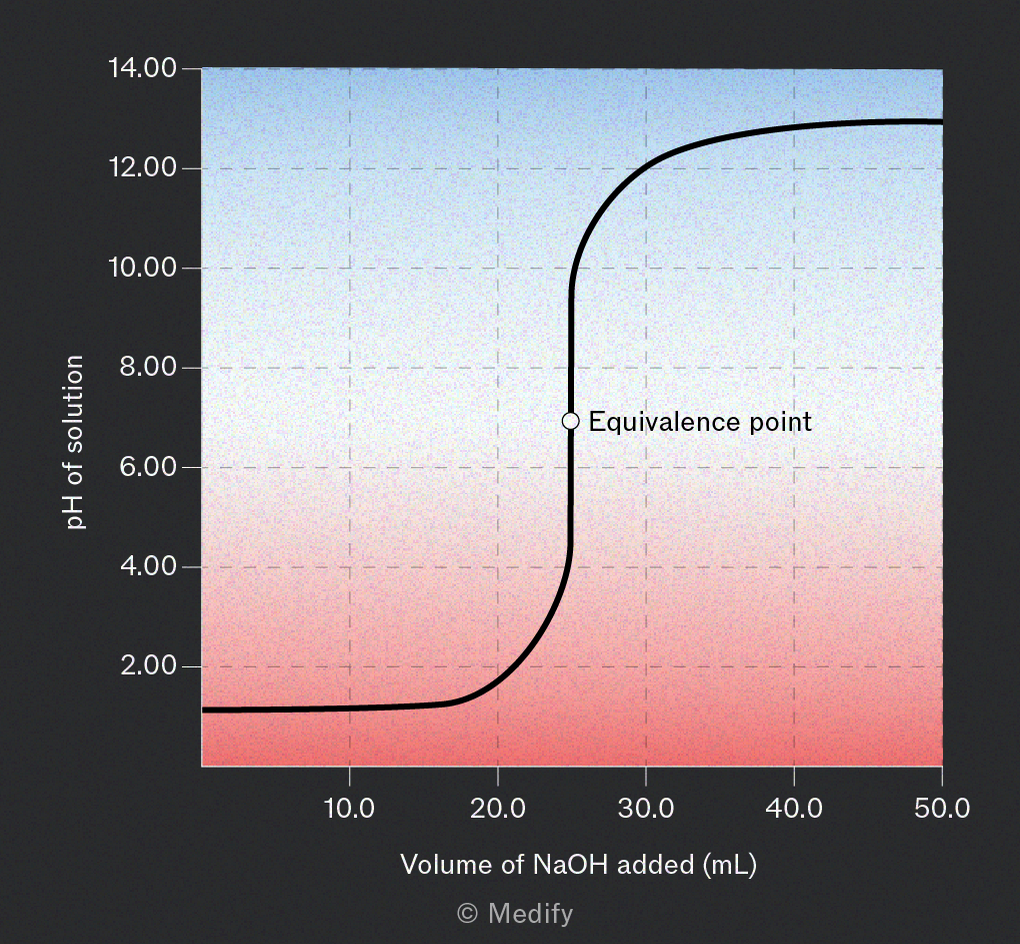
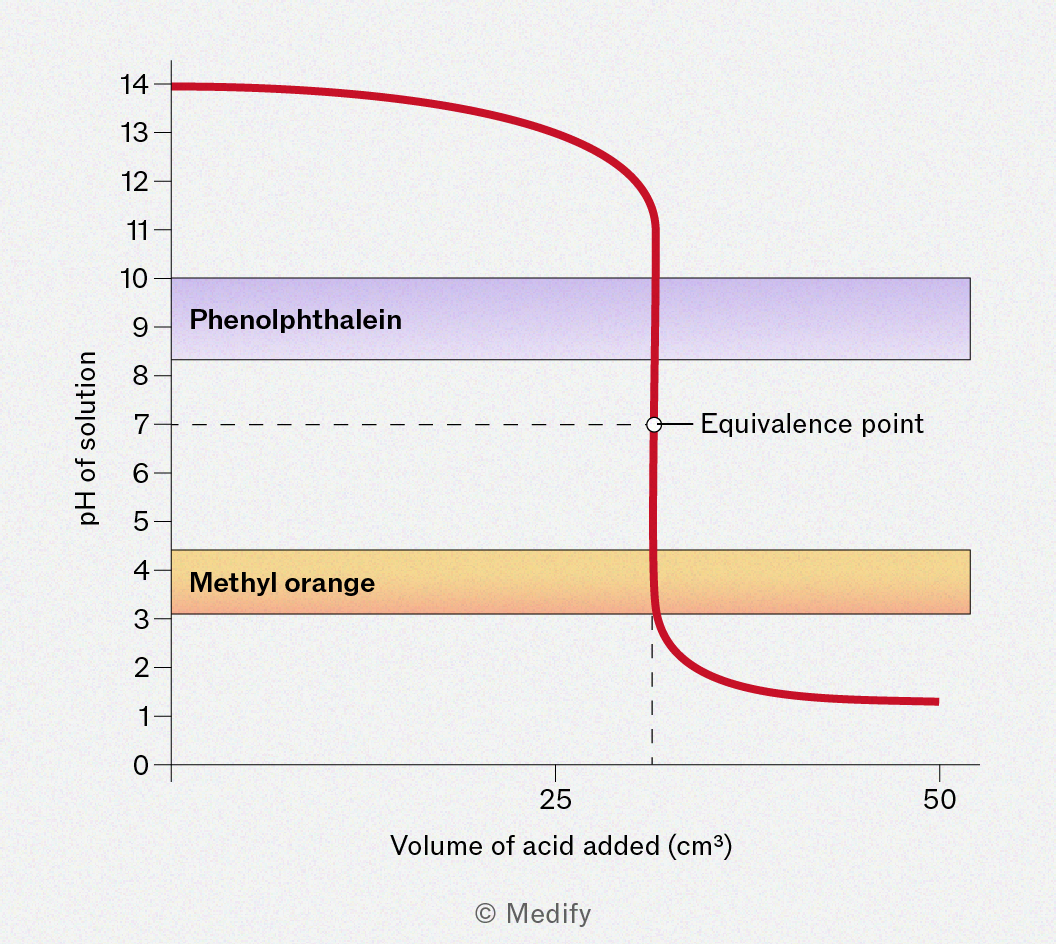
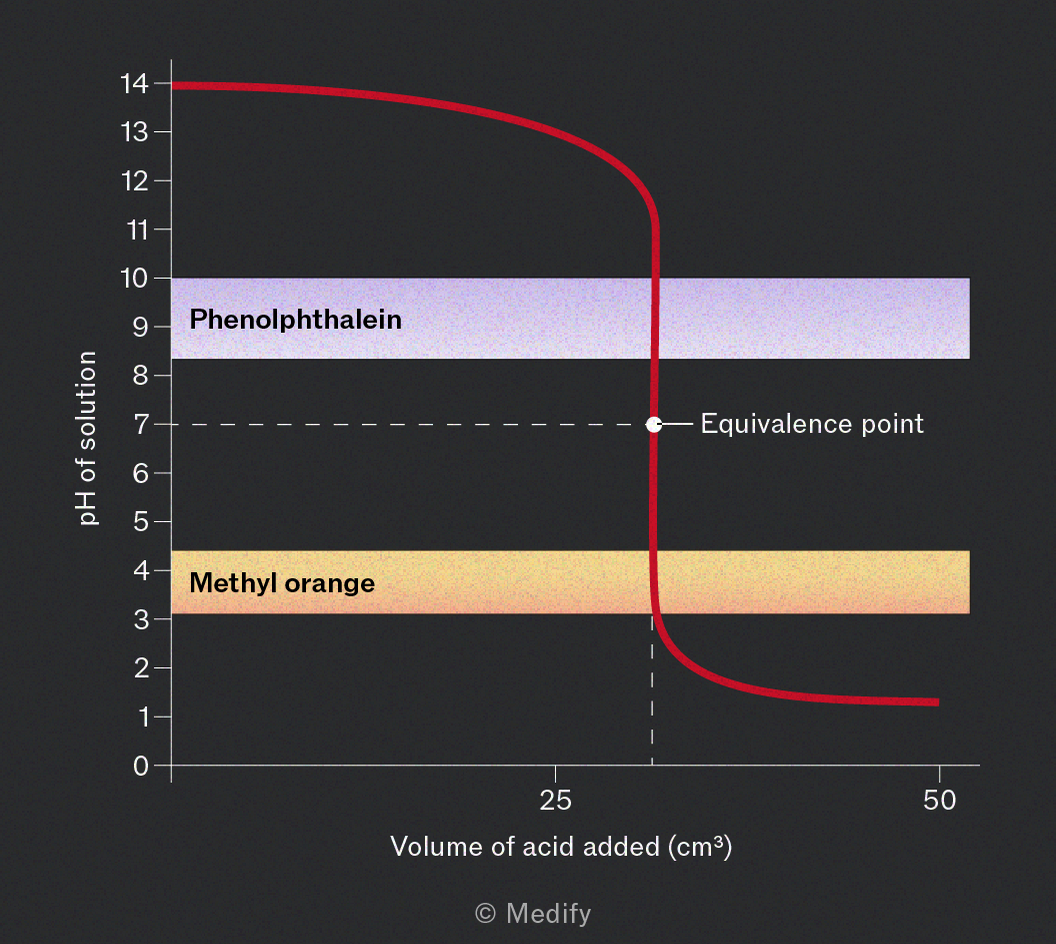
Starts at a low (strong acid), rises slowly initially, then steeply at the point of neutralisation.
There are a range of values which can represent neutralisation centring at an equivalence point of 7.
Following neutralisation the quickly levels off at a high .
Weak base with a strong acid
Example: Ammonia () titrated with .
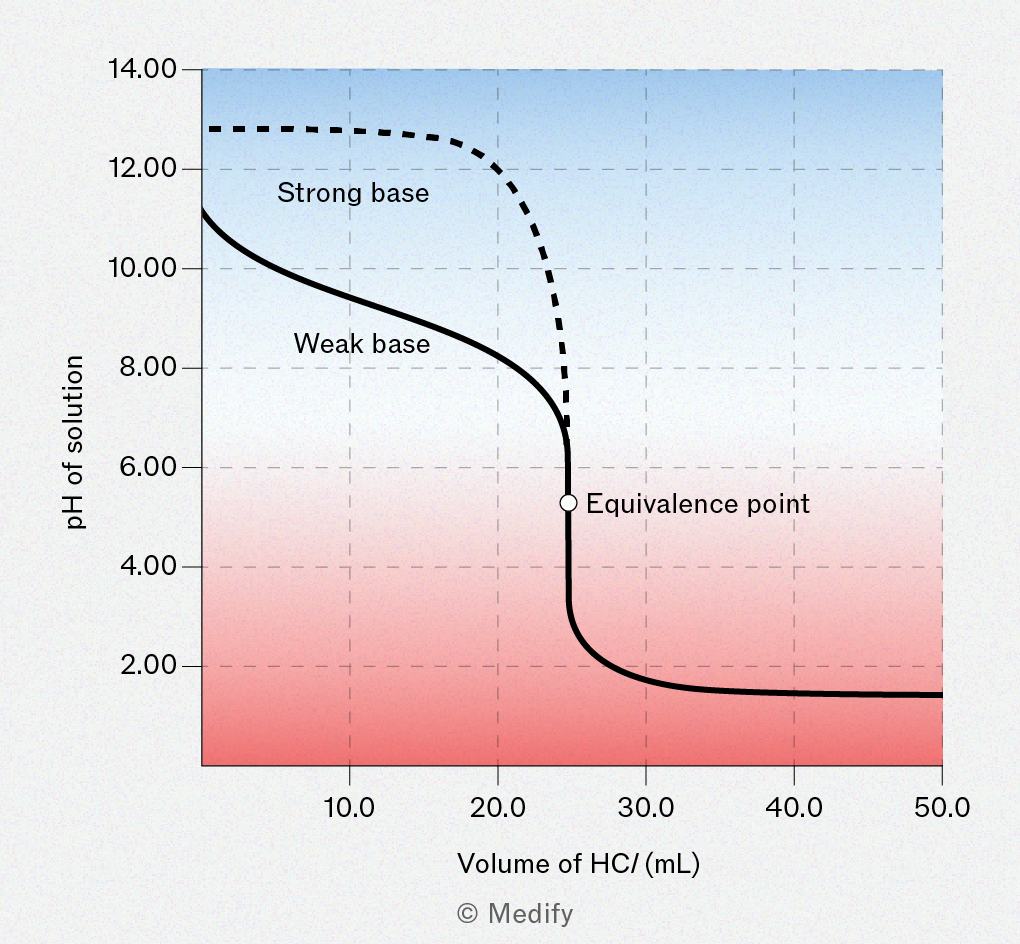
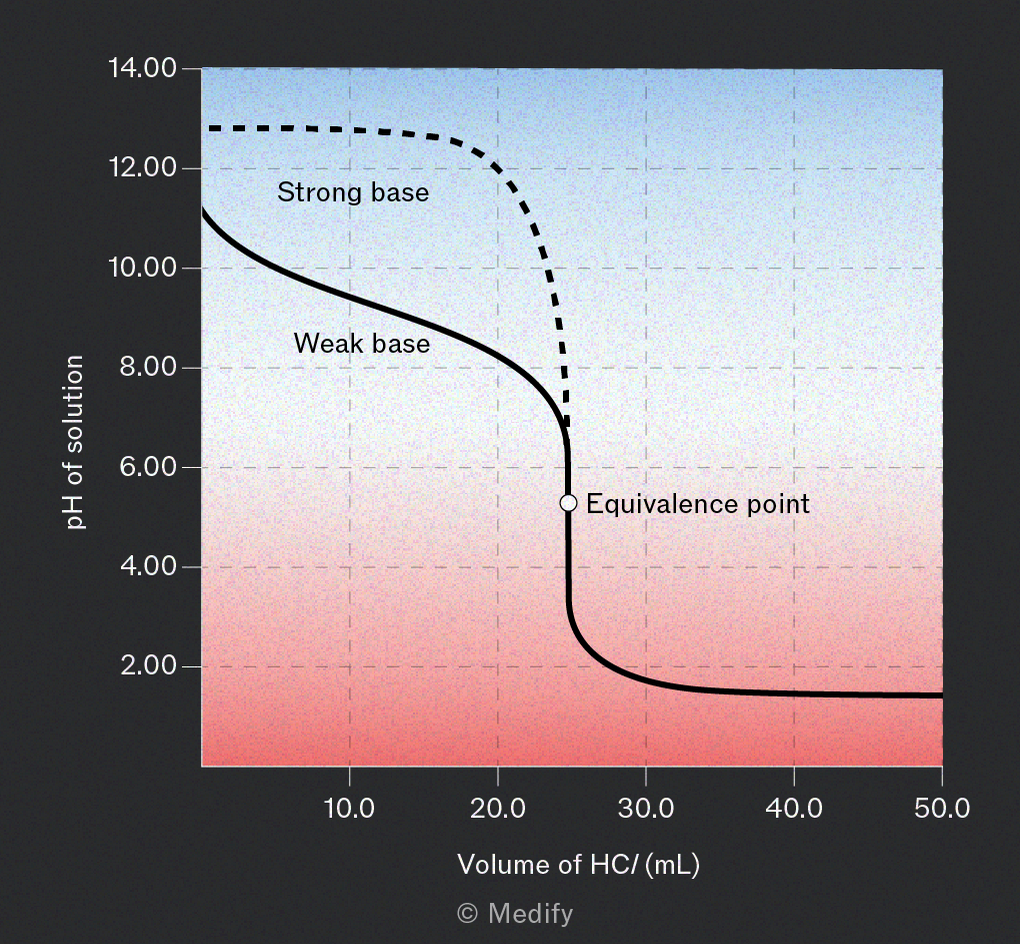
Starts at a lower than a strong base, initially falls gradually then remains steady for a period of acid addition. This is the buffer region; the solution contains a mixture of the weak base and its conjugate acid.
There is then a sharp fall near the point of neutralisation. There are a range of values which can represent neutralisation centering at an equivalence point of below .
The levels off at a low value quickly following neutralisation.
Weak acid with strong base
Example: Ethanoic acid () titrated with ().
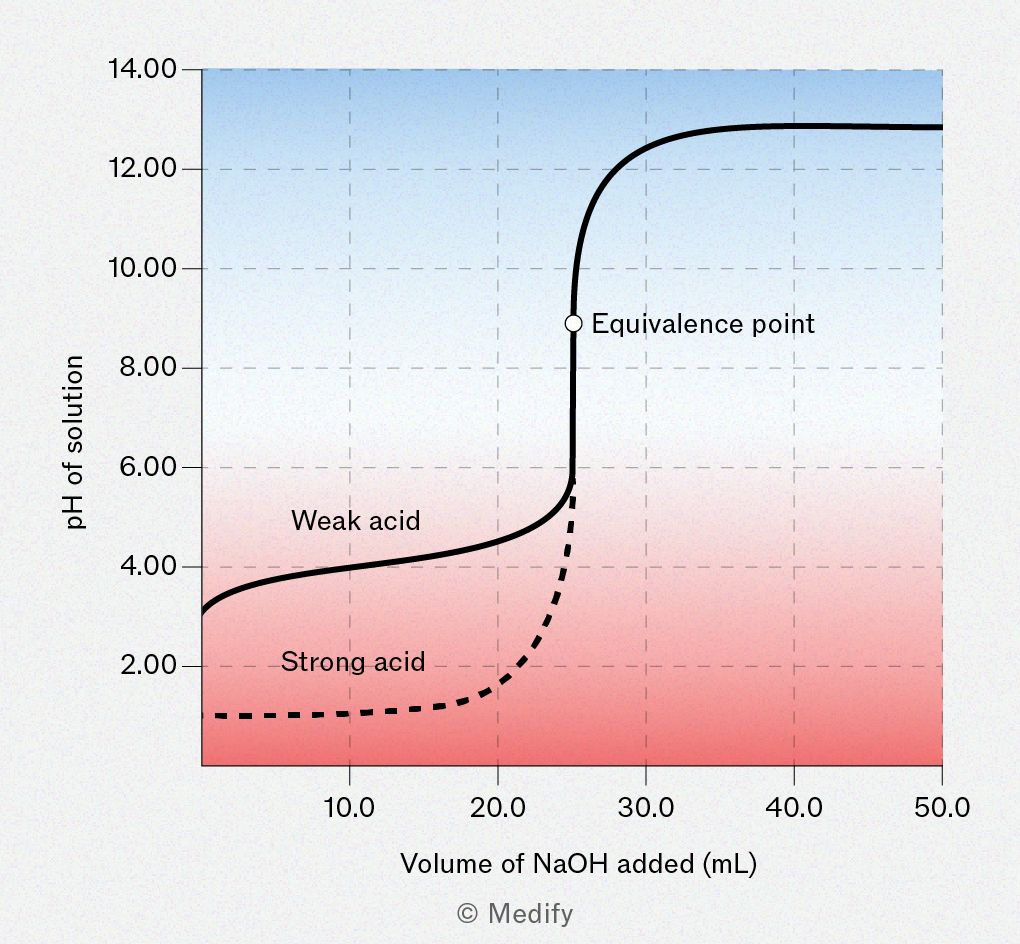
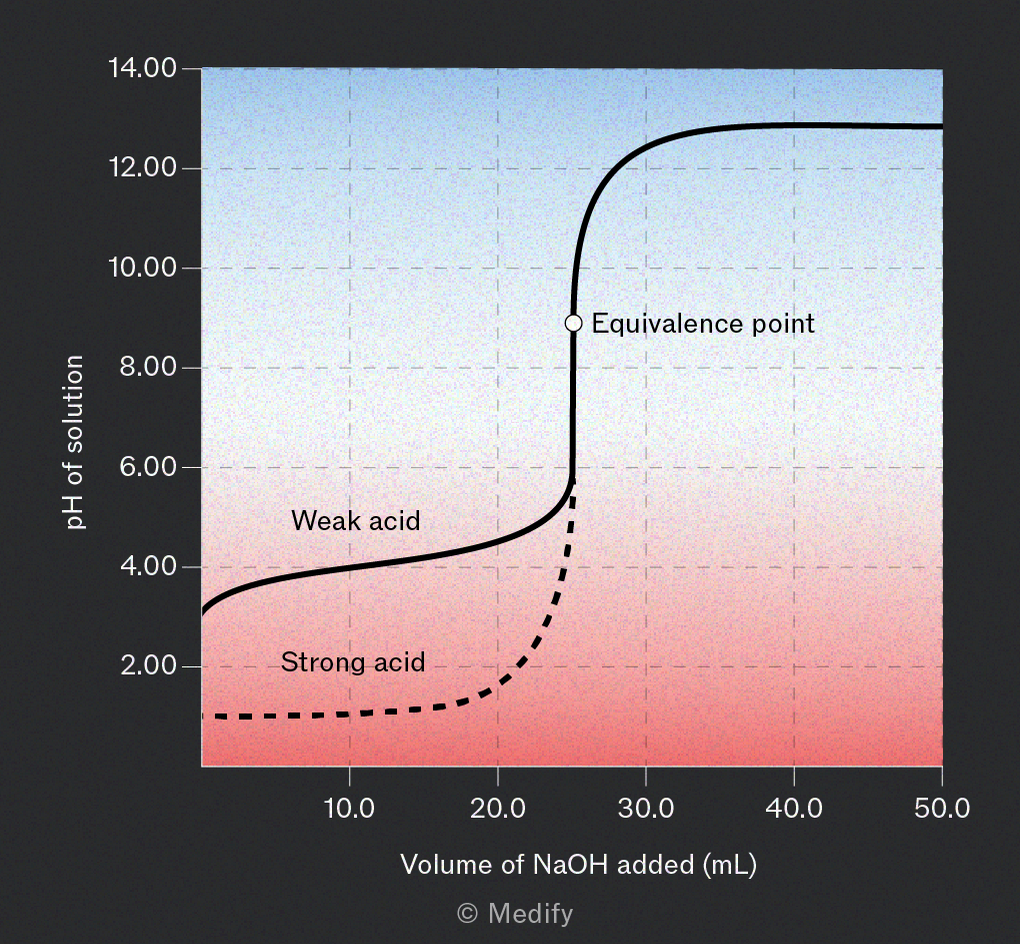
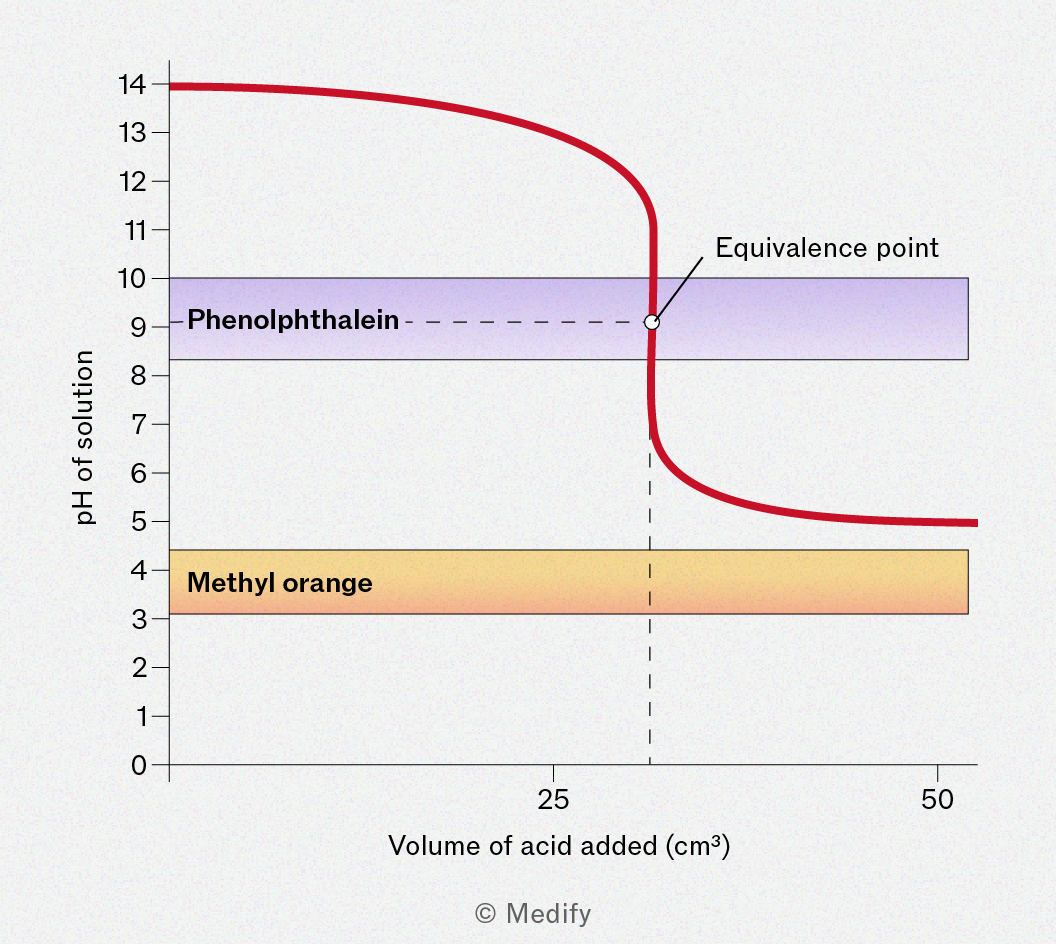
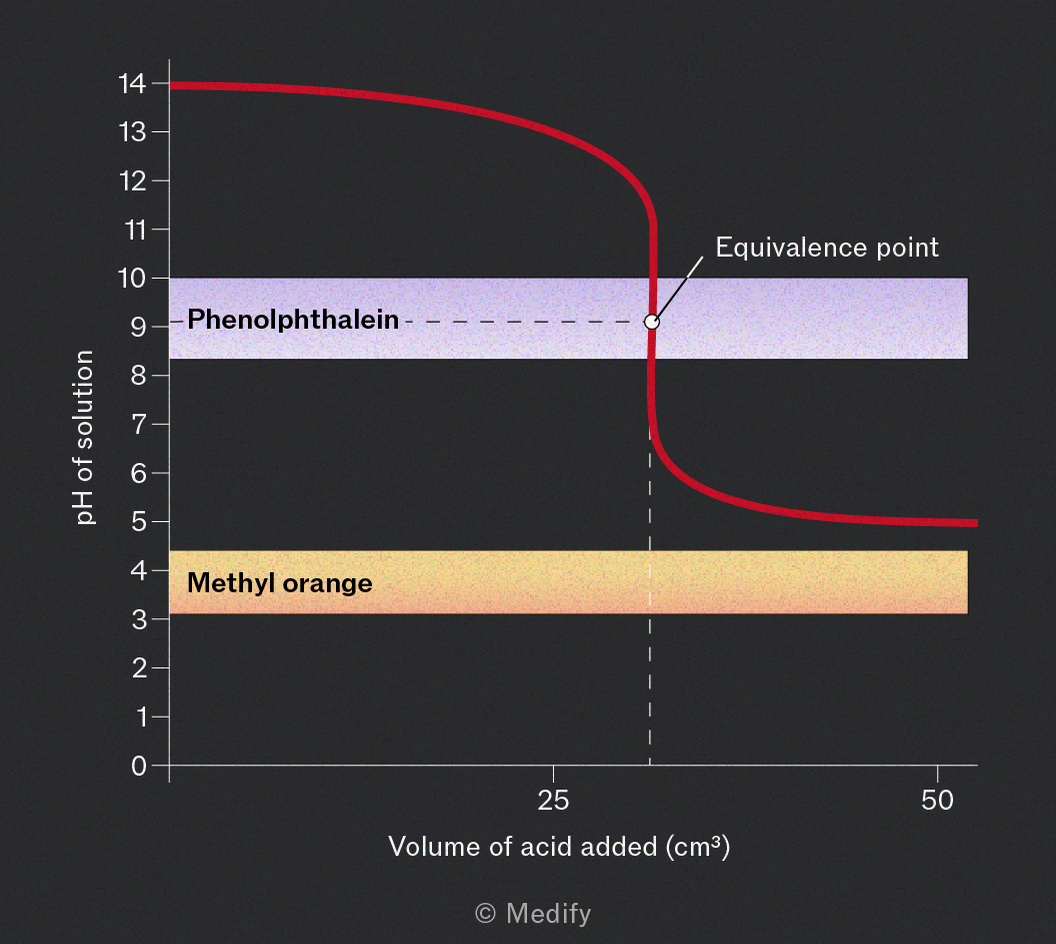
Starts at a higher than a strong acid. rises gradually initially then remains steady for a period of base addition. This is the buffer region; the solution contains a mixture of the weak acid and its conjugate base.
There is a steep increase in as the neutralisation point approaches. There are a range of values which can represent neutralisation centering at an equivalence point above .
Following neutralisation, the quickly levels off at a high .
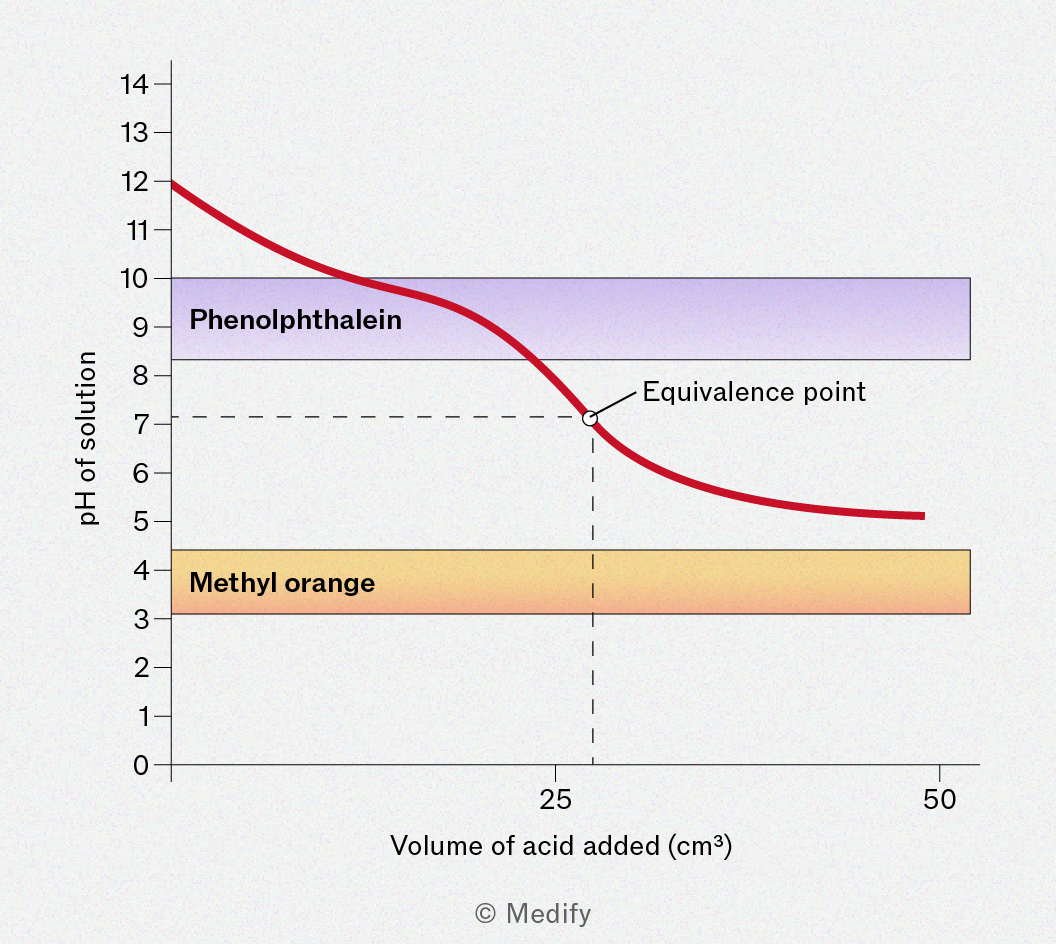
Weak base with weak acid
Example: Ammonia () titrated with ethanoic acid ().
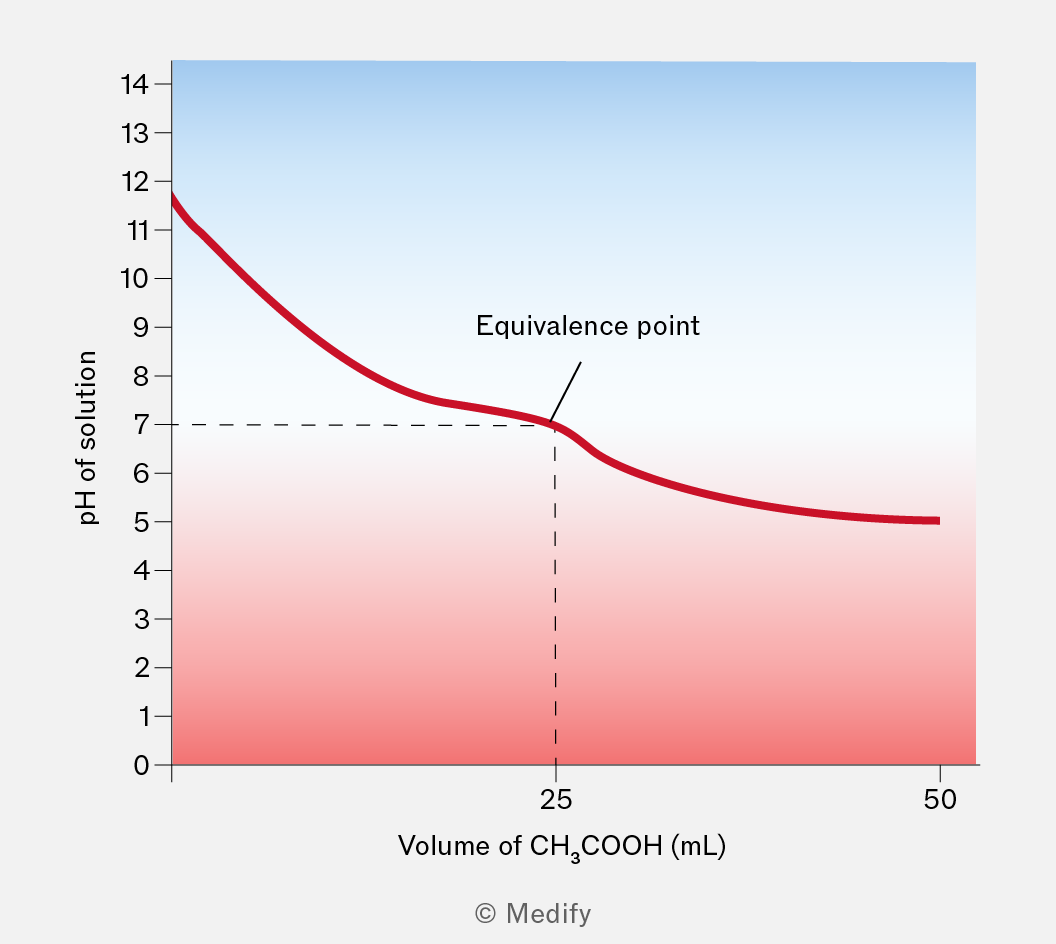
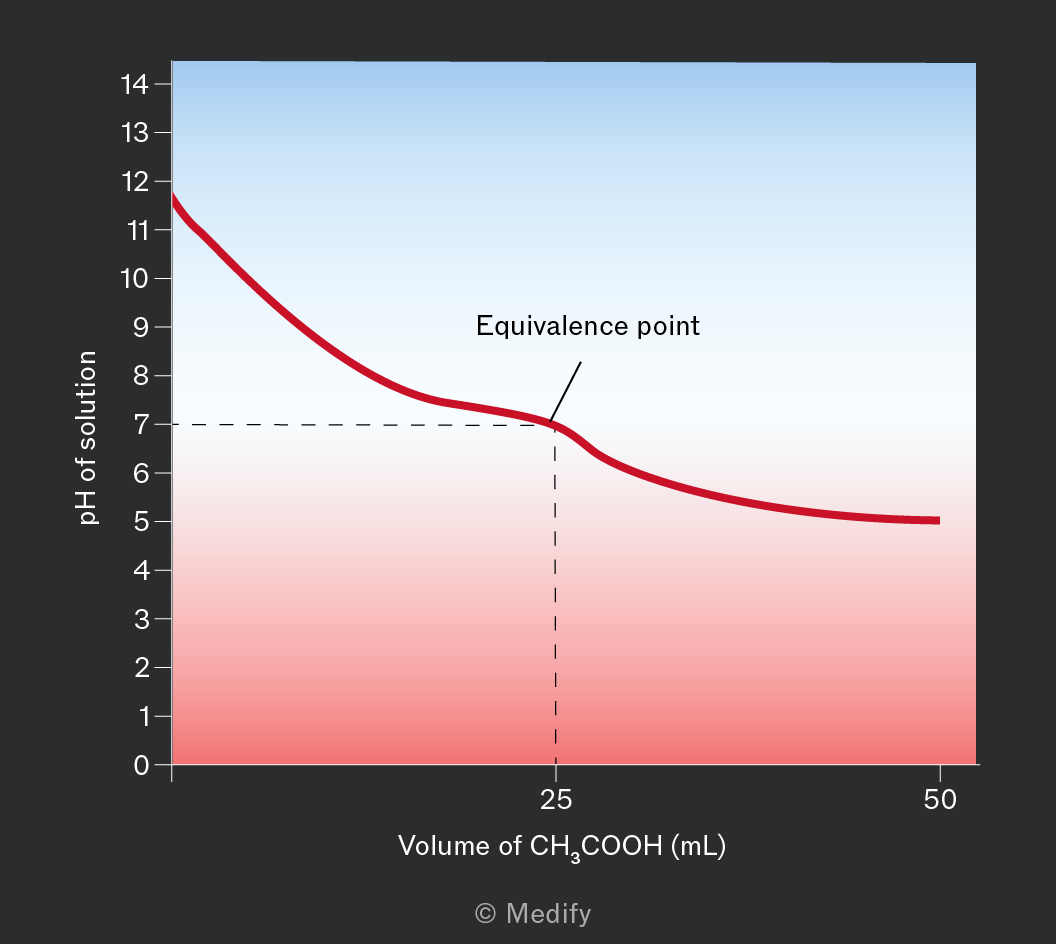
Starts at a lower than a strong base and steadily reduced as the solution approaches neutralisation.
There is only a short range of values, centred around , which can be used to indicate neutralisation.
Following neutralisation the continues to fall gradually.
At the point of neutralisation there is a steep change in . The midpoint of this range is the equivalence point.
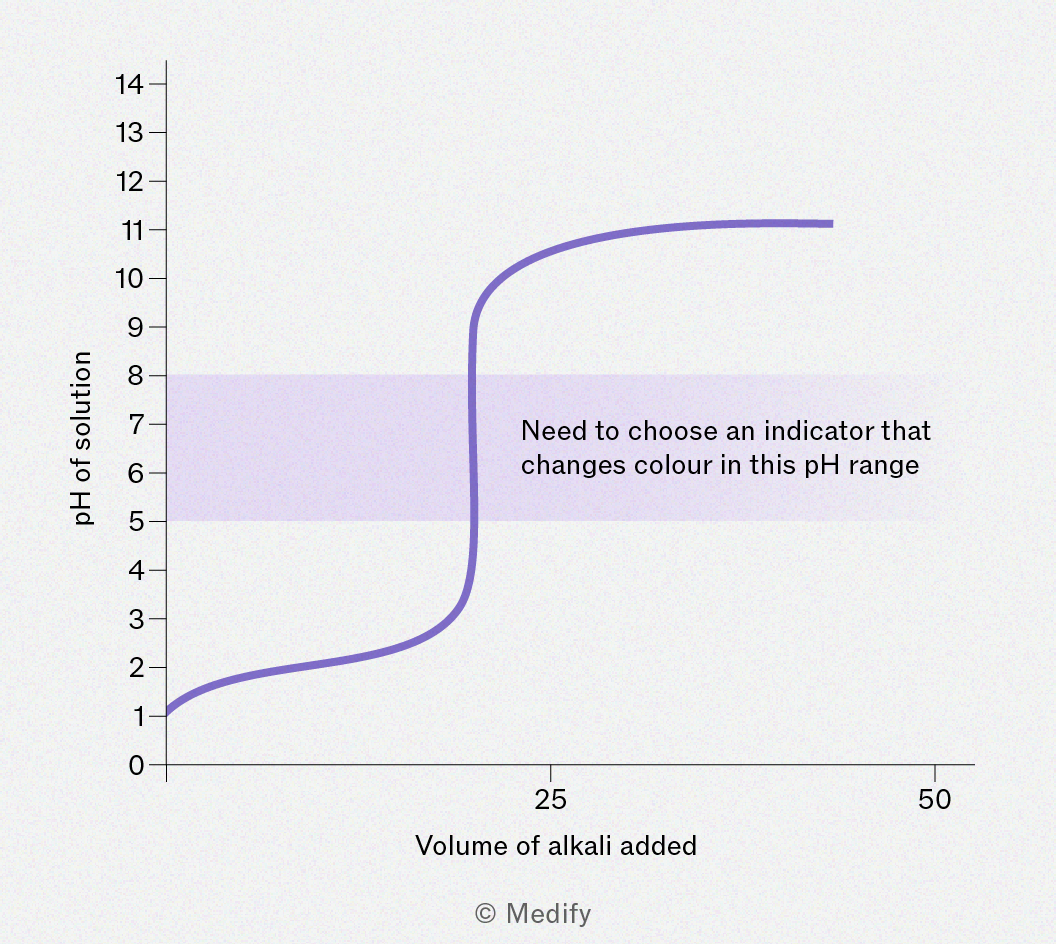
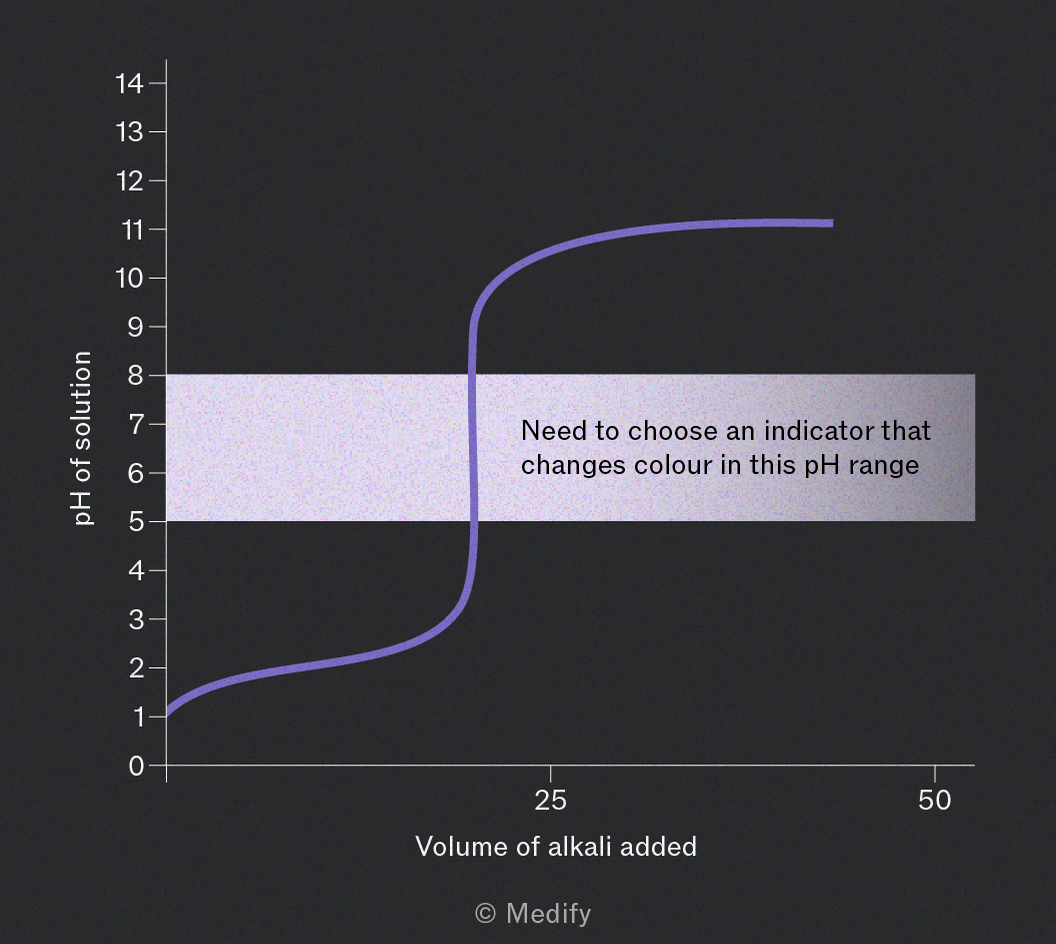
In order for an indicator to be effective at identifying the endpoint of a neutralisation reaction it must exhibit a colour change within the range of the steep change of .
The best indicators will exhibit a change at, or very close to, the equivalence point .
Suitable indicator for a strong acid/strong base titration
The range around the equivalence point is typically wide, from around .
Use indicators with a colour change at a within this range, such as phenolphthalein or methyl orange ().
Suitable indicator for a weak acid/strong base titration
The range around the equivalence point is typically narrower and at a higher equivalence point than a strong acid/strong base titration. It is around .
Use indicators with a colour change at a range above 7, such as phenolphthalein ().
Suitable indicator for a strong acid/weak base titration
The range around the equivalence point is typically narrower and at a lower equivalence point than a strong acid/strong base titration. It is around .
Use indicators with a colour change at a range below 7, such as methyl orange ().
There is no suitable indicator for titrations of weak acids with weak bases, as there is no sharp equivalence point. As a result, these pairings are not used in quantitative analysis.
A buffer solution is a system that minimises changes in when small amounts of an acid or a base are added.
Stability in is crucial for many chemical and biological processes
A buffer solution typically consists of a mixture of:
- a weak acid () and its salt containing conjugate base ()
- a weak base () and its salt containing conjugate acid ().
The weak acid and its conjugate base, or the weak base and its conjugate acid, work together to maintain the equilibrium constant and neutralise added acids or bases, thus maintaining the of the solution within a narrow range.
Le Chatelier’s principle explains how the buffer system shifts equilibrium to minimise changes.
When a weak acid is mixed with a strong base, the strong base neutralises part of the weak acid, forming its conjugate base and water.
If the weak acid is in excess, the remaining acid and the formed conjugate base create a buffer solution:
In an acidic buffer solution containing a weak acid () and its conjugate base () the buffer system responds to the addition of acids and bases in the following way:
Addition of acid (): The excess conjugate base () reacts with the added to form more of the weak acid (), thus reducing the increase in concentration and minimising the pH change:
Addition of base (): The undissociated weak acid () reacts with the added to form water and more conjugate base (), thus reducing the increase in concentration and minimising the pH change:
In a basic buffer solution containing a weak base () and its conjugate acid , the buffer system responds to the addition of acids and bases in the following way:
Addition of acid (): The weak base () reacts with the added to form its conjugate acid (), reducing the increase in concentration and minimising the change:
Addition of Base (): The excess of conjugate acid () reacts with the added to form water and the weak base (), reducing the increase in concentration and minimising the change:
In an acidic buffer solution contain a ethanoic acid mixed with its salt, sodium ethanoate, the solution contains both the weak acid and its conjugate base.
Chemical equilibrium is maintained according to the value of the weak acid.
Buffer action and Le Chatelier’s principle:
Addition of acid (): The ethanoate ions () react with the added to form more ethanoic acid (). According to Le Chatelier’s principle, the system will shift to the left to counter the increase in , thus minimising the change.
Addition of base (): The ethanoic acid () reacts with the added to form water and ethanoate ions (). The system will shift to the right to counter the removal of by , again minimising the change.
The of a buffer solution can be calculated by directly using the acid dissociation constant (), the concentrations of the weak acid, and the concentration of the conjugate base.
Substitute the concentrations into the equation:
Solve for []:
Calculate the pH:
Remember that, when a pair of solutions are mixed to form a buffer, new concentrations must be calculated based on the combined volume.
The calculation process when a buffer solution is formed through the reaction of an excess of weak acid with a strong base needs to factor in the reduction of the moles of following reaction with the base.
The amount of conjugate acid, , can be calculated directly from the amount of strong base used.
The reaction stoichiometry can be used to work out the remaining amount of weak acid, .
Both amounts should be converted to concentration using the combined volume of the solutions.
Question walkthrough
Buffer solutions
Calculating the pH of a buffer solution based on composition and Ka