
Transition metals - AL only (3.2.5)
On this page
The definition of a transition metal is an element that has an incompletely filled d subshell in one or more of its oxidation states. These elements are all found in the d block but not all d block elements are transition metals.
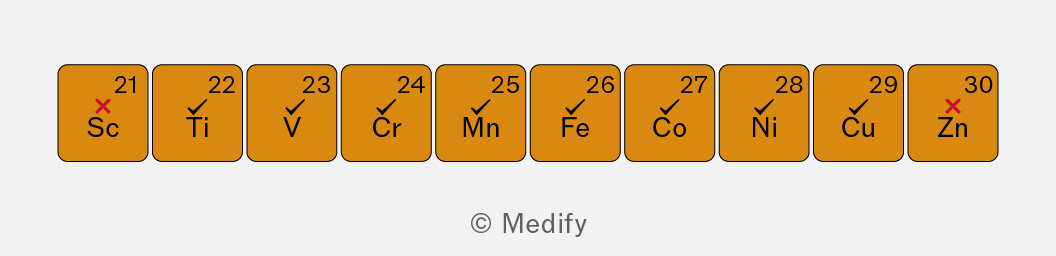
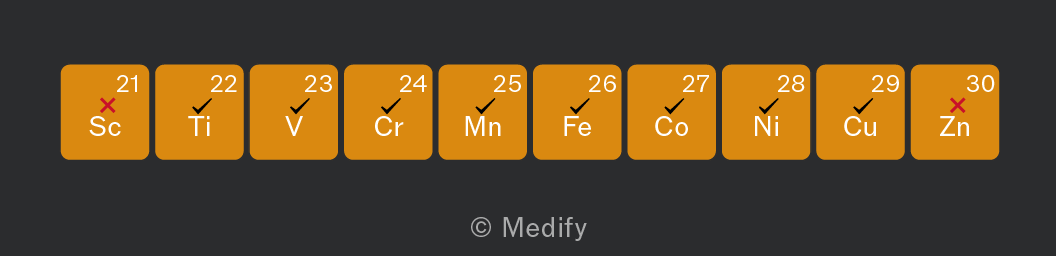
In accordance with this rule, scandium and zinc are not classed as transition metals.
Electron configuration for scandium:
: 1s22s22p63s23p64s23d1
Scandium only forms a 3+ ion.
The electron configuration for is: 1s22s22p63s23p6
All of the d electrons have been lost therefore scandium is not a transition metal.
Electron configuration for zinc:
: 1s22s22p63s23p64s23d10
Zinc only forms a 2+ ion.
The electron configuration for is: 1s22s22p63s23p63d10
All of the s electrons have been lost, and the d orbital is full therefore zinc is not a transition metal.
Transition metals show variable oxidation states.
The oxidation states of the transition metals are always positive. Due to the similar energies of the 4s and 3d orbital, the metal is able to form different cations.
The different oxidation states of a transition metal compound are shown using roman numerals. For example, iron(II) oxide shows iron as the ion, whereas iron(III) oxide shows iron as the ion.
You should be able to deduce the oxidation states of transition metal ion compounds from the charges of the ligands and the overall charge of the complex.
Transition metals can behave as catalysts
Transition metals show variable oxidation states they can donate or gain electrons during the catalysis process and lower the activation energy and provide an alternative reaction pathway, e.g. iron in the Haber process.
Transition metals can act as heterogenous and homogenous catalysts.
Homogeneous catalysts: The catalyst is in the same physical state as the reactants and the reaction occurs at active sites on the surface.
Heterogeneous catalysts: The catalyst is in a different physical state to the reactants.
Transition metals can form complexes with ligands.
Coordination complexes consist of a central metal ion coordinately bonded to ligands. The complexes can be charged (complex ions) or neutral.
As transition metals have variable oxidation states, they can form complexes with different coordination numbers.
A ligand is an atom, ion, or molecule that can donate a pair of electrons to the transition metal to form a coordinate bond to a metal ion.
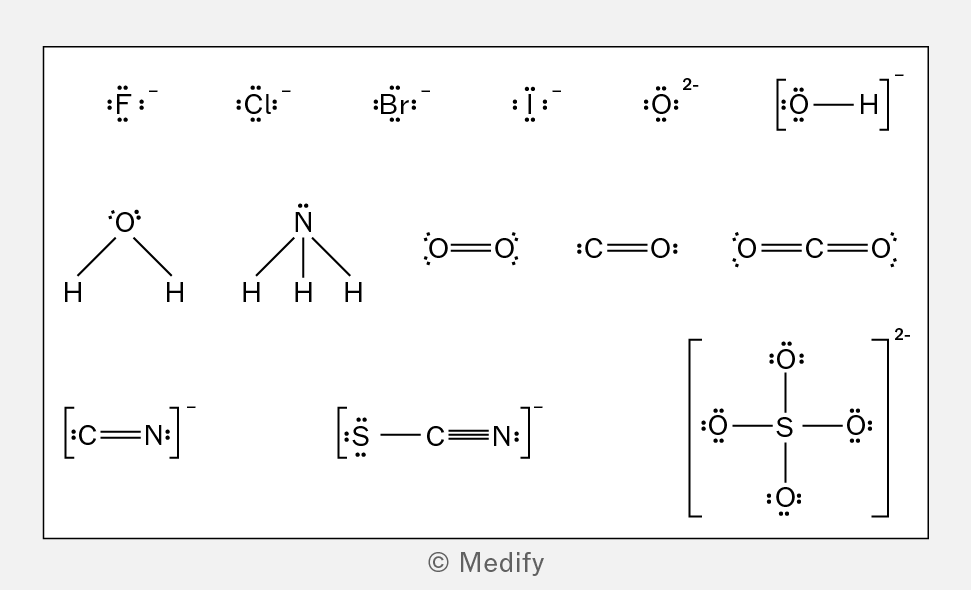
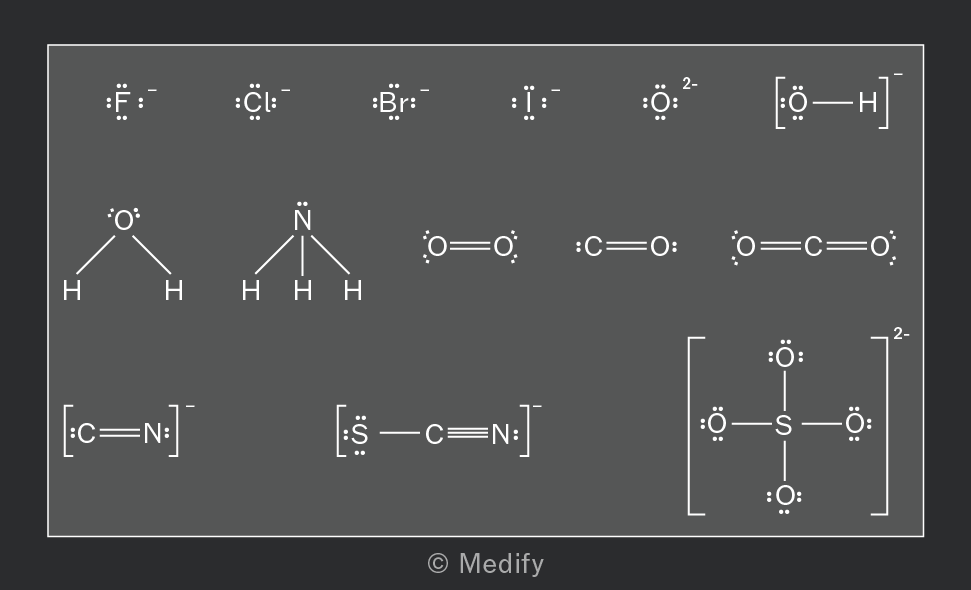
Ligands can be anionic or neutral but all must have available lone pairs.
A complex ion is a transition metal coordinately bonded to one or more ligands.
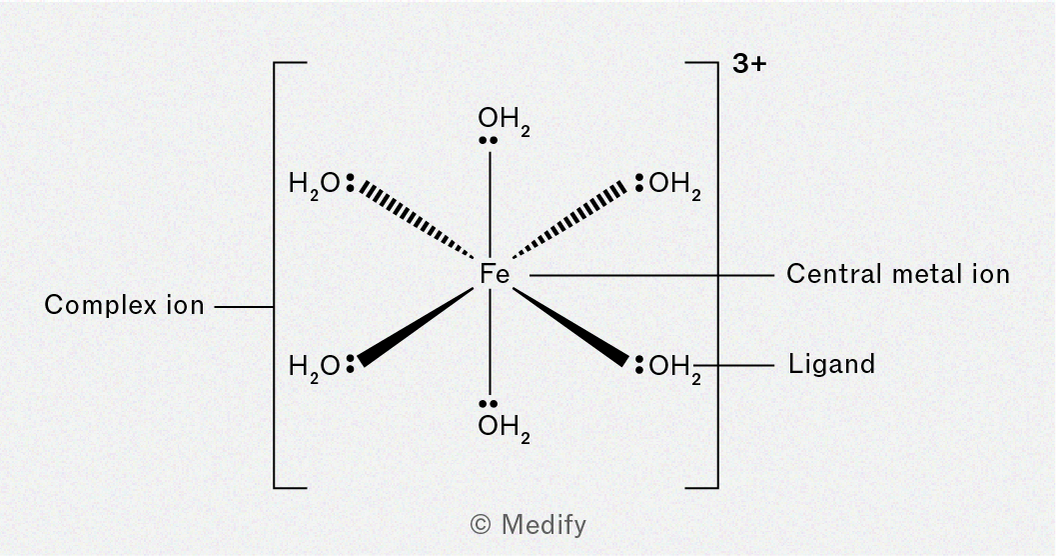
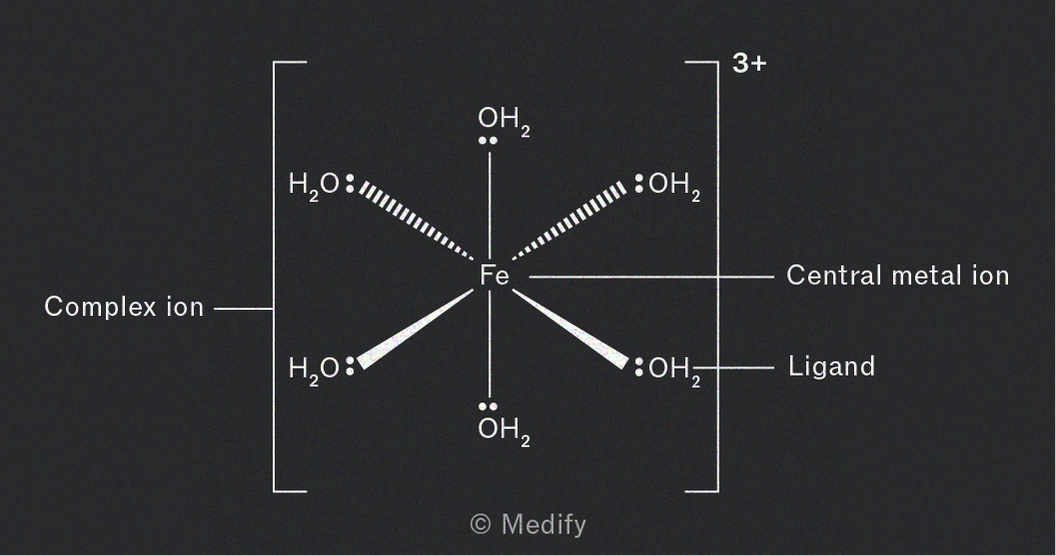
Complex ions have a net charge – the sum of the charges of the ligands and the oxidation state of the metal centre.
The coordination number is the number of coordinate bonds formed between the ligand and the metal ion.
Ligands can be described as monodentate, bidentate, and multidentate, depending upon how many donor atoms have lone pairs that coordinately bond to a transition metal ion.
![Diagram illustrating the coordination complex [CoCl2(en)2]+, showing cobalt (Co) at the center bonded to two chloride (Cl) ions and two bidentate ethylenediamine (en) ligands, with annotations indicating the types of coordinate bonds: bidentate with 2 bonds and monodentate with 1 bond.](https://d3nzlfkeryzt6j.cloudfront.net/4qpp1e90ta9qarhe9ay5i81mr550)
![Diagram illustrating the coordination complex [CoCl2(en)2]+, showing cobalt (Co) at the center bonded to two chloride (Cl) ions and two bidentate ethylenediamine (en) ligands, with annotations indicating the types of coordinate bonds: bidentate with 2 bonds and monodentate with 1 bond.](https://d3nzlfkeryzt6j.cloudfront.net/2ezypr95jrpv1t1i28jupzrn58st)
The suffix dentate comes from the Latin word ‘dens’ meaning tooth. The denticity of ligands relates to how many points they can ‘bite’ with.
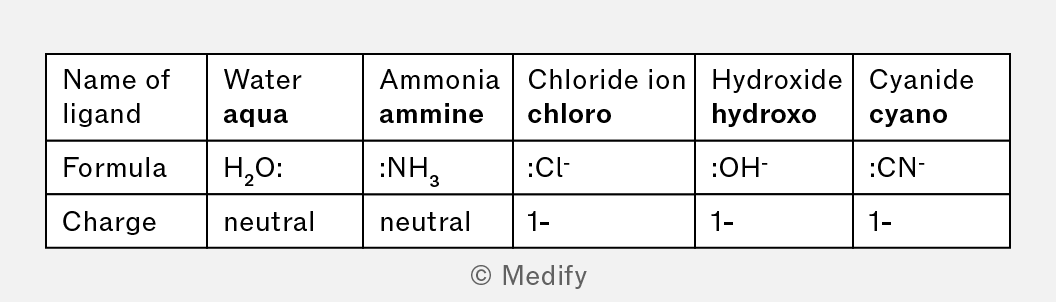
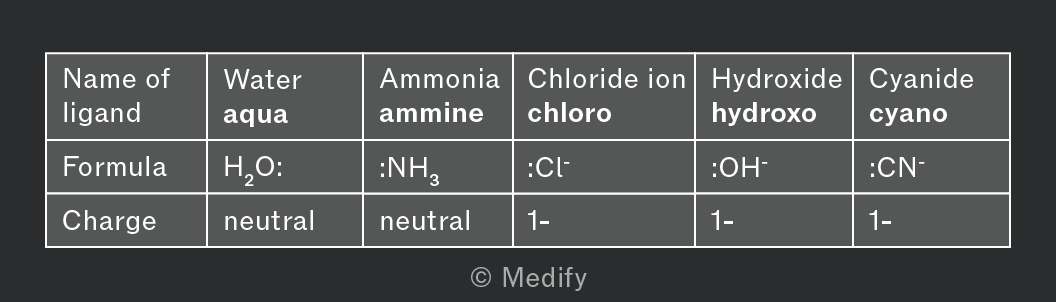
A monodentate ligand contains one donor atom with a lone pair of electrons and forms one coordinate bond with the metal ion.
Below is a table listing the common monodentate ligands and their charges.
Monodentate: ‘one tooth’.
A bidentate ligand contains two donor atoms and forms two coordinate bonds with the metal ion.
Ethane-1,2-diamine (en) and ethanedioate ion are both examples of bidentate ligands.
Ethane-1,2-diamine bonds via the lone pairs on the amine groups and is a neutral ligand.
Ethanedioate bonds via the lone pairs on the oxygens and is an anion with a charge.
The image below shows the lone pairs available to form coordinate bonds and the spatial arrangement, allowing both pairs to orientate towards a central metal.
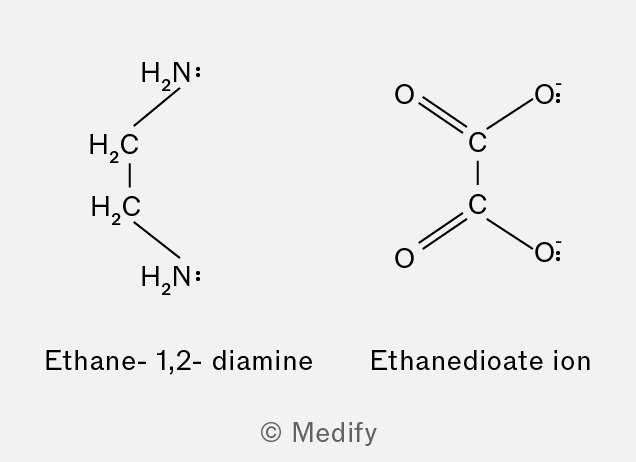
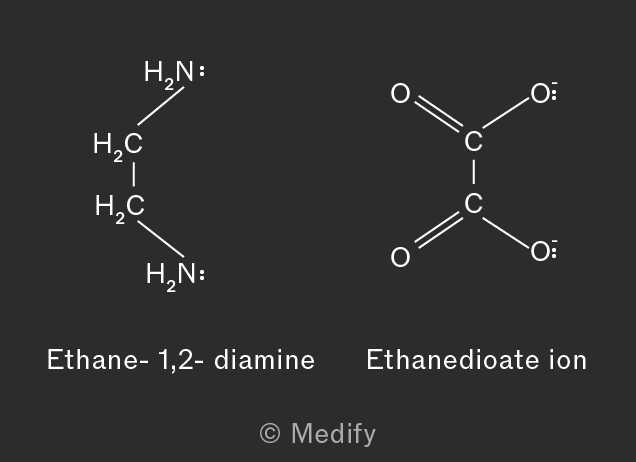
Bidentate: ‘two teeth’.
A multidentate ligand contains many donor atoms and forms many coordinate bonds.
EDTA is able to form six coordinate bonds.
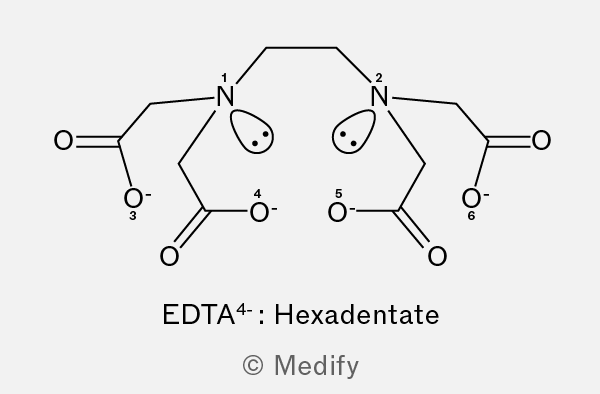
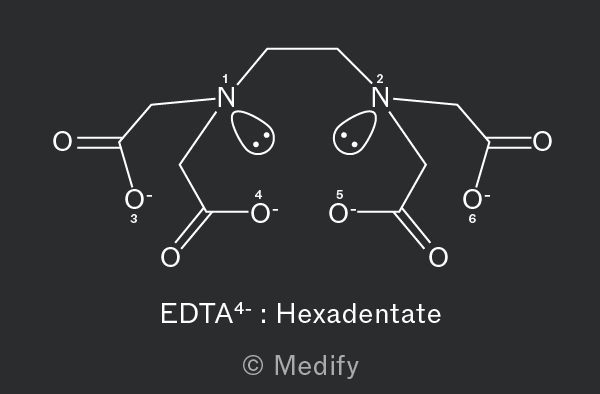
Complexes with multidentate or bidentate ligands are more stable than complexes with monodentate ligands.
Ligand substitution reaction will occur to allow the substitution of monodentate ligands with those of higher denticity.
This is known as the chelate effect.
The enthalpy change for ligand substitution reactions is small.
Breaking bonds with monodentate ligands and forming bonds with multidentate ligands results in similar bond strengths therefore the enthalpy change .
However, the entropy change is significantly positive when multidentate ligands replace monodentate ligands.
There is more disorder in the system as there are more molecules in the products.
In terms of Gibbs free energy, the positive leads to a negative making the chelate effect thermodynamically favourable.
A ligand substitution reaction is one in which a ligand in a complex ion is replaced by another ligand.
If a ligand is substituted with another ligand of similar size, the coordination number and the geometry stays the same.
Ammonia and water ligands are similar in size and therefore ligand substitution does not result in a change in geometry.
The chloride ligand is larger than ammonia and water, therefore this ligand exchange can result in the coordination number and geometry changing; fewer chloride ions can fit around the complex ion.
When is added dropwise to a pink solution of a blue precipitate is initially formed which is then converted to a brown solution as an excess of ammonia is added.
![A diagram illustrating the chemical reactions of cobalt complexes in solution. It shows four test tubes: the first contains a pink solution labeled [Co(H2O)6]2+(aq), indicating the presence of cobalt ions in water. The second shows a blue precipitate, [Co(H2O)4(OH)2](s), formed by adding a small amount of ammonia. The third test tube contains a brown solution, [Co(NH3)6]2+(aq), resulting from an excess of ammonia. The final test tube displays a dark brown solution, [Co(NH3)6]3+(aq), which forms after leaving the solution to stand in air, indicating oxidation.](https://d3nzlfkeryzt6j.cloudfront.net/ed9u1ohf0ddkh2d4xvpkyq58nrfq)
![A diagram illustrating the chemical reactions of cobalt complexes in solution. It shows four test tubes: the first contains a pink solution labeled [Co(H2O)6]2+(aq), indicating the presence of cobalt ions in water. The second shows a blue precipitate, [Co(H2O)4(OH)2](s), formed by adding a small amount of ammonia. The third test tube contains a brown solution, [Co(NH3)6]2+(aq), resulting from an excess of ammonia. The final test tube displays a dark brown solution, [Co(NH3)6]3+(aq), which forms after leaving the solution to stand in air, indicating oxidation.](https://d3nzlfkeryzt6j.cloudfront.net/bratdkjswblap5pgizgyeuu3p4y1)
Step 1: Ammonia acts as a base and deprotonates water.
Step 2: Ligand substitution with ammonia.
When left to stand, the can be further oxidised to and the brown colour darkens.
When is added dropwise to a pale blue solution of , a blue precipitate is initially formed, which is then converted to a deep blue solution as an excess of ammonia is added.
![A diagram illustrating the reaction of copper(II) ions with ammonia. The first test tube shows a pale blue solution of [Cu(H2O)6]2+(aq). The second test tube depicts a blue precipitate of Cu(H2O)4(OH)2(s) after adding a small amount of ammonia. The third test tube displays a deep blue solution of [Cu(NH3)4(H2O)2]2+(aq) after adding an excess of ammonia.](https://d3nzlfkeryzt6j.cloudfront.net/ijafpn0jl6fc1hhbv6yxzmo0mhk5)
![A diagram illustrating the reaction of copper(II) ions with ammonia. The first test tube shows a pale blue solution of [Cu(H2O)6]2+(aq). The second test tube depicts a blue precipitate of Cu(H2O)4(OH)2(s) after adding a small amount of ammonia. The third test tube displays a deep blue solution of [Cu(NH3)4(H2O)2]2+(aq) after adding an excess of ammonia.](https://d3nzlfkeryzt6j.cloudfront.net/p9nl0qbzvvggktjsz97kt30ewpkh)
Step 1: Ammonia acts as a base and deprotonates water.
Step 2: Ligand substitution with ammonia.
As , , and are all a similar small size all the copper complexes have a coordination number of six and an octahedral geometry.
When concentrated is added to a pink solution of a blue solution is formed.
The six water molecules are exchanged for four chloride ions.
The coordination number and shape of the complex changes.
![Two test tubes side by side. The left test tube contains a pink solution labeled [Co(H2O)6]2+(aq), while the right test tube contains a blue solution labeled [CoCl4]2-(aq). An arrow points from the pink solution to the blue solution, indicating a reaction with concentrated hydrochloric acid (conc HCl).](https://d3nzlfkeryzt6j.cloudfront.net/mwfkd1ynrzw9ooe7pruysda5x3ft)
![Two test tubes side by side. The left test tube contains a pink solution labeled [Co(H2O)6]2+(aq), while the right test tube contains a blue solution labeled [CoCl4]2-(aq). An arrow points from the pink solution to the blue solution, indicating a reaction with concentrated hydrochloric acid (conc HCl).](https://d3nzlfkeryzt6j.cloudfront.net/owk41km0jswvdrcu0xik2vwix9sl)
The ionic equation for the ligand substitution is:
has an octahedral shape.
has a tetrahedral shape.
When concentrated is added to a yellow solution of , the yellow solution turns orange.
The six water ligands are exchanged with four chloride ligands.
The coordination number and shape of the complex changes.
![A diagram showing two test tubes. The left test tube contains a yellow solution labeled [Fe(H2O)6]3+(aq), while the right test tube contains an orange solution labeled [FeCl4]-(aq). An arrow indicates the addition of concentrated HCl between the two solutions.](https://d3nzlfkeryzt6j.cloudfront.net/7mob797ap4nbxanj3v59nhm54hmt)
![A diagram showing two test tubes. The left test tube contains a yellow solution labeled [Fe(H2O)6]3+(aq), while the right test tube contains an orange solution labeled [FeCl4]-(aq). An arrow indicates the addition of concentrated HCl between the two solutions.](https://d3nzlfkeryzt6j.cloudfront.net/5vdi83d39zsyyeynmgn1dduycyww)
The ionic equation for the ligand substitution is:
has an octahedral shape.
has a tetrahedral shape.
You need to be able to recall the colour and solubility for these metal ions with addition of ammonia and sodium hydroxide, and any changes in excess.
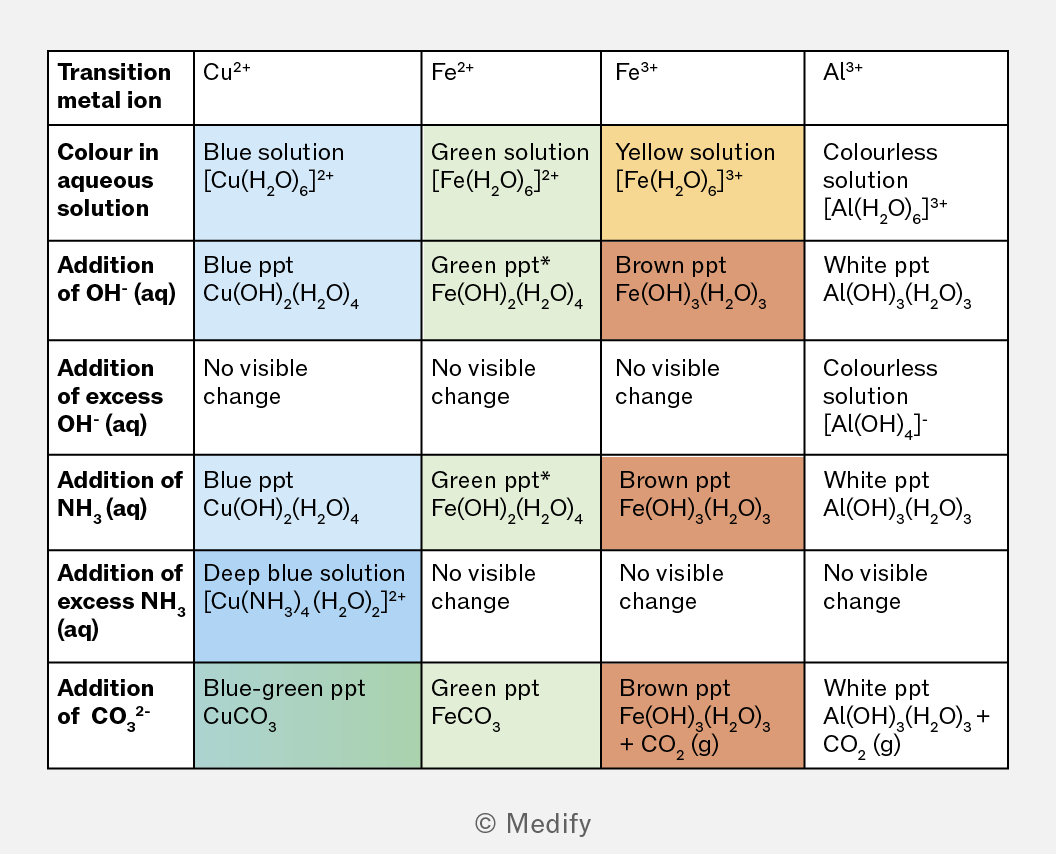
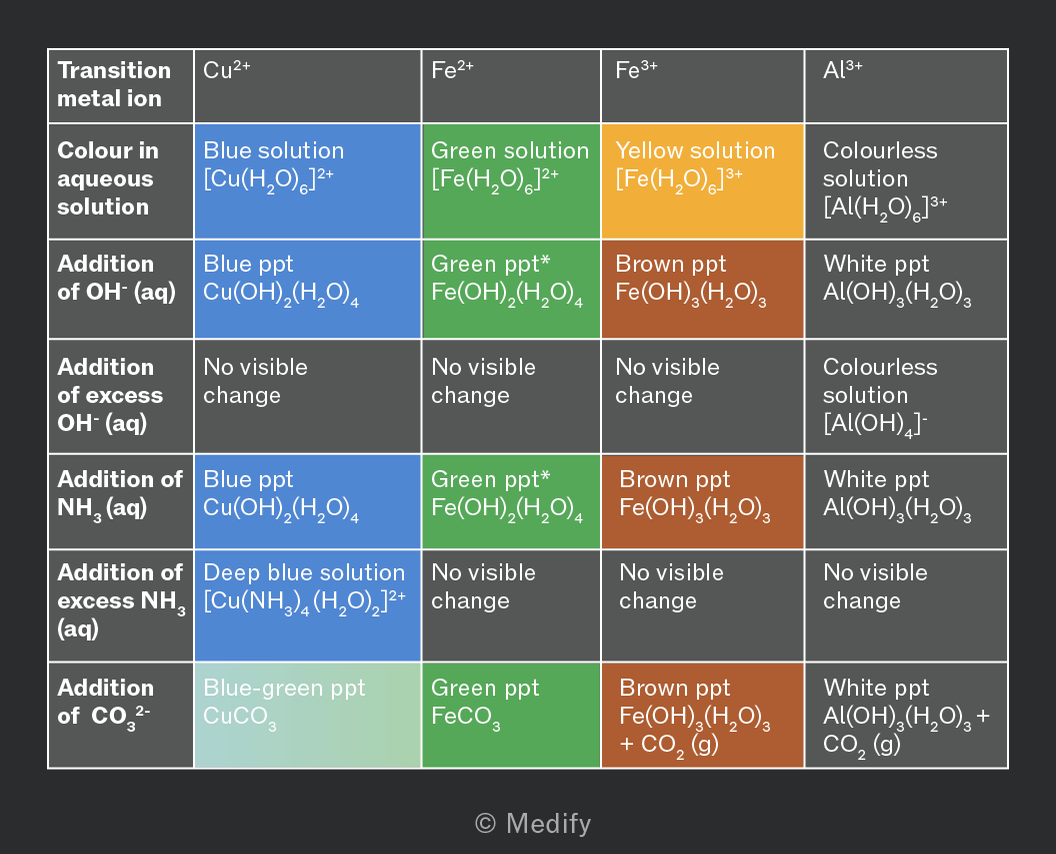
forms a green precipitate which may turn brown on standing with air. This is due to being oxidized to when left to stand in air.
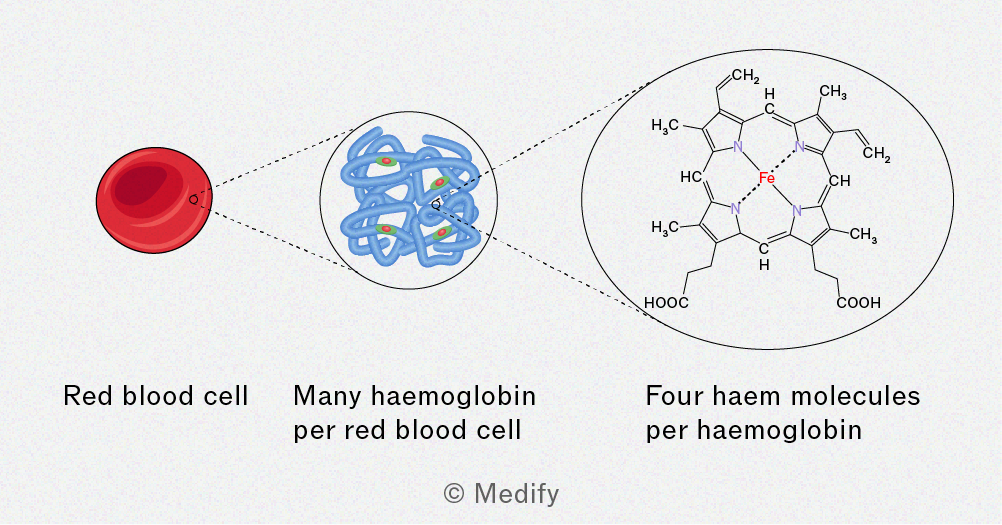
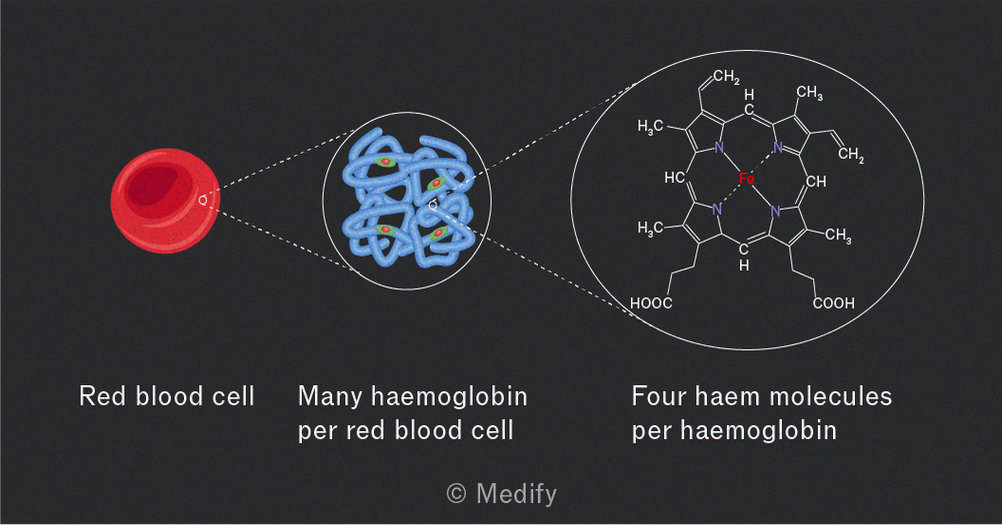
Haemoglobin is an oxygen carrying molecule found in red blood cells.
The haemoglobin molecule contains four polypeptide chains, at the centre of each of these polypeptide chains is a haem complex.
In the centre of each haem complex there is an ion within a multidentate ligand.
The role of iron in haemoglobin
The ions in the haem molecules bind reversibly with to form oxyhaemoglobin.
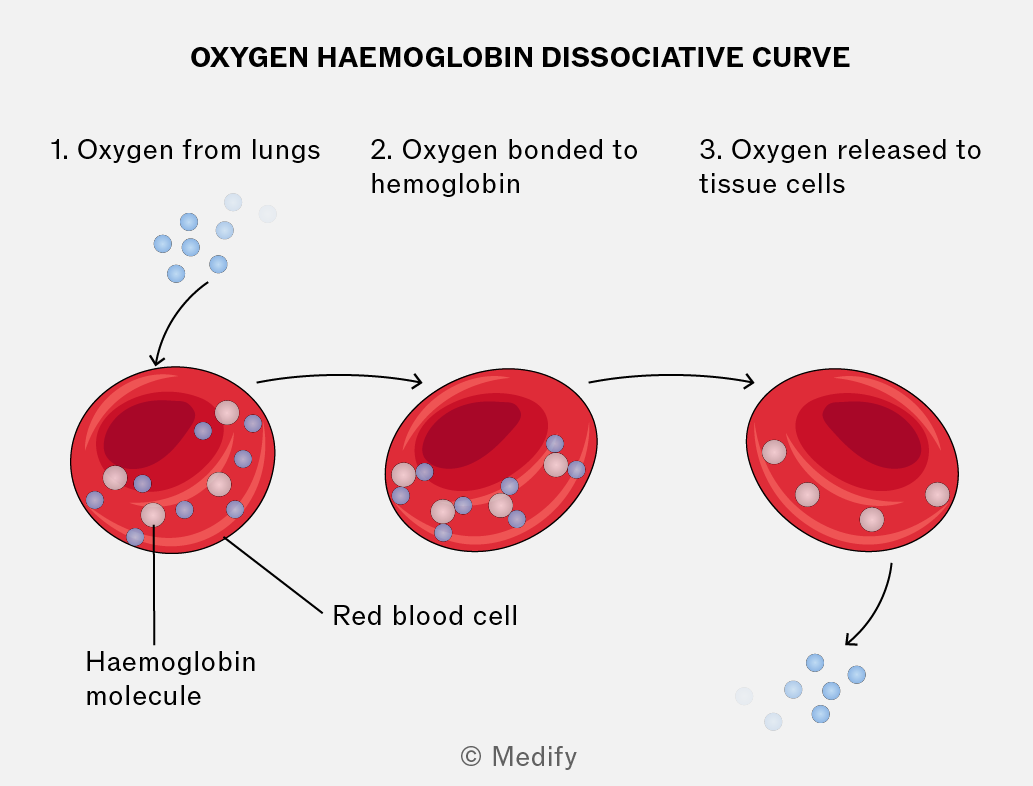
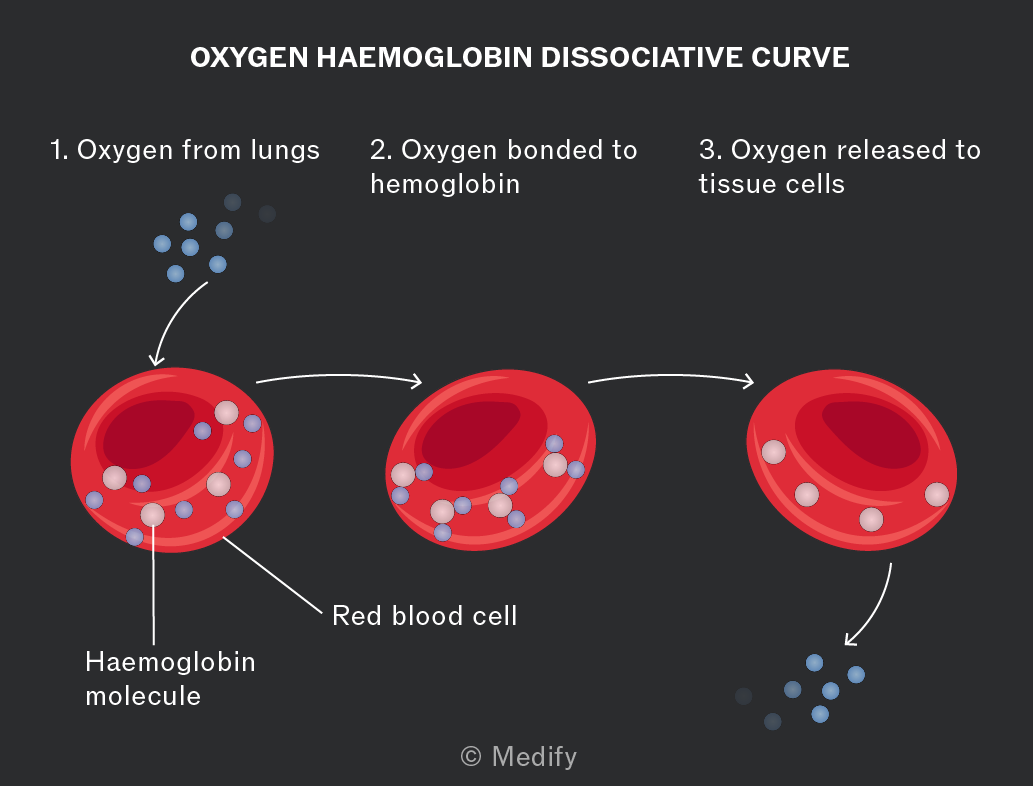
Each haemoglobin unit can bind to four molecules of oxygen. This exchange takes place in the lungs.
The oxygen acts as a ligand and forms a coordinate bond with the .
The oxygen is transported to the cells via haemoglobin, where it can be release.
Carbon monoxide () can also act as a ligand to haemoglobin. It binds to haemoglobin at the same binding site as oxygen.
The coordinate bond between carbon monoxide and haemoglobin is much more stable than the coordinate bond with oxygen.
Equilibrium sits towards the carboxyhaemoglobin product preventing dissociation.
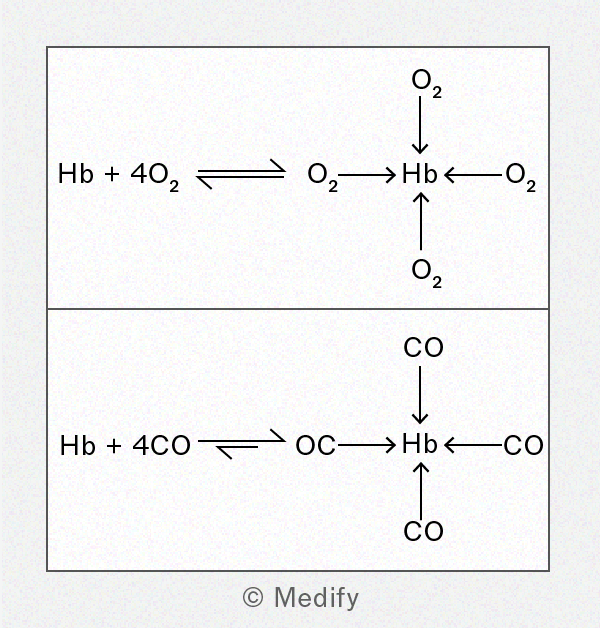
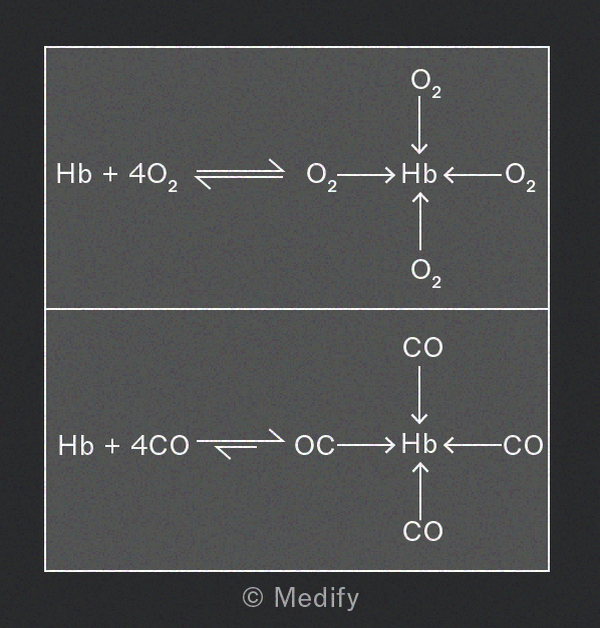
If the haemoglobin is occupied with carbon monoxide less oxygen is transported in the blood, which results in tissues being starved of oxygen and leads to carbon monoxide poisoning.
The shape of the complex ion can be deduced from the number of coordinate bonds between the central metal ion and the ligands.
The most common transition metal complexes have coordination numbers two, four and six. They can be linear, square planar, tetrahedral, or octahedral.
The complex should always be drawn in 3D, using wedged and dashed lines. You will need to remember the bond angles for each shape.
Transition metal ions with two coordinately bonded ligands can adopt a linear shape.
An example is Tollens reagent: .
![A table displaying information about coordination compounds. It includes three columns: 'Number of coordination bonds' with the value '2', 'Name of shape' labeled as 'Linear', and 'Example' showing the chemical structure of [Ag(NH3)2]+.](https://d3nzlfkeryzt6j.cloudfront.net/vtww3z9wz95f84mm0nlgwg74w5gl)
![A table displaying information about coordination compounds. It includes three columns: 'Number of coordination bonds' with the value '2', 'Name of shape' labeled as 'Linear', and 'Example' showing the chemical structure of [Ag(NH3)2]+.](https://d3nzlfkeryzt6j.cloudfront.net/jnui00biau7zrc5g8ug2ytbg17zw)
Four-fold coordination
Transition metal ions with four coordinately bonded ligands can either adopt a tetrahedral or square planar geometry.
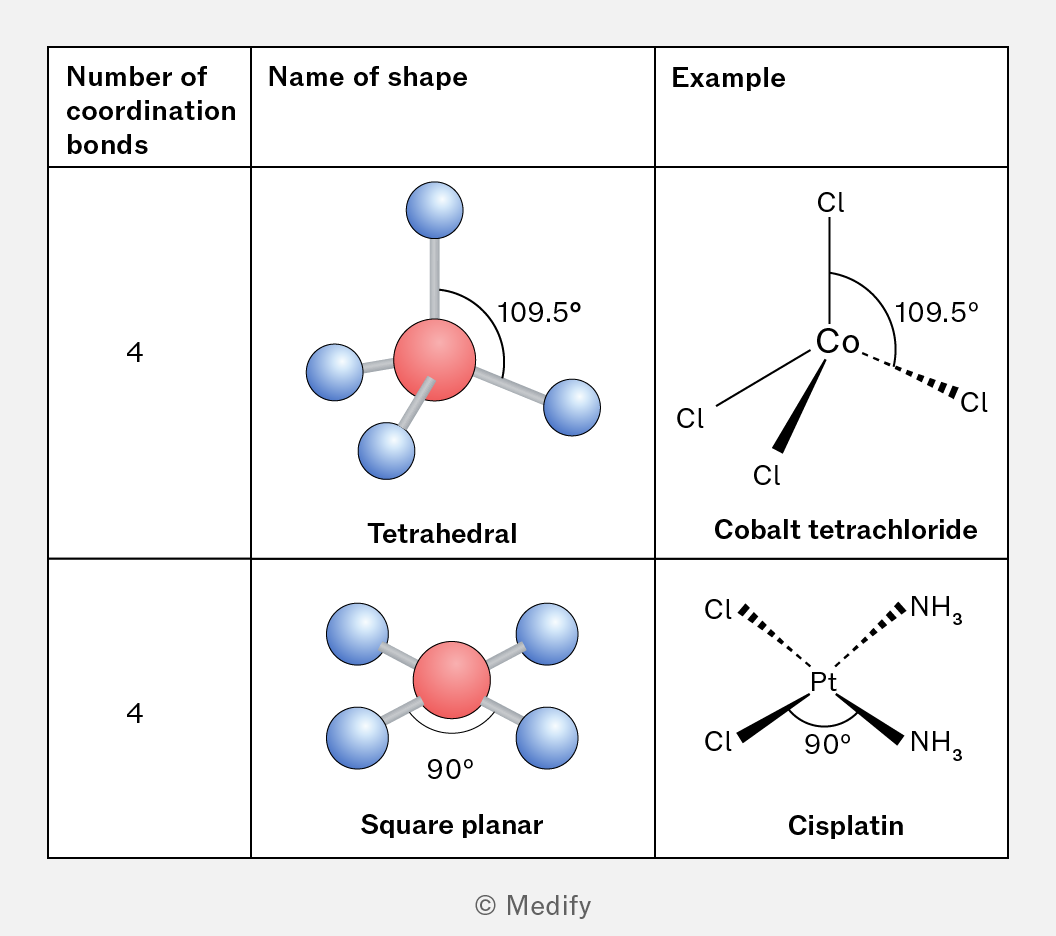
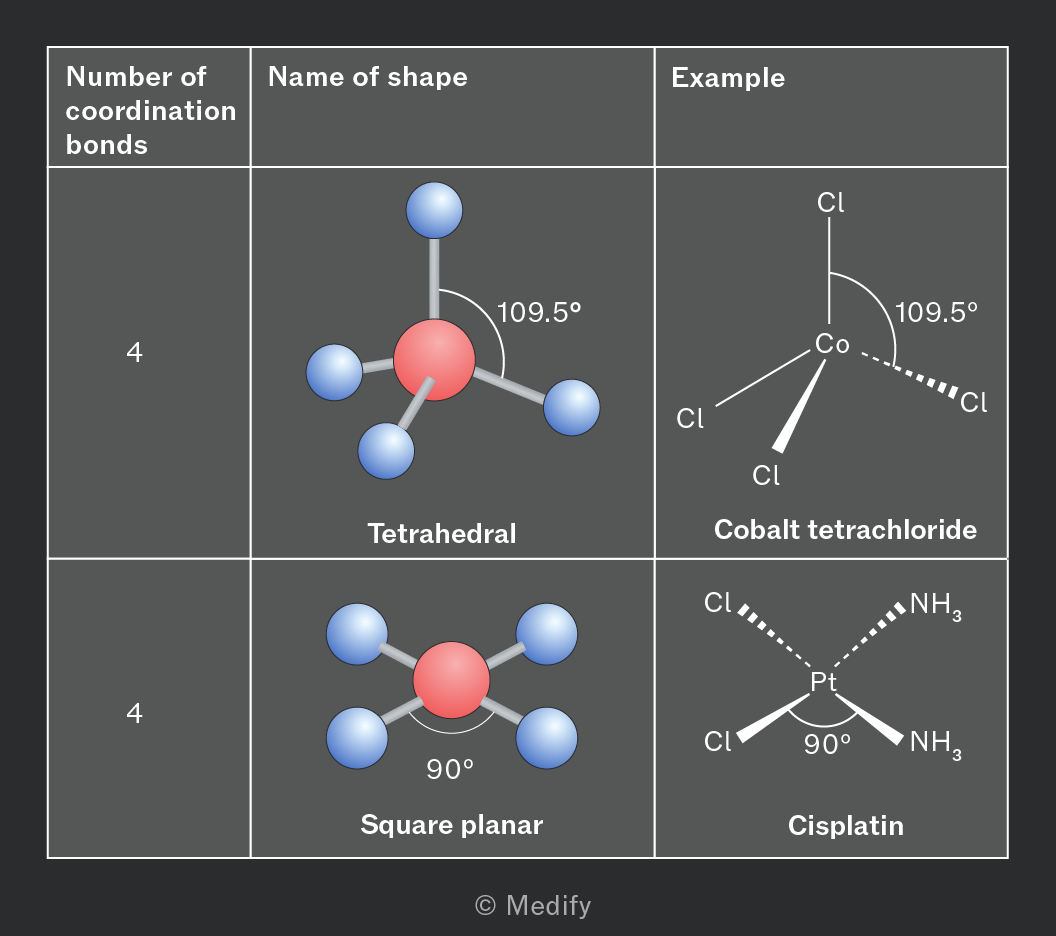
Most tetrachloro complexes are tetrahedral due to the large size of the chloride ion forcing a larger bond angle of 109.5°.
Square planar geometry is common in nickel and platinum complexes.
Six-fold coordination
Transition metal ions with six coordinately bonded ligands have an octahedral shape.
![A diagram illustrating the octahedral shape in coordination chemistry. It shows a central atom represented by a red sphere, surrounded by six blue spheres indicating ligands, with angles of 90 degrees between them. The table includes the number of coordination bonds (6), the name of the shape (Octahedral), and an example of the complex ion [Fe(H2O)6]3+ with water molecules as ligands.](https://d3nzlfkeryzt6j.cloudfront.net/kkq0hupmio0mem7w3iclba4ulnon)
![A diagram illustrating the octahedral shape in coordination chemistry. It shows a central atom represented by a red sphere, surrounded by six blue spheres indicating ligands, with angles of 90 degrees between them. The table includes the number of coordination bonds (6), the name of the shape (Octahedral), and an example of the complex ion [Fe(H2O)6]3+ with water molecules as ligands.](https://d3nzlfkeryzt6j.cloudfront.net/e7jbj452e6axzej3cjke921sctop)
Octahedral and square planar complexes can exhibit cis–trans isomerism.
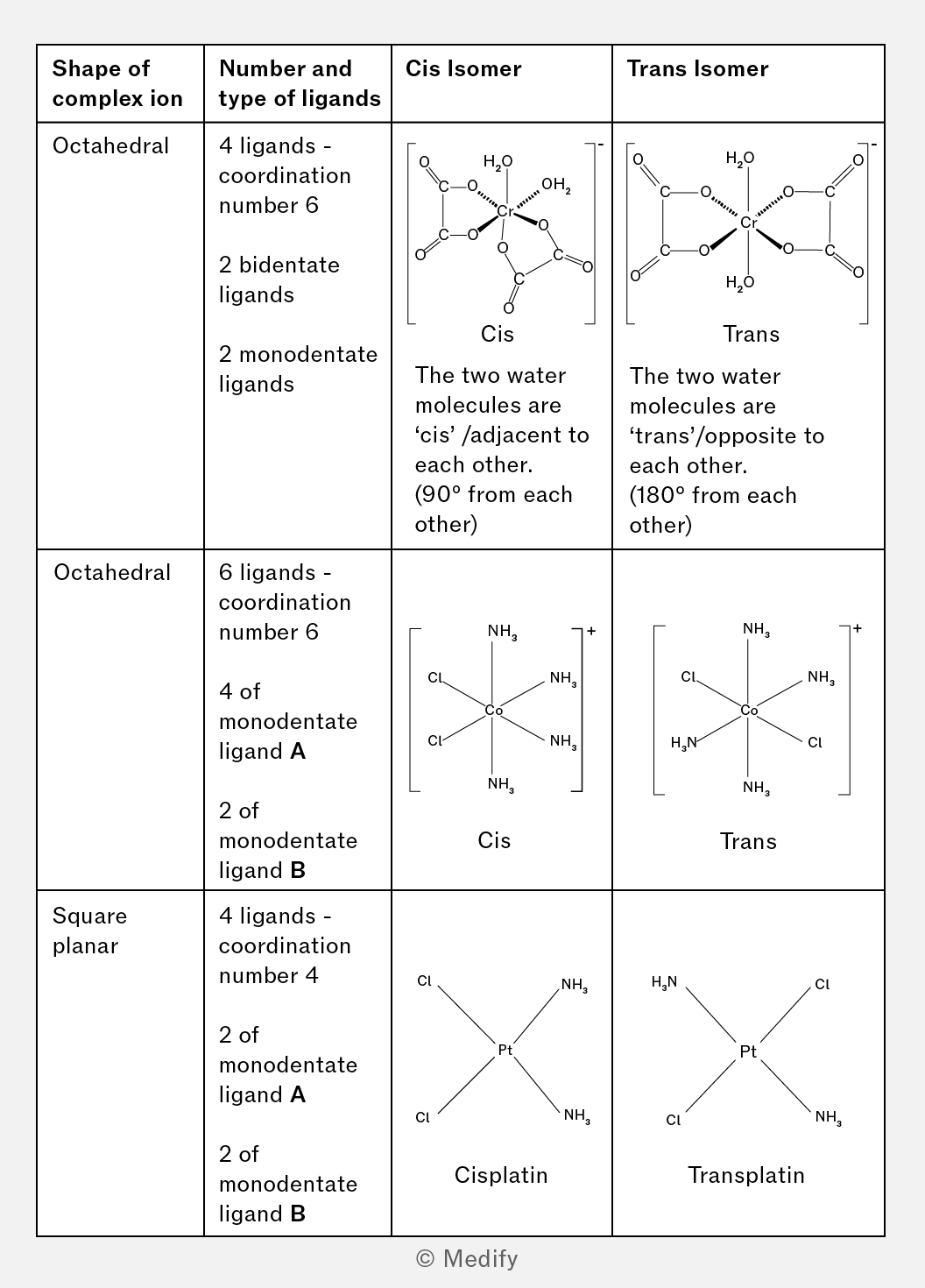
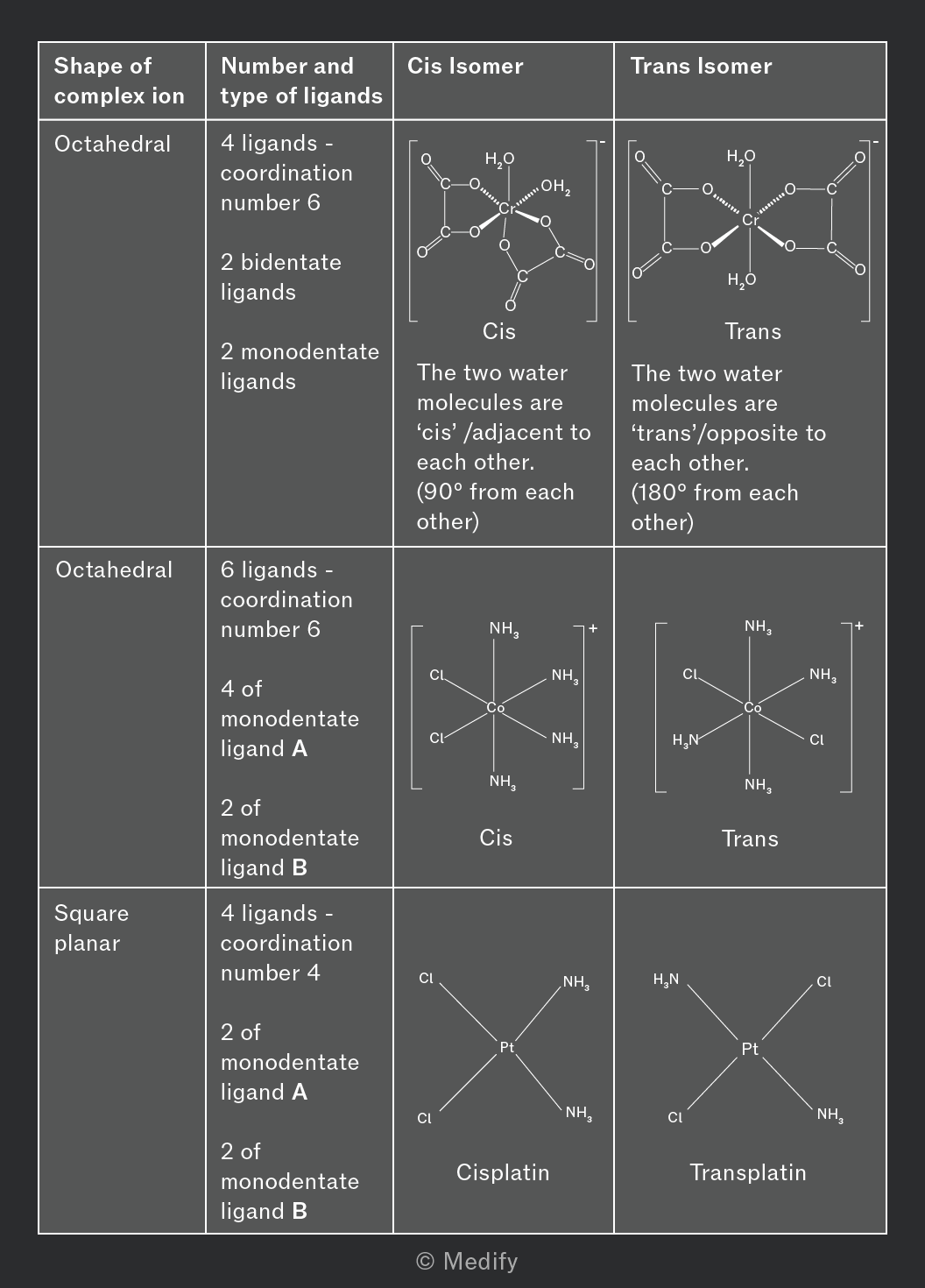
As long as the complex ion has exactly two matching ligands that are different to the rest, they can exhibit cis–trans isomerism.
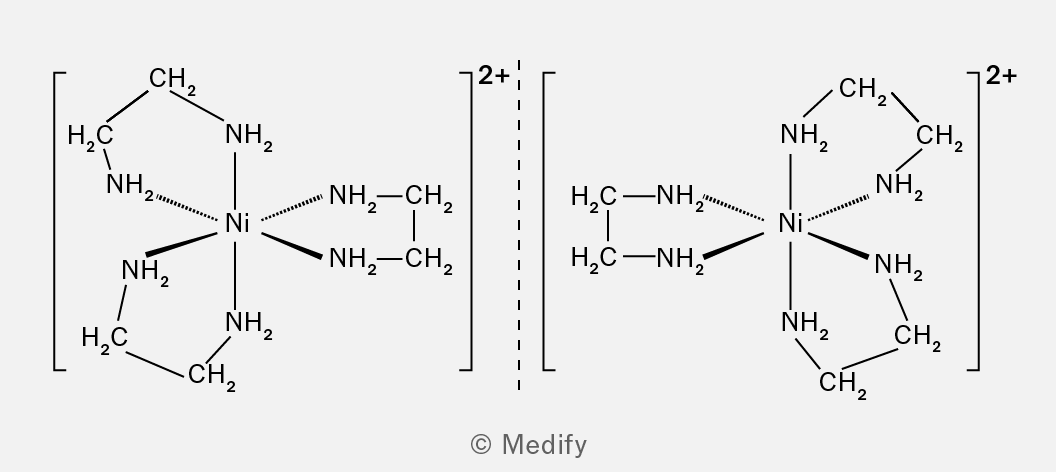
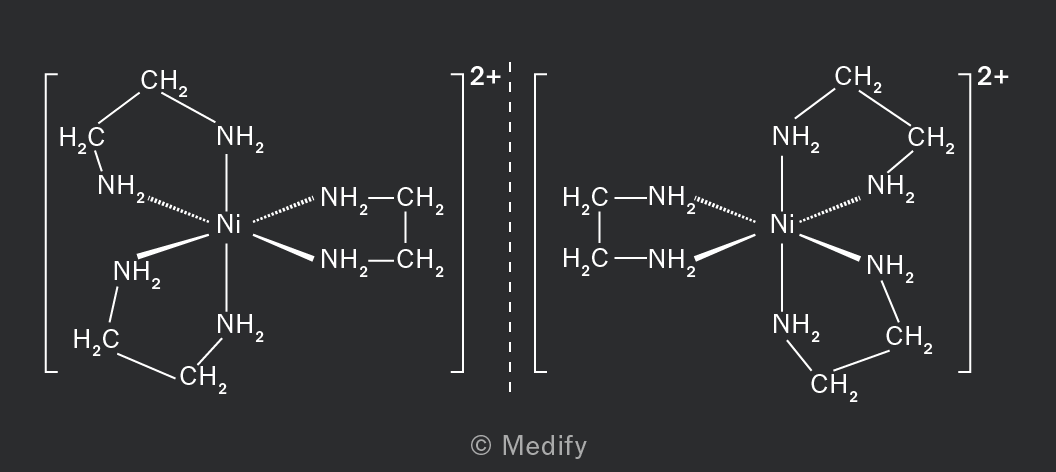
Optical isomers are stereoisomers that are a pair of non-superimposable mirror images of each other.
Optical isomers most commonly occur in octahedral or tetrahedral shaped complexes and must have bidentate or multidentate ligands.
Below is an example of optical isomerism shown by the complex ion.
Cis-platin is an effective anticancer drug.
It is only the cis isomer of the platinum complex that is effective.
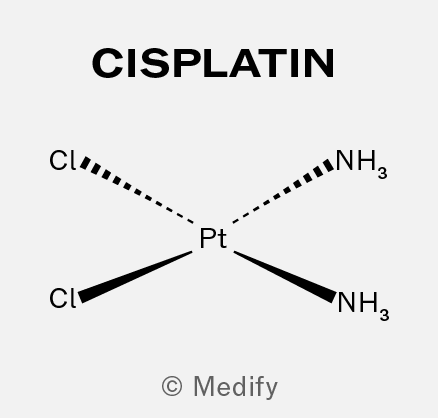
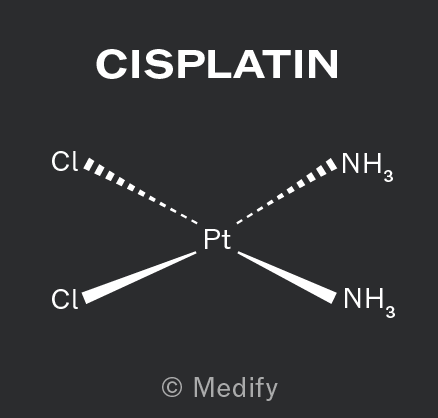
Trans-platin is not a suitable alternative or accompaniment for cis-platin; it is clinically ineffective but still produces toxic side effects.
Transition metals form coloured compounds.
The incompletely filled d orbitalof the transition metal ion results in transition metal complexes having distinct colours, depending upon the complex ion formed, e.g. copper(II) sulphate is blue.
Visible light can be absorbed by the partially filled d orbitals.
Colours in transition metals arise due to d–d electron transitions.
In a complex ion, orbital overlap with ligands splits the d orbital energies into two levels.
Visible light is absorbed to promote an electron from a lower to a higher d orbital.
The wavelength of the light absorbed is linked directly to the size of the energy gap between the d orbitals.
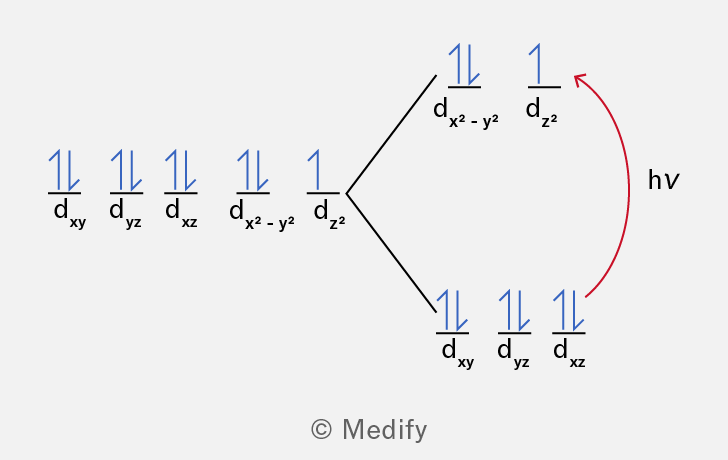
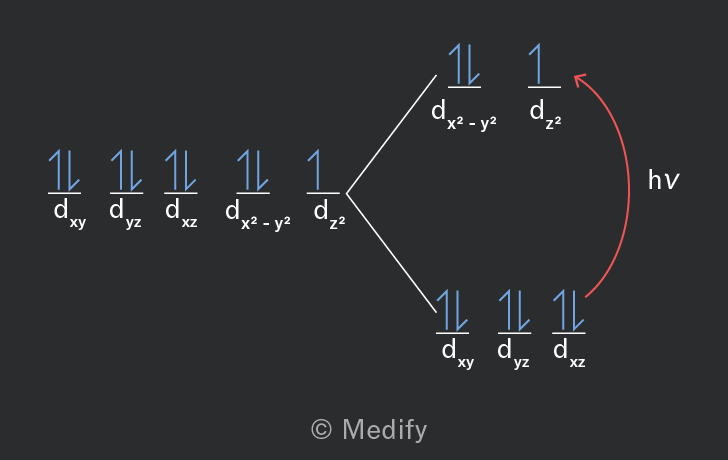
All the remaining light is observed.
The colour observed is the complementary colour of the light absorbed.
The energy difference between the ground state and excited state of d electrons in transition metal ions is described by the equation:
where:
- = Planck’s constant,
- = frequency of the absorbed light ()
- = speed of light ()
- = wavelength of the absorbed light ()
Shorter wavelengths correspond to larger energy differences.
Factors altering , and therefore leading to colour changes in transition metal complexes, are:
- a change in oxidation state,
- a change in coordination number,
- a change in ligand.
A increase in oxidation state increases of d–d transitions:
- increases the positive charge on the metal ion, resulting in greater ligand attraction,
- causing a larger splitting of the d orbitals, increasing due to the increased repulsion between the ligands and the d electrons.
- and have different colours due to absorbing light at different wavelengths. The energy of a d–d transition is higher for than .
Change in coordination number alters of d–d transitions:
- Altering the coordination number changes the way the coordinate bonds overlap with the d orbitals.
- The energy levels of the d orbitals are directly related to overlap with the coordinate bonds.
- Different coordination numbers and/or shapes result in different of d–d transitions.
Ligand type alters ΔE of d–d transitions:
- Strong field ligands such as and create greater splitting of d orbitals leading to a higher of d–d transitions and absorption of light at shorter wavelengths.
- Weak field ligands such as and cause smaller splitting resulting in a lower and absorption of light at longer wavelengths.
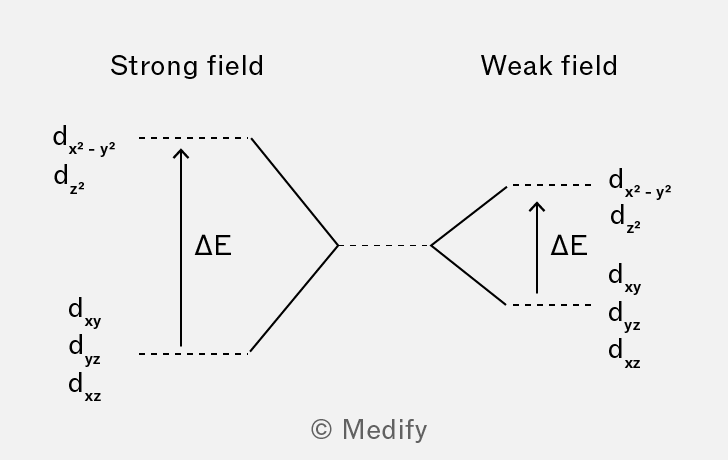
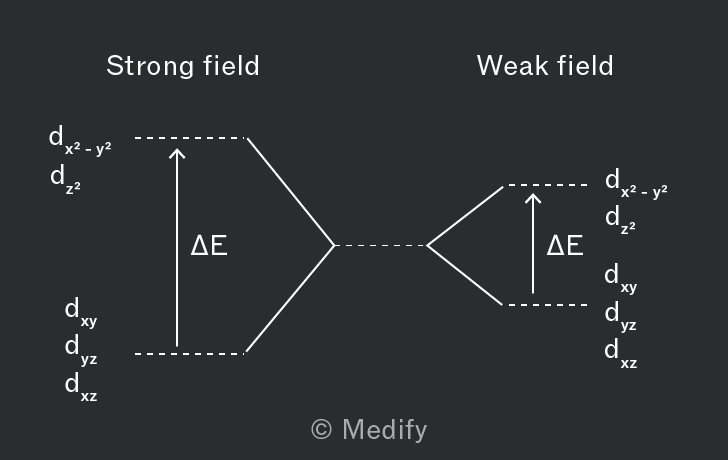
has weak field ligands, a smaller , and is green in colour.
has strong field ligands, a larger , and is yellow in colour.
UV–Vis spectroscopy is used to measure the absorption of ultraviolet and visible light by the transition metal complex.
Each transition metal complex has a unique absorption spectrum, which shows the wavelengths of light absorbed. These can be used to identify complexes which look visually similar and to highlight the best wavelengths to use when using colorimetry.
Transition metal ions can be identified by their colours.
A colorimeter can be used to determine the concentration of coloured ions in a solution.
The transmission/absorbance is then related to the concentration of the solution via calibration of by using the Beer–Lambert law.
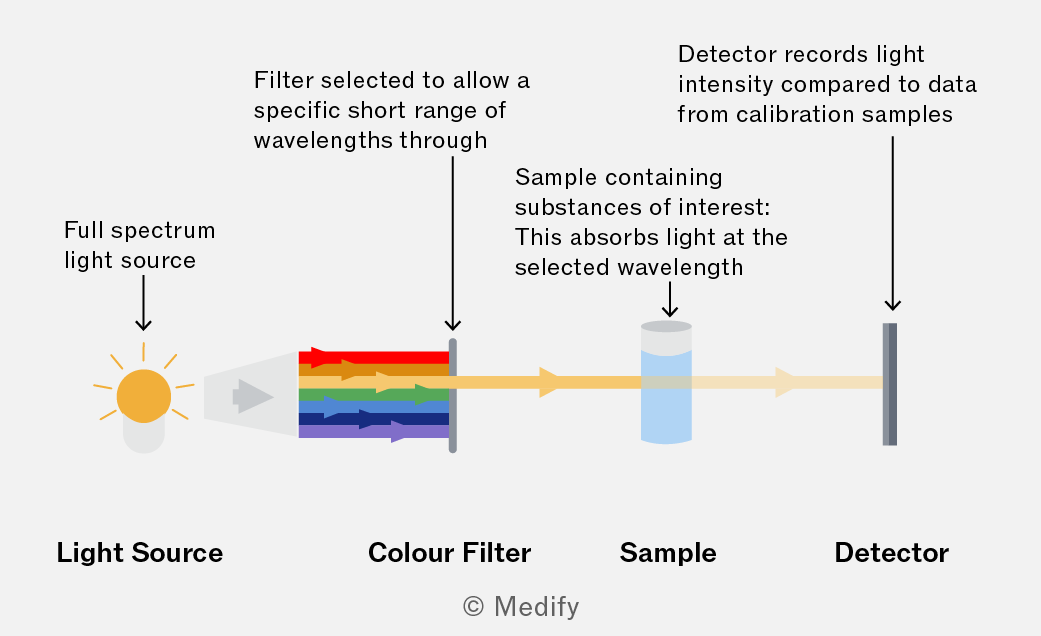
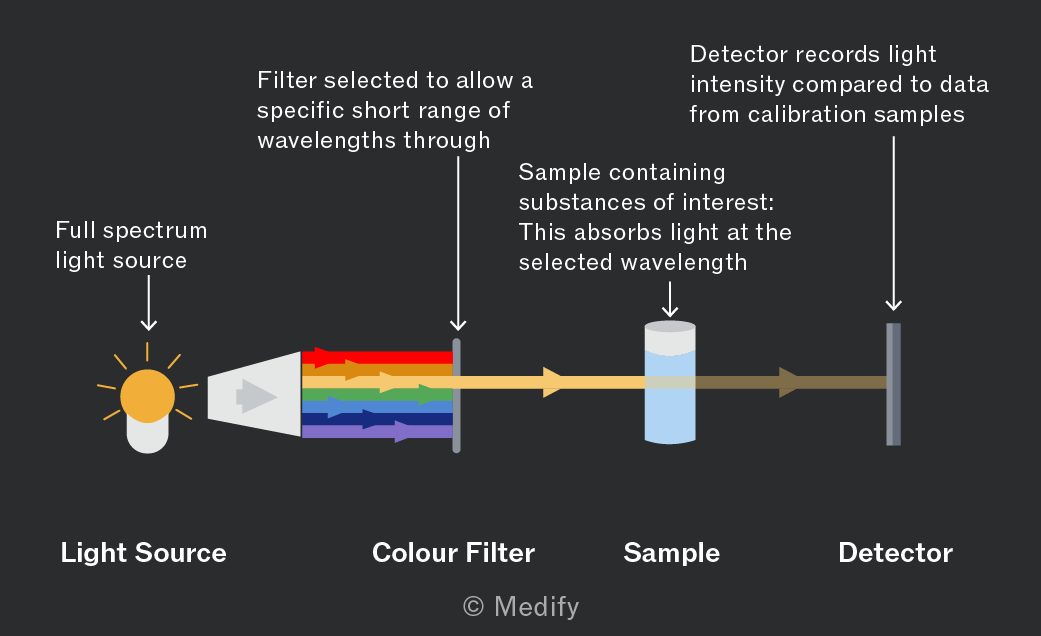
The Beer-Lambert law combines the cuvette’s path length with the complex’s molar absorption coefficient, providing the proportionality constant between concentration and absorption.
Redox reactions are when both reduction and oxidation occur.
Oil Rig: Oxidation is loss of electrons, and Reduction is gain of electrons.
All redox reactions involve an oxidising agent and a reducing agent.
An oxidising agent is a reagent that oxidises another species (an electron acceptor).
A reducing agent is a reagent that reduces another species (an electron donor).
You may be given standard electrode potential data to construct redox equations involving transition metals; the more positive the value, the greater the tendency for the species to be reduced.
The electrode (redox) potential measures the tendency of a transition metal ion to be reduced and change from a higher to a lower oxidation state.
In acidic conditions, there is a higher concentration of ions which can help stabilise lower oxidation states, making reduction easier. This increases the redox potential.
In alkaline conditions, there is a higher concentration of ions which can stabilise higher oxidation states, making reduction harder. This decreases the redox potential.
Different ligands can stabilise different oxidation states of a transition metal, affecting the redox potential.
- Strong field ligands, such as cyanide or ammonia, stabilise lower oxidation states.
- Weak field ligands, such as water or chloride ions, stabilise higher oxidation states.
Tollens’ reagent contains aqueous silver nitrate, dissolved in ammonia forming the complex ion .
Aldehydes are easily oxidised to carboxylate ions in basic conditions.
Tollens’ reagent acts as an oxidising agent. It is reduced, causing silver ions () to be reduced to metallic silver ( ).
This results in a silver mirror forming on the inside of the test tube, indicating the presence of an aldehyde.
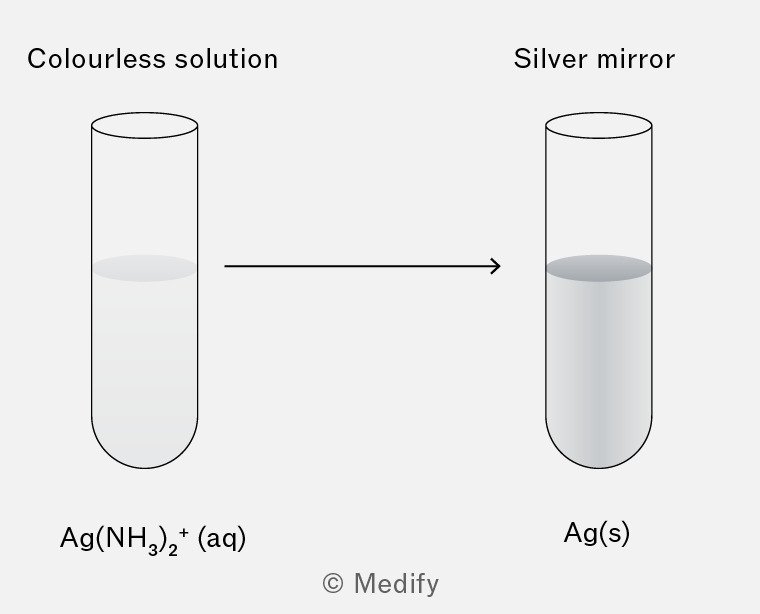
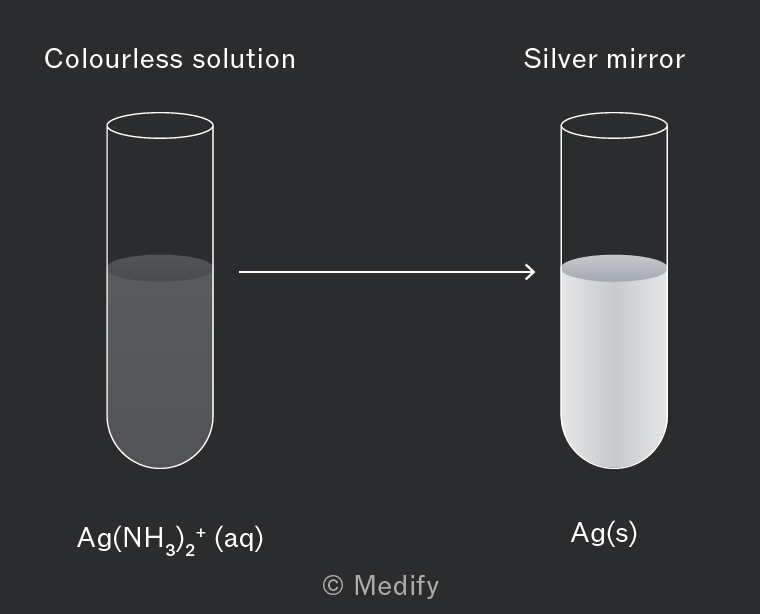
Ketones cannot be oxidised as they lack a hydrogen atom on the carbonyl atom. Therefore ketones do not react with Tollens’ reagent and no silver mirror forms.
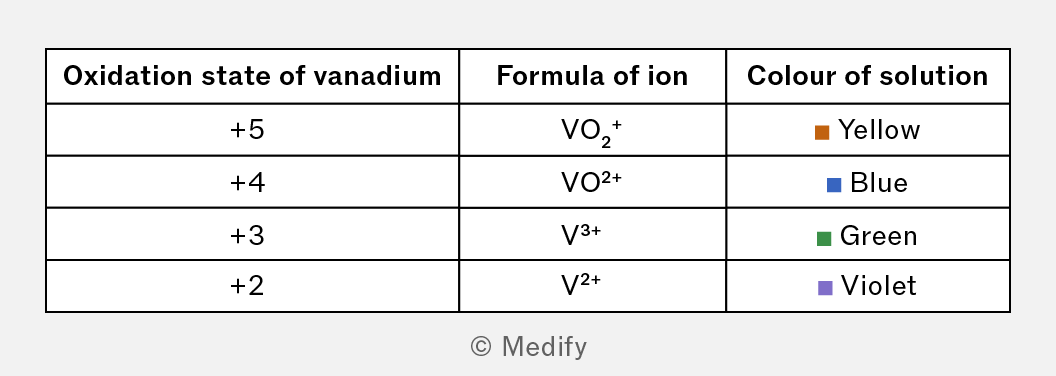
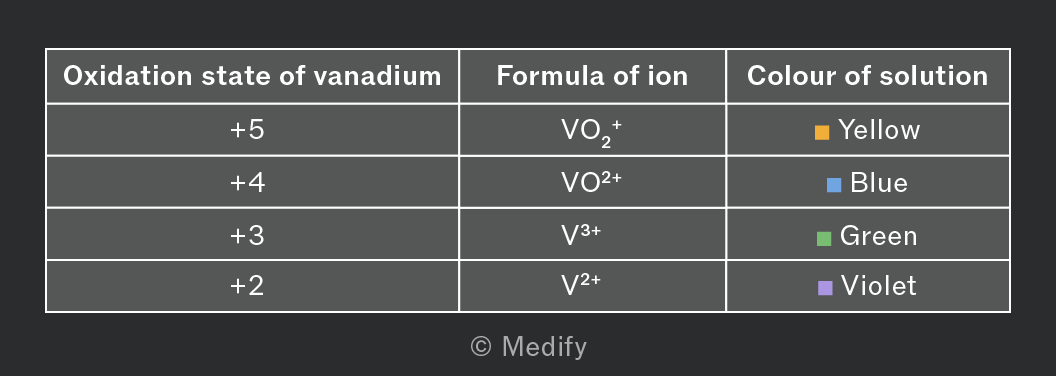
The variable oxidation states of vanadium can be observed when zinc is reacted with the vanadate ion, , under acidic conditions.
As the reaction progresses the vanadium species are successively reduced by zinc.
- Zinc is oxidised to and acts as a reducing agent.
- is colourless and therefore does not impact the solution colour.
- The reduction takes place in acidic conditions.
is oxidised to by potassium manganate (VII).
- The loses an electron and is oxidised to .
- Purple , acidified manganate (VII), gains electrons; it is the oxidising agent.
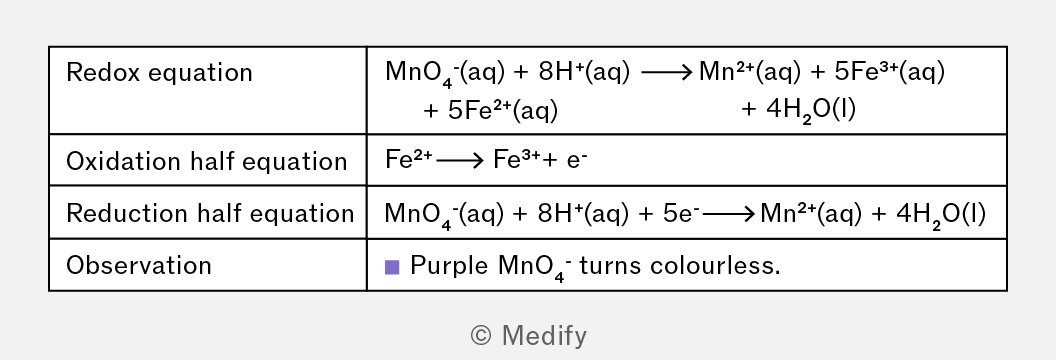
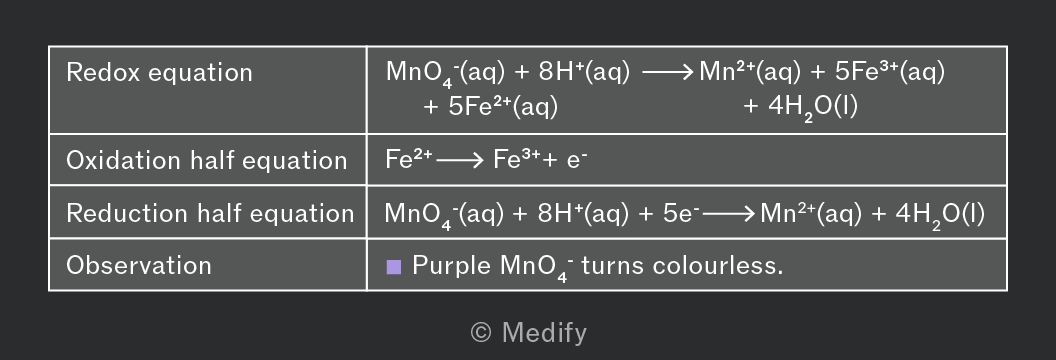
Balancing the electrons from the half ionic equations creates a balanced ionic equation.
These species can be used in quantitative titration experiments.
No indicator is required in a transition metal redox titration as the colour change is shown as the oxidation state of the changes.
For titration calculations with this system, a 1:5 mole ratio of : must be applied.
can be oxidised to by potassium manganate (VII).
- The loses two electrons and is oxidised.
- Purple , acidified manganate (VII), is the oxidising agent.
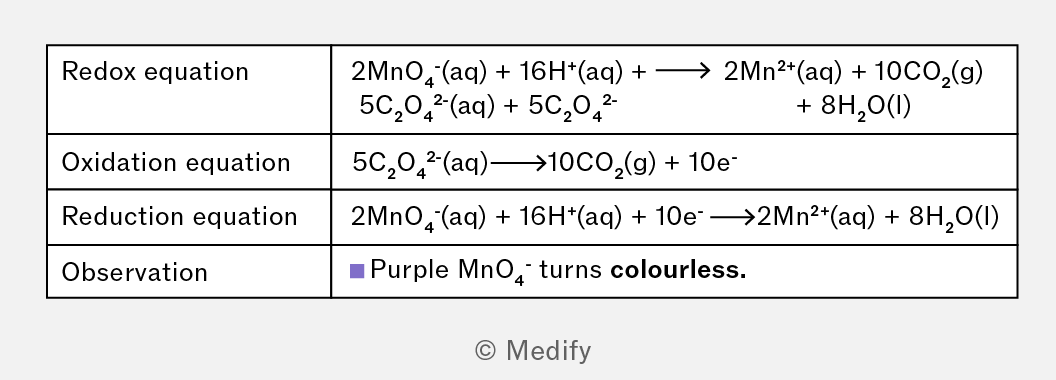
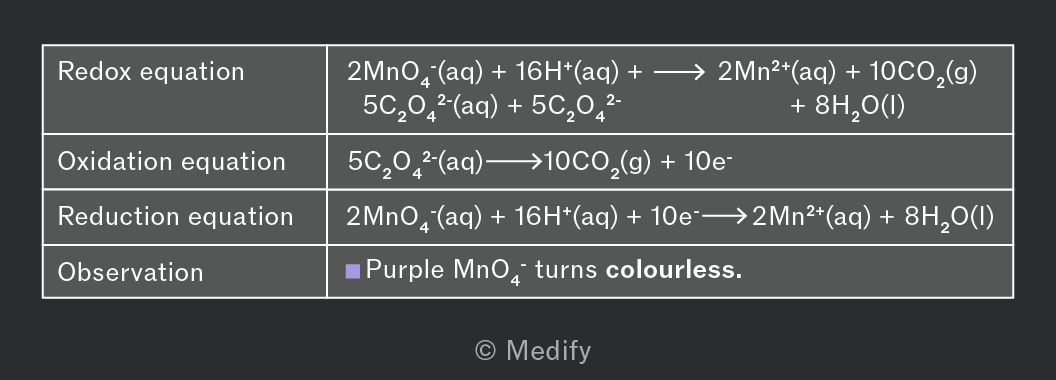
Balancing the electrons from the half ionic equations creates a balanced ionic equation.
No indicator is required in a transition metal redox titration as the colour change is shown as the oxidation state of the changes.
For titration calculations with this system a 2:5 mole ratio of : must be applied.
Question walkthrough
Redox titration
A complex calculation using the titration of Fe2+ with MnO4-
There are two different types of catalysts.
Homogeneous catalysts are catalysts which are in the same phase as the reactants in the chemical reaction. For example gaseous chlorine free radicals in the decomposition of the gaseous ozone layer.
Heterogeneous catalysts are catalysts which are in a different phase to the reactants in the chemical reaction. For example the use of solid iron in the Haber process where the reactants – nitrogen and hydrogen – are in the gaseous phase.
Mechanism for homogeneous catalysis:
- The catalyst interacts with the reactants to form an intermediate complex. This step lowers the activation energy required for the reaction to occur.
- The intermediate undergoes a transformation to form the products.
- The catalyst is then regenerated.
This significantly speeds up reactions allowing for increased rate of production and/or lower operating temperatures with reduced energy costs.
Aqueous iron(II) ions are used as a catalyst in the reaction between iodide ions and peroxodisulphate ions.
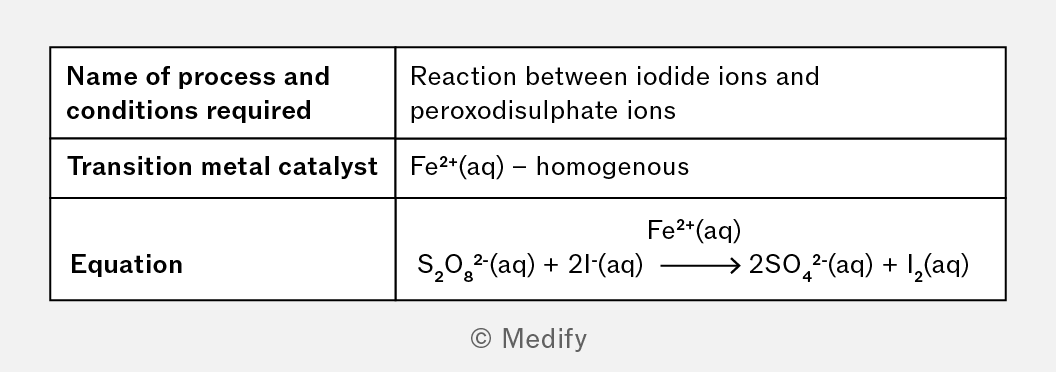
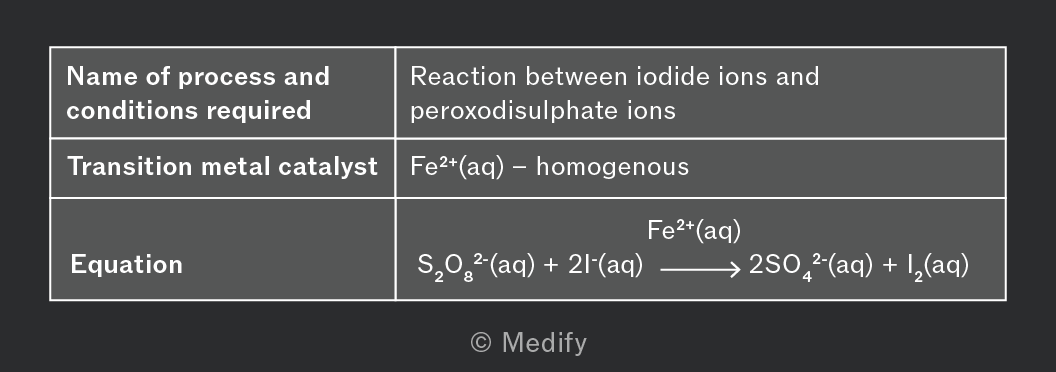
Homogeneous catalyst: The catalyst is in the same physical state as the reactants.
With heterogeneous catalysis the reaction occurs at active sites on the surface of a solid catalyst.
A support medium is used to:
- Maximise the surface area: By dispersing the catalyst onto a support medium such as alumina, the surface area available for the reaction is significantly increased. A larger surface area allows more reactant molecules to interact with the catalyst, enhancing the reaction rate.
- Minimise cost: The support medium is usually less expensive than using a large quantity of the catalyst alone, this reduces the amount of catalyst required.
Catalyst poisoning occurs when unwanted substances adsorb onto the catalyst’s active sites, blocking reactants from binding to those sites.
Impurities in reactants, or other contaminants can act as poisons; for example sulfur compounds, lead and other heavy metals.
Impact of catalytic poisoning:
- Poisoning reduces the effectiveness of the catalyst resulting in a decreased reaction rate.
- Higher temperatures may be required to achieve the same reaction rates, resulting in increased energy costs.
- More frequent changing of the catalyst increases the cost of a process.
Vanadium(V) oxide is used as a catalyst in the contact process.
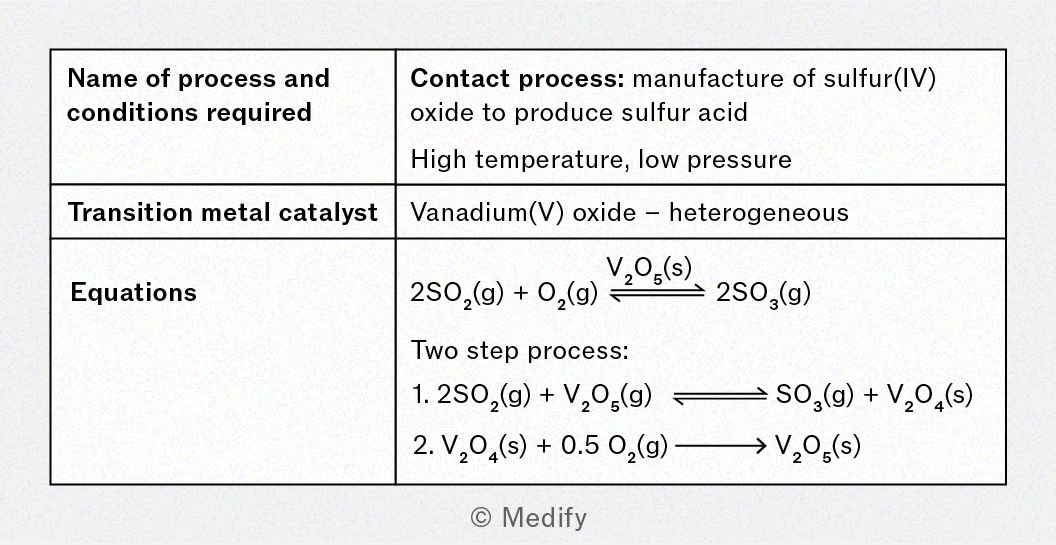
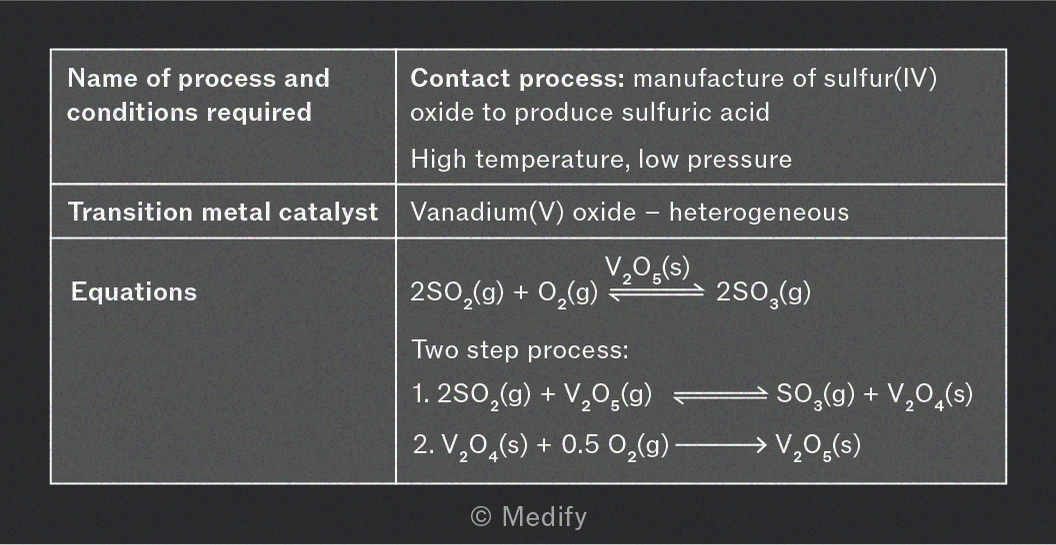
Heterogeneous catalyst: The catalyst is in a different physical state to the reactants and the reaction occurs at active sites on the surface.
Iron is used as a catalyst in the Haber process.
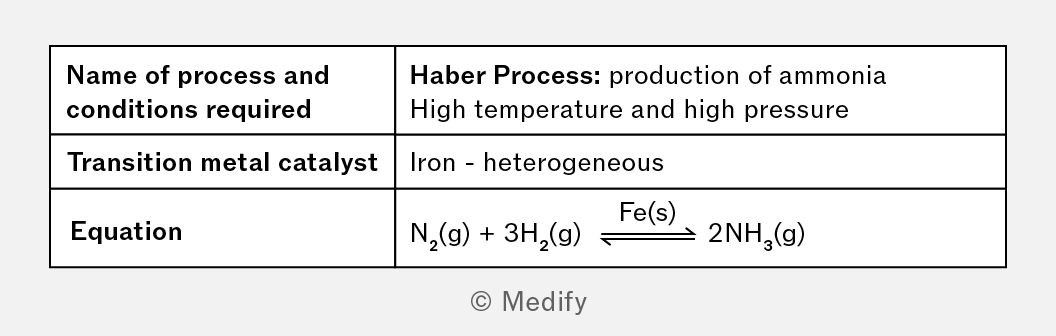
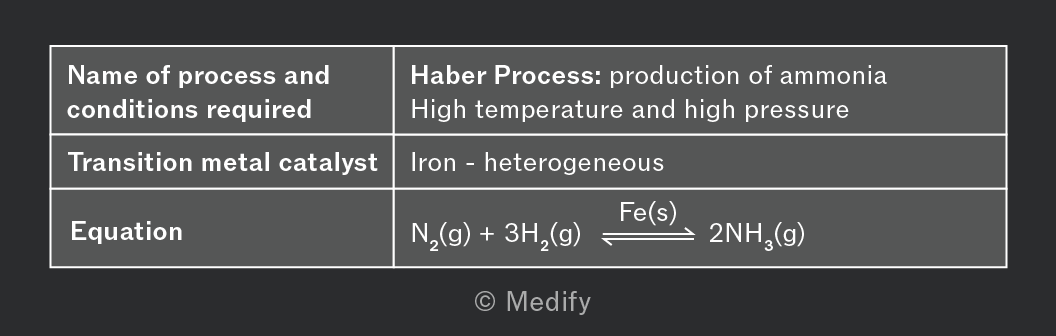
Heterogeneous catalyst: The catalyst is in a different physical state to the reactants and the reaction occurs at active sites on the surface.
The versatility of transition metals to exist in multiple oxidation states means that they can act as oxidising or reducing agents in different catalytic processes.
- By temporarily accepting (or donating) electrons, they can help lower the activation energy and increase the rate of reactions.
- They are then easily able to donate (or accept) electrons and return to their original form.
- Variable oxidation states enable the formation of different coordination complexes and intermediates during catalysis.
Autocatalysis occurs when one of the reaction products acts as a catalyst for the reaction.
In the redox titration between and , the ions act as an autocatalyst for the reaction.
Reaction equations:
The initial rate of reaction is slow. There is repulsion between the reacting species which are both negatively charged.
As soon as the is formed, the reaction rate increases. is oxidised to by .
can also oxidise ions. This reaction has a lower activation energy as the reactants are oppositely charged and do not repel.
The autocatalyst is regenerated in the reaction.