
Algebra (M2)
On this page
You need to be able to express relationships between different quantities using mathematical symbols.
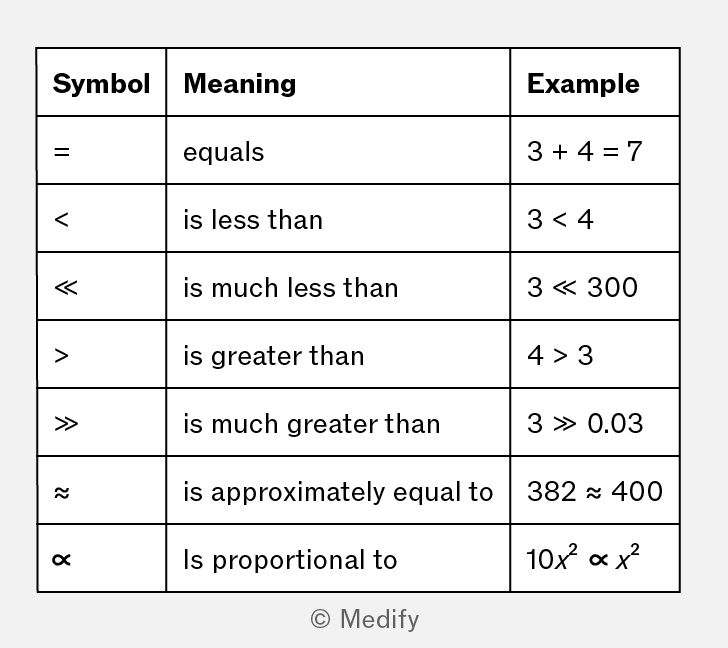
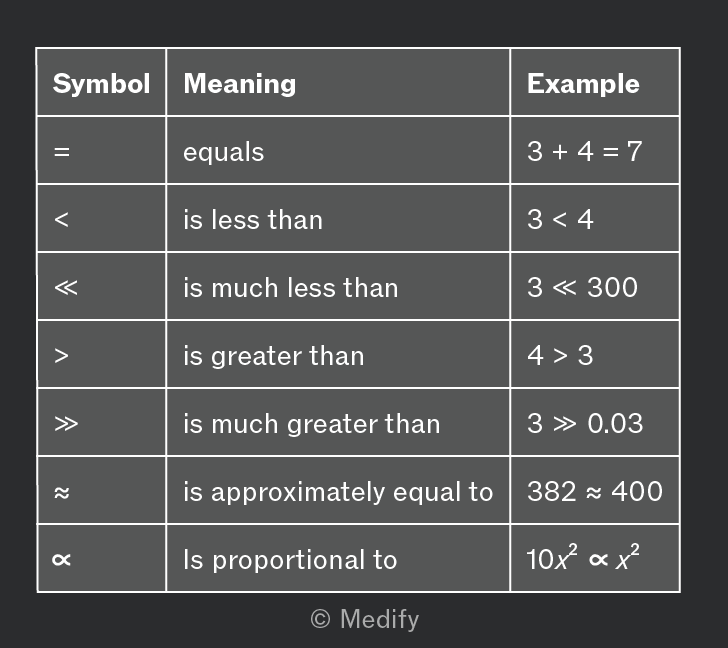
It is important to note that you need to know and be able to use these symbols correctly:
Question walkthrough
Understand and use the symbols
Determine the correct symbol for each of the gaps in the mathematical sentences below.
The symbol means ‘is proportional to’.
When the quantity A is directly proportional to the quantity B, you can write it as:
When the quantity A is inversely proportional to the quantity B, you can write it as:
Question walkthrough
Understand and use the symbols: =, <, <<, >>, >, âˆ, ~, ≡
,
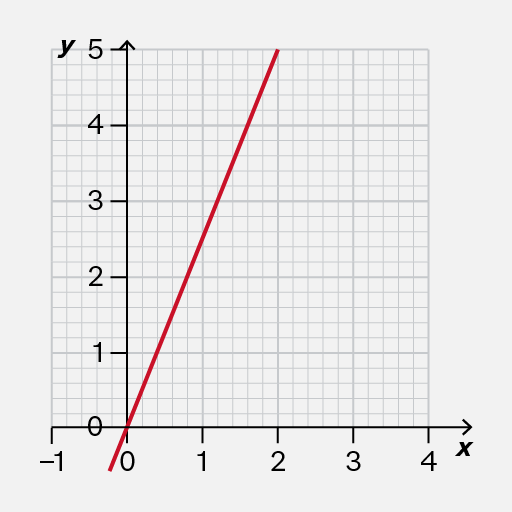
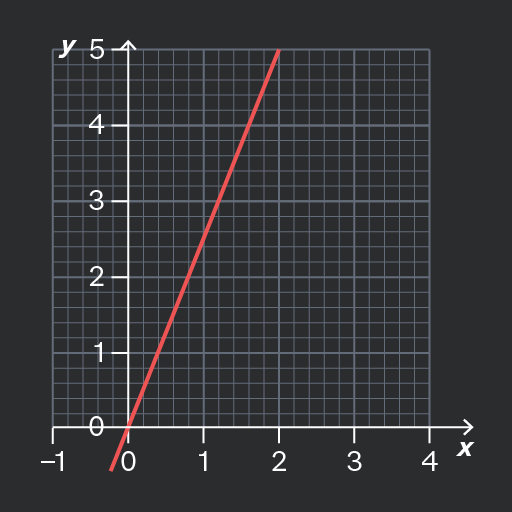
Two quantities are only directly proportional when a linear graph of the two quantities is plotted, and the graph goes through the origin.
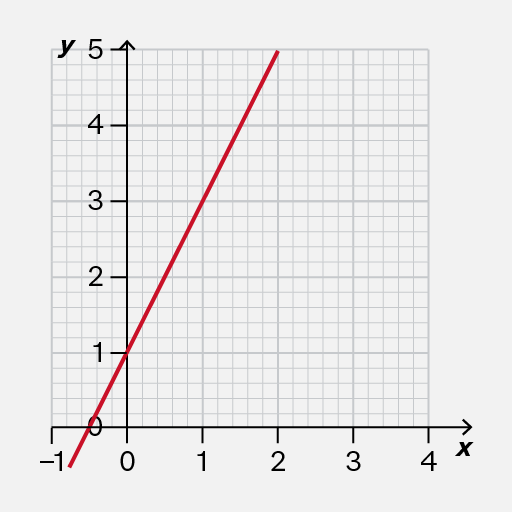
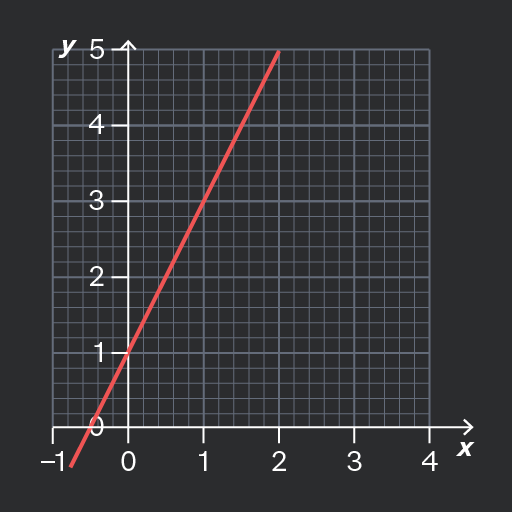
Equations describe rules and relationships between quantities.
Consider the following linear equation:
It is straightforward to determine the value of if the other two terms are known, but what if we need to determine the value of or
Then, we must rearrange the equation to make either or the subject. Making something the subject of an equation means rearranging so that the desired term is isolated on one side in terms of the other variables.
It is important to note that you should generally rearrange an equation before inserting or substituting values into your terms to avoid any unnecessary confusion.
Question walkthrough
Rearranging Linear Equations I
Rearranges x=yz to make z the subject by dividing both sides by y, cancelling the y term to isolate z.
The order in which you rearrange terms is important to maximise your efficiency and reduce the time taken to isolate your desired quantity.
Consider the following linear equation:
Multiple valid methods exist to make the subject of the above equation. However, starting with operations that directly simplify the equation, such as addition or subtraction, is generally good practice. Afterwards, apply multiplication or division to fully isolate the term.
Question walkthrough
Rearranging Linear Equations II
Rearranges a=b/c+d to make c the subject by isolating b/c, multiplying through by c, then dividing by (a−d).
When you substitute numerical values into an algebraic equation, you must use the correct order of operations.
Consider the equation:
When you substitute in a negative value, you must remember that the negative sign is part of the number that will be squared. For example, when
Use brackets around each negative number to make the calculation clearer.
It is useful to know that if two quantities have the same sign (both positive or both negative), then if you multiply or divide them, the result will be positive. If they have different signs, the result will be negative.
Question walkthrough
Substituting numerical values into algebraic equations
Substitutes negative values for x and y into z=2x²−y/x, using brackets around negative numbers to keep the calculation clear, then evaluates each term in turn.
When carrying out a calculation, it is important that you follow the correct order of operations, BIDMAS:
- B rackets
- I ndices (also known as powers or exponents)
- D ivision and M ultiplication
- A ddition and S ubtraction
Consider this calculation:
For the first term of the equation, first do the subtraction inside the brackets, then the index, and finally the multiplication.
For the second term of the equation, first do the division, then the index inside the brackets, then the subtraction, and finally the multiplication.
Then add the two terms. The value of is
Question walkthrough
Using BIDMAS
Substitutes given values into a multi-term expression involving brackets, an index, and fractions, then evaluates step by step following BIDMAS.
For most simple equations, you can solve them using the same process that you might use to rearrange the equation to make the unknown variable the subject of the equation.
Consider the following equation, which is only true for one value of :
You can use any valid method to rearrange the equation to make the subject, which solves the equation:
Question walkthrough
Solve an equation by rearranging it.
Rearranges the SUVAT equation v-squared equals u-squared plus 2as to solve for the distance travelled, given the initial and final velocities and the acceleration.
Logarithms to base 10 tell you the power that 10 must be raised to to give a particular number.
For example, what is ?
Starting from 1:
multiply by 10 once → 10
multiply by 10 twice → 100
multiply by 10 three times → 1000
Therefore, =3
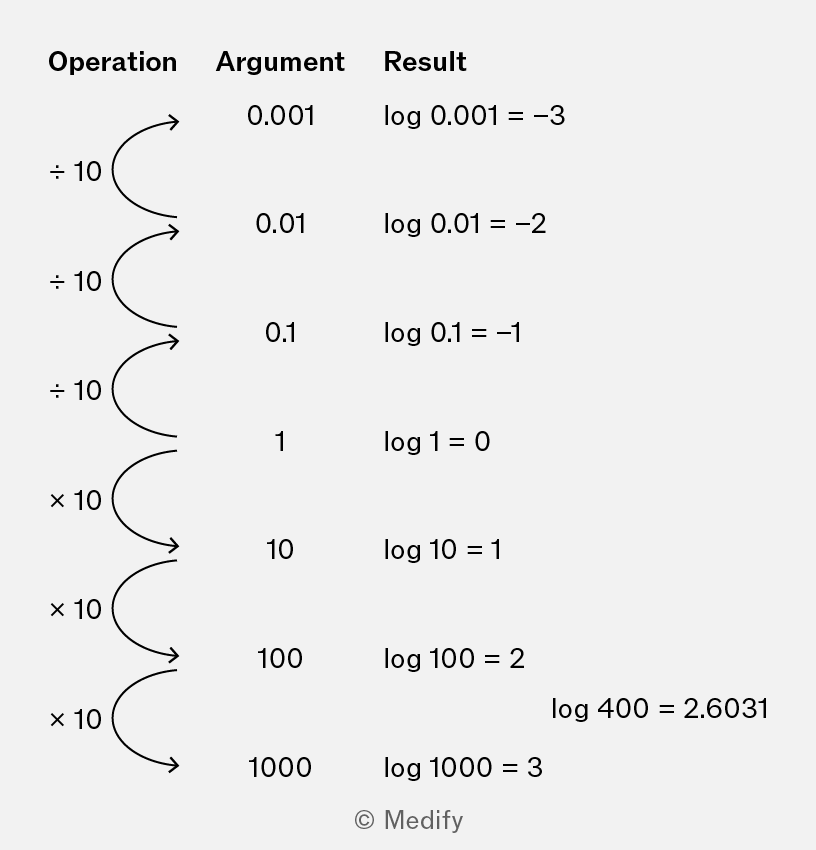
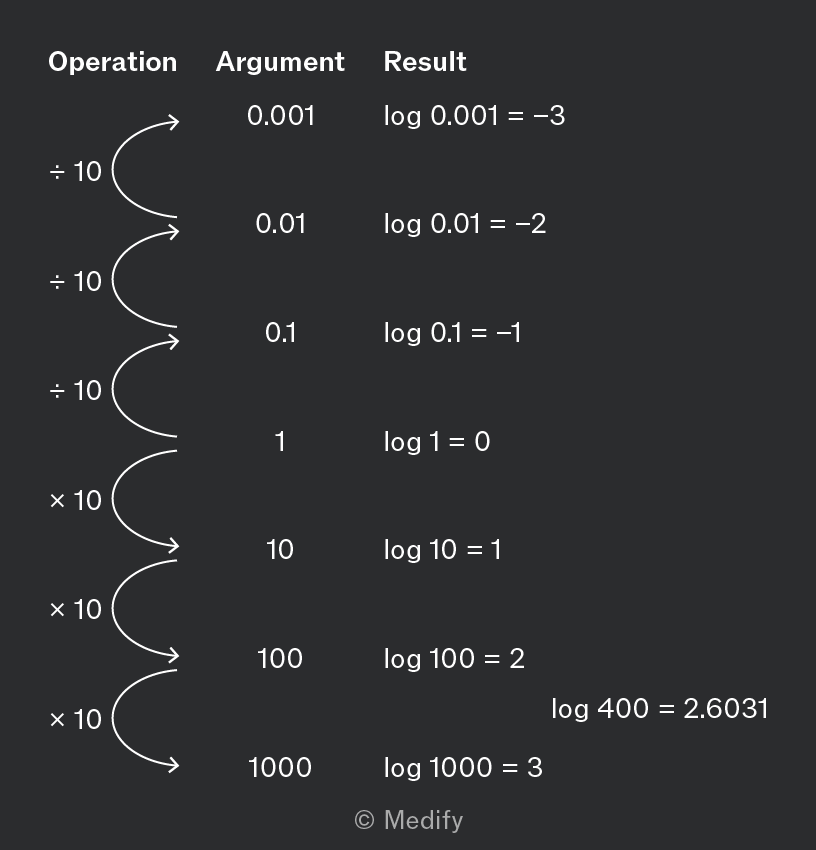
The logarithm of a number between 0 and 1 is negative. For example,
because =0.01.
You can think of this as starting from 1 and dividing by 10 twice to get 0.01.
Similarly, natural log (ln) is a type of logarithm that uses the number e (approximately 2.718) as its base.
It tells you by what power e needs to be raised to give the number.
For example:
ln(e2) = 2 because e must be raised to the power 2 to give e2.
A logarithm can use any positive number as its base. The following example uses base 7.
It is important to note that in your A-level science exam questions, logarithms will use base 10 or base only. As these logarithms are commonly used in mathematics and science, you will usually see them written without the base. Make sure to use the correct button on your calculator!
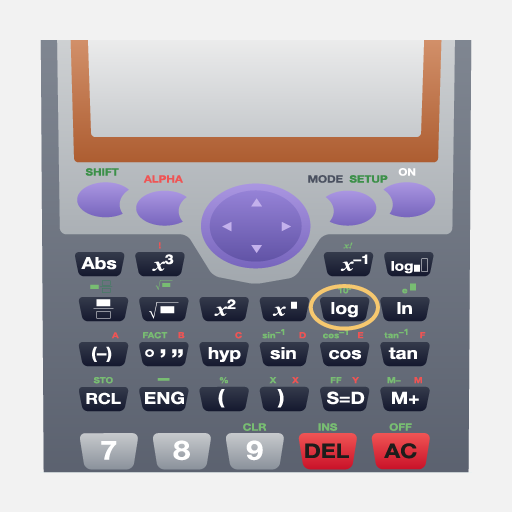
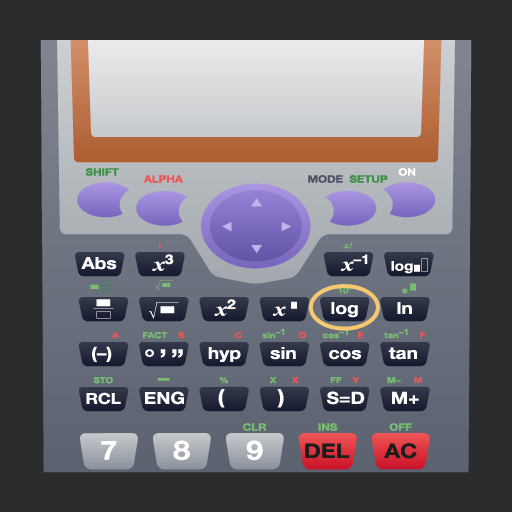
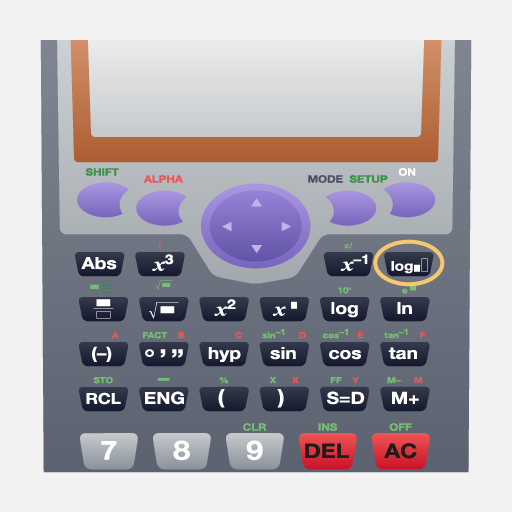
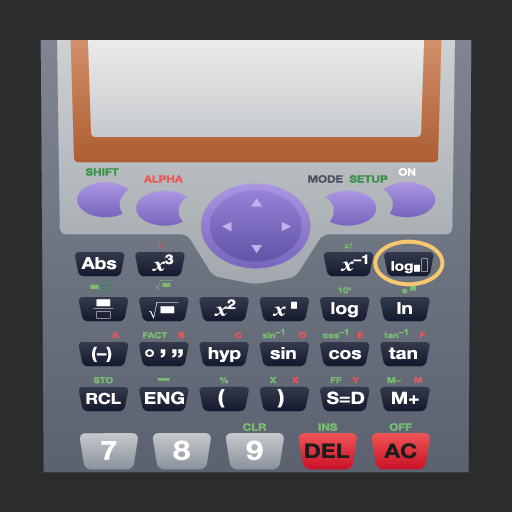
In chemistry, there are instances where you will have to do the inverse of a logarithm.
The inverse of log10 is 10x
For example:
In chemistry, this is important when converting pH back into
The inverse of ln is ex
For example:
This can be useful when working with the Arrhenius equation.
On a calculator:
- You can access 10x using the inverse/SHIFT function of log.
- You can access ex using the inverse/SHIFT function of ln.