
Compounds, formulae and equations (2.1.2)
On this page
To determine the formula for an ionic compound the following guidelines should be observed:
- There should be no overall charge (the number of positive and negative charges should cancel to create a neutral uncharged ionic compound).
- The positive ion (cation) is always placed first (on the left-hand side) and the negative ion (anion) is always on the right-hand side.
- Brackets are used to keep the component parts of a polyatomic ion together, for example
or - Subscript numbers multiply the ion on the left of the bracketed contents.
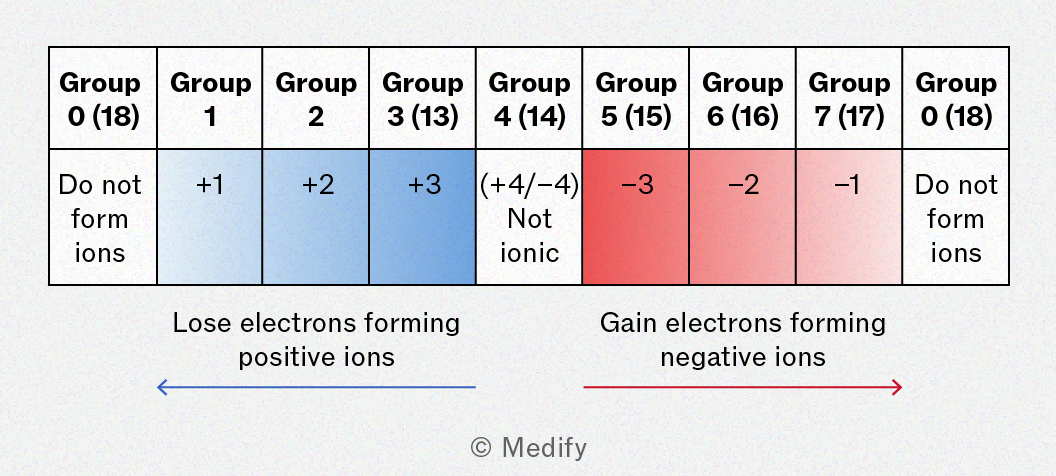
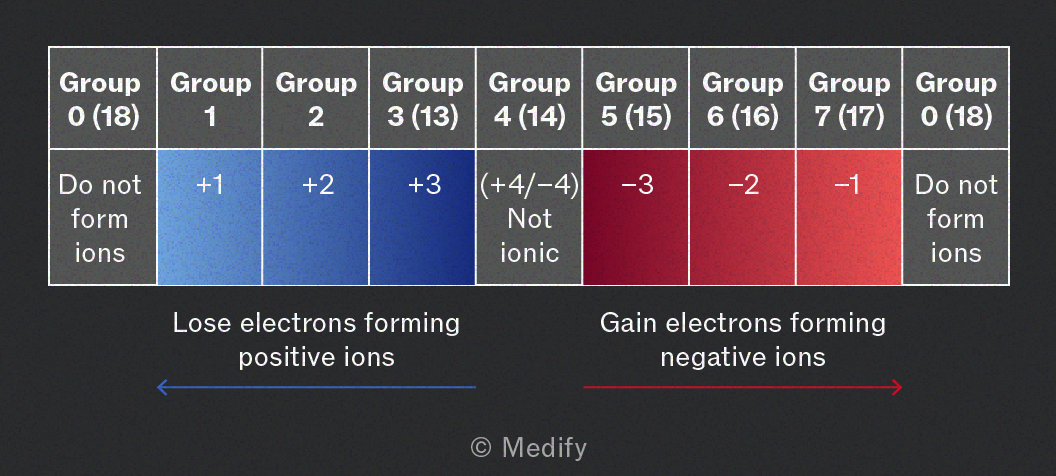
The charge on a simple ion must reflect the proximity of the atom to the nearest noble gas.
The charge value is equal to the number of electrons that must be lost (forming a positive ion) or gained (forming a negative ion) to achieve the nearest noble gas configuration.
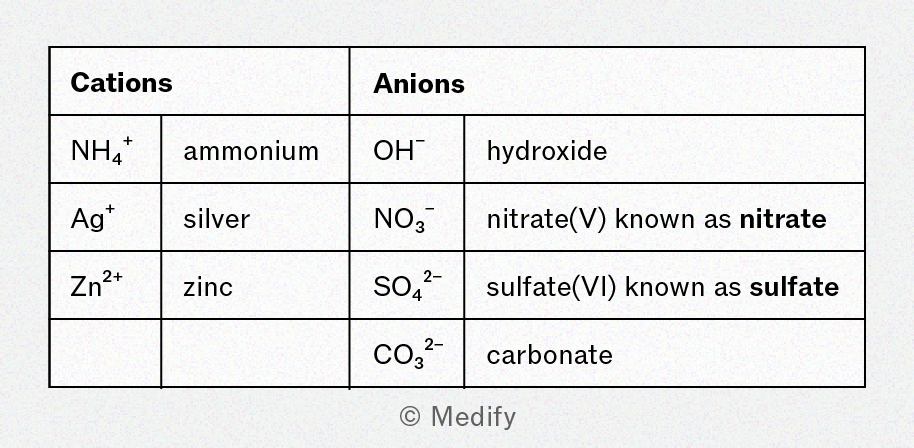
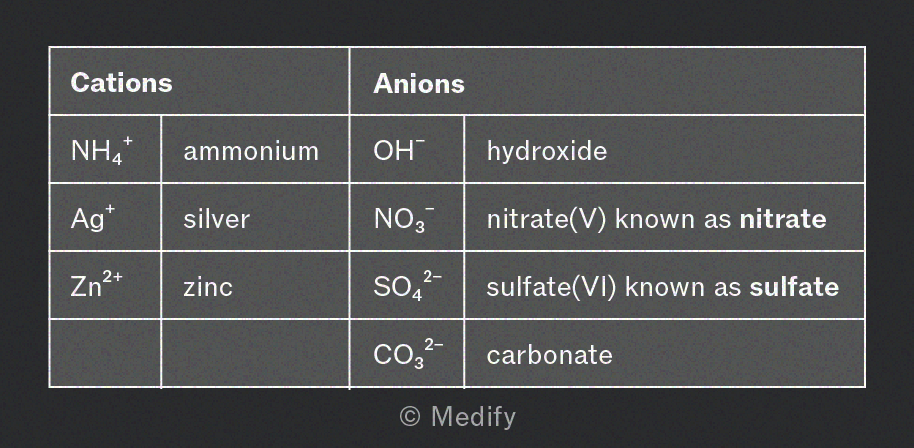
You are expected to be able to recall the formulae of the following polyatomic ions:
The following non-metallic elements exist as diatomic molecules (two atoms covalently bonded together):
When referred to by the element name such as nitrogen this refers to the diatomic molecule therefore when drawing the formula should be shown as .
Oxygen, , can also be observed as ozone, .
Some elements exist as multiple atoms covalently bonded in a single molecule, known as polyatomic molecules. The ones you are expected to recall are:
- phosphorus:
- sulfur: .
Walkthrough
Identifying the formula of an ionic compound
Identifying the formula of a product from a given reaction.
The formulae for the reactant(s) are written on the left-hand side of an equation, and the right-hand side of the equation features the formulae for the product(s) of the reaction.
State symbols show the physical state of reactants and products in a chemical reaction and should be used as required.
Conservation of mass means that no atoms are created or destroyed in a chemical reaction; the total number of atoms should be the same on both sides.
The two halves of an equation – the reactants and products – are separated by an arrow.
This shows the direction of the reaction.
Alternatively, the reversible reaction symbol is used, if the reaction does not go to completion.
Balancing equations is a process to make sure there are the same number of atoms on each side of the symbol equation therefore obeying the law of conservation of mass.
When balancing equations ensure:
- the only numbers changes are the coefficients. These are placed in front of the formulae
- the formulae are not altered in any way, such as changing to to increase the number of oxygen atoms.
To convert a balanced (stoichiometric) symbol equation into an ionic equation we must:
- split compounds composed of aqueous ions into the individual ions, including any multiples
- leave intact in the equation any substance that does not contain aqueous ions or is covalently bonded
- cancel out spectator ions which appear on both sides of the equation and do not undergo any change.
When balancing equations, we must:
- identify the number of atoms of each element in the reactants and products
- add the appropriate coefficient in front of the formulae to balance the number of atoms on each side
- make sure that the final balanced equation has the same number of each type of atom on both sides.
Question walkthrough
Writing a balanced equation
Using a description of a reaction to construct a balanced equation
Question walkthrough
Constructing a net ionic equation
Identifying and removing counterions to produce a net ionic equation
Question walkthrough
Balancing redox equations
Balance an ionic redox equation based on oxidation states, charge and H+/H2O.