
Acids (2.1.4)
On this page
Not all hydrogen-containing substances are acidic, although all conventional acids contain hydrogen in their formulae.
is known as a hydrogen ion or a proton. It is formed when a hydrogen atom loses an electron.
The hydrogen in a molecule must be releasable as a proton in aqueous solution for a substance to be a Brønsted–Lowry acid.
Brønsted–Lowry acid–base reactions involve the transfer of protons.
Brønsted–Lowry acids are chemical substances that release ions in an aqueous solution.
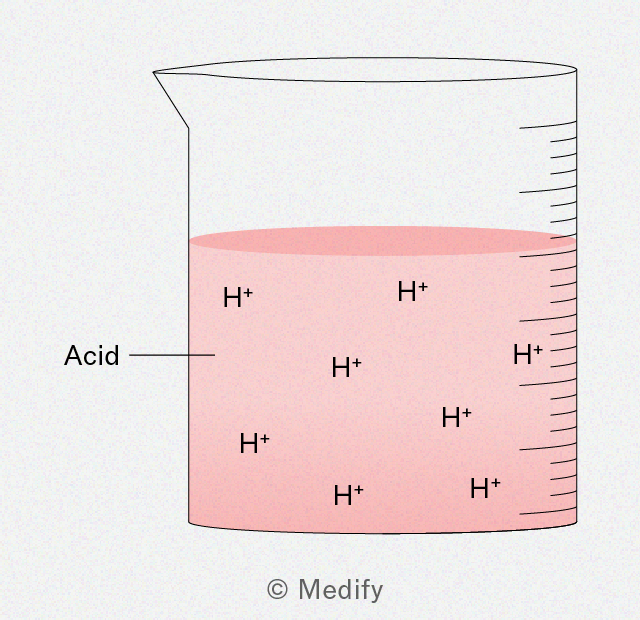
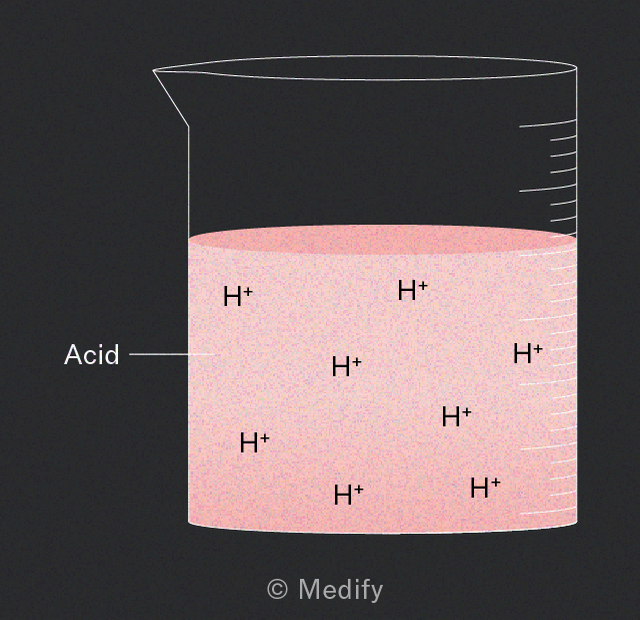
dissociates in water releasing ions as follows:
The ions further combine with molecules forming hydronium ( ) ions:
The overall equation for the dissociation of in water (with state symbols) is:
Alkalis are chemical species that release hydroxide, , ions in aqueous solutions.
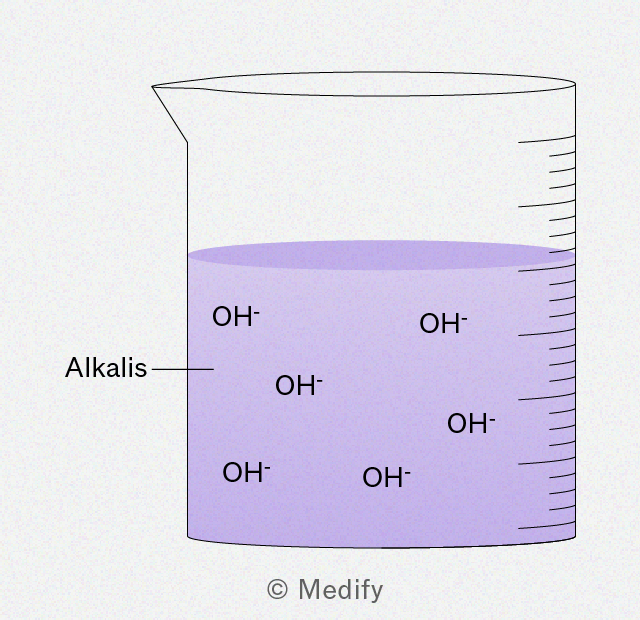
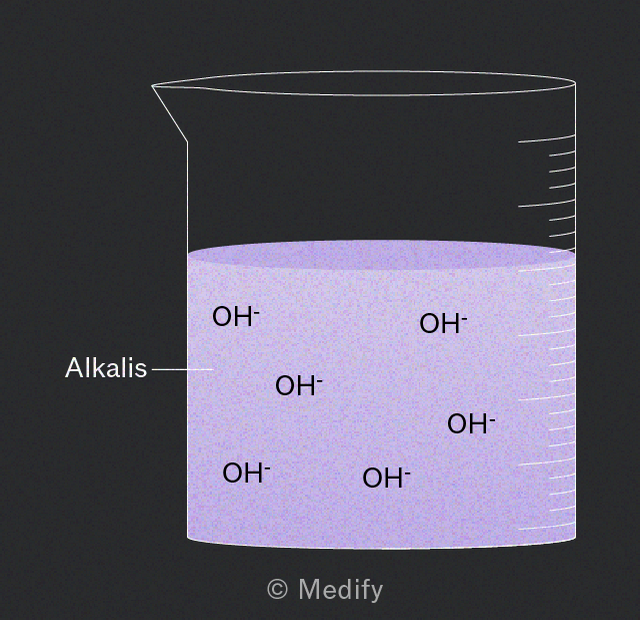
dissociates in water liberating ions:
Ammonia, , does not contain , but dissolves in water producing and ions:
The names and chemical formulae of some mineral acids you are should be able to recall are:
- Hydrochloric acid ()
- Sulfuric acid ()
- Nitric acid ()
- Phosphoric acid ()
- Carbonic acid ()
The charge of the anion is linked to the number of protons in the acid.
The names and chemical formulae of some alkalis you are should be able to recall are:
- Sodium hydroxide ()
- Potassium hydroxide ()
- Magnesium hydroxide ()
- Ammonium hydroxide ()
The charge of the cation is linked to the number of hydroxide ions.
A strong acid, , completely dissociates in aqueous solution to form and .
In strong acids:
Prominent examples of strong acids are , , and .
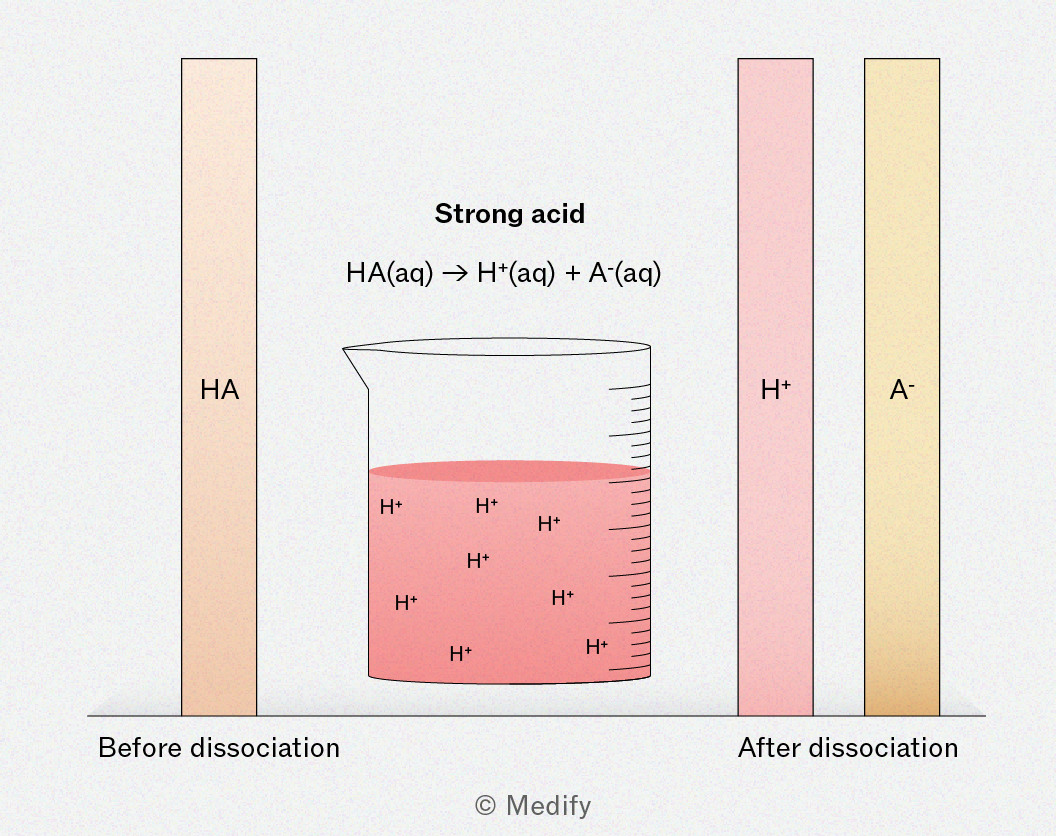
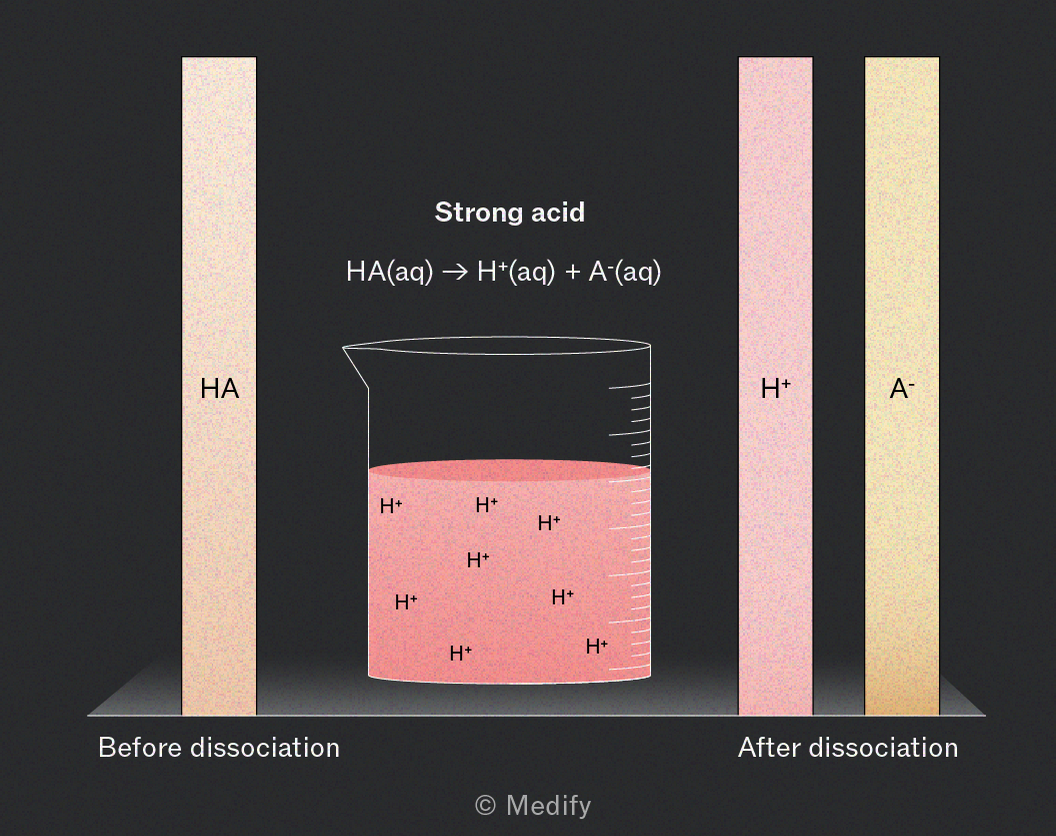
Both concentration (the total amount of the acid per unit volume) and strength (the degree of dissociation) of the acid impact the overall of a solution.
Strong acids will have a lower than weak acids when matched by concentration.
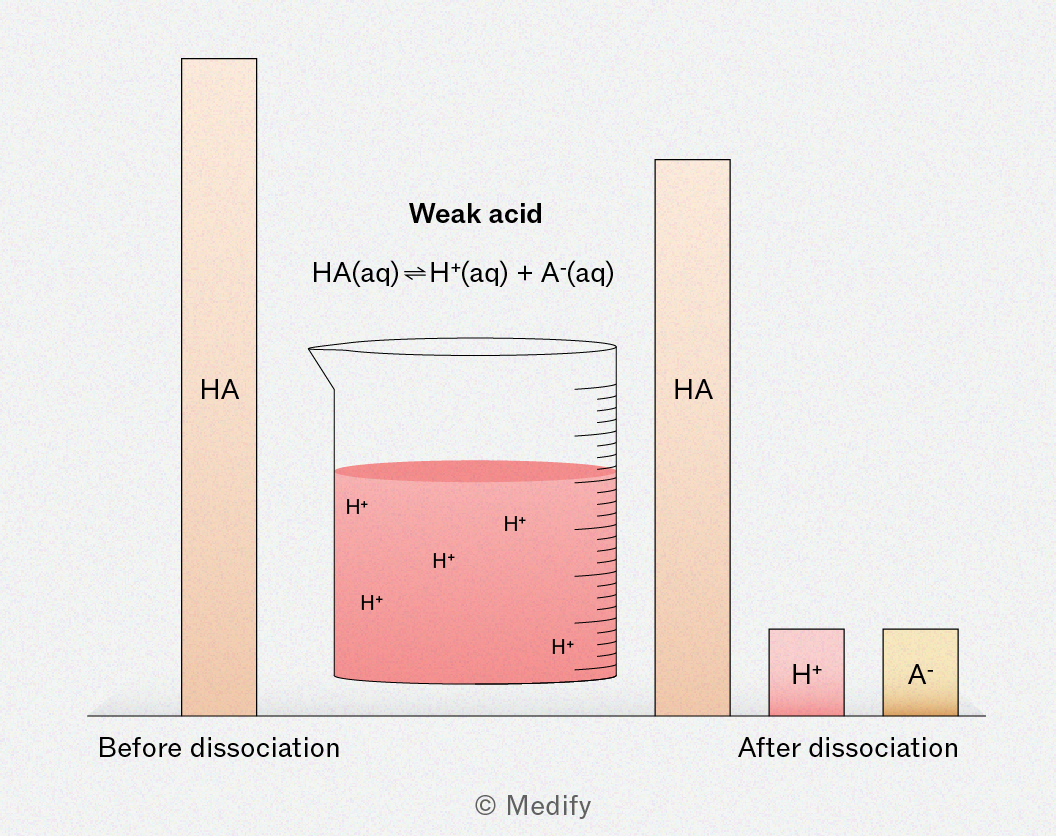
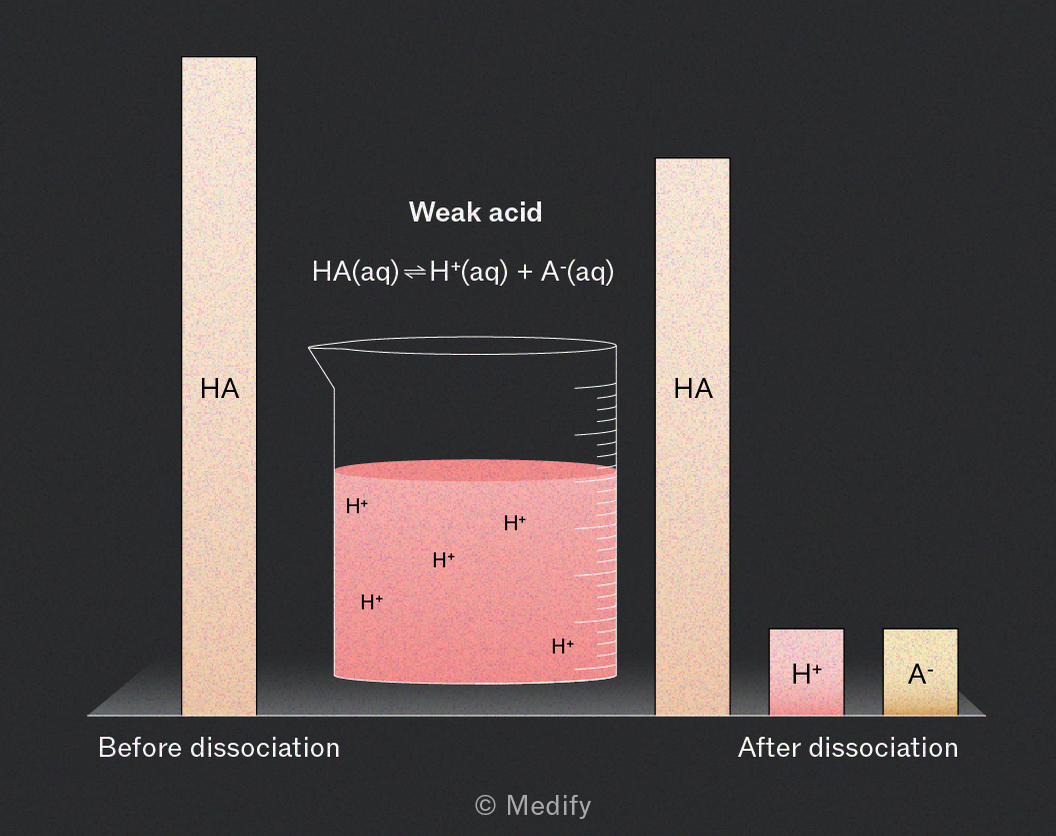
Weak acids only partially dissociate in water (usually less than 10%), releasing a limited number of their ions.
The partial dissociation can be identified by use of a double headed arrow (⇌) showing reversibility.
In weak acids:
Carboxylic acids, such as acetic acid, are weak acids.
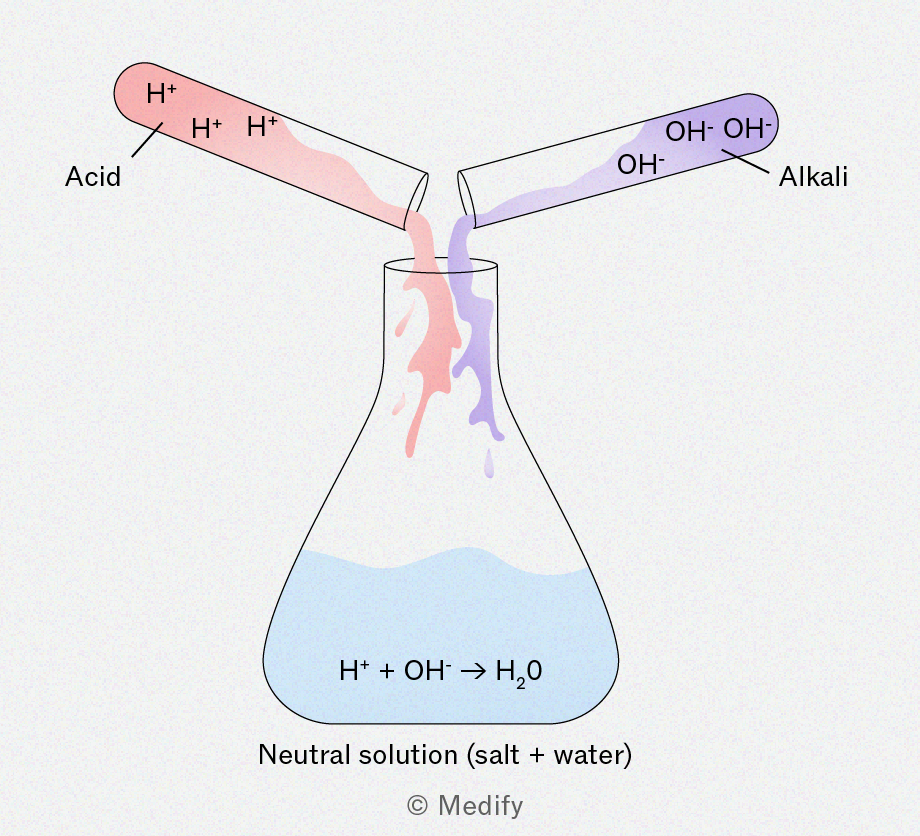
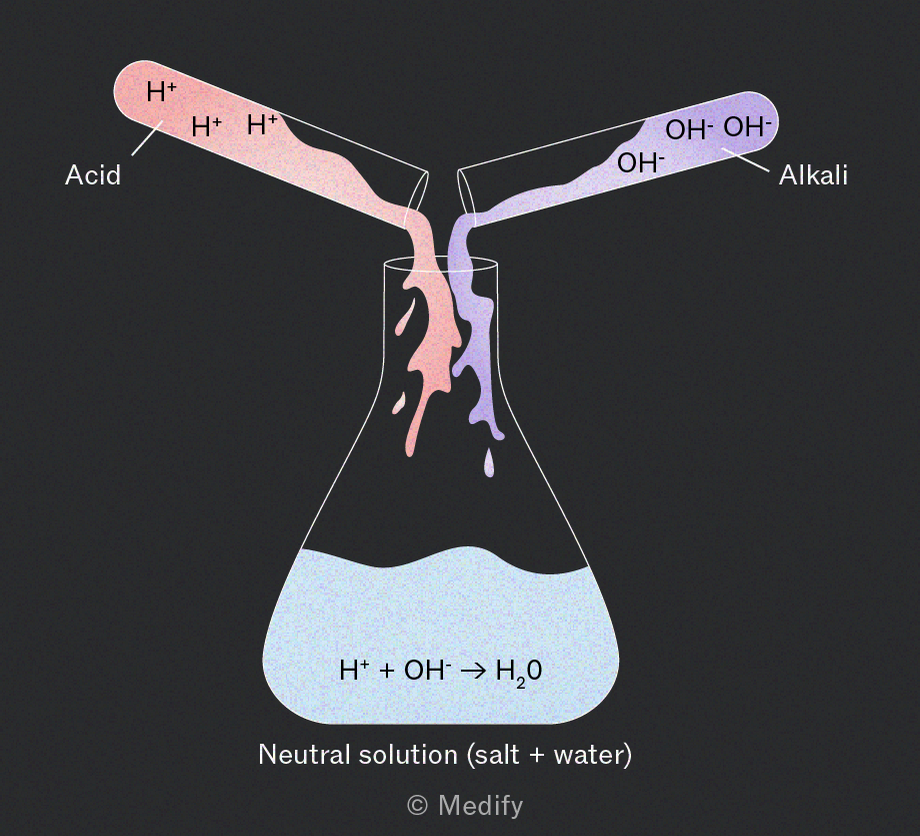
The chemical reaction of an acid with a base produces water. This is known as the neutralisation reaction.
The ions from the acid react with ions from the alkali, producing water (a neutral substance).
The final solution has a of at s.t.p.
Acid + Alkali → Salt + Water
Hydrochloric acid reacts with sodium hydroxide, producing sodium chloride and water.
All neutralisation reactions with water soluble bases (alkalis) simplify down to the same net ionic equation:
Acid + Metal carbonate → Salt + Water + Carbon dioxide
Hydrochloric acid reacts with magnesium carbonate forming magnesium chloride, carbon dioxide, and water.
The net ionic equation for the reaction omits the chloride ions present on both sides of the equation.
Titration is a laboratory technique used for quantitative chemical analysis.
It is used to accurately calculate the concentration of one solution through reaction with another solution of known concentration. To do this, the volume of each solution at the endpoint must be determined; this is where neither solution is in excess.
An indicator is a chemical substance that undergoes a chemical or a physical change to mark the endpoint of the titration.
In acid–base titrations, indicators used sharply change colour with the change in pH of the reaction mixture at the point of neutralisation. The colour change marks the end point of the titration, indicating the ratio of volumes required for neutralisation.
One solution in a titration must be of known concentration.
A standard solution is a solution of known concentration. It must be accurately prepared using a volumetric glass flask.
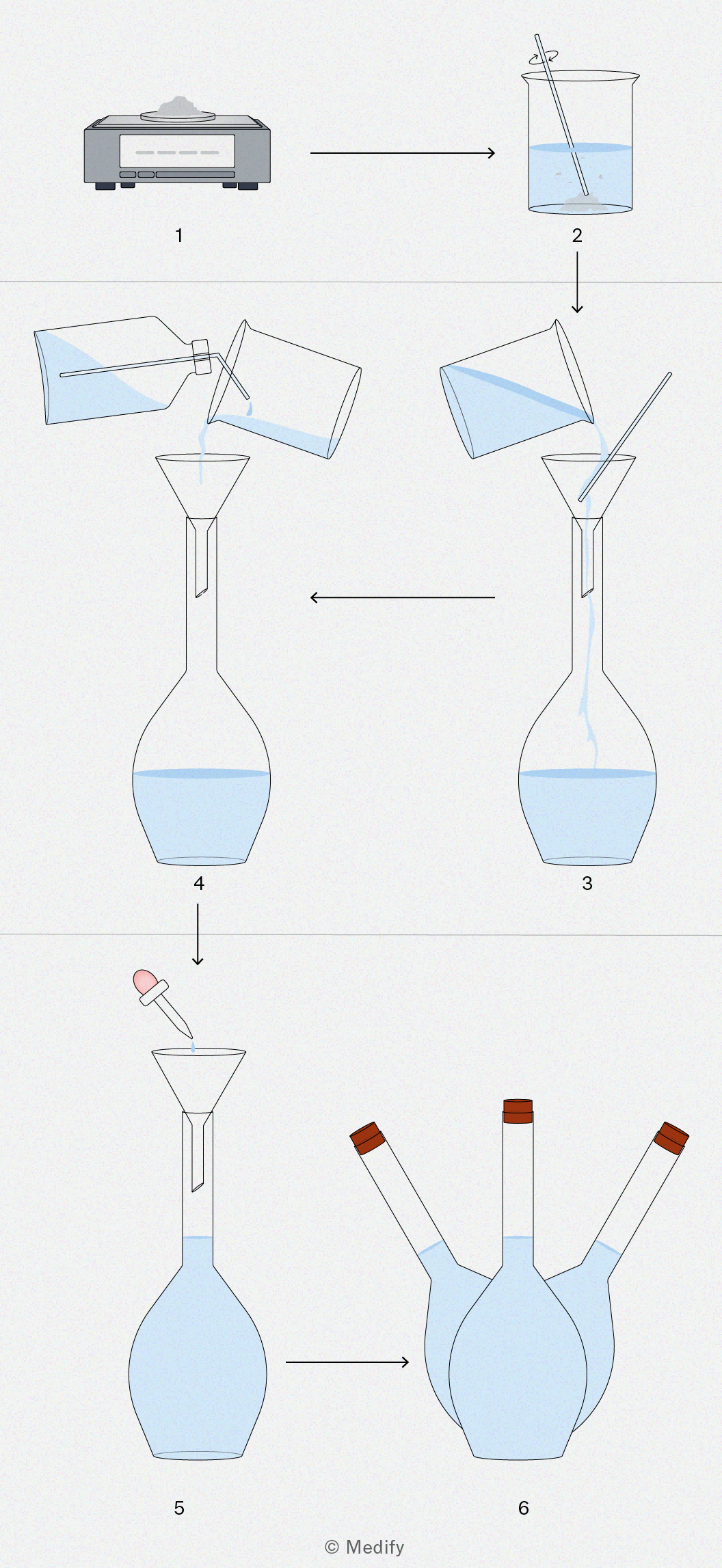
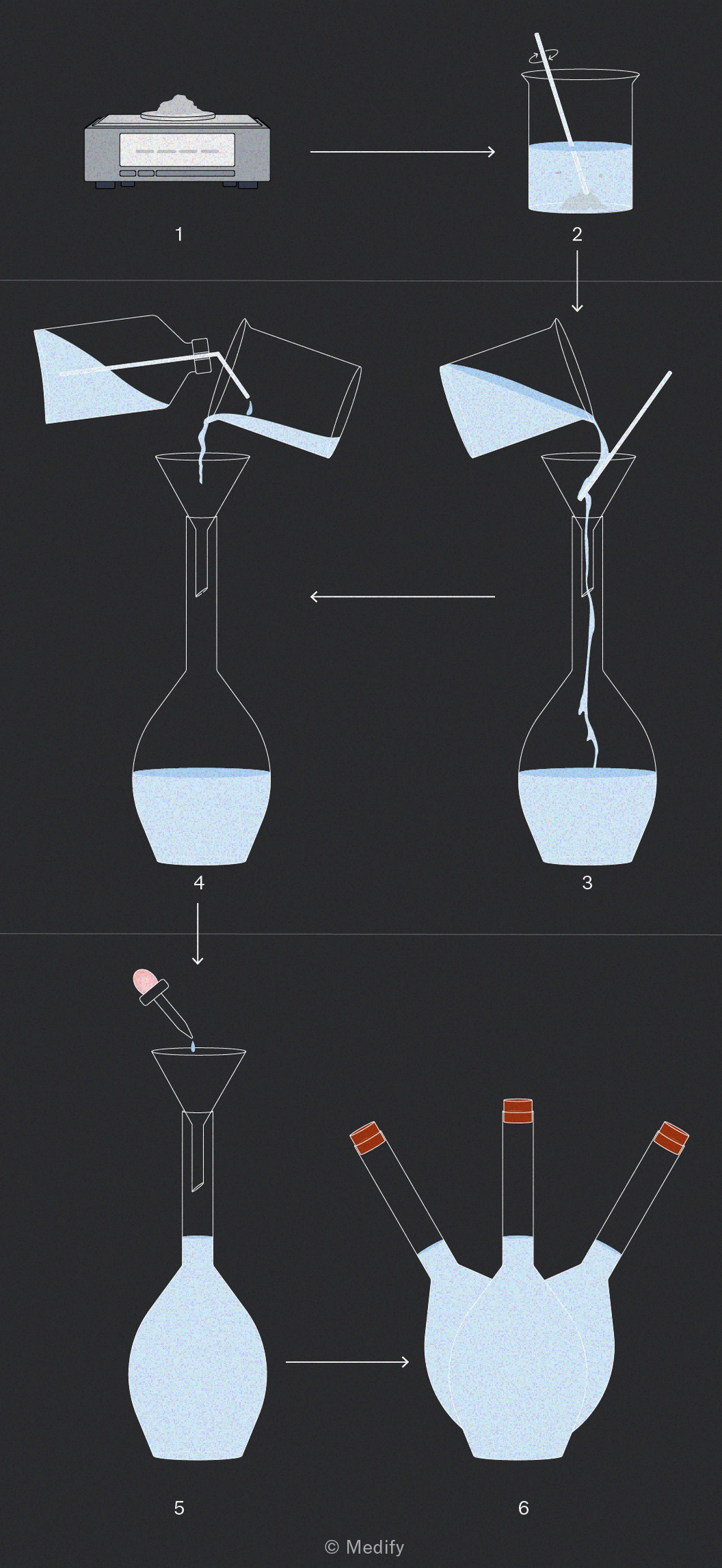
The preparation of a standard solution involves the following steps:
- Calculate the mass of solute required to achieve the desired concentration and weigh on an analytical balance.
- Transfer the solute to a clean beaker and add a small amount of solvent (distilled water). Stir until fully dissolved. Ensure all solute is transferred by reweighing the empty weighing dish.
- Transfer the concentrated solution to the volumetric flask using a glass funnel.
- Rinse the beaker, stirring rod and funnel with solvent (distilled water) and add washings to the volumetric flask. This ensures complete transfer of solute.
- Fill the volumetric flask with solvent to the fill line. Use a pipette for the final addition to improve accuracy. Ensure the meniscus is viewed at eye level while doing this.
- Stopper the volumetric flask and slowly invert sideways two to three times to thoroughly mix all the contents.
How to perform an acid–base titration
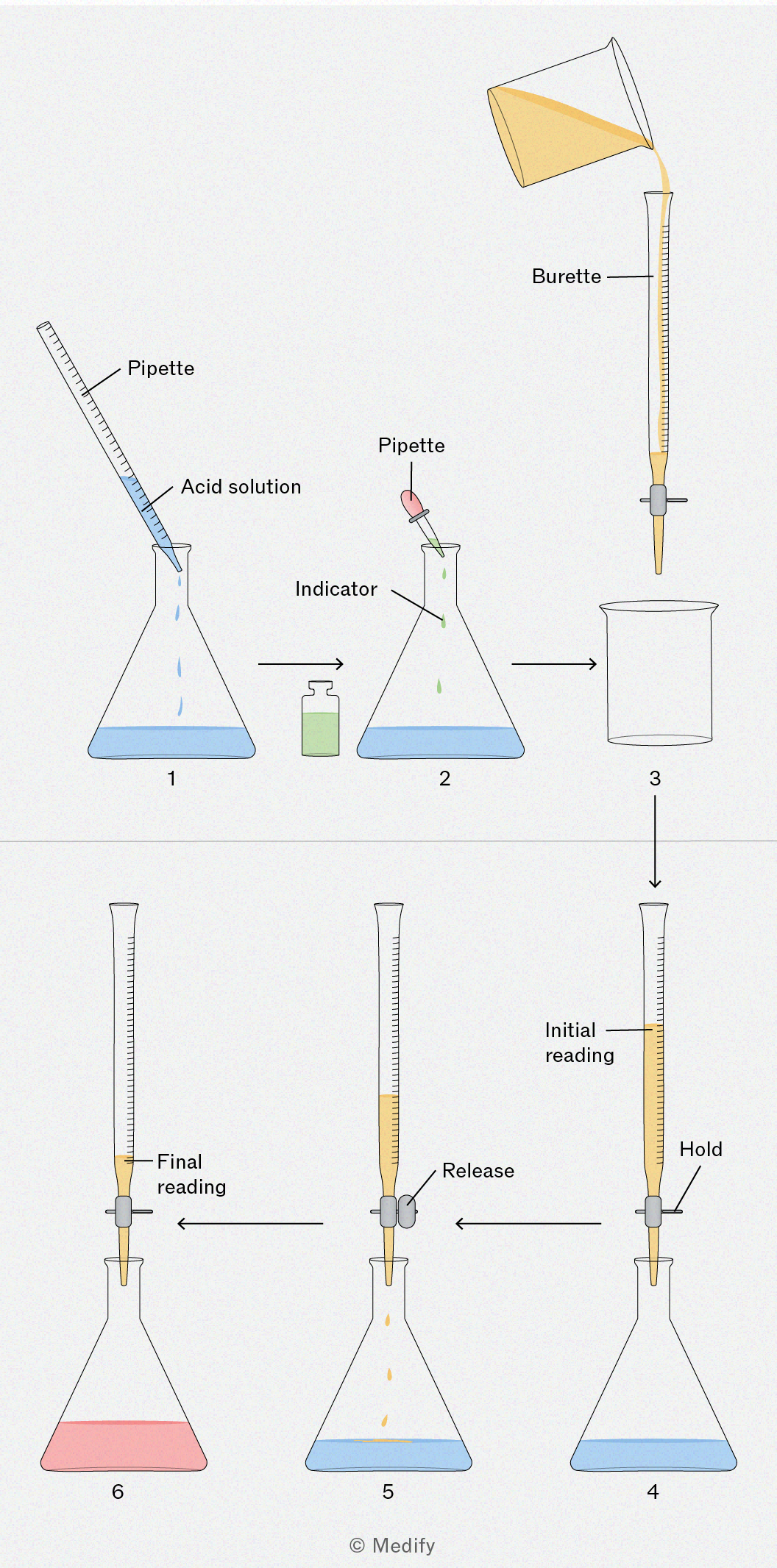
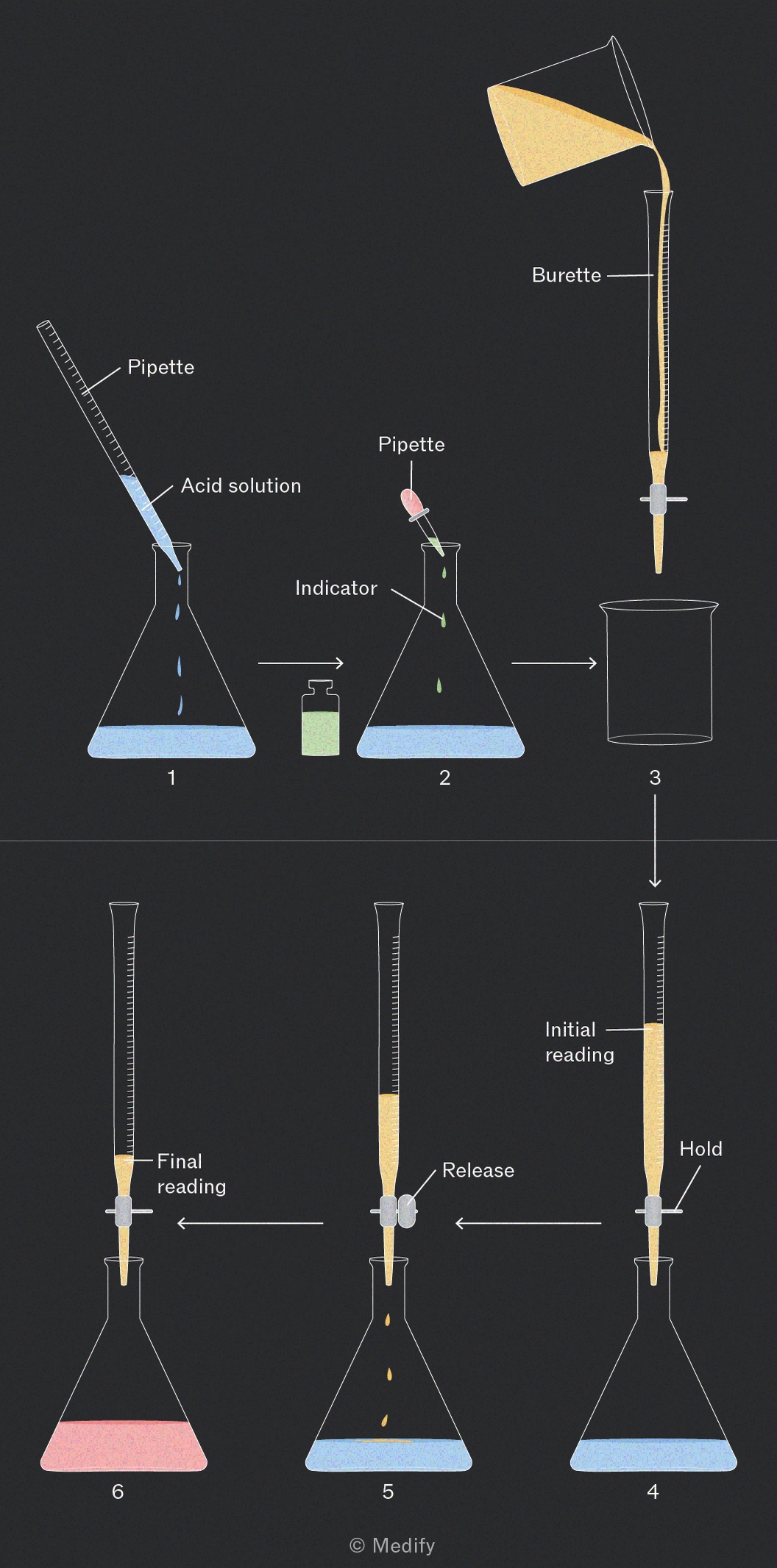
- Pipette a specific volume (usually 25 cm3) of the analyte solution into a conical flask. Gently touch the tip of the pipette to the flask to ensure all the solution is transferred.
- Add a few drops of indicator to the titration flask and gently swirl the mixture for a uniform distribution. Note the initial colour.
- Fill a 50 cm3 burette with the standard solution. Open the burette tap once to run the excess solution out into a beaker, removing any air bubbles forming in the burette. This ensures the titre volume does not include the volume of air.
- Note the initial burette reading V1, to the nearest 0.05 cm3, keeping your eye exactly horizontal to the level of the lower meniscus. This avoids the parallax error.
- Open the burette tap to slowly run the burette solution into the conical flask, while continuously swirling.
- Close the tap as soon as the titration mixture begins to change colour. Use a white tile underneath the flask to help observe the colour change. Add dropwise until the colour change is permanent. Note the final burette reading V2.
Calculate the volume (V) by subtracting V1 from V2.
V = V2 – V1
Repeat the process, until at least two titres are concordant, meaning they differ within 0.1 cm3 only. A mean titre can be taken for calculation.
In titration calculations, the volume of a standard solution of substance A at the endpoint can be used to calculate the moles of substance A involved in the reaction.
The stoichiometric mole ratio from the balanced chemical equation can then be used to find the moles of substance B.
The concentration of B, is determined using the calculated moles and the volume of solution B at the endpoint.
The number of moles () of an acid or base in a solution are related to the solution volume () and concentration () by the formula:
where:
- = number of moles (in ),
- = concentration (in ),
- = volume (in ).
You often need to convert from to for these questions by dividing by 1000.