
Periodicity (3.1.1)
On this page
The periodic table is a fundamental tool in chemistry that organises the elements based on their atomic number, creating a systematic arrangement that reveals patterns in their properties and reactivity.
These repeating patterns are known as periodicity.
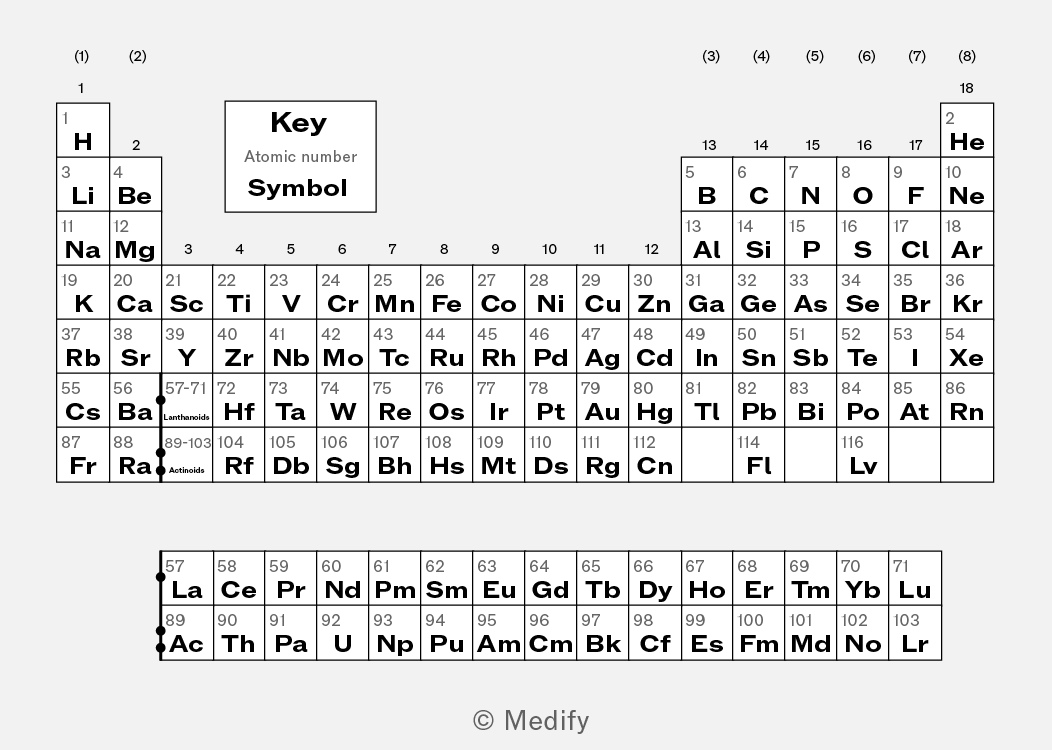
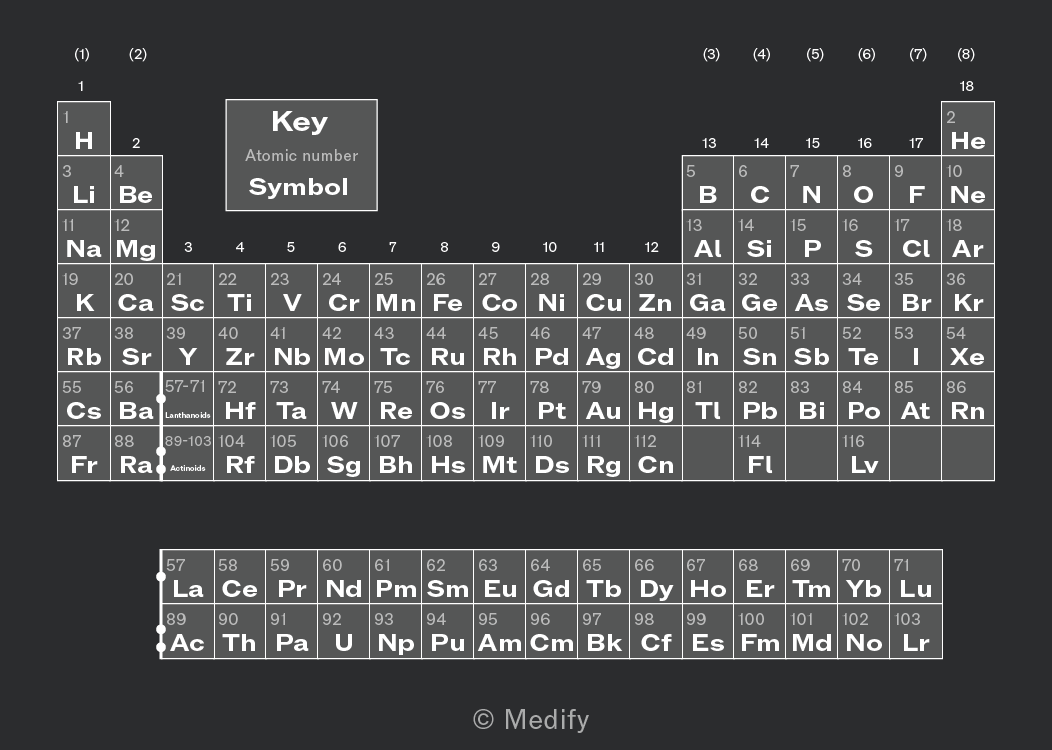
The atomic number represents the number of protons in the nucleus of an atom.
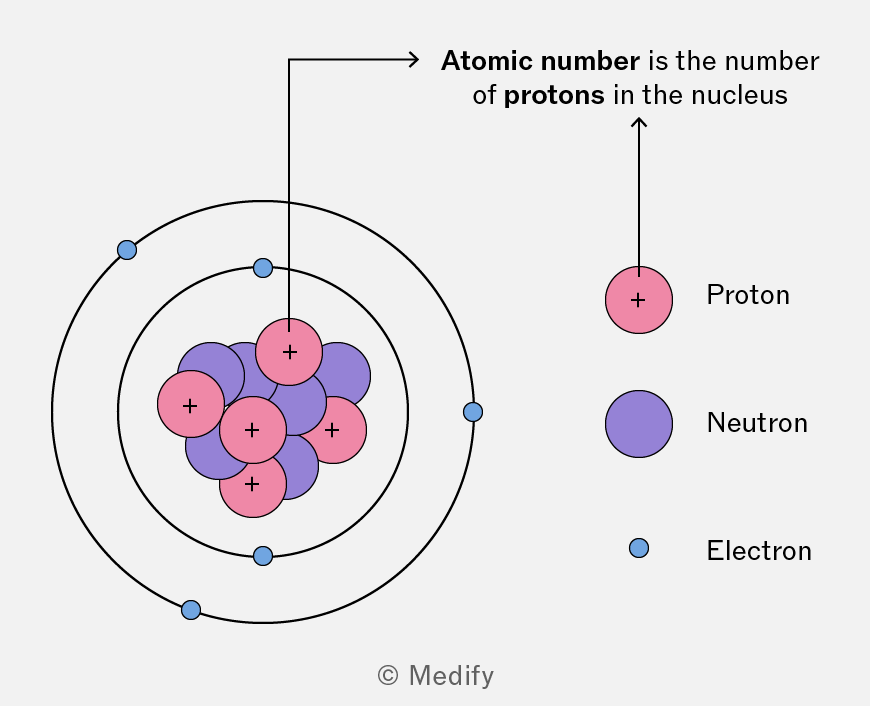
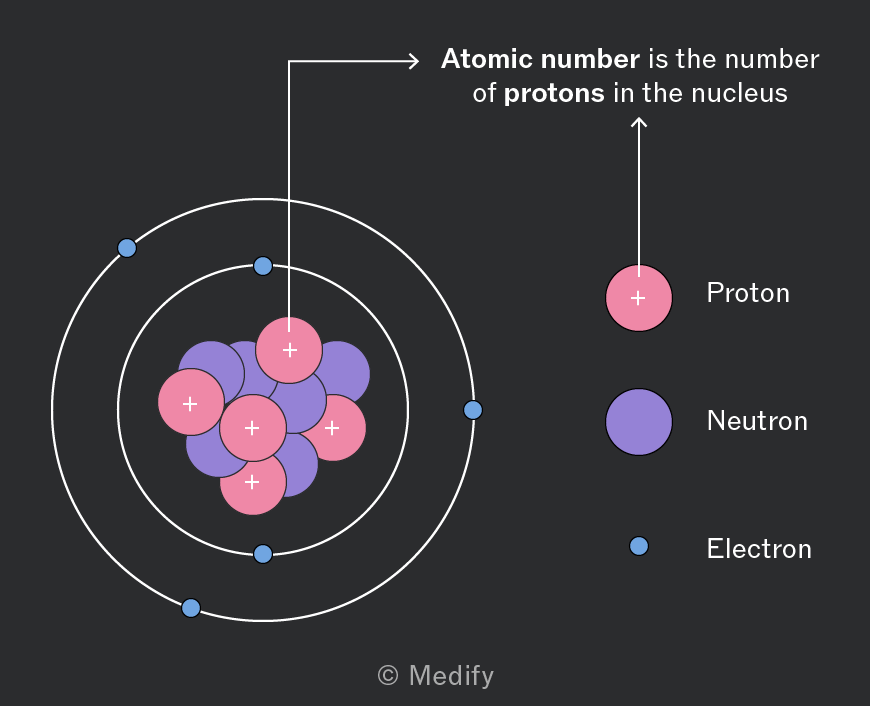
It is a unique identifier for each element and is a fundamental factor in the organisation of the periodic table.
Elements are arranged in increasing order of atomic number from left to right.
The periodic table is divided into rows called periods.
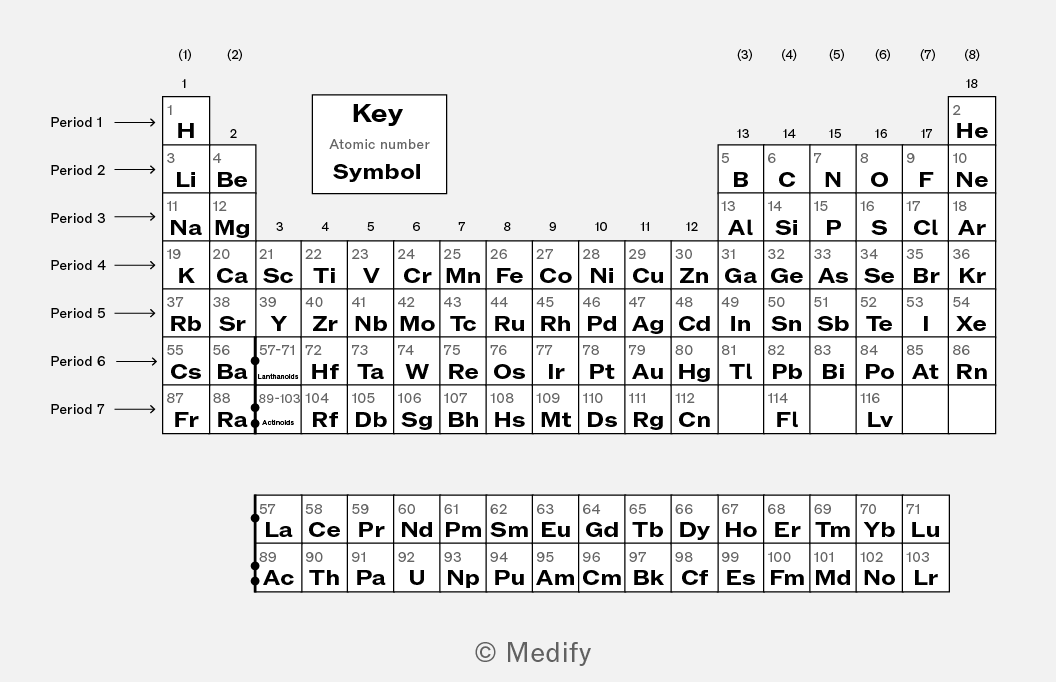
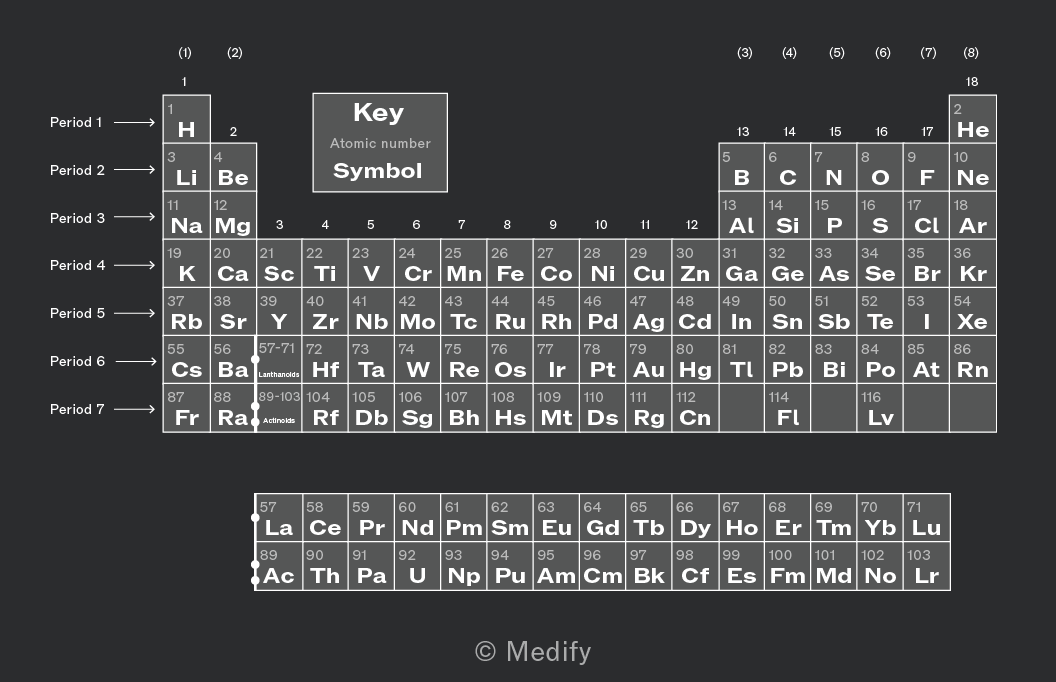
There are a total of seven periods.
Elements in the same period have the same number of electron shells.
Columns in the periodic table are known as groups.
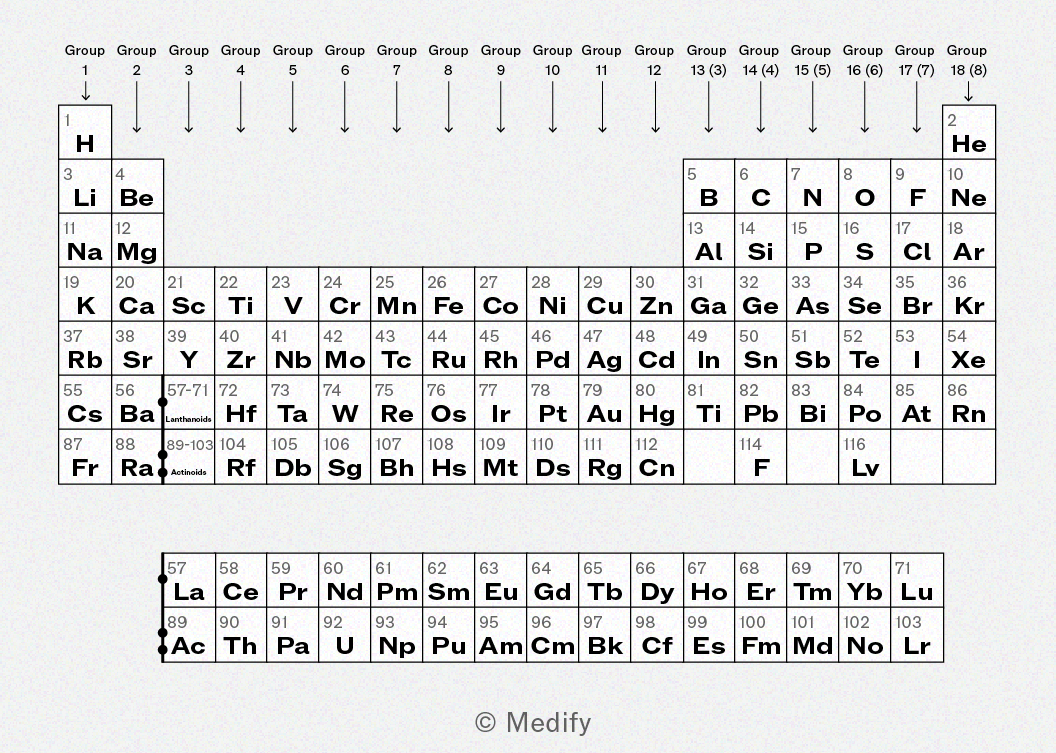
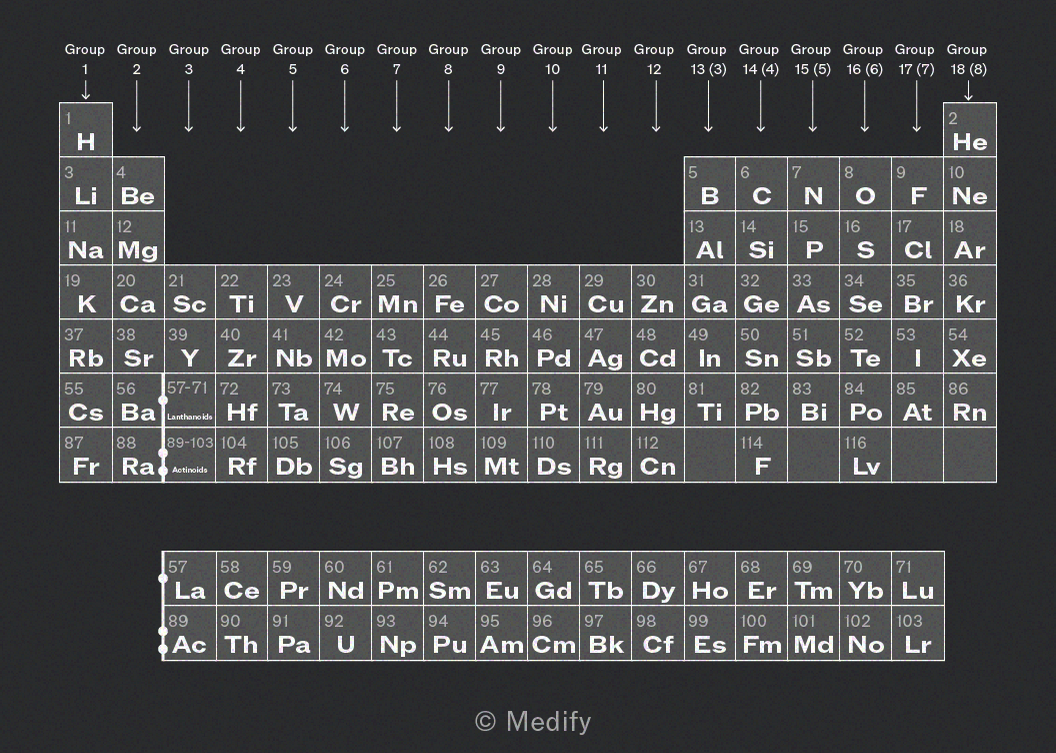
There are 18 groups in the periodic table.
Elements within the same group have similar chemical properties because they have the same number of outer electrons.
Each period of the periodic table starts with one electron in a new electron shell.
The number before the orbital indicates the shell number, which also corresponds to the period number.
In period 2, the 2s subshell is filled first with two electrons.
After the 2s subshell is filled, electrons then occupy the 2p subshell, which can hold up to six electrons.
The trend in electron configuration across period 2 is shown below.
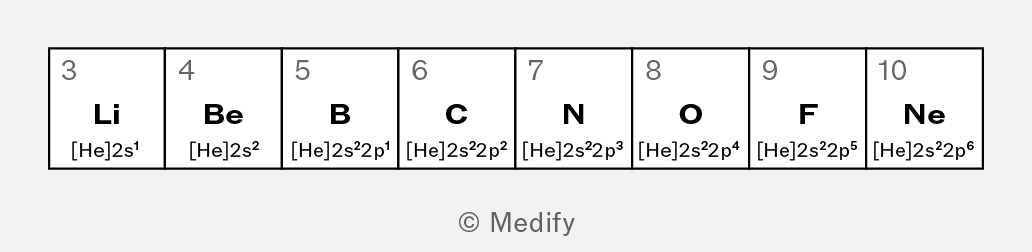
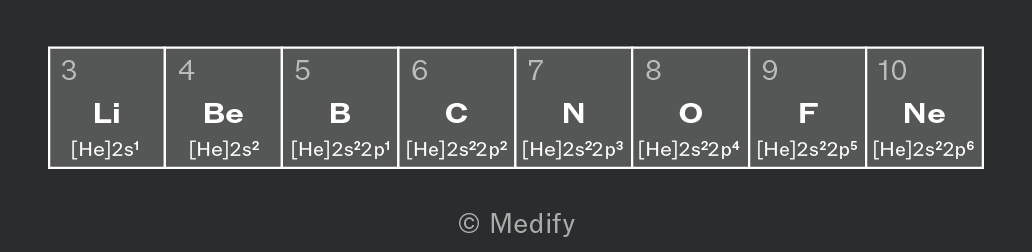
In the period 3, the 3s subshell is filled first with two electrons.
Once the 3s subshell is filled, electrons begin to occupy the 3p subshell, which can hold up to six electrons.
The trend in electron configuration across period 3 is shown below.
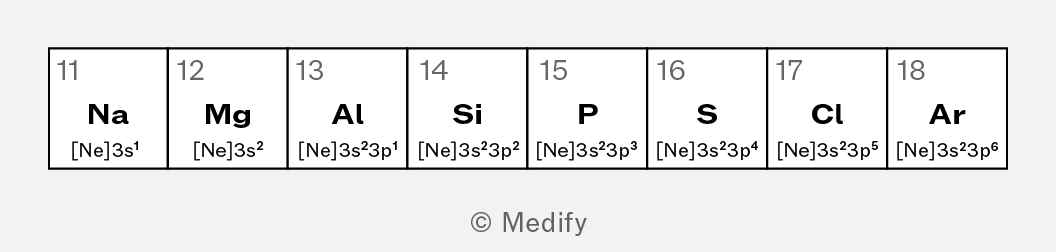
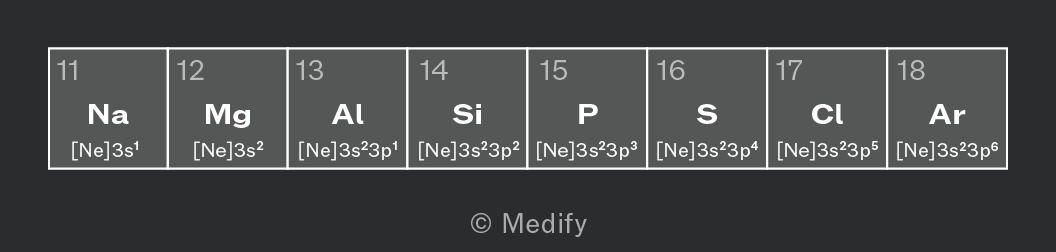
All of the elements in the periodic table belong to blocks based on their electron configuration.
s-block: the outermost electron is in the s-subshell; for example, the electron configuration for potassium is
p-block: the outermost electron is in the p-subshell; for example, the electron configuration for aluminium is
d-block: the outermost electron is in the d-subshell; for example, the electron configuration for vanadium is
f-block: the outermost electron is in the f-subshell; for example, the electron configuration for cerium is
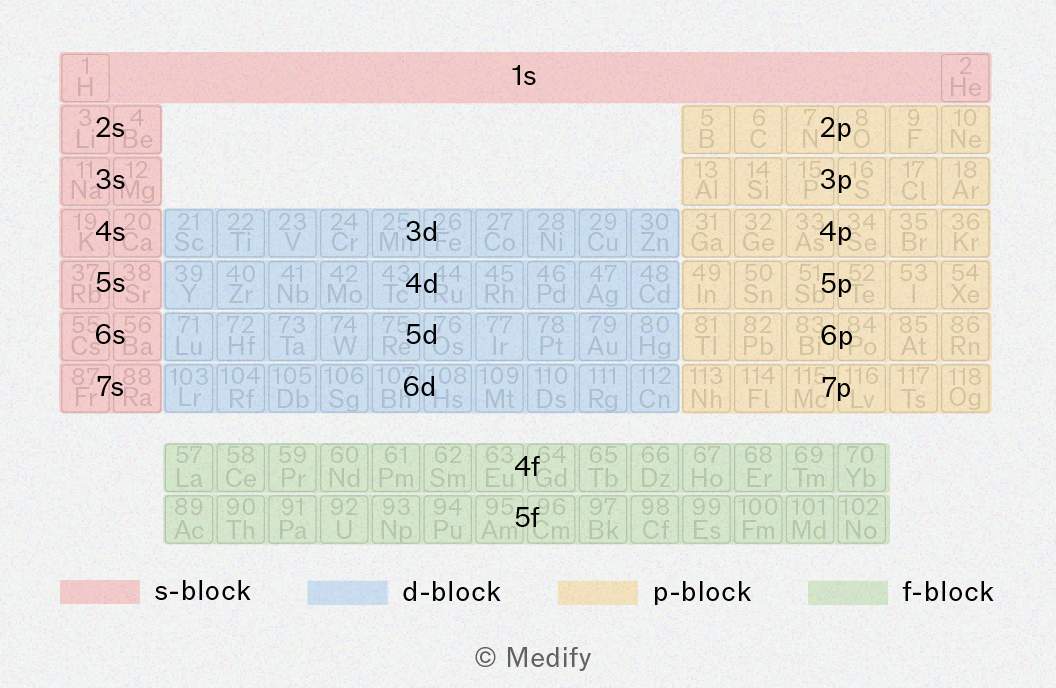
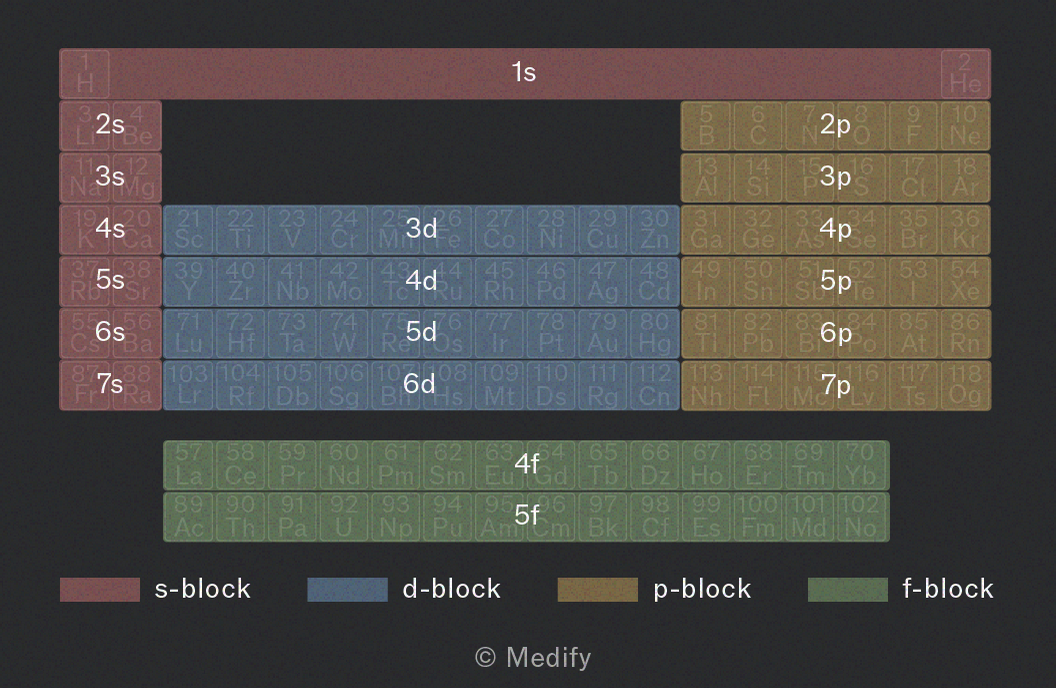
The atomic radius is taken from atoms in their most stable elemental form. It gives information about the distance between the nucleus and the outer shell electrons.
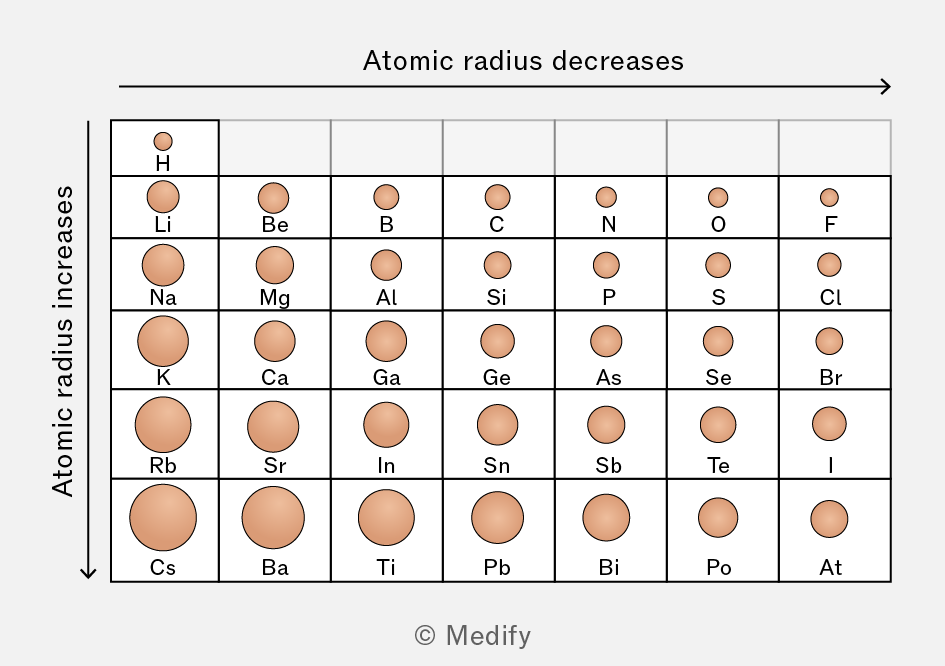
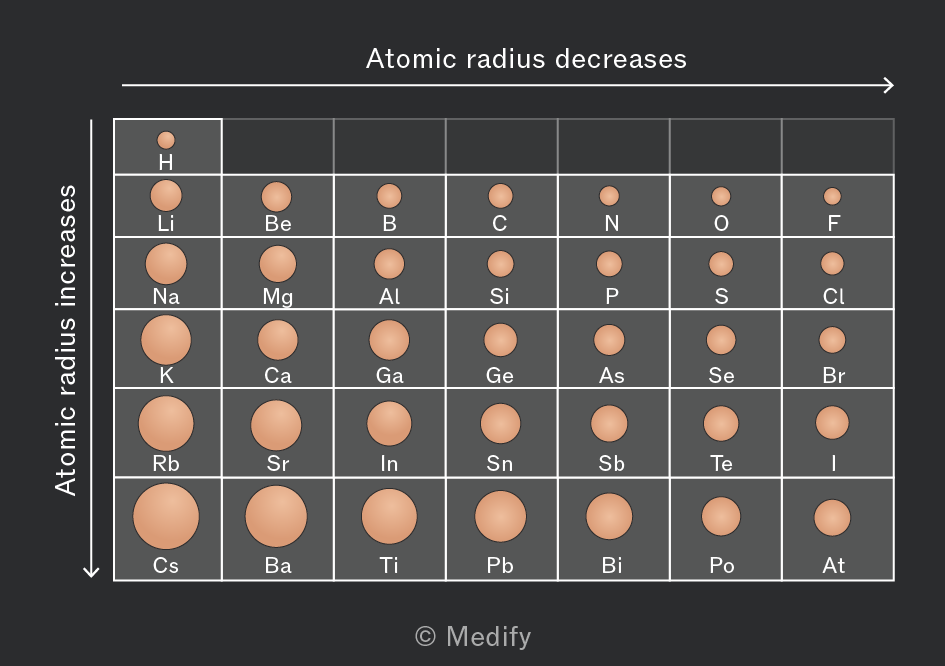
Across periods in the periodic table, atomic radii decrease from left to right.
The increasing atomic number across the period, and therefore the increased nuclear charge, attracts the electrons more tightly to the nucleus.
Electrons are added to the same electron shell, so there is no significant increase in nuclear shielding across the period. This means the stronger nuclear attraction directly reduces the atomic radius.
Ionisation energy is the amount of energy required to remove one mole of electrons from one mole of gaseous atoms of an element to form one mole of gaseous 1+ ions:
First ionisation energy decreases down the group.
The increasing atomic radius down the group means the outer electrons are further from the nucleus.
The increase in energy level means there is an increased amount of nuclear shielding from filled electron shells.
The net effect is that, despite the increased nuclear charge, the effective nuclear attraction to the outermost electron decreases. The outermost electron is easier to remove and the first ionisation energy decreases.
Across a period, the nuclear charge increases. The energy level, and therefore the nuclear shielding from filled electron shells, remains approximately the same.
This leads to a stronger attraction between the nucleus and the outer electrons as nuclear charge increases across the period. The outershell electrons are drawn closer to the nucleus reducing atomic radius.
As more energy is required to remove the outer electron and the first ionisation energy increases across the period.
Although across a period, the general trend is that the first ionisation energy increases, there are some exceptions.
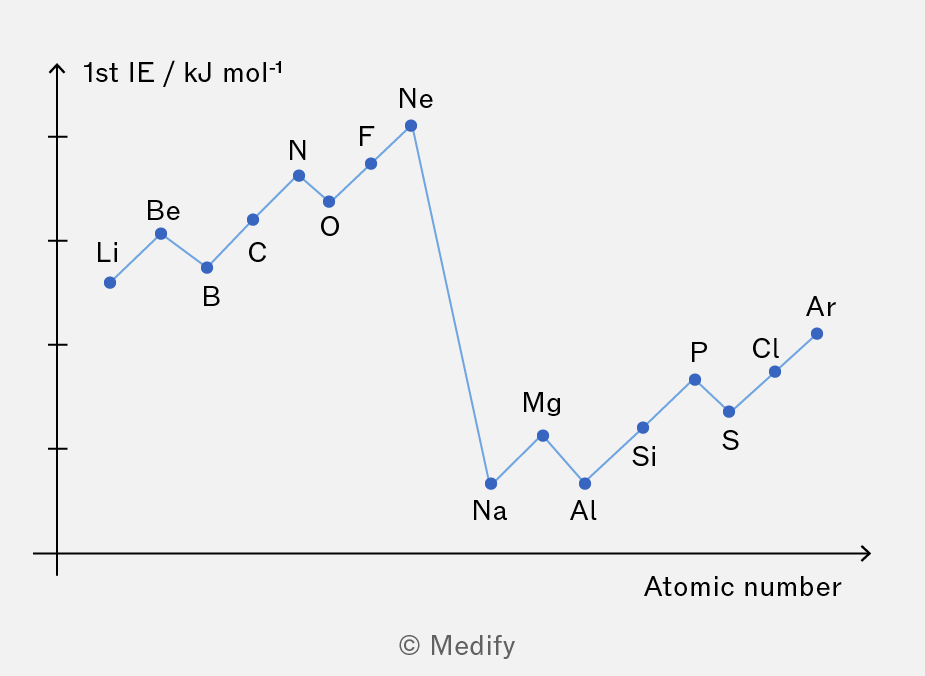
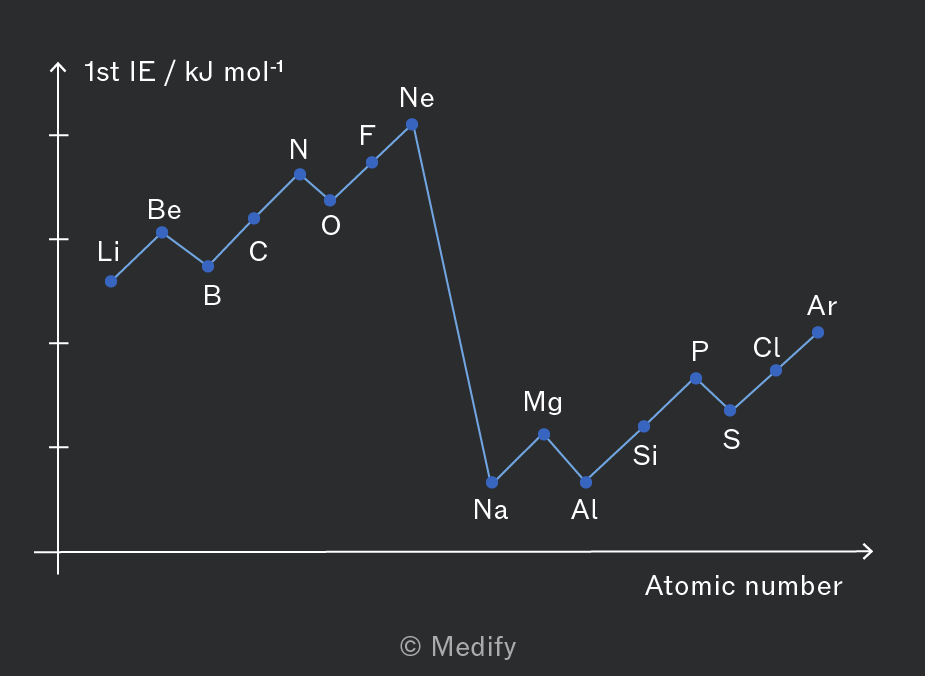
There is a drop in first ionisation energy between Group 2 and 3, and . This is linked to the outermost electron sitting in the p-subshell, which is at a higher energy level than the s-subshell.
There is another drop in first ionisation energy between Group 5 and 6, and . This is linked to electron–electron repulsion in the half filled p-subshell. The fourth electron in the p-subshell is paired in an orbital and so experiences more electron-electron repulsion than the unpaired p-subshell electrons in group five elements.
Successive ionisation energies are associated with the repeated removal of electrons from increasingly positive ions.
First ionisation energy:
Second ionisation energy:
Third ionisation energy:
Each successive ionisation energy is higher than the previous one but the size of the increase is related to the position of the outermost electron within the subshells.
Successive ionisation energies can be used to make predictions about:
- the number of electrons in the outer shell
- the group number
- the identity of an element.
Successive ionisation energies for an unknown period 3 element are shown below:
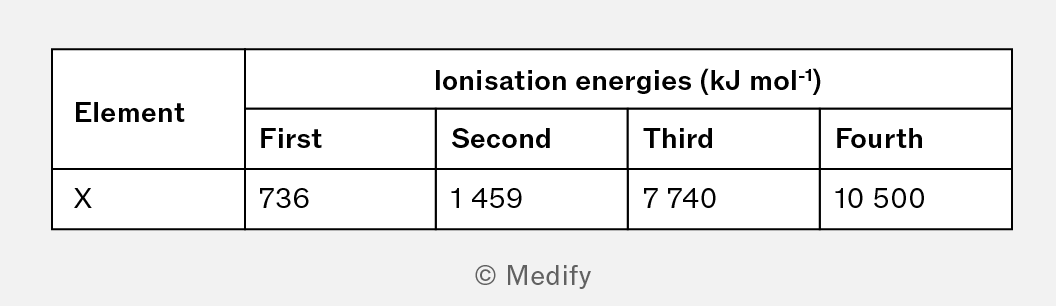
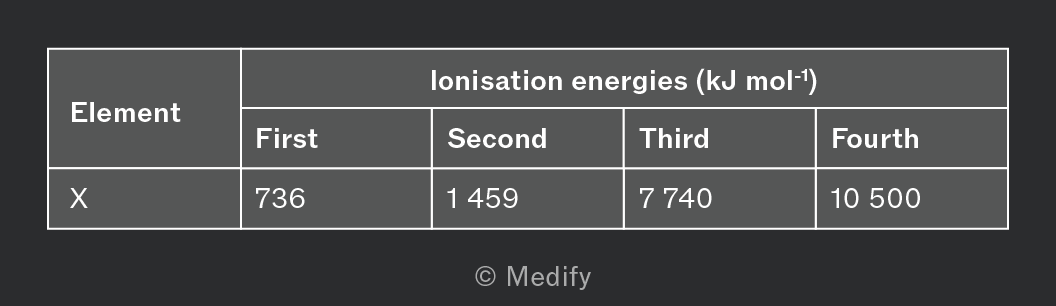
There is a steady rise between the first ionisation energy and second ionisation energy for the unknown element.
Between the second ionisation energy and third ionisation energy, there is comparatively a sharp rise indicating that the third electron is being removed from a new energy level.
From this information, we can therefore deduce that element X is in Group 2.
As it is in period 3, element X must be magnesium.
Question walkthrough
First ionisation energies
Using successive ionisation energies to deduce the identity of a compound
The general trend across periods is an increase in melting point from Group 1 to Group 4. There is then a sharp decrease in melting point between Group 4 and Group 5.
The melting points from Group 5 onwards are comparatively low.
The trend exists due to the transition from giant lattices to simple molecules, held together by weak intermolecular forces.
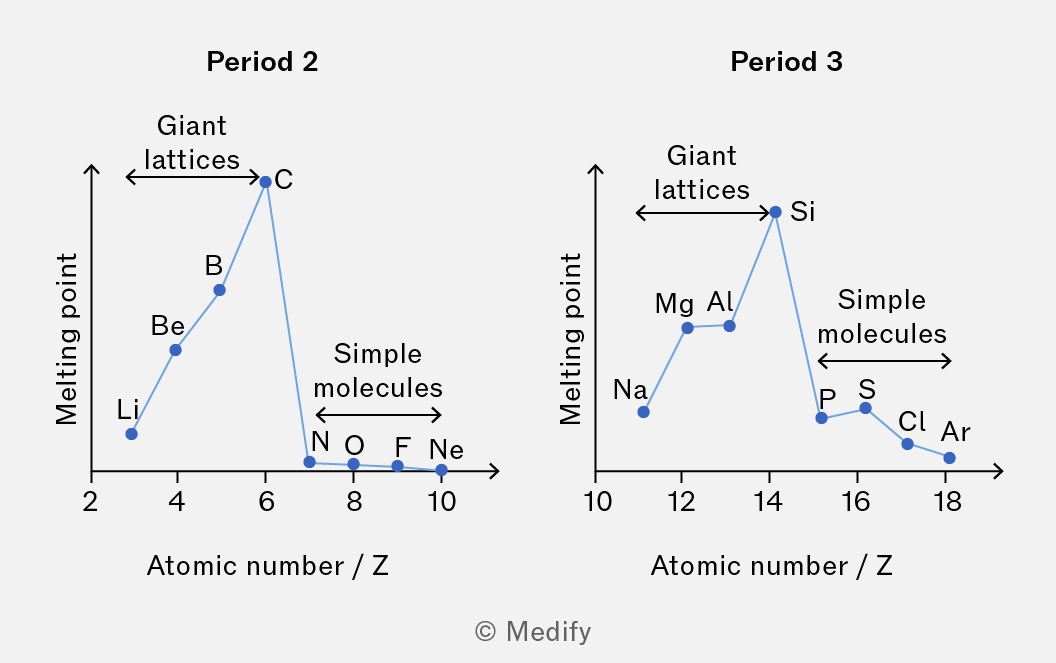
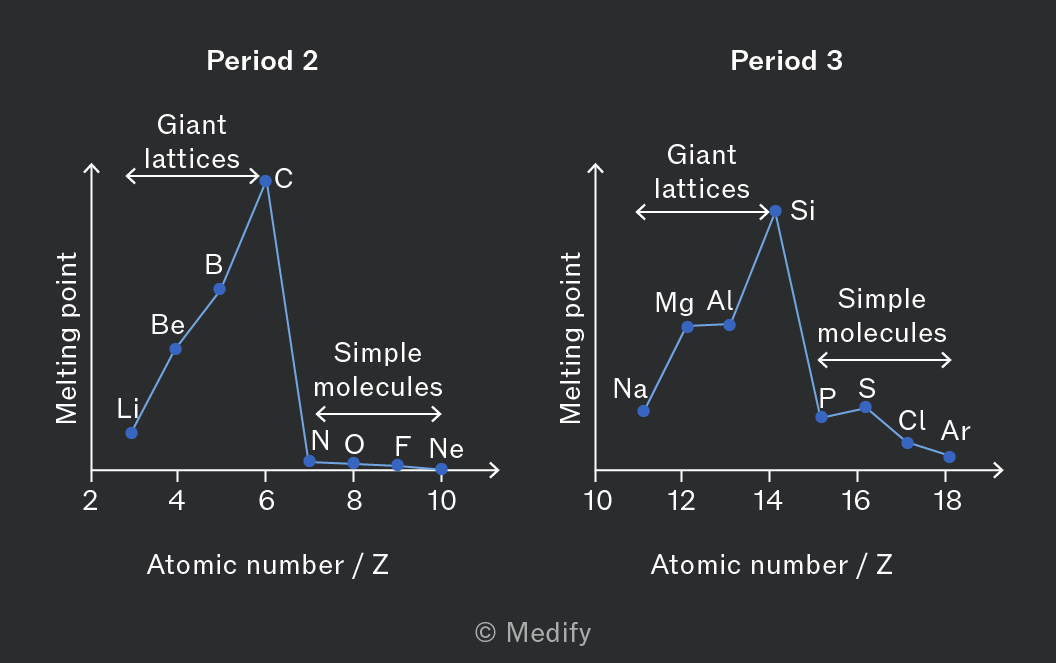
There is an increase in melting point between phosphorus () and sulfur () in period 3. This is due to the increased molecular size and therefore the number of electrons is higher in compared to , creating to more significant temporary dipoles. This leads to stronger intermolecular forces that require more energy to overcome.
Giant covalent lattices always have high melting points and boiling points due to the many strong covalent bonds between atoms in the lattice, which require lots of energy to break.
Most giant covalent lattices are unable to conduct electricity as all the outer shell electrons are held in position within covalent bonds.
There are exceptions: graphite and graphene only bond to three other carbon atoms, leaving one electron to become delocalised per carbon atom.
These electrons are free to move throughout the whole structure and therefore current can flow.
Giant covalent lattices are insoluble in all solvents.
The covalent bonds in a giant covalent lattice are significantly stronger than any interaction between the atoms in the lattice and a solvent.
It is not energetically favourable to break lattice bonds in order to interact with solvent molecules.
Giant covalent lattices are generally strong, but strength can vary depending on their structure.
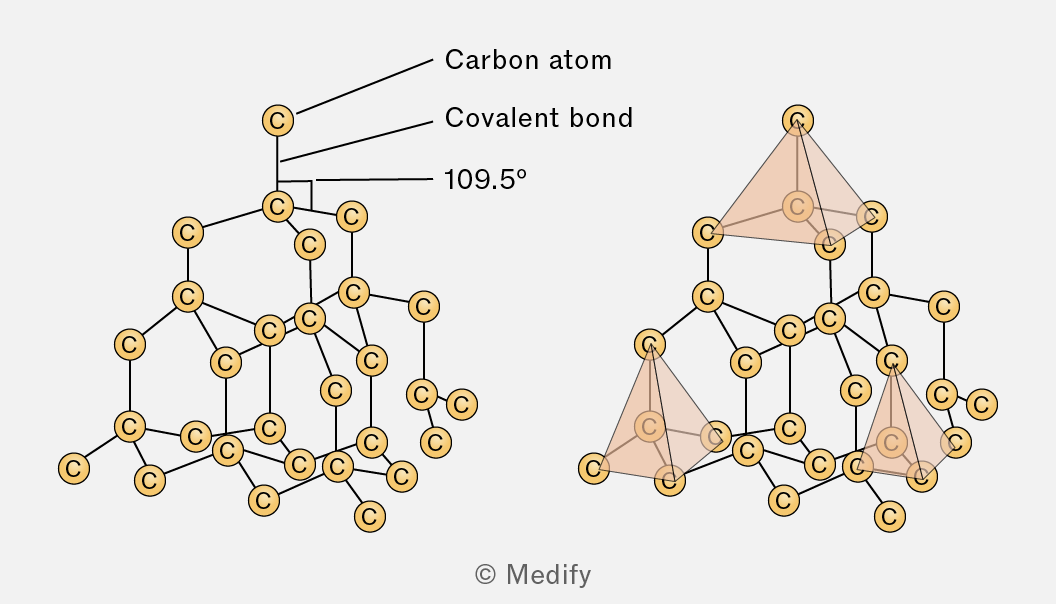
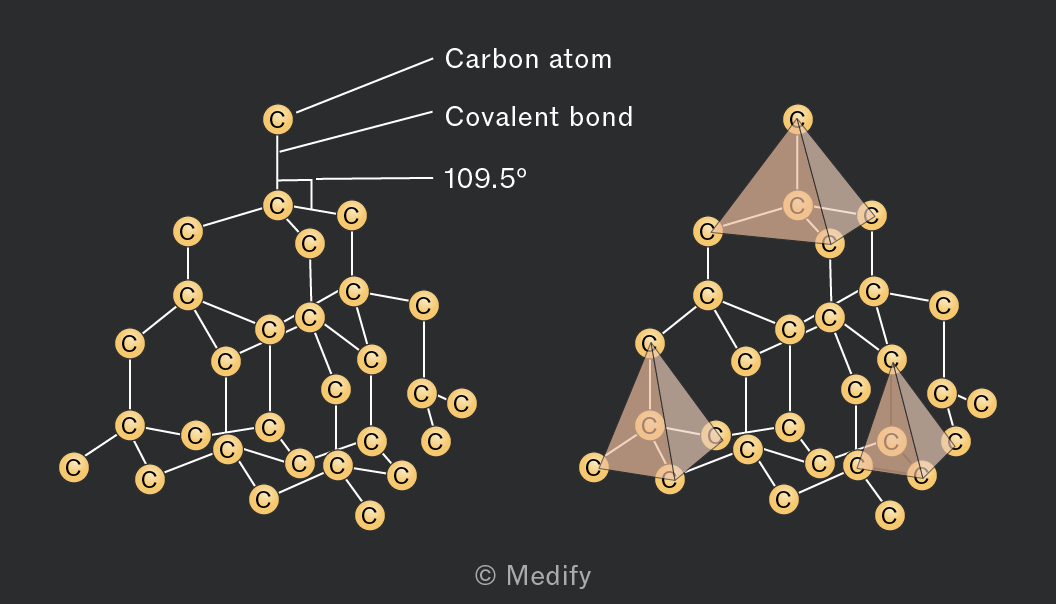
Diamond is hard because of its rigid tetrahedral arrangement of carbon atoms.
Graphite is soft because it requires little energy to overcome the weak intermolecular forces between layers.
Diamond is a giant covalent structure where each carbon atom is covalently bonded with four other carbons to form a rigid repeating tetrahedral structure with bond angles of 109.5°.
Graphite consists of carbon atoms which are covalently bonded to only three other carbon atoms with a bond angle of 120°.
One electron per carbon atom is unpaired and not involved in covalent bonding. These electrons become delocalised and free to move throughout the whole structure. Where electrons are free to move there is electrical conductivity.
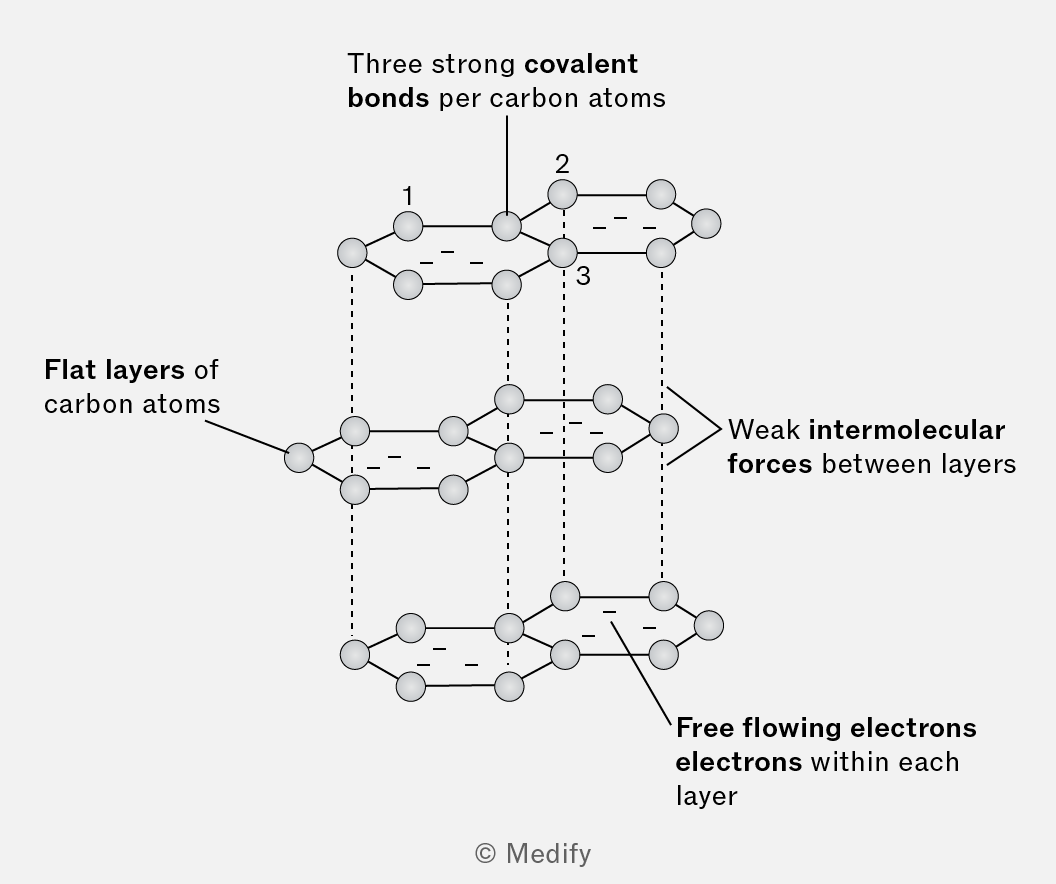
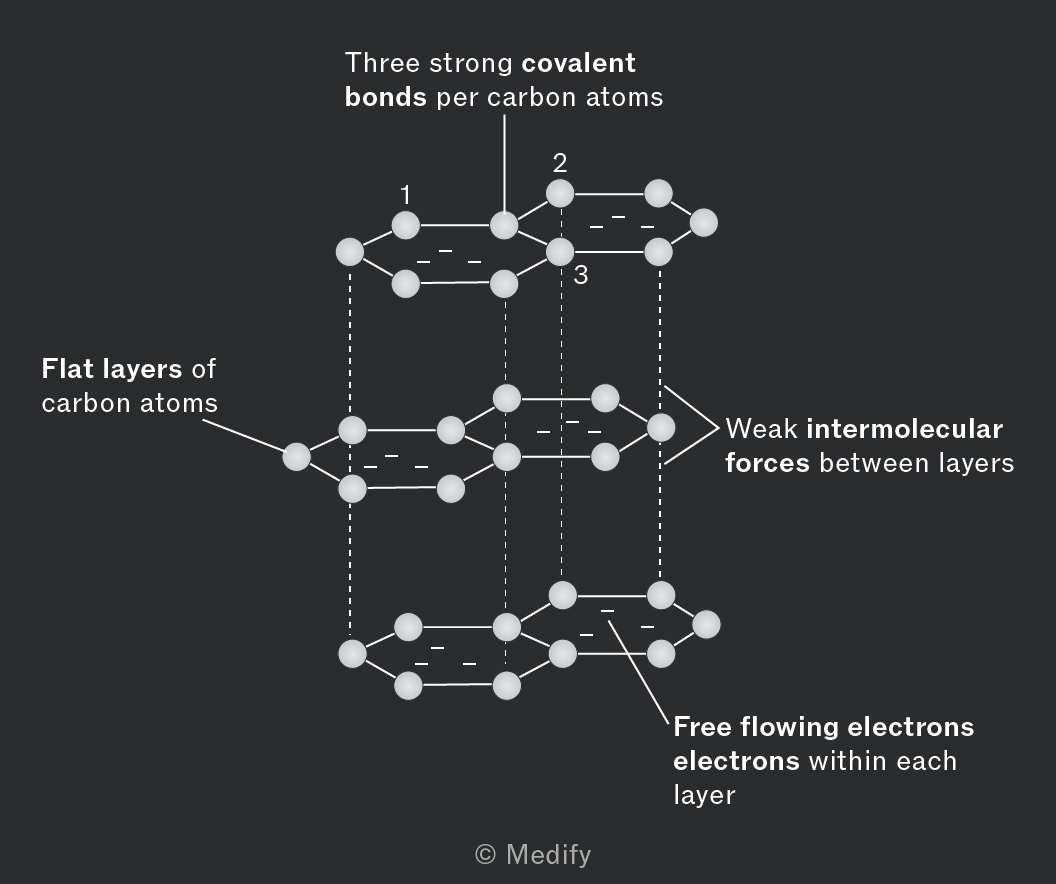
The carbon atoms are arranged in flat hexagonal layers.
These layers are held together by weak intermolecular (London dispersion) forces of attraction. The layers can easily slide over each other, making graphite a good lubricant and able to leave marks on paper.
Graphene is a single layer of graphite and, therefore, also consists of carbon atoms bonded to three other carbon atoms arranged in hexagons.
As graphene consists of one layer of graphite, it is only one atom thick and is considered two dimensional.
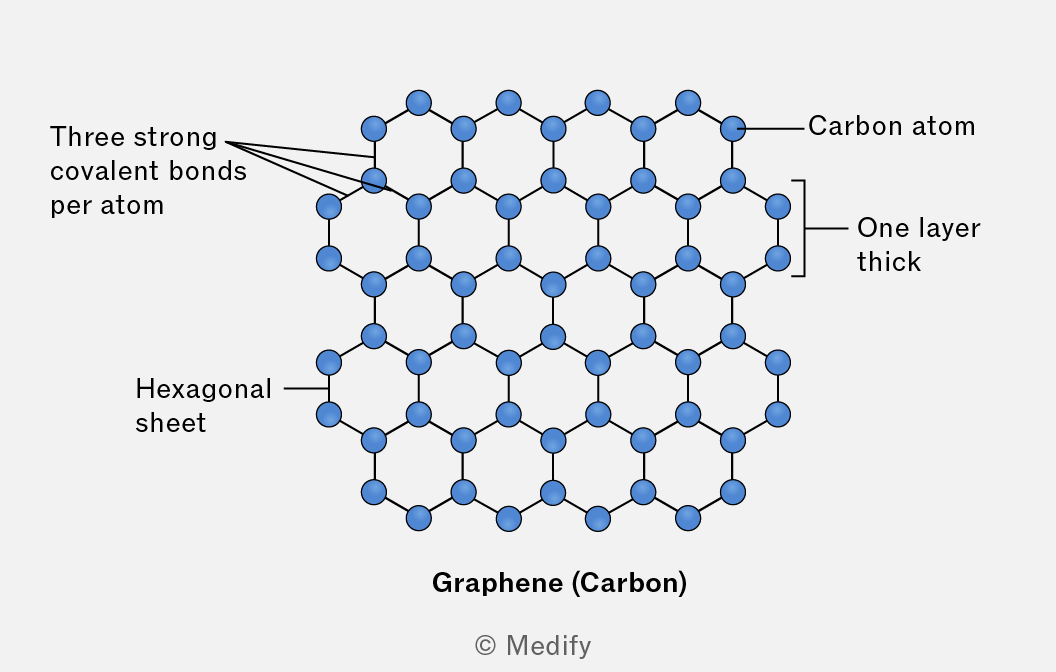
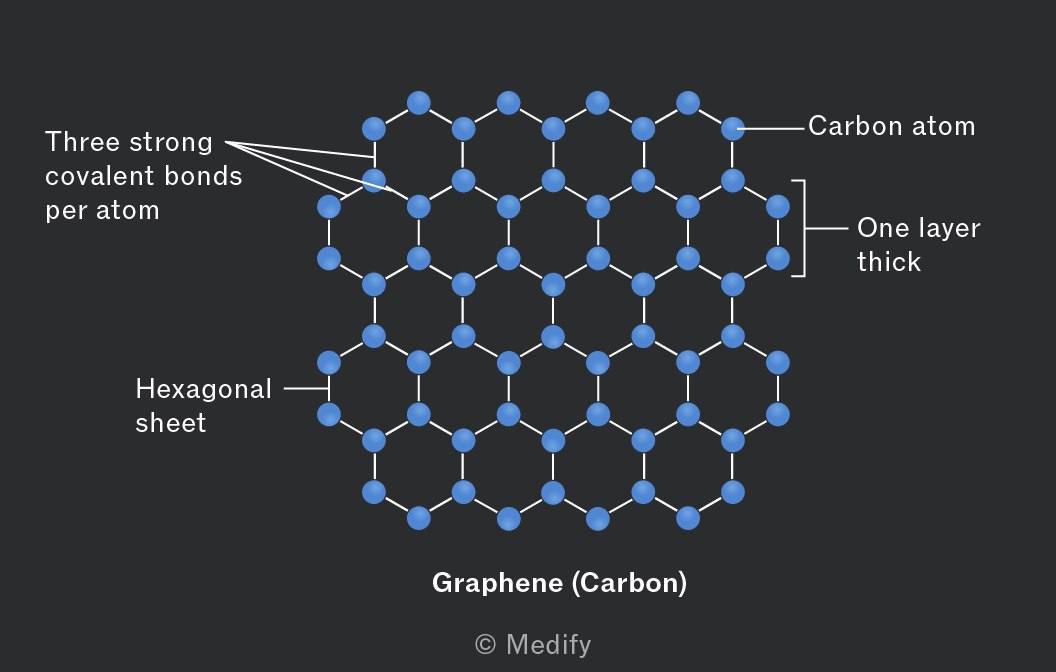
One electron per carbon atom is unpaired and not involved in covalent bonding. These electrons become delocalised and free to move along the plane of the structure.
Where electrons are free to move there is electrical conductivity.
Graphene is an excellent conductor of electricity.
Combined with its thin structure and its exceptional strength, graphene is a critical component in small-scale electronics.
Graphene has exceptional strength.
The individual bonds in graphene are shorter and stronger than those in diamond.
Combined with the regular structure across the layer, graphene has exceptional tensile strength.
In a solid metal, each atom becomes a cation, donating its outer shell electrons to a ‘sea’ of delocalised electrons which are free to move throughout the whole structure.
The strong electrostatic forces of attraction between the cations and the delocalised electrons is metallic bonding.
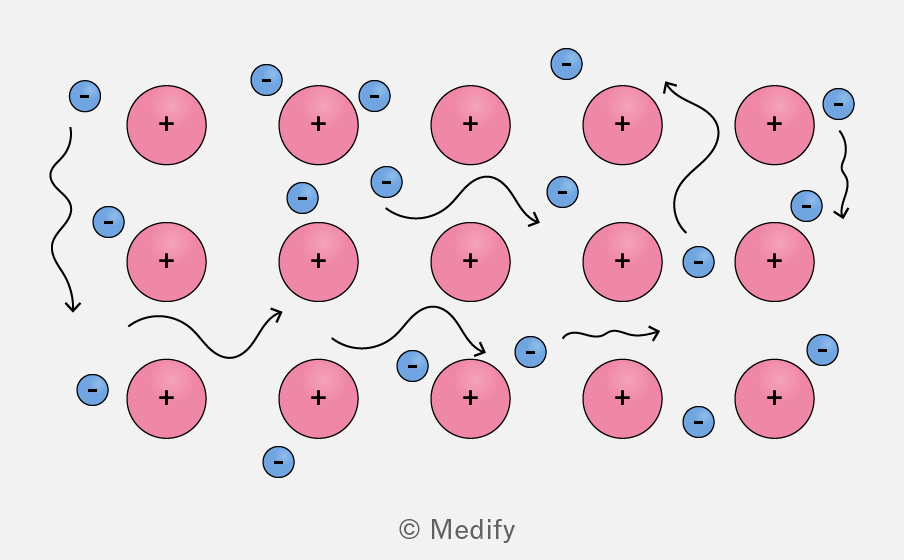
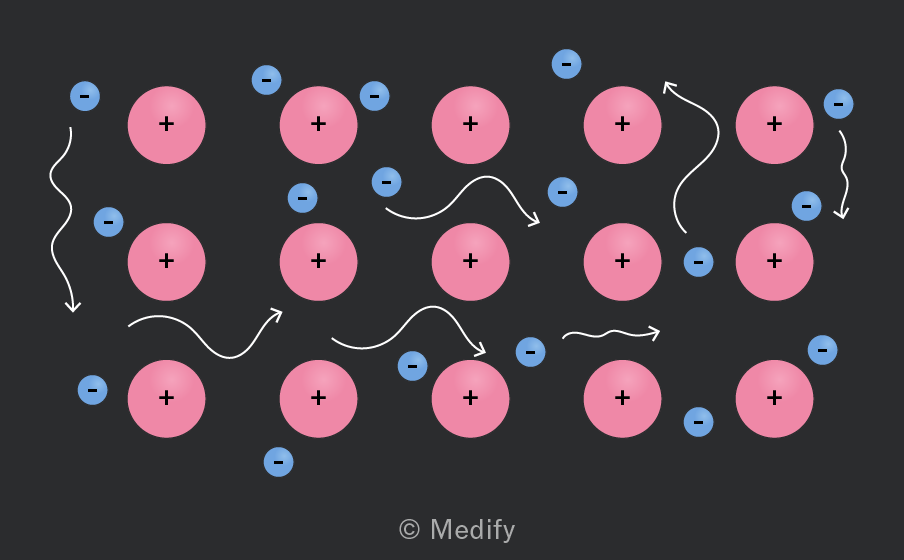
The cations are fixed in position; it is only the delocalised electrons which are free to move throughout the whole structure.
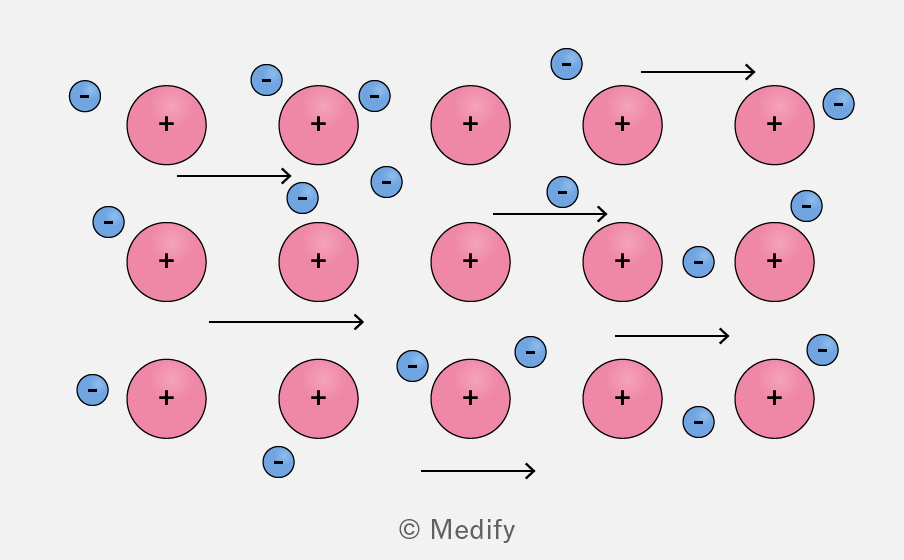
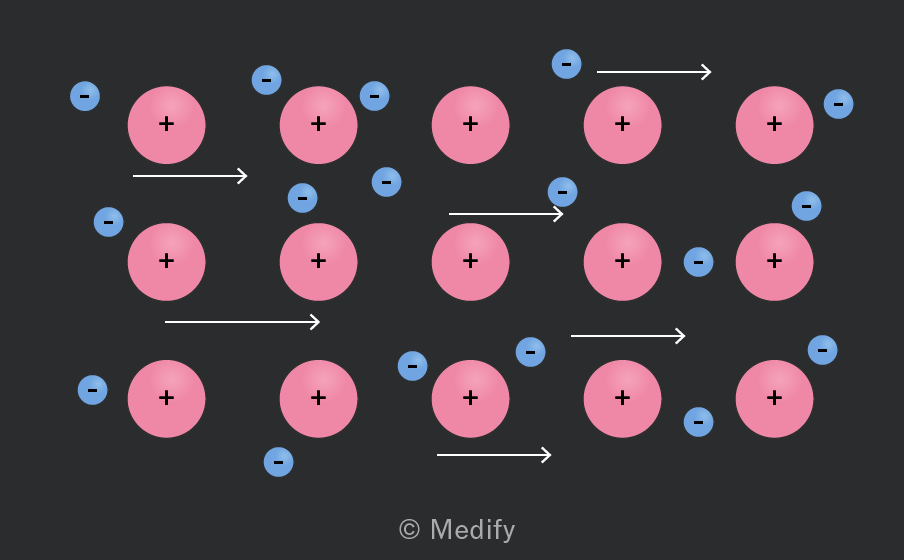
Where electrons are free to move there is electrical conductivity.
Giant metallic lattices usually have high melting points and boiling points.
This is due to the strong electrostatic forces of attraction between the positive metal ions and delocalised electrons, which require a lot of energy to overcome.
The melting point of a giant metallic lattice will vary with the nature of the cation formed.
Larger cations with lower charges will exhibit weaker electrostatic attraction and a lower boiling point.
Metals can conduct electricity, even when solid, due to the delocalised electrons, which are free to move throughout the giant metallic lattice and carry charge.
Metals are insoluble.
There are interactions between polar solvents and metals. However, this leads to chemical reactions rather than dissolution.