
Chemical equilibrium (3.2.3)
On this page
Dynamic equilibrium occurs in a closed system, containing a reversible reaction, when the rate of the forward reaction is equal to the rate of reverse reaction.
A closed system is described as one where energy can be exchanged with the environment but matter cannot.
When a reversible reaction reaches dynamic equilibrium, both reactions still progress, but the observed concentrations of reactants and products do not change.
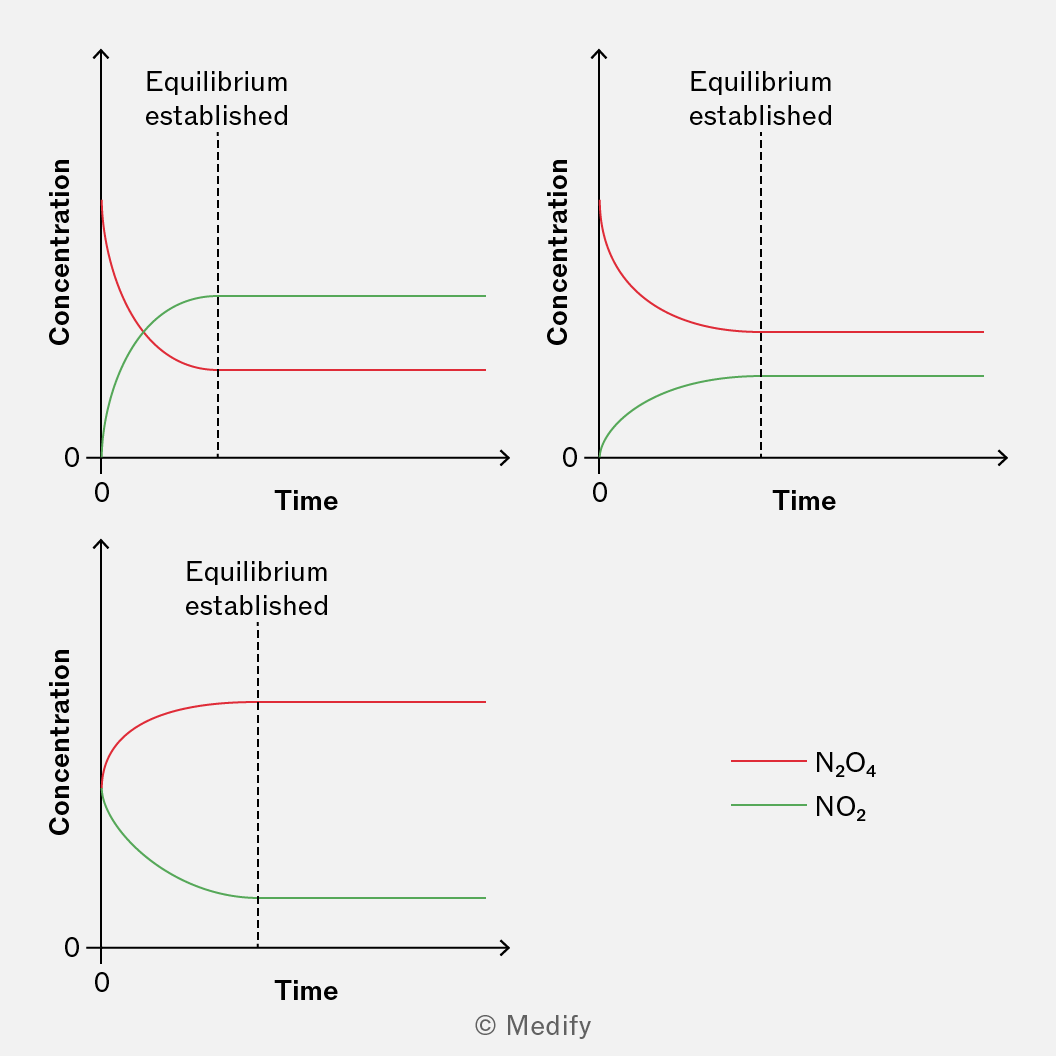
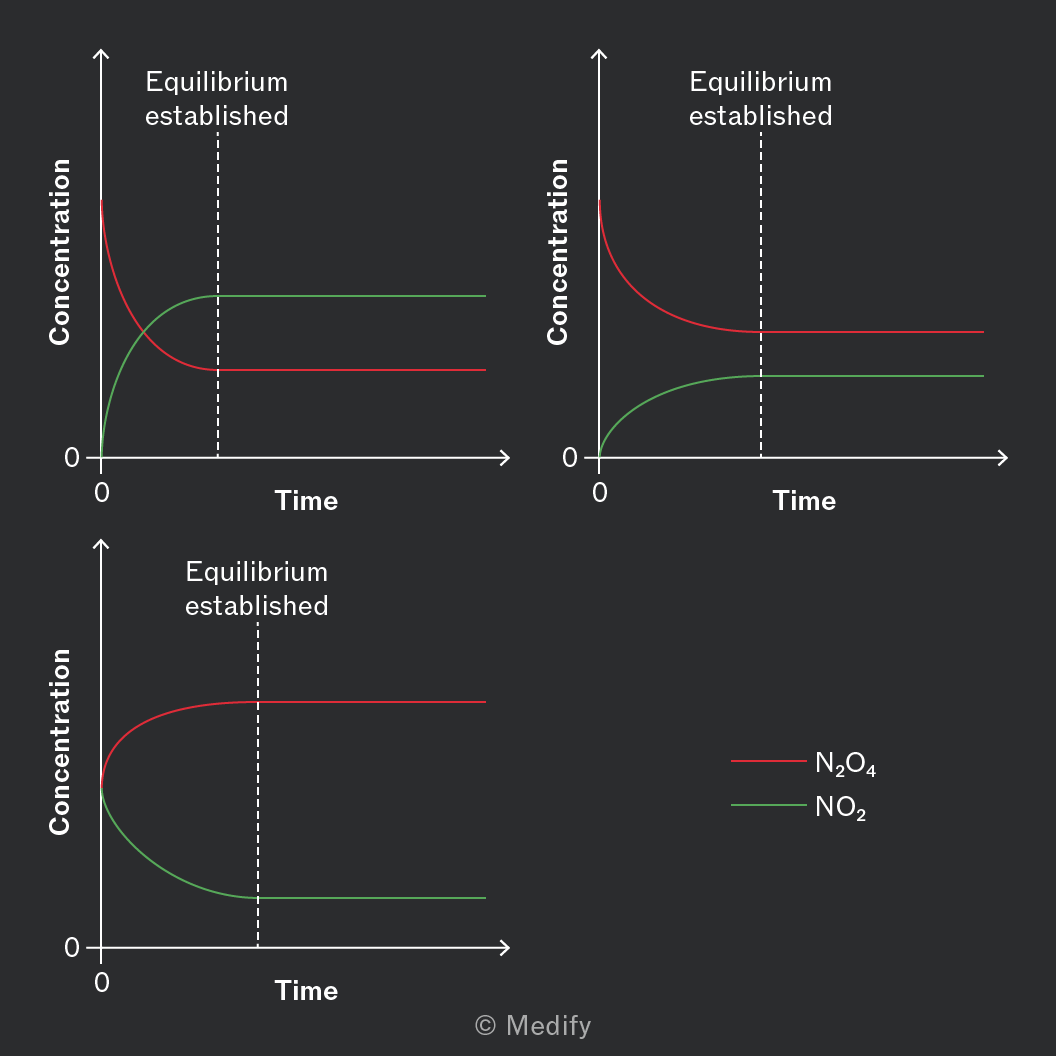
The time taken to reach dynamic equilibrium can be identified by monitoring concentration over time and highlighting when the gradient becomes zero.
Le Chatelier’s principles describe the qualitative effect of changing the reaction conditions on the position of dynamic equilibrium.
If equilibrium is disturbed by changing conditions, the position of equilibrium will adjust to counteract the change.
Increasing temperature favours the endothemic reaction.
Increasing temperature increases the rate of all chemical reactions by increasing the energy of the particles in the system and therefore the frequency of effective collisions.
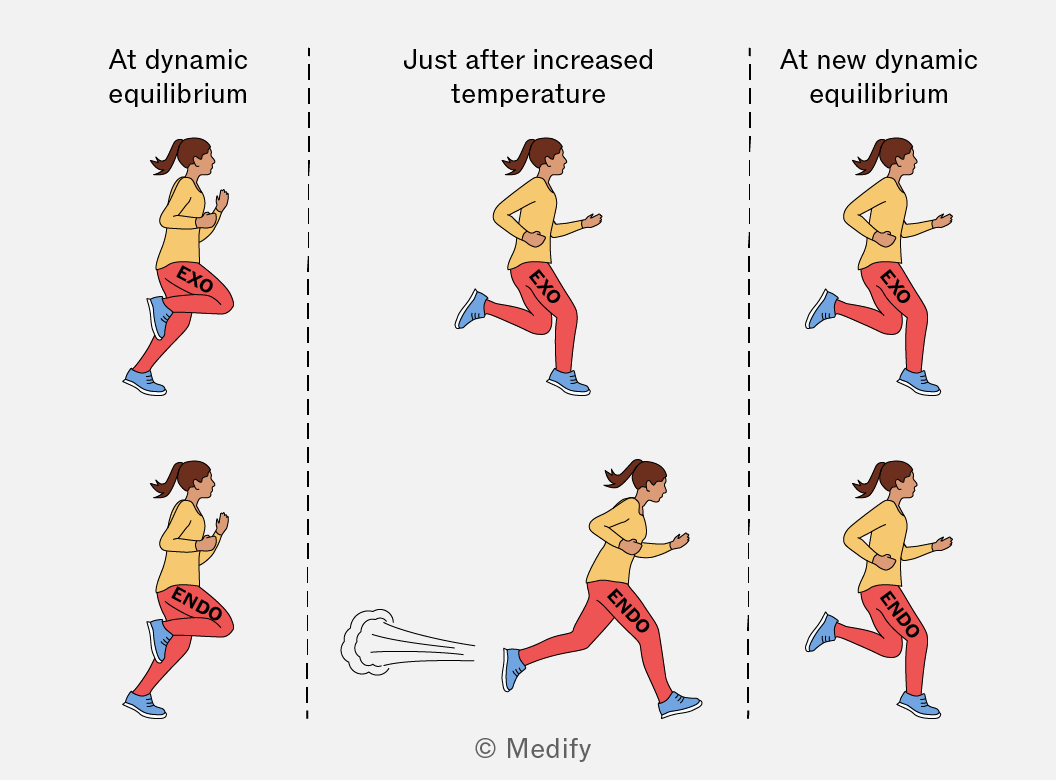
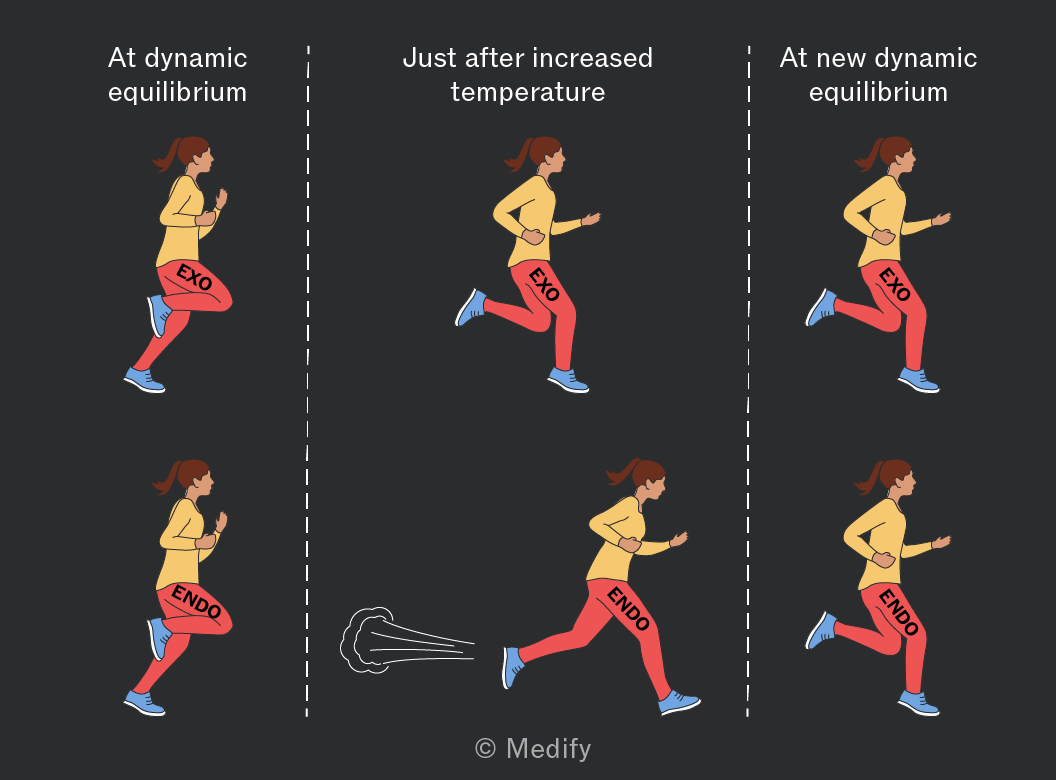
The impact of increasing temperature has a greater impact on an endothermic reaction’s rate constant than on an exothermic reaction’s rate constant.
The equilibrium shifts to favour the products of the endothermic reaction until the concentrations on the exothermic side are high enough for the rates to become equal again.
Increasing pressure favours the reaction with fewer gaseous moles of products.
Increasing pressure increases the rate of all chemical reactions by increasing the number of reactant particles within a given volume in the system, and therefore the frequency of effective collisions.
The impact of increasing pressure has a greater initial impact on reactions with a higher number of reactant molecules; the overall concentration increase as used in the rate equation is increased more.
As a result, equilibrium shifts towards the side with fewer gaseous molecules until the rate of the forward and backward reactions becomes equal.
If there is an equal number of gaseous molecules on either side of the reversible reaction, increasing or decreasing the pressure will have no effect on the position of equilibrium.
The rate of reaction will increase equally in both directions; the system will remain in dynamic equilibria.
Increasing concentration of any reactant involved in the rate equation will cause an increase in the rate of that reaction and cause the position of equilibria to shift towards the products.
Catalysts increase the rate at which equilibrium is established but do not change the position of equilibria.
Catalysts increase the rate of reaction by providing an alternative reaction pathway with a lower activation energy.
As they increase the rate of both the forward and reverse reactions equally, the presence of a catalyst does not affect the position of equilibrium or the value of the equilibrium constant. Catalysts simply allow the system to reach equilibrium faster.
The Haber process produces ammonia, primarily for fertilisers. As a reversible reaction, it reaches dynamic equilibrium, so conditions must be optimised to maximise ammonia yield:
Ideal conditions for maximum yield
- Reactant concentration is increased through continual addition of nitrogen and hydrogen, while the product, ammonia, is removed as it is produced.
- . Low temperature favours the exothermic reaction, increasing ammonia yield. Temperature cannot be too low or the rate of reaction would be too slow.
- . High pressure favours the side with fewer moles (ammonia), also increasing yield.
- Iron catalyst increases the rate of the process without impacting yield.
The equilibrium constant, , is the reaction quotient at equilibria, and represents the ratio of the concentrations of products to reactants at equilibrium, in homogeneous reactions.
, , , denote the concentrations of the respective substances at equilibrium, and , , , are the stoichiometric coefficients of the balanced equation.
Heterogeneous equilibria involve reactants and products in different phases.
In these equilibria, the concentration of pure solids and liquids are considered constant and therefore not included in the equilibrium expressions.
For this heterogeneous system, the equilibrium constant, Kc, is given by:
Where:
- and are the concentrations of each species in
- and are the stoichiometric coefficients from the balanced chemical equation.
and are solids and do not appear in the expression.
Calculate by inputting the equilibrium concentrations of each species into the expression for .
Determine units for by inserting the unit for concentration into the expression and applying the laws of indices.
The magnitude of can be used to estimate the position of equilibrium:
If the value for is the position of equilibrium is shifted over to the right-hand side, towards the products.
If the value for is the position of equilibrium is shifted to the left-hand side, towards the reactants.
An ICE (Initial, Change, Equilibrium) table is useful for establishing equilibrium concentrations.
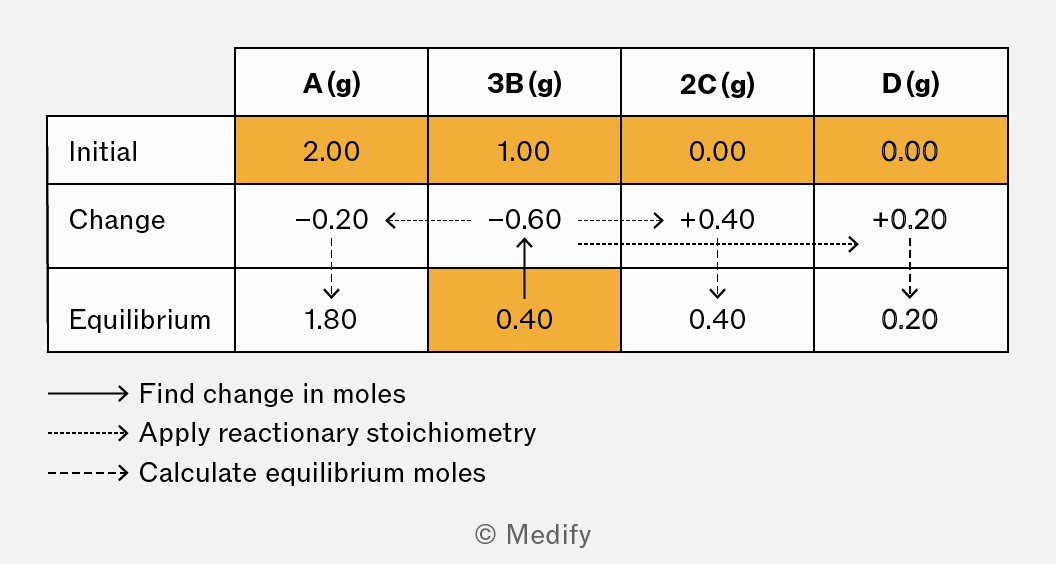
1. Write the balanced chemical equation: This will help determine the stoichiometric relationships between the reactants and products.
2. Set up an ICE table: Add any data you have for the initial moles, changes in moles, and equilibrium moles of the reactants and products.
3. Apply the reaction stoichiometry to the change in moles.
Remember all the data in an ICE table is in moles; you may need to convert between moles and concentration or partial pressure.