Biological molecules (3.1)›Lipids (3.1.3)

Lipids (3.1.3)

An overview of lipids (3.1.3) from AQA A level Biology including: triglycerides, phospholipids and how to test for the presence of lipids
5 min

Triglycerides are non-polar, hydrophobic molecules consisting of one glycerol molecule (an alcohol) and three fatty acid chains. They are the main components of fats and oils and are insoluble in water, but soluble in organic solvents, e.g., ethanol.

Fatty acids have a methyl group () at one end of a hydrocarbon chain (R group) and a carboxyl group () at the other end.
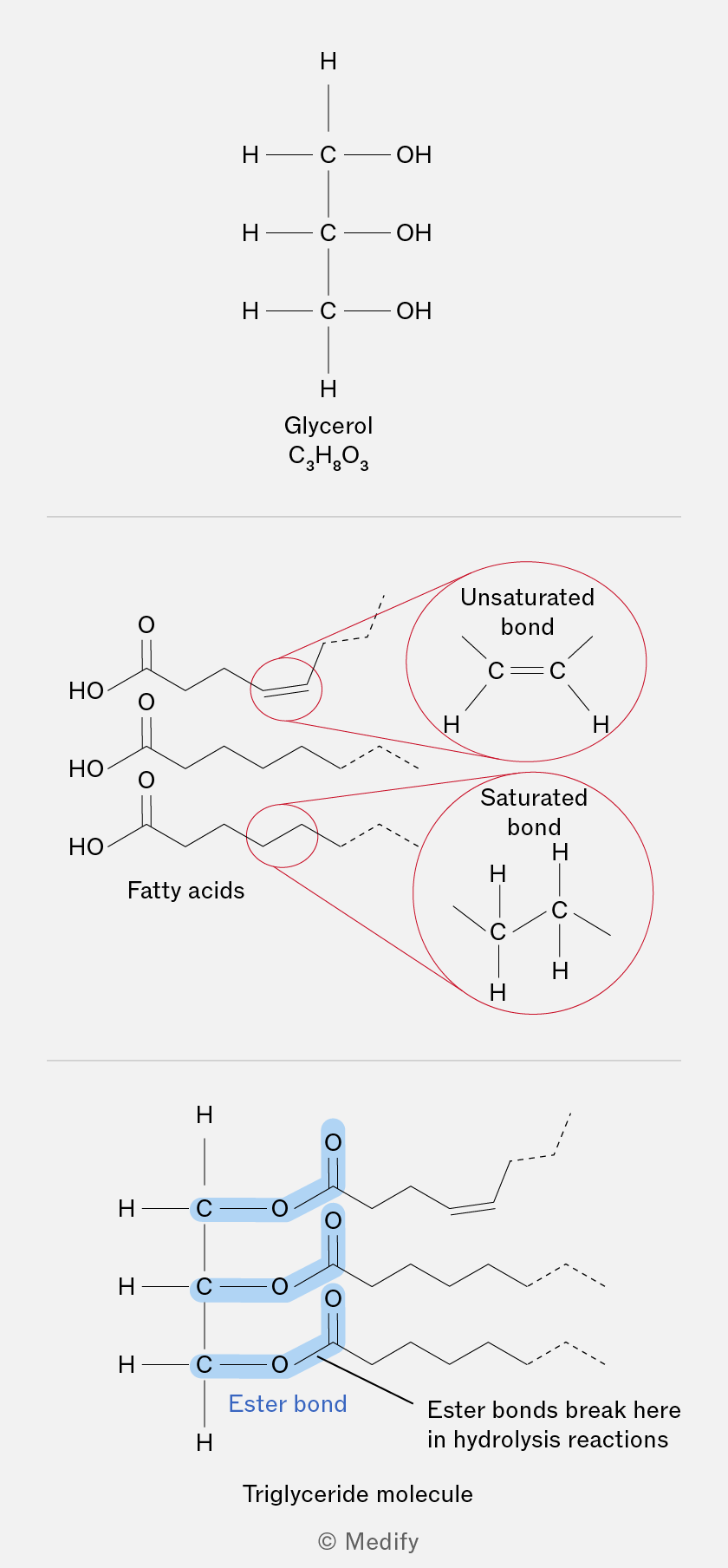
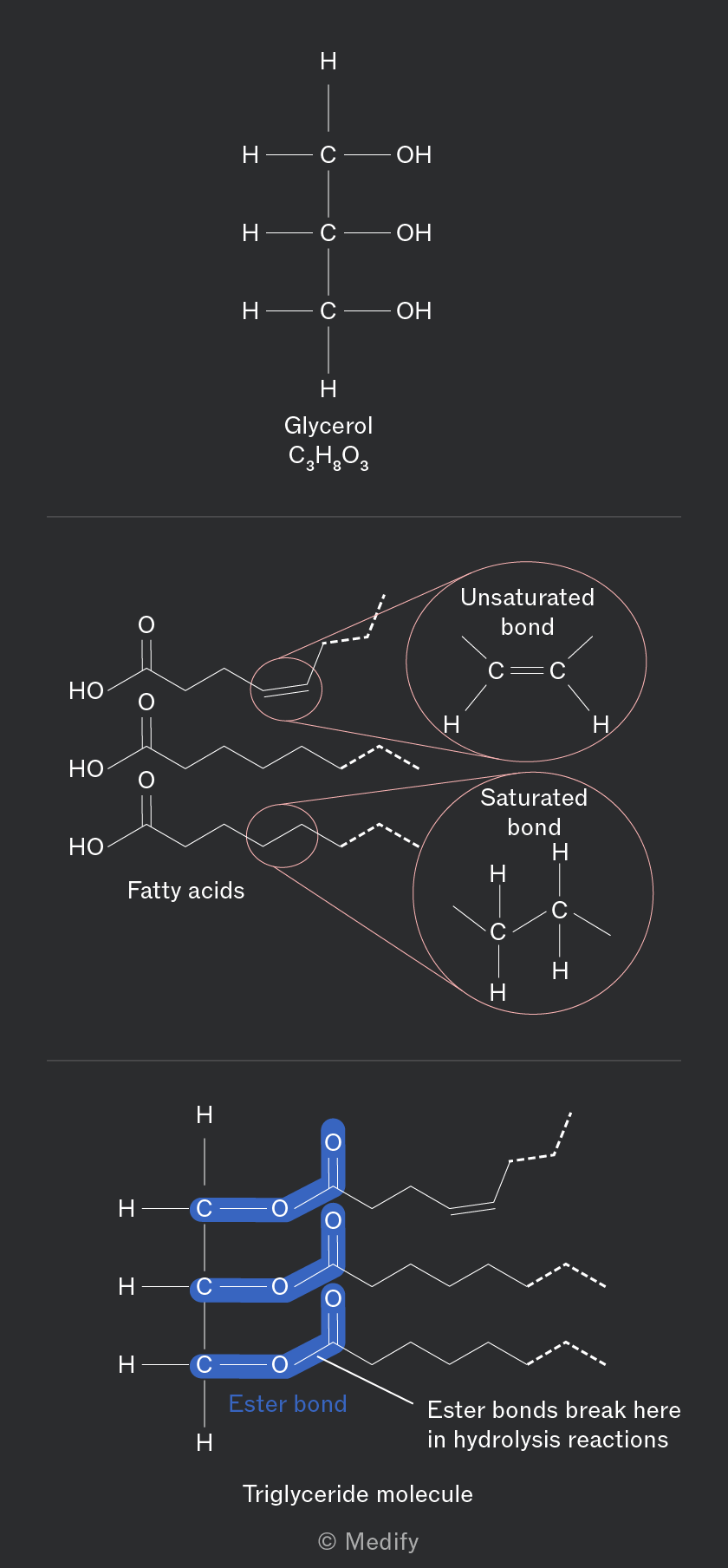
The image is divided into three sections. The top section shows the structure of glycerol with three carbon atoms each bonded to a hydroxyl group (OH) and hydrogen atoms, labeled as 'Glycerol C3H8O3'. The middle section depicts fatty acids with two zoomed-in circles showing an unsaturated bond (C=C) labeled 'Unsaturated bond', and a saturated bond (C-C) labeled 'Saturated bond'. The bottom section illustrates a triglyceride molecule where three fatty acid chains are connected to a glycerol backbone, highlighting 'Ester bond' in blue. The text 'Ester bonds break here in hydrolysis reactions' is annotated next to the ester bonds, and below is the label 'Triglyceride molecule'.
Add to favourites

Triglycerides contain a high ratio of hydrogen:oxygen atoms, which means that they release water when oxidised. This is called metabolic water and can be a source of hydration, especially for animals living in arid environments.

Triglycerides are a source of energy owing to the high number of bonds which store energy.

Add to favourites

Triglycerides are formed through a condensation reaction where each hydroxyl group () of glycerol reacts with a carboxyl group () of a fatty acid to form an ester bond.

Three fatty acids are attached to one glycerol molecule, three water molecules are released per triglyceride formed.

Ester bonds are broken during the digestion of the triglyceride molecule through hydrolysis reactions consuming three water molecules per triglyceride hydrolysed.
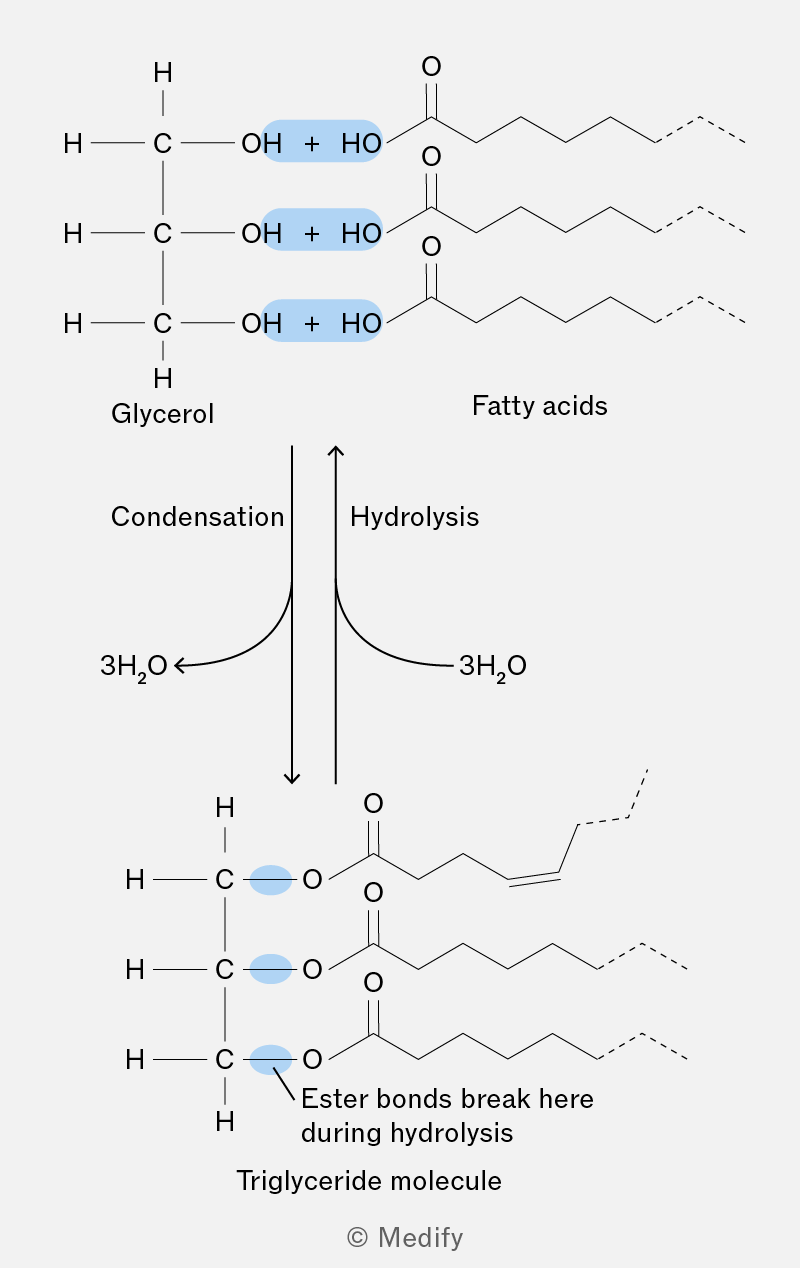
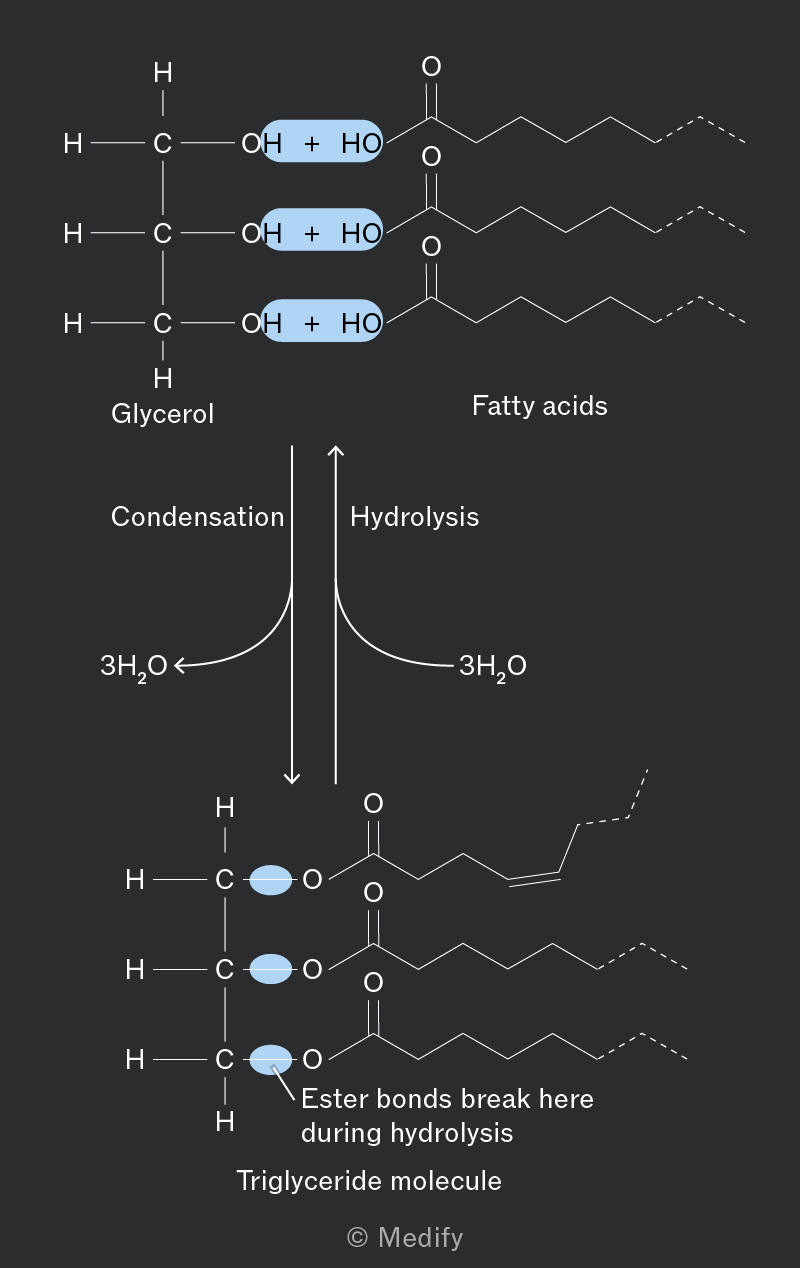
The image shows a chemical diagram illustrating the formation and breakdown of a triglyceride molecule. At the top, there are structures labeled 'Glycerol' and 'Fatty acids'. Glycerol is depicted with three hydroxyl (OH) groups, each paired with a plus sign and a hydroxyl group (HO) from the fatty acids, highlighted in blue. To the right, fatty acids are shown with long hydrocarbon chains and carboxyl groups (C=O). Below this, arrows labeled 'Condensation' and 'Hydrolysis' point downwards and upwards, respectively, with '3H2O' indicated for both processes. The bottom section shows a triglyceride molecule, where the glycerol and fatty acids are connected by ester bonds, highlighted in blue. An annotation states 'Ester bonds break here during hydrolysis'. The molecule is labeled 'Triglyceride molecule'.
Add to favourites

Fatty acids can differ in hydrocarbon chain length (R group) and in their saturation.

Saturated fatty acids have no double bonds. They form a straighter structure and pack tightly together, resulting in higher melting points and being in a solid state at room temperature. They are primarily found in animal fats.

Unsaturated fatty acids contain one (monounsaturated) or more (polyunsaturated) double bonds, leading to ‘kinks’ in the hydrocarbon chains that prevent tight packing. This lowers the melting point, so they are usually liquids at room temperature. They are typically found in vegetable oils.
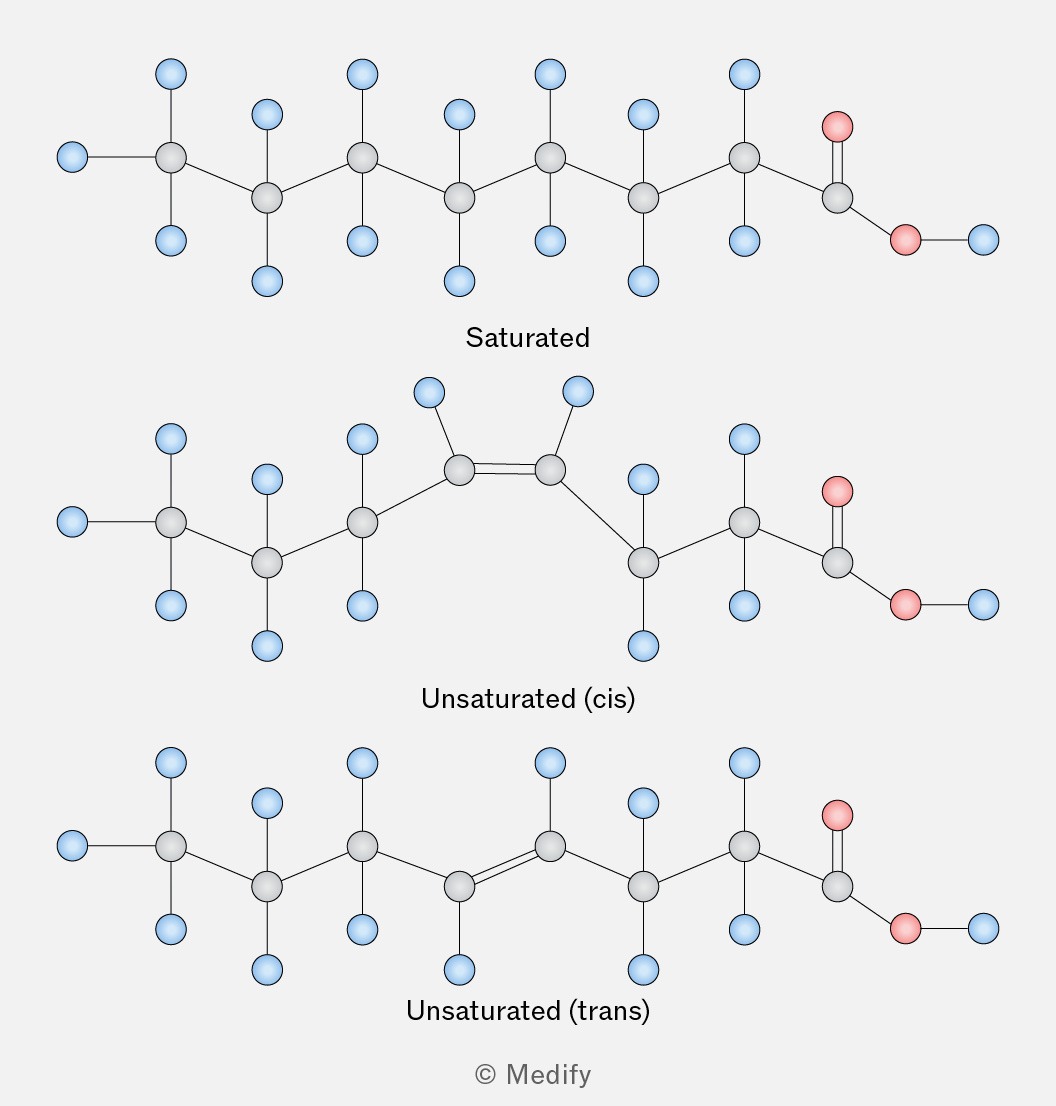
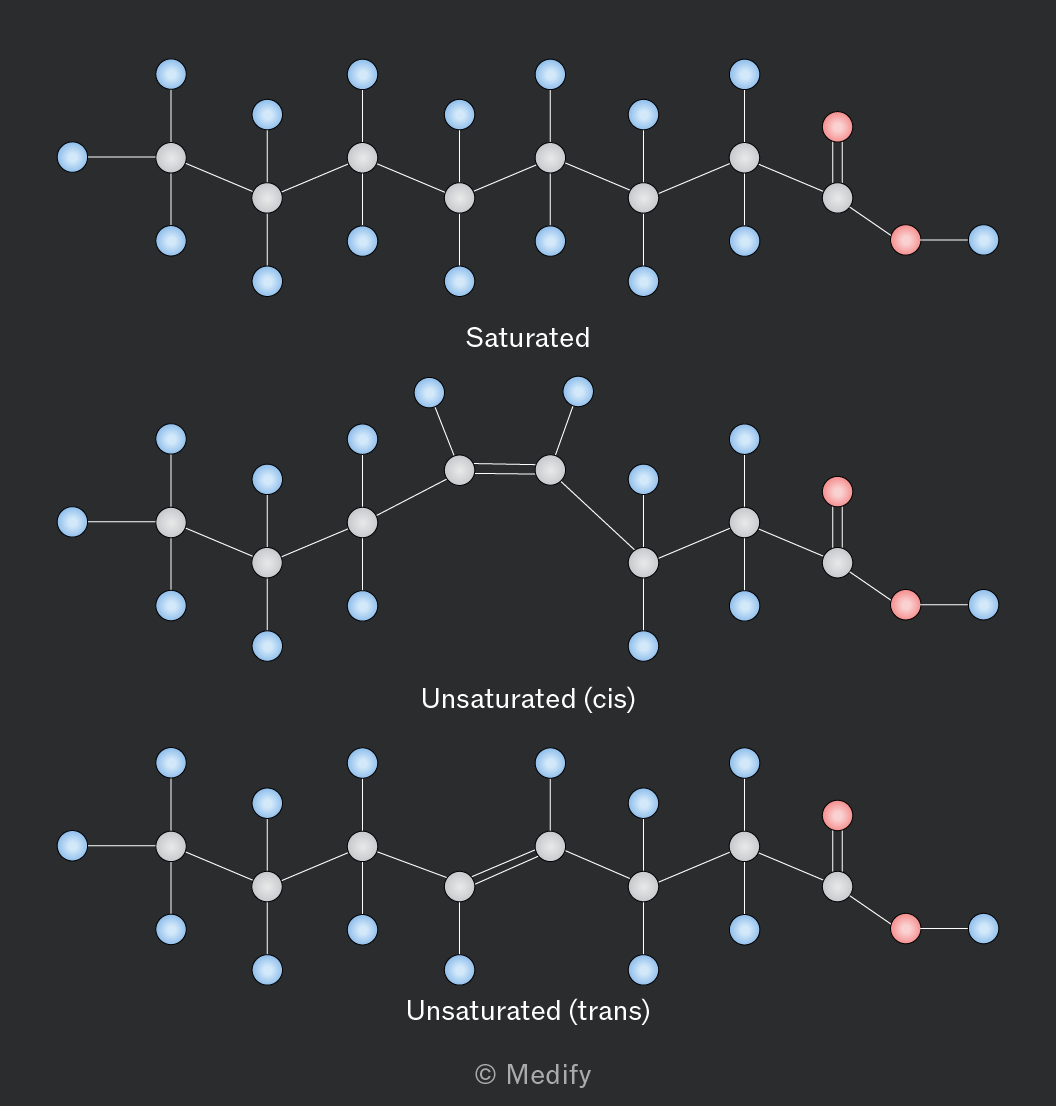
The image shows three chemical structures labeled as 'Saturated,' 'Unsaturated (cis),' and 'Unsaturated (trans).' The 'Saturated' structure is a linear chain of carbon atoms with single bonds, featuring hydrogen atoms (blue) and a carboxyl group (red) at one end. The 'Unsaturated (cis)' structure has a similar chain with one double bond creating a kink in the chain. The 'Unsaturated (trans)' structure also has a double bond but maintains a straighter chain due to the trans configuration. Each structure has labeled carbon and hydrogen atoms and a carboxyl group in red at the end.
Add to favourites

Phospholipids are essential components of cell membranes.

The structure of phospholipids is similar to triglycerides: glycerol plus two fatty acid chains and one phosphate. This results in a hydrophilic polar ‘head’ and two hydrophobic fatty acid ‘tails’.
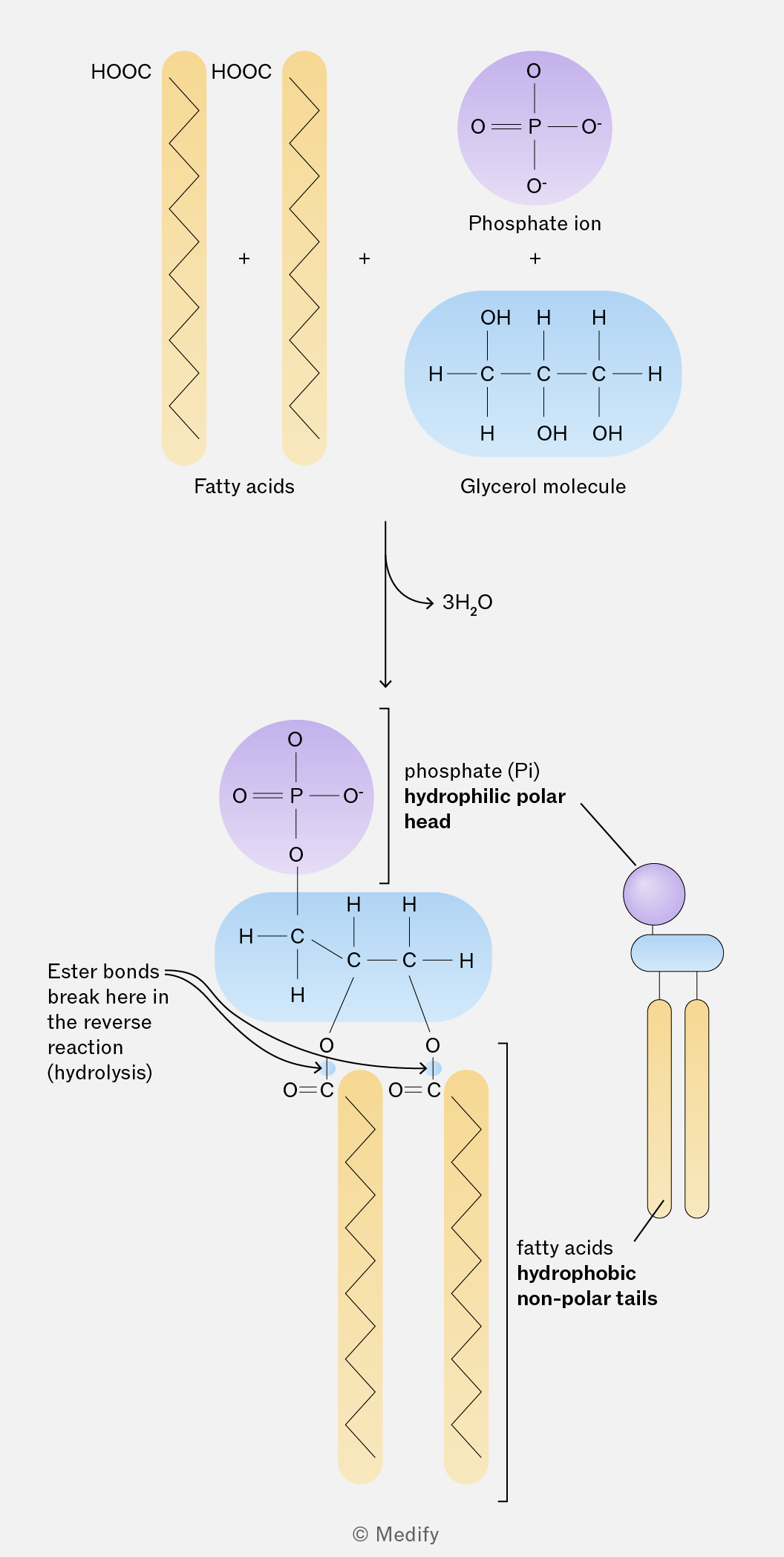
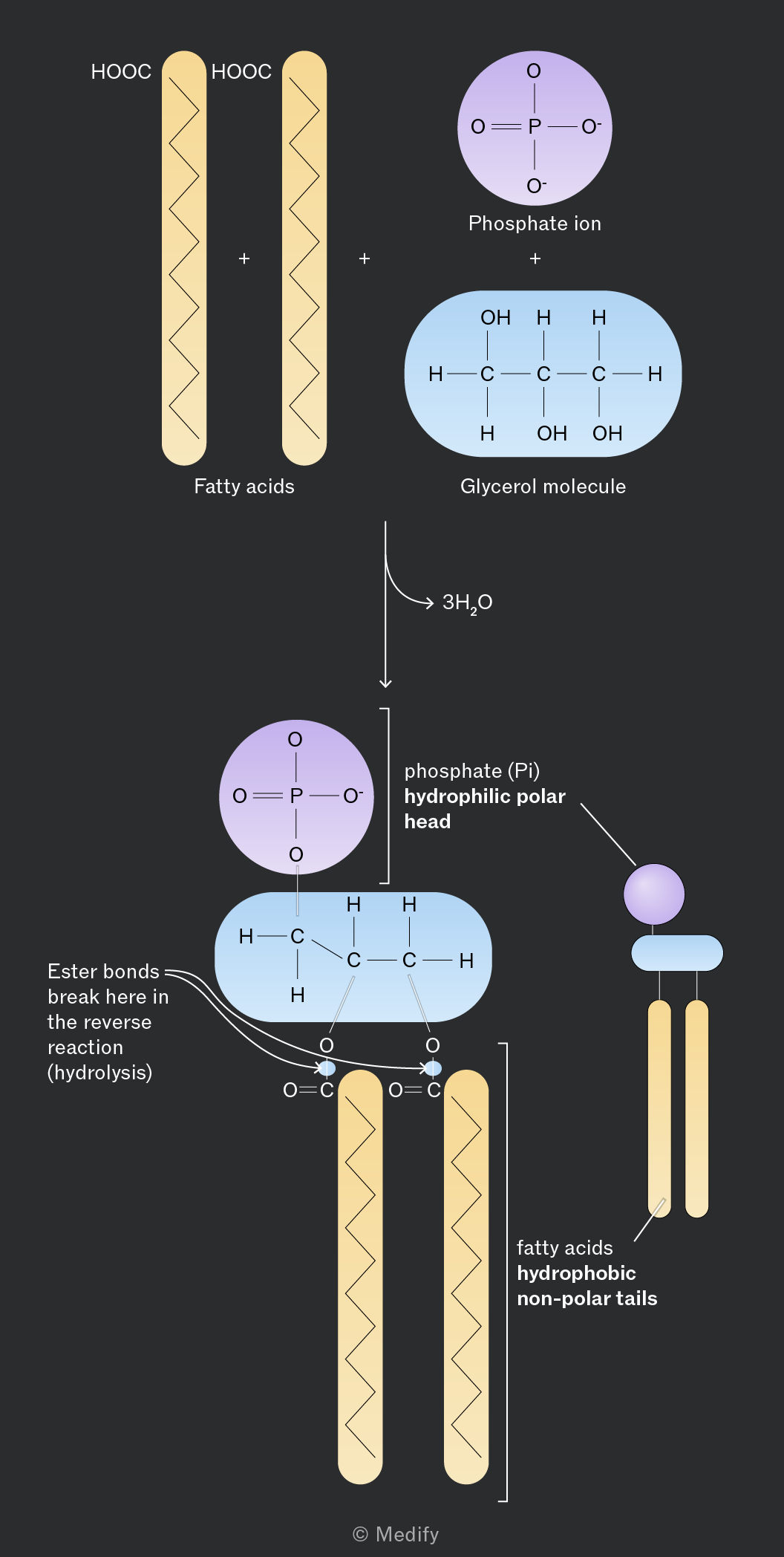
The image illustrates the formation of a phospholipid from fatty acids, a glycerol molecule, and a phosphate ion. On the left, two vertical yellow zigzag lines represent fatty acids labeled 'HOOC' at the top. To the right, a purple circle represents a phosphate ion with 'O', 'O-', and a double-bonded 'O' connected to 'P'. Below this is a blue oval representing a glycerol molecule, showing three carbon atoms bonded to hydroxyl groups ('OH') and hydrogen atoms ('H'). An arrow points downward to a combined structure: a phosphate group linked to the glycerol backbone with fatty acid chains attached. Annotations indicate 'Ester bonds break here in the reverse reaction (hydrolysis)', 'phosphate (Pi) hydrophilic polar head', and 'fatty acids hydrophobic non-polar tails'. A side illustration shows a simplified phospholipid with a purple circle head and two yellow tails. The reaction shows the release of '3H2O'.
Add to favourites

Phospholipids are amphipathic. In aqueous environments, phospholipids spontaneously arrange into a bilayer with the hydrophilic heads facing outwards, facing the surrounding water and the hydrophobic tails facing inward. This arrangement forms the basic structure of cell-surface membranes.
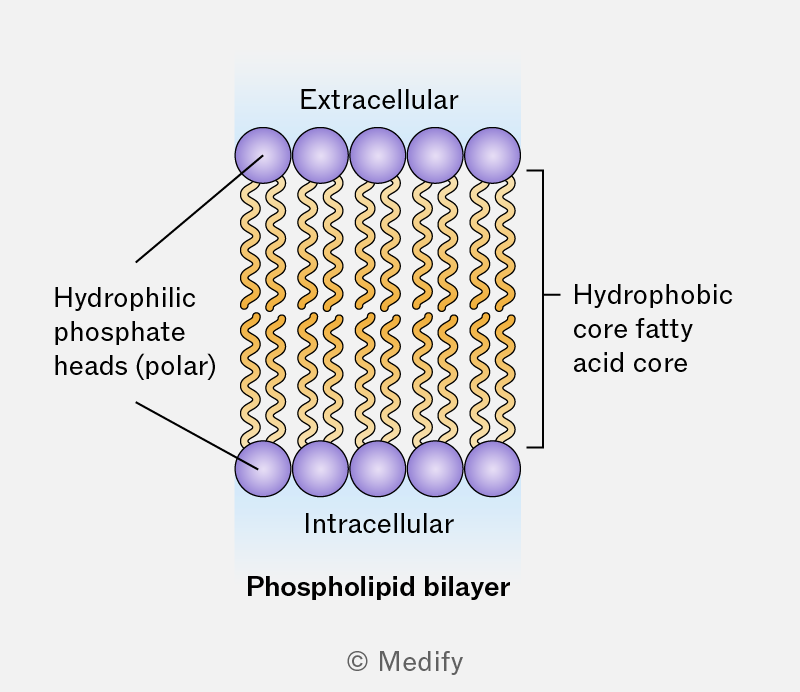
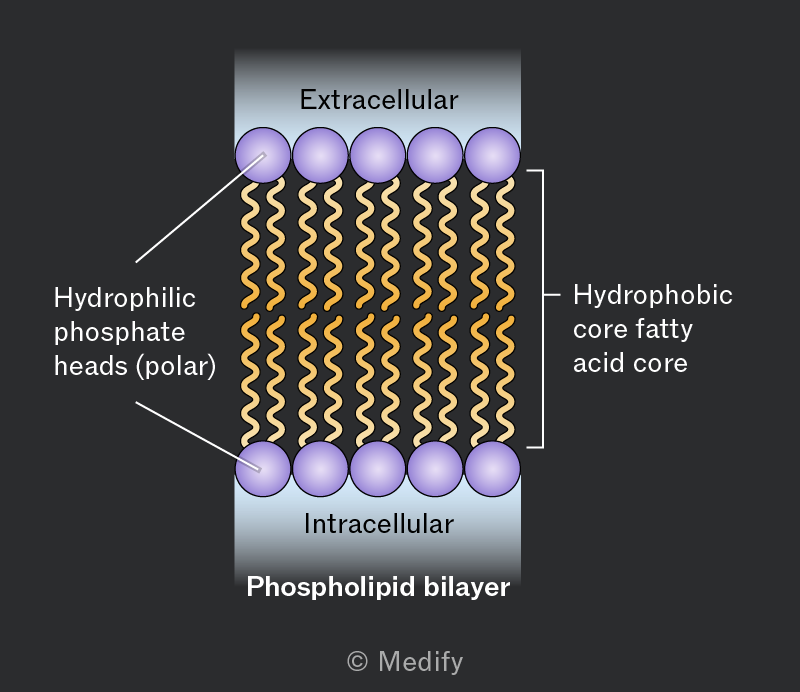
The image illustrates a phospholipid bilayer. At the top, it is labeled 'Extracellular', and at the bottom, 'Intracellular' with a light blue background. The bilayer consists of two rows of purple circles representing hydrophilic phosphate heads, labeled on the left as 'Hydrophilic phosphate heads (polar)'. The interior of the bilayer shows orange wavy lines indicating the hydrophobic core fatty acid tails, labeled on the right as 'Hydrophobic core fatty acid core'. The entire structure is labeled below as 'Phospholipid bilayer'.
Add to favourites

The phospholipid bilayer is an essential part of the cell membrane:

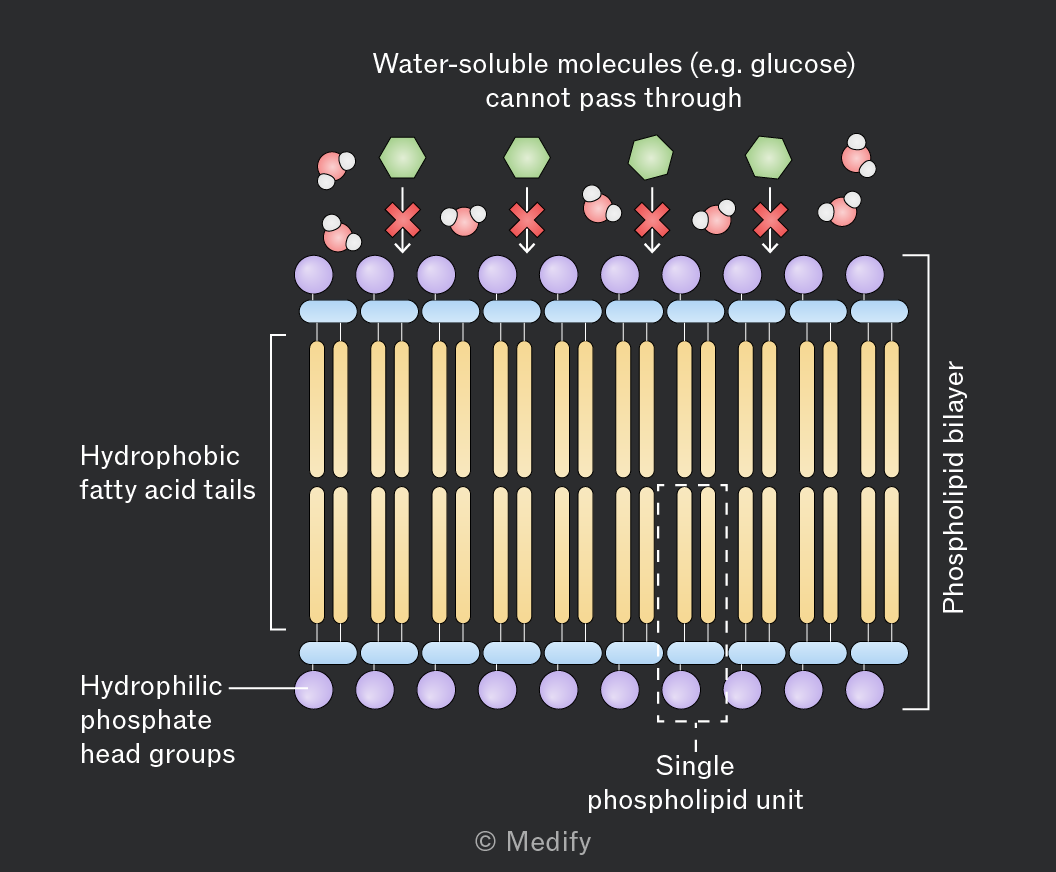
  • The bilayer has a hydrophobic core that prevents water-soluble substances from passing through easily. This enables control over substances entering and exiting the cell.
  • The hydrophilic heads form a barrier at the surface of the plasma membrane, separating the inside and outside of a cell.
  • This bilayer is flexible and can enclose parts of the cell, pinching off to form membrane–bound organelles.
  • The phospholipid head can be modified with carbohydrates, forming glycolipids which enable cell signalling.
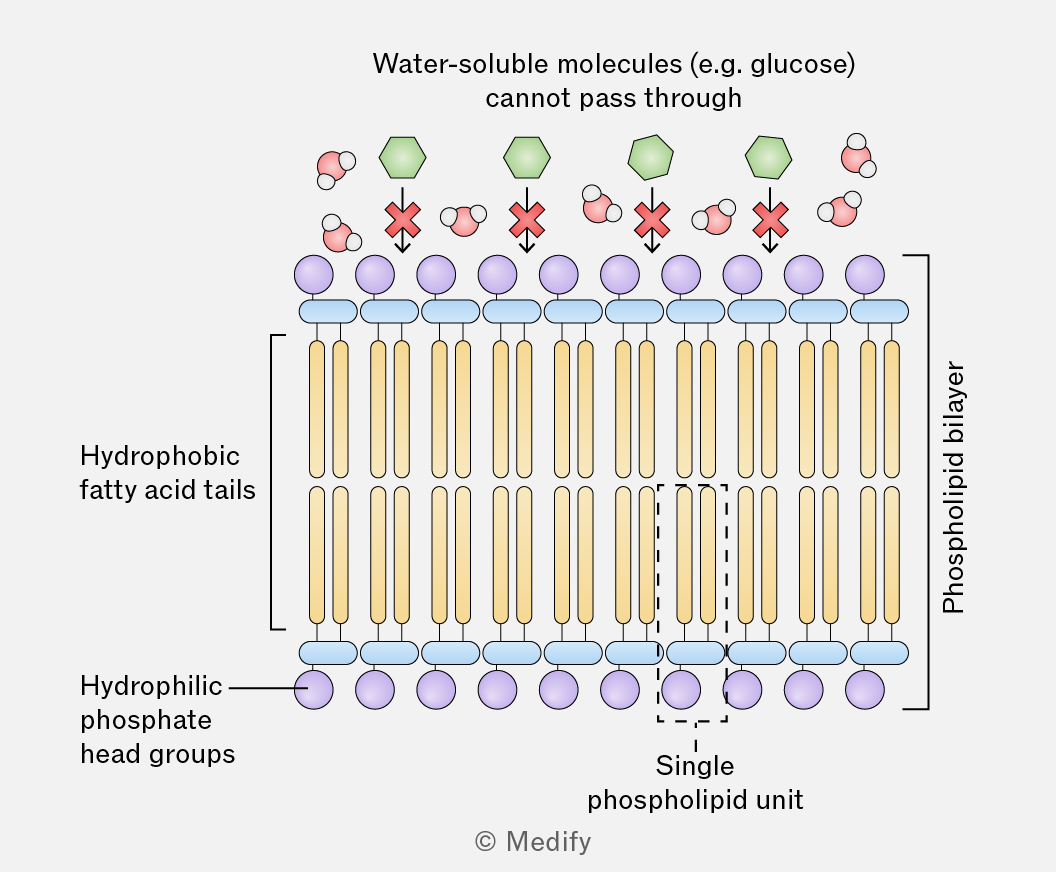
Diagram of a phospholipid bilayer. The bilayer consists of two layers of phospholipids with hydrophilic phosphate head groups labeled on the outside and hydrophobic fatty acid tails labeled on the inside. The label 'Single phospholipid unit' points to one phospholipid. Above the bilayer, there are water-soluble molecules (e.g., glucose) shown with arrows and red 'X' marks, indicating they cannot pass through. The entire structure is labeled 'Phospholipid bilayer'.
Add to favourites

The emulsion test is used to identify lipids in a sample.

Method:

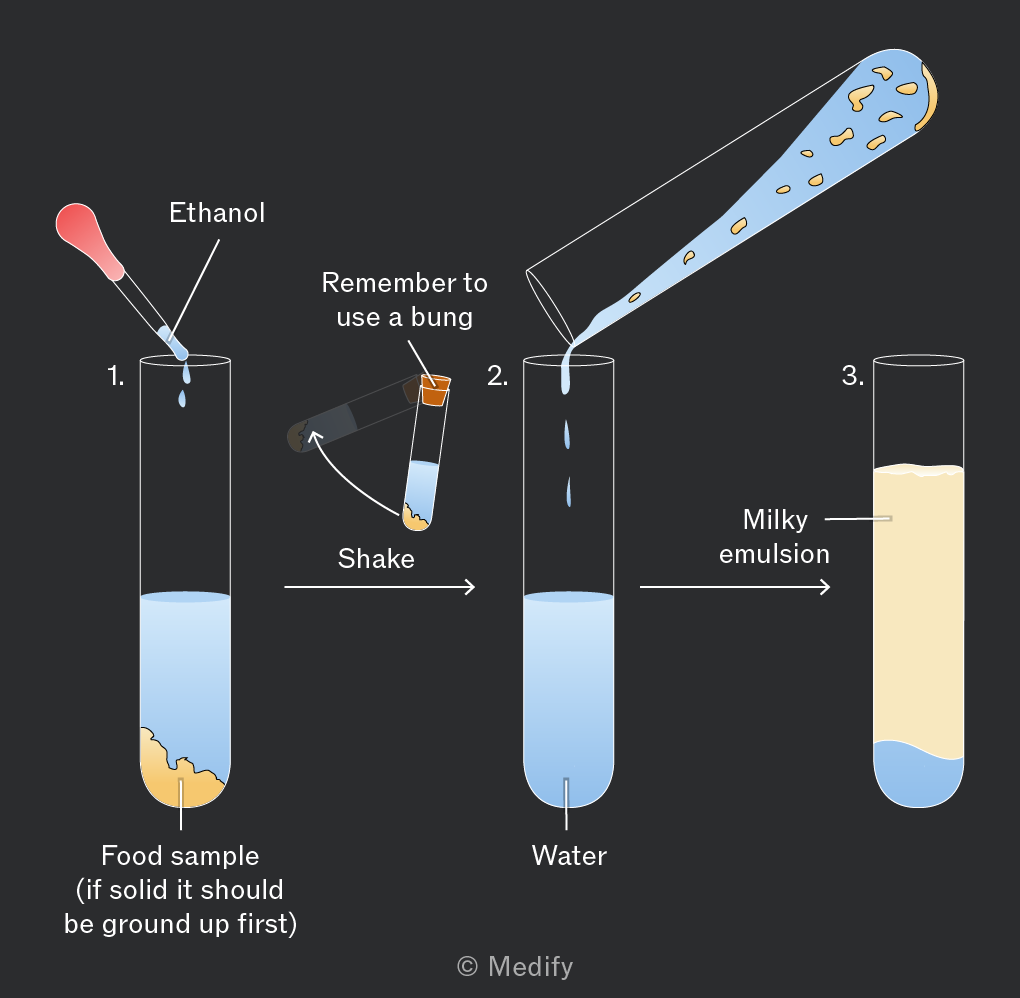
  1. Add ethanol to the sample and shake to mix.
  2. Add the mixture to a test tube containing water.

Results:

A white emulsion (cloudy appearance) indicates the presence of lipids. The more lipid present, the more pronounced the milkiness/white colour.

The emulsion test is qualitative and cannot provide concentration values.
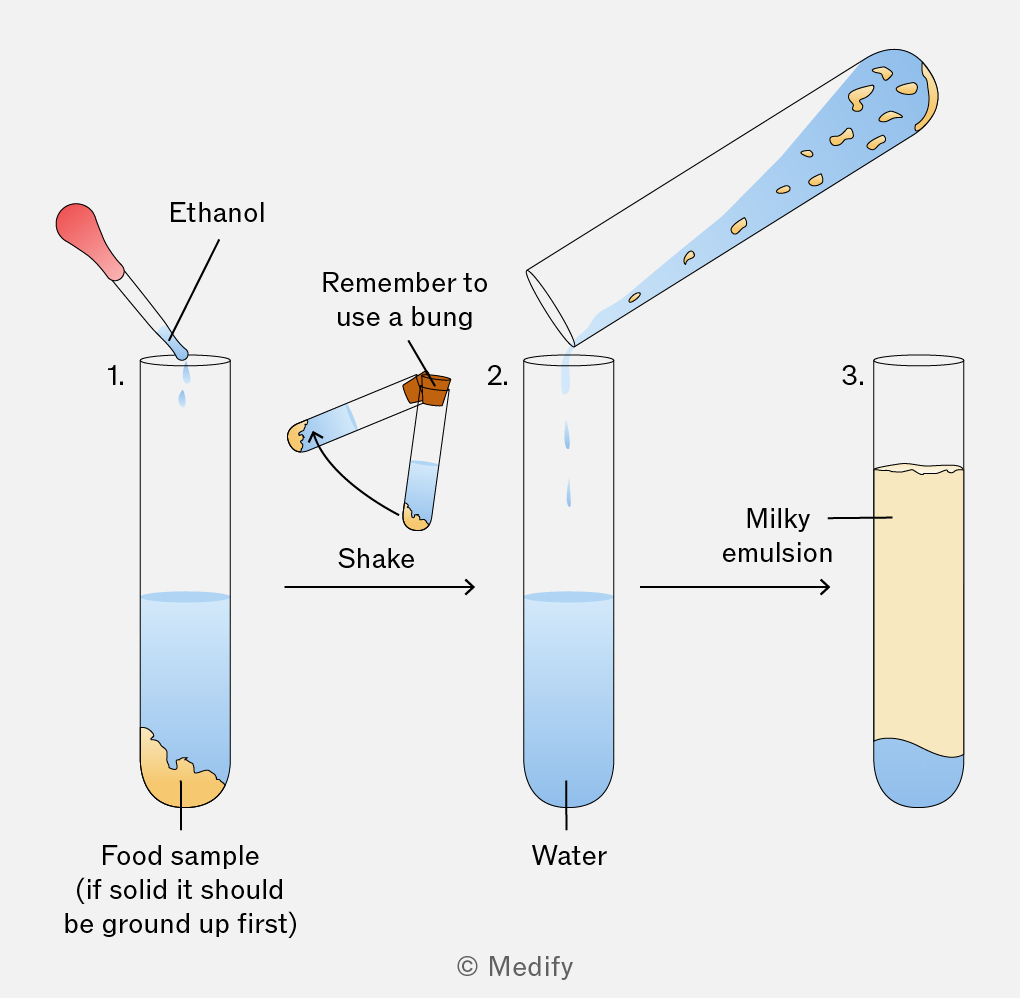
The image depicts a three-step process involving test tubes. Step 1 shows a test tube labeled '1.' containing a food sample at the bottom, with a dropper adding ethanol. Text beneath reads 'Food sample (if solid it should be ground up first)'. An arrow labeled 'Shake' points to a horizontal test tube with a bung, indicating it should be shaken. Step 2 shows a test tube labeled '2.' with water, with liquid being poured from the horizontal test tube. An arrow points to Step 3, a test tube labeled '3.' containing a milky emulsion. Text labels include 'Ethanol', 'Remember to use a bung', 'Water', and 'Milky emulsion'.
Add to favourites