
Water (3.1.7)
On this page
Water, , is a simple covalent molecule. The central oxygen shares a single covalent bond with each hydrogen.
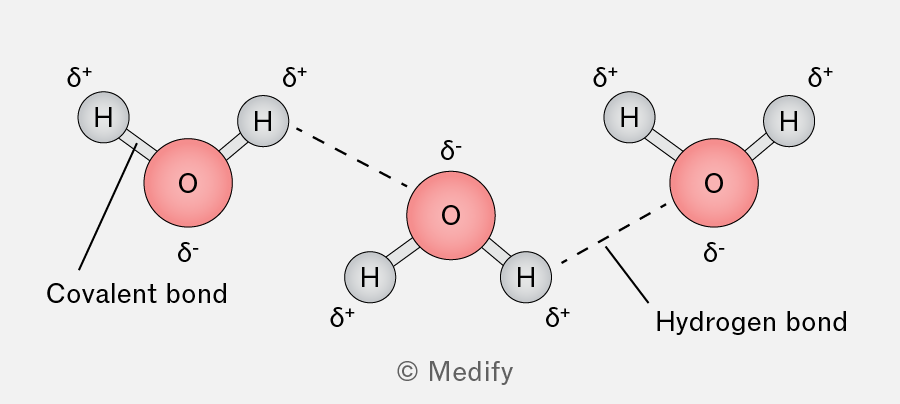
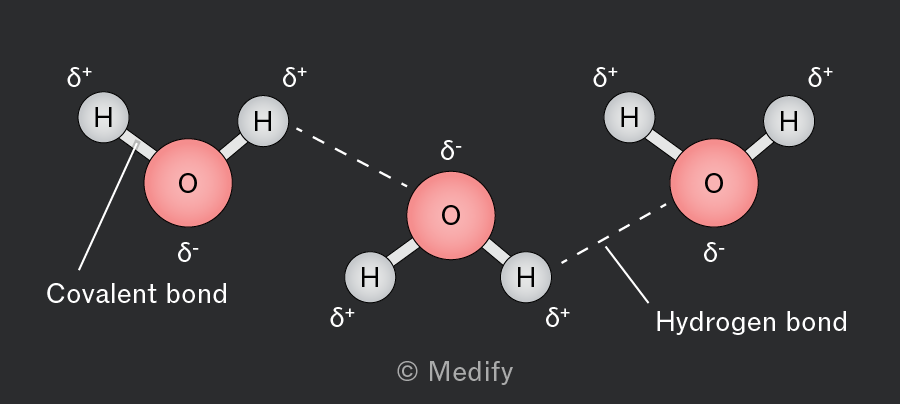
Water is polar because the oxygen atom attracts the shared electrons more strongly, meaning that it has a partial negative charge, while the hydrogen atoms are partially positive. This polarity results in water molecules interacting with each other through hydrogen bonds.
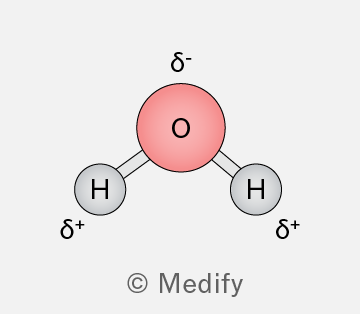
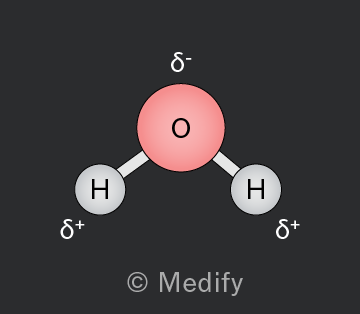
Hydrogen bonds are strong electrostatic intermolecular interactions. They form between water molecules as the partially positively charged hydrogen atom is attracted to the lone electron pair of the electronegative oxygen atom.
Hydrogen bonds are responsible for some unique properties of water, such as cohesion, adhesion, heat capacity, and surface tension.
Water is a polar molecule, so it interacts with charged species, behaving as a solvent. This property facilitates numerous metabolic reactions that occur in aqueous environments.
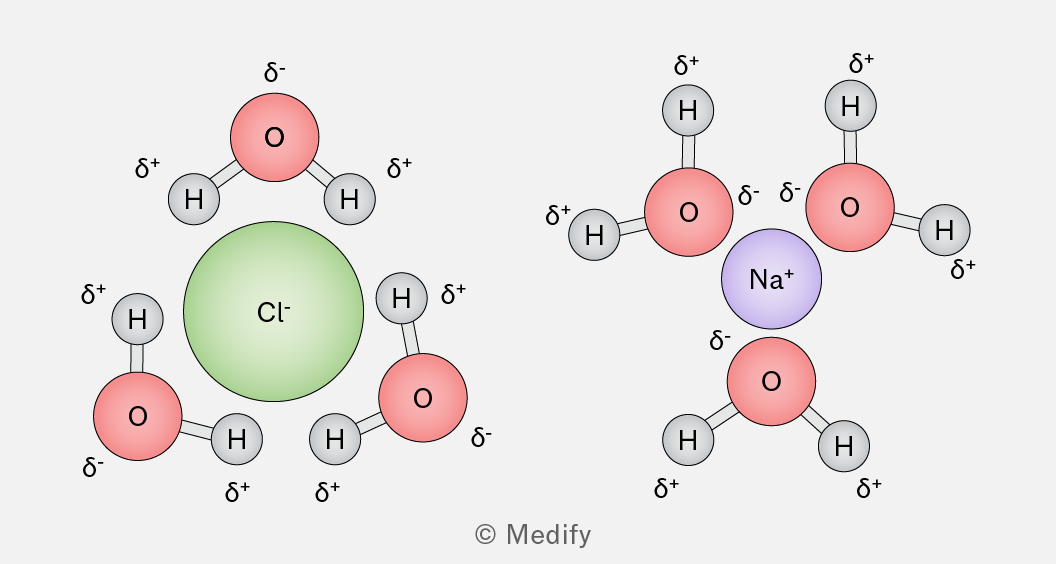
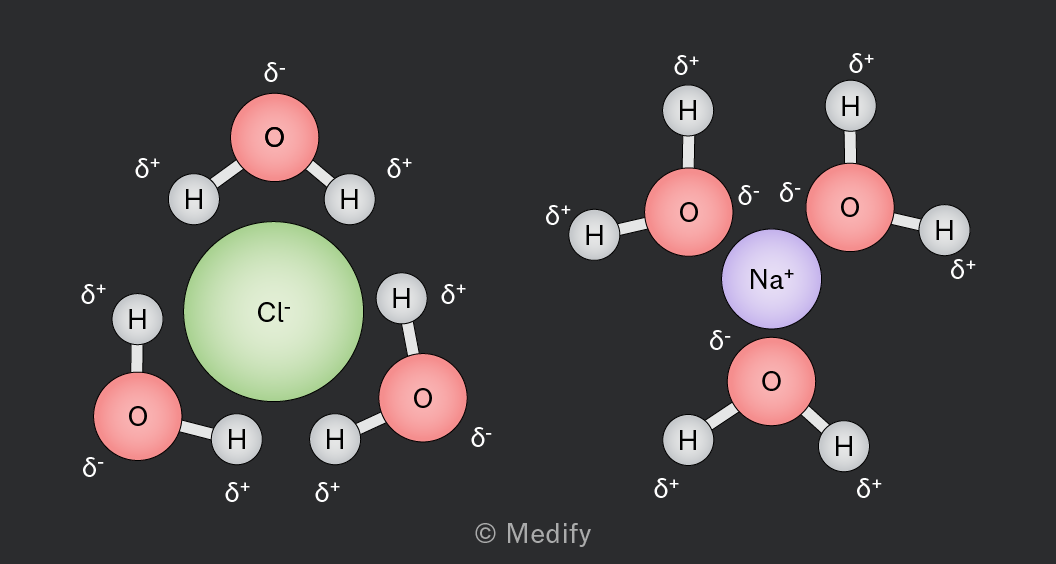
In ionic compounds such as sodium chloride, the positive ions are attracted to the partially negative oxygen of the water molecules, while ions are attracted to the partially positive hydrogens.
As water freezes, it becomes less dense as hydrogen bonds lock the molecules into a fixed crystalline structure, where there is increased spacing between molecules. This reduced density causes ice to float.
A lot of energy is needed to break the hydrogen bonds between water molecules, which means that the structure of water also results in a high boiling point.
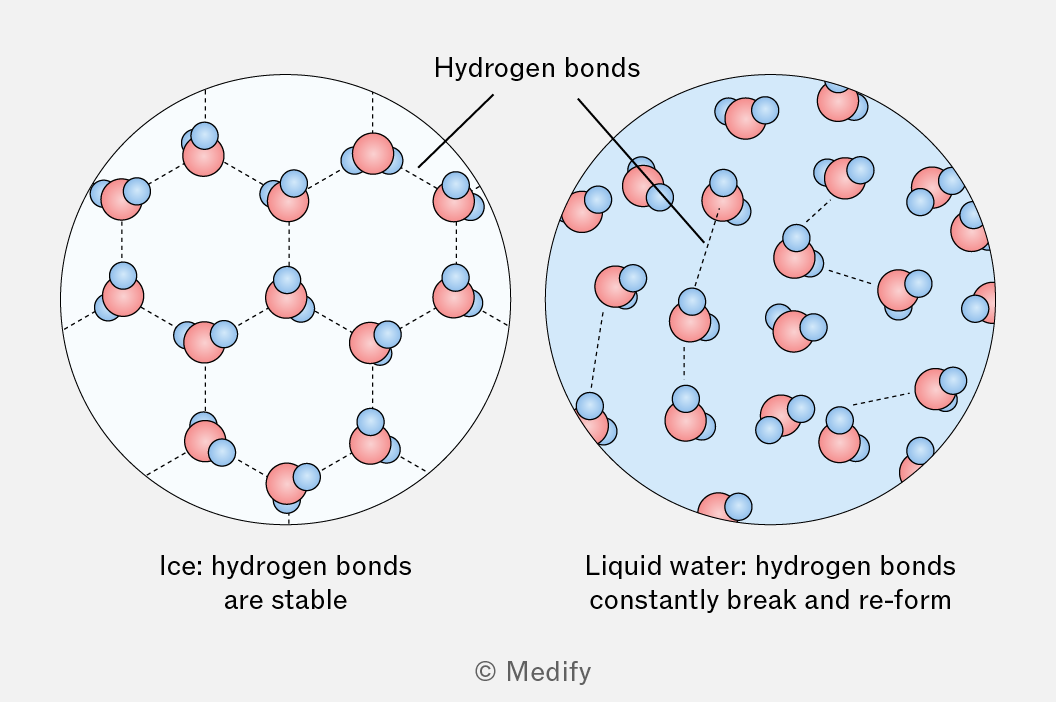
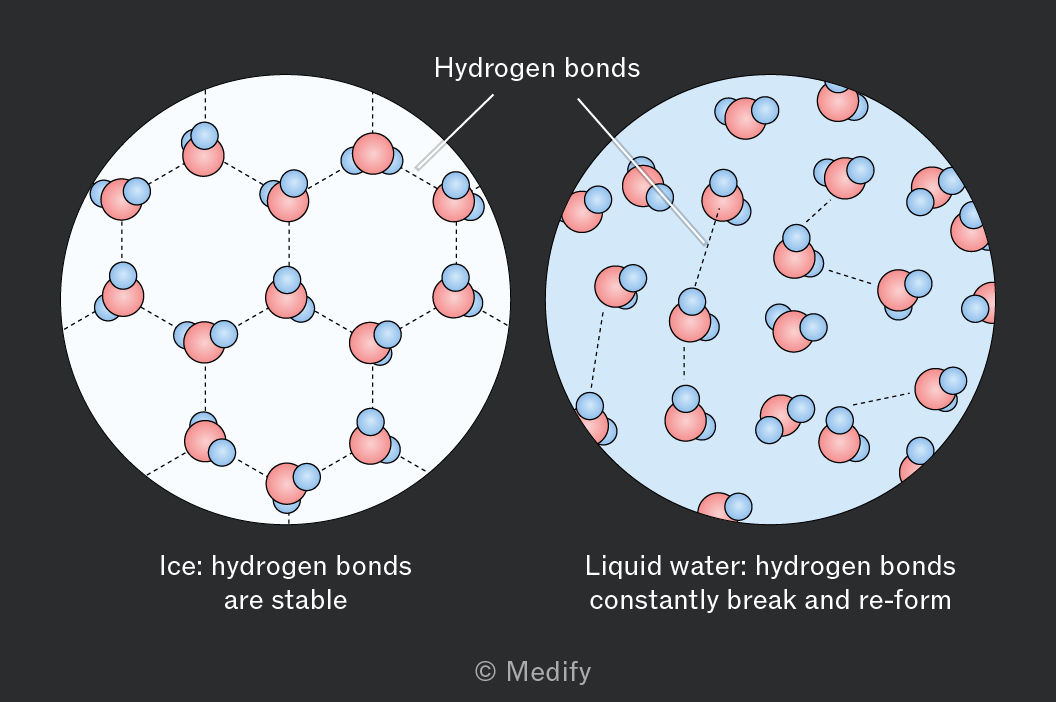
Cohesion is the attraction between molecules of the same substance. In water, hydrogen bonding causes strong cohesion, allowing water molecules to form continuous columns for transport in the xylem during transpiration.
Cohesion also contributes to water’s high surface tension, enabling small organisms to move across the water surface.
Adhesion is the attraction between molecules of different substances. In plants, water molecules adhere to the walls of xylem vessels, helping maintain a continuous column of water and aiding its movement against gravity during transpiration. Adhesion also contributes to capillary action.
Water has a high specific latent heat of vapourisation (energy required to change from liquid to gas) due to the strong hydrogen bonds between water molecules, which require substantial energy to break.
This property allows organisms to use water vapourisation as a cooling mechanism. When organisms sweat or transpire, the vaporised water molecules carry away heat, cooling the body without significant water loss.
Most organisms (but particularly small ones) require a stable temperature range to survive.
The specific heat capacity of water is the amount of heat energy required to raise the temperature of 1 of water by 1 .
Water’s high specific heat capacity means it resists temperature changes, providing a stable environment. This stability makes large water bodies, such as oceans and lakes, thermally stable habitats, ideal for aquatic life.
A metabolite is any molecule that participates in a metabolic reaction. Water is a crucial metabolite, often serving as a reactant and frequently produced as a byproduct.
Water plays a vital role in condensation and hydrolysis reactions, essential for forming and breaking down polymers, such as polysaccharides and polypeptides.
Water is essential in plants for both structural and metabolic reasons:
- It provides support and turgidity, helping cells maintain shape, and is used in photosynthesis to produce glucose and oxygen.
- Water acts as a solvent, dissolving mineral ions for transport in the xylem and assimilates (sugars) for transport in the phloem.
- Evaporation of water helps to keep the plant cool.
- It is a metabolite used in many hydrolysis reactions.