Biological molecules (3.1)›Inorganic ions (3.1.8)

Inorganic ions (3.1.8)

An overview of inorganic ions (3.1.8) from AQA A level Biology
2 min

On this page

An ion is an atom or group of atoms with an electrical charge. Ions with a positive charge are cations, while those with a negative charge are anions.

Inorganic ions are crucial in various cellular processes, existing in the cytoplasm and body fluids of organisms. Their concentrations can vary and each type of inorganic ion has a specific role based on its properties.
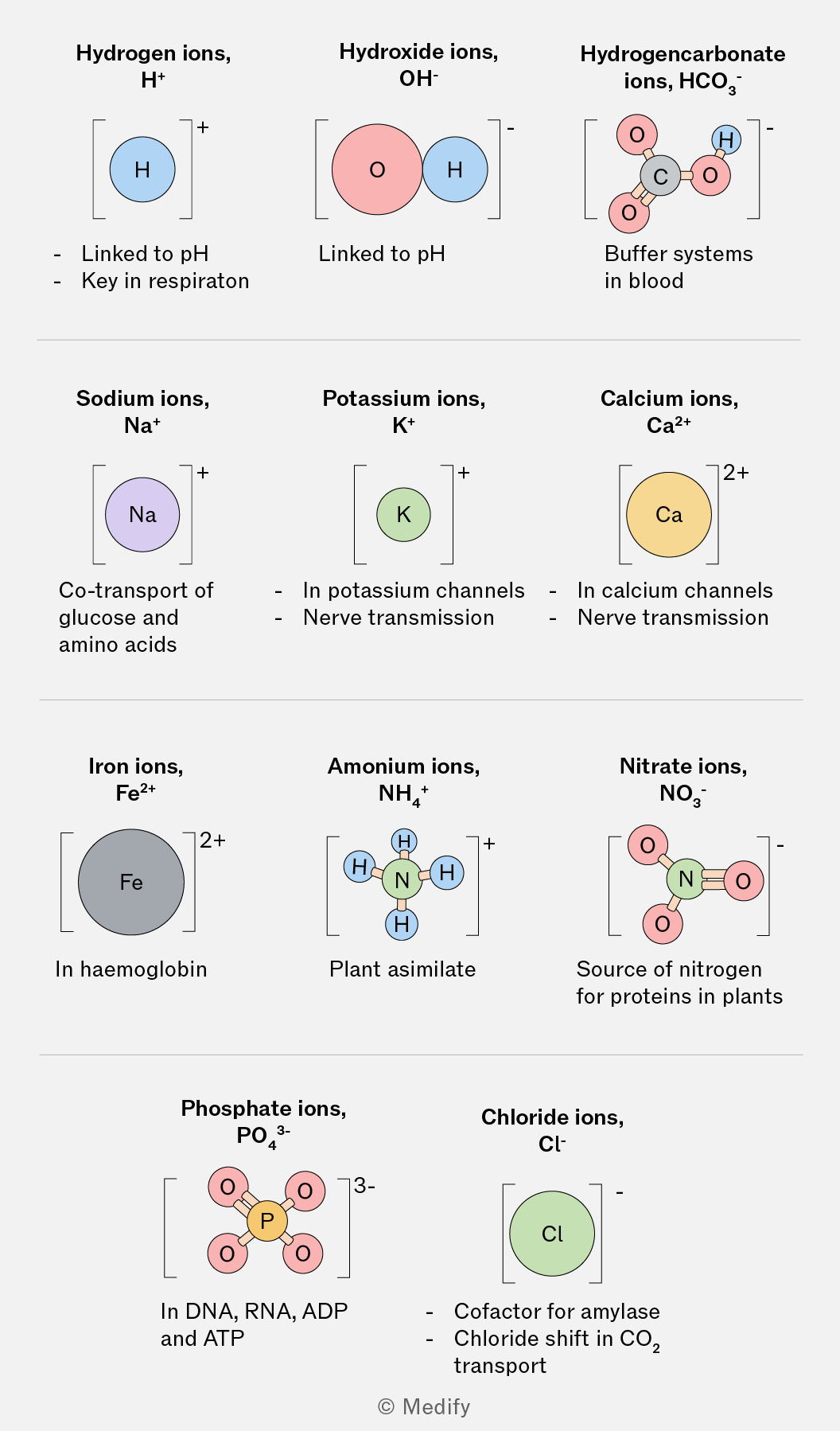
The image is a diagram of various ions with their chemical symbols and charges, each accompanied by a brief description of their biological significance. Top row: 'Hydrogen ions, H+' with a blue circle labeled 'H' and description 'Linked to pH, Key in respiration'. 'Hydroxide ions, OH-' with a red circle labeled 'O' and a blue circle labeled 'H', description 'Linked to pH'. 'Hydrogencarbonate ions, HCO3-' with a central grey circle labeled 'C', surrounded by red circles labeled 'O' and a blue circle labeled 'H', description 'Buffer systems in blood'. Middle row: 'Sodium ions, Na+' with a purple circle labeled 'Na', description 'Co-transport of glucose and amino acids'. 'Potassium ions, K+' with a green circle labeled 'K', description 'In potassium channels, Nerve transmission'. 'Calcium ions, Ca2+' with an orange circle labeled 'Ca', description 'In calcium channels, Nerve transmission'. Bottom row: 'Iron ions, Fe2+' with a grey circle labeled 'Fe', description 'In haemoglobin'. 'Ammonium ions, NH4+' with a central blue circle labeled 'N' surrounded by smaller blue circles labeled 'H', description 'Plant assimilate'. 'Nitrate ions, NO3-' with a central blue circle labeled 'N' surrounded by red circles labeled 'O', description 'Source of nitrogen for proteins in plants'. 'Phosphate ions, PO4 3-' with a central orange circle labeled 'P' surrounded by red circles labeled 'O', description 'In DNA, RNA, ADP and ATP'. 'Chloride ions, Cl-' with a green circle labeled 'Cl', description 'Cofactor for amylase, Chloride shift in CO2 transport'.
Add to favourites

Hydrogen ions determine the of a solution. The concentration of is inversely related to ; more ions correspond to lower .

is crucial for enzyme activity, as changes can alter enzyme structure, particularly the shape of its active site.

Add to favourites

Iron ions () are essential for oxygen transport in haemoglobin and myoglobin. in haemoglobin binds oxygen, allowing red blood cells to carry it throughout the body.

Iron ions are also essential in electron transport during respiration and photosynthesis.

Add to favourites

Phosphate ions () form phosphate groups, essential components of DNA, RNA, ATP, and phospholipids.

In ATP, the phosphate bonds store energy, which is released during cellular processes. Phosphate ions are essential for energy transfer through ATP and play a critical role in signal transduction pathways, regulating various cellular processes.

Add to favourites

Hydroxide ion () are important in the process of maintaining by neutralising excess ().

Add to favourites