Biological molecules (3.1)›The structure of DNA and RNA (3.1.5.1)

The structure of DNA and RNA (3.1.5.1)

An overview of the structure of DNA and RNA (3.1.5.1) from AQA A level Biology including: nucleotides, nucleic acids and the structure of DNA and RNA
5 min

Nucleotides (or mononucleotides) are monomers that are linked by condensation reactions to form nucleic acids (or polynucleotides; DNA and RNA).

Add to favourites

Deoxyribonucleic acid (DNA) and ribonucleic acid (RNA) are information–carrying molecules found in nearly all living cells. They are polymers of nucleotides.

  • DNA stores genetic information.
  • RNA has several roles, including transferring genetic information from DNA to ribosomes (mRNA), combining with proteins to form ribosomes (rRNA), and being involved in protein synthesis (tRNA).
Add to favourites

Early scientists doubted that DNA carried the genetic code because it seemed too simple. This changed after experimental observations:

  • Avery showed that DNA from a dead virulent strain of bacteria could transform a live non-virulent strain into a virulent one. When the DNA was destroyed, transformation did not occur.
  • Hershey and Chase used bacteriophages (viruses that infect bacteria). They labelled DNA with the radioactive isotope and protein with the isotope. They found that only labelled DNA entered bacteria and caused infection.
Add to favourites

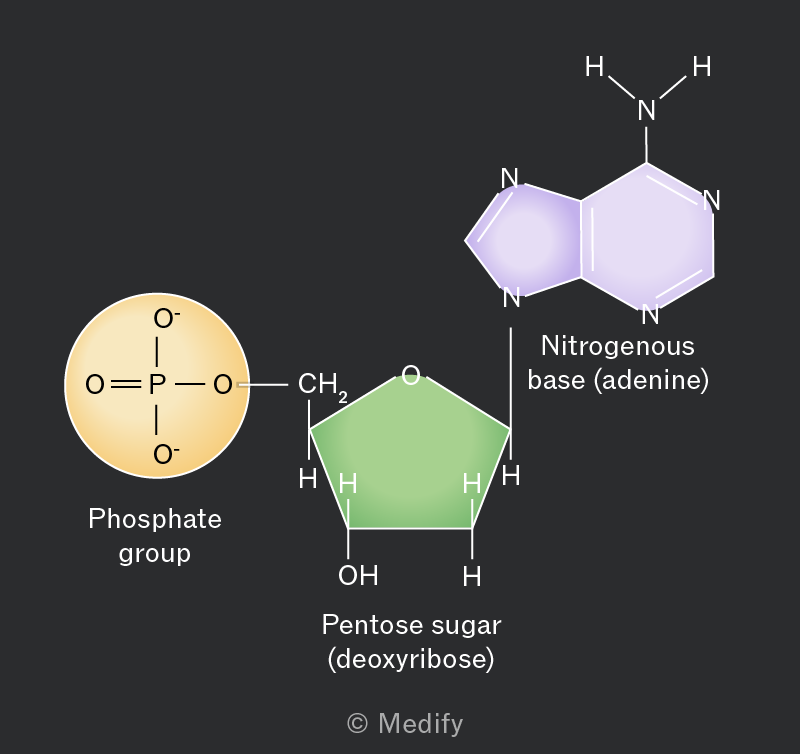
Nucleotides (mononucleotides) consist of three primary components joined together by condensation reactions:

  • a pentose sugar, which is a 5-carbon sugar molecule
  • a phosphate group, which is attached to the 5′ carbon of the pentose sugar
  • a nitrogenous base (nitrogen-containing organic base), which is attached to the 1′ carbon of the pentose sugar.

By convention, the carbon numbers in the sugar are numbered 1′ to 5′.
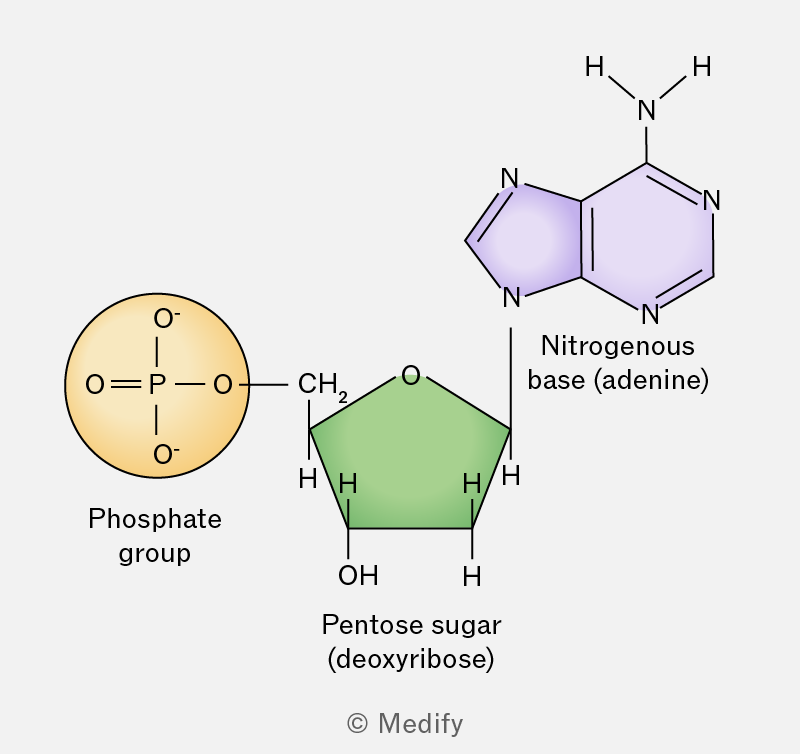
The image shows the structure of a nucleotide composed of three parts: a phosphate group, a pentose sugar (deoxyribose), and a nitrogenous base (adenine). The phosphate group is depicted as an orange circle with a chemical structure showing an oxygen atom double-bonded to a phosphorus atom, which is single-bonded to two additional oxygen atoms, one of which carries a negative charge. The pentose sugar is shown as a green pentagon labeled 'Pentose sugar (deoxyribose)', with the chemical structure indicating the presence of hydroxyl (OH) and hydrogen (H) groups. The nitrogenous base is represented as a purple double-ring structure labeled 'Nitrogenous base (adenine)', featuring nitrogen (N) atoms and hydrogen (H) atoms bonded to the rings.
Add to favourites

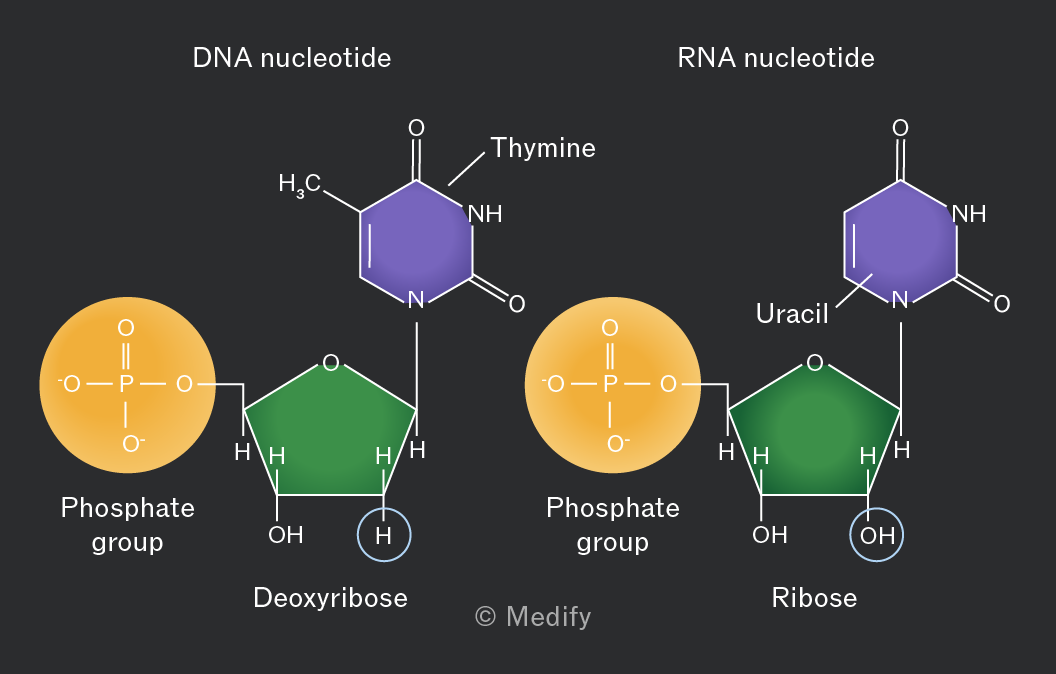
DNA and RNA nucleotides differ in the type of pentose sugar they contain:

  • DNA (deoxyribonucleic acid) contains the pentose sugar deoxyribose which lacks an oxygen atom on the 2′ carbon.
  • RNA (ribonucleic acid) contains the pentose sugar ribose which has a hydroxyl attached to the 2′ carbon.
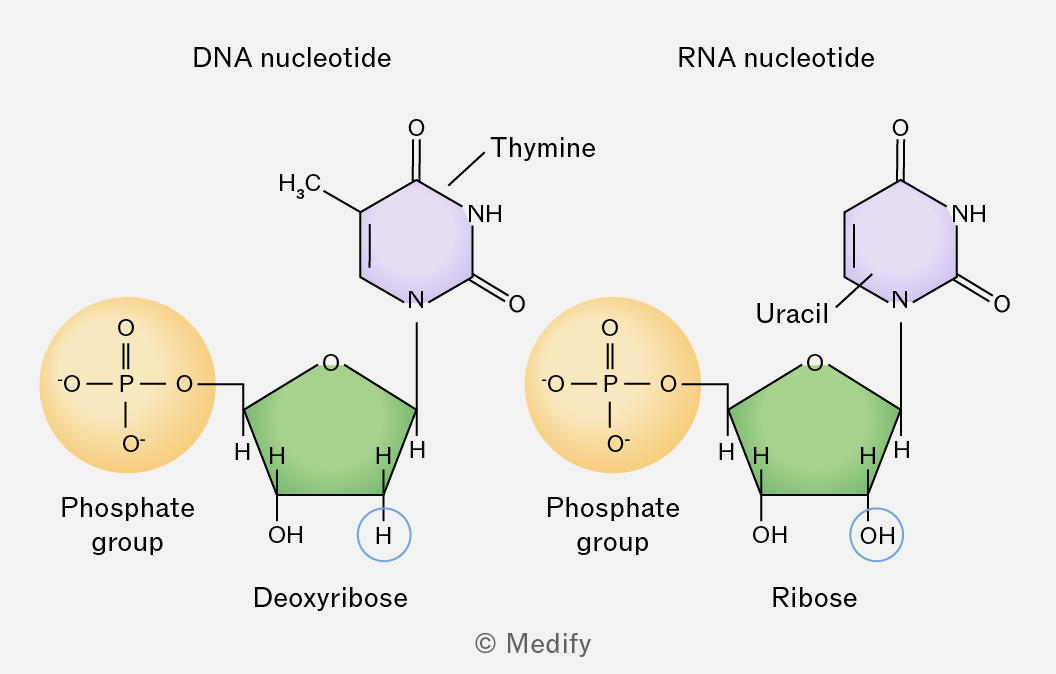
The image shows two nucleotide structures: a DNA nucleotide and an RNA nucleotide. The DNA nucleotide consists of a phosphate group, a deoxyribose sugar, and a thymine base. The phosphate group is illustrated as a circle with a chemical structure inside: O=P(O)(O-)O-. The deoxyribose sugar is shown as a pentagon with OH and H groups attached. The thymine base is a hexagon labeled 'Thymine' with a chemical structure including CH3 and NH groups. The RNA nucleotide consists of a phosphate group, a ribose sugar, and a uracil base. The phosphate group is similar to that in the DNA nucleotide. The ribose sugar is shown as a pentagon with OH groups. The uracil base is a hexagon labeled 'Uracil' with a structure including NH groups. Both nucleotides are labeled at the top: 'DNA nucleotide' and 'RNA nucleotide.'
Add to favourites

DNA and RNA nucleotides differ in one of their nitrogenous bases (nitrogen-containing organic bases):

DNA and RNA polynucleotides both contain adenine, cytosine, and guanine.

The fourth nitrogenous base DNA contains is thymine, but in RNA it is uracil.

Add to favourites

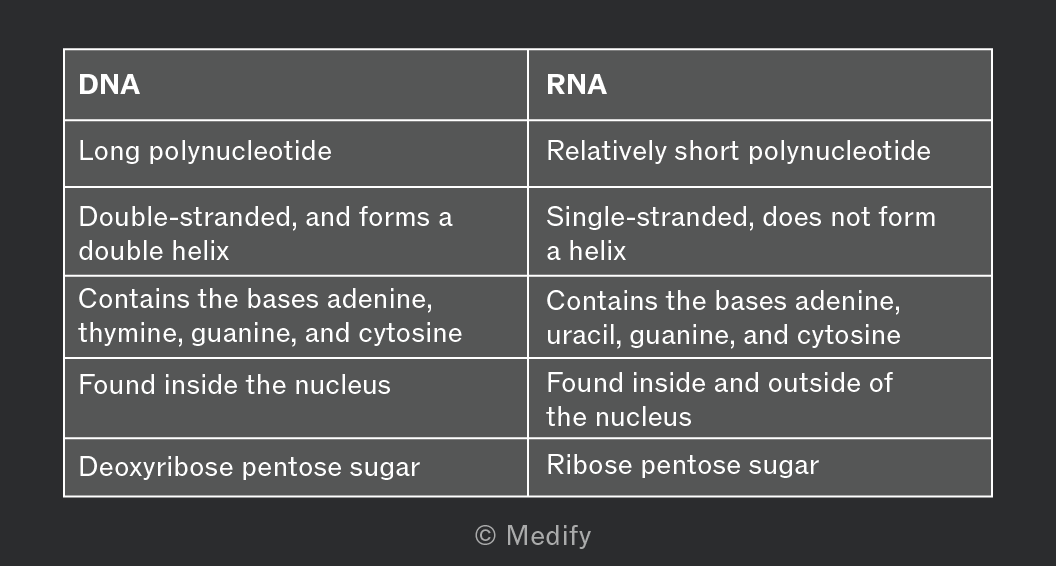
DNA and RNA have similar structures, but also several important differences.
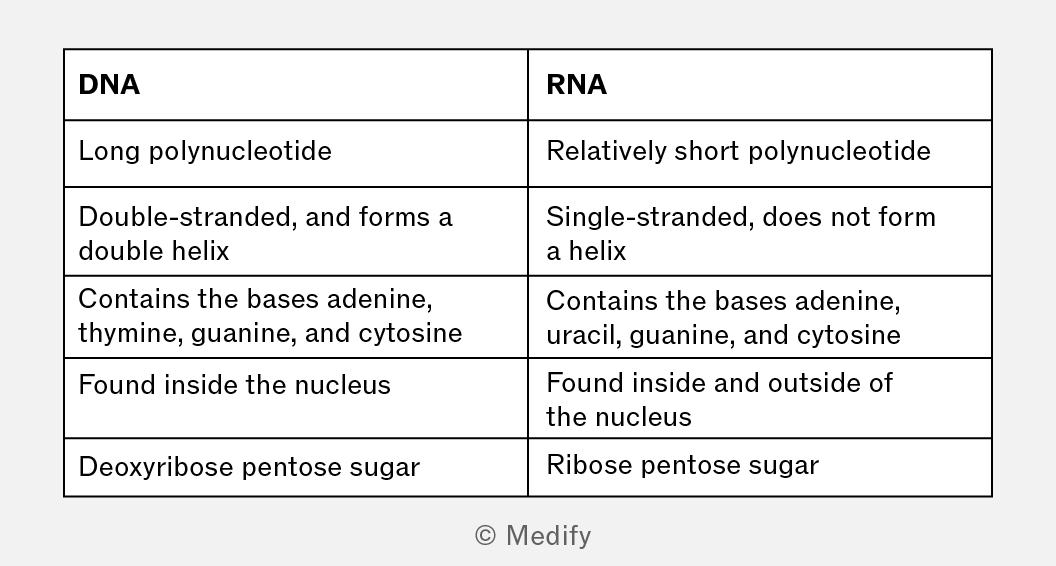
A comparison table between DNA and RNA. The table has two columns with headers: 'DNA' and 'RNA'. Under 'DNA': 1. 'Long polynucleotide', 2. 'Double-stranded, and forms a double helix', 3. 'Contains the bases adenine, thymine, guanine, and cytosine', 4. 'Found inside the nucleus', 5. 'Deoxyribose pentose sugar'. Under 'RNA': 1. 'Relatively short polynucleotide', 2. 'Single-stranded, does not form a helix', 3. 'Contains the bases adenine, uracil, guanine, and cytosine', 4. 'Found inside and outside of the nucleus', 5. 'Ribose pentose sugar'.
Add to favourites

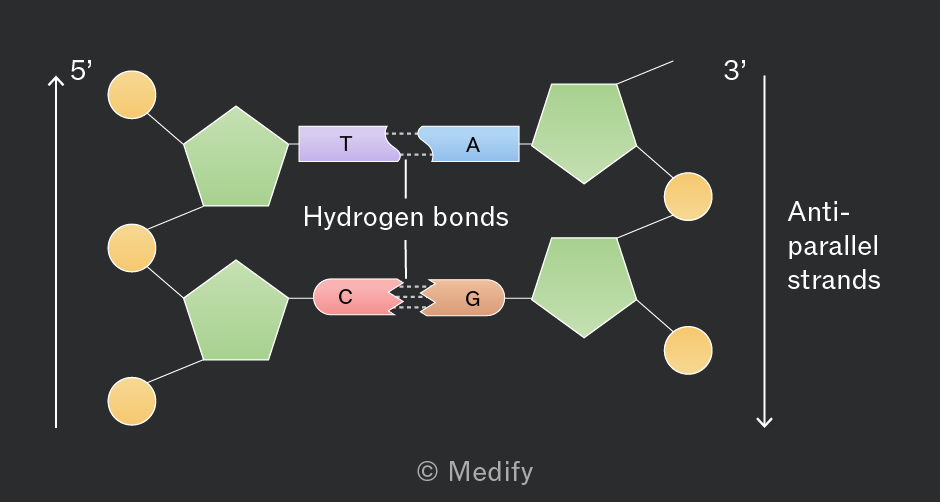
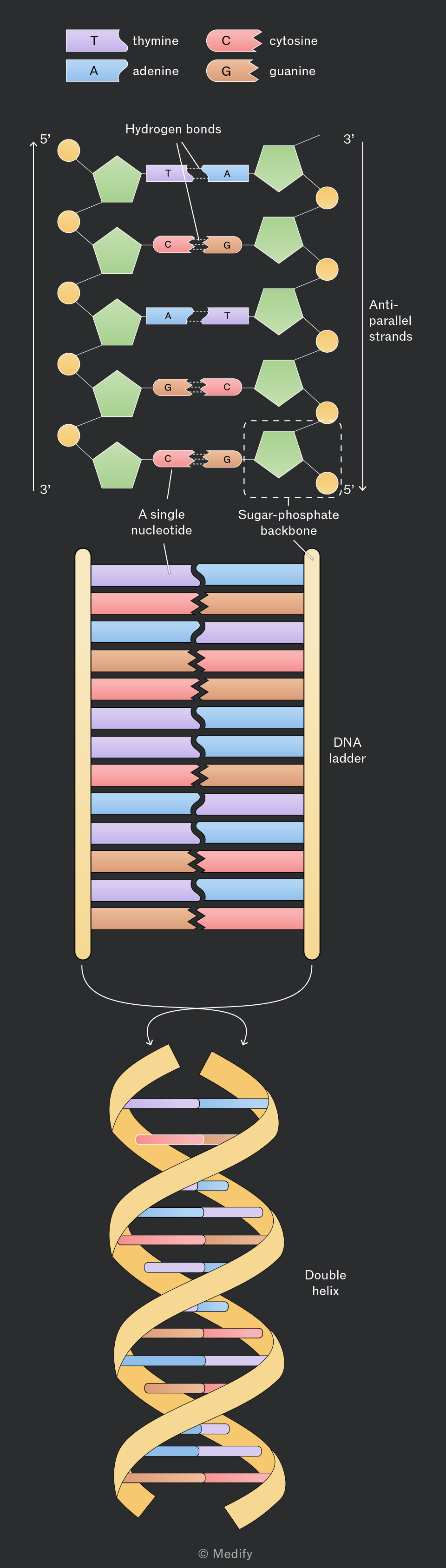
Adenine (A) pairs with thymine (T) through 2 hydrogen bonds.

Guanine (G) pairs with cytosine (C) through 3 hydrogen bonds.
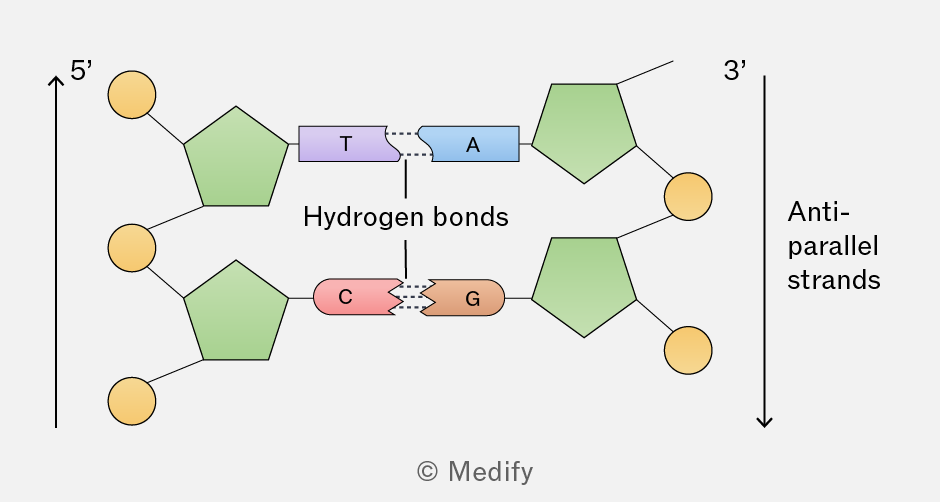
The image depicts a section of DNA with two anti-parallel strands. The left strand is labeled '5’' at the top, and the right strand is labeled '3’' at the top, indicating directionality. Each strand consists of a backbone shown as a zigzag line with orange circles representing phosphate groups and green pentagons representing sugar molecules. The bases are shown between the strands: a purple rectangle labeled 'T' pairs with a blue rectangle labeled 'A' through dotted lines labeled 'Hydrogen bonds'. Below, a red rectangle labeled 'C' pairs with an orange rectangle labeled 'G', also through dotted lines indicating hydrogen bonds. On the right side, an arrow points downward labeled 'Anti-parallel strands'.
Add to favourites

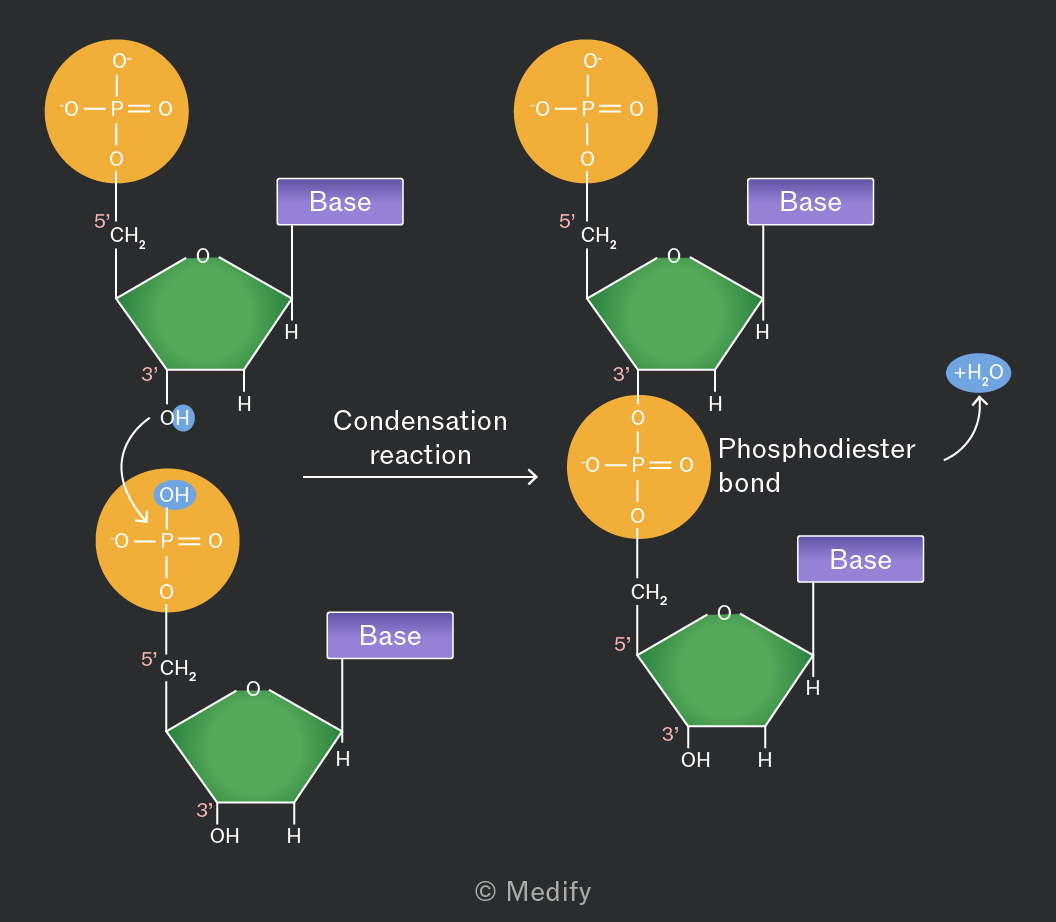
Di- and polynucleotides are formed when condensation reactions link nucleotides by phosphodiester bonds.

Phosphodiester bonds occur between the phosphate group of one nucleotide and the hydroxyl group on the 3’ carbon of the pentose sugar of another nucleotide.

This linkage forms the sugar–phosphate backbone of DNA and RNA strands.
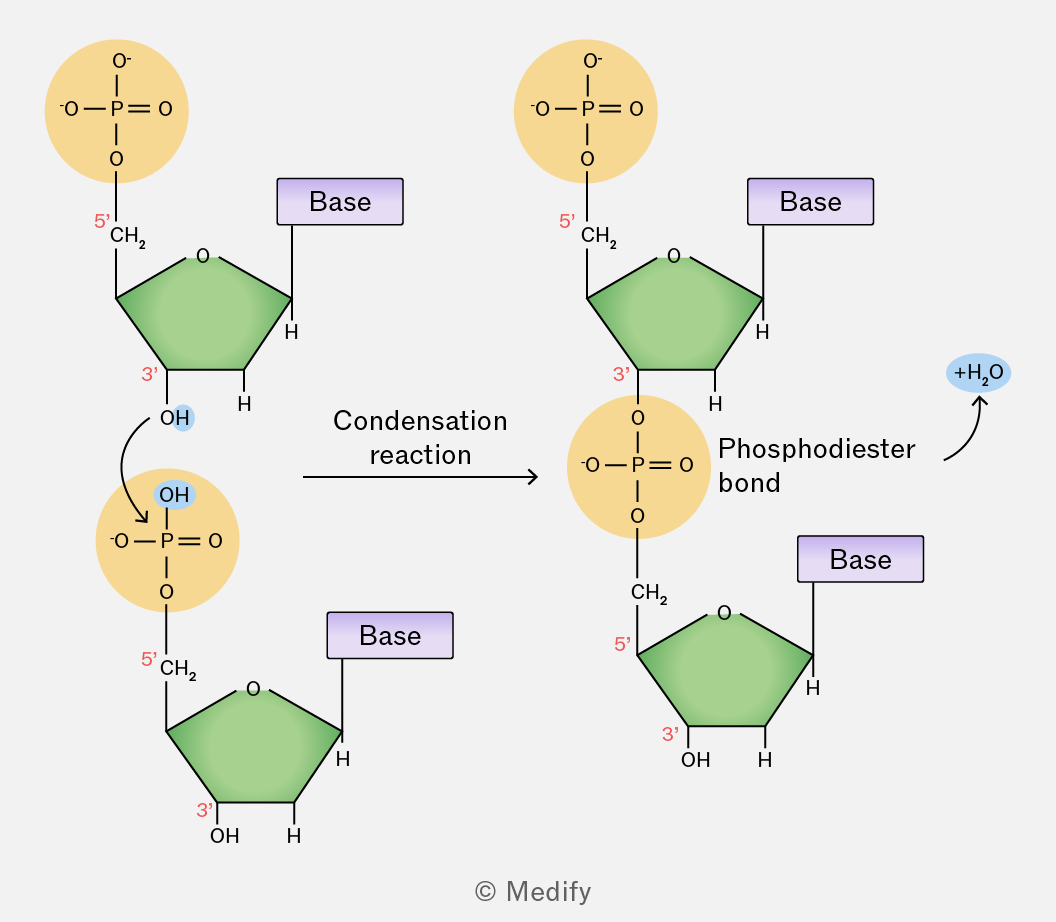
The image shows a diagram of a condensation reaction forming a phosphodiester bond between two nucleotides. On the left, two nucleotide structures are shown. Each nucleotide consists of a phosphate group (indicated by an orange circle with 'O - P = O' and two 'O' atoms bonded to 'P'), a pentose sugar (green pentagon), and a base (purple rectangle labeled 'Base'). The first nucleotide has a phosphate group labeled '5’', a sugar labeled '3’', and an 'OH' group. An arrow labeled 'Condensation reaction' points right toward the second nucleotide. The reaction results in a phosphodiester bond, indicated by the merging of the phosphate group with the sugar of the second nucleotide. The second nucleotide's structure is similar to the first, with a phosphate labeled '5’', a sugar labeled '3’', and a base. The right side shows the new bond formed, labeled 'Phosphodiester bond', and a byproduct '+H2O' indicated with an arrow. The bases remain unlabeled in detail but are represented by the purple rectangles. The structure and labels convey the process of nucleotide linkage in nucleic acids.
Add to favourites

A DNA molecule is made up of 2 DNA polynucleotide chains.

The two strands run antiparallel to each other; 1 strand runs in the 5’ to 3’ direction, while the other runs in the 3’ to 5’ direction.

Hydrogen bonds between complementary base pairs hold the two chains together.

Add to favourites

The two bonded DNA strands twist to form a double helix structure.
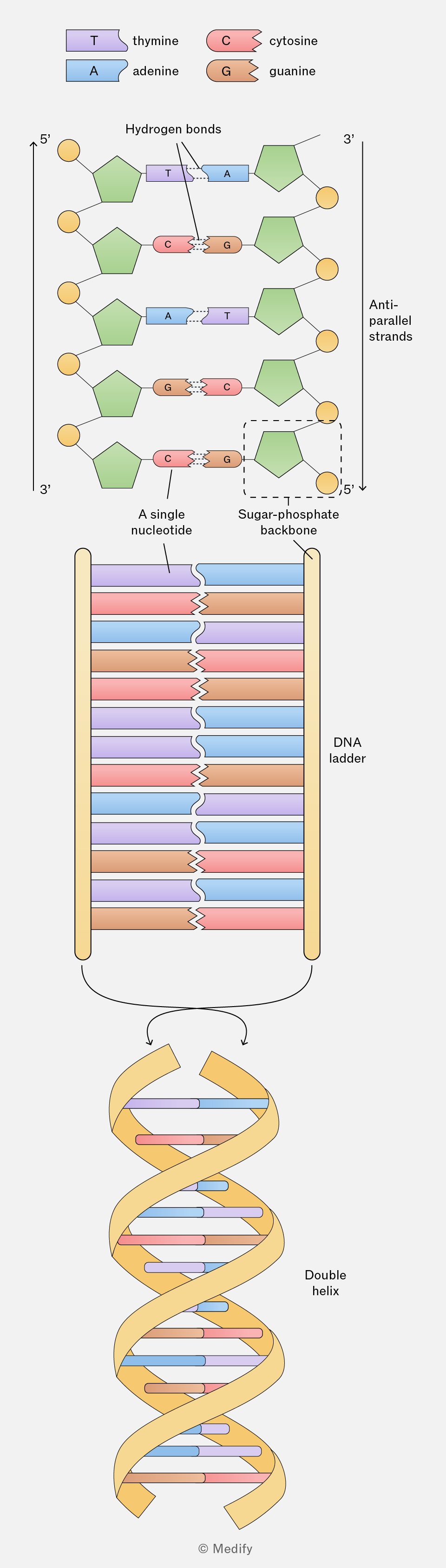
The image illustrates the structure of DNA. At the top, there is a legend showing base pairs: thymine (T) in purple, adenine (A) in blue, cytosine (C) in pink, and guanine (G) in orange. Below, a section of a DNA molecule is shown with two anti-parallel strands. The left strand is labeled 5' to 3' and the right strand is labeled 3' to 5'. The strands consist of green pentagons representing the sugar-phosphate backbone, and base pairs connected by hydrogen bonds: T-A and C-G. Annotations include 'Hydrogen bonds,' 'A single nucleotide,' and 'Sugar-phosphate backbone.' Below the strands, a simplified 'DNA ladder' is shown, with colored rungs representing base pairs. At the bottom, the DNA ladder is twisted into a 'Double helix.'
Add to favourites

Unlike DNA, RNA molecules are relatively short, single–stranded polynucleotide chains.

Add to favourites