
Acids and bases
On this page
Acids and bases are a core concept in chemistry and biochemistry. Since the range is heavily associated with the feasibility of biological processes, understanding and the factors that influence it is highly relevant in medicinal chemistry.
There is a strong chance that questions linked to acids and bases will feature in your Section III exam.
The concentration of hydrogen ions in solution describes its acidity.
Hydrogen ion concentration is converted to a more condensed and manageable scale using
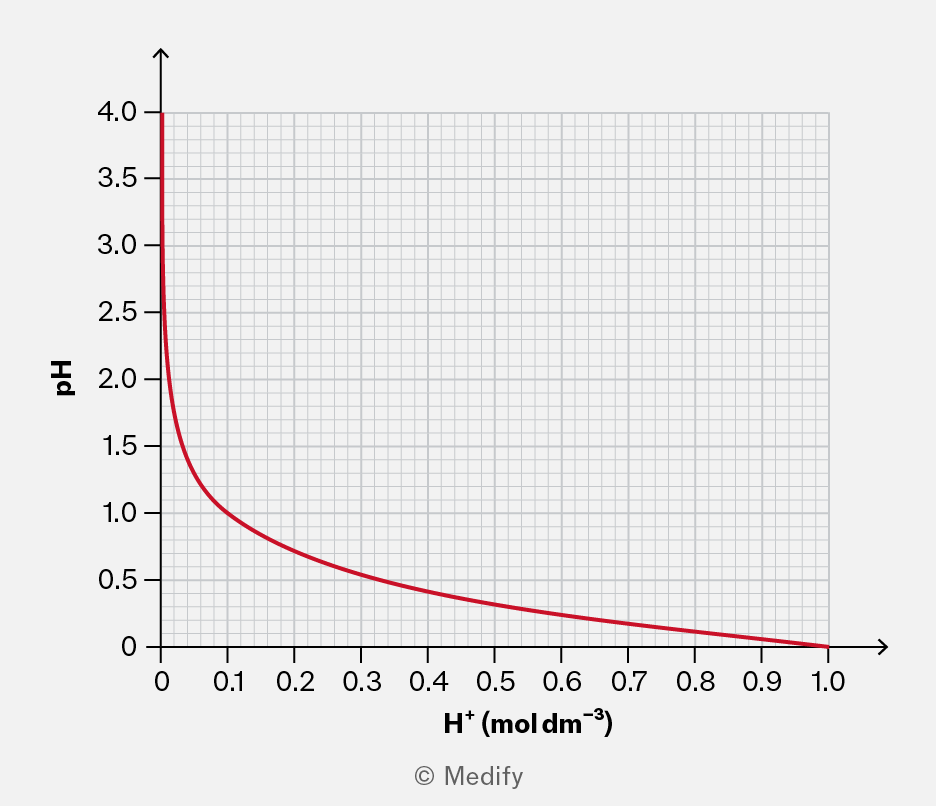
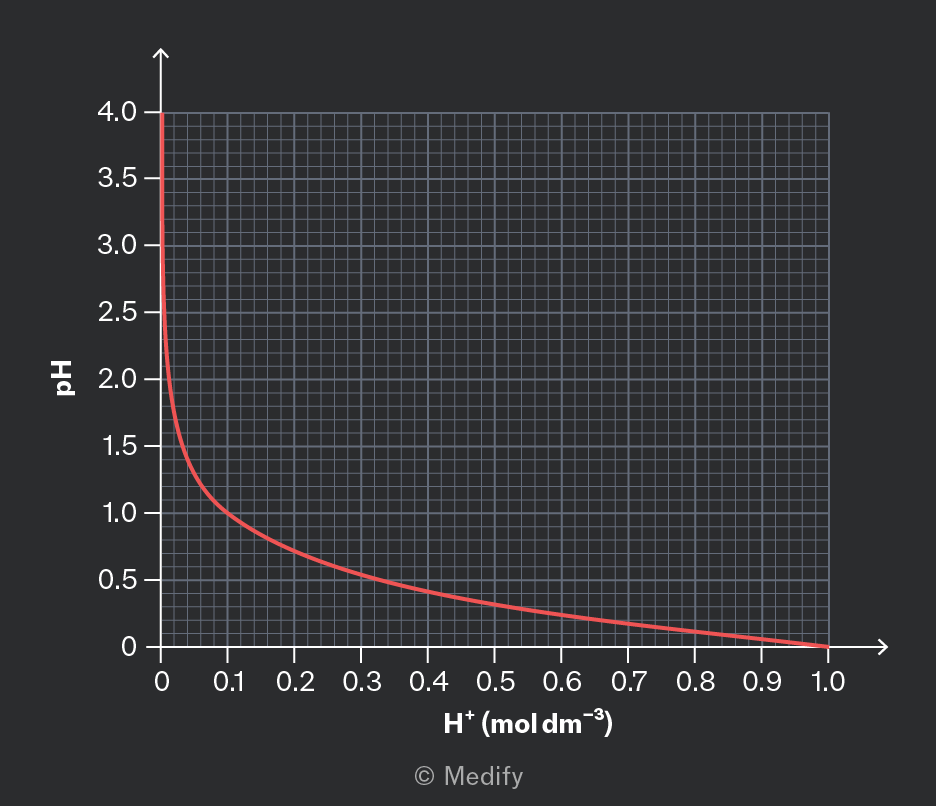
Increasing by 1 unit represents a 10 times decrease in hydrogen ion concentration.
Acids have low and high hydrogen ion concentrations.
Alkalis have high and low hydrogen ion concentrations.
Acids can be strong or weak. This refers to the degree to which they dissociate into hydrogen ions and their conjugate base in solution, not to their overall concentration.
values are equilibrium constants describing the degree of dissociation in acids.
Higher means higher dissociation, higher and lower
Higher means lower dissociation, lower and higher
The stimulus may contain some information about this, but it is likely to be hidden. If you are comfortable with these relationships, your interpretation of the material provided will be much faster.
Buffers are solutions that use the rules of equilibrium to resist changes in caused by small additions of acids or alkalis.
The ratio of : correlates with the and, therefore, the of a system.
A buffer system contains an excess of and in comparison to :
- When additional acid () is added, the excess will react to form resulting in a minimal change to the ratio of : and therefore no significant change in the
- When additional alkali () is added, the excess of further dissociates to maintain The excess of means there is a minimal change to the ratio of : and therefore no significant change in the
You may need to use log rules when tackling questions featuring acids and bases. These could feature in inter-conversion between:
and
and
and
They may also be applied in creating and using derivations from the equation, such as the Henderson-Hasselbalch equation:
Remember that the potential, always relates to the negative log of whatever it precedes.
Question walkthrough
Suitable pH ranges
How scientific literacy and reasoning can link in the general topic area of acids and bases.
Not all hydrogen-containing substances are acidic, although all conventional acids contain hydrogen in their formulae.
is known as a hydrogen ion or a proton. It is formed when a hydrogen atom loses an electron.
The hydrogen in a molecule must be releasable as a proton in aqueous solution for a substance to be a Brønsted–Lowry acid.
Brønsted–Lowry acid–base reactions involve the transfer of protons.
Brønsted–Lowry acids are chemical substances that release ions in an aqueous solution.
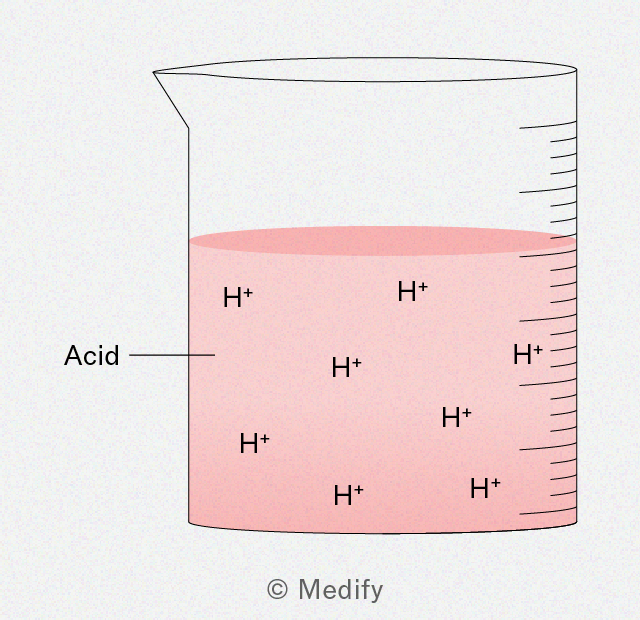
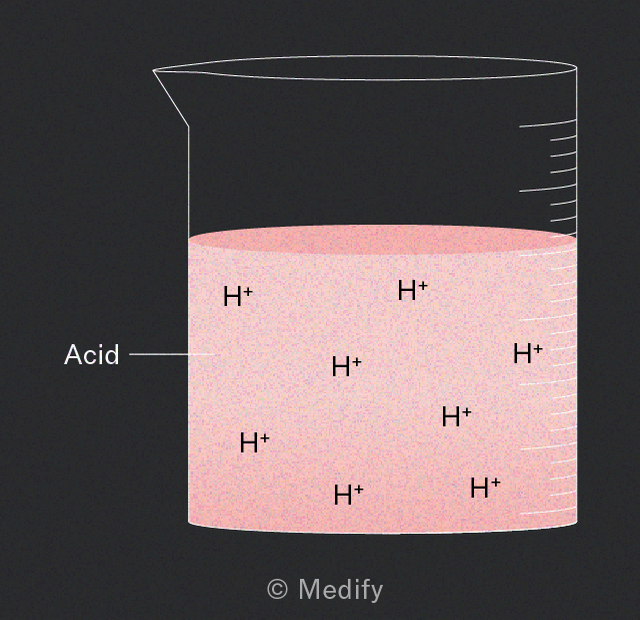
dissociates in water releasing ions as follows:
The ions further combine with molecules forming hydronium ( ) ions:
The overall equation for the dissociation of in water (with state symbols) is:
Alkalis are chemical species that release hydroxide, , ions in aqueous solutions.
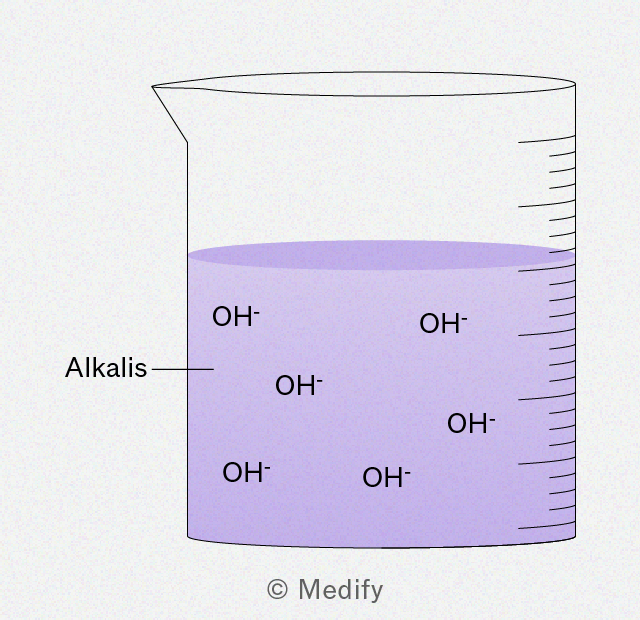
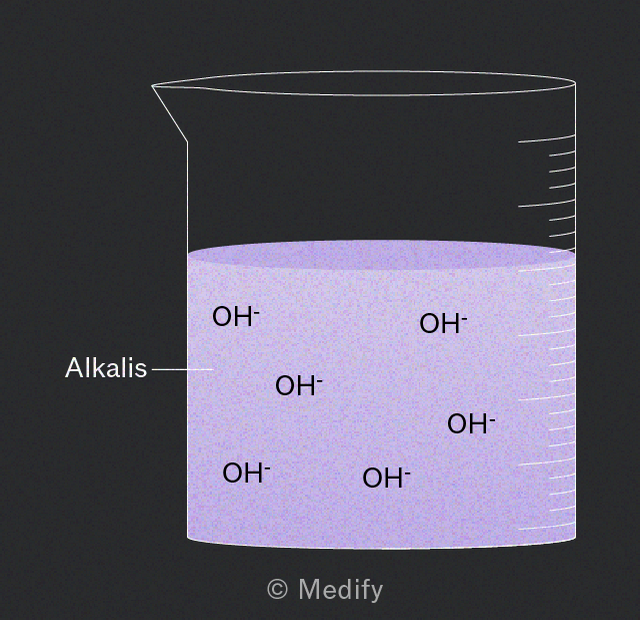
dissociates in water liberating ions:
Ammonia, , does not contain , but dissolves in water producing and ions:
The names and chemical formulae of some mineral acids you are should be able to recall are:
- Hydrochloric acid ()
- Sulfuric acid ()
- Nitric acid ()
- Phosphoric acid ()
- Carbonic acid ()
The charge of the anion is linked to the number of protons in the acid.
The names and chemical formulae of some alkalis you are should be able to recall are:
- Sodium hydroxide ()
- Potassium hydroxide ()
- Magnesium hydroxide ()
- Ammonium hydroxide ()
The charge of the cation is linked to the number of hydroxide ions.
A strong acid, , completely dissociates in aqueous solution to form and .
In strong acids:
Prominent examples of strong acids are , , and .
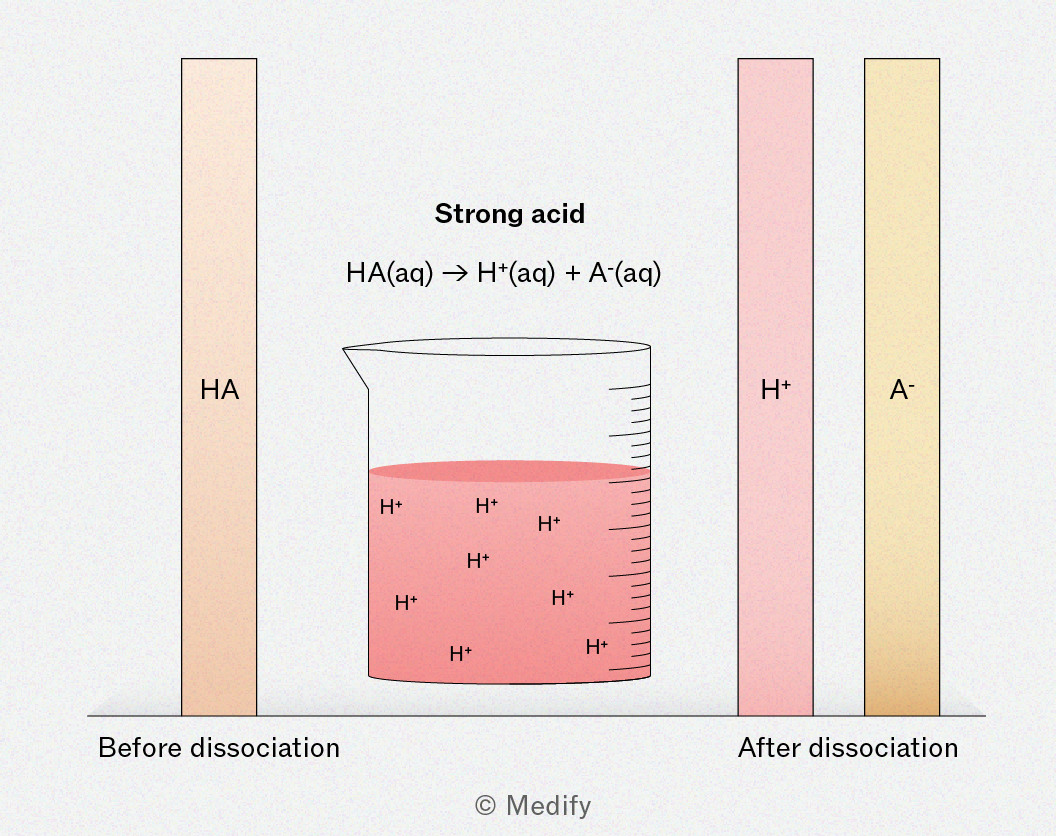
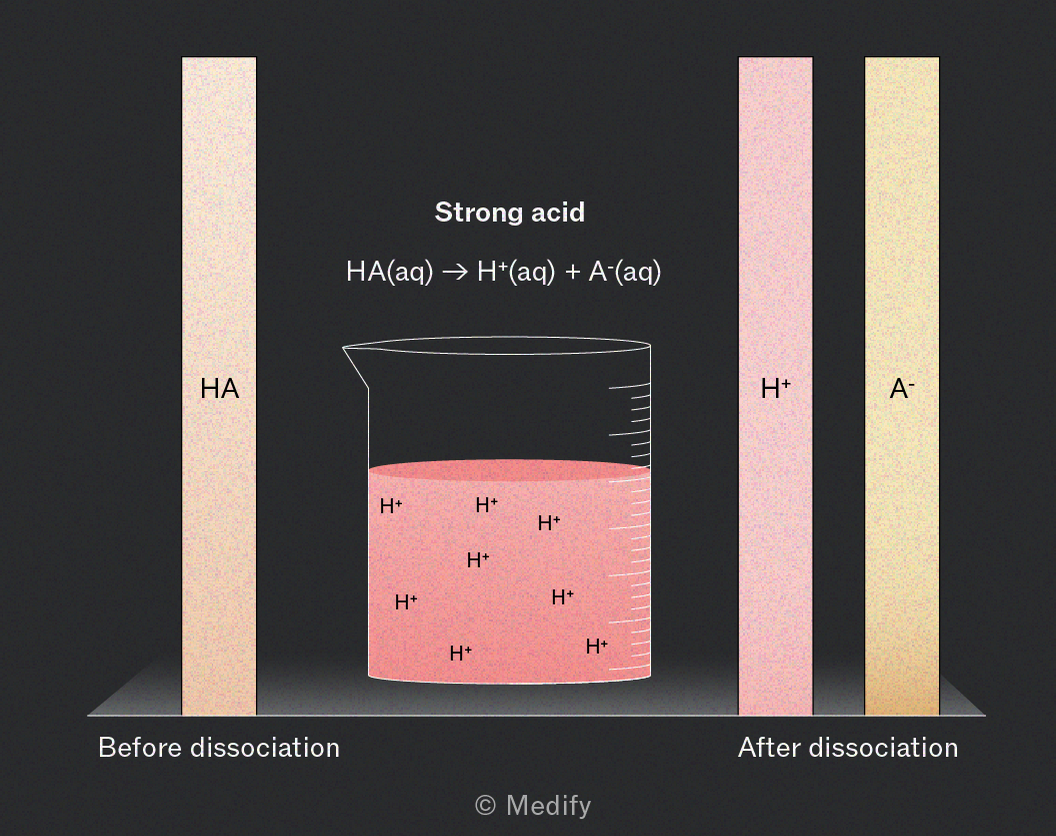
Both concentration (the total amount of the acid per unit volume) and strength (the degree of dissociation) of the acid impact the overall of a solution.
Strong acids will have a lower than weak acids when matched by concentration.
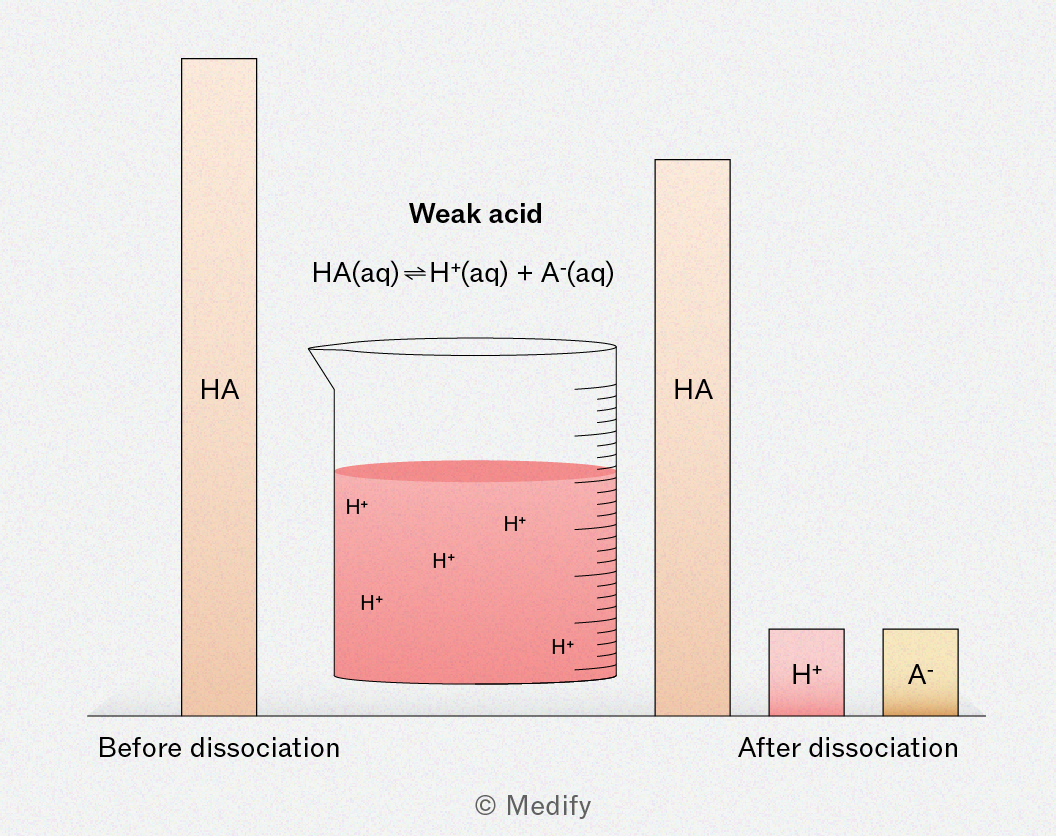
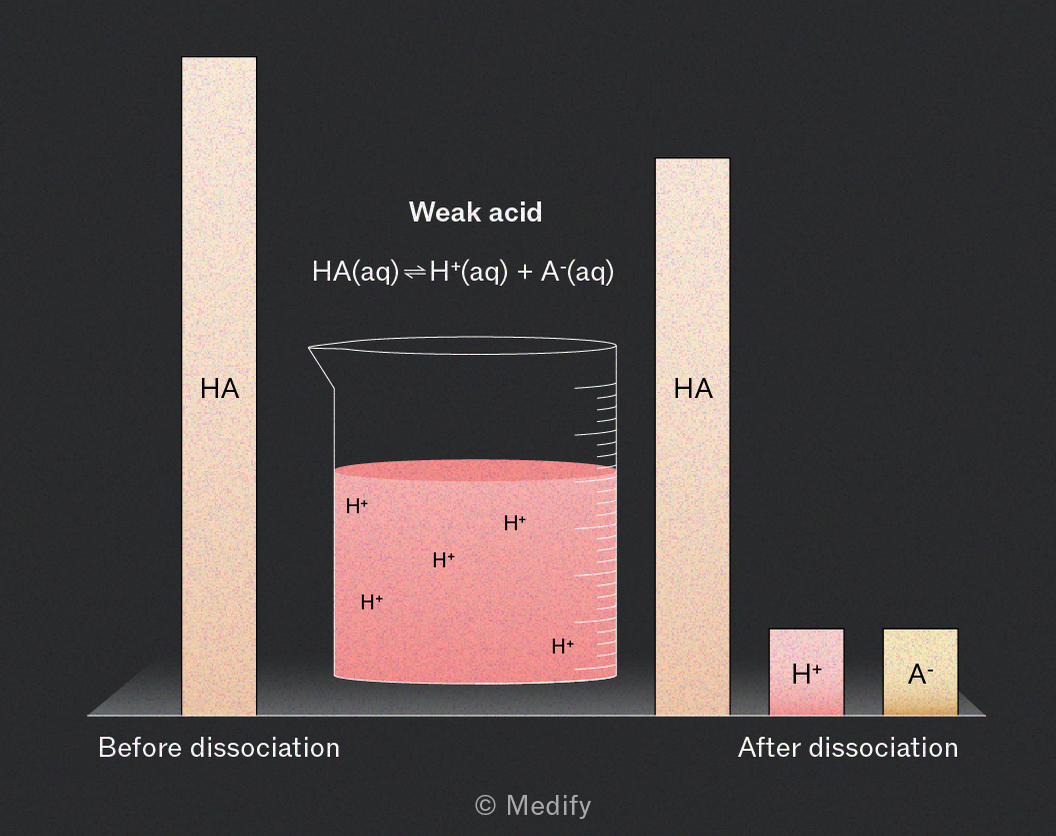
Weak acids only partially dissociate in water (usually less than 10%), releasing a limited number of their ions.
The partial dissociation can be identified by use of a double headed arrow (⇌) showing reversibility.
In weak acids:
Carboxylic acids, such as acetic acid, are weak acids.
A conjugate acid–base pair consists of two species that transform into each other by the gain or loss of a proton.
In this reaction:
- is the acid, and is its conjugate base.
- is the base, and is its conjugate acid.
A monobasic acid, also known as a monoprotic acid, releases one proton per molecule when dissolved in water.
Hydrochloric acid
A dibasic acid, also known as a diprotic acid, can donate two protons per molecule. This usually occurs in two steps.
Sulfuric acid
is a dibasic acid because it donates two protons per molecule, one in each step.
A tribasic acid, also known as a triprotic acid, can donate three protons per molecule. This occurs in three steps.
Phosphoric acid
is a tribasic acid because it donates three protons per molecule, one in each step.
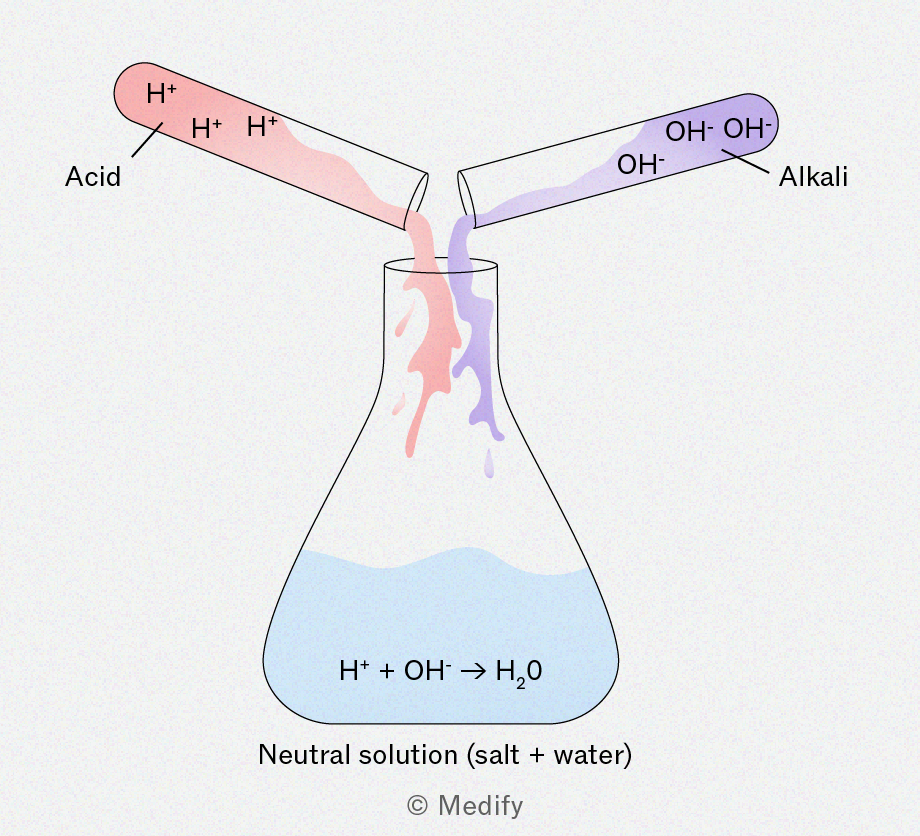
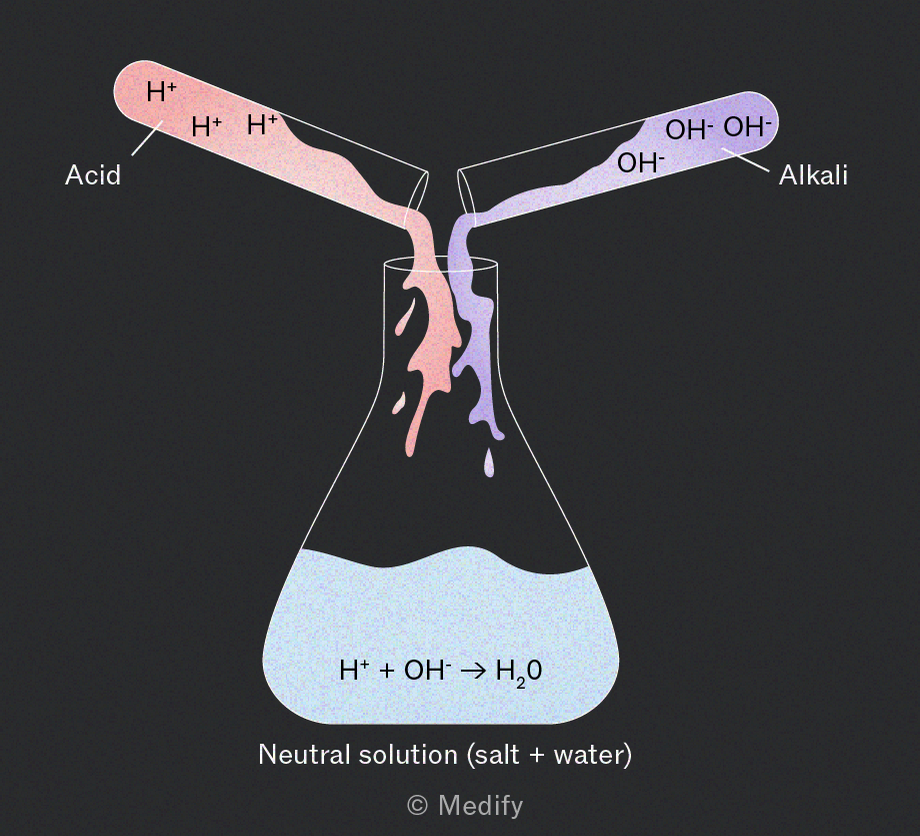
The chemical reaction of an acid with a base produces water. This is known as the neutralisation reaction.
The ions from the acid react with ions from the alkali, producing water (a neutral substance).
The final solution has a of at s.t.p.
Acid + Alkali → Salt + Water
Hydrochloric acid reacts with sodium hydroxide, producing sodium chloride and water.
All neutralisation reactions with water soluble bases (alkalis) simplify down to the same net ionic equation:
Acid + Metal carbonate → Salt + Water + Carbon dioxide
Hydrochloric acid reacts with magnesium carbonate forming magnesium chloride, carbon dioxide, and water.
The net ionic equation for the reaction omits the chloride ions present on both sides of the equation.
Metal + Acid → Salt + Hydrogen
Zinc reacts with hydrochloric acid:
In ionic form:
Metal Oxide + Acid → Salt + Water
Magnesium oxide reacts with hydrochloric acid:
In ionic form:
The scale is a logarithmic scale used to measure the acidity or basicity of a solution. It is based on the concentration of hydrogen ions, , in the solution.
The of a solution is defined as the negative logarithm of the hydrogen ion concentration:
where:
- is the measure of the acidity or basicity of the solution.
- [] is the concentration of hydrogen ions in .
The hydrogen ion concentration can be calculated from the using the inverse logarithmic function:
Neutral solution: Neutral solutions contain an equal concentration of hydrogen ions and hydroxide ions. A of indicates a neutral solution at s.t.p, where .
Acidic solution: Acidic solutions contain a higher concentration of hydrogen ions than hydroxide ions. A less than indicates an acidic solution at s.t.p, where [] is greater than .
Basic solution: Basic solutions contain a lower concentration of hydrogen ions than hydroxide ions. A greater than indicates a basic (alkaline) solution at s.t.p, where is less than .
The concentration of hydrogen ions [] in a solution of a strong monobasic acid, is equal to the initial concentration of the acid, since it fully dissociates.
The acid dissociation constant, , measures the strength of a weak acid by quantifying its degree of dissociation in aqueous solution.
For a generic weak acid , which partially dissociates into and , the equilibrium can be represented as:
The equilibrium constant for this dissociation is given by:
Where:
- is the concentration of hydrogen ions.
- is the concentration of the conjugate base.
- is the concentration of the undissociated acid.
A higher value indicates a stronger acid, which dissociates more in solution, producing more ions per mole of acid.
A lower is derived from a higher value, thus a lower indicates a stronger acid.
The is the negative logarithm of the acid dissociation constant :
The scale is used as values, like [], cover many orders of magnitude. This relationship provides a more convenient way to express acid strength on a logarithmic scale, which compresses the range of values.
Approximations are required to calculate the of a weak acid.
The concentration of the undissociated acid remains almost the same at equilibrium because the dissociation is minimal.
The concentration of hydrogen ions is approximately equal to the concentration of the conjugate base formed. This is due to the negligible dissociation of compared to the amount of hydrogen ions produced by dissociation of the weak acid.
For very weak acids, only a small fraction of the acid molecules dissociate in water. This justifies the approximations used to calculate , because the change in due to dissociation is minimal.
For stronger weak acids, where is higher, e.g. , the degree of dissociation increases.
As a larger fraction of the acid dissociates, the difference between and becomes more significant, invalidating the approximation.
For a weak acid dissociates as follows:
The acid dissociation constant is:
Using the approximations:
Which rearranges to give:
Allowing pH to be calculated from :
Water undergoes slight dissociation into and ions.
The ionic product of water, , is a special equilibrium constant that applies to the self-ionisation of water.
It quantifies the extent to which water dissociates into hydrogen ions () and hydroxide ions () at a given temperature.
Water molecules self-ionise according to the following equilibrium reaction:
The equilibrium constant for this dissociation, the ionic product of water, , and is defined as:
At (), the value of is:
This value changes with temperature; as temperature increases, increases because the dissociation of water is an endothermic process.
In a neutral solution the concentrations of and are equal.
In pure water, at s.t.p:
If an acid is added to water, increases and decreases to maintain
If a base is added, increases and decreases to maintain
Calculating the of a strong base requires the use of the ionic product of water.
At ()
- Determine the concentration of hydroxide ions from the concentration of the strong base.
- Rearrange the equation for , making the subject.
- Use the value obtained for [] to calculate pH.
When a strong acid is diluted the pH of the solution increases.
Strong acids are fully dissociated in solution and the following equation is used to calculate the pH:
There is no change to the moles of acid present during dilution therefore, to determine the new concentration of an acid after dilution, the following equation can be applied:
where:
- is initial concentration
- is initial volume
- is final concentration
- is final volume.
The table below shows the initial concentration of the strong acid and effect of the dilution factor on the .
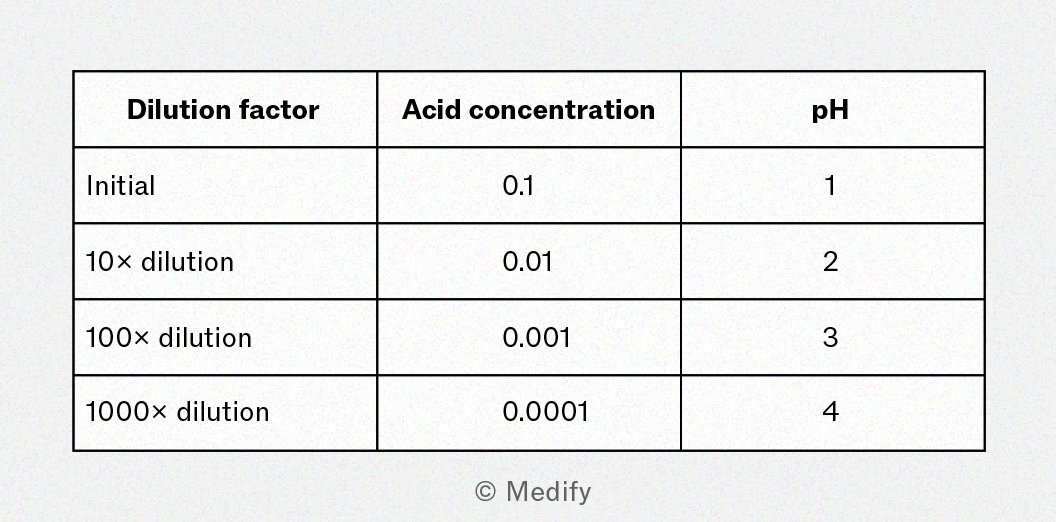
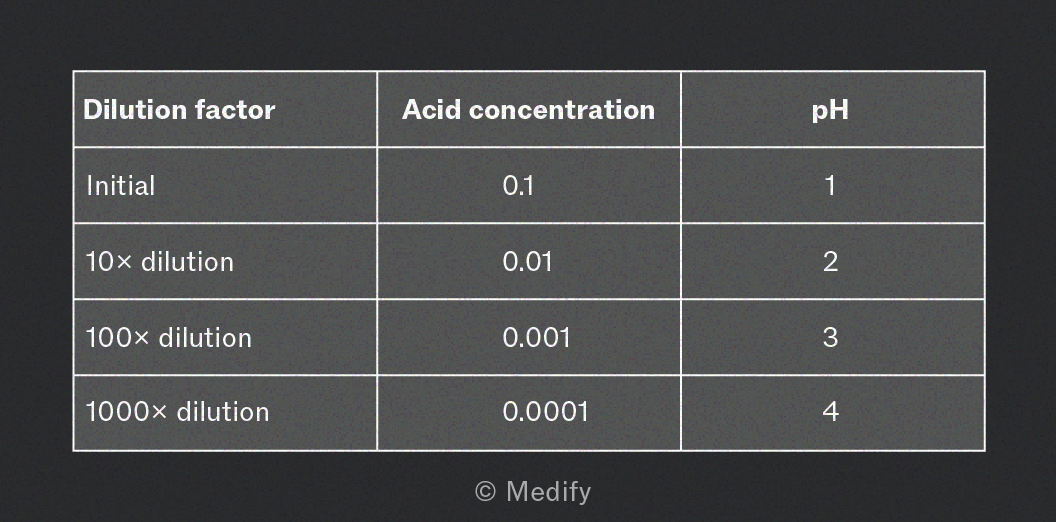
Note that as concentration reduces by a factor of 10, increases by 1,
When a weak acid is diluted the of the solution increases.
There is no change to the moles of acid present during dilution, therefore, to determine the new concentration of an acid after dilution, the following equation can be applied:
where:
- is initial concentration
- is initial volume
- is final concentration
- is final volume.
Weak acids are partially dissociated in solution according to their acid dissociation constant, , and the following equations are used to calculate the pH:
Step 1: Calculate []
Step 2: Calculate
The table below shows the initial concentration of a weak acid and effect of the dilution factor on the .
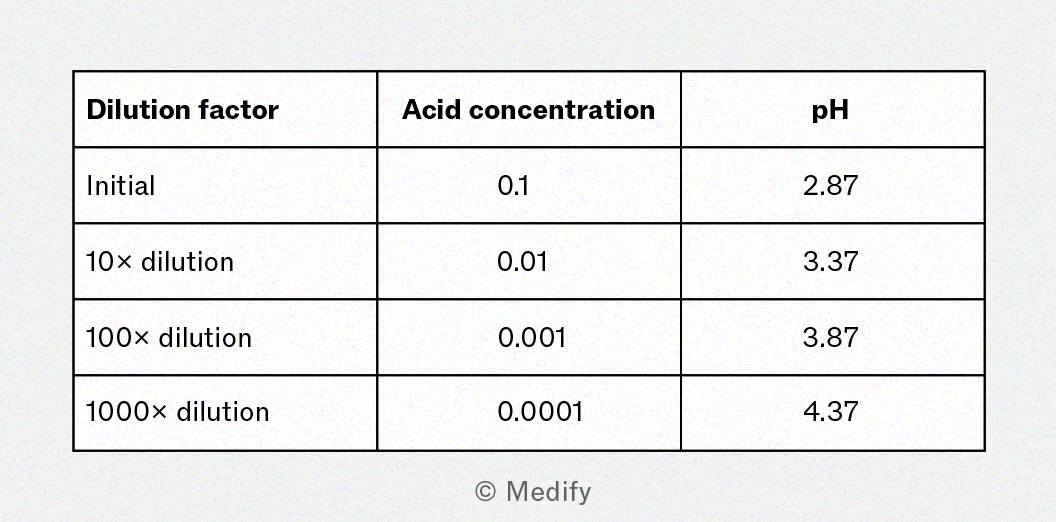
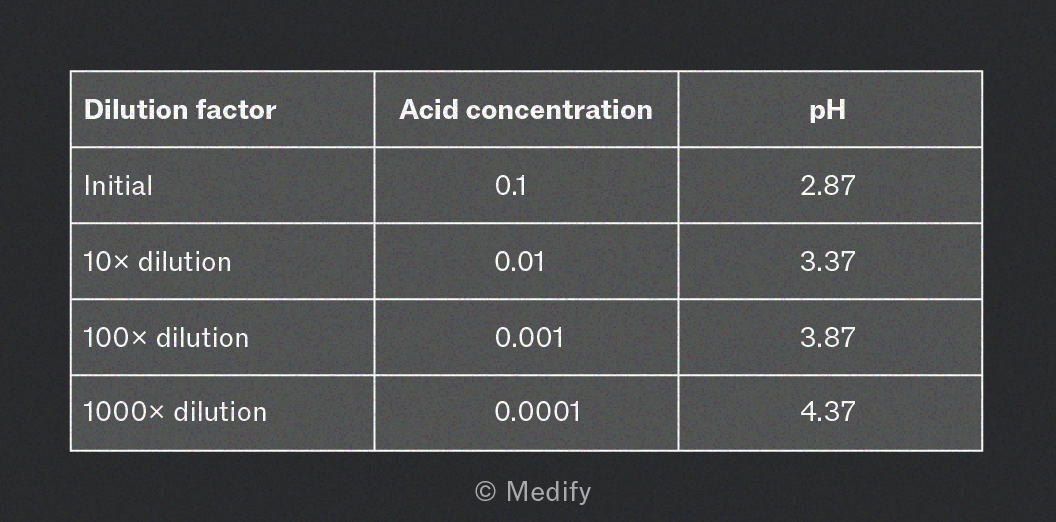
Note that as concentration reduces by a factor of 10, increases by 0.5,
A buffer solution is a system that minimises changes in when small amounts of an acid or a base are added.
Stability in is crucial for many chemical and biological processes
A buffer solution typically consists of a mixture of:
- a weak acid () and its salt containing conjugate base ()
- a weak base () and its salt containing conjugate acid ().
The weak acid and its conjugate base, or the weak base and its conjugate acid, work together to maintain the equilibrium constant and neutralise added acids or bases, thus maintaining the of the solution within a narrow range.
Le Chatelier’s principle explains how the buffer system shifts equilibrium to minimise changes.
In an acidic buffer solution containing a weak acid () and its conjugate base () the buffer system responds to the addition of acids and bases in the following way:
Addition of acid (): The excess conjugate base () reacts with the added to form more of the weak acid (), thus reducing the increase in concentration and minimising the pH change:
Addition of base (): The undissociated weak acid () reacts with the added to form water and more conjugate base (), thus reducing the increase in concentration and minimising the pH change:
In a basic buffer solution containing a weak base () and its conjugate acid , the buffer system responds to the addition of acids and bases in the following way:
Addition of acid (): The weak base () reacts with the added to form its conjugate acid (), reducing the increase in concentration and minimising the change:
Addition of Base (): The excess of conjugate acid () reacts with the added to form water and the weak base (), reducing the increase in concentration and minimising the change:
In an acidic buffer solution contain a ethanoic acid mixed with its salt, sodium ethanoate, the solution contains both the weak acid and its conjugate base.
Chemical equilibrium is maintained according to the value of the weak acid.
Buffer action and Le Chatelier’s principle:
Addition of acid (): The ethanoate ions () react with the added to form more ethanoic acid (). According to Le Chatelier’s principle, the system will shift to the left to counter the increase in , thus minimising the change.
Addition of base (): The ethanoic acid () reacts with the added to form water and ethanoate ions (). The system will shift to the right to counter the removal of by , again minimising the change.
When a weak acid is mixed with a strong base, the strong base neutralises part of the weak acid, forming its conjugate base and water.
If the weak acid is in excess, the remaining acid and the formed conjugate base create a buffer solution:
The of a buffer solution can be calculated by directly using the acid dissociation constant (), the concentrations of the weak acid, and the concentration of the conjugate base.
Substitute the concentrations into the equation:
Solve for []:
Calculate the pH:
Remember that, when a pair of solutions are mixed to form a buffer, new concentrations must be calculated based on the combined volume.
The calculation process when a buffer solution is formed through the reaction of an excess of weak acid with a strong base needs to factor in the reduction of the moles of following reaction with the base.
The amount of conjugate acid, , can be calculated directly from the amount of strong base used.
The reaction stoichiometry can be used to work out the remaining amount of weak acid, .
Both amounts should be converted to concentration using the combined volume of the solutions.
Maintaining the of blood within the narrow range of 7.35 to 7.45 is crucial for proper physiological function; in particular, the stability of enzymes.
The carbonic acid () – hydrogencarbonate () buffer system plays a key role in this process.
- Carbonic acid (): A weak acid that can donate protons () to the solution.
- Hydrogencarbonate (): The conjugate base of carbonic acid, capable of accepting protons.
The equilibrium between these components can be represented as:
When a small amount of acid is added to the blood:
The additional hydrogen ions () from the strong acid react with to form .
This minimises change: The formation of reduces the concentration of ions, mitigating the decrease.
When a small amount of base is added to the blood:
The hydroxide ions from the base react with to form and .
This minimises change: The conversion of to and water consumes ions, mitigating the increase.
Titration is a laboratory technique used for quantitative chemical analysis.
It is used to accurately calculate the concentration of one solution through reaction with another solution of known concentration. To do this, the volume of each solution at the endpoint must be determined; this is where neither solution is in excess.
An indicator is a chemical substance that undergoes a chemical or a physical change to mark the endpoint of the titration.
In acid–base titrations, indicators used sharply change colour with the change in pH of the reaction mixture at the point of neutralisation. The colour change marks the end point of the titration, indicating the ratio of volumes required for neutralisation.
One solution in a titration must be of known concentration.
A standard solution is a solution of known concentration. It must be accurately prepared using a volumetric glass flask.
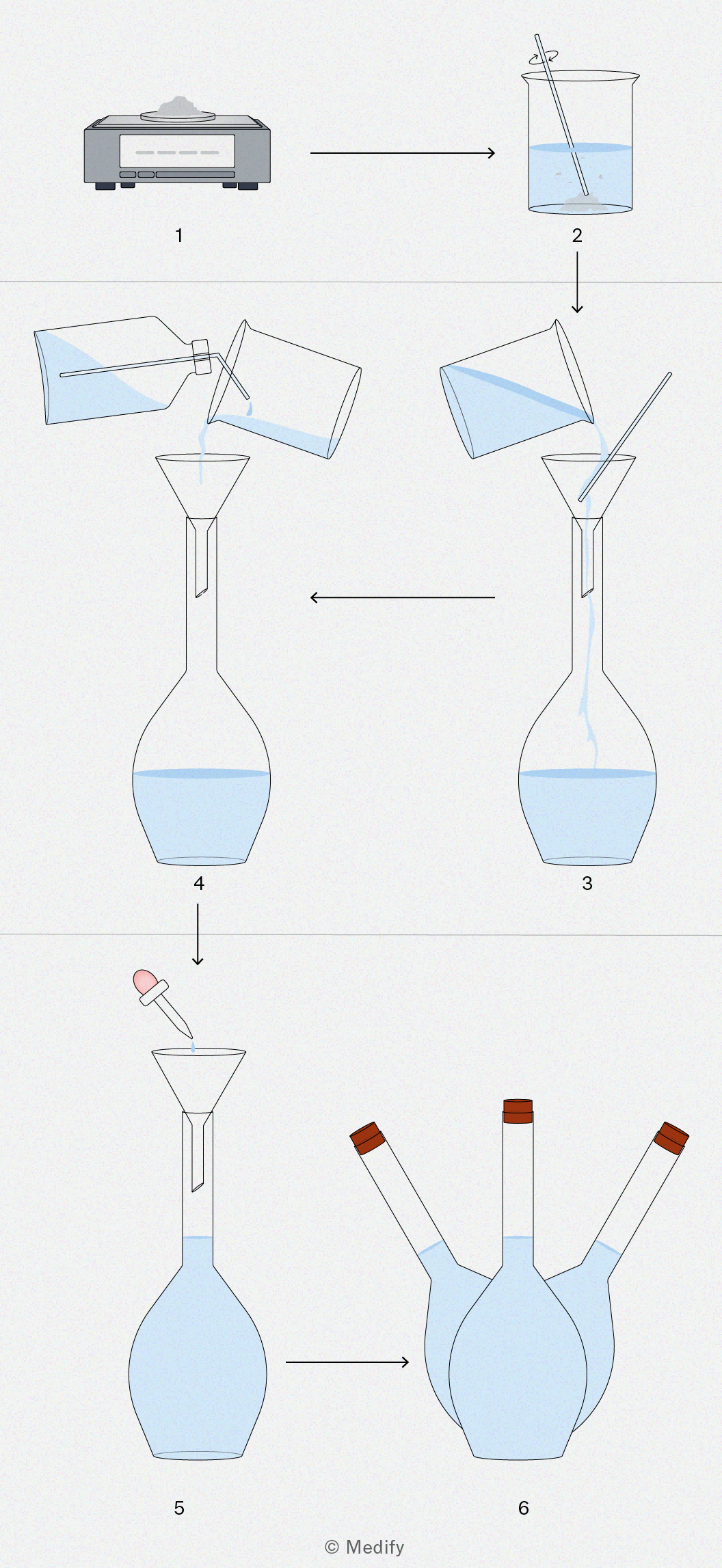
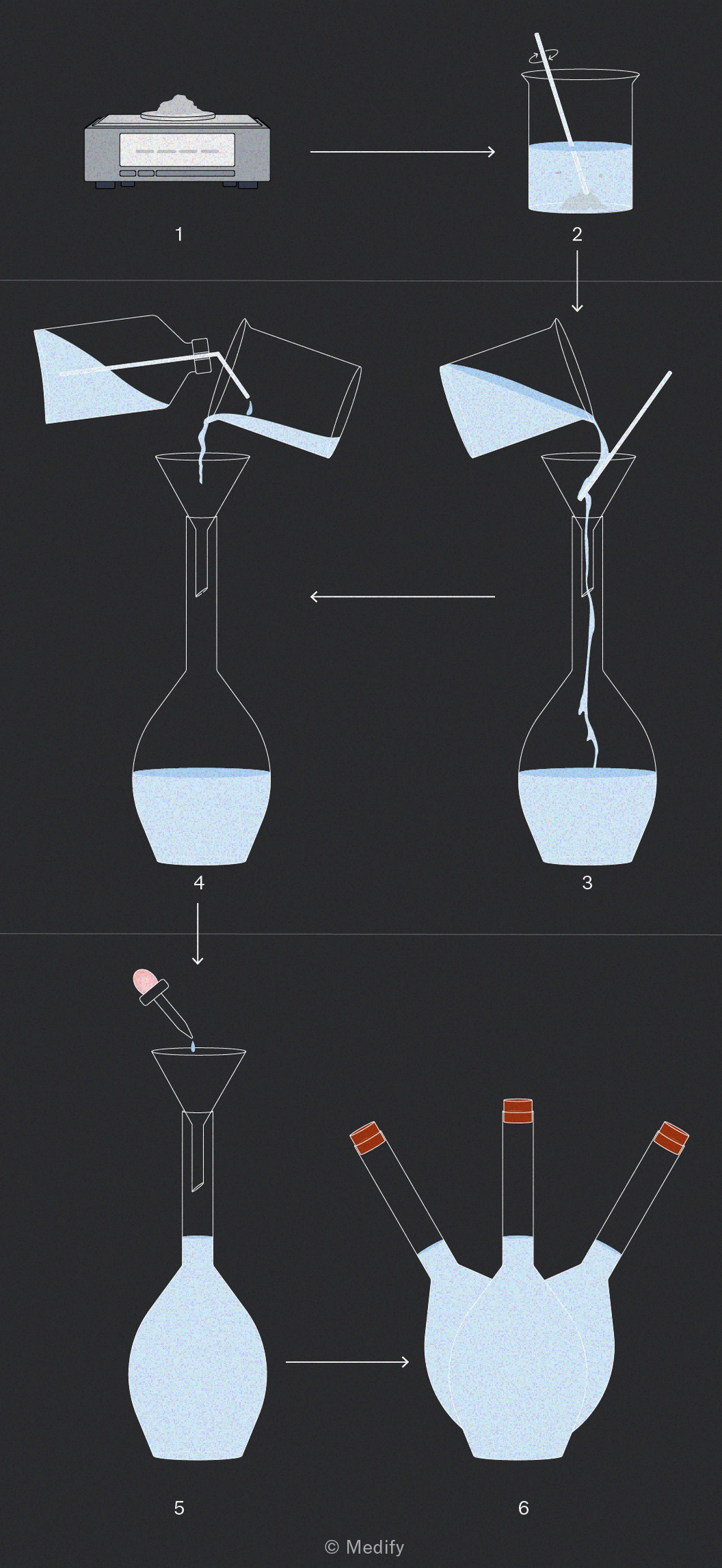
The preparation of a standard solution involves the following steps:
- Calculate the mass of solute required to achieve the desired concentration and weigh on an analytical balance.
- Transfer the solute to a clean beaker and add a small amount of solvent (distilled water). Stir until fully dissolved. Ensure all solute is transferred by reweighing the empty weighing dish.
- Transfer the concentrated solution to the volumetric flask using a glass funnel.
- Rinse the beaker, stirring rod and funnel with solvent (distilled water) and add washings to the volumetric flask. This ensures complete transfer of solute.
- Fill the volumetric flask with solvent to the fill line. Use a pipette for the final addition to improve accuracy. Ensure the meniscus is viewed at eye level while doing this.
- Stopper the volumetric flask and slowly invert sideways two to three times to thoroughly mix all the contents.
How to perform an acid–base titration
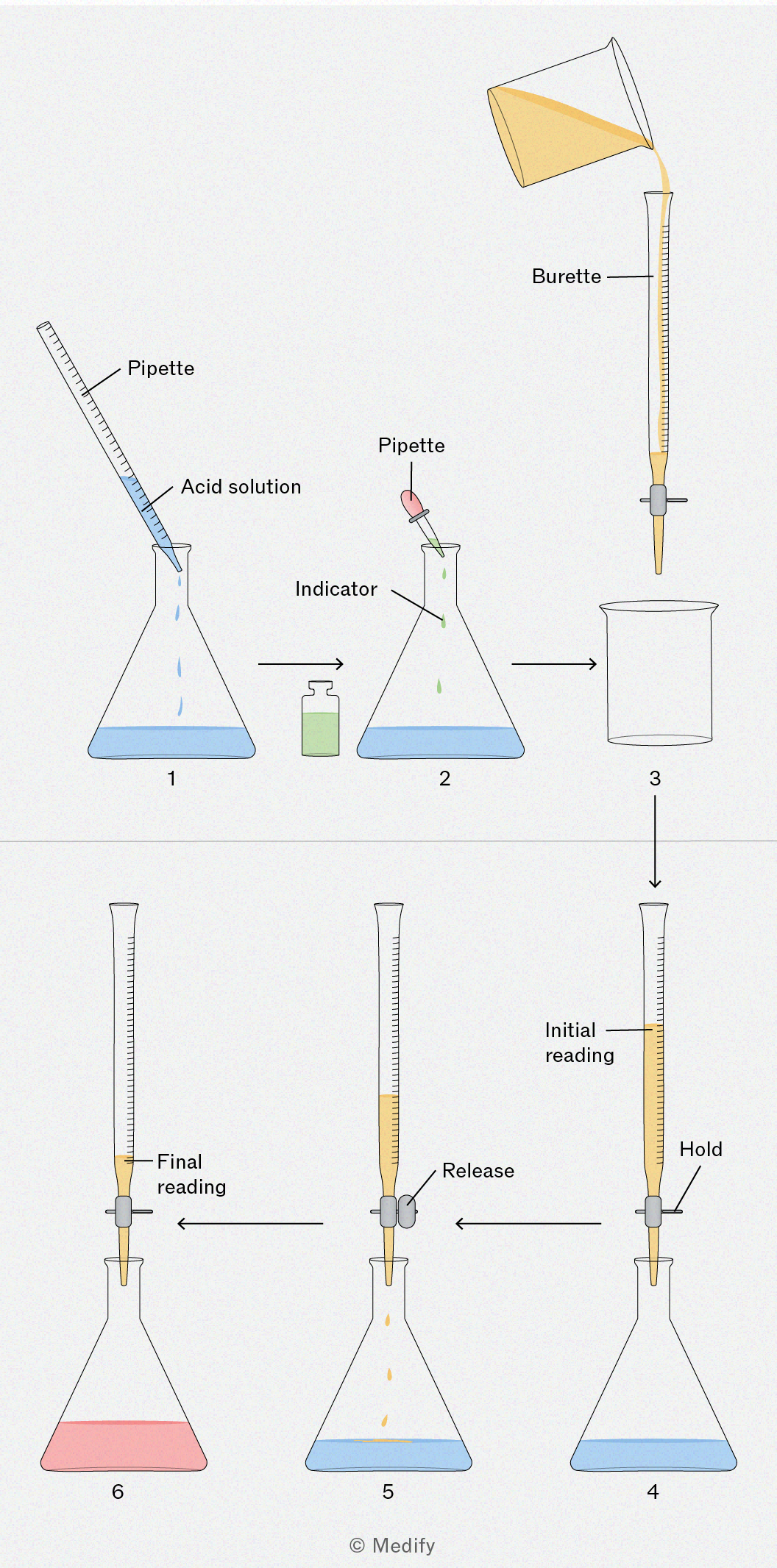
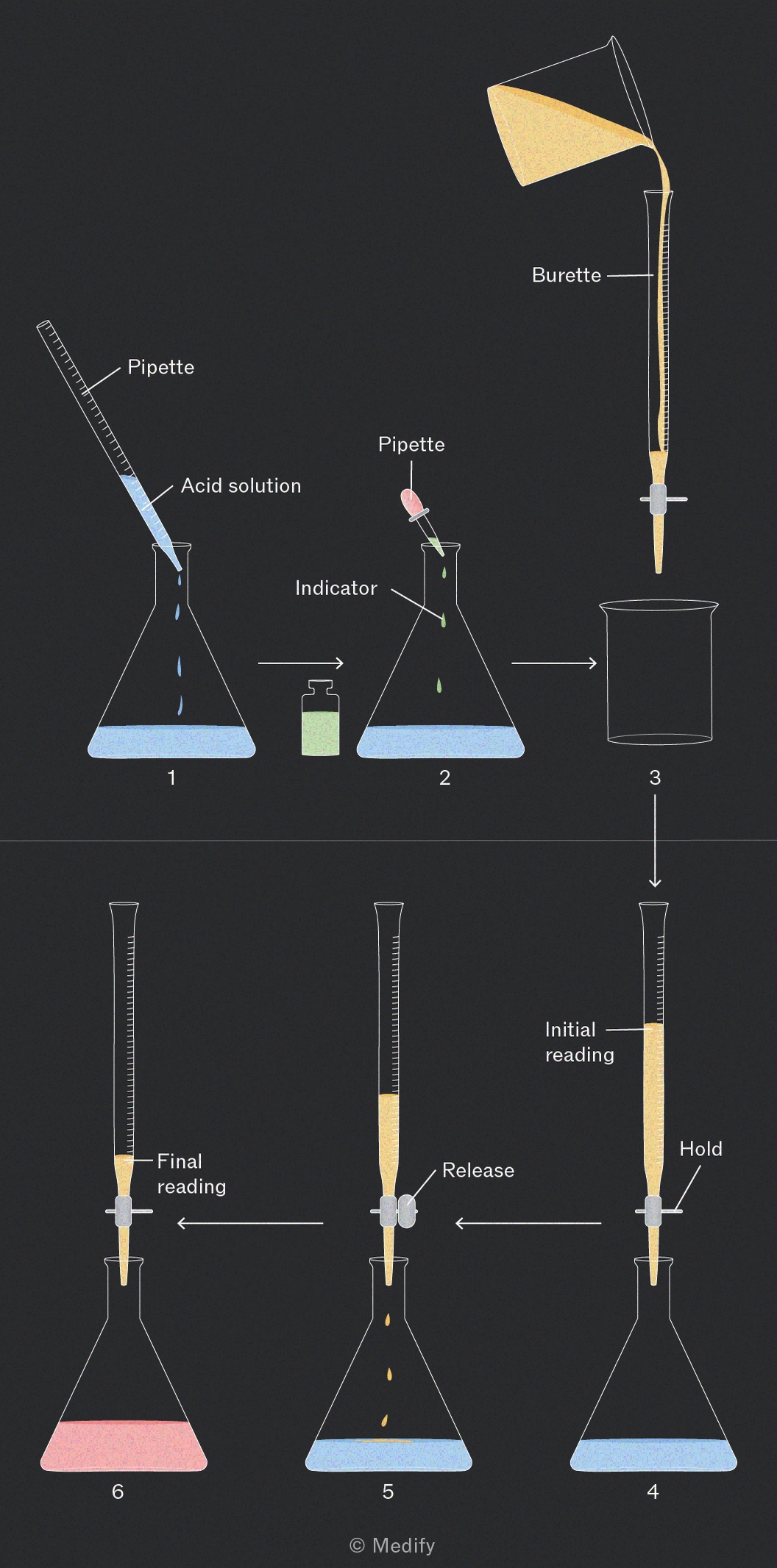
- Pipette a specific volume (usually 25 cm3) of the analyte solution into a conical flask. Gently touch the tip of the pipette to the flask to ensure all the solution is transferred.
- Add a few drops of indicator to the titration flask and gently swirl the mixture for a uniform distribution. Note the initial colour.
- Fill a 50 cm3 burette with the standard solution. Open the burette tap once to run the excess solution out into a beaker, removing any air bubbles forming in the burette. This ensures the titre volume does not include the volume of air.
- Note the initial burette reading V1, to the nearest 0.05 cm3, keeping your eye exactly horizontal to the level of the lower meniscus. This avoids the parallax error.
- Open the burette tap to slowly run the burette solution into the conical flask, while continuously swirling.
- Close the tap as soon as the titration mixture begins to change colour. Use a white tile underneath the flask to help observe the colour change. Add dropwise until the colour change is permanent. Note the final burette reading V2.
Calculate the volume (V) by subtracting V1 from V2.
V = V2 – V1
Repeat the process, until at least two titres are concordant, meaning they differ within 0.1 cm3 only. A mean titre can be taken for calculation.
In titration calculations, the volume of a standard solution of substance A at the endpoint can be used to calculate the moles of substance A involved in the reaction.
The stoichiometric mole ratio from the balanced chemical equation can then be used to find the moles of substance B.
The concentration of B, is determined using the calculated moles and the volume of solution B at the endpoint.
The number of moles () of an acid or base in a solution are related to the solution volume () and concentration () by the formula:
where:
- = number of moles (in ),
- = concentration (in ),
- = volume (in ).
You often need to convert from to for these questions by dividing by 1000.
titration curves represent the change in as an acid is incrementally neutralised by a base, or vice versa.
Titration curves are crucial for understanding the neutralisation process and for selecting appropriate indicators to determine the endpoint of a titration.
Strong acid with strong base
Example: Hydrochloric acid () titrated with sodium hydroxide ().
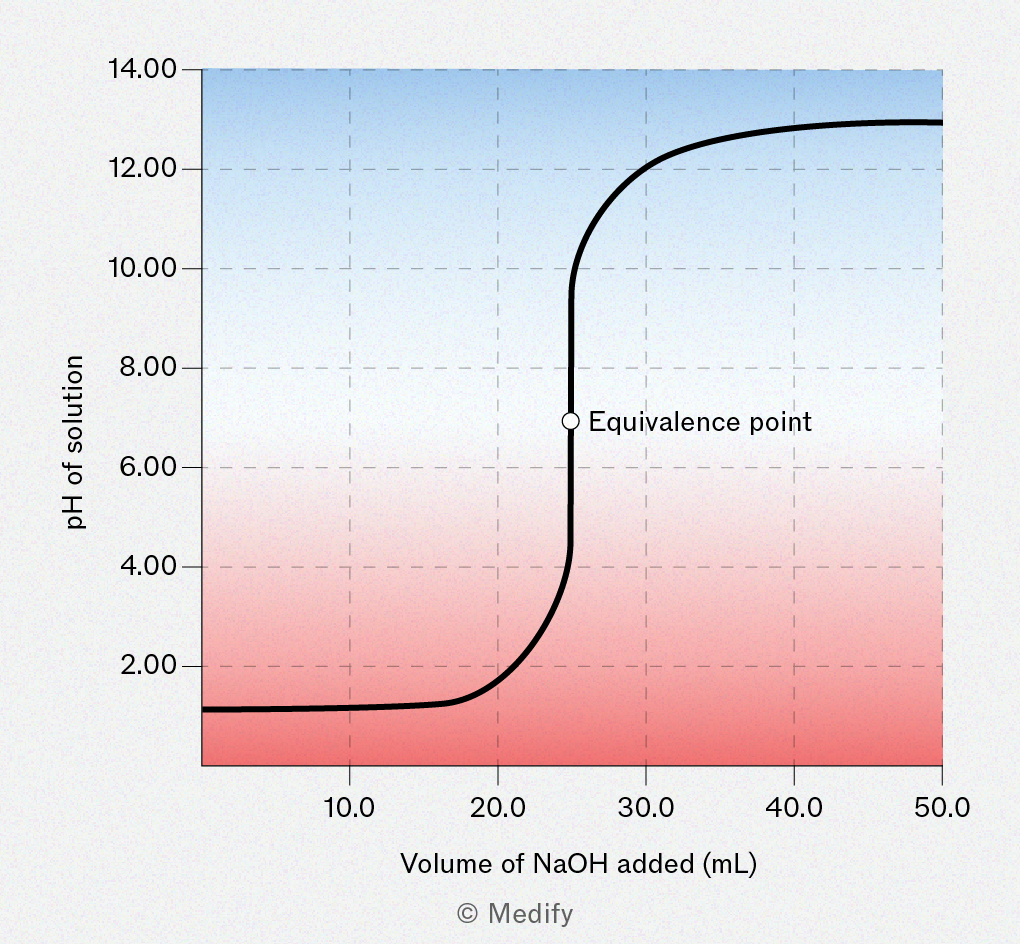
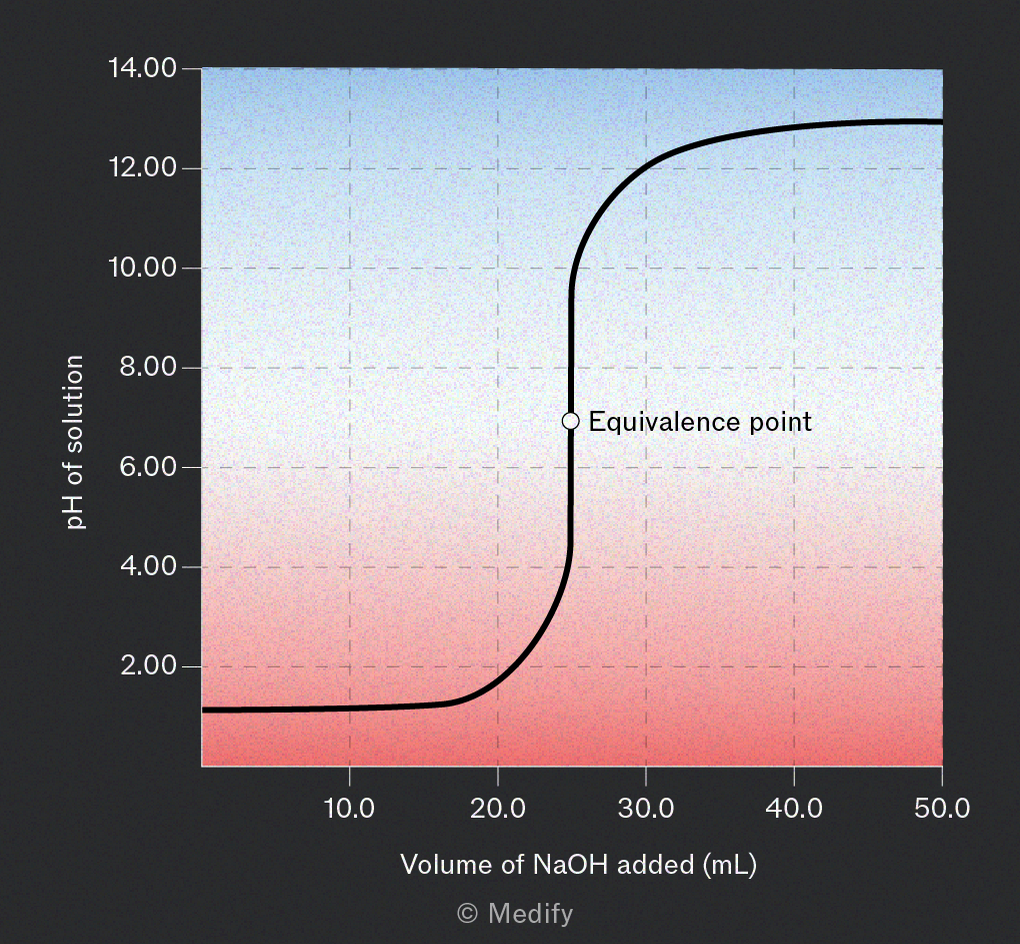
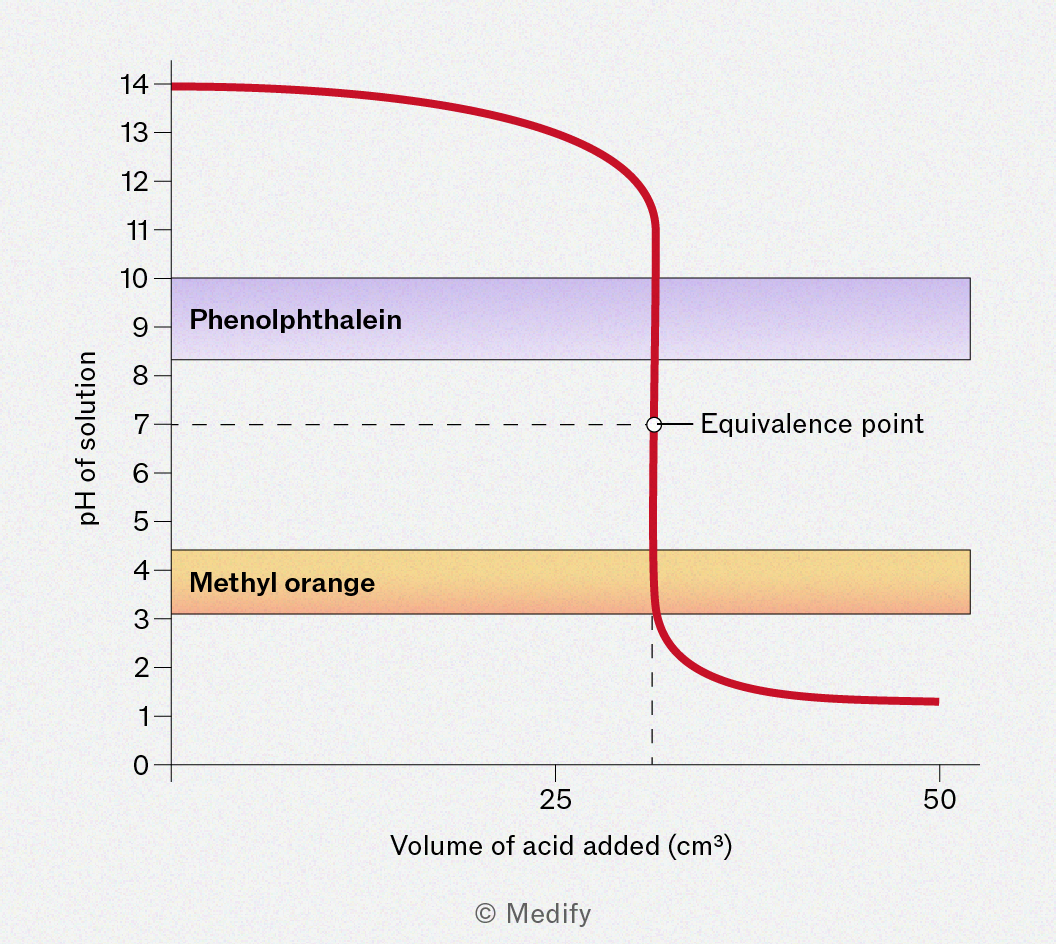
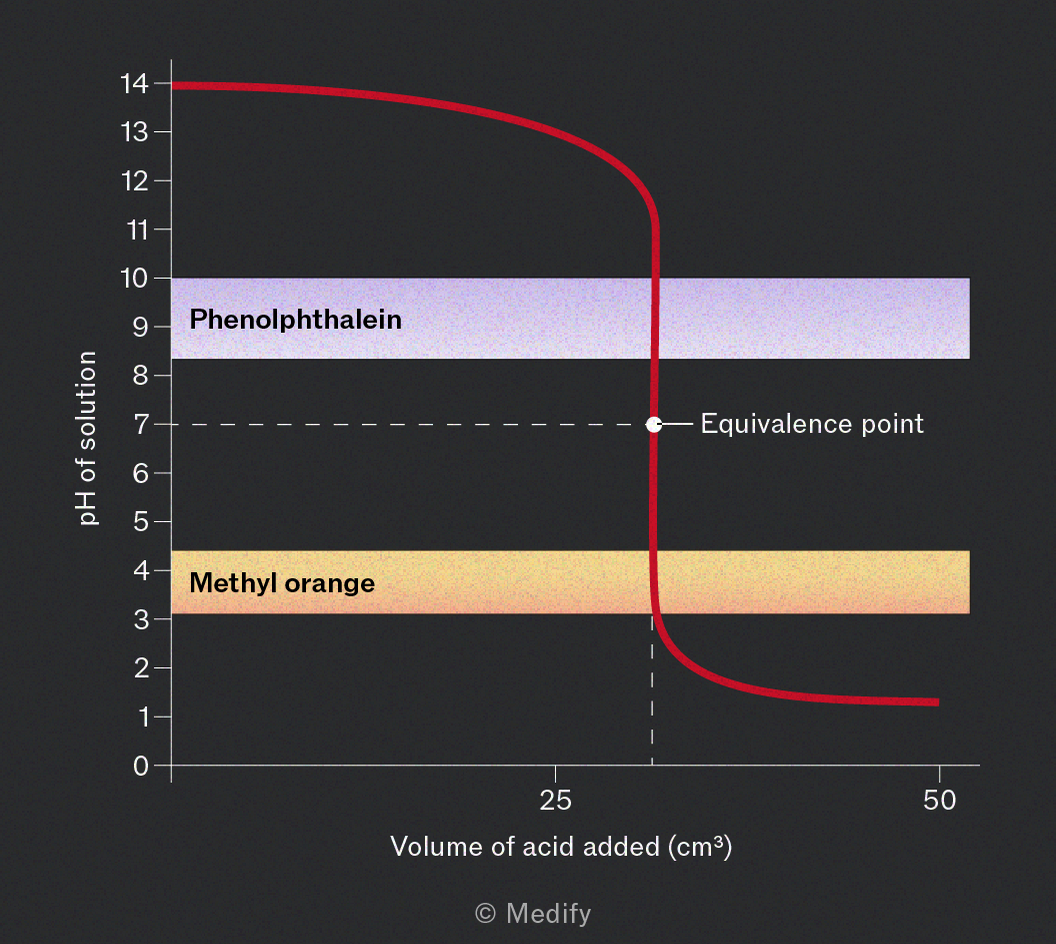
Starts at a low (strong acid), rises slowly initially, then steeply at the point of neutralisation.
There are a range of values which can represent neutralisation centring at an equivalence point of 7.
Following neutralisation the quickly levels off at a high .
Weak base with a strong acid
Example: Ammonia () titrated with .
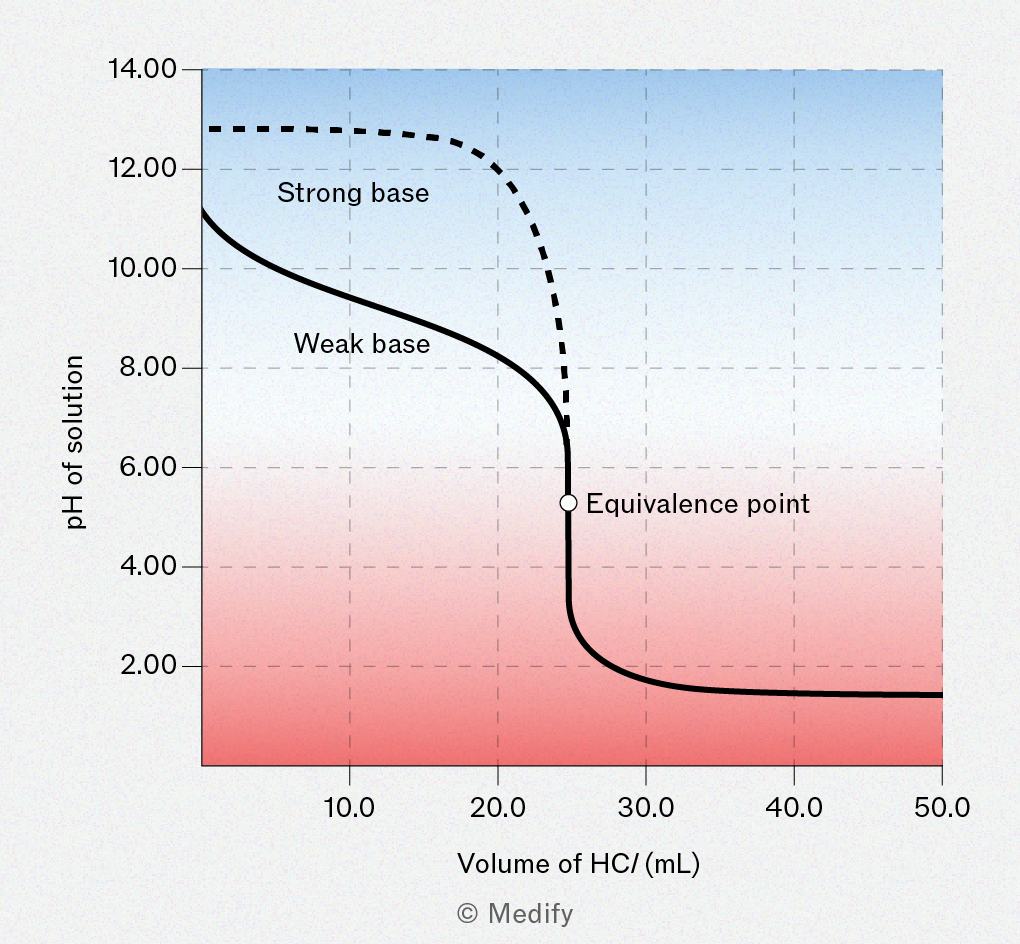
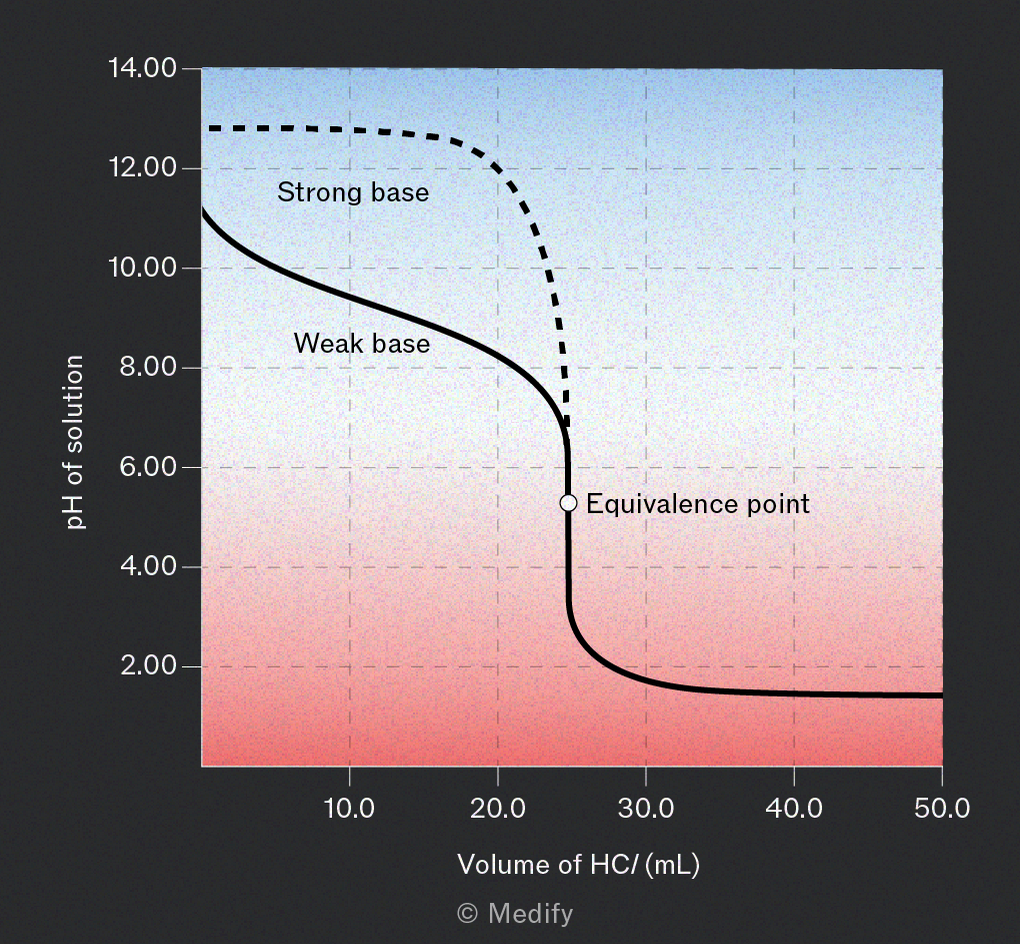
Starts at a lower than a strong base, initially falls gradually then remains steady for a period of acid addition. This is the buffer region; the solution contains a mixture of the weak base and its conjugate acid.
There is then a sharp fall near the point of neutralisation. There are a range of values which can represent neutralisation centering at an equivalence point of below .
The levels off at a low value quickly following neutralisation.
Weak acid with strong base
Example: Ethanoic acid () titrated with ().
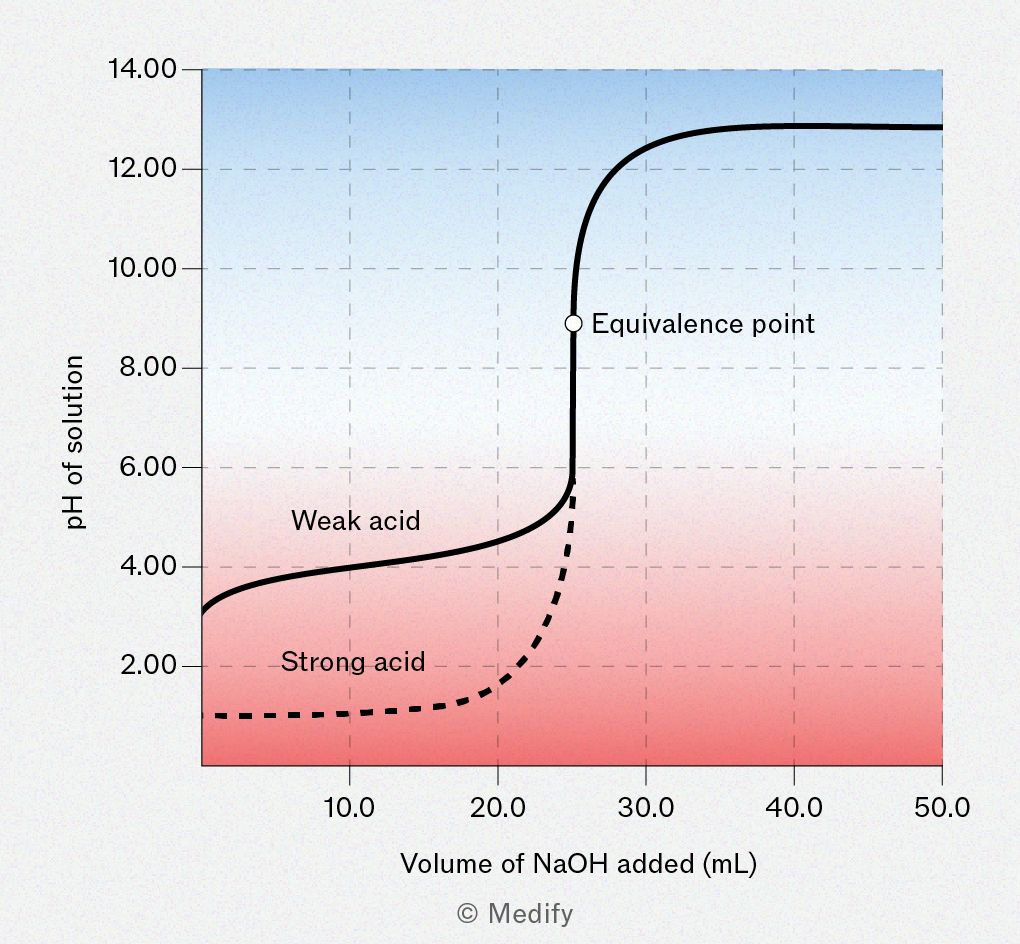
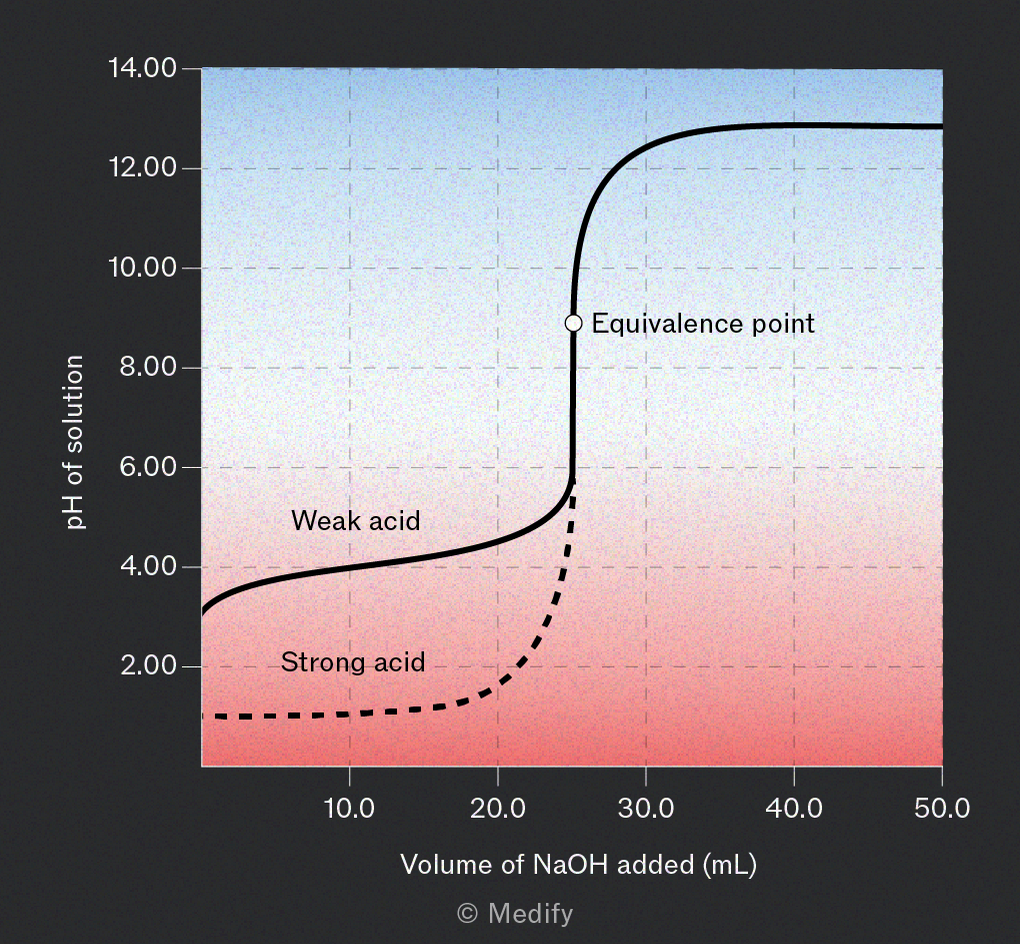
Starts at a higher than a strong acid. rises gradually initially then remains steady for a period of base addition. This is the buffer region; the solution contains a mixture of the weak acid and its conjugate base.
There is a steep increase in as the neutralisation point approaches. There are a range of values which can represent neutralisation centering at an equivalence point above .
Following neutralisation, the quickly levels off at a high .
Weak base with weak acid
Example: Ammonia () titrated with ethanoic acid ().
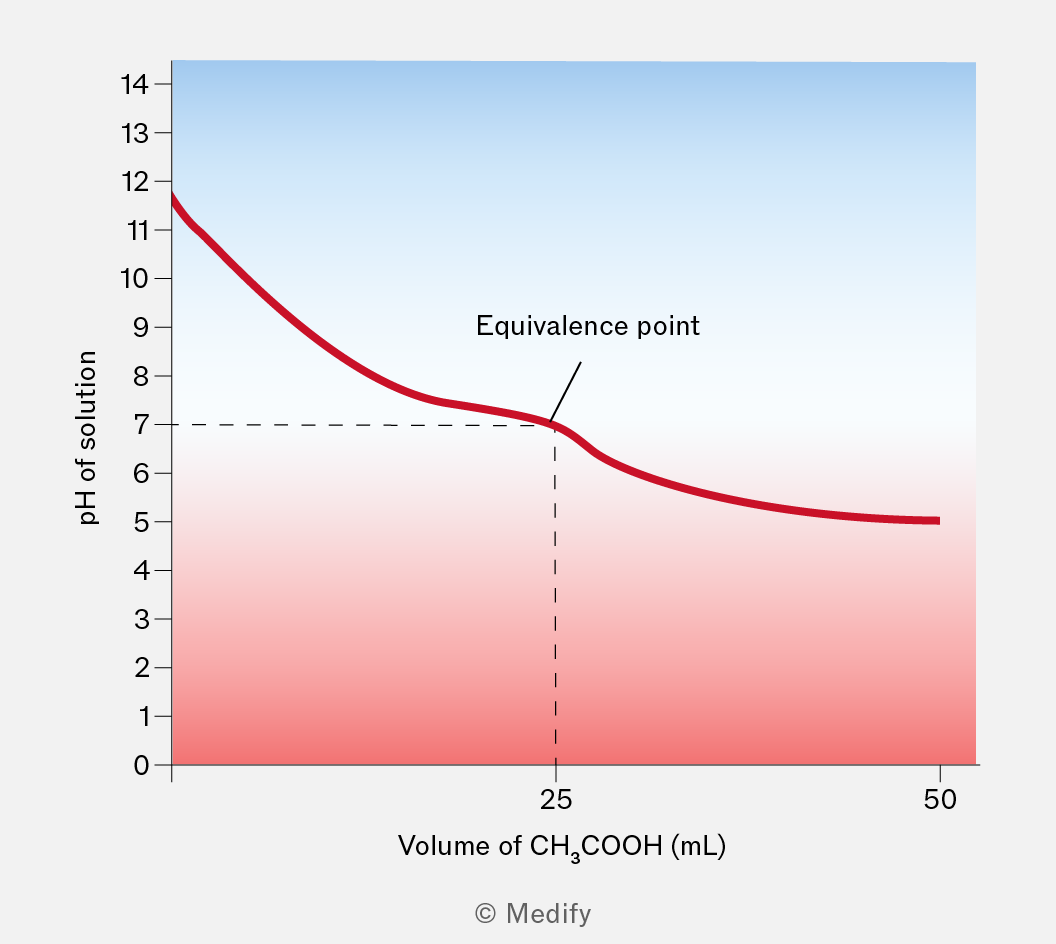
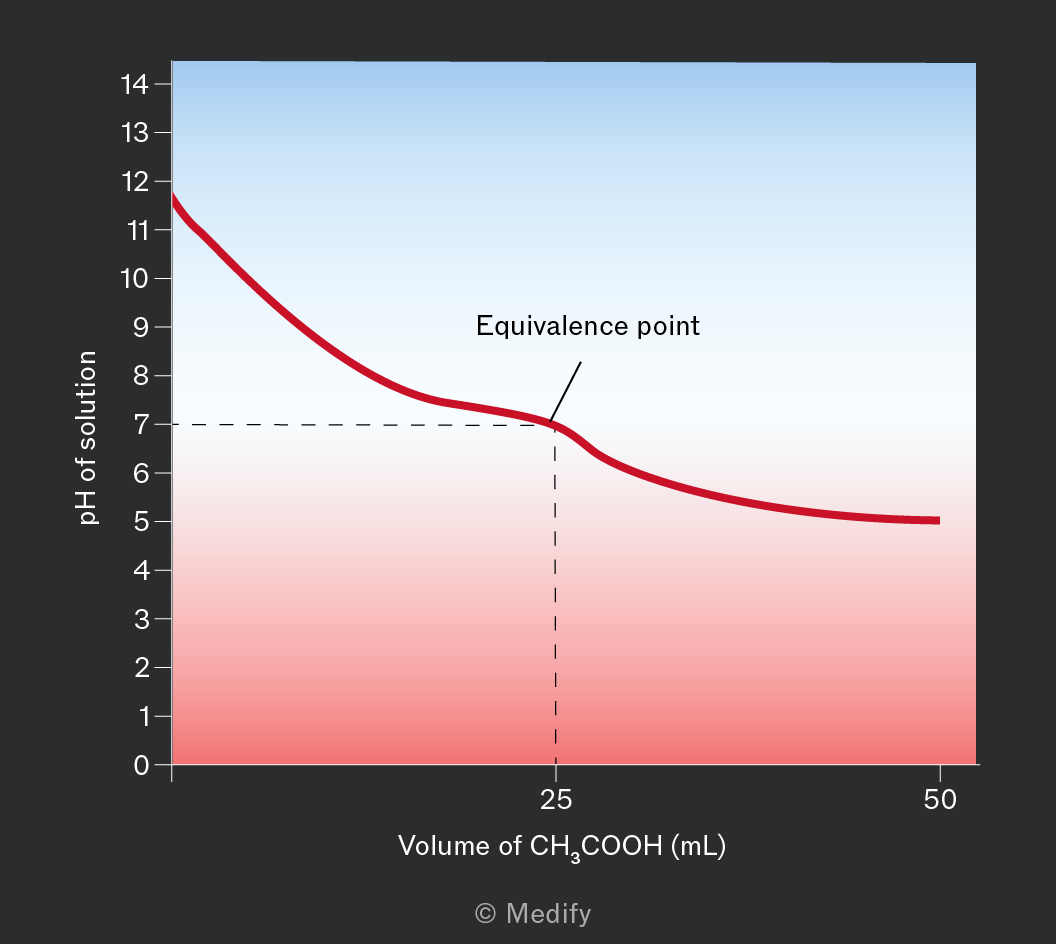
Starts at a lower than a strong base and steadily reduced as the solution approaches neutralisation.
There is only a short range of values, centred around , which can be used to indicate neutralisation.
Following neutralisation the continues to fall gradually.
At the point of neutralisation there is a steep change in . The midpoint of this range is the equivalence point.
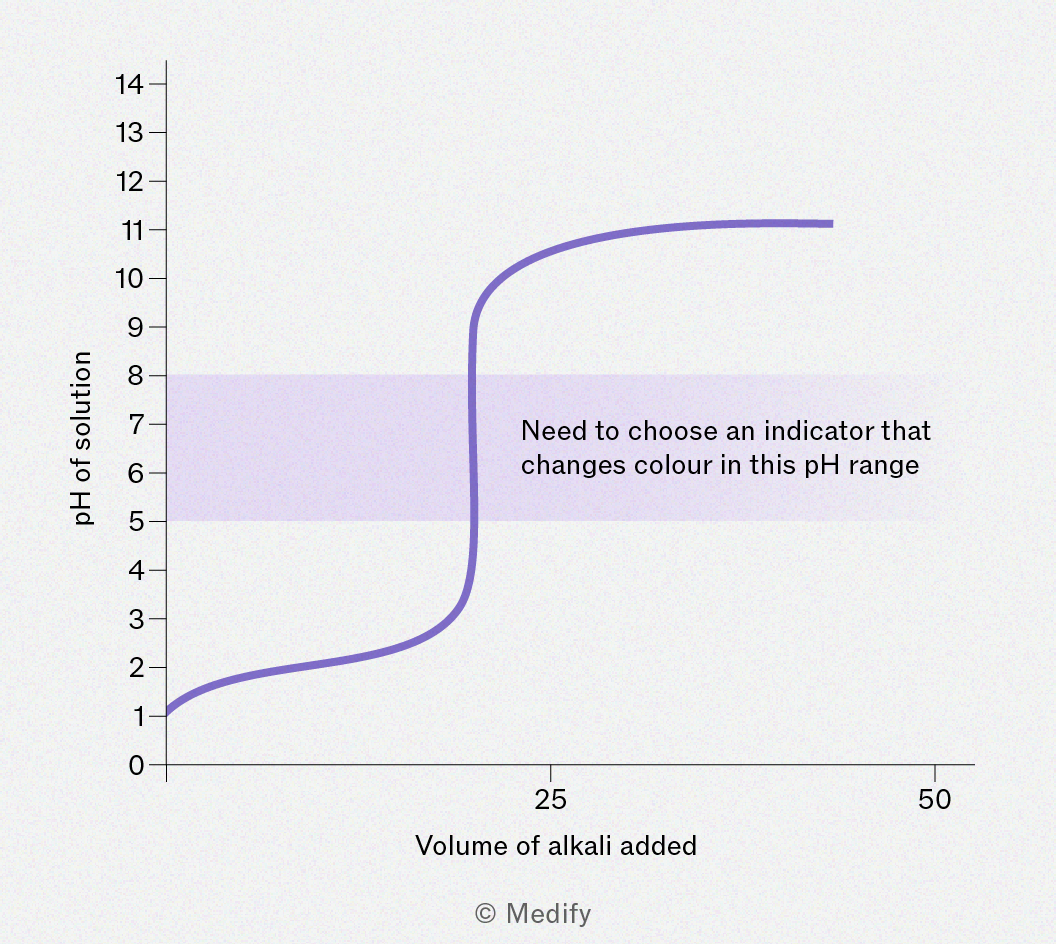
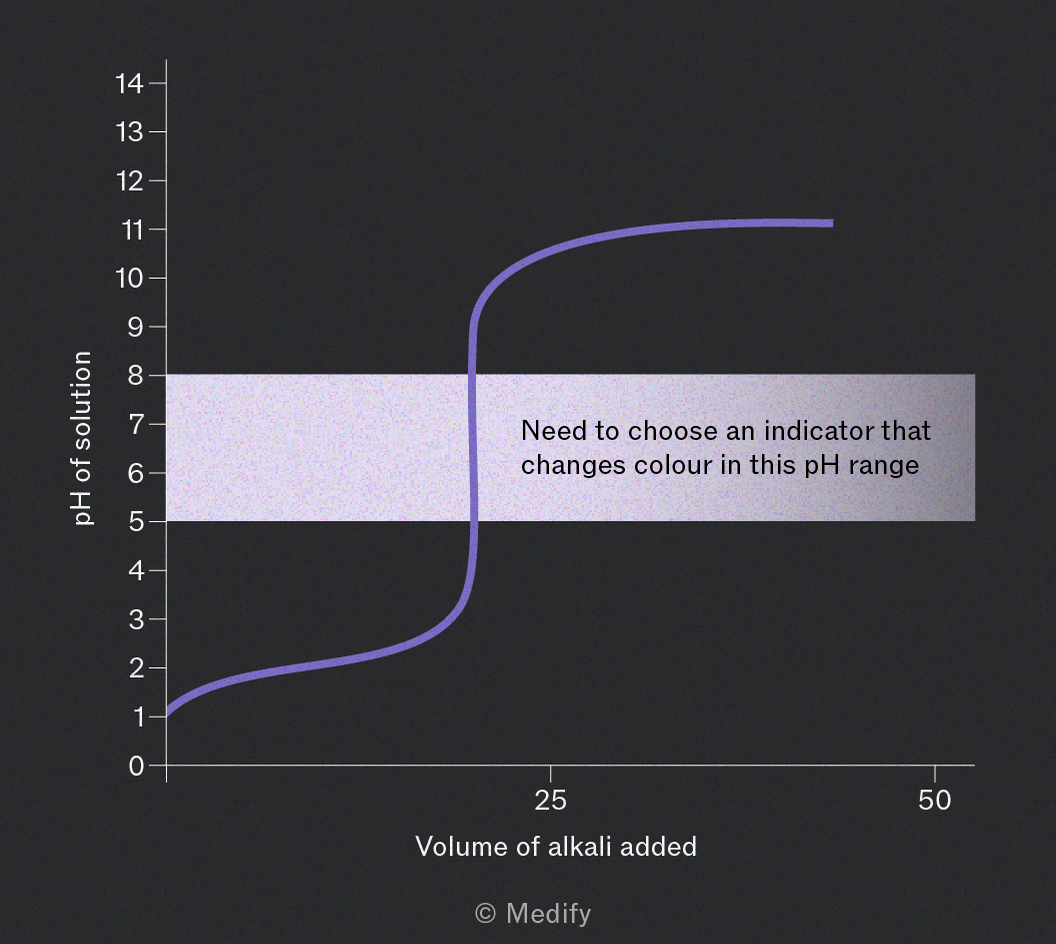
In order for an indicator to be effective at identifying the endpoint of a neutralisation reaction it must exhibit a colour change within the range of the steep change of .
The best indicators will exhibit a change at, or very close to, the equivalence point .
Suitable indicator for a strong acid/strong base titration
The range around the equivalence point is typically wide, from around .
Use indicators with a colour change at a within this range, such as phenolphthalein or methyl orange ().
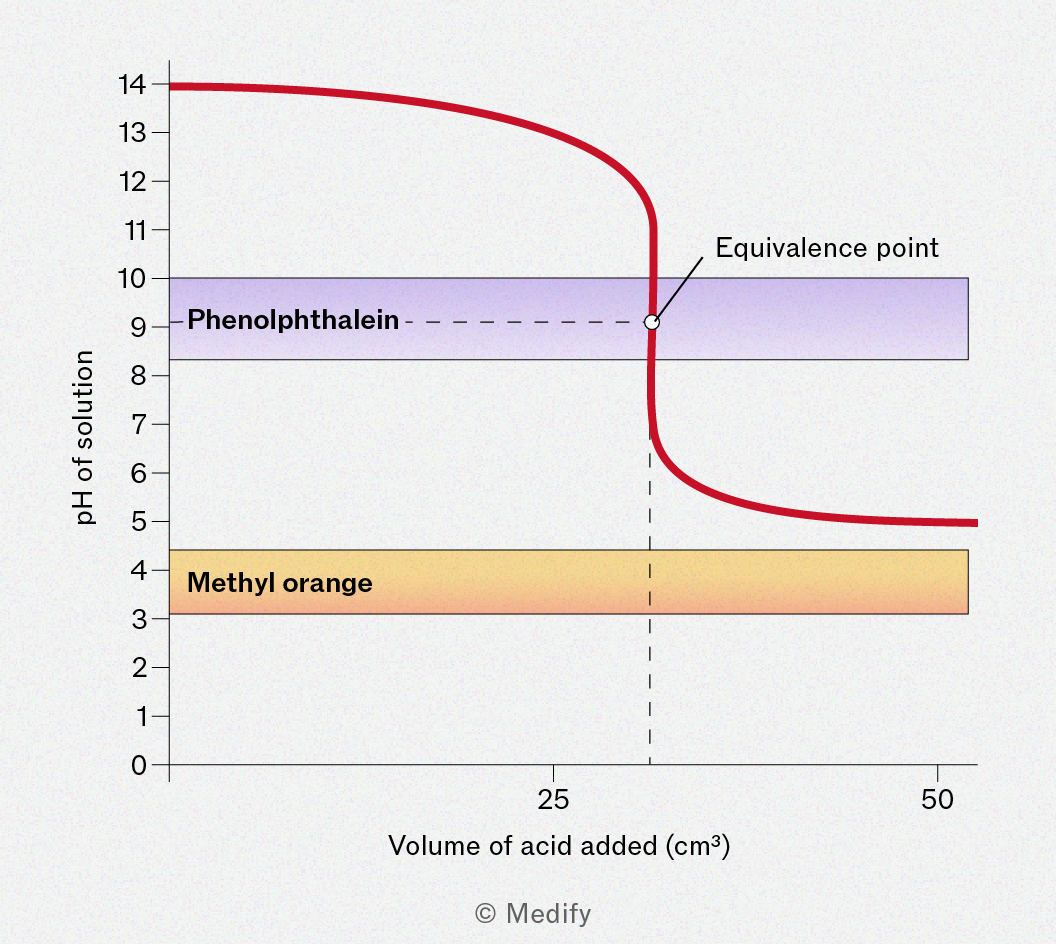
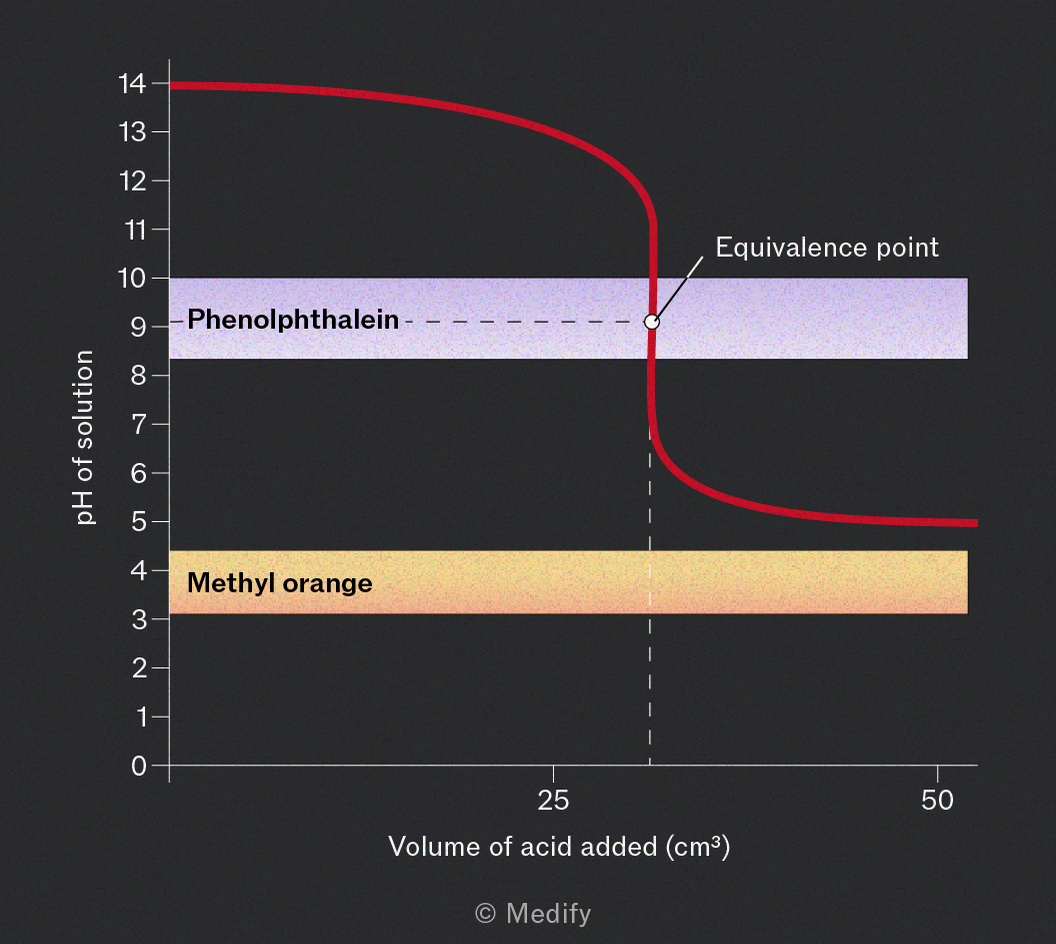
Suitable indicator for a weak acid/strong base titration
The range around the equivalence point is typically narrower and at a higher equivalence point than a strong acid/strong base titration. It is around .
Use indicators with a colour change at a range above 7, such as phenolphthalein ().
Suitable indicator for a strong acid/weak base titration
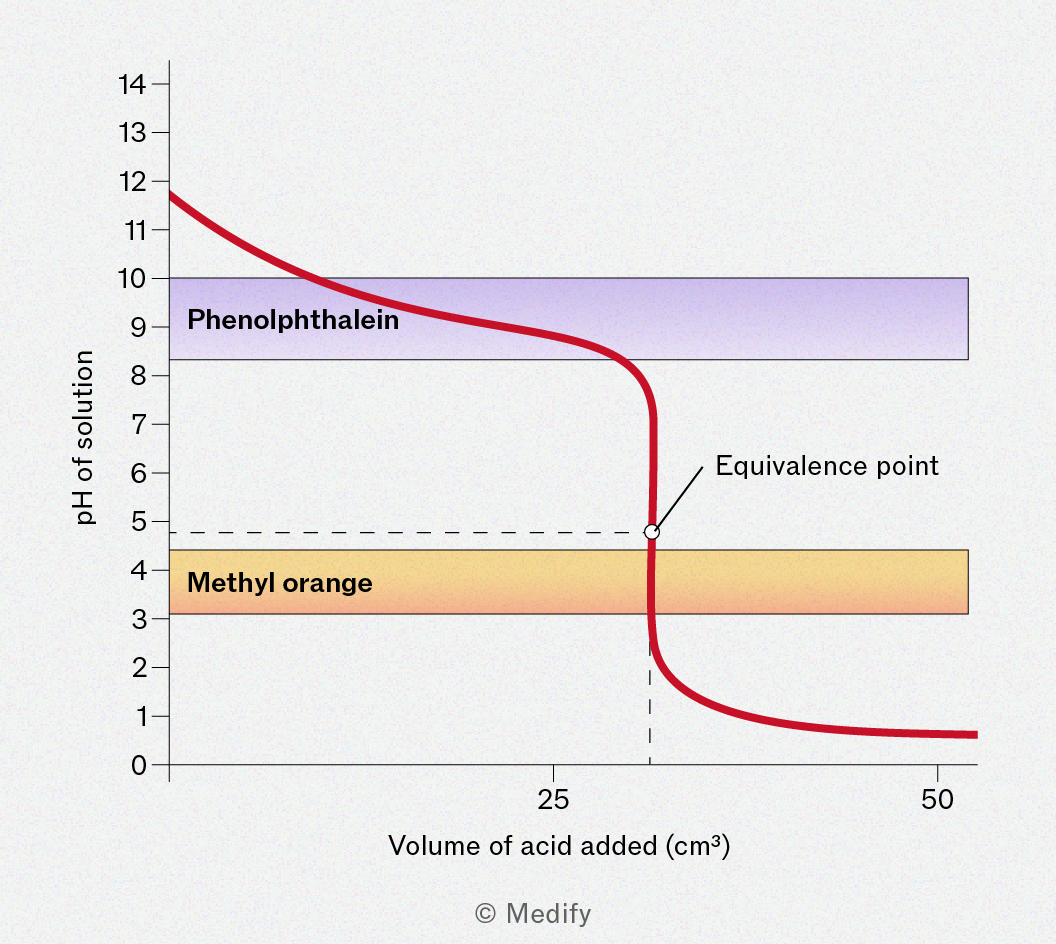
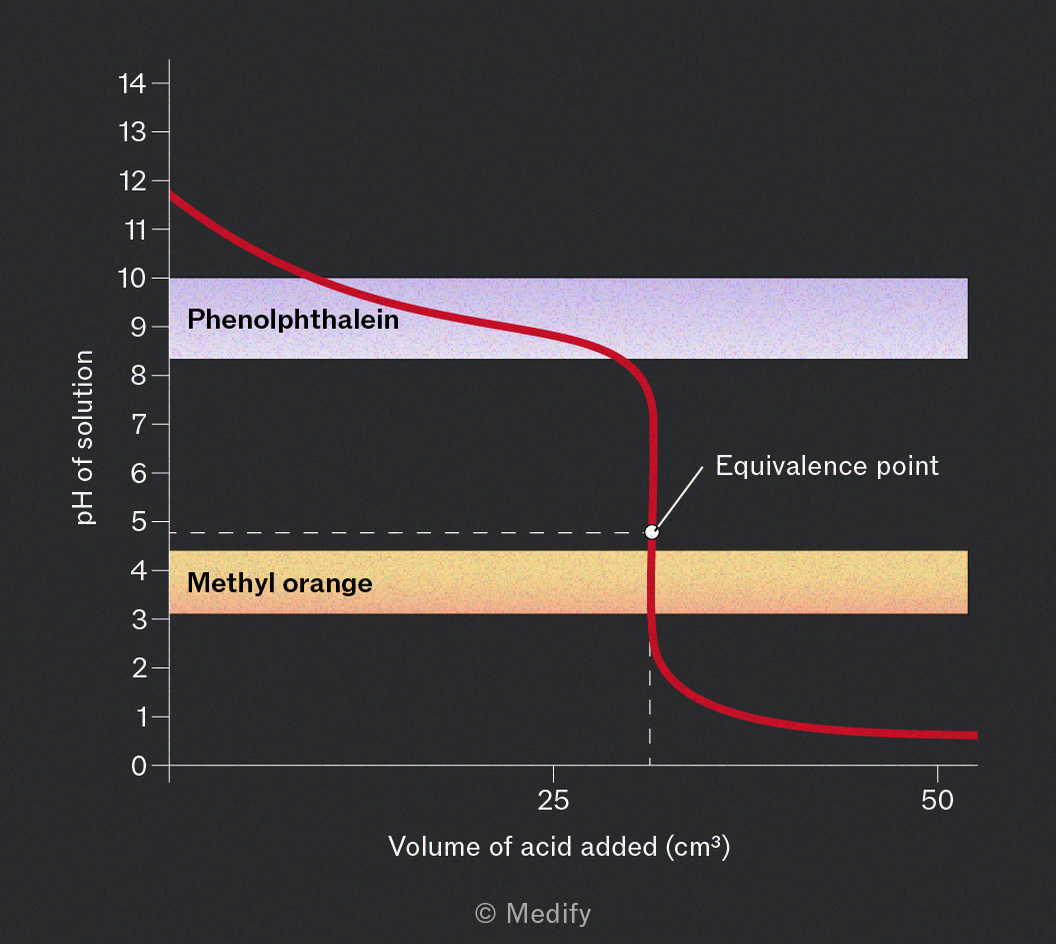
The range around the equivalence point is typically narrower and at a lower equivalence point than a strong acid/strong base titration. It is around .
Use indicators with a colour change at a range below 7, such as methyl orange ().
There is no suitable indicator for titrations of weak acids with weak bases, as there is no sharp equivalence point. As a result, these pairings are not used in quantitative analysis.
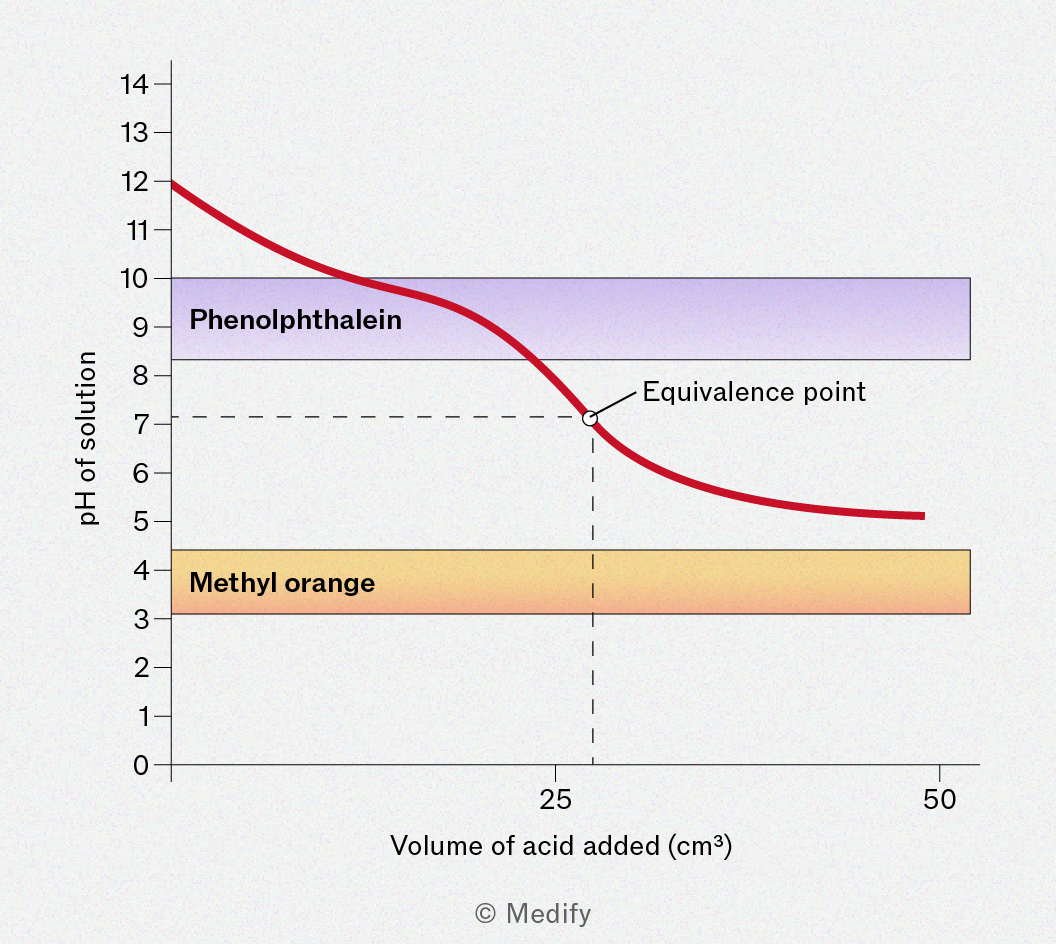
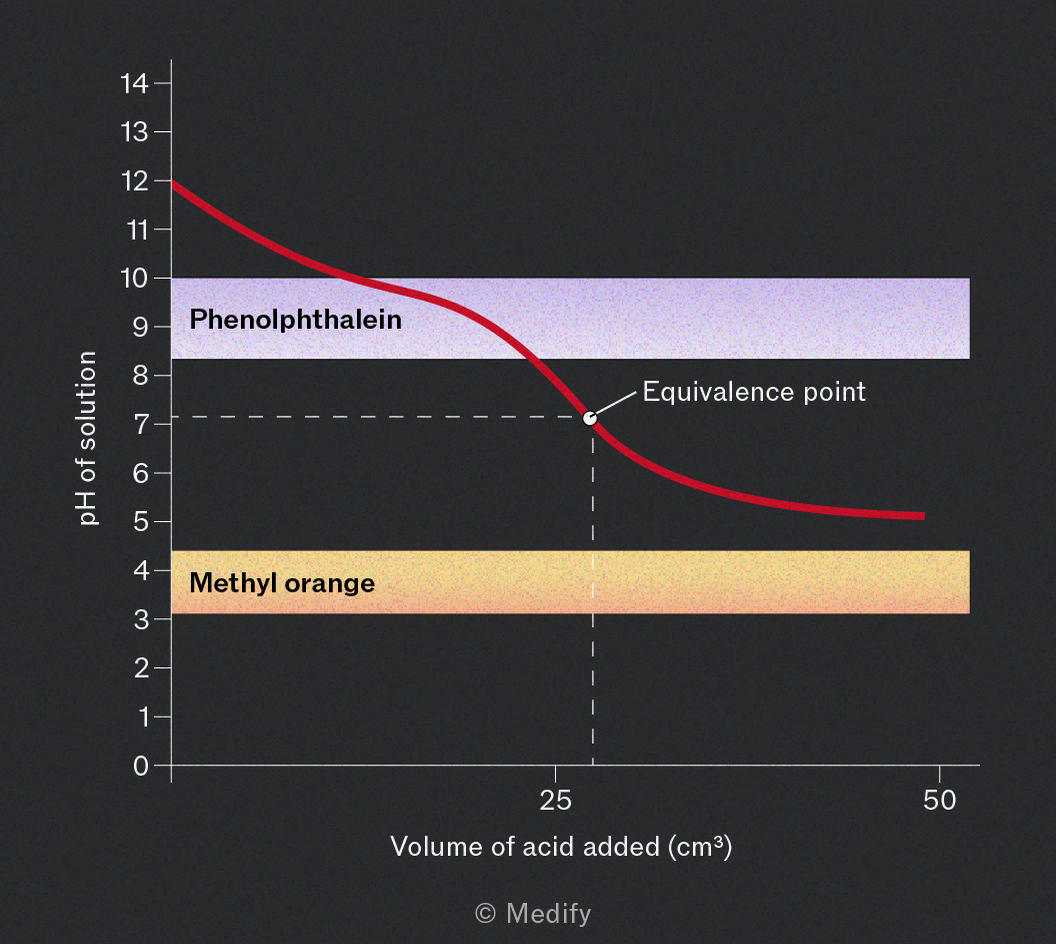
Indicators are weak acids () that change colour depending on the .
The range of over which the colour change is observed depends on the of the indicator.
Phenolphthalein is a commonly used indicator. It is colourless in acidic form () and pink in basic form ().
Acidic solution:
- High , equilibrium shifts left.
- predominates, the solution is colourless.
Basic solution:
- Low , equilibrium shifts right.
- predominates, the solution is pink.
A meter is an essential tool in chemistry labs for quantitatively measuring the acidity or alkalinity of a solution.
Accurate measurements are crucial in various fields, including biochemistry, environmental science, and medicine.
In a weak acid–strong base titration, the buffer action can be seen in the initial part of the titration curve, where there is a gradual change in pH.
This region is known as the buffer region, which occurs before reaching the equivalence point.
In the buffer region, the weak acid is partially neutralised by the strong base, forming its conjugate base.
The presence of both and in significant amounts allows the solution to resist changes in pH, demonstrating the buffer effect.
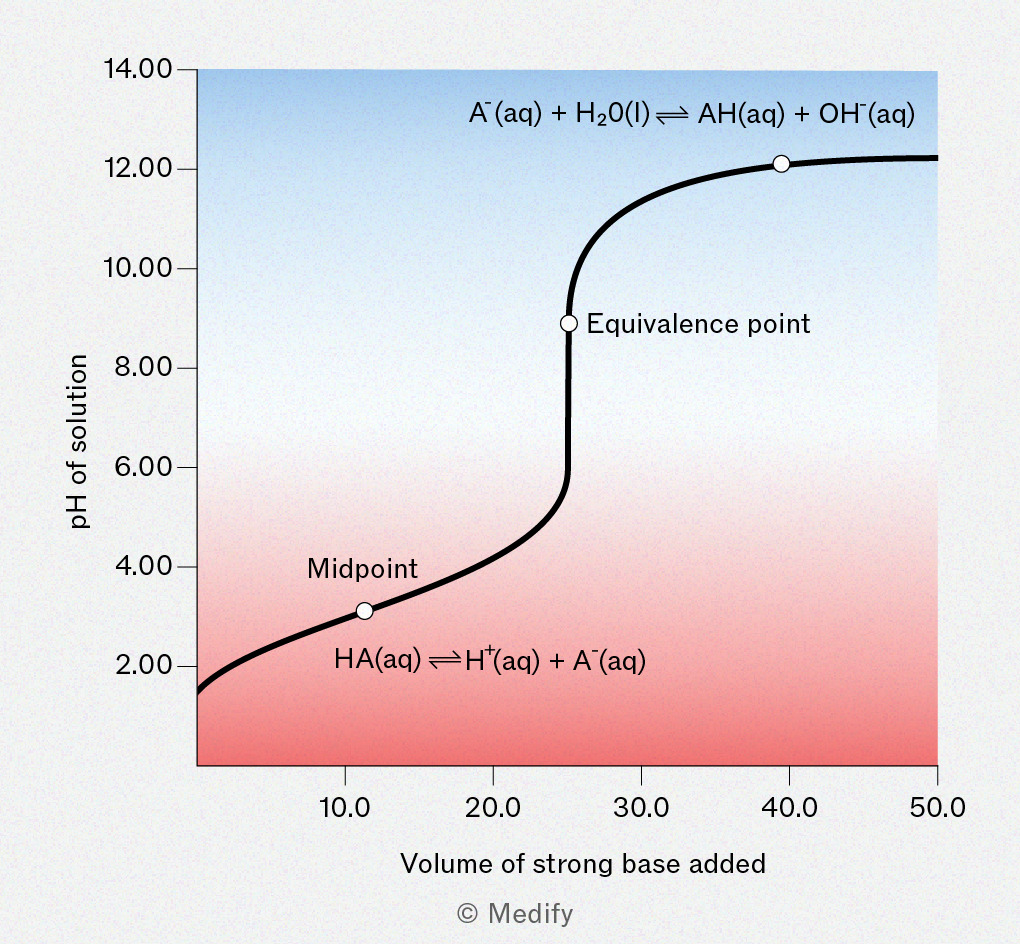
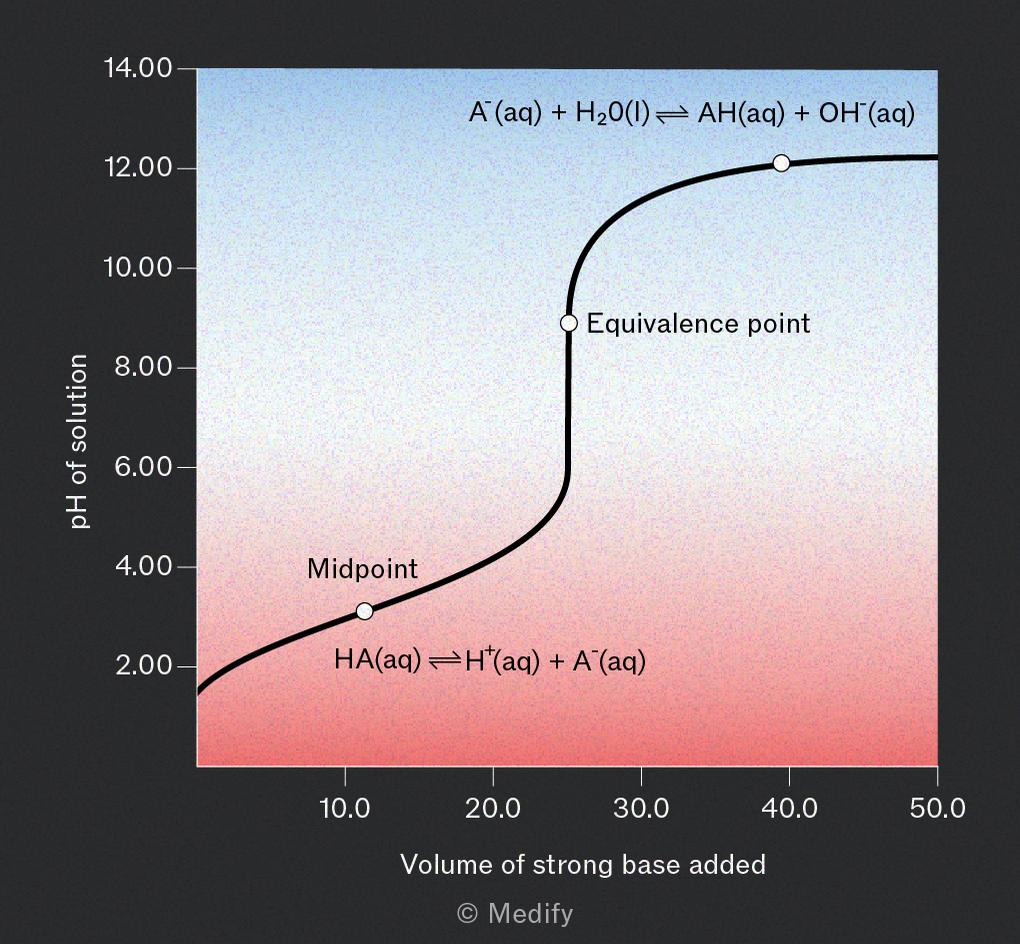
can be determined using the half-equivalence point, which is halfway to the equivalence point, where half the weak acid has been neutralised.
At the half-equivalence point:
therefore
To determine from the titration curve of a weak acid
- Identify the half-equivalence point on the titration curve.
- This is the point where half the volume of base required to reach the equivalence point has been added.
- Measure the at this point.
- Calculate
At the half-equivalence point:
therefore