The periodic table
On this page
The periodic table is a fundamental tool in chemistry that organises the elements based on their atomic number, creating a systematic arrangement that reveals patterns in their properties and reactivity.
These repeating patterns are known as periodicity.
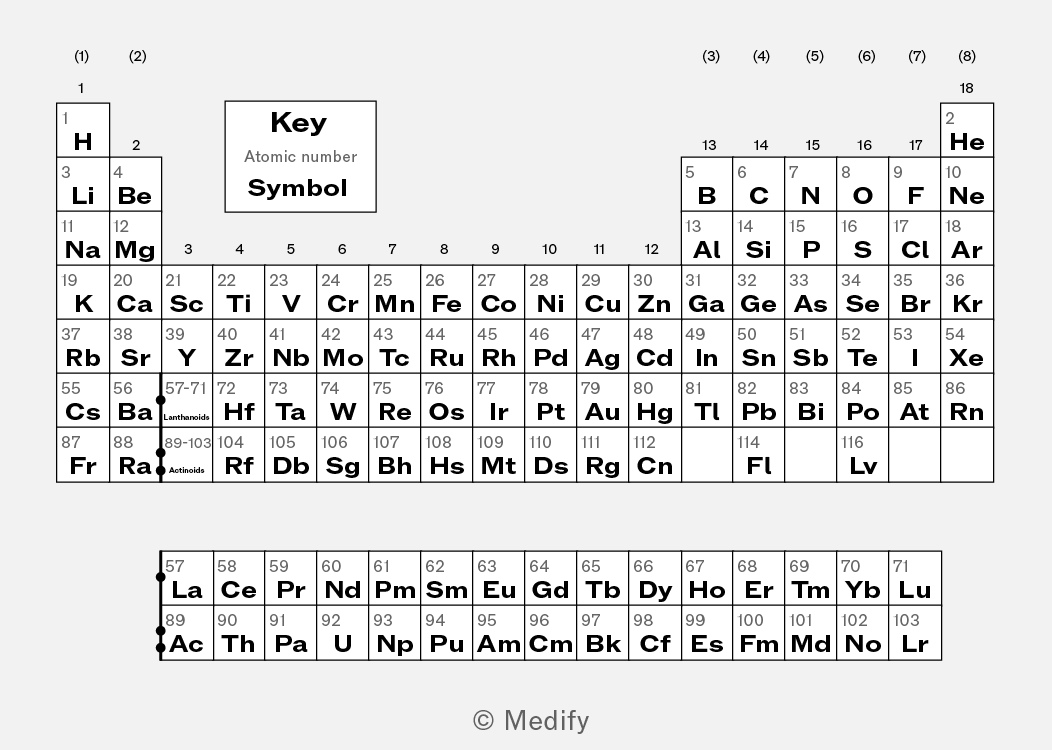
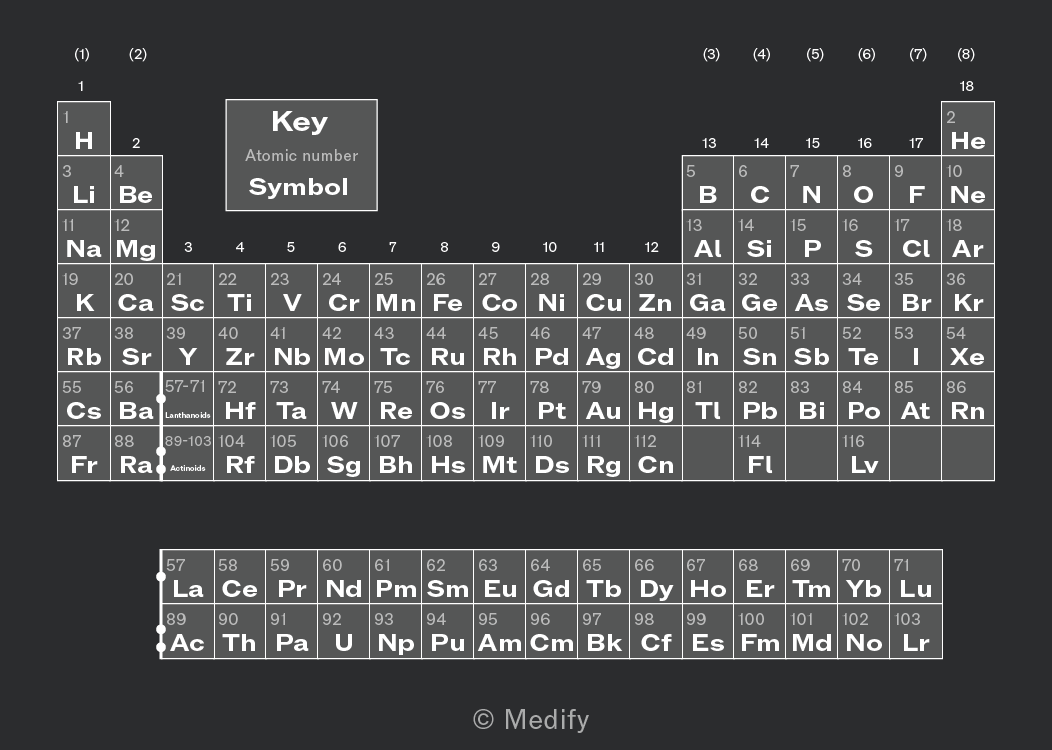
The atomic number represents the number of protons in the nucleus of an atom.
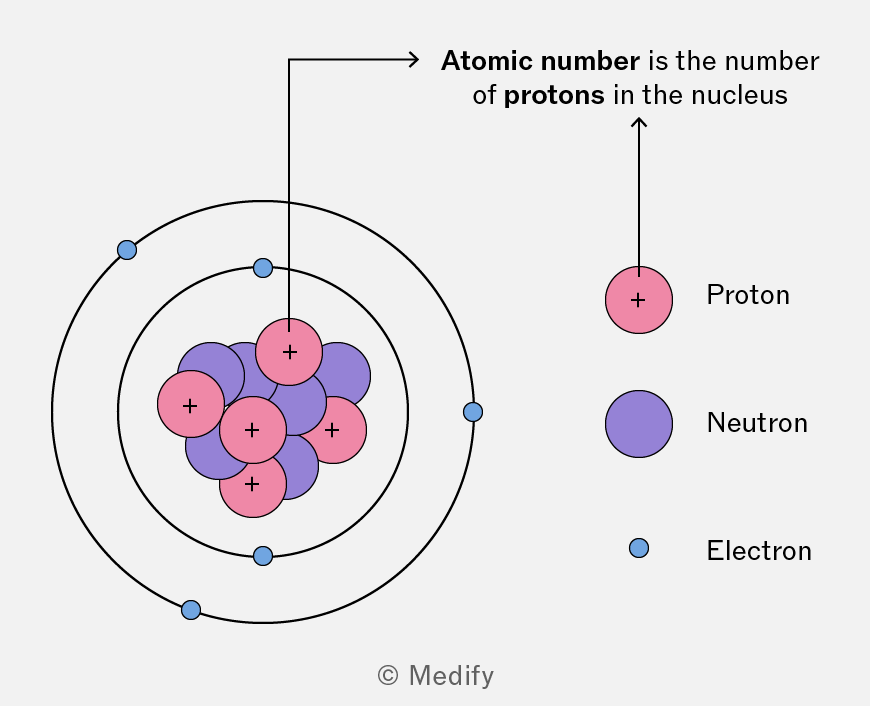
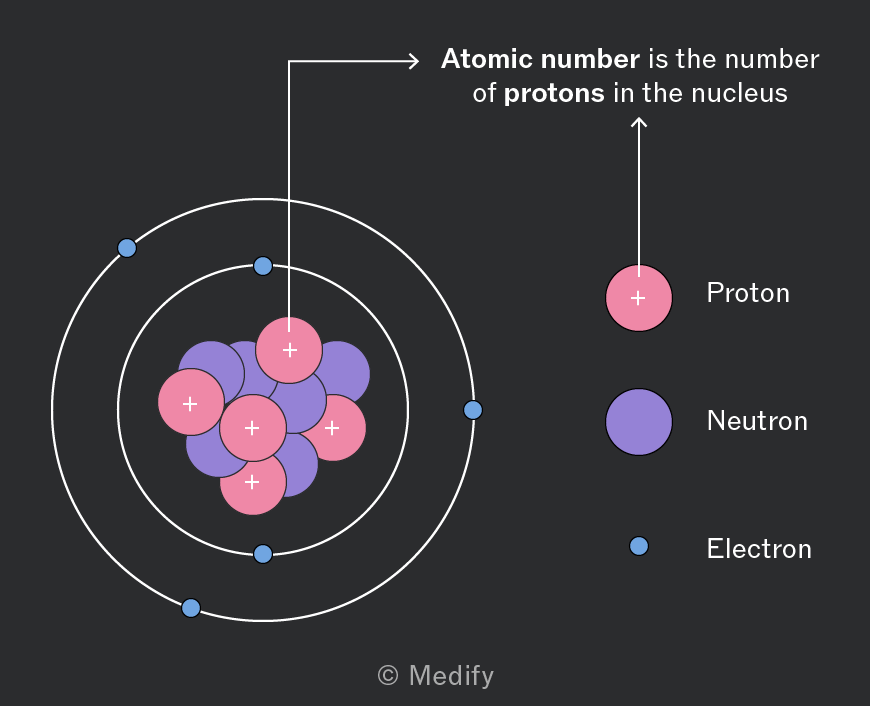
It is a unique identifier for each element and is a fundamental factor in the organisation of the periodic table.
Elements are arranged in increasing order of atomic number from left to right.
The periodic table is divided into rows called periods.
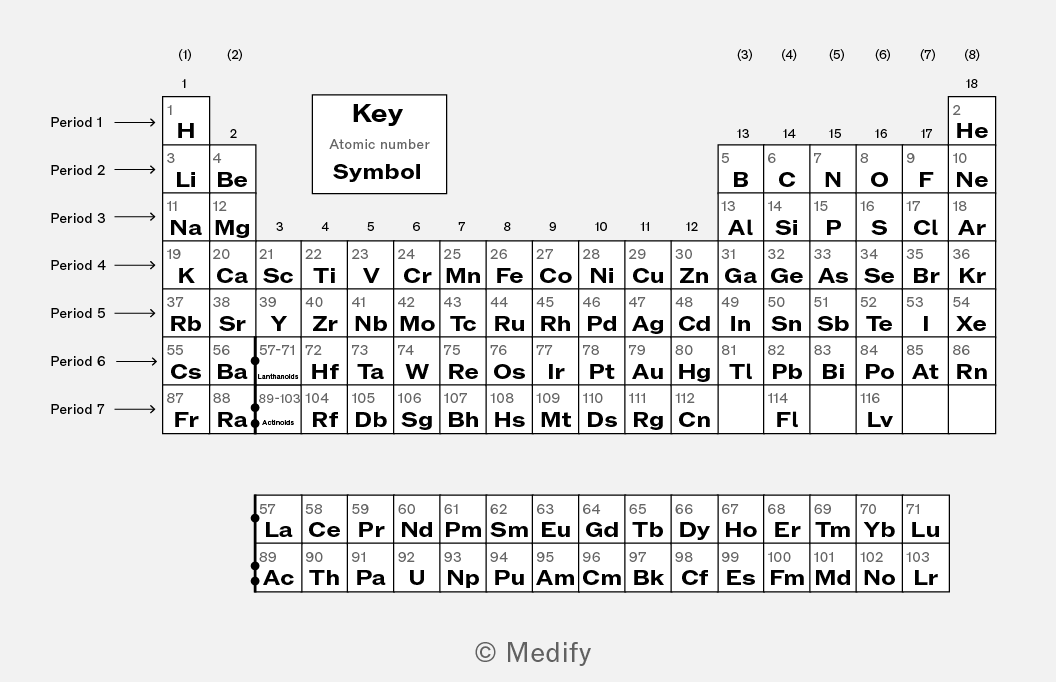
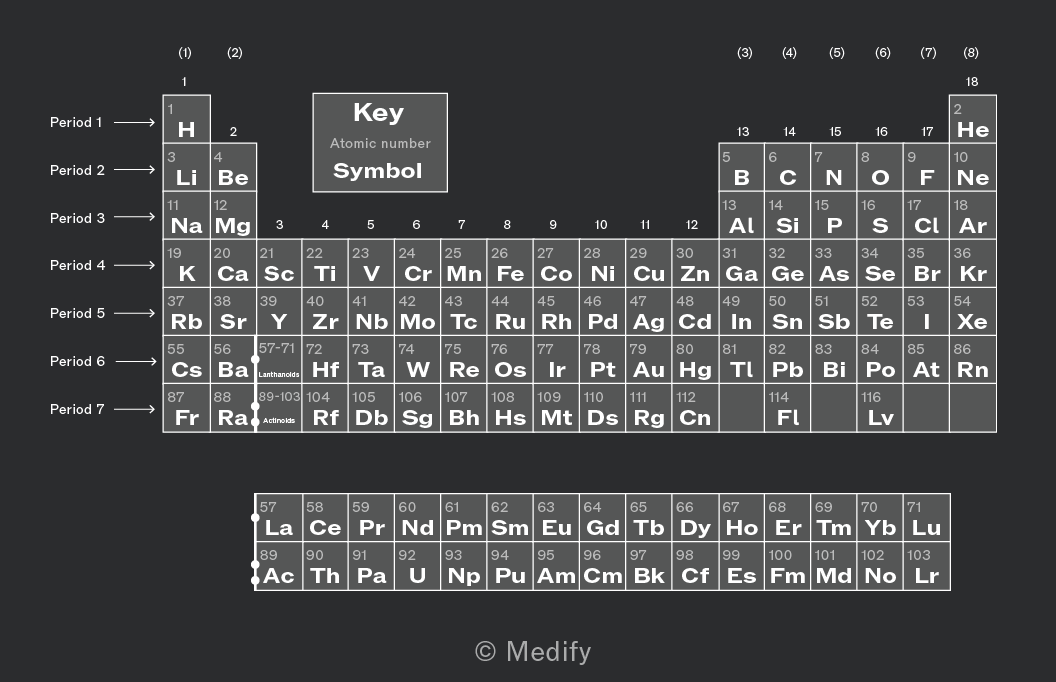
There are a total of seven periods.
Elements in the same period have the same number of electron shells.
Columns in the periodic table are known as groups.
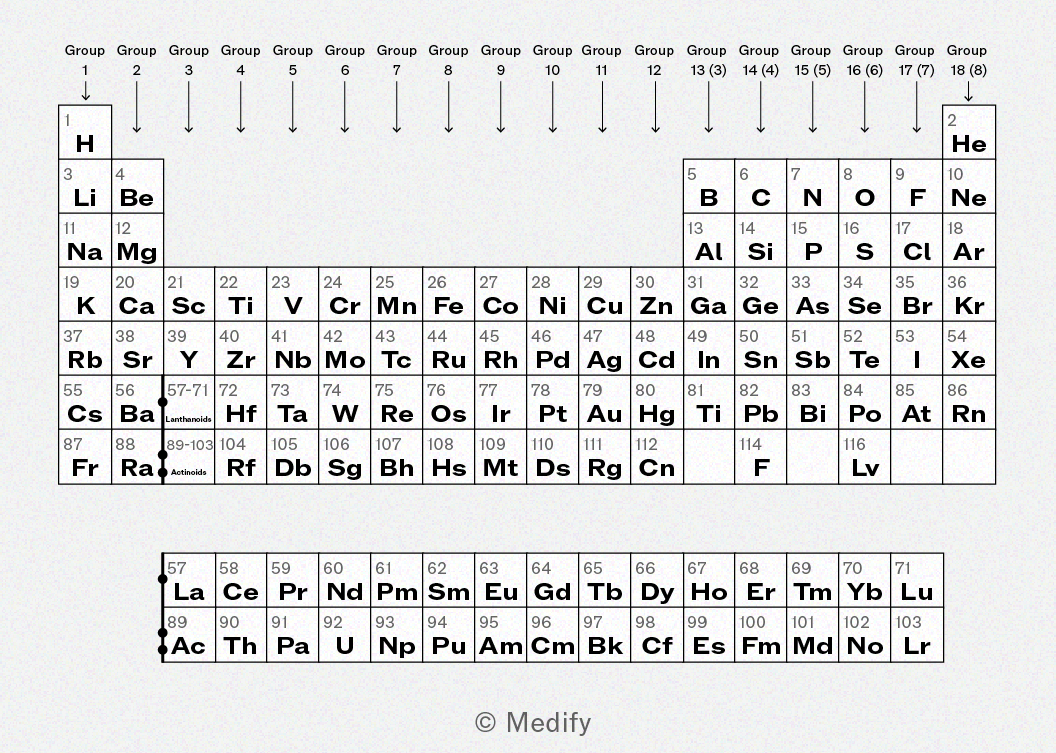
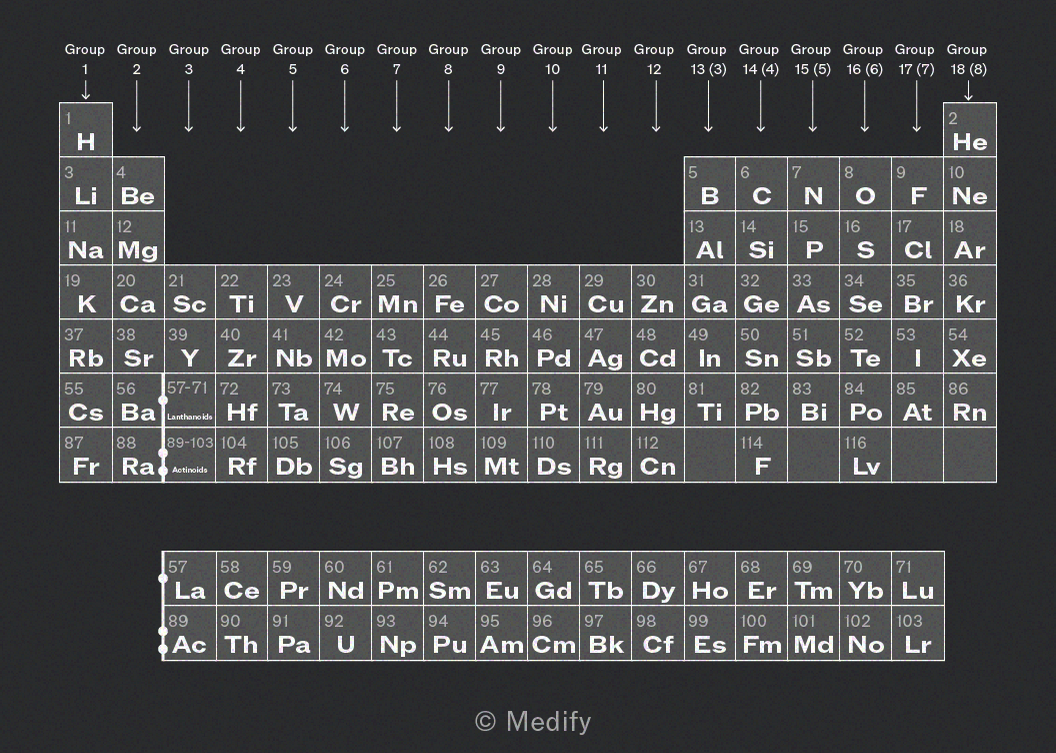
There are 18 groups in the periodic table.
Elements within the same group have similar chemical properties because they have the same number of outer electrons.
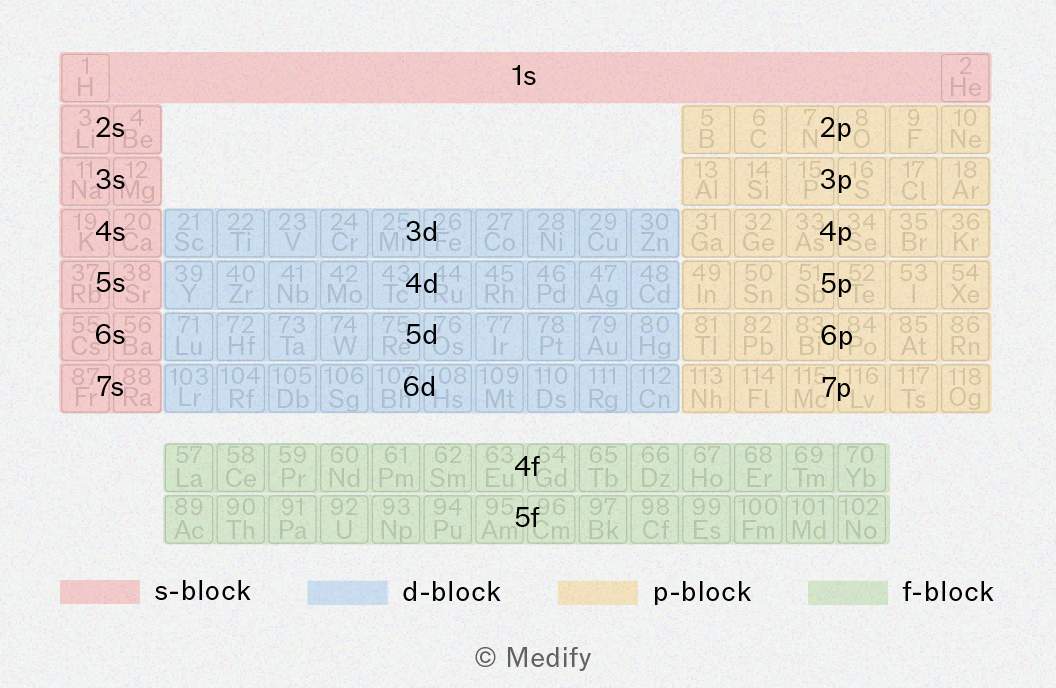
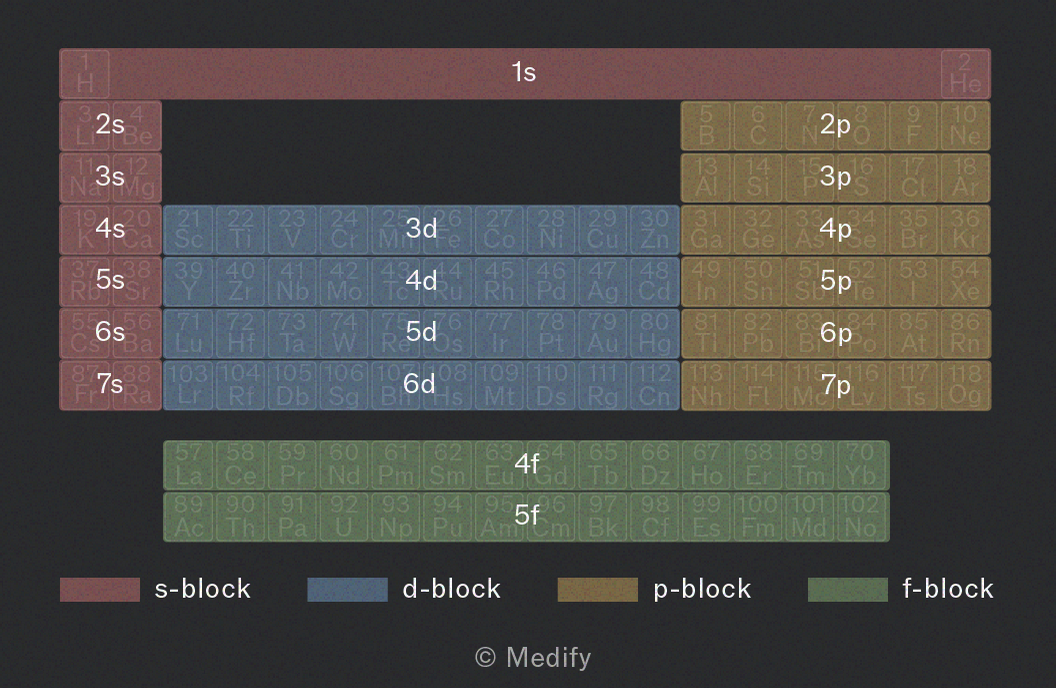
All of the elements in the periodic table belong to blocks based on their electron configuration.
s-block: the outermost electron is in the s-subshell; for example, the electron configuration for potassium is
p-block: the outermost electron is in the p-subshell; for example, the electron configuration for aluminium is
d-block: the outermost electron is in the d-subshell; for example, the electron configuration for vanadium is
f-block: the outermost electron is in the f-subshell; for example, the electron configuration for cerium is
The Group 2 elements, also called the alkaline earth metals, each have two electrons in their outermost s-subshell.
During redox reactions, they tend to lose these two electrons, forming ions with a 2+ charge.
Group 2 metals have an outer electron configuration of .
Calcium (Ca)
or
In redox reactions, Group 2 metals lose their two outer electrons to reach a stable electron configuration similar to that of a noble gas. This electron loss produces cations with a 2+ charge.
In this oxidation half equation, calcium loses its two outer electrons, forming
The increased reactivity of Group 2 metals as you go down the group is explained as follows.
Increasing atomic radius. As you move down the group, each element has an additional electron shell compared to the one above it. This increased distance between the nucleus and the outermost electrons means the nucleus has less pull on these outer electrons.
Greater shielding effect. With more inner electron shells, there is increased shielding. The inner electrons create a barrier that lessens the attraction between the nucleus and the outermost electrons.
Although the positive nuclear charge increases with each successive element, this is offset by the larger atomic radius and increased shielding. Consequently, the effective nuclear charge felt by the outer electrons decreases down the group, contributing to the increased reactivity.
The Group 2 elements react by losing their electrons forming +2 cations. The formation of these +2 cations from gaseous atoms requires two ionisation energies:
The first ionisation energy removes one mole of electrons from one mole of gaseous atoms.
The second ionisation energy removes one mole of electrons from one mole of gaseous +1 ions.
The reactivity of the Group 2 elements can be explained based on their first and second ionisation energies as shown in the bar graph.
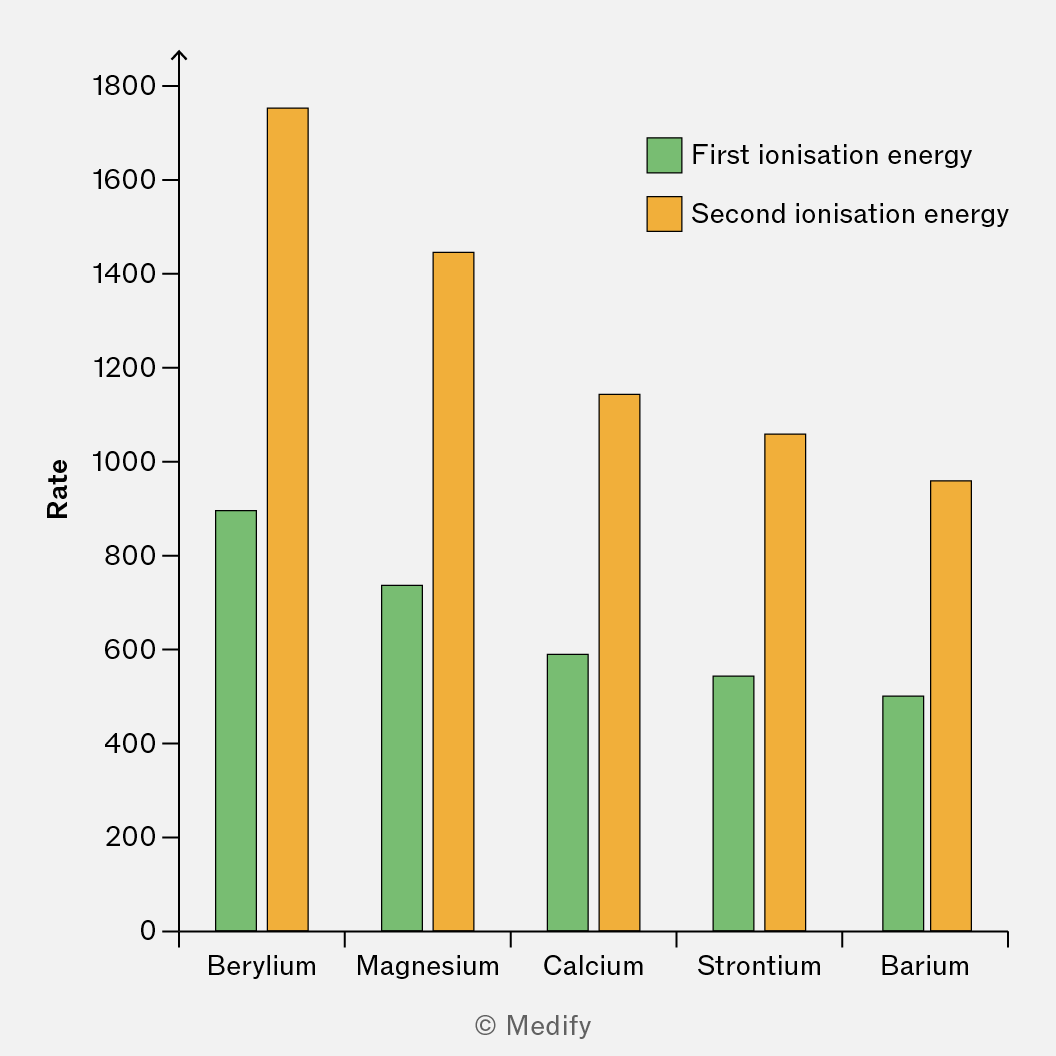
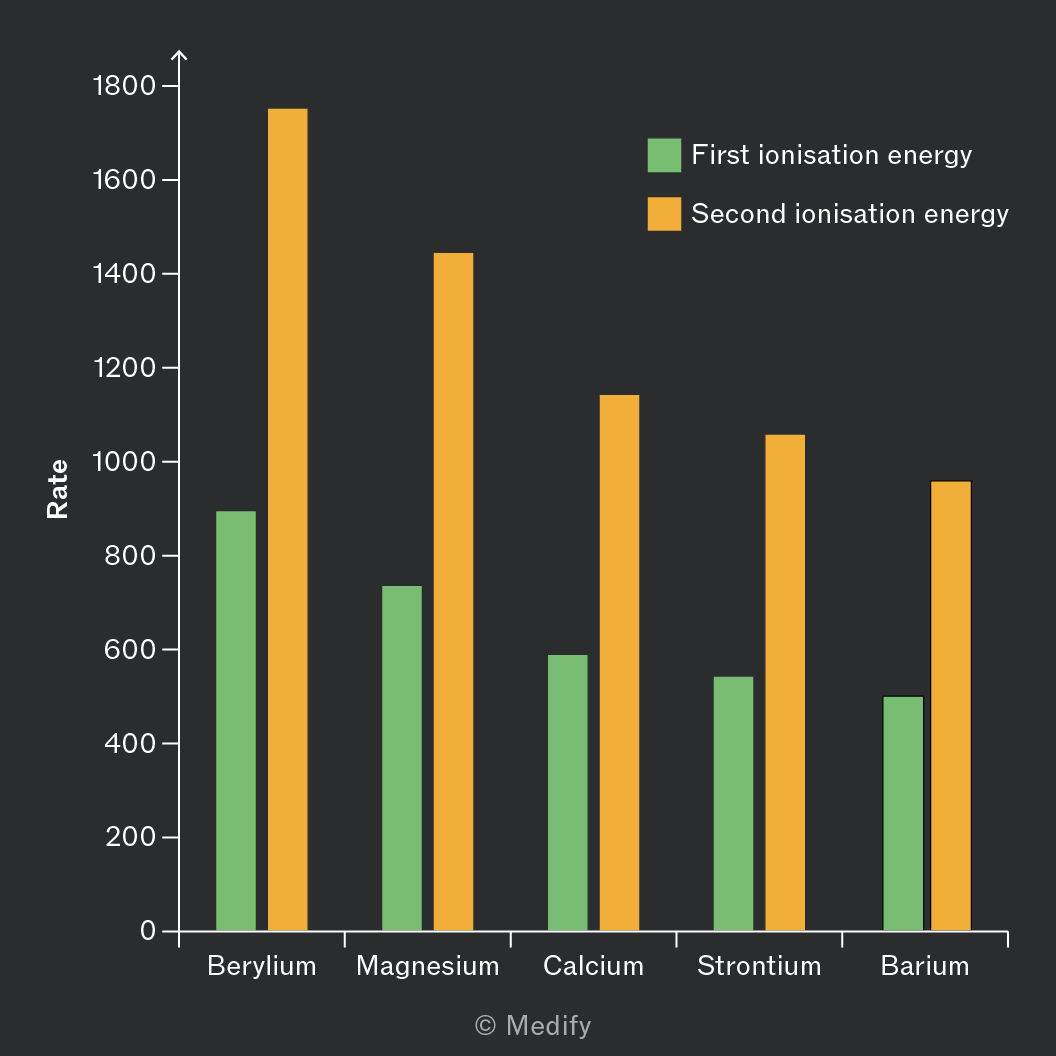
Both the first and second ionisation energies decrease as you go down Group 2.
The second ionisation energy is always higher than the first ionisation energy; it requires more energy to remove an electron from a positive ion due to the increased electrostatic attraction.
The non-metal elements in group 7 are called halogens.
All of the elements in group 7 covalently bond with themselves to produce diatomic molecules.
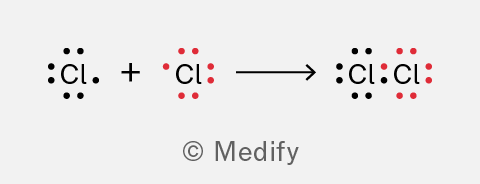
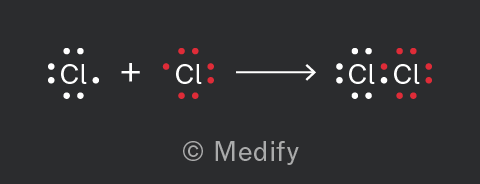
Figure: Lewis diagram showing the formation of a molecule of chlorine (Cl2) from two atoms of chlorine
As you go down group 7, the melting points and boiling points of the halogens increases.
At room temperature and pressure, flourine and chlorine are gasses, bromine is a liquid, and iodine is a solid.
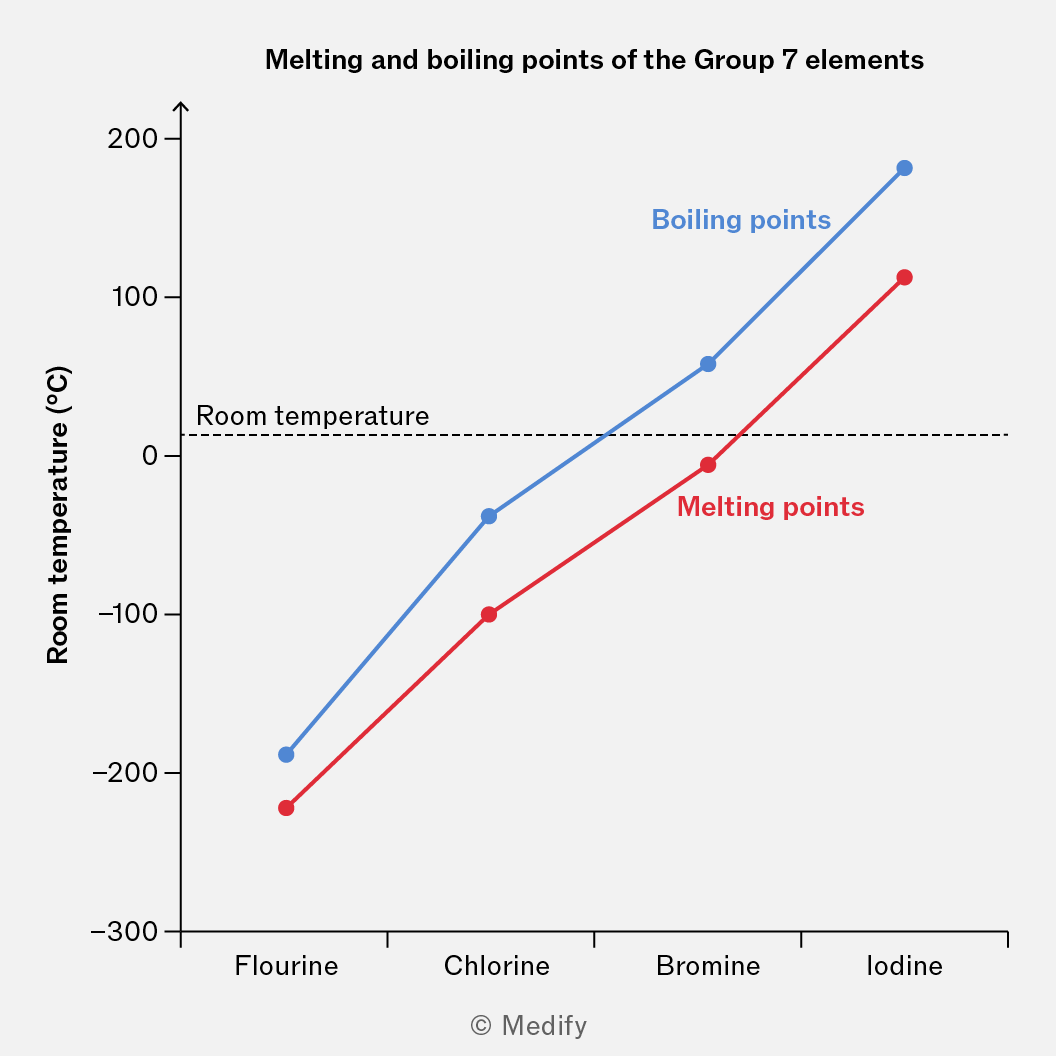
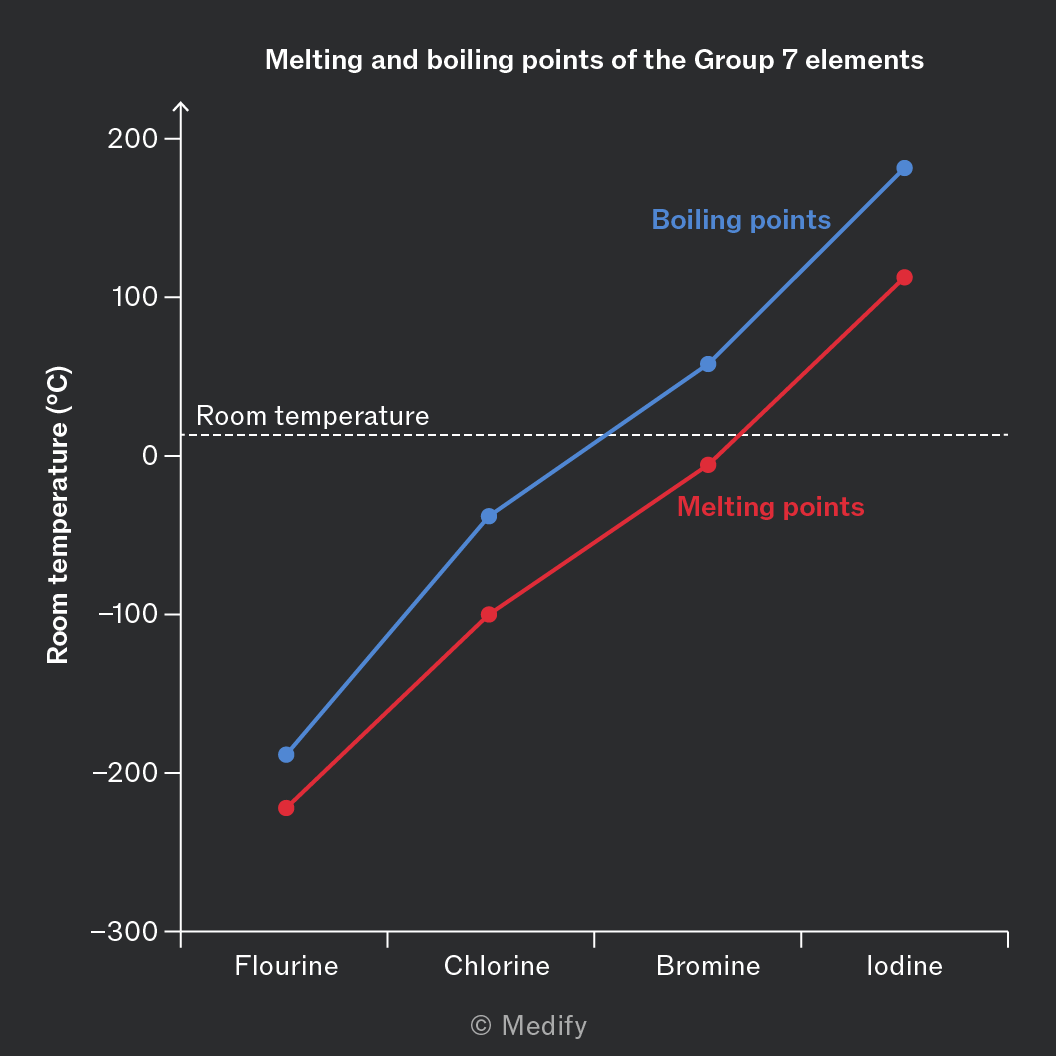
Figure: Graph showing the boiling points and melting points of the group 7 elements
The halogen molecules increase in molecular size as you move down the group. This results in larger and more polarisable electron clouds, as shown in the diagram below.
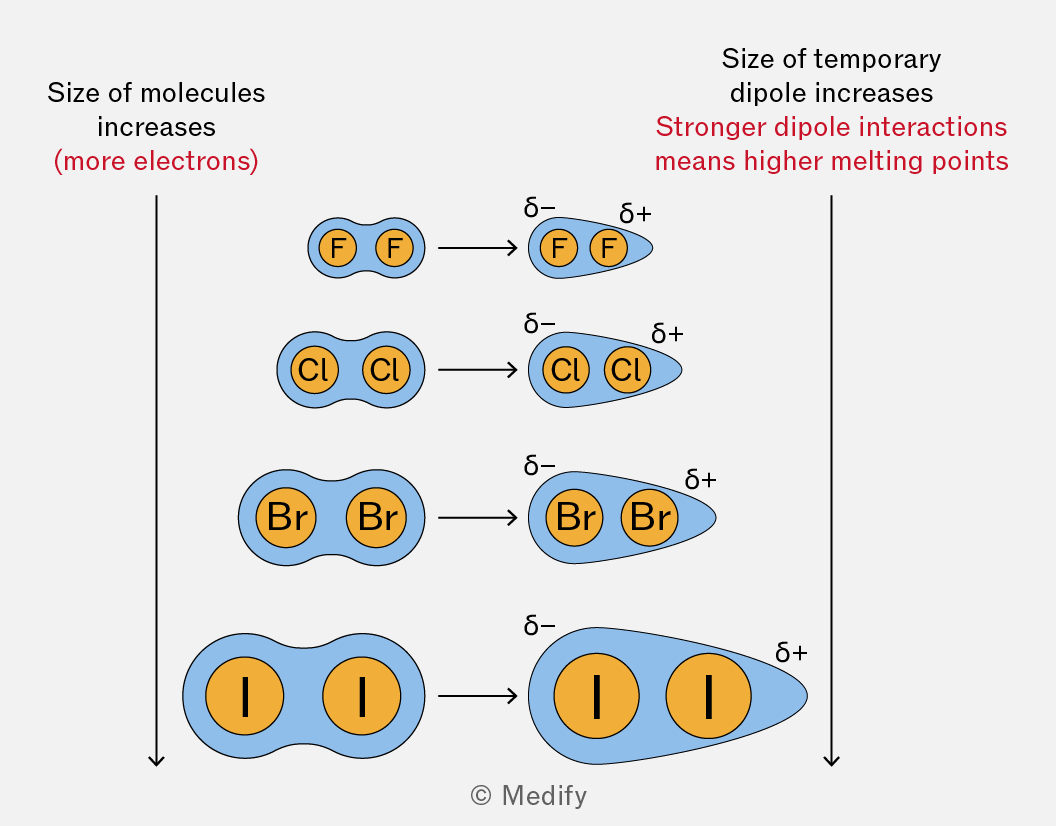
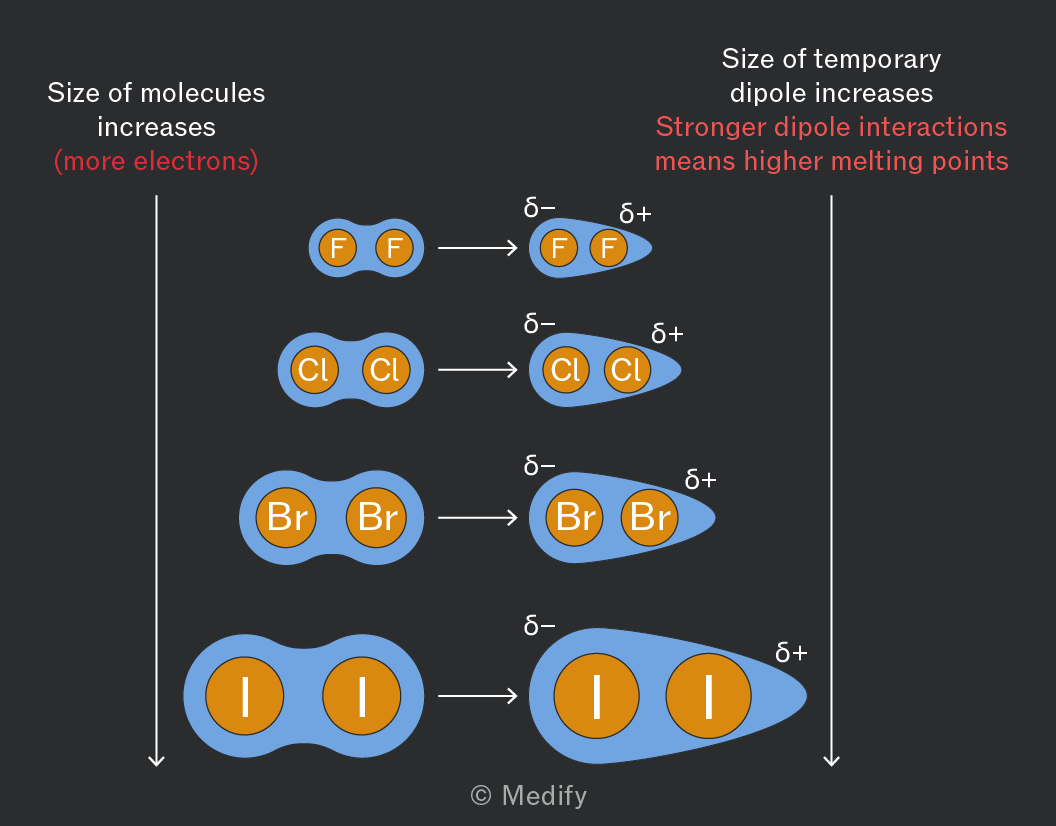
London dispersion forces, which are caused by temporary fluctuations in electron distribution, become stronger in larger, more polarisable molecules.
The larger halogen molecules exhibit stronger London dispersion forces compared to the smaller halogen molecules. This means more energy is required to overcome these forces, leading to higher boiling and melting points for the larger halogen molecules.
Displacement reactions are chemical reactions in which a more reactive element displaces a less reactive element from a compound.
Reactivity decreases as you go down group 7.
The displacement equations below show elemental halogens displacing halide ions below them in the group.
Group 7 elements gain one electron to form -1 ions. They are reduced and act as oxidising agents. Their oxidising power depends on how easily they attract electrons.
Oxidising power decreases down the group because atomic radius increases meaning the outer shell is further from the positive nucleus.
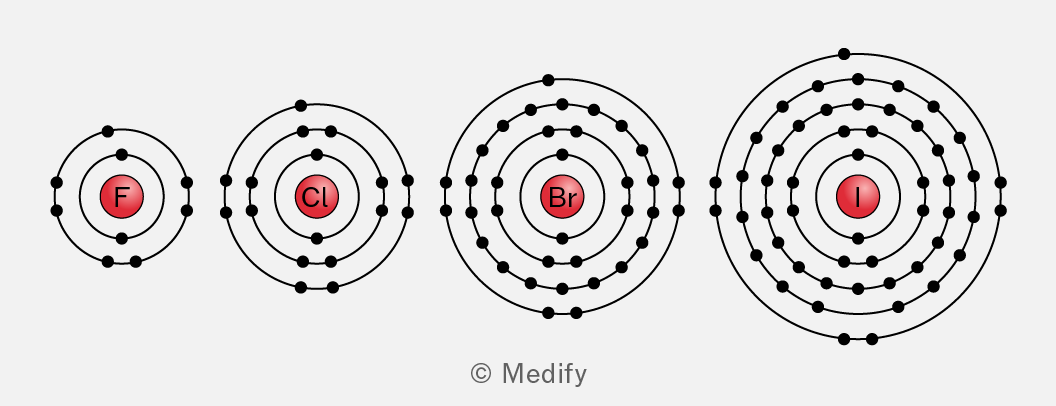
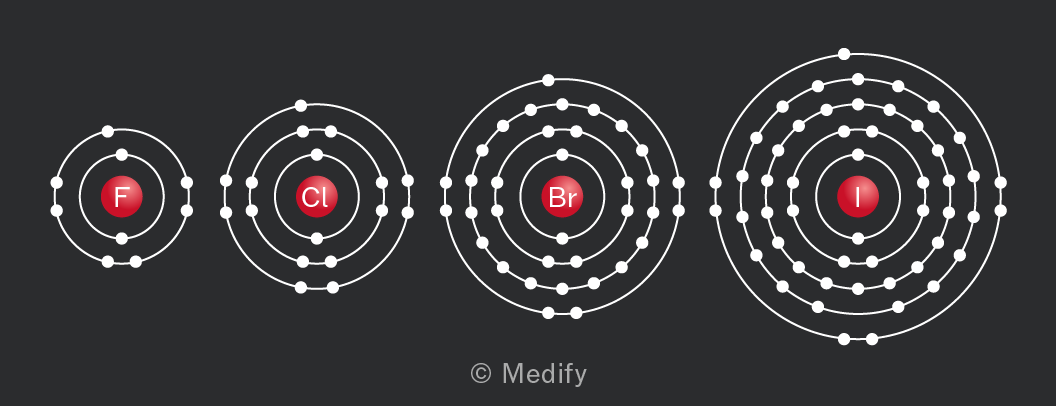
Increased electron shielding also reduces the nuclear attraction for incoming electrons, making it harder for the halogen atom to gain an electron.
This means the oxidising power and the reactivity of halogens both decrease as you go down the group.
Electronegativity refers to the ability of an atom to attract a shared pair of electrons in a covalent bond.
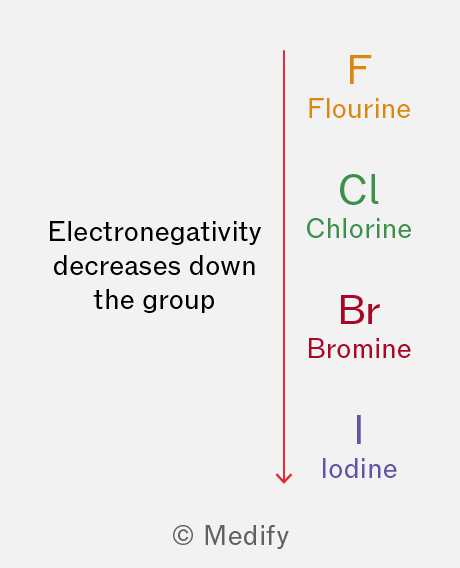
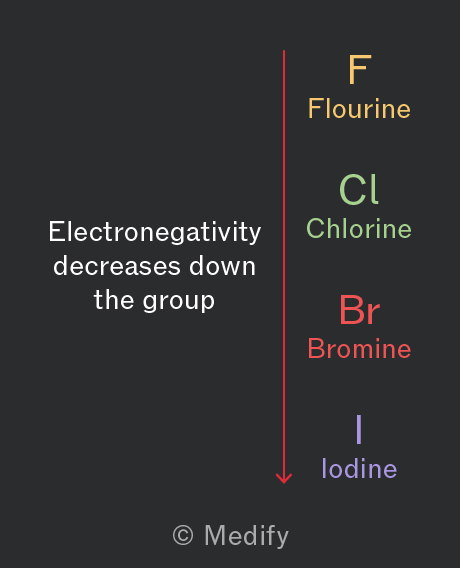
As you go down group 7, the electronegativity decreases.
This occurs because the atomic radius increases with the addition of electron shells, which causes greater shielding of the outer electrons from the positive charge of the nucleus.
A disproportionation reaction is a reaction in which the same element is simultaneously oxidised and reduced.
The disproportionation reaction of chlorine is used to sterilise drinking water.
The reaction below shows the atoms of chlorine are in an oxidation state of in elemental chlorine. They are oxidised to in hypochlorous acid, , and reduced to in .
can dissociate further:
Chlorate ions, produced behave as sterilising agents, and will kill bacteria present in the water.
Sodium hypochlorite, , is used to disinfect, by killing bacteria, and is the main active component in bleach.
A disproportionation reaction of chlorine occurs at room temperature in the manufacture of bleach:
The chlorine atoms are in an oxidation state of in elemental chlorine.
They are oxidised to in the sodium hypochlorite, , and reduced to in the sodium chloride.
The ionic equation for this reaction is:
The reduction half-equation is:
The oxidation half equation is:
Chlorine is a powerful disinfectant that effectively kills harmful bacteria, viruses, and other pathogens present in water.
Its ability to react with and destroy the cellular structures of microorganisms makes it an essential part of maintaining water safety.
The use of chlorine provides a reliable and cost-effective solution to ensuring that drinking water is free from waterborne diseases, safeguarding public health on a large scale. Water that is safe to drink is sometimes called potable water.
Halide ions can be identified with simple test tube reactions.
The unknown solution is first acidified with nitric acid.
Silver nitrate is then added dropwise to produce a silver halide precipitate.
The reaction follows the following general ionic equation:
If a solution contains halide ions it will form a silver halide precipitate, .
The colour of the precipitate formed depends on the halide ion present:
Silver chloride : white
Silver bromide : cream
Silver iodide : yellow
Silver carbonates also precipitate in neutral solutions, but the nitric acid added reacts with any carbonate ions that might be present, preventing a false positive result.
Hydrochloric acid should never be used to acidify the silver nitrate in this test as it is a source of chloride ions. These would react with silver ions, giving a false positive result.
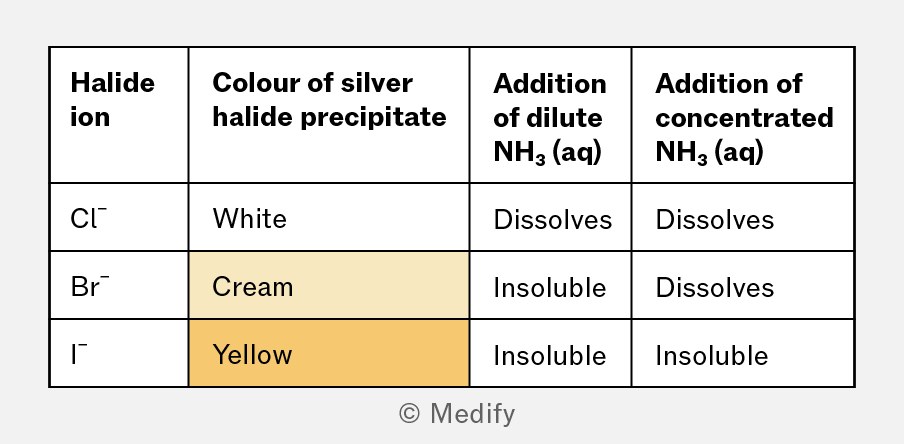
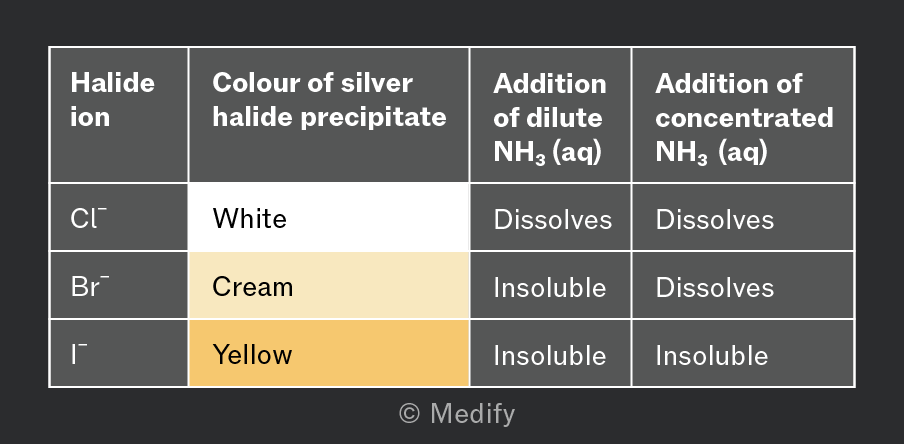
Further testing of precipitates of silver halides, formed by the addition of acidified silver nitrate to a halide ion solution, can be carried out by adding dilute ammonia, followed by concentrated ammonia to confirm the silver halide present.
The table shows the observations of reactions of halide ions with silver nitrate, and the subsequent addition of ammonia solutions: