
Redox and electrochemistry
On this page
Oxidation can be defined as the removal of electrons from an atom (taken by an oxidising agent).
Oxidation can be defined as the increase of oxidation number of an atom.
Oxidising agent: An oxidising agent is a substance that gains electrons during a chemical reaction.
By accepting electrons, the oxidising agent is reduced.
The oxidising agent causes another substance to lose electrons and thus be oxidised.
Reduction can be defined as the gain of electrons by an atom (provided by a reducing agent).
Reduction can be defined as the reduction of oxidation number of an atom.
Reducing agent: A reducing agent is a substance that loses electrons during a chemical reaction.
By donating electrons, the reducing agent is oxidised.
The reducing agent causes another substance to gain electrons, and thus be reduced.
Oxidation numbers are a way of describing the location of electrons in a chemical species. They indicate the degree of oxidation (loss of electrons) or reduction (gain of electrons) of an atom in a compound compared to in its elemental form.
There are rules for assigning oxidation numbers.
- The oxidation number of an atom in its elemental form is (e.g., ).
- For monatomic ions, the oxidation number is equal to the charge of the ion (e.g., is , is ).
- Oxygen in compounds usually has an oxidation number of (except in peroxides where it is ).
- Hydrogen in compounds usually has an oxidation number of (except when bonded to metals in hydrides, where it is ).
- The sum of the oxidation numbers in a neutral compound must be , and in a polyatomic ion, it must equal the overall charge of the ion.
Roman numerals (without a sign) are used to indicate the magnitude of the oxidation number of an element which commonly holds different oxidation numbers in different compounds.
Iron (II) represents where the oxidation number of iron is +2.
Iron (III) denotes where the oxidation number of iron is +3.
Nitrate (V) represents where the oxidation number of nitrogen is +5.
Nitrate (III) represents where the oxidation number of nitrogen is +3. The common name for is the nitrite ion.
The name nitrate written without an oxidation number is always assumed as .
The rules for assigning oxidation numbers can be used to construct the chemical formulae of a compound from its name.
There are many varieties of manganese oxide. The chemical formula of each compound can be deduced using the oxidation states given by roman numerals in the name.
Manganese (II) Oxide – The oxidation state of manganese is +2 and the oxidation state of oxygen is -2. A neutral compound must contain a 1:1 ratio of as the sum of the oxidation states must equal 0. The chemical formula is therefore .
Manganese (III) Oxide – The oxidation state of manganese is +3 and the oxidation state of oxygen is -2. A neutral compound must contain a 1:1.5 ratio of as the sum of the oxidation states must equal 0. This translates to a 2:3 whole number ratio. The chemical formula is therefore .
A disproportionation reaction involves a single element in one species undergoing both oxidation and reduction simultaneously.
Definition: The same element in a single species is both oxidised (loses electrons) and reduced (gains electrons) in the same reaction.
Example: A classic example is the reaction of chlorine with water:
Here, chlorine () is simultaneously:
- Reduced to chloride ions () in
- Oxidised to hypochlorite ions () in .
It is important to note that disproportionation requires an element that can exist in multiple oxidation states, allowing it to undergo both oxidation and reduction within the same reaction.
Disproportionation reactions can be predicted by standard electrode potentials ().
A disproportionation reaction can occur if the standard electrode potentials allow for both oxidation and reduction of the same species to be thermodynamically favourable.
For disproportionation to be favourable, the value of the overall reaction must be positive.
Using standard electrode potentials, we can predict the disproportionation of chlorine in water:
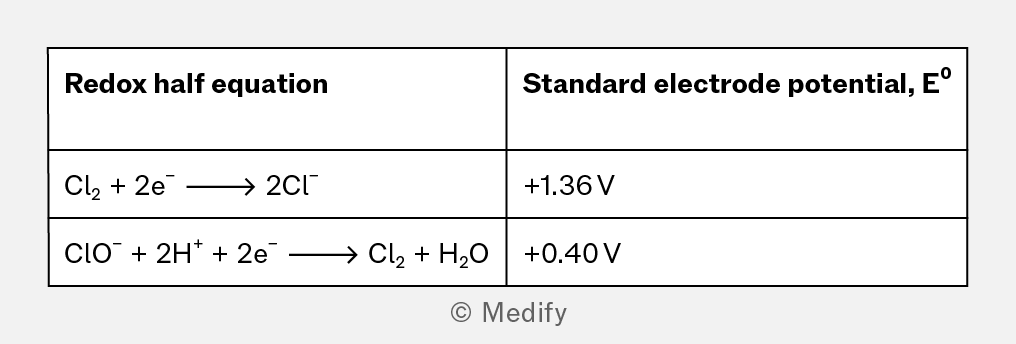
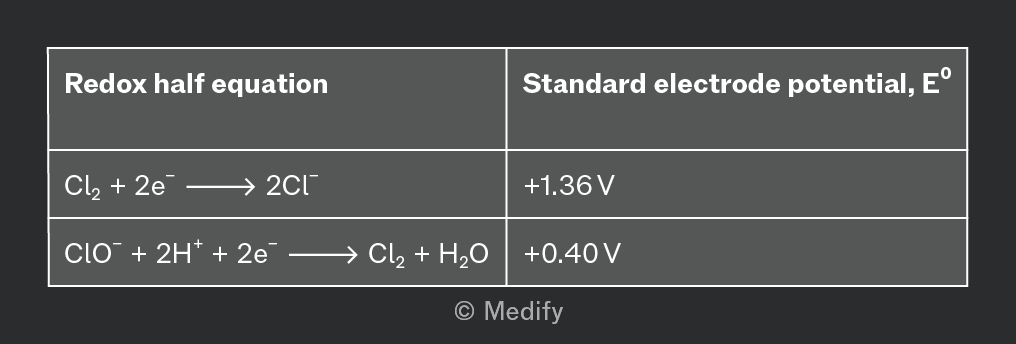
Reduction half equation:
Oxidation half equation:
Since the reduction potential for is more positive than that of , the overall reaction has a positive ; can disproportionate into and , being reduced and oxidised simultaneously.
By comparing values, we can identify which species are likely to undergo disproportionation.