
Thermodynamics
On this page
Enthalpy, which has the symbol , is the thermal energy stored within a chemical system.
Enthalpy change, often denoted as , is a measure of the heat energy transferred or exchanged during a chemical reaction or a physical change at constant pressure.
reflects the difference in enthalpy between the products and the reactants involved in a process.
In chemical reactions, the bonds can be broken and/or formed.
When bonds are broken, this requires energy from the surroundings and therefore energy is taken in.
When bonds are formed, this releases energy to the surroundings.
The overall energy change in a reaction depends on how much thermal energy is transferred overall during the reaction.
When thermal energy is taken in from the surroundings, the enthalpy change is positive; this is an endothermic reaction.
Examples of endothermic reactions include:
- Photosynthesis
- Thermal decomposition
- The reaction between sodium carbonate and ethanoic acid.
When thermal energy is released to the surroundings, the enthalpy change is negative; this is an exothermic reaction.
Examples of exothermic reactions include:
- Aerobic respiration
- Combustion reactions
- Neutralisation reactions.
An enthalpy profile diagram is a graphical representation used to illustrate the enthalpy changes that occur during a chemical reaction.
It plots the changes in the enthalpy of the system as the reaction progresses along the reaction coordinate, the progress of the reaction from reactants to products.
- The axis represents the reaction coordinate.
- The axis represents the enthalpy of the chemical system.
Key features typically included on an enthalpy profile diagram are:
- Reactants: the starting materials of the reaction, usually placed on the left side of the diagram.
- Products: the final substances formed as a result of the reaction, usually placed on the right side of the diagram.
- Transition State: this is the highest energy point along the reaction pathway, representing the point at which the old bonds are breaking and the new bonds are forming.
- Activation Energy (): this is the energy barrier that must be overcome for the reaction to proceed. It is typically measured as the energy difference between the reactants and the transition state.
- Enthalpy Change (): This is the difference in enthalpy between the products and the reactants.
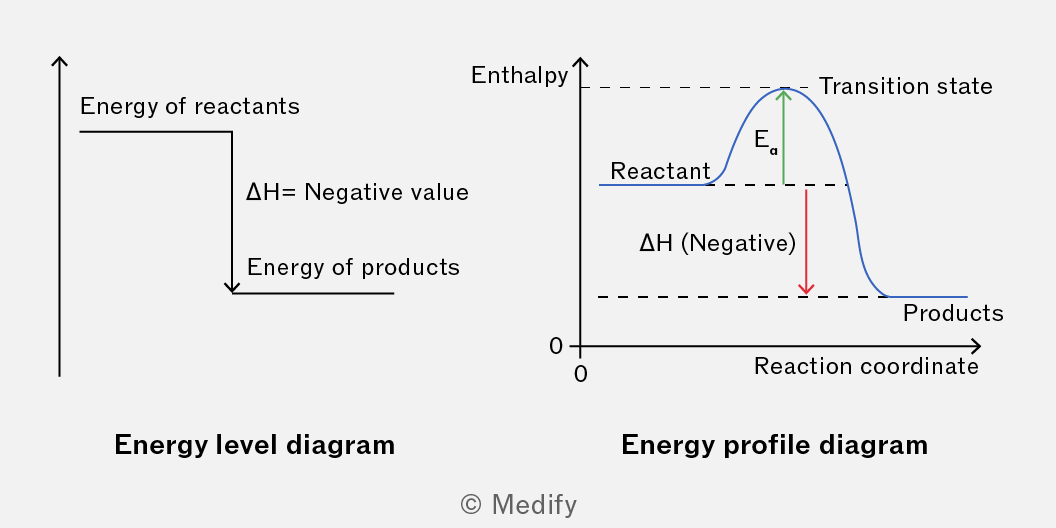
Here is an enthalpy profile diagram for an exothermic reaction:
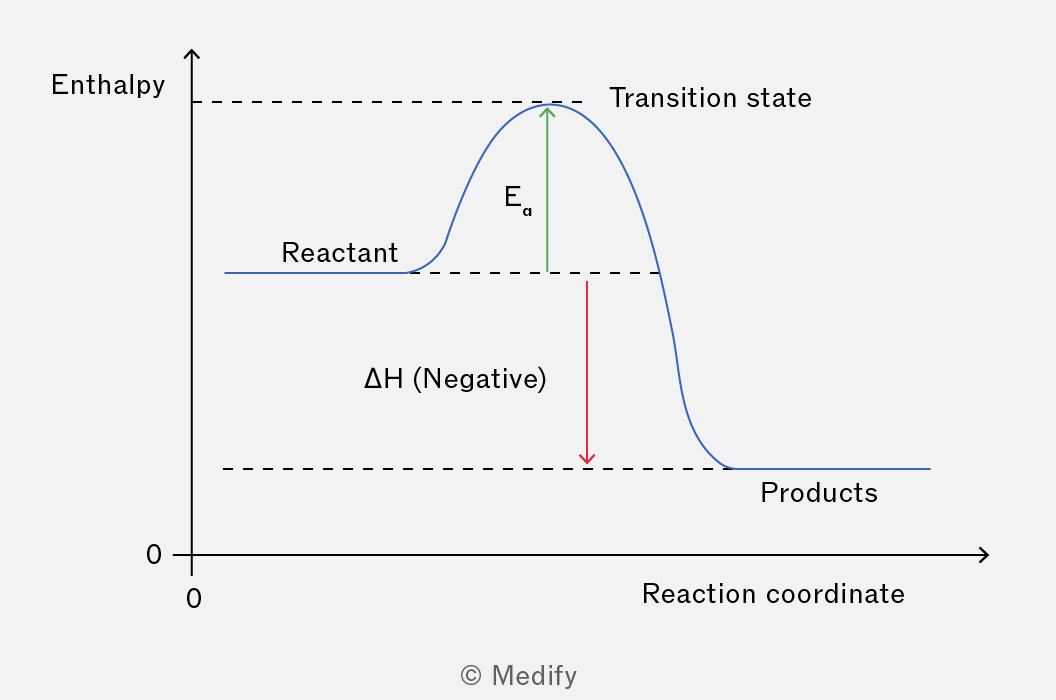
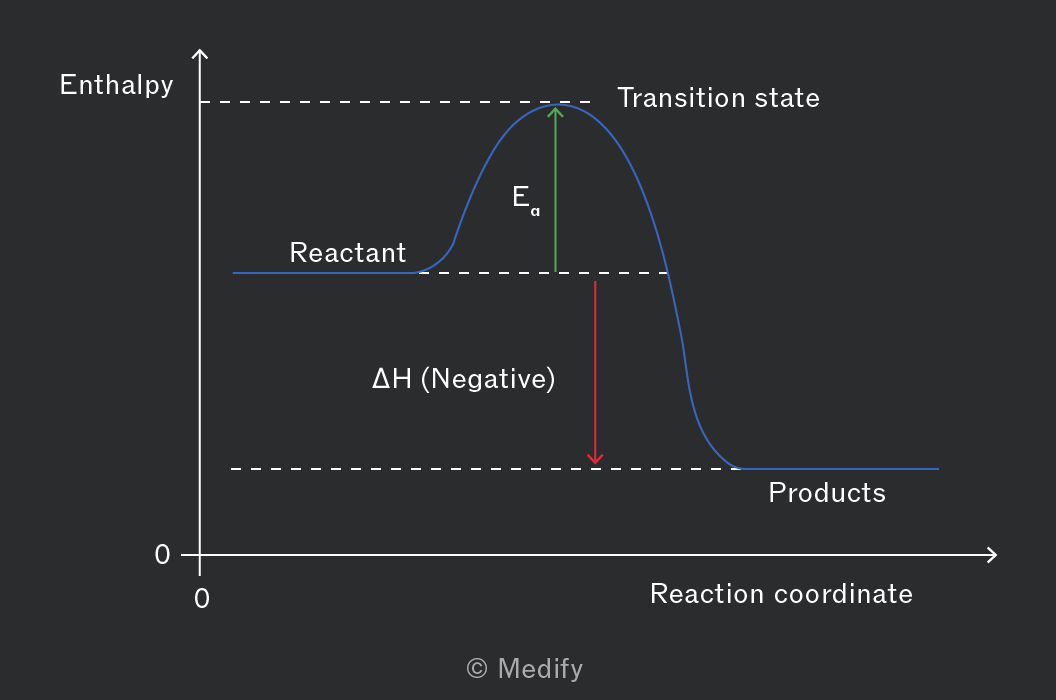
In enthalpy profile diagrams for exothermic reactions, the products are lower in energy than the reactants.
This illustrates that more energy is released during bond formation than is taken in for bond breaking.
Heat energy is therefore transferred to the surroundings, so these will warm up.
Here is an enthalpy profile diagram for an endothermic reaction:
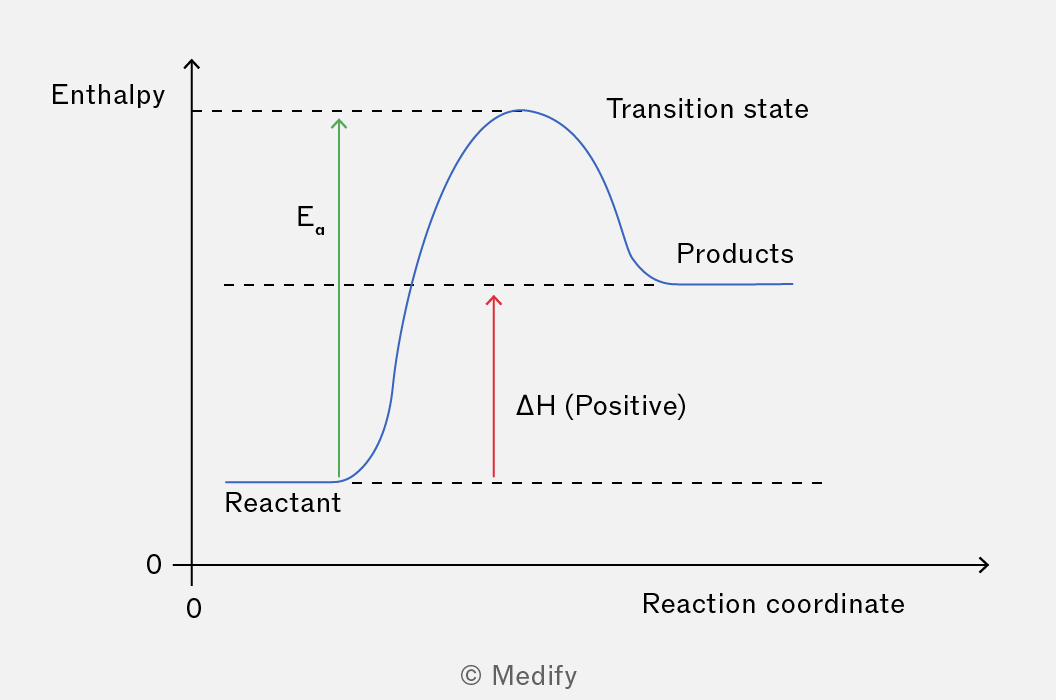
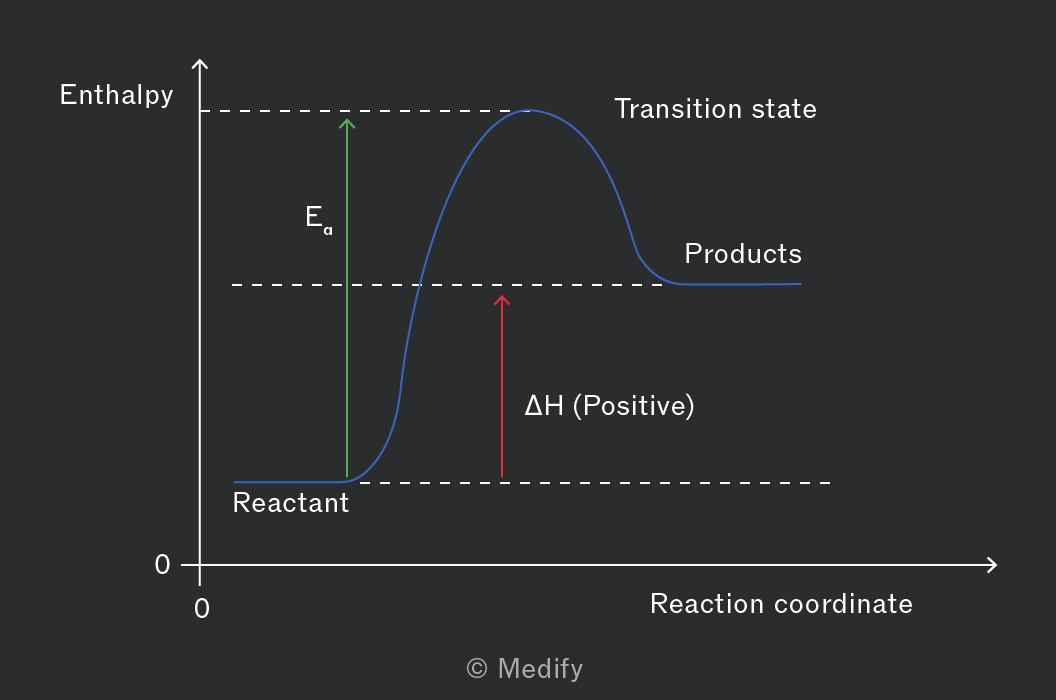
In enthalpy profile diagrams for exothermic reactions, the products are higher in energy than the reactants.
This illustrates that more energy is taken in for bond breaking than is released for bond making.
Heat energy is therefore taken in from the surroundings, so these will become colder.
The activation energy, , is the minimum energy required for a reaction to take place. It is often described as an energy barrier.
In enthalpy profile diagrams, the activation energy of a reaction is shown by the difference between the enthalpy of the reactants and the transition state.
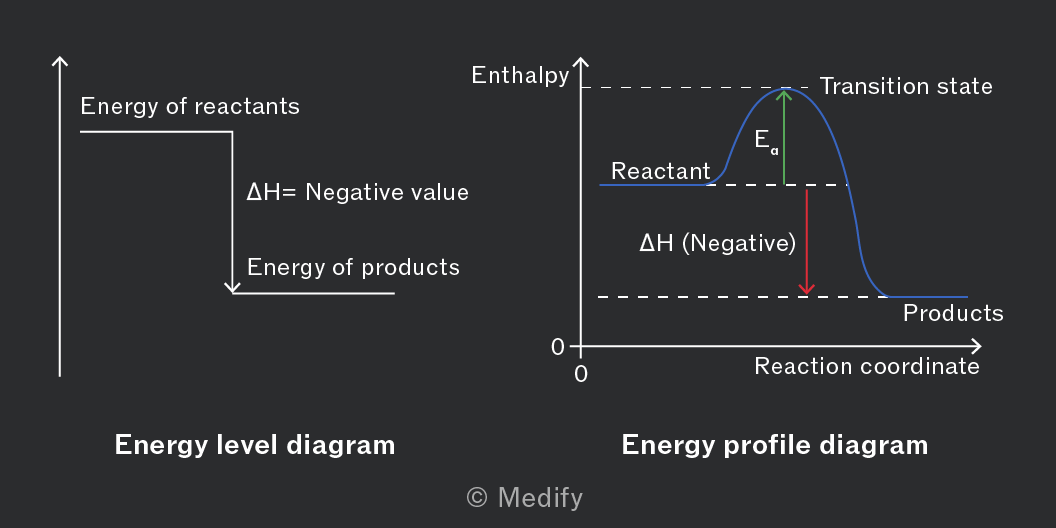
Energy level diagrams are more basic than energy profile diagrams as they do not show energy changes over the progression of a reaction. As a result, they often have no x axis.
Standard conditions refer to a set of predefined environmental conditions used as a reference point for measuring and comparing chemical reactions or properties.
Standard conditions are defined as:
- Temperature:
- Pressure:
Standard states are the specific physical states of substances under the standard conditions.
Enthalpy change of reaction, , is:
“The enthalpy change when the reactants in the stoichiometric equation as provided react to give the products under standard conditions.”
For example:
The enthalpy change of reaction refers to the moles of reactants stated in the reaction stoichiometry exactly as given.
The enthalpy change of reaction can be either exothermic or endothermic.
Enthalpy change of formation, , is:
“The enthalpy change when one mole of a substance is produced from its constituent elements, with all reactants and products in standard states, under standard conditions.”
For example:
The reaction stoichiometry must always be adjusted to give one mole of product.
The enthalpy change of formation can be either exothermic or endothermic.
By definition, the enthalpy change of formation, , of an element in its standard state is zero.
Enthalpy change of combustion, is:
“The enthalpy change when one mole of a substance is completely combusted in oxygen, with all reactants and products in standard states, under standard conditions.”
For example:
The reaction stoichiometry must always be adjusted to show one mole of fuel.
The enthalpy change of combustion is always exothermic.
Enthalpy change of neutralisation, , is:
“The enthalpy change when one mole of water is produced in a reaction between an acid and alkali, under standard conditions.”
For example:
The reaction stoichiometry must always be adjusted to show one mole of water formed.
The enthalpy change of neutralisation is always exothermic.
First ionisation energy, , is:
“The energy required to remove one mole of electrons from one mole of gaseous atoms to form one mole of gaseous ions with a +1 charge.”
For example:
The reactant in the first ionisation energy must always be a single gaseous atom, not a molecule.
Ionisation energy is always endothermic.
Enthalpy change of atomisation, , is:
“The enthalpy change required to form one mole of gaseous atoms from the element in its standard state.”
For example:
The reaction stoichiometry must be constructed to form one mole of atoms.
First electron affinity, , is:
“The enthalpy change when one mole of gaseous atoms gains one mole of electrons to form one mole of gaseous ions with a -1 charge.”
For example:
The reactant in the first electron affinity must always be a single gaseous atom, not a molecule. For chlorine it is not .
First electron affinity is exothermic for non-metals, as these form more stable anions.
Enthalpy changes cannot be measured directly; they require analysis of the temperature changes of the environment around a reaction.
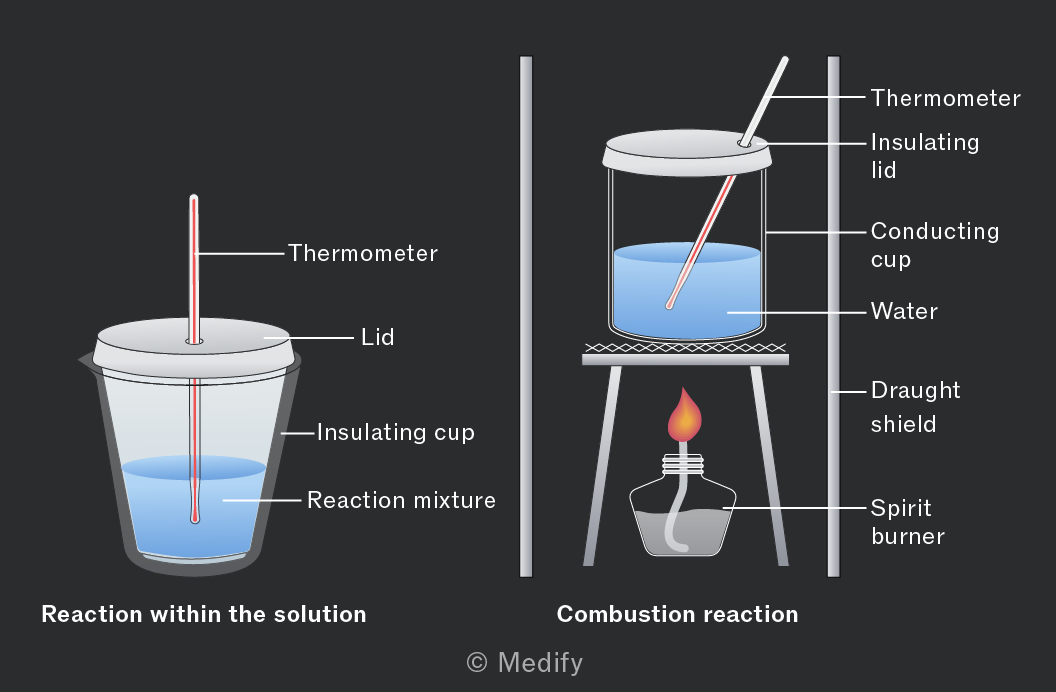
Calorimetry is a method used to measure enthalpy changes experimentally. This can either be achieved through mixing reactants in solution within a calorimeter, or warming of water in a calorimeter above a combustion reaction.
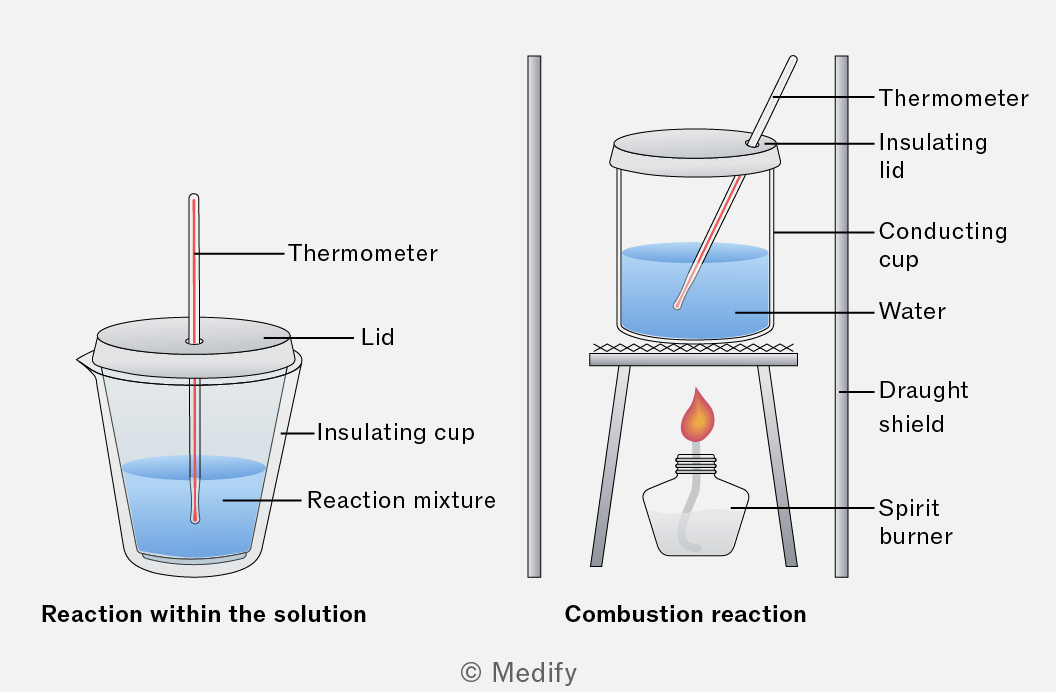
Calorimetry measures the temperature change in the surroundings of a chemical reaction over time.
Once the temperature change of the surroundings, , is determined experimentally, the energy change can be determined using the following equation:
Where:
- = energy change ()
- = mass ()
- = specific heat capacity ()
- = change in temperature ()
The energy change will depend on the specific heat capacity of the substance being heated.
The specific heat capacity of water is .
Specific heat capacity is the energy required to heat of a substance by .
Once the energy change, q, has been determined, the enthalpy change in , can be determined using the equation:
Where:
- = enthalpy change ()
- = energy change ()
- = number of moles ()
Before using the equation, the energy change obtained from calorimetry, , needs to be converted from to by dividing by 1000.
The substance that provides the number of moles, , depends on the definition of the specific enthalpy being calculated.
In calorimetry calculations involving solutions, it is generally assumed that of the solution has a mass of .
It is also assumed that the specific heat capacity of the solution is , the same as the specific heat capacity of water.
The average bond enthalpy is:
“The predicted energy required to break one mole of a given bond in a gaseous molecule under standard conditions.”
The units of average bond enthalpy are and the value is, by definition, always endothermic.
Average bond enthalpies are measured over a wide variety of different gaseous molecules containing that bond. An actual bond enthalpy in a specific molecule may differ from the average value quoted in data books. Values of from average bond enthalpies will differ from those obtained through experimental results.
Average bond enthalpies can be used to determine the overall enthalpy change of a chemical reaction using the following equation:
The overall enthalpy is exothermic when the energy released from the bonds made is greater than the energy consumed by the bonds broken.
Hess’s Law allows us to calculate a hard-to-measure enthalpy change indirectly, via consideration of an alternative route to that directly from reactants to products, using the idea of the conservation of energy.
Hess’s Law states that:
“The total enthalpy change in a chemical reaction is independent of the route by which the chemical reaction takes place as long as the initial and final conditions are the same.”
All reactions can be considered as reversible in enthalpy cycles.
Regardless of feasibility, the enthalpy change of a reverse reaction is equal in magnitude and opposite in sign to the forward reaction.
Put more practically, when you go the “wrong way” along an arrow in an enthalpy cycle, change the sign of .
When provided with details on the enthalpy of combustion, , of substances in a chemical reaction, the reaction can be considered as occurring via the combustion products, carbon dioxide and water.
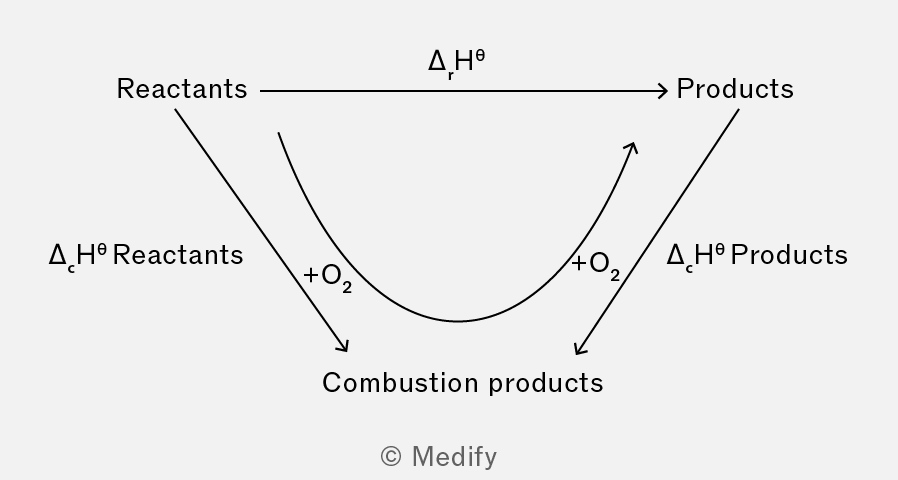
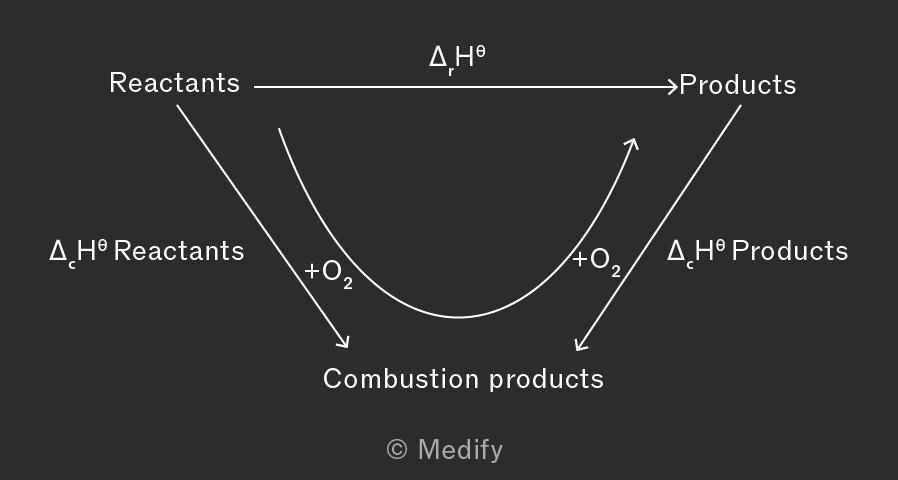
Following the alternative route of this enthalpy cycle, of the products needs to be considered as the reverse reaction – it is the hypothetical reaction from combustion products to fuel.
When you go the “wrong way” along an arrow in an enthalpy cycle, change the sign of .
As a result:
When provided with details on the enthalpy of formation, , of substances in a chemical reaction the reaction can be considered as occurring via the constituent elements in their standard states.
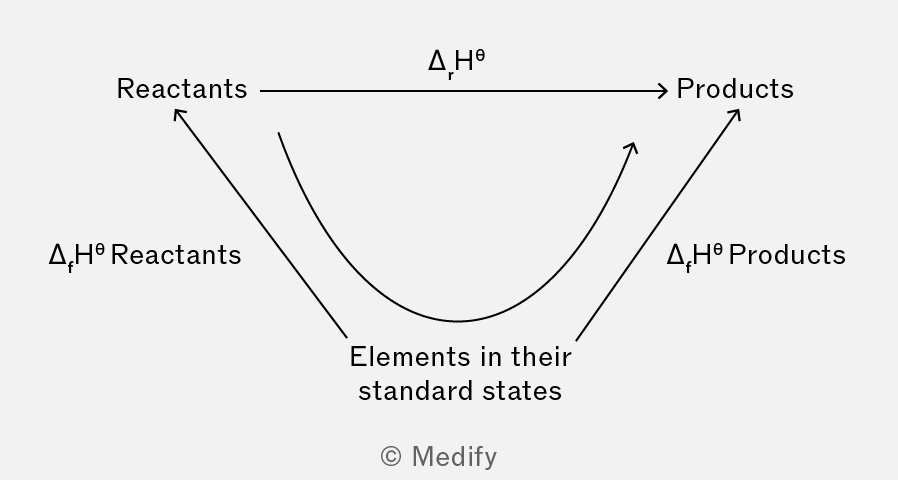
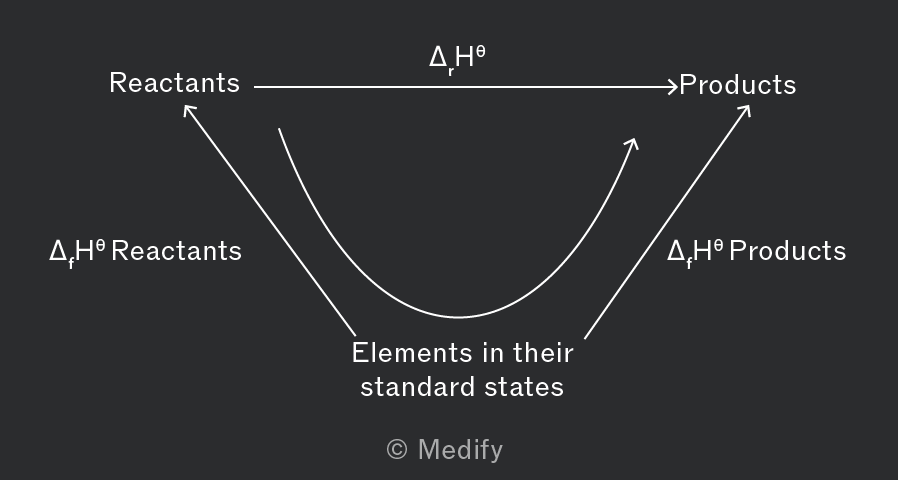
Following the alternative route of this enthalpy cycle, of the reactants needs to be considered as the reverse reaction – it is the hypothetical deformation enthalpy, from reactants to their constituent elements.
When you go the ”wrong way” along an arrow in an enthalpy cycle, change the sign of .
As a result:
Lattice enthalpy, , is:
“The enthalpy change when one mole of an ionic lattice is formed from its constituent gaseous ions under standard conditions.”
For example:
where and are gaseous ions, and is the solid ionic lattice.
Calculating lattice enthalpy is a key step in understanding ionic compounds and their stability.
Lattice enthalpy, , is always a negative value because the process of forming the ionic lattice is one of making bonds which releases energy; it is an exothermic process.
The magnitude of the lattice enthalpy is a direct measure of the strength of the ionic bonds within the lattice.
High (more negative) lattice enthalpy indicates strong electrostatic forces of attraction between the ions, leading to a more stable ionic structure.
Low (less negative) lattice enthalpy suggests weaker ionic bonds and a less stable structure.
The strength of electrostatic attraction, and therefore lattice enthalpy, depends on two main factors; ionic charge and ionic radius.
Higher charge on the ions increases the strength of the electrostatic attraction between them.
Ions with a smaller ionic radius are packed closer together, which increases the electrostatic attraction between them.
Ions with a higher charge and/or a lower volume are described as having a higher charge density.
A compound with a high lattice enthalpy typically has a higher melting point and a higher boiling point; more energy is required to overcome the strong ionic bonds.
The Born-Haber cycle is a complex thermochemical cycle that allows us to calculate the lattice enthalpy of an ionic compound using Hess’ Law and a series of composite enthalpies.
The enthalpies used in the construction of a Born-Haber cycle are:
- , lattice enthalpy
- , enthalpy of formation
- , enthalpies of atomisation
- , first ionisation energy (and subsequent ionisation energies if required)
- , first electron affinity (and subsequent electron affinities if required)
It is useful to note that, while it is possible to draw Born-Haber cycles to scale, this is not necessary for their use. A rough sketch is sufficient in an exam.
The ionic compound in its standard state will be at the cycle’s lowest point. This can be created from its elements in their standard states () or from its constituent ions in their gaseous states ().
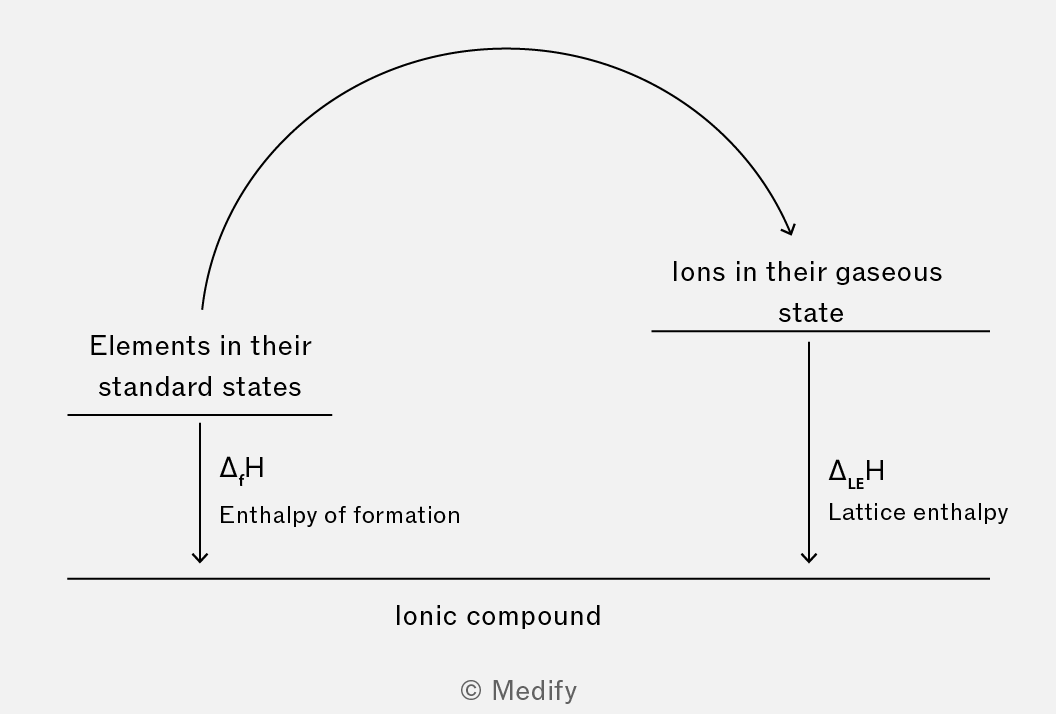
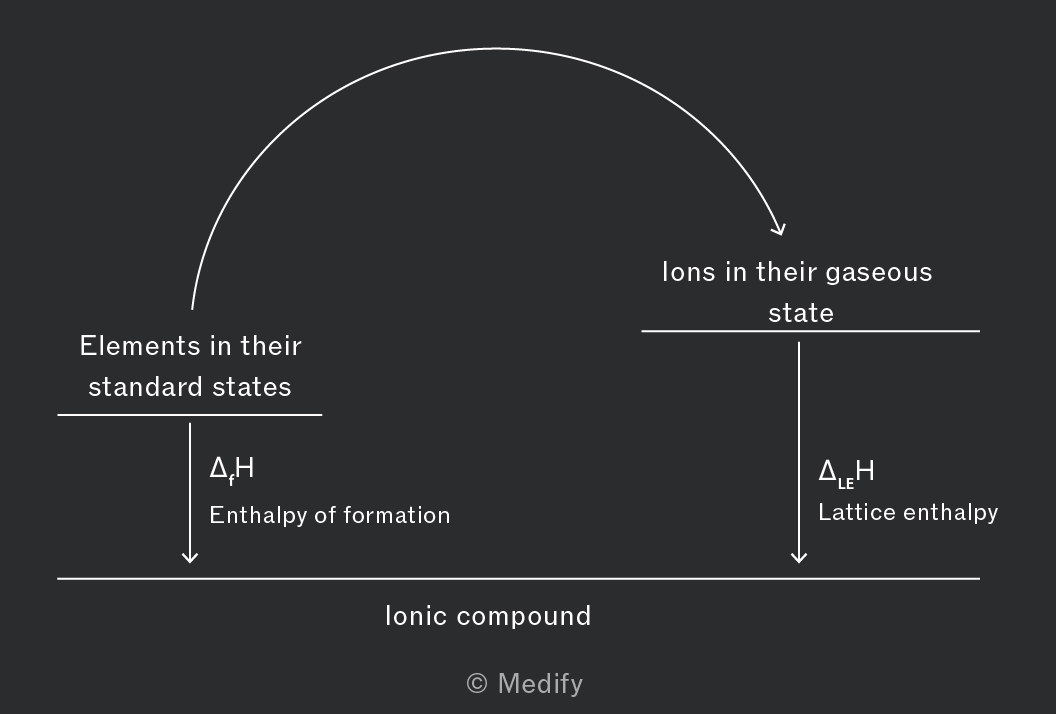
Note that both arrows follow the direction of the reaction described in the enthalpy definitions: towards the ionic compound.
The remaining enthalpies are used to connect the elements in their standard states to the ions in their gaseous states.
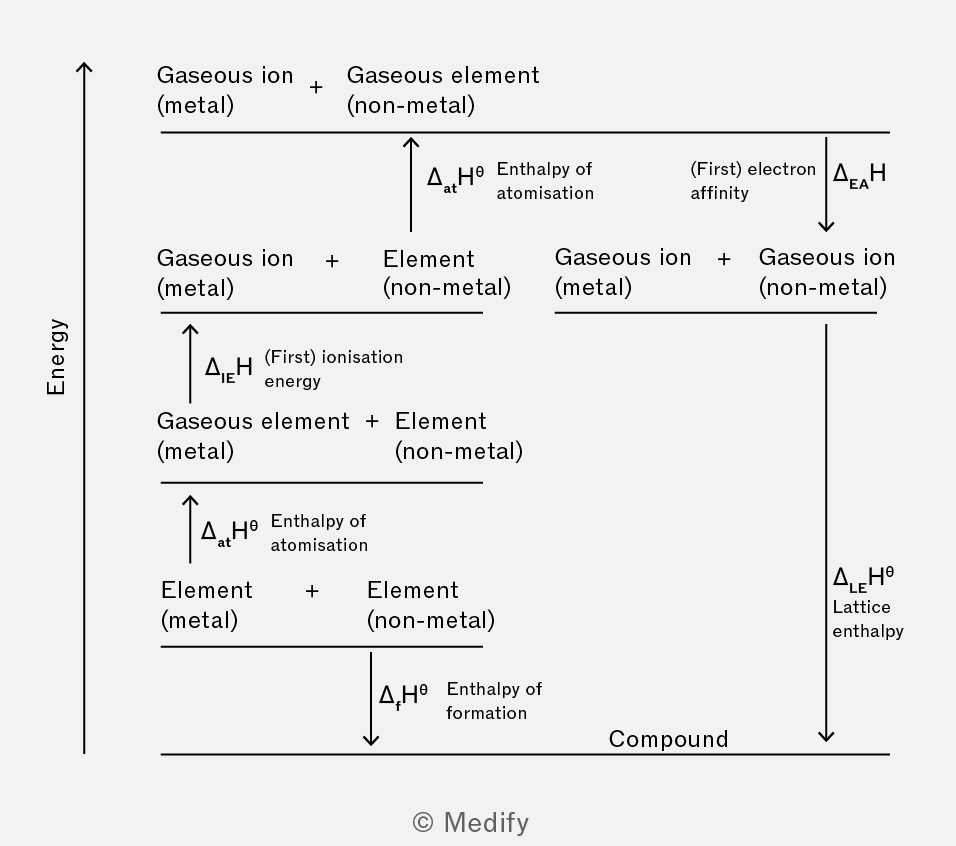
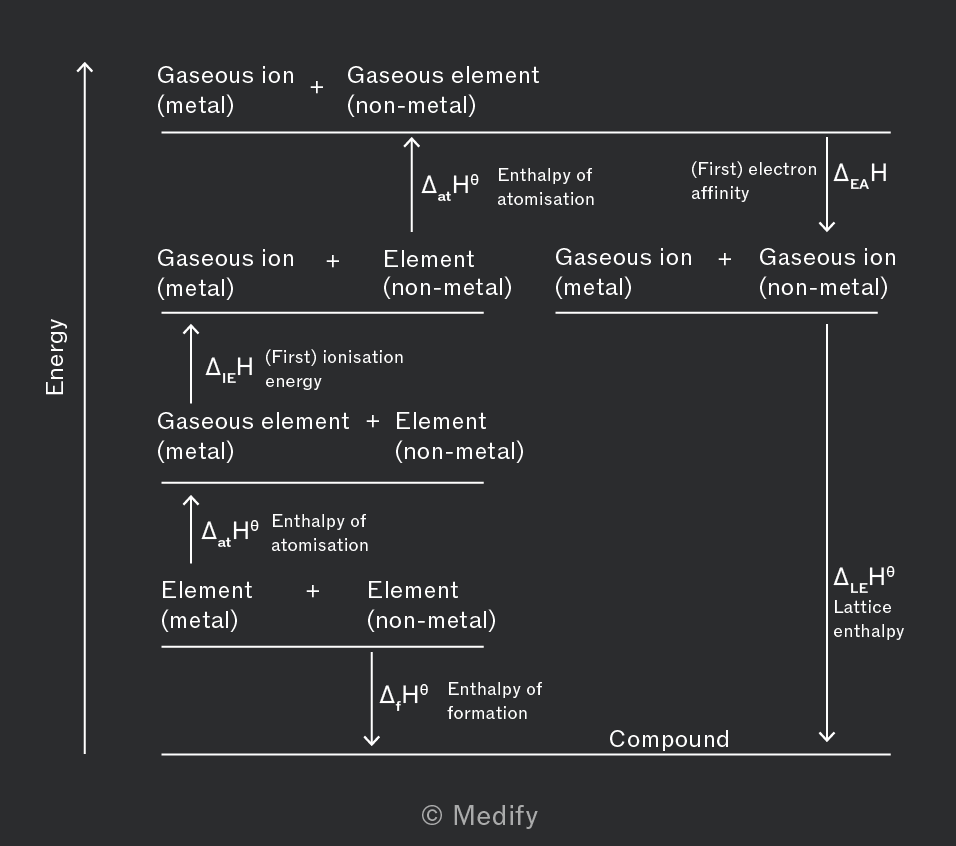
To connect the elements in their standard states to the ions in their gaseous states.
- Atomise each element, separately. This is endothermic, so the single gaseous species sits above the element in its standard state.
- Take electrons from the metal atoms to reach their preferred charge, This is endothermic so the gaseous cation will sit above its gaseous atom.
- Ionise the non-metal atoms to their preferred charge, This is exothermic, so the gaseous anion will sit below its gaseous atom.
Born-Haber cycles can be used to calculate missing enthalpies.
Hess’s Law states that the total enthalpy change in a chemical reaction is independent of the route by which the chemical reaction takes place as long as the initial and final conditions are the same.
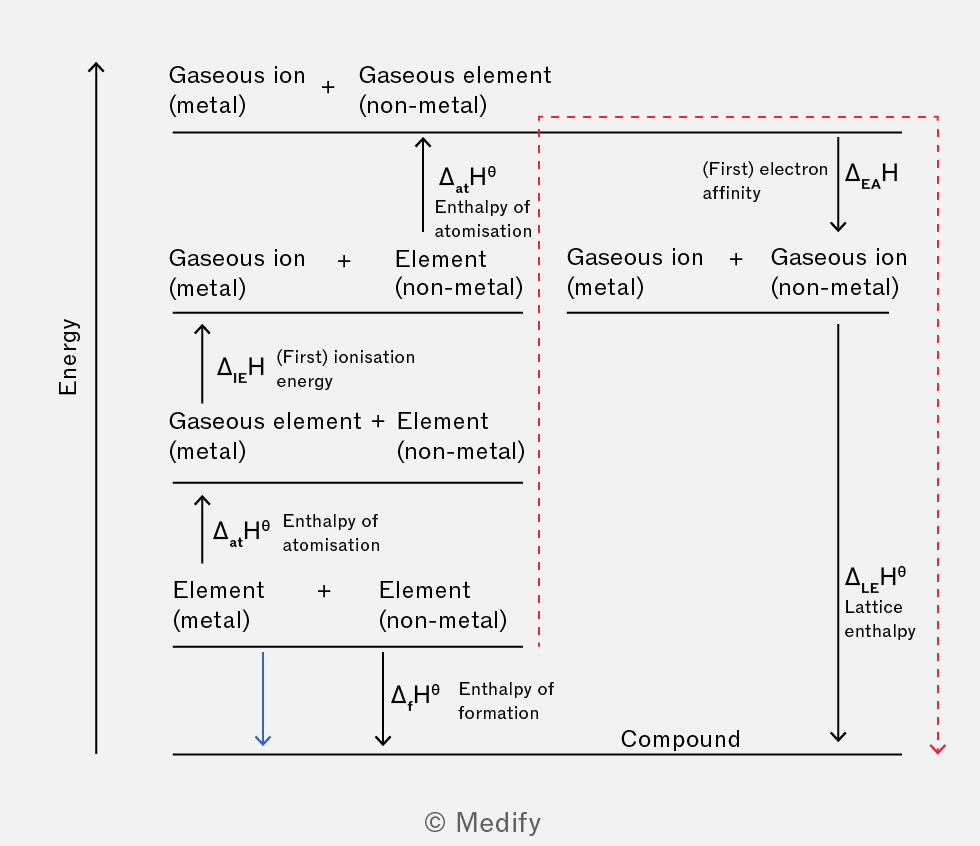
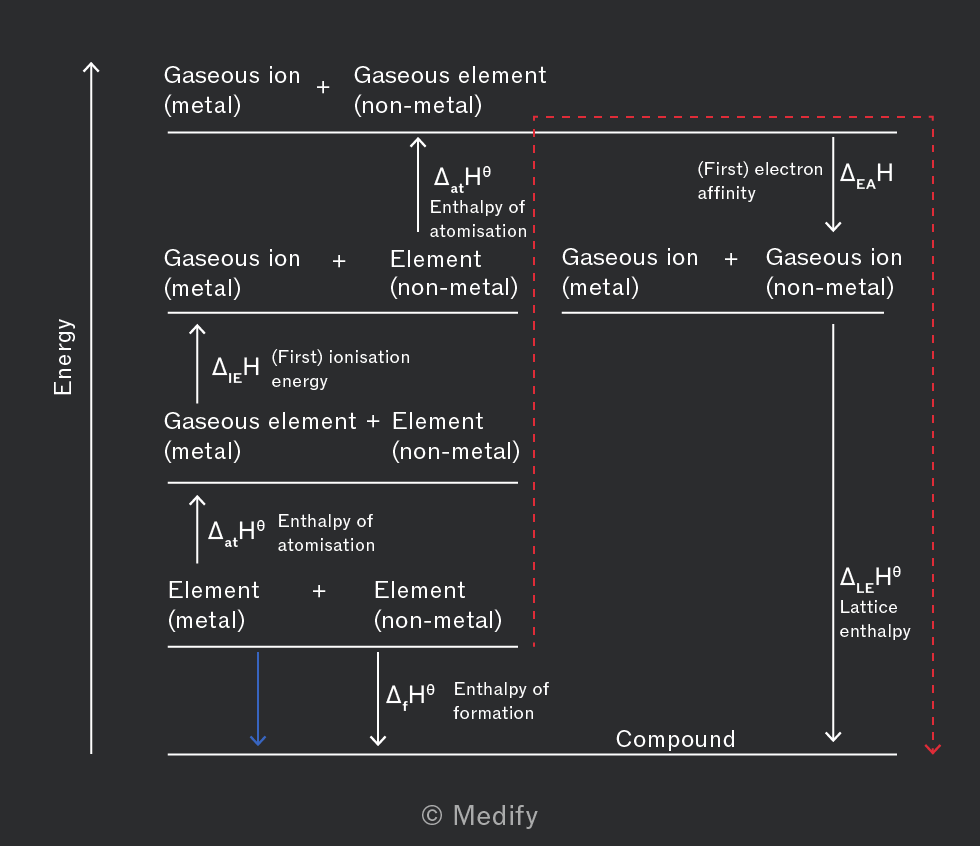
For a Born-Haber cycle this means, for example, that the formation enthalpy can be equated to the sum of the remaining enthalpies shown.
In this example, all arrows are followed in their forwards direction, so there is no need for sign reversal.
In a Born-Haber cycle the reaction stoichiometry is dictated by the composition of the ionic compound at the base.
It is crucial to adjust the enthalpy values used in line with the stoichiometry shown in the cycle.
In the cycle for there are two moles of gaseous chlorine atoms formed and two moles of ions formed using two moles of electrons. Both the and the must be doubled in the calculation.
Polarisation of ions is the electron cloud distortion around an anion due to proximity to cation of high charge density.
When an ion is highly polarised, there is a degree of electron sharing, and the bonding becomes partially covalent.
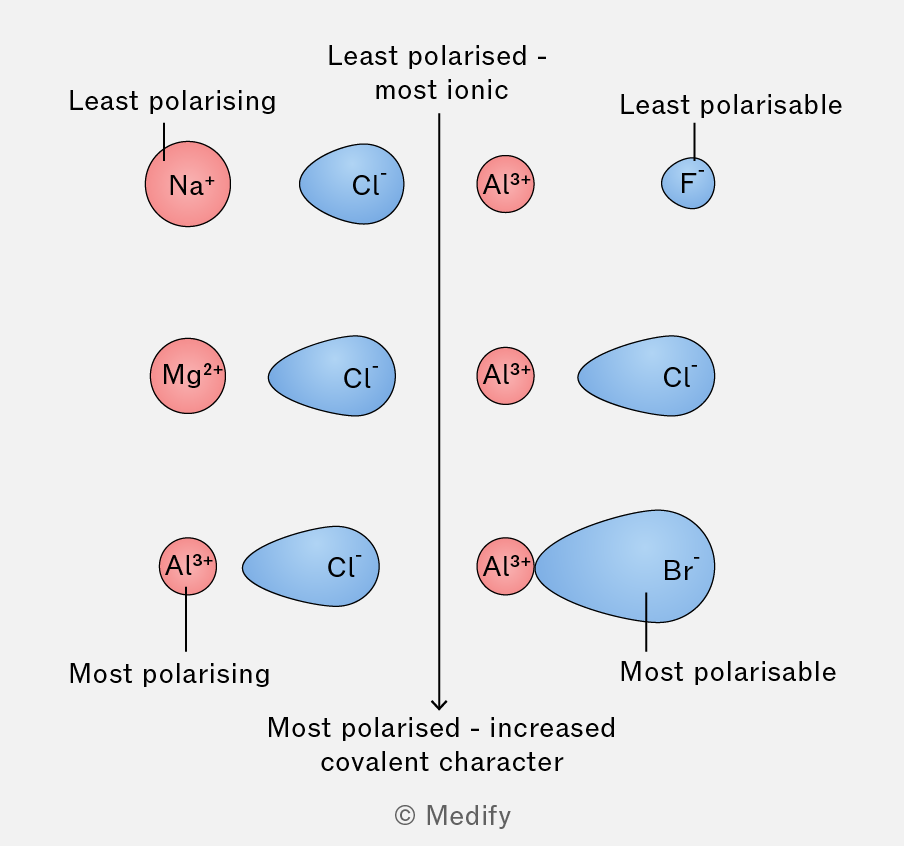
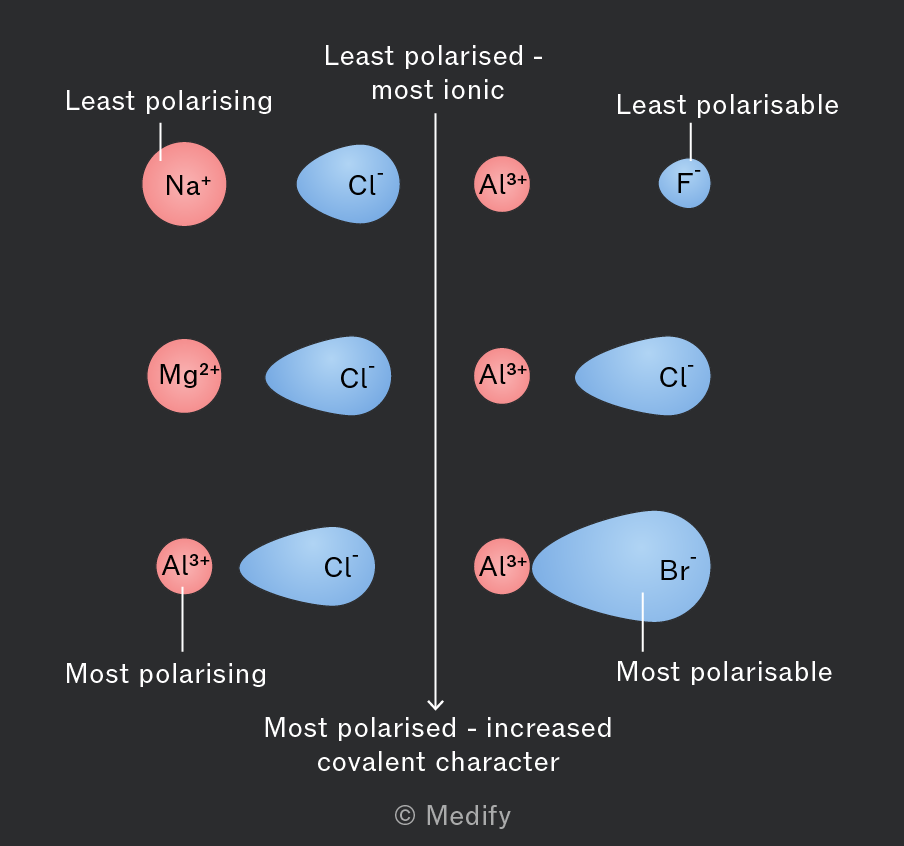
The most polarisable anions are large with a low charge; the charge density is low.
The most polarising cations are small with a high charge; the charge density is high.
Lattice enthalpies can be more exothermic than predicted based on a purely ionic model.
In reality, there is polarisation of the ions, leading to a partially covalent nature to the bond.
The energy released when the partial covalent bonds are formed is greater than that from the electrostatic attraction alone. The degree of polarisation varies with the size and charge of the ions involved. The greater the polarisation, the larger the difference in lattice enthalpy compared to the purely ionic value.
Water molecules, being polar, have a partial negative charge on the oxygen atom and a partial positive charge on the hydrogen atoms.
During hydration, when gaseous ions dissolve in water, the negative ions show intermolecular interactions with the positive sides of water molecules, whilst positive ions interact with the negative side.
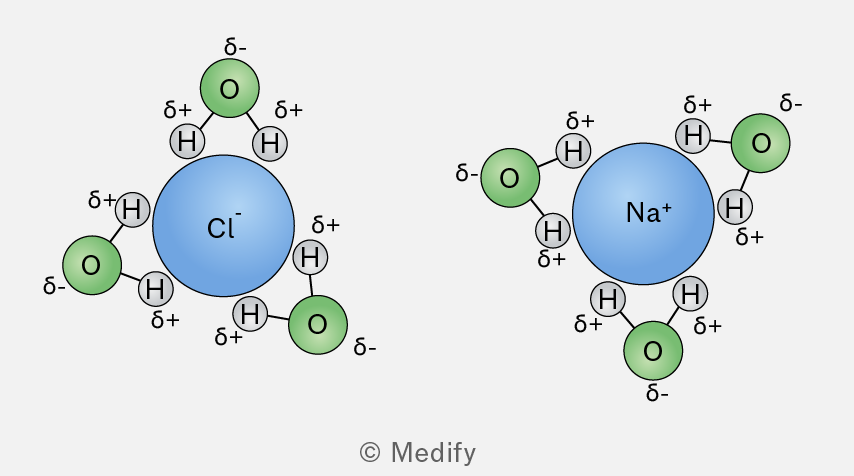
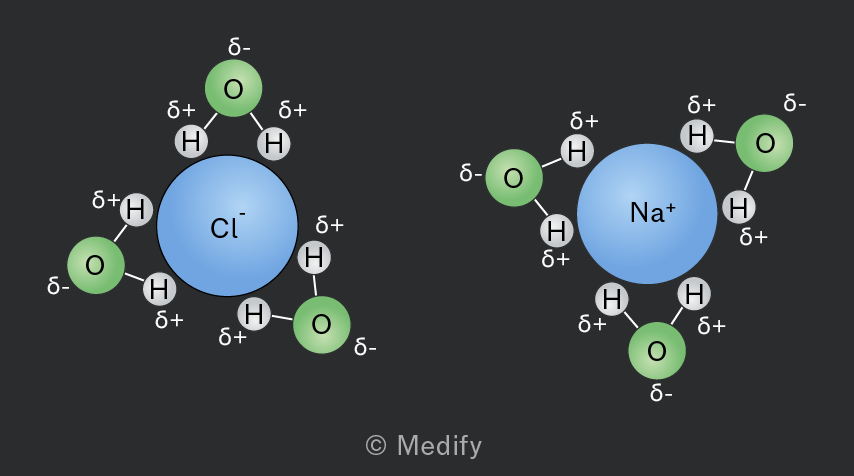
This interaction releases energy, making the hydration process exothermic.
The hydration enthalpy depends on the charge and size of the ion. Smaller, highly charged ions have a greater charge density and show higher due to stronger ion-dipole interactions.
When an ionic compound fully dissolves, it splits into its composite ions (the reverse of lattice enthalpy), and each ion is hydrated.
The overall enthalpy change of solution is the sum of the enthalpy changes of hydration minus the lattice enthalpy.
Both and are negative values. can be negative or positive depending on the relative magnitudes of and .
- If is negative, the dissolving process is exothermic, and the solution increases in temperature.
- If is positive, the dissolving process is endothermic, and the solution decreases in temperature.
The lattice enthalpy, the enthalpy of solution and the enthalpies of hydration can be connected in an enthalpy cycle.
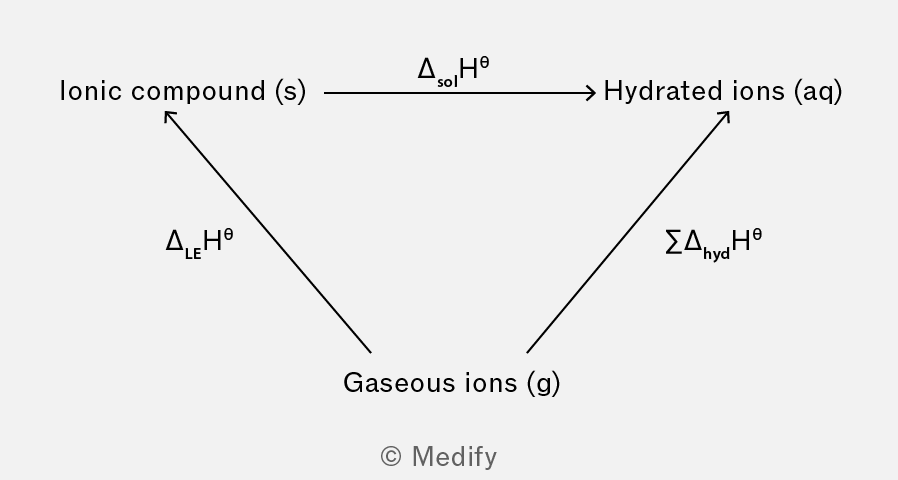
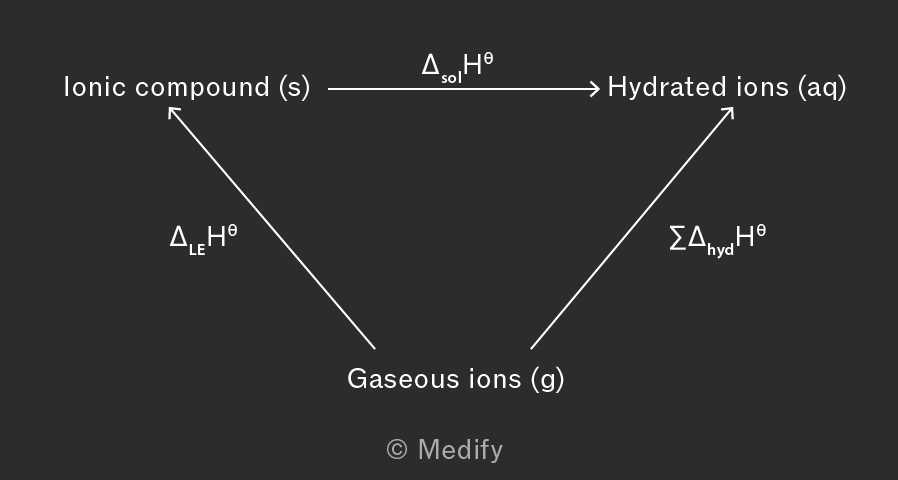
It is useful to know that this enthalpy cycle can be used to calculate a missing value given a subset of the data.
Entropy, is a measure of the dispersal of energy in a system. It quantifies the degree of disorder within a system.
Entropy reflects how energy is spread out within a system.
- High entropy means energy is more dispersed
- Low entropy indicates that energy is more concentrated.
Entropy increases as the disorder of a system increases. The more disordered a system is, the greater its entropy.
A system with high entropy has more ways of arranging particles and hence is more disordered. Conversely, a system with low entropy is more ordered.
In a solid, particles are arranged in a structured, fixed pattern, leading to lower entropy compared to liquids and gases where particles have freedom to move around.
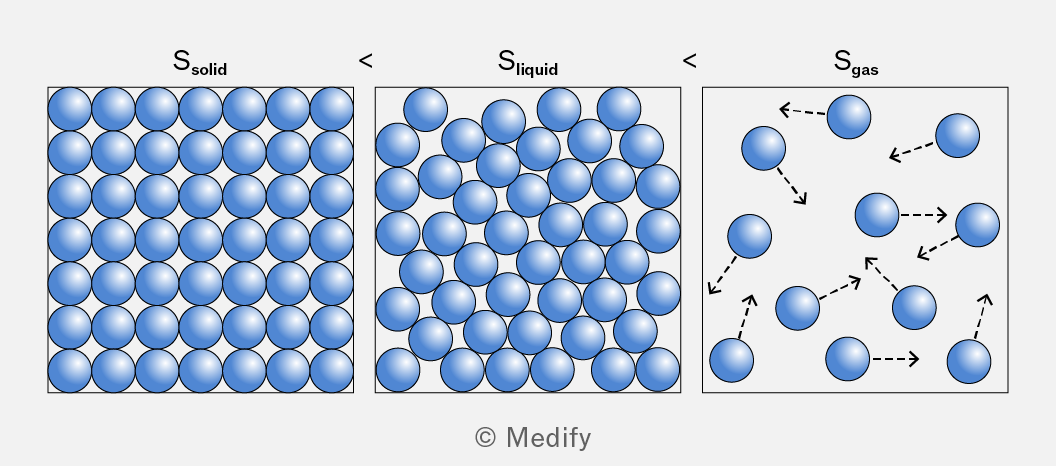
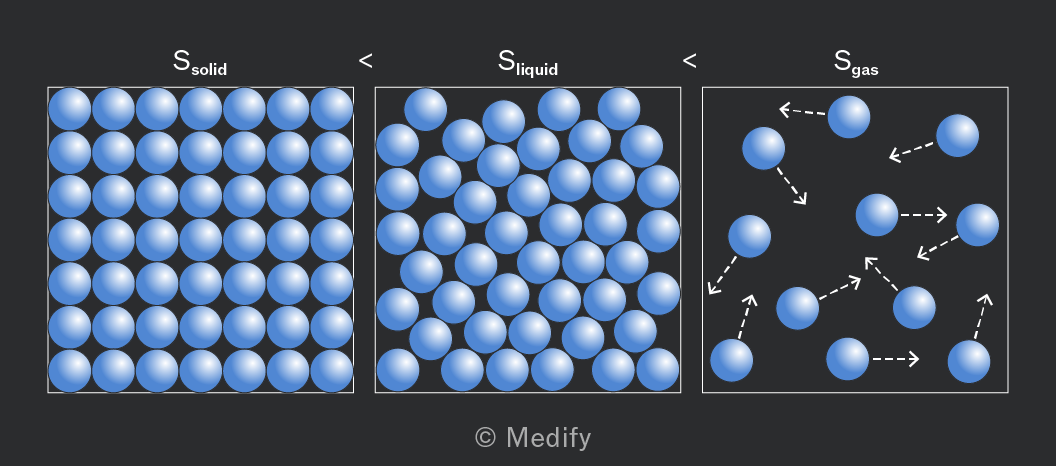
Entropy plays a crucial role in understanding the stability of a system.
In thermodynamics, a system’s stability is often related to its entropy:
A process or reaction that leads to an increase in entropy is more entropically favourable. Nature tends to move towards states of higher entropy, as systems tend to evolve towards greater disorder over time.
Entropy in solids
Particle arrangement: In a solid, particles are tightly packed in a fixed, orderly structure, such as a crystalline lattice. The particles have limited movement and vibrate about fixed positions.
Energy distribution: Energy is not widely dispersed because the particles have little freedom to move. As a result, solids have low entropy.
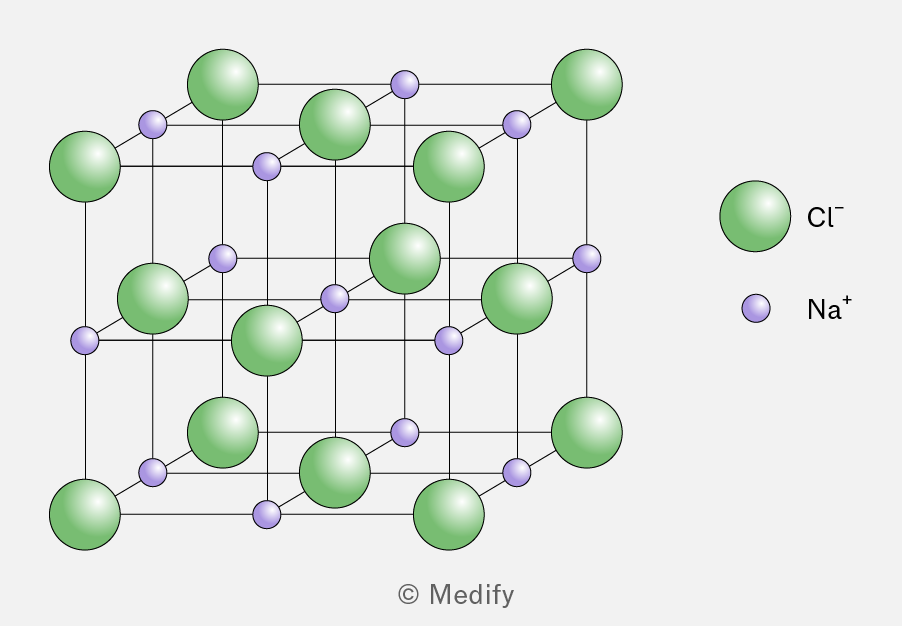
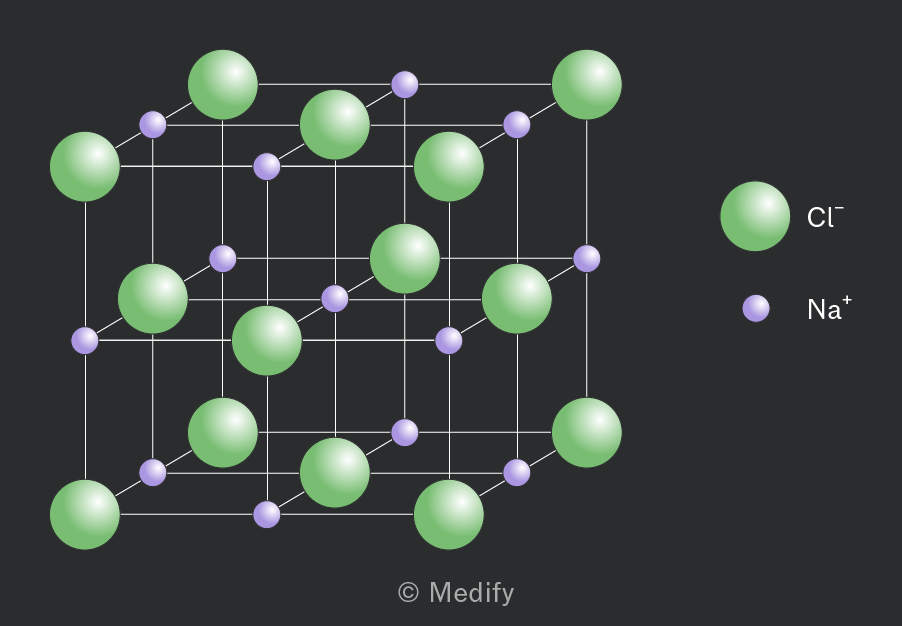
Example: A crystal of sodium chloride at room temperature has relatively low entropy due to its highly ordered crystalline structure.
Entropy in liquids
Particle arrangement: In a liquid, particles are still close together but not in a fixed position. They can move around and slide past each other, giving liquids a fluid nature.
Energy distribution: There is more dispersal of energy compared to solids, leading to higher entropy. The particles have more freedom to move, but not as much as in a gas.
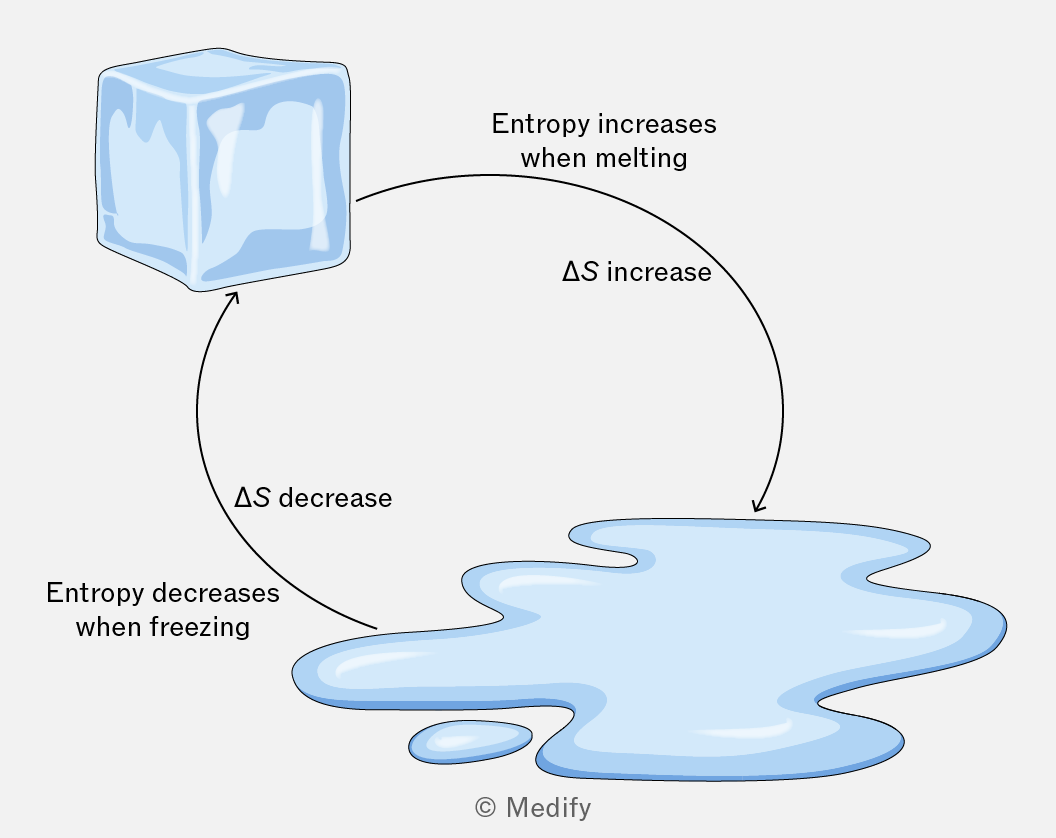
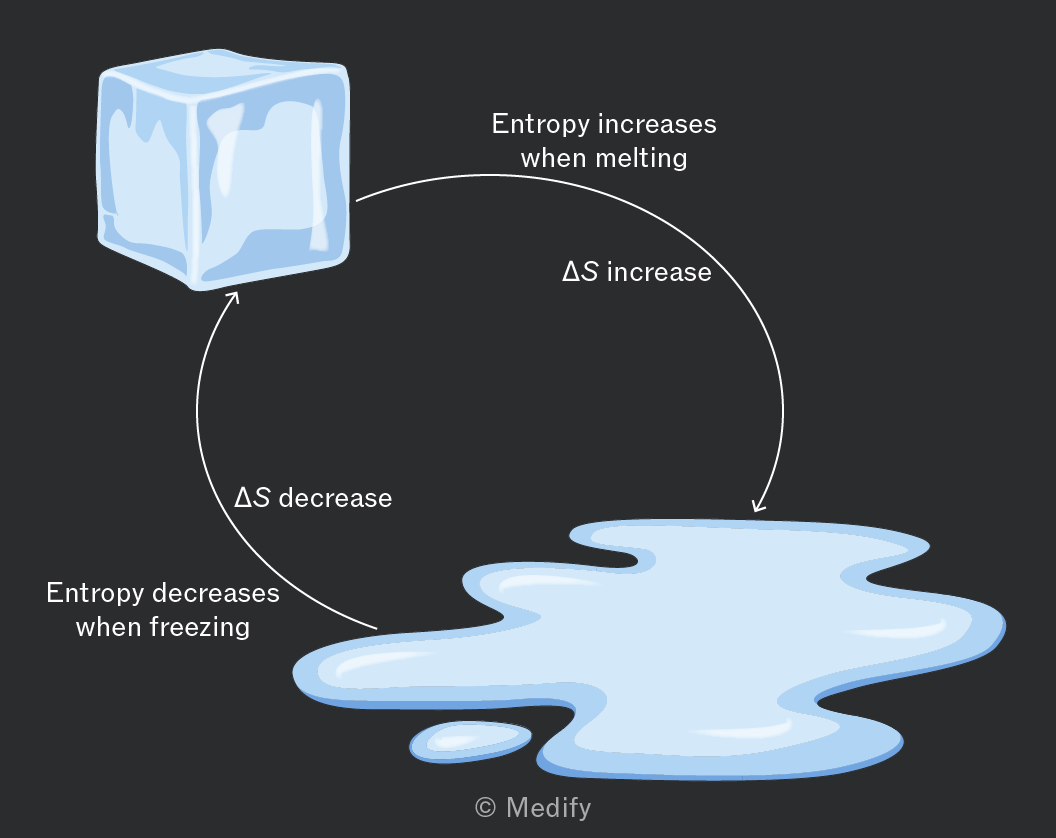
Example: Liquid water ( at room temperature has higher entropy than ice because the water molecules can move more freely.
Entropy in gases
Particle arrangement: In a gas, particles are far apart and move independently in all directions. There is no fixed structure, and the particles are in constant, random motion.
Energy distribution: Energy is highly dispersed because the particles have the greatest freedom of movement. As a result, gases have the highest entropy.
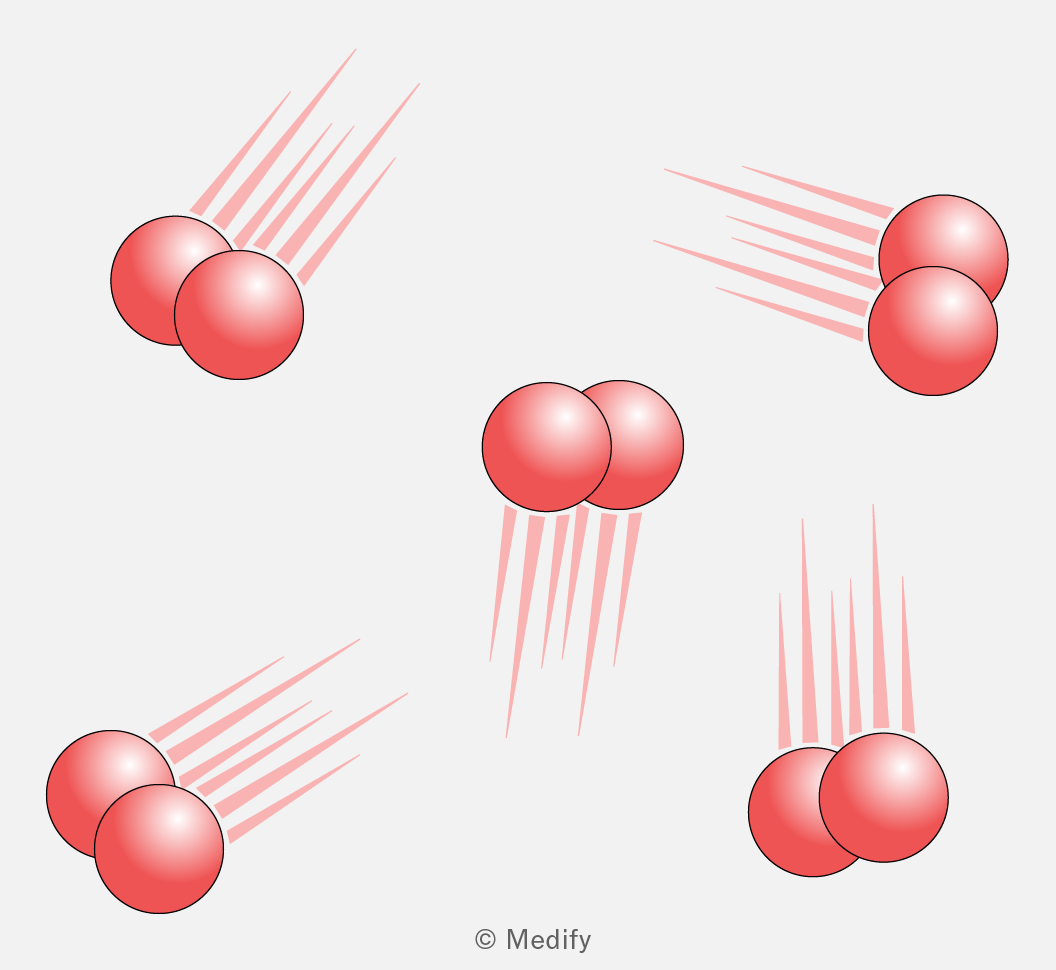
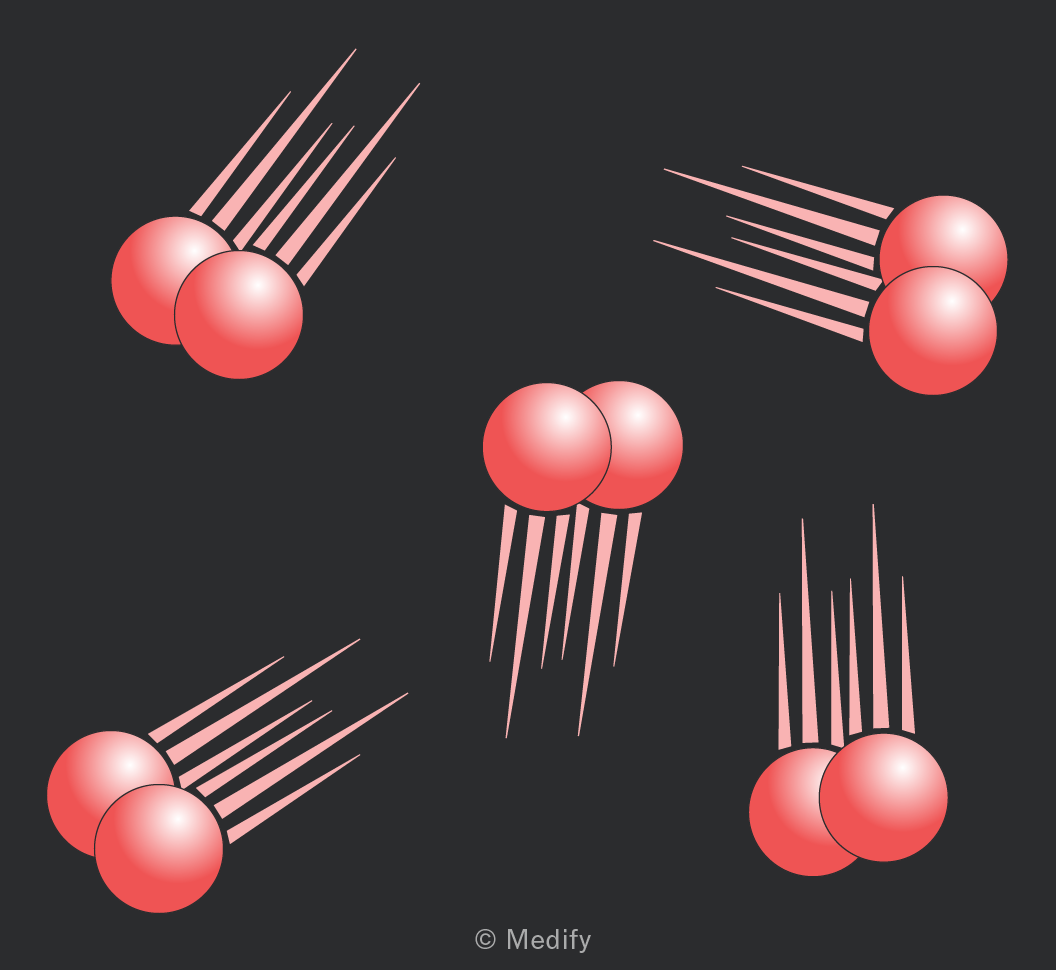
Example: Gaseous oxygen ( has very high entropy compared to liquid oxygen or solid oxygen because in the gaseous state the oxygen molecules are free to move throughout the entire volume of the container.
This graph shows how entropy changes as temperature increases across the solid, liquid and gas phases:
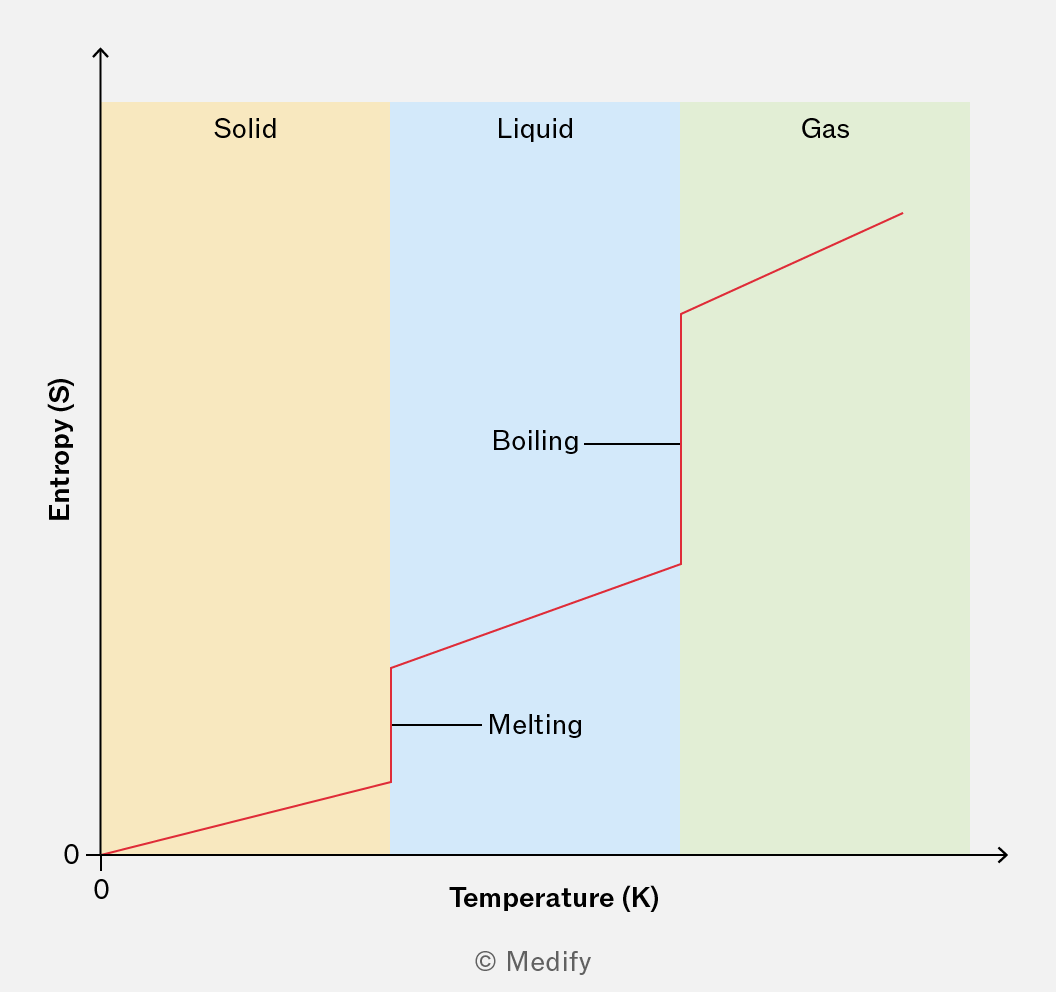
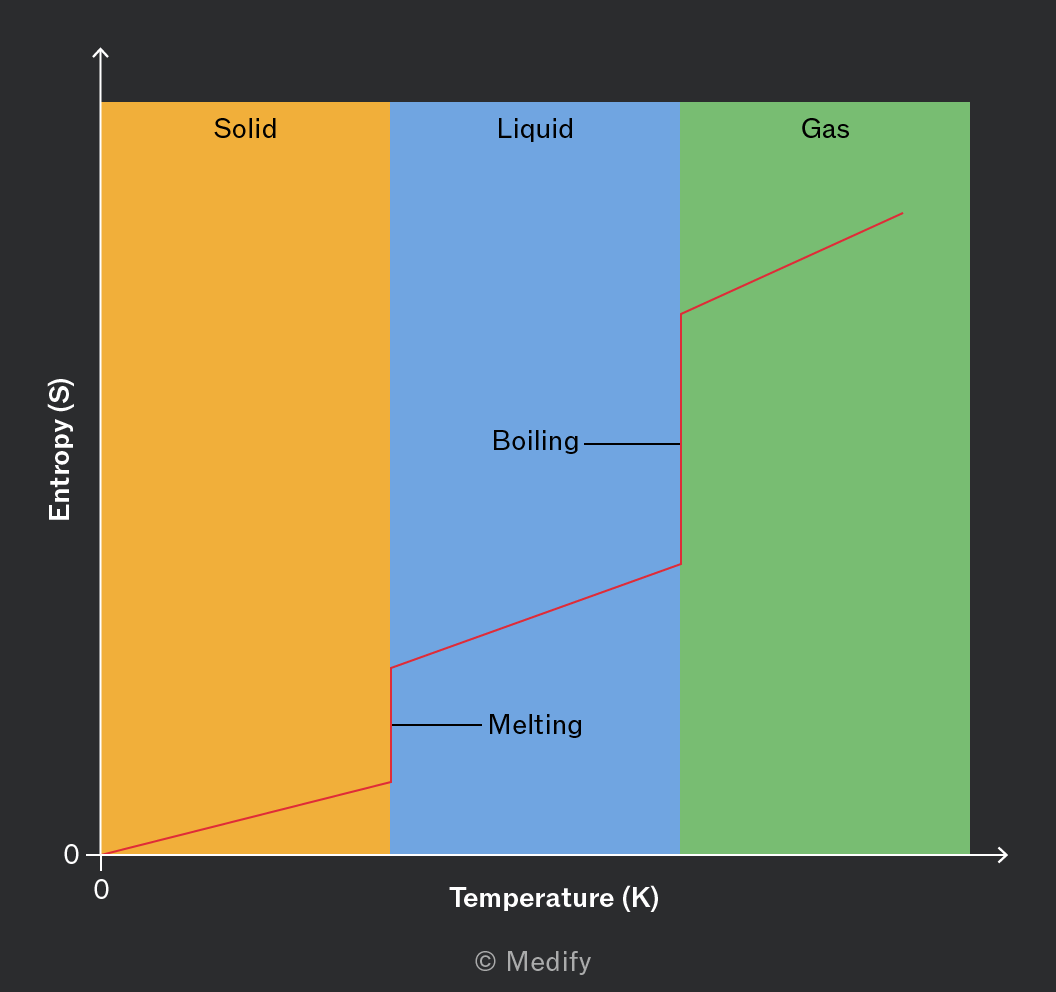
The graph shows that as a substance changes state there is a dramatic increase in entropy shown by the vertical lines (boiling and melting). This is linked to the change in particle arrangement.
The entropy increases gradually with temperature within a state. This is linked to increased vibration and/or motion of the particles and its relationship to the degree of disorder and energy dispersal increases.
Consider , the change in entropy, for the decomposition of copper carbonate :
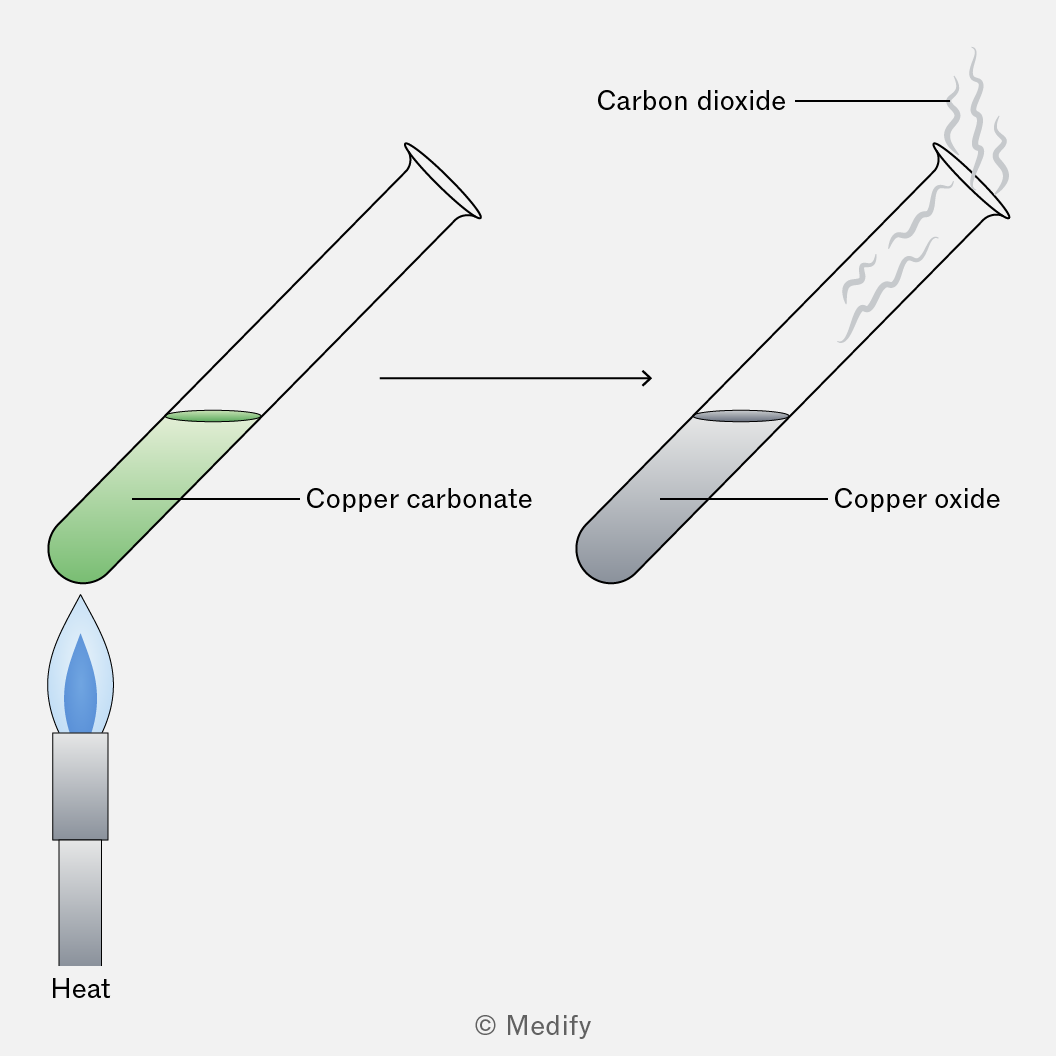
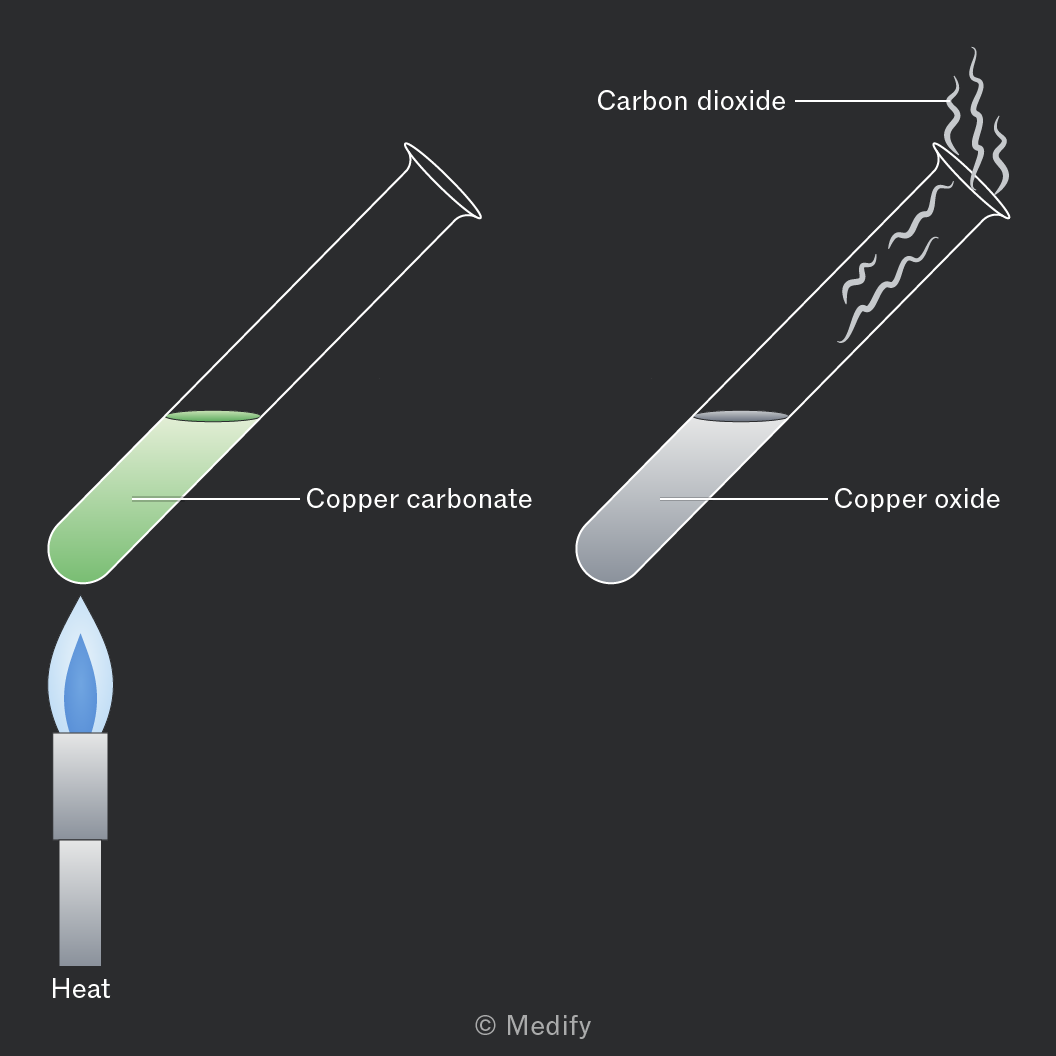
In this reaction, a solid decomposes to produce a solid and a gas ). The number of gaseous molecules increases from zero to one.
The formation of a gaseous molecule from a solid significantly increases the system’s entropy because the gas molecules are much more disordered and have more freedom to move than solid particles.
Consider , the change in entropy, for the synthesis of ammonia from nitrogen and hydrogen in the Haber process:
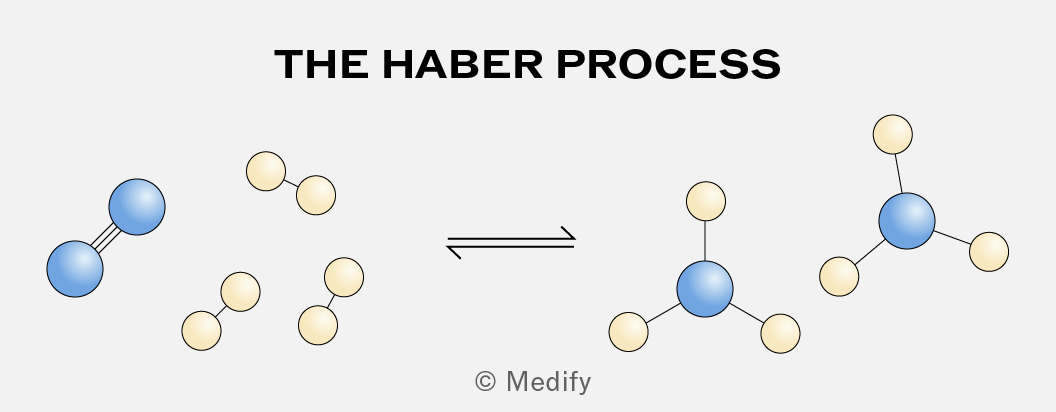
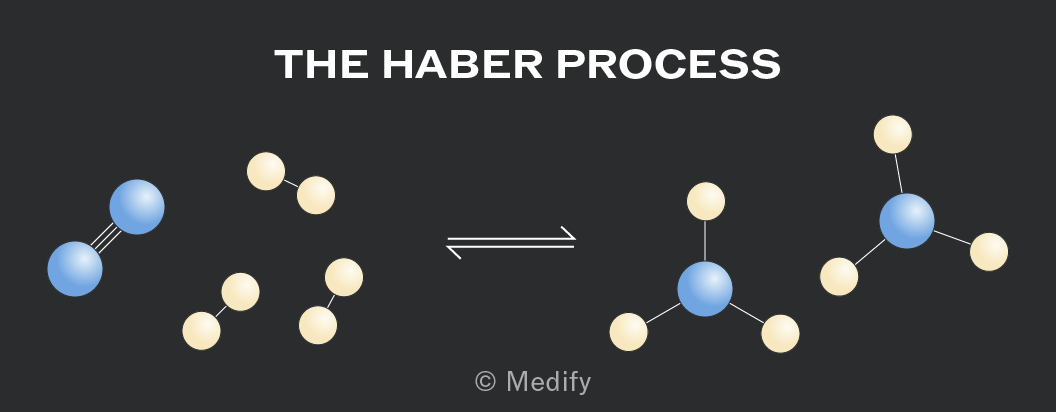
In this reaction, four moles of gas – one mole of – and three moles of react to produce two moles of ammonia gas.
The total number of gaseous molecules decreases from four to two, which means the entropy of the system decreases.
Fewer gas molecules result in less disorder and a lower entropy state.
The change in entropy, for a chemical reaction or physical process is calculated using:
where:
- = change in entropy
- = entropy of the products
- = the entropy of the reactants.
A positive change in entropy, indicates that the disorder of the system increases, which increases the likelihood of a spontaneous process.
Consider dissolving ammonium nitrate in water.
There is an increase in entropy, as the solid dissolves into ions in solution, creating disorder, which drives the reaction.
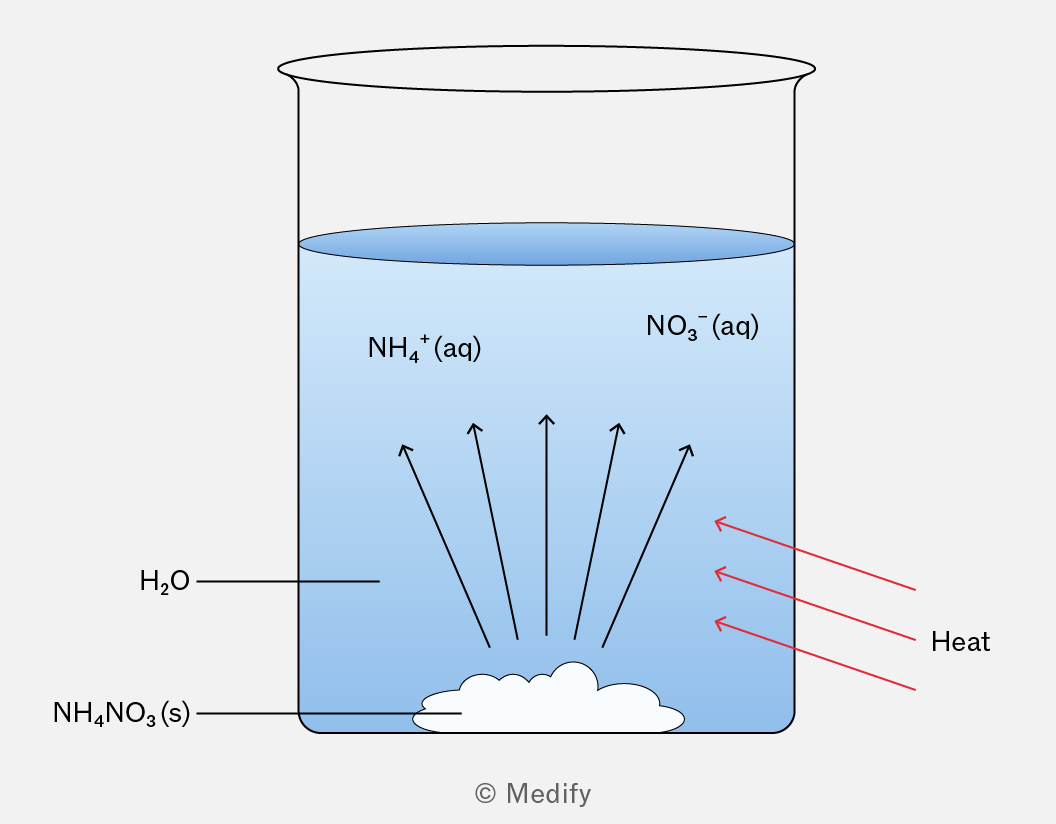
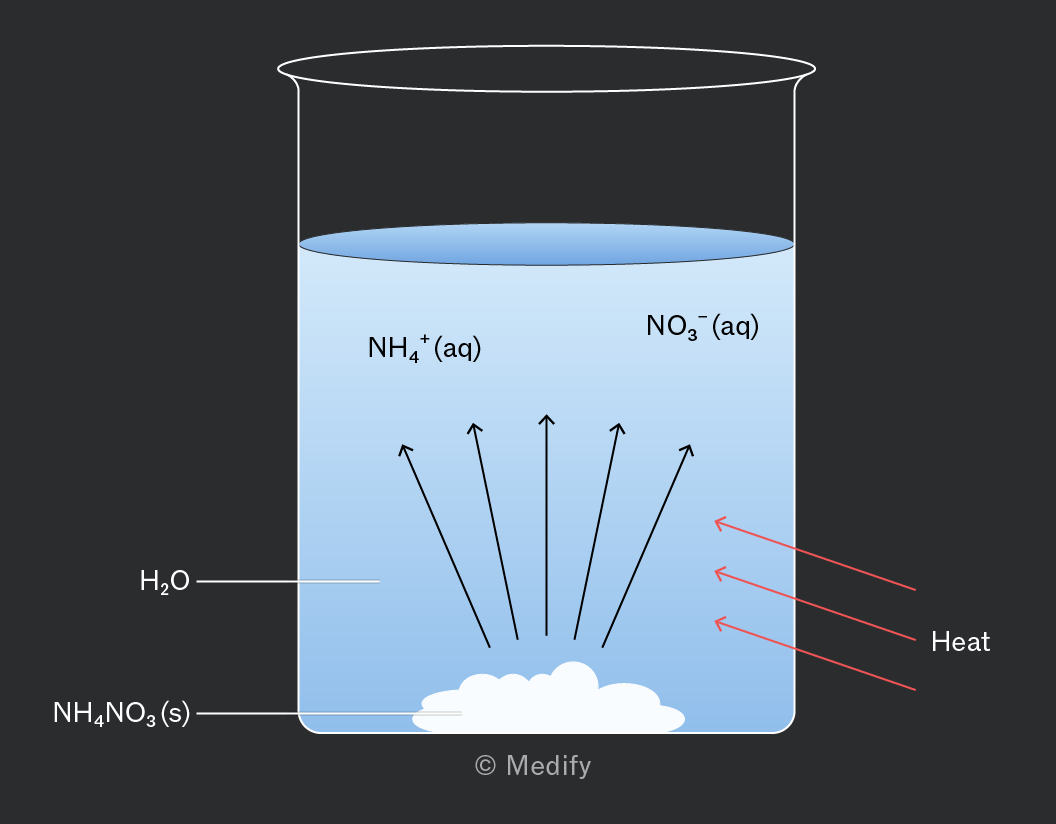
This endothermic reaction, absorbs thermal energy, cooling the surroundings.
The increase in entropy makes the reaction feasible despite a positive enthalpy change. It is only spontaneous above a given temperature.
Consider the reaction between ethanoic acid and ammonium carbonate.
This reaction releases gas, significantly increasing disorder
The reaction is also mildly exothermic making it feasible and spontaneous at all temperatures.
Consider the complete combustion of magnesium metal.
The reaction is highly exothermic, . This reaction releases energy as heat and light.
The reaction shows a reduction in entropy, : a gaseous reactant converts to a solid product.
This reaction is only feasible below a certain (very high) temperature.
The reaction is not spontanious at r.t.p. due to a high activation energy.
Consider the mixing of solid barium hydroxide with solid ammonium chloride.
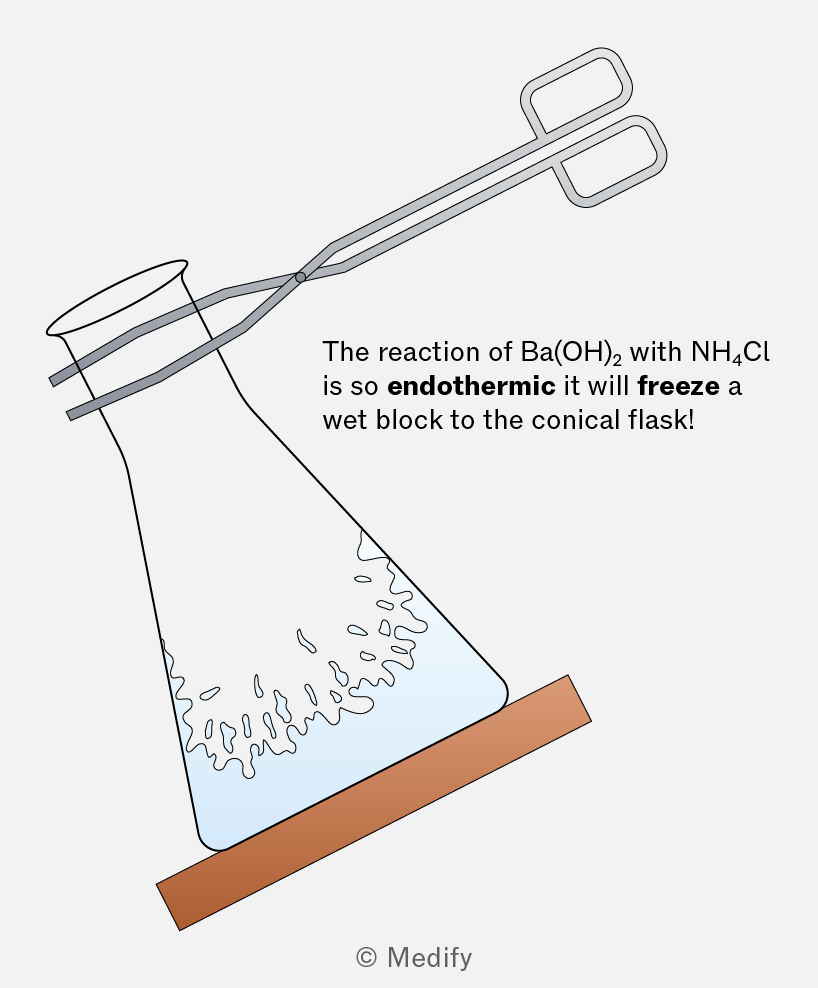
This is a highly endothermic reaction, absorbing enough thermal energy from the surroundings to reduce the environmental temperature to below the freezing point of water.
The magnitude of the entropy increase when solid products are fully converted to gases and liquids is so large that the reaction is feasible despite a highly positive .
The reaction is only spontanious above certain temperatures.
The total entropy change in a reaction is expressed as:
where refers to the entropy change within the reactants and products, and accounts for the heat exchanged with the environment.
This relationship shows how both the reaction’s internal changes and the effect on surroundings influence the reaction’s spontaneity.
depends on the heat exchanged with the surroundings and is calculated using the formula:
where:
- is the enthalpy change of the reaction
- is the temperature in kelvin.
Exothermic reactions release heat energy to the surroundings.
The increase in temperature of the surroundings correlates to increase . Reaction releasing heat can compensate for a negative ensuring that is always positive.
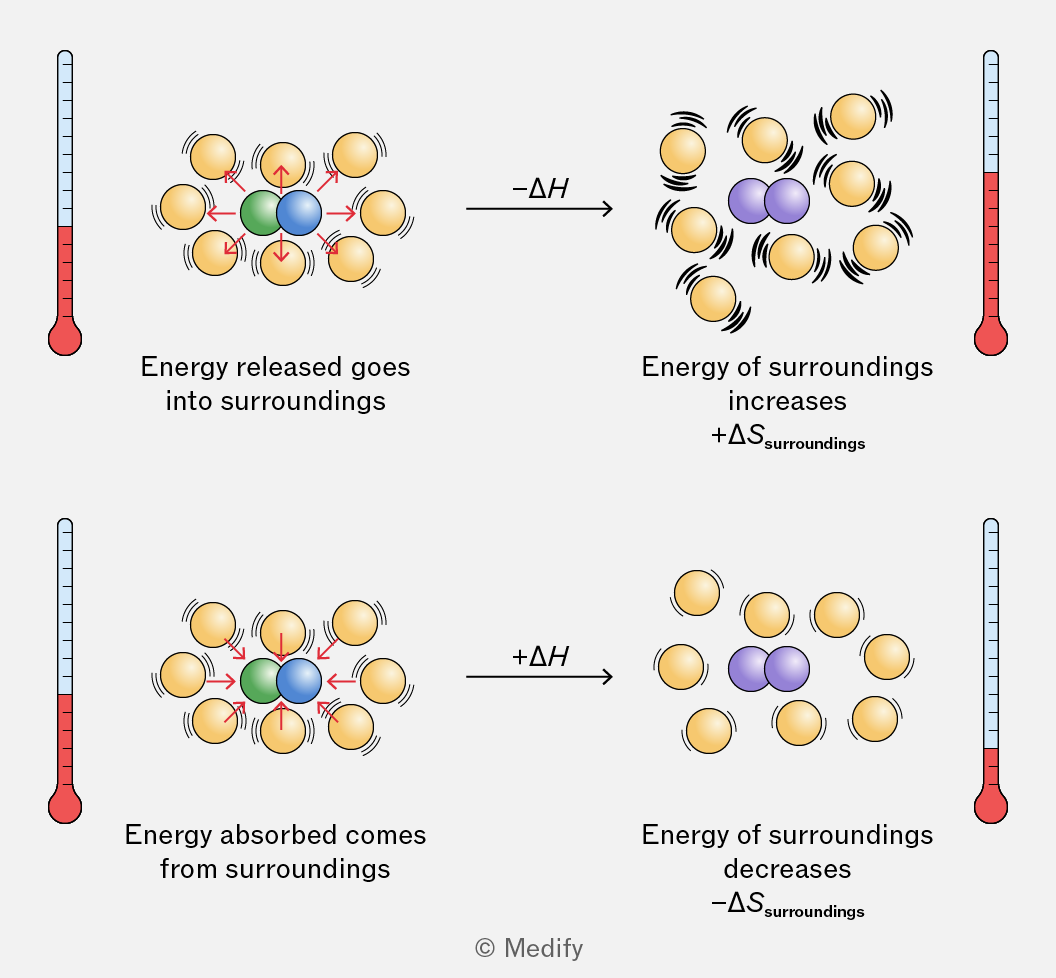
Endothermic reactions take heat energy from the surroundings.
The decrease in the temperature of the surroundings correlates to a reduction in . must be positive therefore a positive is necessary for feasibility.
The spontaneity of a reaction is influenced by the sign of .
For a reaction to be spontaneous, must be positive. Even if is negative, a sufficiently large positive can result in a positive , making the reaction spontaneous.
This highlights the importance of considering both system and surroundings in determining the feasibility of reactions under given conditions.
A reaction’s feasibility is based on changes in enthalpy , entropy, , and the temperature, of the system.
We calculate feasibility using the Gibbs free energy equation:
When is negative, the reaction is feasible (spontaneous).
Both and influence the outcome; is the heat exchange at constant pressure, and represents the effect of entropy at a given temperature.
Entropy, , measures system disorder; reactions increasing disorder (positive ) are more likely feasible, especially at higher temperatures where becomes more significant.
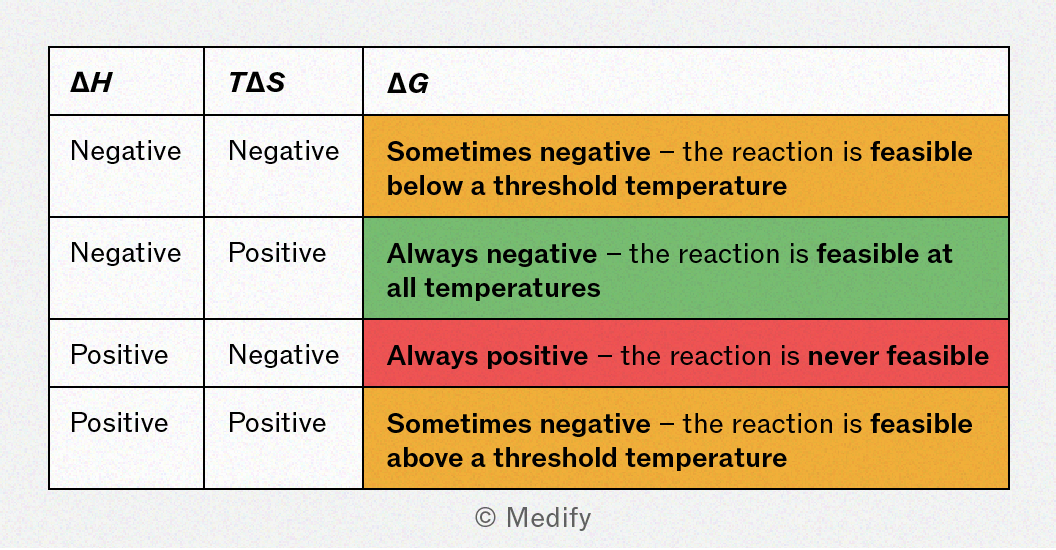
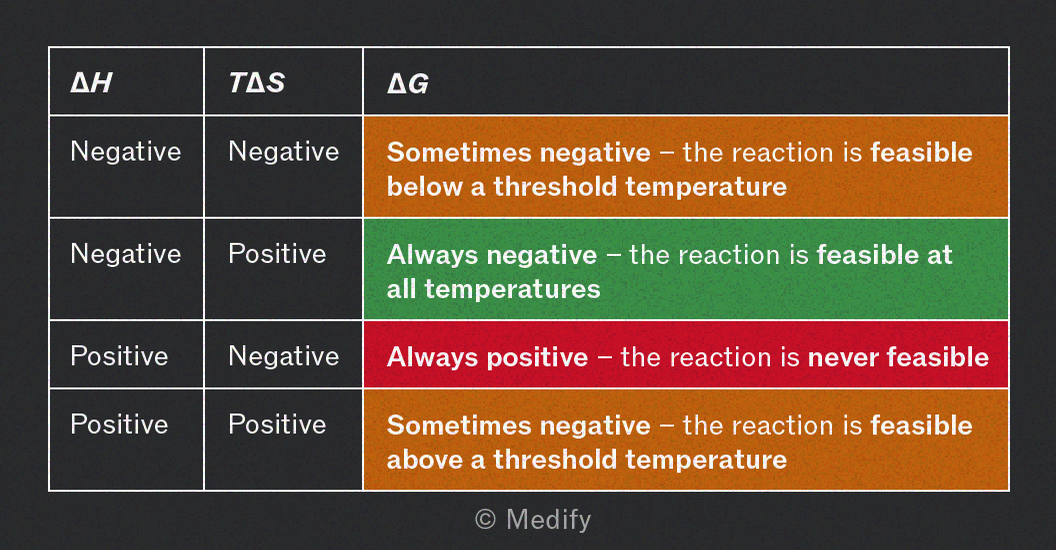
is the product of entropy and temperature, highlighting entropy’s influence as temperature rises. When the value of is negative, favouring feasibility.
Enthalpy, , indicates heat absorbed or released in a reaction.
Exothermic reactions (negative ) are more likely feasible since they release energy, often resulting in a negative .
However, endothermic reactions (positive ) may be feasible at higher temperatures if compensates.
The sign of determines whether a process is feasible (spontaneous):
(negative ): The process is feasible, meaning it can occur spontaneously without external input.
(positive ): The process is not feasible, meaning it will not occur spontaneously.
: The system is at equilibrium, and the process has no net tendency to occur in either direction.
In order to calculate , first determine .
You may be provided with values for (enthalpy change) and (entropy change) or you may need to calculate them based on given data.
Convert the units:
Ensure that the units of are compatible. Often, is given in , in and can be or .
To make them compatible:
- Convert from into by dividing by 1000.
- Convert from into by adding 273.
Apply the Gibbs free energy equation:
Now, substitute the values into the Gibbs free energy equation:
The temperature at which a reaction becomes feasible can be calculated using the Gibbs free energy equation.
Consider a reaction with the following enthalpy and entropy data:
As is positive and is also positive could be negative: the reaction is feasible above a threshold temperature.
To find the temperature at which a reaction becomes feasible, we set .
Rearranging to solve for the threshold temperature:
The reaction will be feasible at temperatures above 333 K.
can tell us if a reaction is thermodynamically feasible, but it does not provide any information about the rate of the reaction.
A reaction with a negative might occur so slowly that it is effectively not happening within any practical time frame. This is often due to a high activation energy barrier.
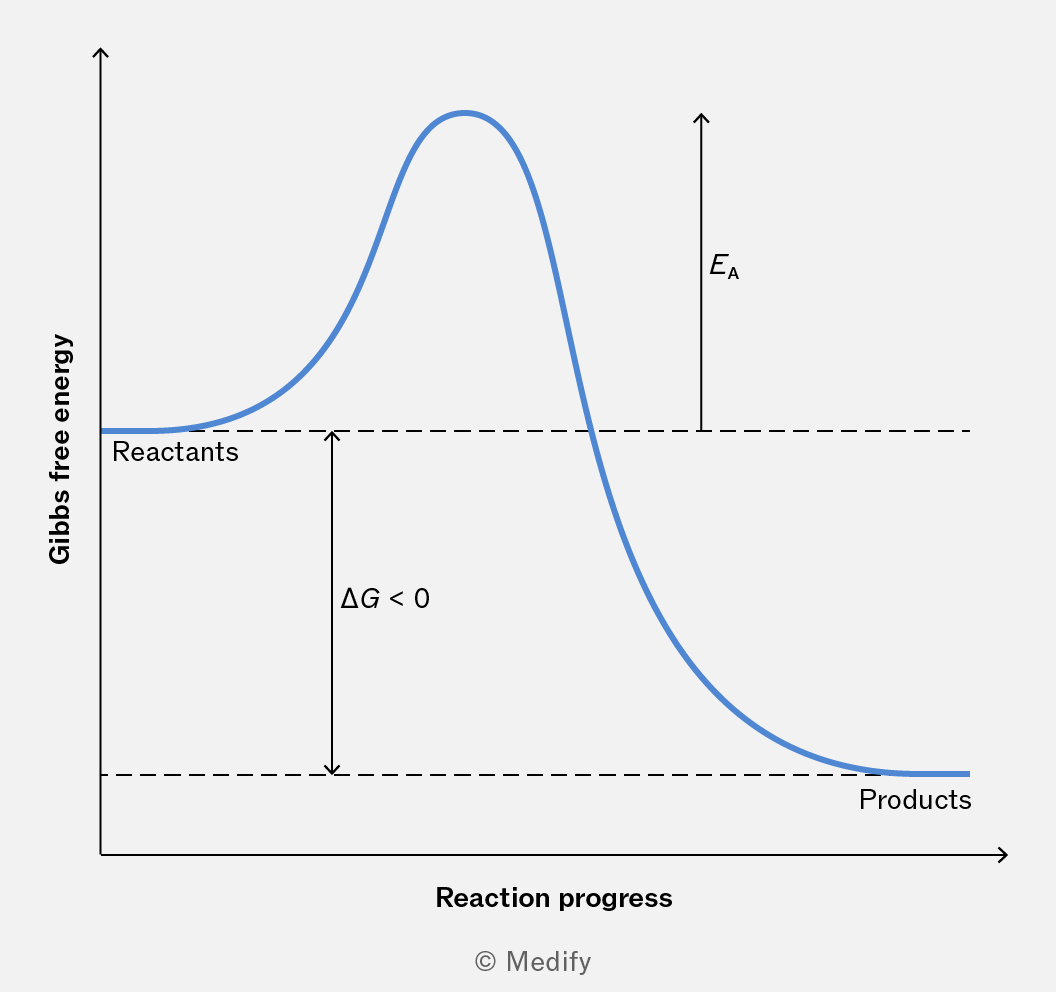
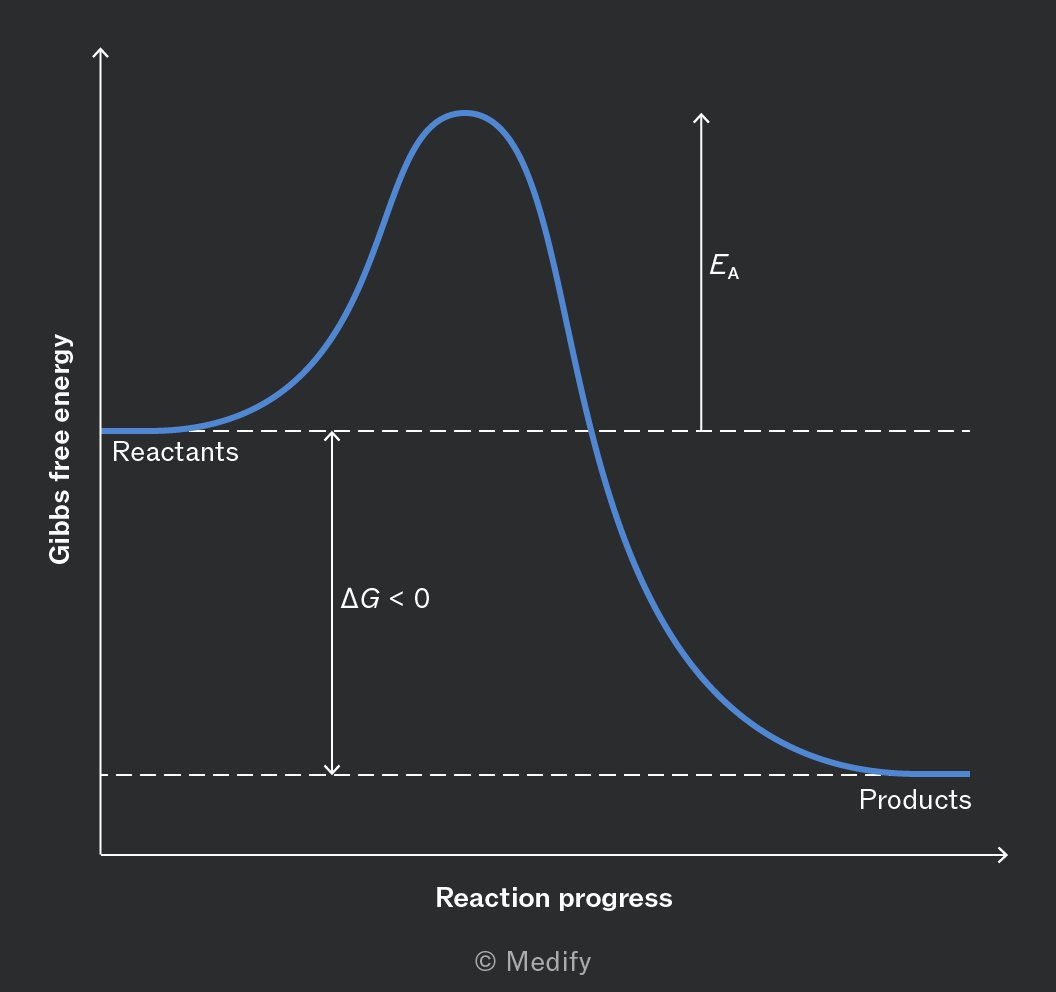
Activation energy, , is the minimum energy required for reactants to form the transition state before converting into products.
Even if , a high activation energy can make the reaction proceed very slowly.
Limitations of – diamond to graphite conversion
The conversion of diamond to graphite is thermodynamically feasible at standard conditions because graphite is the more stable form of carbon: .
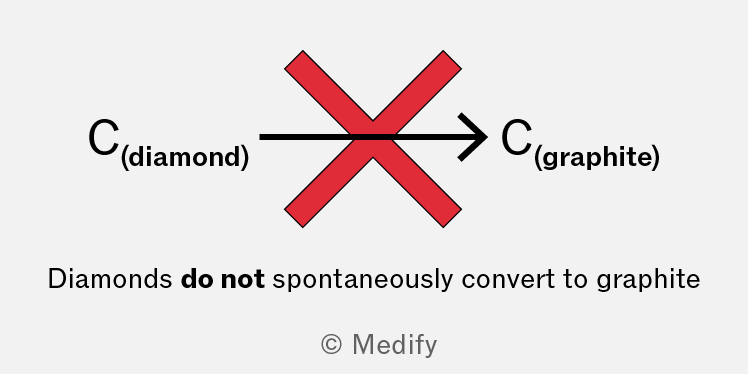
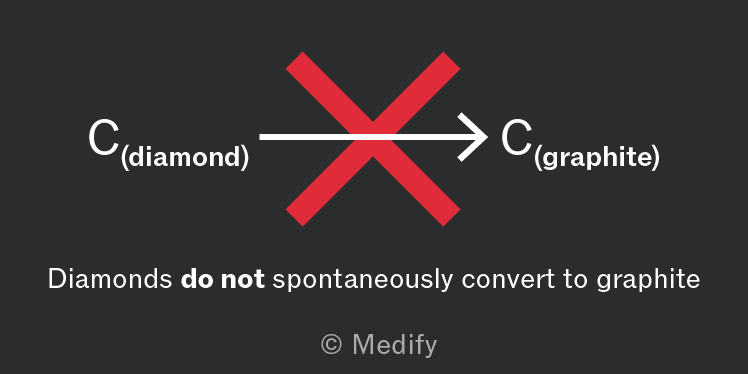
Despite being thermodynamically feasible, the process is extremely slow because of the very high activation energy required to break the strong covalent bonds in diamond.
As a result, diamonds do not spontaneously turn into graphite at room temperature.
Limitations of – decomposition of hydrogen peroxide
The decomposition of hydrogen peroxide, , into water and oxygen has a negative at all temperatures and is therefore thermodynamically feasible.
Without a catalyst, this reaction is slow because of the high activation energy. Hydrogen peroxide can be safely stored at room temperature for a number of months. However, adding a catalyst like manganese dioxide significantly lowers the activation energy, making the reaction proceed rapidly.
Limitations of – the rusting of iron
The rusting of iron is thermodynamically feasible, as it has a negative below a threshold temperature; it is exothermic but shows a reduction in entropy.
The reaction rate is slow under normal conditions, which is why rusting is not immediate. However, the presence of water and salt can lower the activation energy and increase the reaction rate, making the rusting process occur faster.
The relationship between Gibbs free energy, , and the equilibrium constant, , is crucial in understanding reaction feasibility.
The equation connects these Gibbs free energy to the equilibrium constant, where is the gas constant and is the temperature in kelvin.
If a reaction is spontaneous at constant temperature and pressure, it has a negative . The value of must be positive meaning that must be greater than one.
The equation demonstrates how Gibbs free energy is influenced by the equilibrium constant.
When is large, , it indicates that products are favoured at equilibrium, leading to a positive value for and a negative .
Conversely, when is small, , reactants are favoured, resulting in a negative value for and a positive .
For reactions with a large equilibrium constant, , the concentration of products at equilibrium is much greater than that of reactants.
This correlates with a negative , meaning the forward reaction is spontaneous under the given conditions.
The larger the value of , the more favourable the forward reaction, reinforcing the concept that a large corresponds to a significant driving force toward products.
For reactions with a small equilibrium constant the concentration of reactants at equilibrium is much greater than that of products.
This correlates with a positive , meaning the reaction is not spontaneous under the given conditions.
A small value of (below one) means the reaction does not proceed significantly toward products.