Practical chemistry for exams›RP11 - Identifying transition metal ions

RP11 - Identifying transition metal ions

An overview of RP11 - Identifying transition metal ions
4 min

In AQA Required Practical 11 – Identifying transition metal ions, the aim is to identify the transition metal ions present in three different solutions Q, R, and S.

This will be achieved by carrying out three different tests:

  • Test 1: Reactions with sodium hydroxide to observe the formation of characteristic precipitates
  • Test 2: Reactions with sodium carbonate to observe the formation of characteristic precipitates
  • Test 3: Reactions with silver nitrate, primarily to identify halides but also the formation of precipitates with sulfate ions.

By analysing the precipitates and reactions in these tests, you will determine the specific transition metal ions in each of the three solutions.

Add to favourites

In Required Practical 11: Identifying transition metal ions, as outlined by AQA, there are several important safety requirements to be aware of (beyond normal lab practice, such as wearing goggles).

  • Wear gloves as well as goggles when handling solutions Q, R, and S to avoid skin and eye irritation.
  • Handle silver nitrate carefully when adding it to solutions Q, R, and S, as it can stain skin and clothing. Clean up any spills immediately with water.
  • Ensure test tubes are securely clamped during heating in the water bath to prevent spills.
  • Handle sodium hydroxide with care, as it may cause irritation to skin.
Add to favourites

Experimental method for AQA Required Practical 11 – Identifying transition metal ions

Part 1: testing with
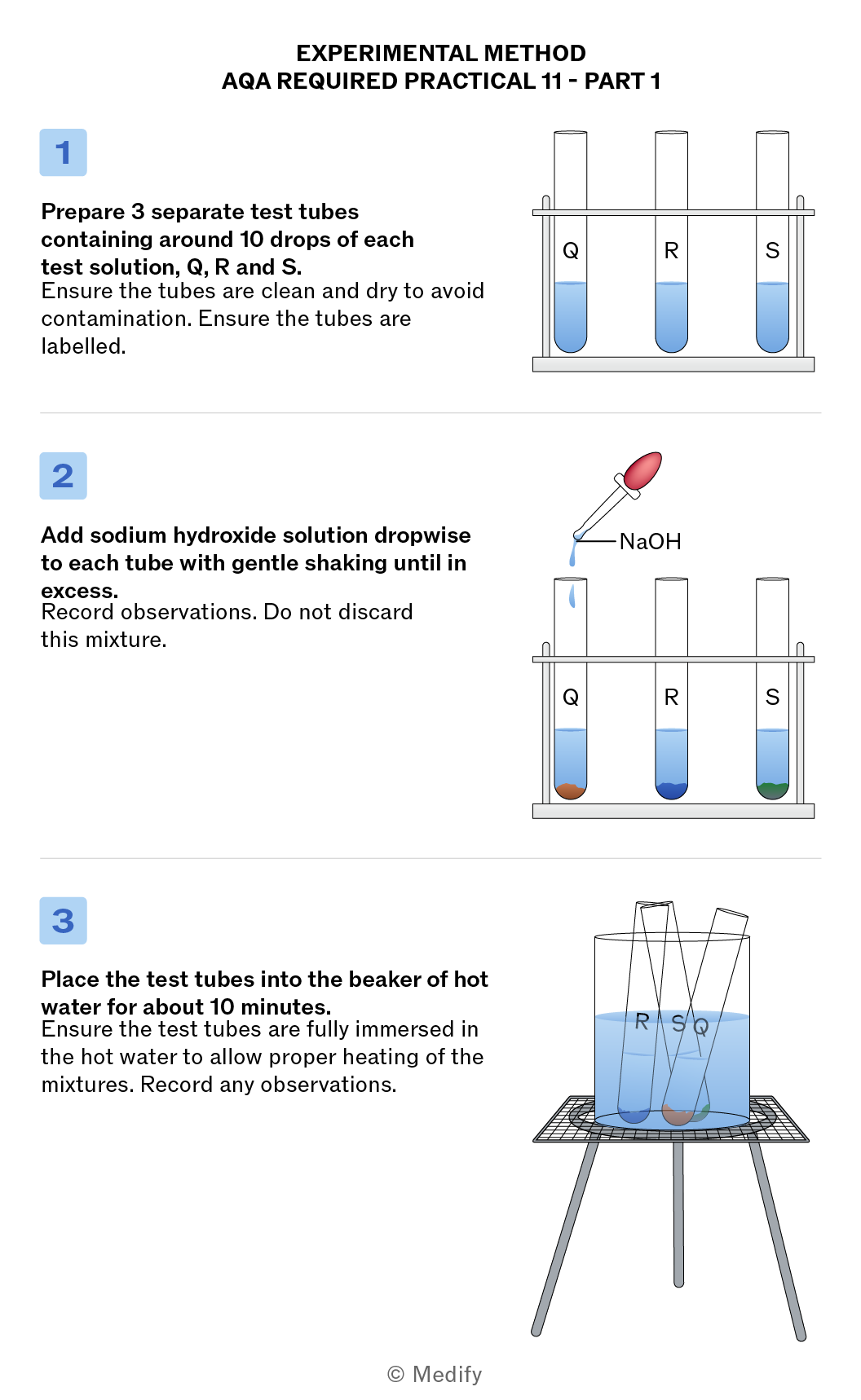
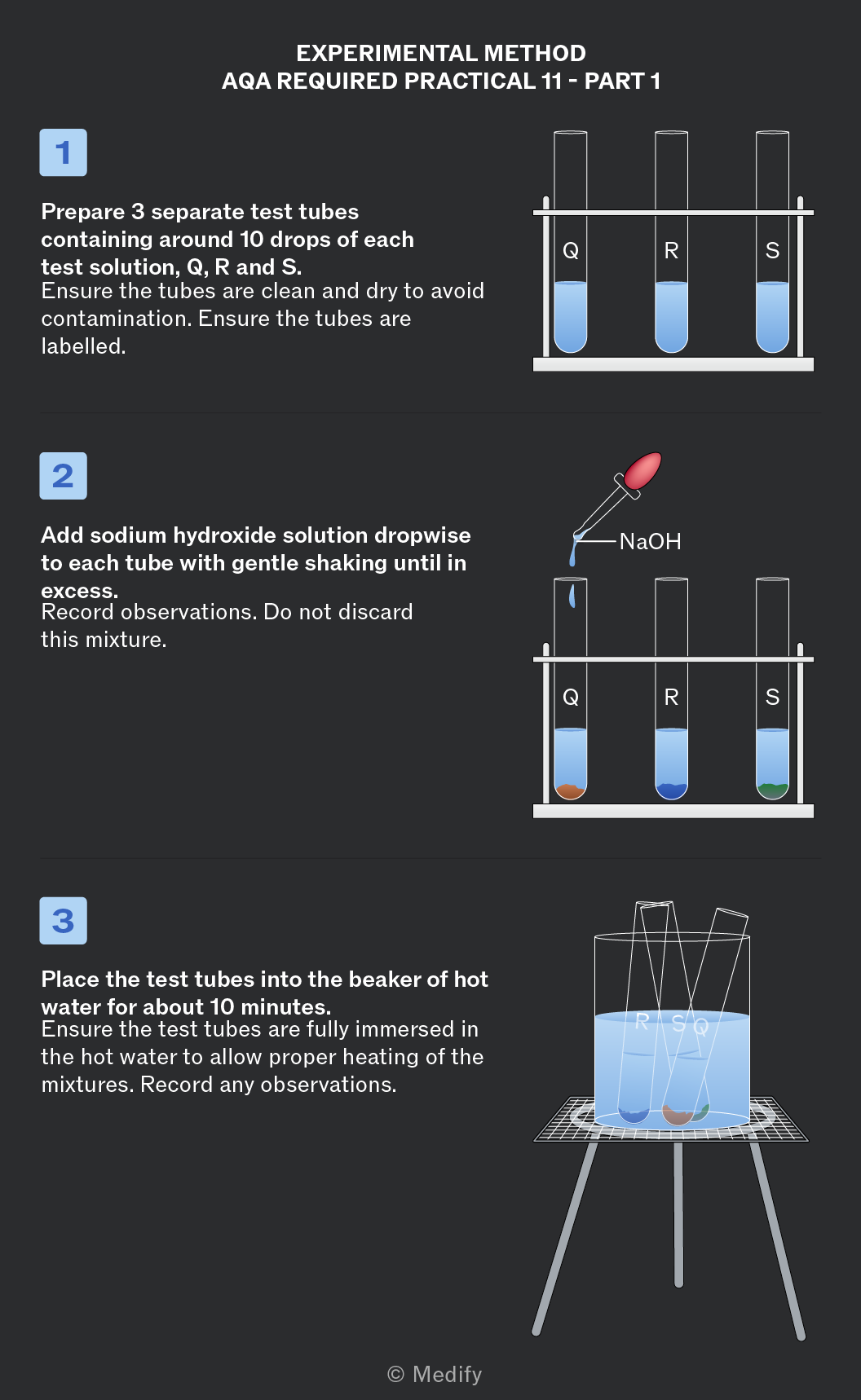
EXPERIMENTAL METHOD AQA REQUIRED PRACTICAL 11 - PART 1. 1. Prepare 3 separate test tubes containing around 10 drops of each test solution, Q, R and S. Ensure the tubes are clean and dry to avoid contamination. Ensure the tubes are labelled. 2. Add sodium hydroxide solution dropwise to each tube with gentle shaking until in excess. Record observations. Do not discard this mixture. 3. Place the test tubes into the beaker of hot water for about 10 minutes. Ensure the test tubes are fully immersed in the hot water to allow proper heating of the mixtures. Record any observations.
Add to favourites

Experimental method for AQA Required Practical 11 – Identifying transition metal ions

Part 2 – testing with
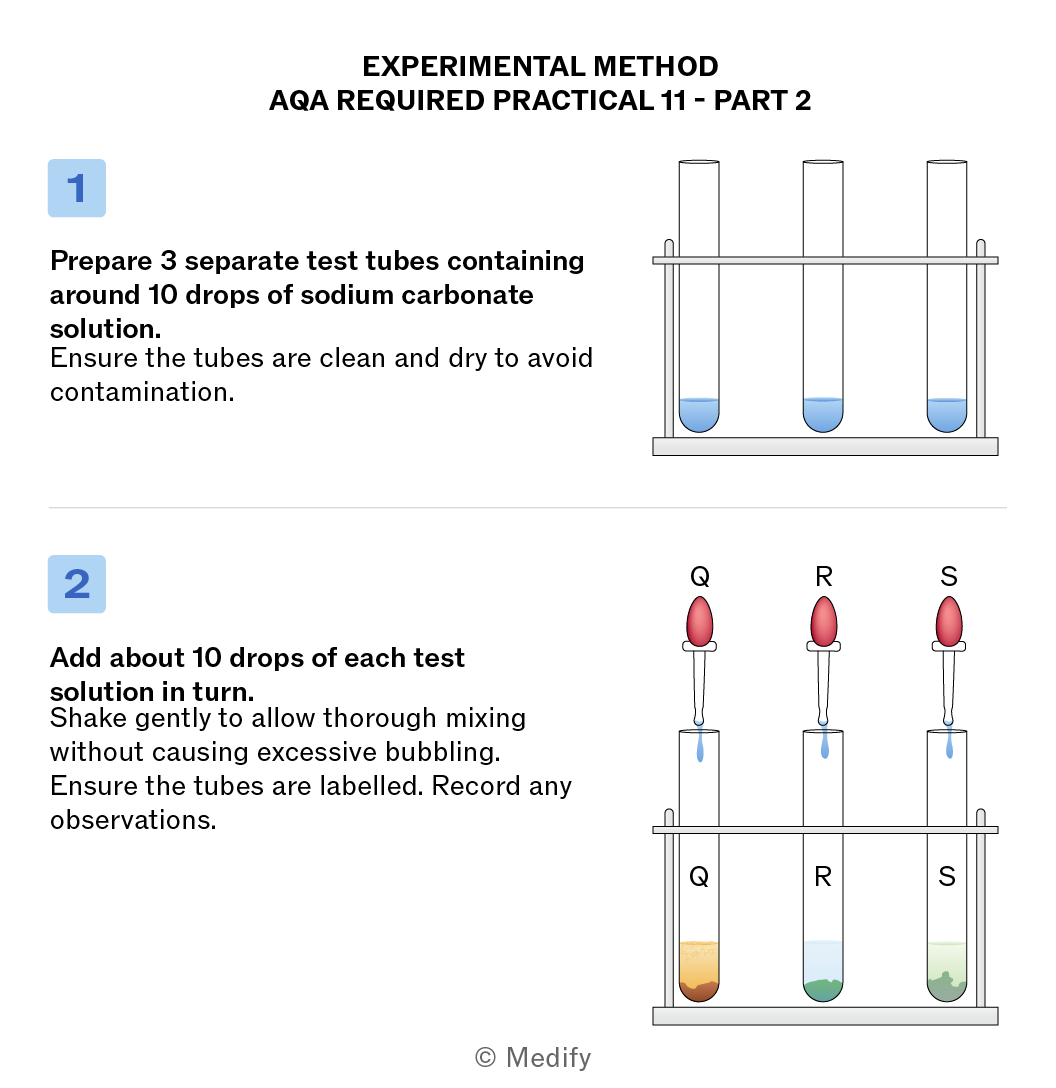
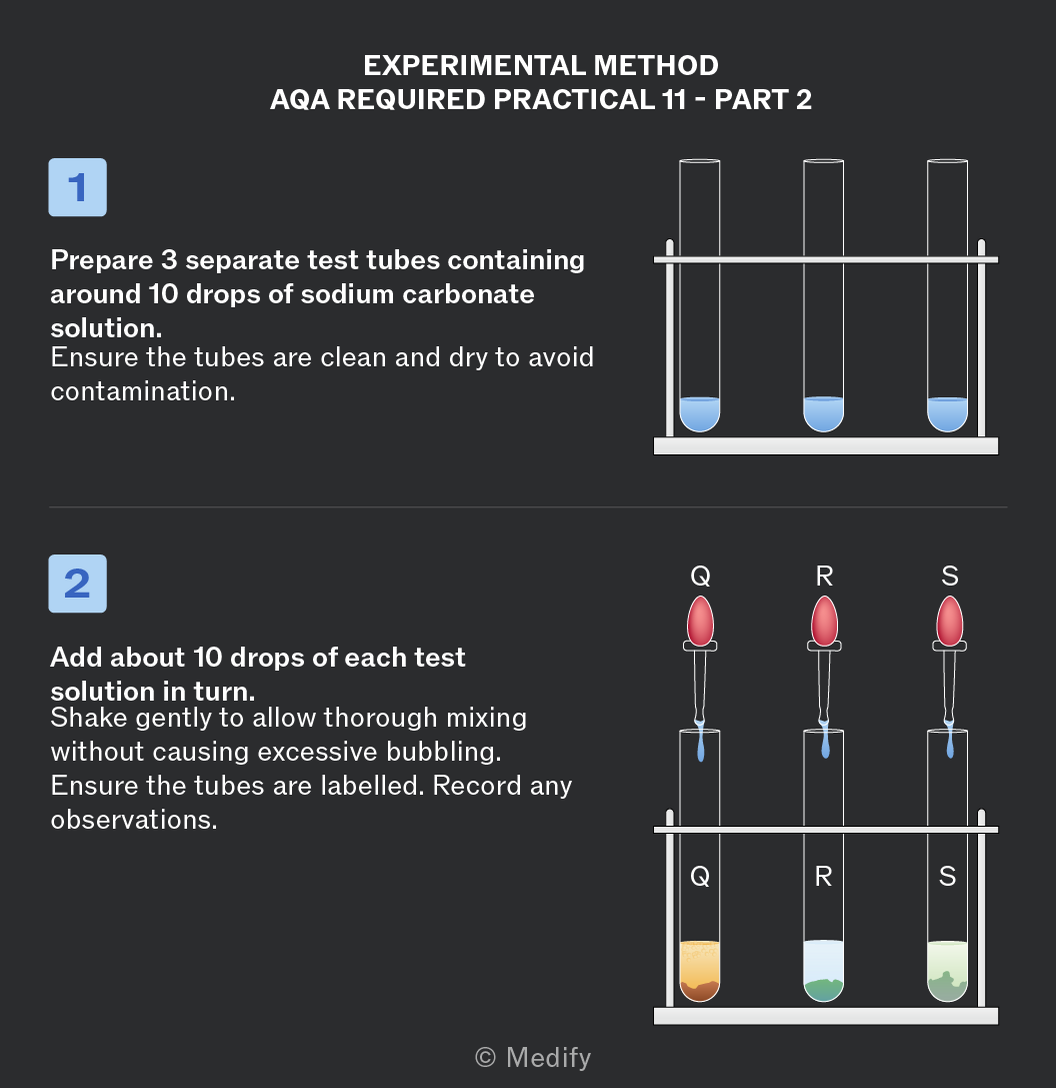
EXPERIMENTAL METHOD AQA REQUIRED PRACTICAL 11 - PART 2. 1 Prepare 3 separate test tubes containing around 10 drops of sodium carbonate solution. Ensure the tubes are clean and dry to avoid contamination. 2 Add about 10 drops of each test solution in turn. Shake gently to allow thorough mixing without causing excessive bubbling. Ensure the tubes are labelled. Record any observations.
Add to favourites

Experimental method for AQA Required Practical 11 – Identifying transition metal ions

Part 3 – testing with
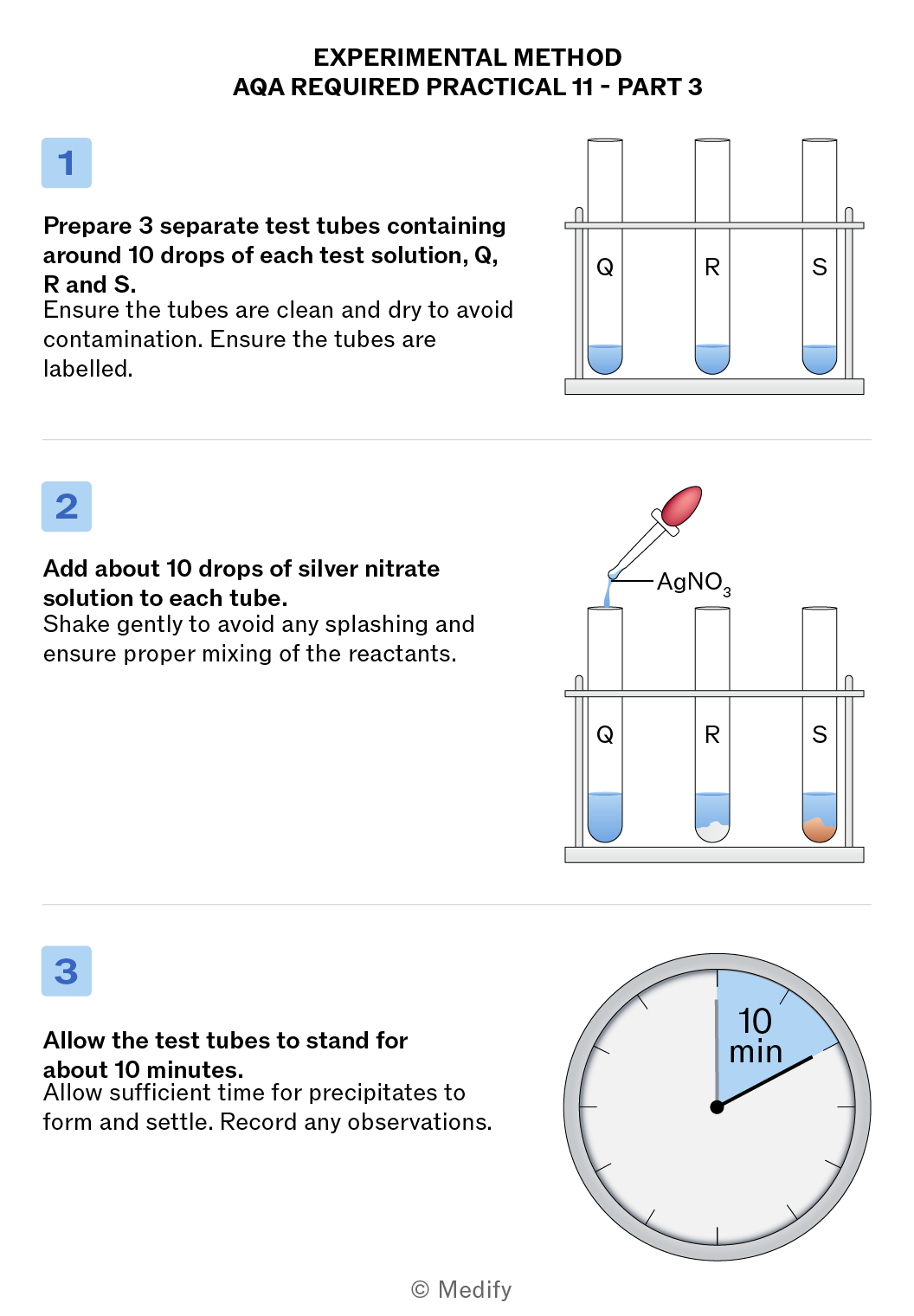
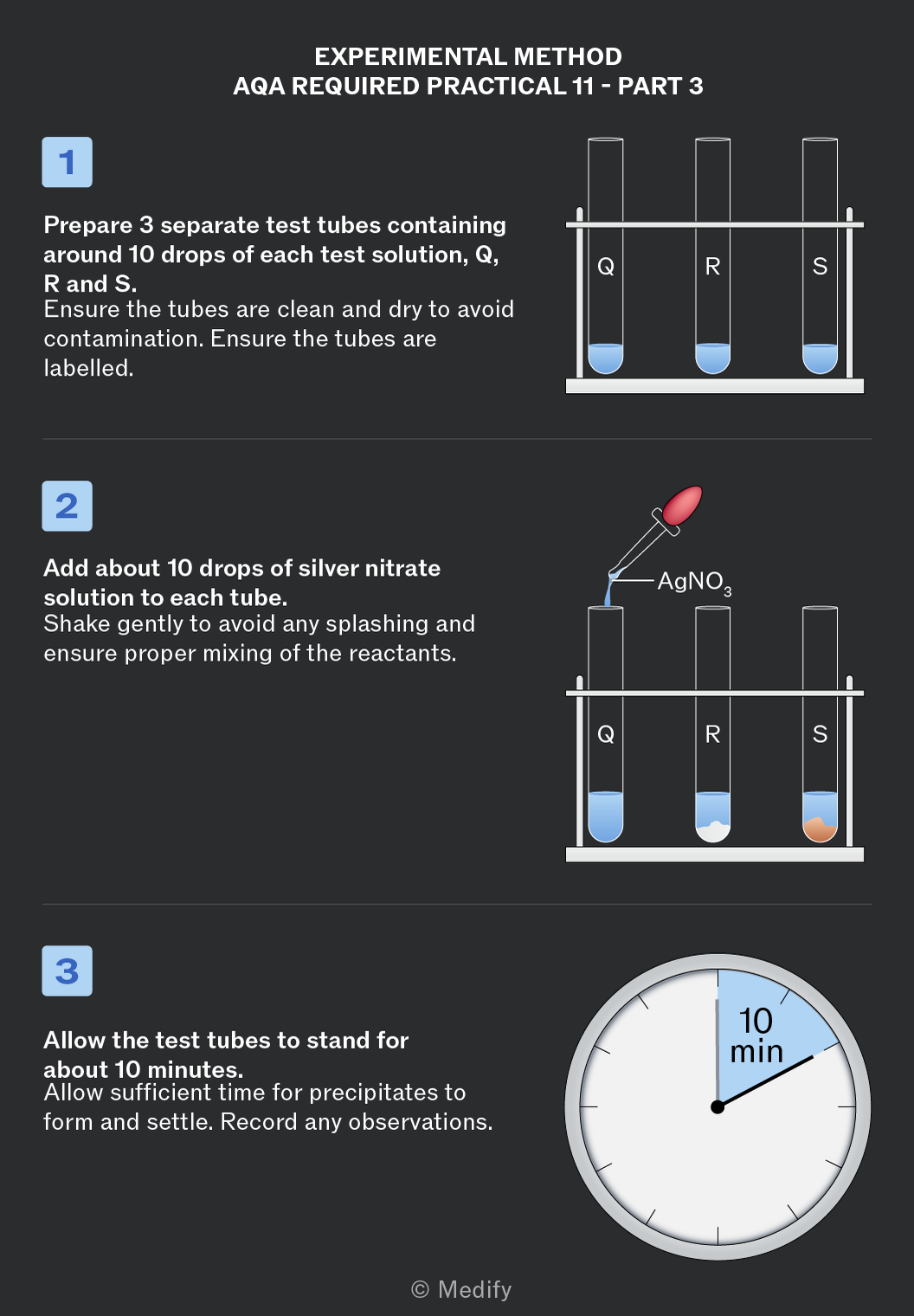
EXPERIMENTAL METHOD AQA REQUIRED PRACTICAL 11 - PART 3. 1. Prepare 3 separate test tubes containing around 10 drops of each test solution, Q, R and S. Ensure the tubes are clean and dry to avoid contamination. Ensure the tubes are labelled. 2. Add about 10 drops of silver nitrate solution to each tube. Shake gently to avoid any splashing and ensure proper mixing of the reactants. 3. Allow the test tubes to stand for about 10 minutes. Allow sufficient time for precipitates to form and settle. Record any observations.
Add to favourites

Wearing the appropriate personal protective equipment is essential to avoid direct contact with harmful chemicals and to ensure safety throughout the experiment.
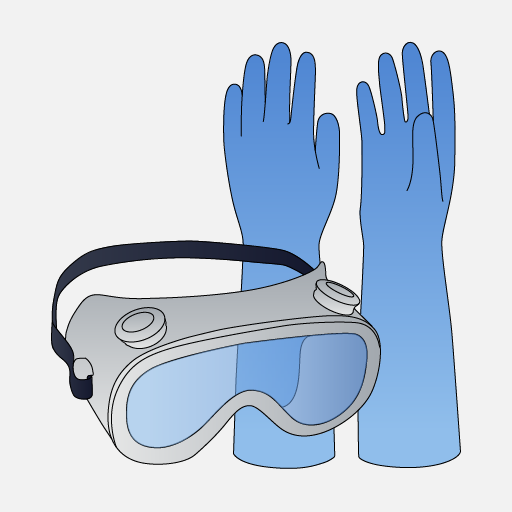

A simple illustration of a pair of goggles and gloves.
Do

Wear goggles and gloves when handling any chemicals, particularly concentrated acids, ammonia, and metal salts, as they can be corrosive or irritating to the skin and eyes.

A person wearing no goggles or gloves whilst handling chemicals.
Don't

Skip protective equipment just because ‘it’s only a few drops’.

Add to favourites

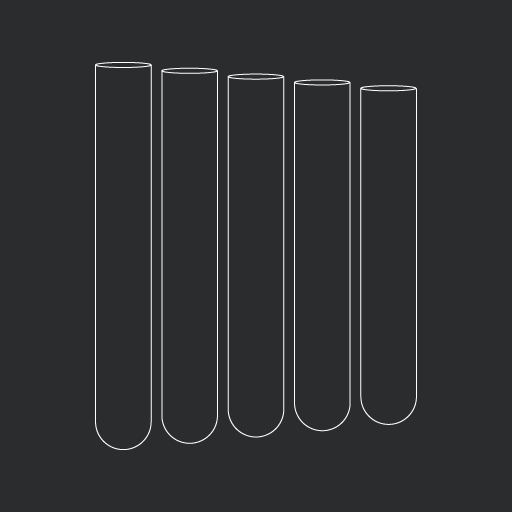
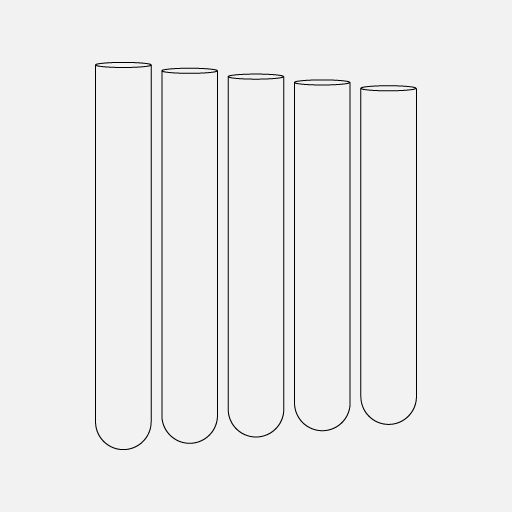
It is crucial to use clean and dry glassware when performing analytical tests.
Five test tubes arranged in a row, with varying heights and shapes.
Do

Ensure all glassware is clean and dry before use to avoid contamination and ensure accurate results.

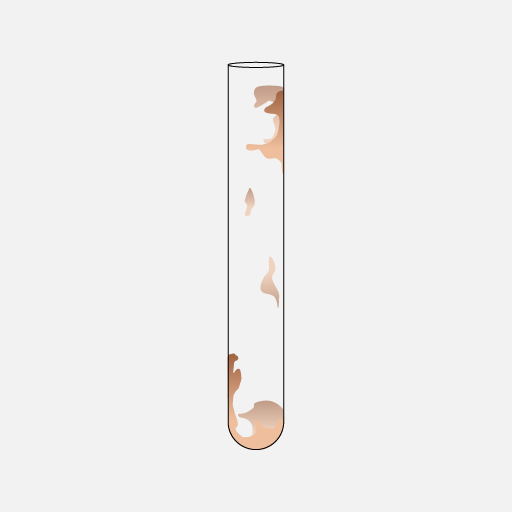
A test tube with a white body and brownish stains or markings on its surface.
Don't

Reuse glassware that has not been properly cleaned and dried, as this could lead to inaccurate readings or unintended chemical reactions.

Add to favourites

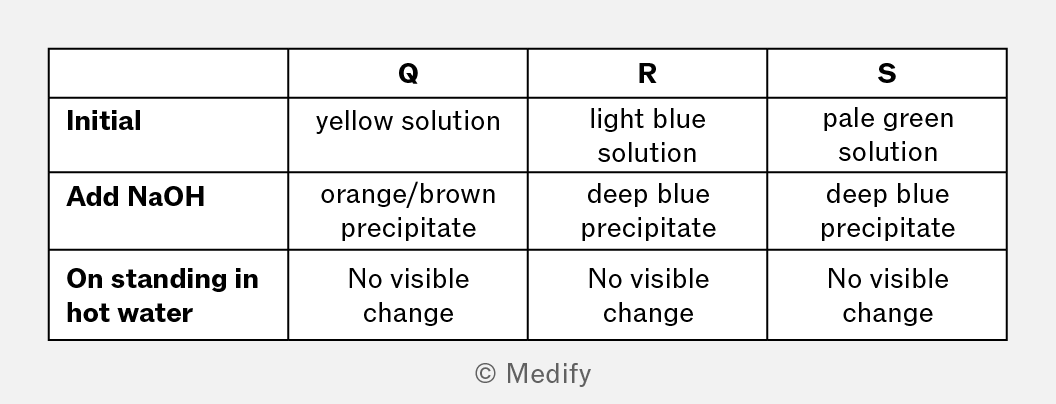
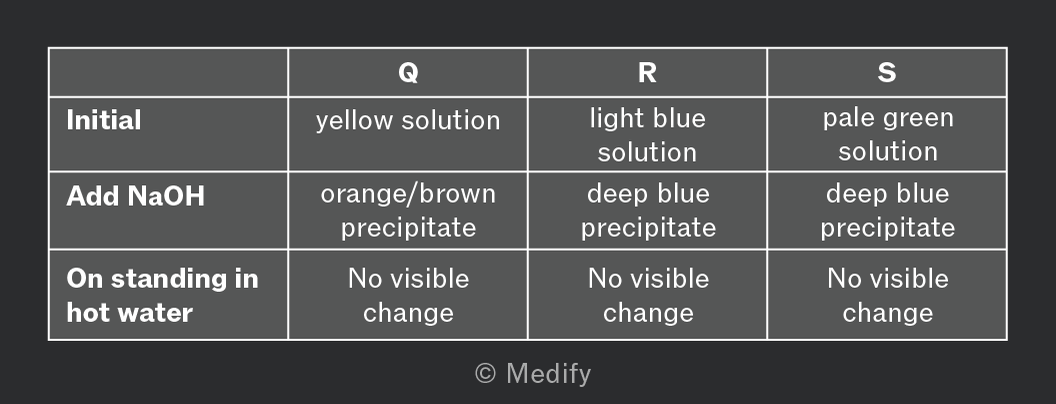
Analysis of the results is qualitative. For reaction with
A table displaying experimental results with columns labeled Q, R, and S. The rows include 'Initial' with values 'yellow solution', 'light blue solution', and 'pale green solution'; 'Add NaOH' with values 'orange/brown precipitate', 'deep blue precipitate', and 'deep blue precipitate'; and 'On standing in hot water' with values 'No visible change', 'No visible change', and 'No visible change'.
  • The orange-brown precipitate indicates from the presence of ions.
  • The deep blue precipitate indicates from the presence of ions.
  • The grey-green precipitate indicates from the presence of ions.

It may be hard to distinguish between a precipitate and a solution on the initial addition of but this will settle on standing in warm water allowing the observation to be confirmed.

Add to favourites

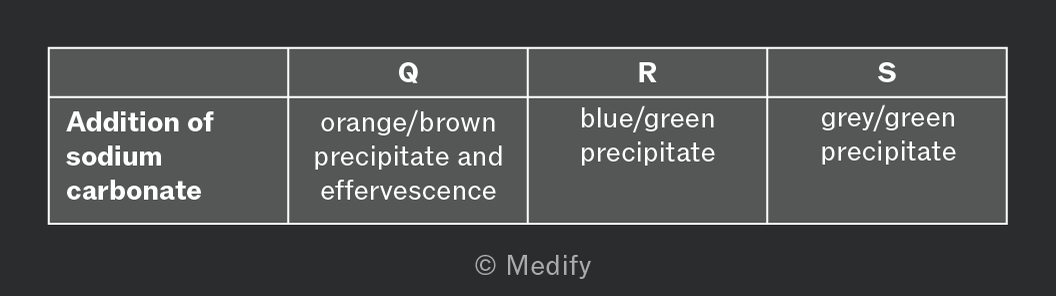
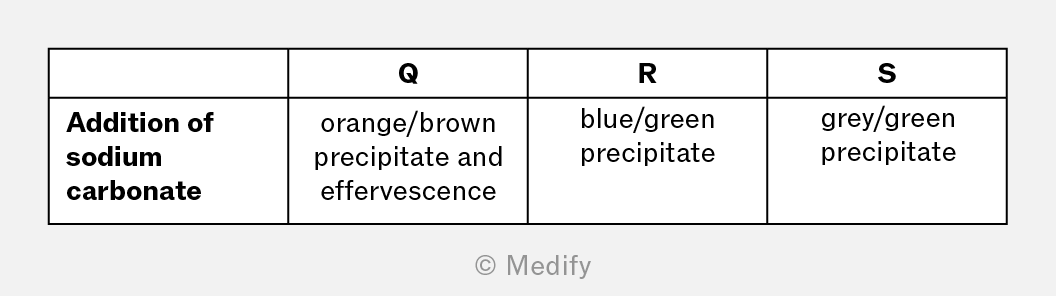
Analysis of the results is qualitative. For reaction with :
A table showing the results of the addition of sodium carbonate. The first column lists 'Addition of sodium carbonate'. The second column labeled 'Q' describes an 'orange/brown precipitate and effervescence'. The third column labeled 'R' describes a 'blue/green precipitate'. The fourth column labeled 'S' describes a 'grey/green precipitate'.
  • The orange precipitate indicates from the presence of ions. The effervescence occurs as solutions are much more acidic and is liberated from the carbonate.
  • The blue-green precipitate indicates from the presence of ions.
  • The grey-green precipitate indicates from the presence of ions.
Add to favourites

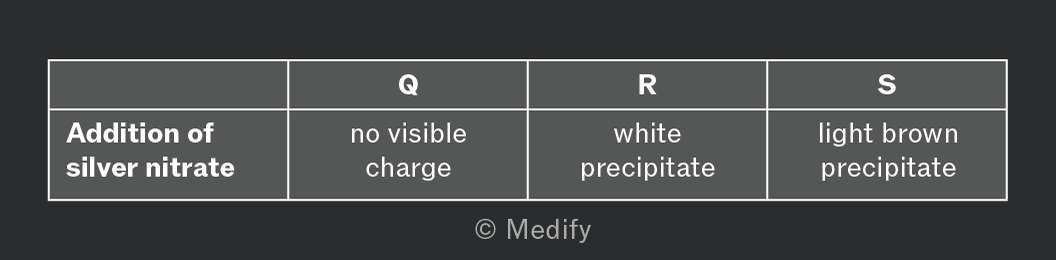
Analysis of the results is qualitative. For the reaction with
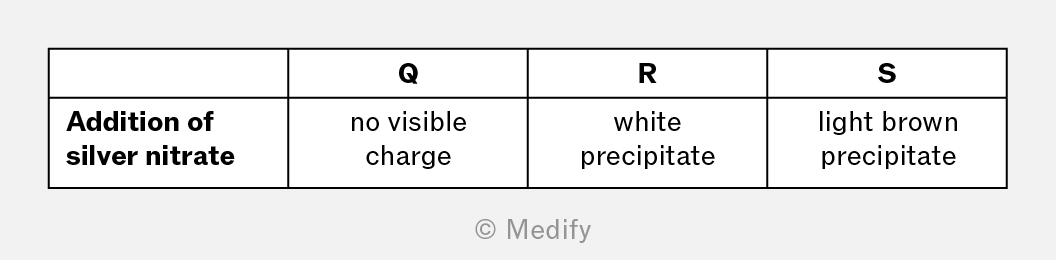
A table displaying the results of the addition of silver nitrate, with columns labeled Q, R, and S. Under Q, it states 'no visible charge'. Under R, it states 'white precipitate'. Under S, it states 'light brown precipitate'.
  • No precipitate forming indicates the absence of halides.
  • The white precipitate of silver chloride confirms the presence of ions in the solution.
  • The light brown precipitate is actually white silver sulfate, discoloured by formed during the reaction.
Add to favourites