Practical chemistry for exams›CP 1 - Measuring the molar volume of a gas

CP 1 - Measuring the molar volume of a gas

An overview of CP 1 - Measuring the molar volume of a gas
3 min

In Edexcel Core Practical 1: Measure the molar volume of a gas, a known volume of ethanoic acid and a known mass of calcium carbonate are reacted together to determine the molar volume of carbon dioxide gas at room temperature and pressure.

The balanced equation for the reaction is:

Add to favourites

In Edexcel core practical 1: Measure the molar volume of a gas, there are several important safety requirements to be aware of (beyond normal lab practice such as wearing goggles).

  • Ensure the delivery tube does not become blocked during the practical.
  • Ethanoic acid causes skin irritation.
Add to favourites

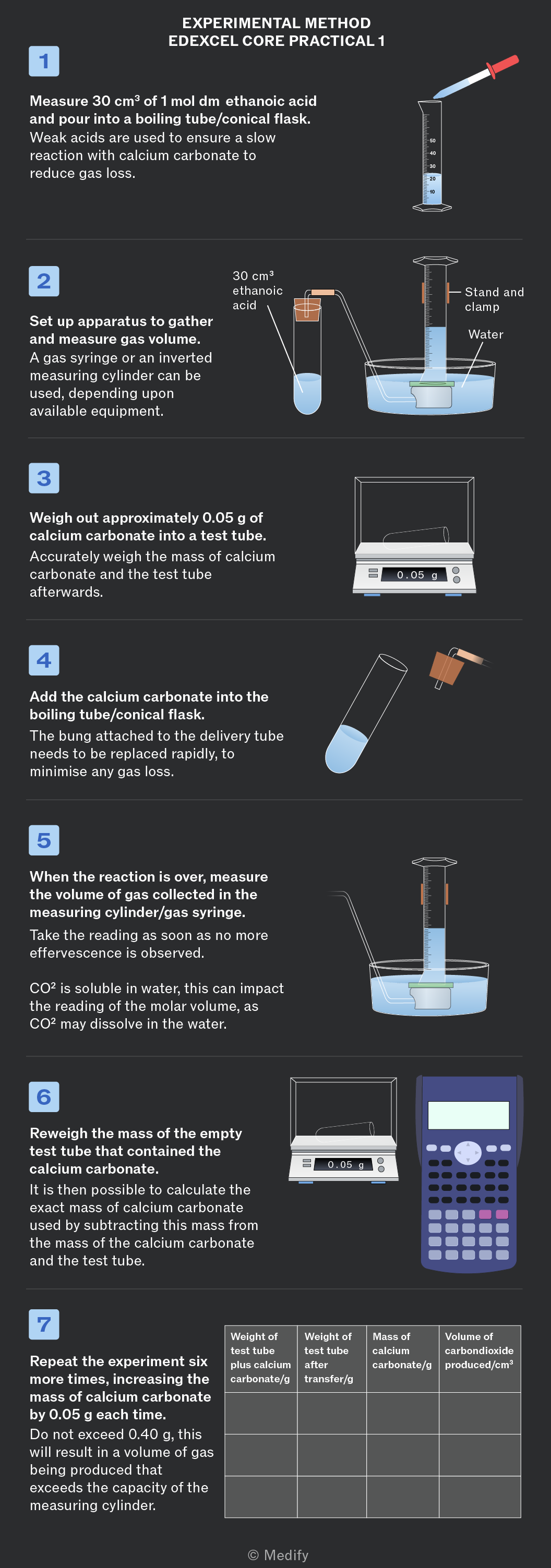
Experimental method for Edexcel Chemistry Core Practical 1
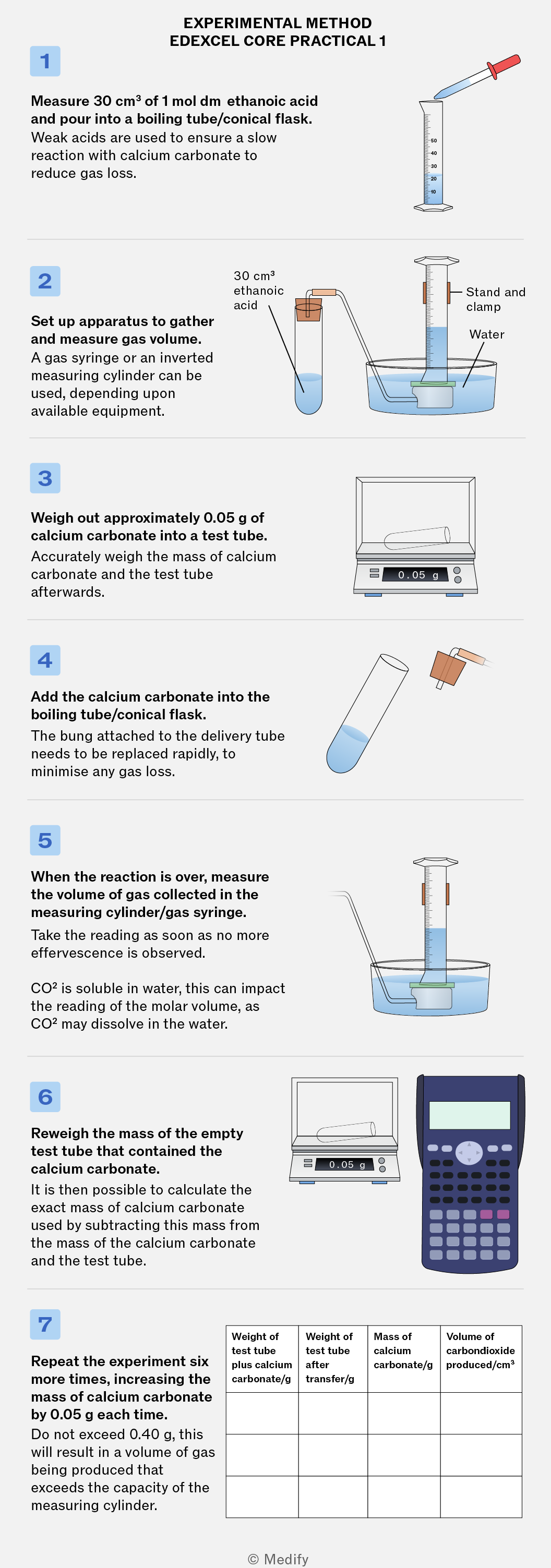
The image depicts a step-by-step experimental method for Edexcel Core Practical 1. Step 1: Measure 30 cm³ of 1 mol dm ethanoic acid and pour into a boiling tube/conical flask. A measuring cylinder is shown with an annotation '30 cm³'. Step 2: Set up apparatus to gather and measure gas volume. Illustration shows 30 cm³ ethanoic acid in a conical flask connected to an inverted measuring cylinder filled with water, labeled 'Stand and clamp'. Step 3: Weigh out approximately 0.05 g of calcium carbonate into a test tube. An electronic balance displays '0.05 g'. Step 4: Add the calcium carbonate into the boiling tube/conical flask, with a delivery tube connecting to the measuring cylinder. Step 5: Measure the volume of gas collected in the measuring cylinder/gas syringe after the reaction is complete. The cylinder is marked with water level. Step 6: Reweigh the mass of the empty test tube that contained the calcium carbonate, balance shows '0.05 g'. Step 7: Repeat the experiment six more times, increasing the mass of calcium carbonate by 0.05 g each time. A table is shown with columns labeled 'Weight of test tube plus calcium carbonate/g', 'Weight of test tube after transfer/g', 'Mass of calcium carbonate/g', 'Volume of carbon dioxide produced/cm³' and empty rows. Annotations include instructions and notes on each step.
Add to favourites

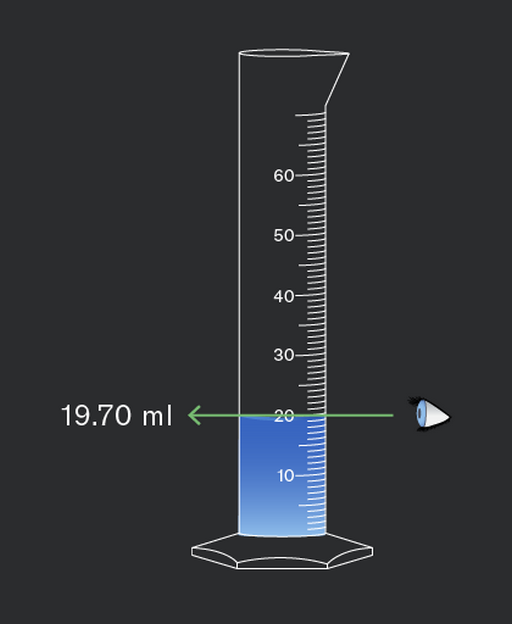
Misreading the volume of reactants used will impact your calculations.
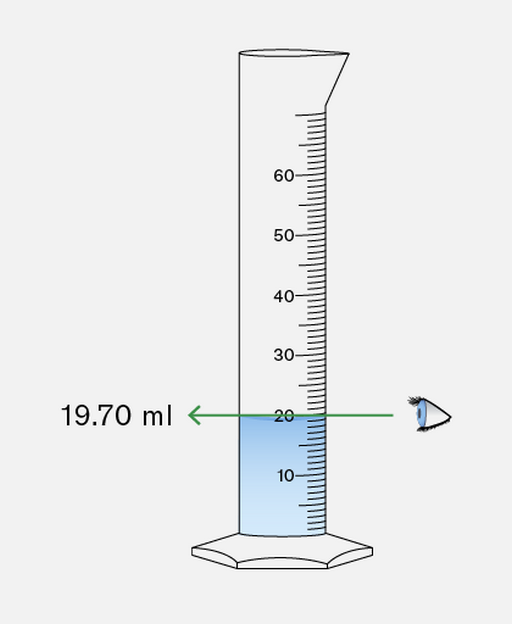
A graduated cylinder showing a measurement of 19.70 ml, with a blue liquid filling the cylinder up to the 20 ml mark, and an arrow pointing to the measurement.
Do

Use a measuring cylinder with
increments and read the meniscus at eye level for accuracy.

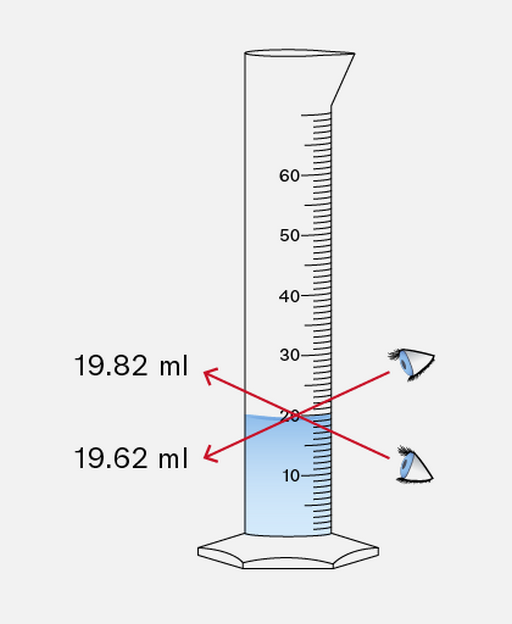
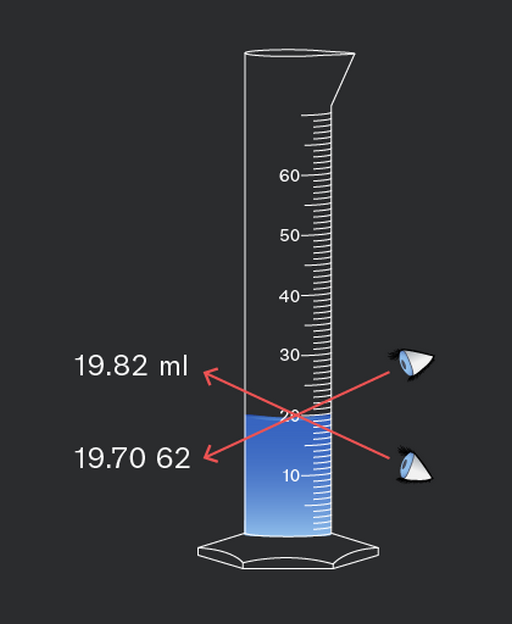
A graduated cylinder showing a liquid level at 19.82 ml and 19.62 ml, with red arrows pointing to the respective measurements.
Don't

Hold the cylinder at an angle or read from above/below – this causes parallax error (e.g. misread as ).

Add to favourites

When measuring the molar volume of a gas (carbon dioxide in this instance). Plot a graph, with mass of calcium carbonate against volume of gas produced. Draw a line of best fit that passes through the origin.
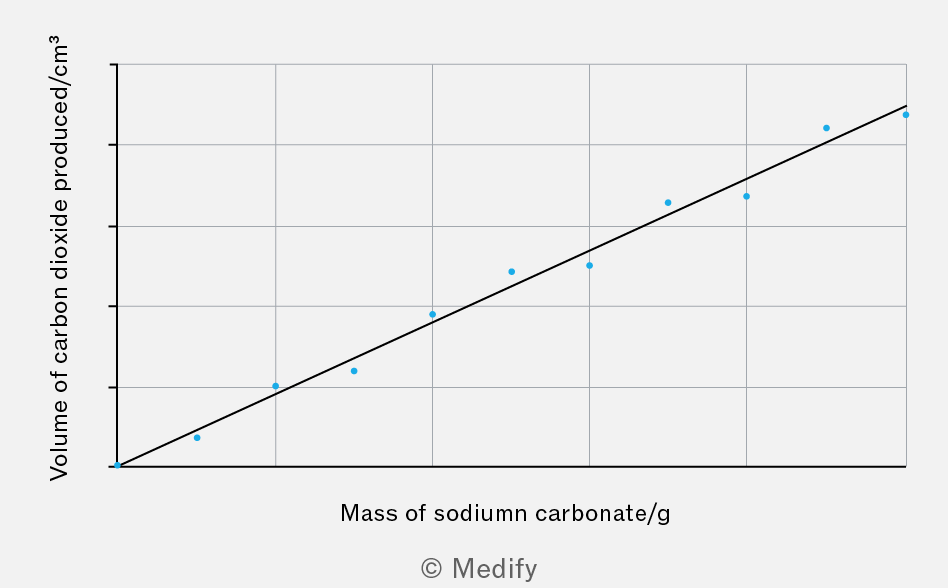
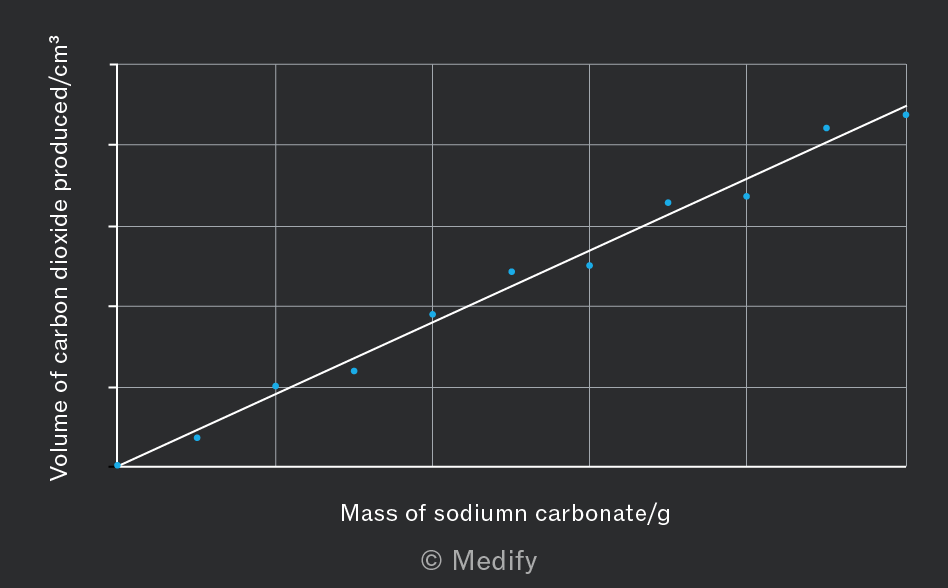
A scatter plot graph with a line of best fit. The x-axis is labeled 'Mass of sodium carbonate/g' and the y-axis is labeled 'Volume of carbon dioxide produced/cm³'. The graph contains eight blue markers representing data points. The markers are approximately positioned at (0.5, 10), (1.0, 20), (1.5, 25), (2.0, 30), (2.5, 40), (3.0, 45), (3.5, 55), and (4.0, 60) on the grid. A black line of best fit runs diagonally from the bottom left to the top right of the graph. There are no numeric values on the axes, and no markers are present at the origin. The graph is credited to Medify.

Calculate the gradient of this line to determine the volume of produced from any given mass of calcium carbonate.

From the graph, the volume of at the given mass can be recorded. This volume should be converted into dm3 and divided by the number of moles of to determine the molar volume.

From the balanced equation, the stoichiometric ratio between calcium carbonate and carbon dioxide is 1:1.

Calculate the moles of calcium carbonate for a given mass and therefore the moles of produced. Using the equation:

Add to favourites